
Chapter 6 ConstructedResponse Items and Scoring Rubrics Frey
Chapter 6 Constructed-Response Items and Scoring Rubrics Frey, Modern Classroom Assessment © 2014 SAGE Publications, Inc.

Objectives The learner will be able to: • Describe constructed-response items • Identify some of the advantages of constructed-response items for assessment • Identify the characteristics of a good essay question • Describe scoring rubrics and how to create them Frey, Modern Classroom Assessment © 2014 SAGE Publications, Inc.
What Do Constructed-Response Items Look Like? Tasks that ask students to create a complex written answer or product Supply items rather than selection items Used to assess either knowledge and understanding or skill and ability Frey, Modern Classroom Assessment © 2014 SAGE Publications, Inc.
Advantages of Constructed-Response Over Selection Items Can serve as instruction to guide student thinking and learning in more positive ways May make better use of instructional time Often more valid than objectively scored approaches Frey, Modern Classroom Assessment © 2014 SAGE Publications, Inc.
Characteristics of a Good Essay Question It is a supply item. It requires lengthy answers. It allows for creative and unique responses. It is subjectively scored. It has instructions that provide guidance as to the way of thinking and the form of the response. Frey, Modern Classroom Assessment © 2014 SAGE Publications, Inc.

Rubrics The assessment tool of choice for constructed-response items A written set of scoring rules, often in the form of a table Identifies the criteria and required parts and pieces for a good-quality answer or product Shows the relative weights of the criteria and pieces, and the possible range of points for each Frey, Modern Classroom Assessment © 2014 SAGE Publications, Inc.
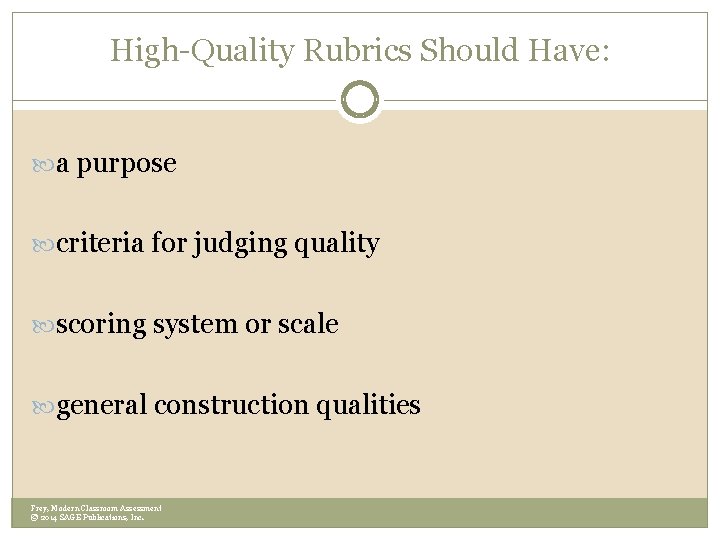
High-Quality Rubrics Should Have: a purpose criteria for judging quality scoring system or scale general construction qualities Frey, Modern Classroom Assessment © 2014 SAGE Publications, Inc.
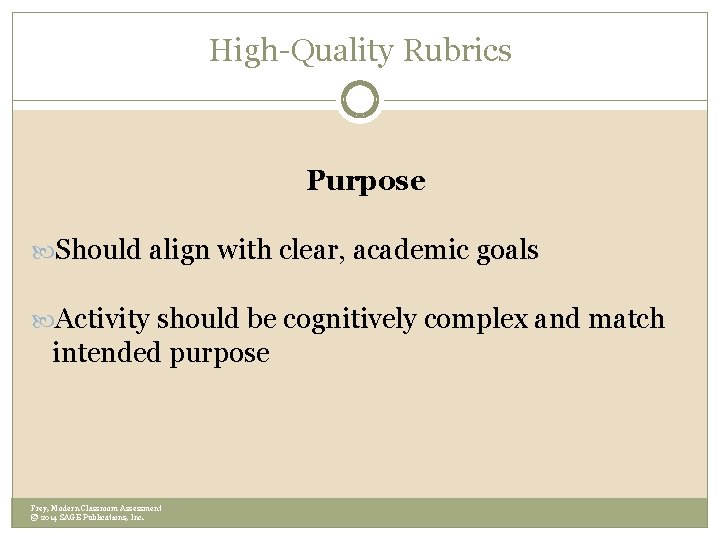
High-Quality Rubrics Purpose Should align with clear, academic goals Activity should be cognitively complex and match intended purpose Frey, Modern Classroom Assessment © 2014 SAGE Publications, Inc.
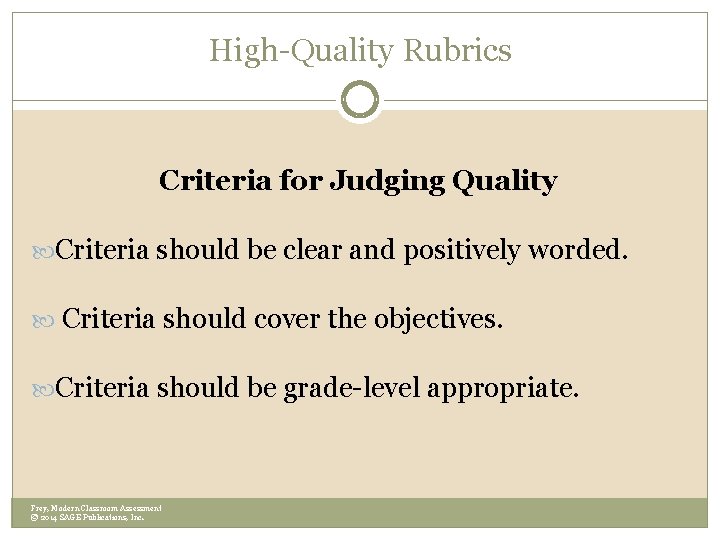
High-Quality Rubrics Criteria for Judging Quality Criteria should be clear and positively worded. Criteria should cover the objectives. Criteria should be grade-level appropriate. Frey, Modern Classroom Assessment © 2014 SAGE Publications, Inc.
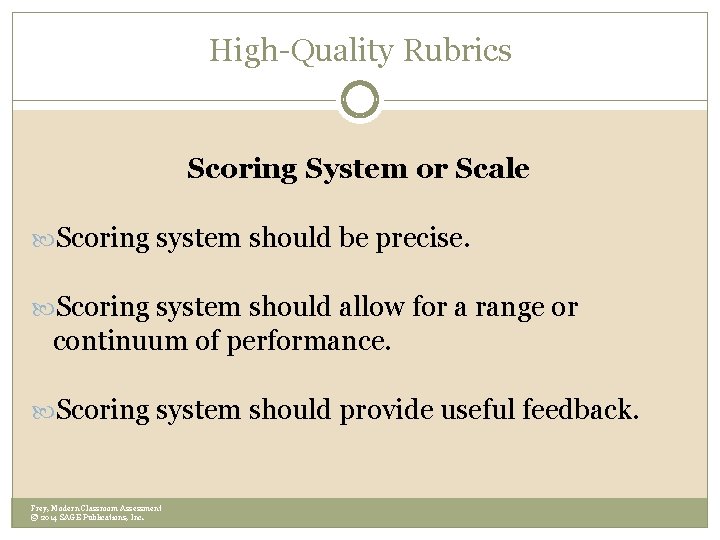
High-Quality Rubrics Scoring System or Scale Scoring system should be precise. Scoring system should allow for a range or continuum of performance. Scoring system should provide useful feedback. Frey, Modern Classroom Assessment © 2014 SAGE Publications, Inc.
High-Quality Rubrics General Construction Qualities Rubrics should be organized. Rubrics should be free of mechanical errors. Rubrics should reflect real-world expectations of performance. Frey, Modern Classroom Assessment © 2014 SAGE Publications, Inc.
How to Make a Rubric Identify the purpose of the assessment What is to be measured by the rubric? What will the score represent? Determine the criteria for success What will a good performance look like? What are the crucial indicators of quality in student "answers"? What are key components, characteristics, or traits which determine quality in the answer or product or performance created by the students? Design the scoring system Are the distinctions between each score meaningful? Is each possible score well-defined in observable ways that make sense to everyone? Frey, Modern Classroom Assessment © 2014 SAGE Publications, Inc.
Advantages of Rubrics Allow for quick scoring and quick feedback Improve teaching Encourage growth of student meta-cognitive and critical thinking skills Allow for meaningful sharing of student performance data Frey, Modern Classroom Assessment © 2014 SAGE Publications, Inc.
Things to Think About 1. Do students prepare more for essay tests or multiple-choice tests? 2. With the enduring popularity of traditional paper -and-pencil tests and the increase in technology, some teachers are concerned about students losing their writing skills. Are you? 3. Some studies have found that females outperform on constructed-response tests. Why might this be true? Frey, Modern Classroom Assessment © 2014 SAGE Publications, Inc.
Key Points • Constructed-response items are assessment tasks which ask students to create a complex answer. The answer can be written, like an essay or book report, or designed like a map or graph. • Constructed-response items are likely authentic assessments because they produce behaviors that are similar to the academic things we want students to do in the real-world. They also allow assessment of deep understanding. • The most common constructed-response item type and the one with a long history is the essay assignment. This chapter focuses on essays used to assess understanding, not to measure writing skill. To evaluate essays in terms of student knowledge and understanding requires a well-defined set of criteria as to what a great answer looks like. • Scoring rubrics make teacher-chosen criteria for quality concrete and allow for more subjective (reliable) scoring. They are the assessment tool of choice for constructed-response items. Frey, Modern Classroom Assessment © 2014 SAGE Publications, Inc.
- Slides: 15