
CHAPTER 6 Congress Learning Objectives Define the role

CHAPTER 6 Congress
Learning Objectives ü Define the role the U. S. Congress plays as the legislative branch of government, and how that role has evolved over time ü Identify the structure and powers of Congress, explain bicameralism, and distinguish between the roles of the House and Senate ü Assess the role that political parties play in the leadership of Congress 2 Copyright © 2014 Cengage Learning
Learning Objectives ü Identify key leadership positions and their functions in Congress ü Explain reapportionment and redistricting ü Compare and contrast the different types of committees found in Congress ü Describe the various steps necessary for a bill to become a law 3 Copyright © 2014 Cengage Learning
Learning Objectives ü Explain why Congress often delegates its lawmaking authority to regulatory agencies ü Describe the role of the Senate in confirming presidential appointments, and the congressional procedures for impeachment and removal of executive and judicial officers ü Assess the “casework” functions of members of Congress in assisting constituents, educating them on policy issues, and performing other services on their behalf 4 Copyright © 2014 Cengage Learning
Article I and the Creation of Congress § Founders took care in building this branch § Congress has ultimate authority for enacting new laws § Ensures representation of the people through direct election of members 5 Copyright © 2014 Cengage Learning
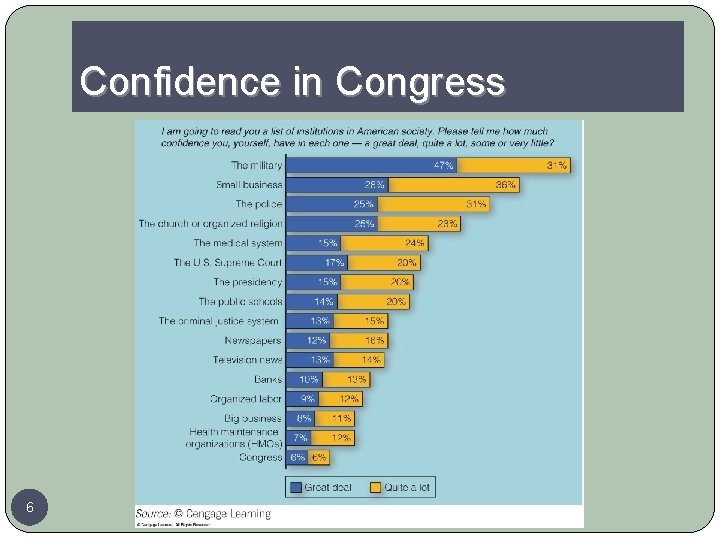
Confidence in Congress 6 Copyright © 2014 Cengage Learning

The Structure and Organization of Congress § Bicameral legislature § Two chambers: Senate and House of Representatives § The “Great Compromise” § Equal state representation in the Senate § Representation based on population in the House § Nearly equal sharing of legislative power 7 Copyright © 2014 Cengage Learning
The Structure and Organization of Congress § The House of Representatives § The “People’s House” § Two-year terms § Proportionality ensures House reflects the popular will 8 Copyright © 2014 Cengage Learning
The Structure and Organization of Congress § The House of Representatives § Reapportionment: allocating house seats to each state after every 10 -year census § Redistricting: redrawing congressional district lines to achieve “one person, one vote” § Gerrymandering: drawing district boundaries to favor one party 9 Copyright © 2014 Cengage Learning
The Structure and Organization of Congress § Qualifications for the House § At least 25 years old § U. S. citizen for a minimum of seven years § Residency established in the state (though not necessarily the district) from which they are elected 10 Copyright © 2014 Cengage Learning
The Structure and Organization of Congress § The Senate: A Stabilizing Factor § Intended to represent the states equally § Two senators per state § Originally elected not by the people of the state, but by state legislatures § Seventeenth Amendment: senators elected by citizens of the state they represented 11 Copyright © 2014 Cengage Learning
The Structure and Organization of Congress § Senate § Serve 6 -year staggered terms § Every two years, one-third of the seats up for re-election § At least 30 years old § U. S. citizen for at least 9 years § Residency established in the state he or she represents 12 Copyright © 2014 Cengage Learning
The Structure and Organization of Congress § Leadership in Congress § Each chamber maintains its own leadership structure to conduct its business § Political party system drives leadership § Majority caucus § party with a majority of seats § Minority caucus § party with a minority of seats 13 Copyright © 2014 Cengage Learning
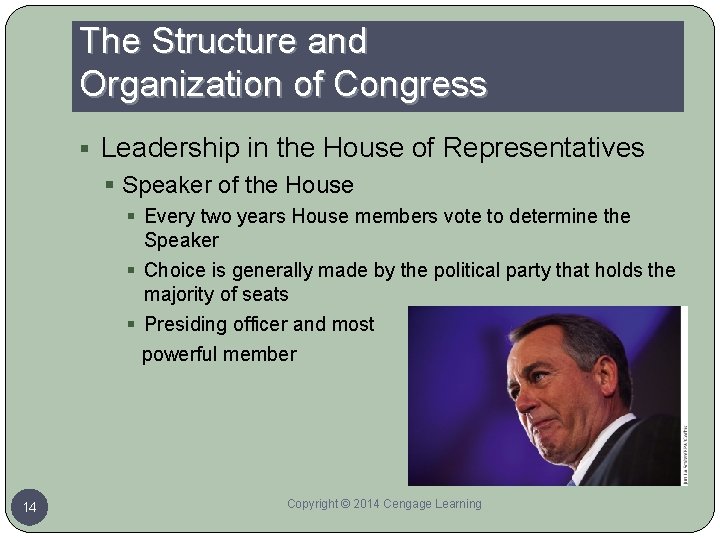
The Structure and Organization of Congress § Leadership in the House of Representatives § Speaker of the House § Every two years House members vote to determine the Speaker § Choice is generally made by the political party that holds the majority of seats § Presiding officer and most powerful member 14 Copyright © 2014 Cengage Learning
The Structure and Organization of Congress § Speaker of the House § Responsible for assigning new bills to committees § Recognizes members to speak in the House chamber § Ultimate arbiter/ interpreter of House rules § Appoints members to special committees § Influential in assigning members to permanent committees § Schedules votes on a bill 15 Copyright © 2014 Cengage Learning
The Structure and Organization of Congress § House majority leader and minority leader § Oversee development of party platforms § Responsible for achieving party coherence in voting § Whips § Contact members of their party caucus to convince them to vote the way their party leadership wants them to vote 16 Copyright © 2014 Cengage Learning
The Structure and Organization of Congress § Leadership in the Senate § Vice president is the presiding officer § Cannot engage in floor debates § No legislative duties § President pro tempore § Senator in the majority caucus serving the most consecutive years § Largely a ceremonial role 17 Copyright © 2014 Cengage Learning
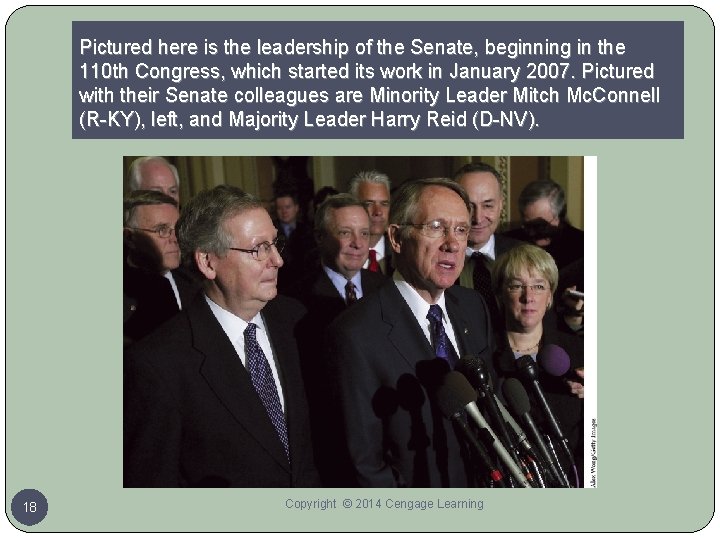
Pictured here is the leadership of the Senate, beginning in the 110 th Congress, which started its work in January 2007. Pictured with their Senate colleagues are Minority Leader Mitch Mc. Connell (R-KY), left, and Majority Leader Harry Reid (D-NV). 18 Copyright © 2014 Cengage Learning
The Structure and Organization of Congress § Majority caucus elects a Senate majority leader § Majority leader makes committee leadership assignments § Minority caucus elects a Senate minority leader § Majority and minority whips § Keep track of how caucus members are planning to vote 19 Copyright © 2014 Cengage Learning
The Committee System § Four categories of work by members of Congress § Running for re-election § Serving constituents § Working on legislation § Working on bills in committees § Voting on proposed bills § Providing oversight of federal agencies 20 Copyright © 2014 Cengage Learning
The Committee System § Committee work § Generating ideas for new laws and debating the merits of those ideas § Holding hearings, conducting investigations, and listening to testimony § Offering modifications/additions to proposed bills § Oversight of federal agencies 21 Copyright © 2014 Cengage Learning
The Committee System § Bill: a formally proposed piece of legislation § Each member assigned to a few committees § Becomes an expert in the subject of the committee § Subcommittees are more specialized 22 Copyright © 2014 Cengage Learning
The Committee System § Types of Committees in Congress § Standing committees § Permanent committees in the House and Senate § Focus on a particular area of public policy § Reporting legislation: the House or Senate cannot vote on a bill unless the standing committee votes to approve it 23 Copyright © 2014 Cengage Learning
The Committee System § Select committee § Examines a particular issue of concern § Dissolved after work on issue is complete § Conference committee § House members and senators work together to iron out differences in the different versions of a bill 24 Copyright © 2014 Cengage Learning
The Committee System § Joint committee § Do not propose legislation § Typically permanent § Investigative and focus on issues of general concern 25 Copyright © 2014 Cengage Learning
The Committee System § Leadership of Congressional Committees § All chairs are members of the majority caucus § Chairs determine what gets done and when § Partisan Nature of the Committee System § Ensures that all committees have a majority of members of their party § “Supermajority” of seats on most powerful committees 26 Copyright © 2014 Cengage Learning
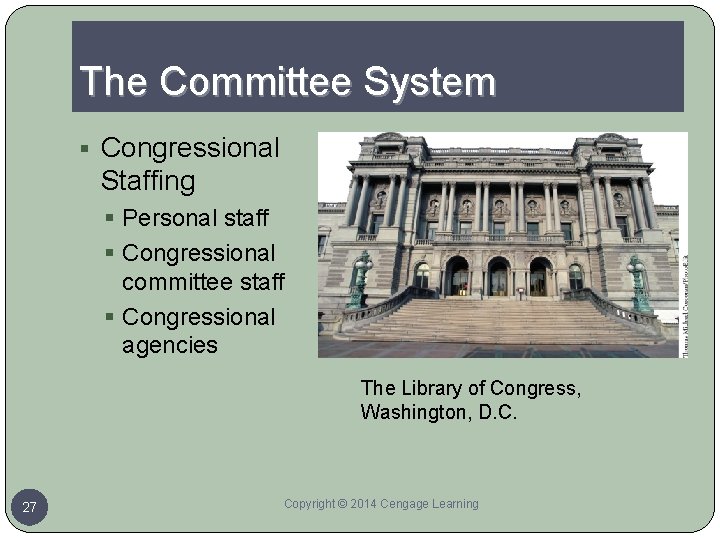
The Committee System § Congressional Staffing § Personal staff § Congressional committee staff § Congressional agencies The Library of Congress, Washington, D. C. 27 Copyright © 2014 Cengage Learning
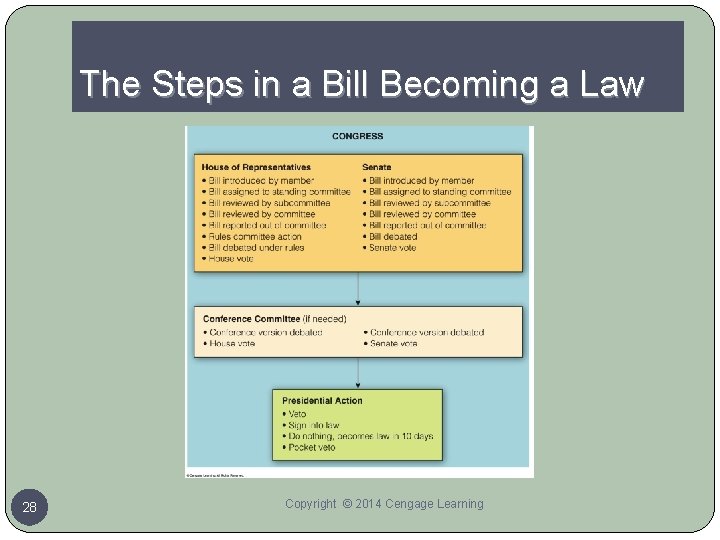
The Steps in a Bill Becoming a Law 28 Copyright © 2014 Cengage Learning
How a Bill Becomes a Law § Step 1: Bill Is Introduced § Step 2: Bill Is Sent to a Standing Committee for Action § Step 3: Bill Goes to the Full House and Senate for Consideration § § 29 House Rules committee Open and closed rules Filibuster Cloture rule Copyright © 2014 Cengage Learning
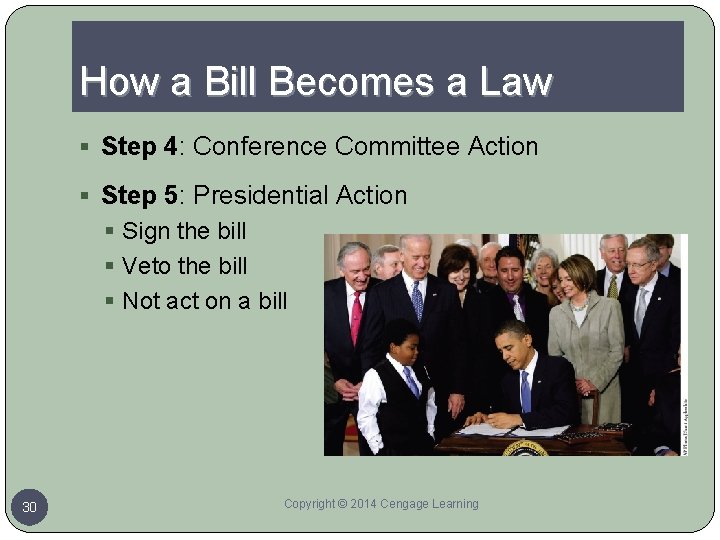
How a Bill Becomes a Law § Step 4: Conference Committee Action § Step 5: Presidential Action § Sign the bill § Veto the bill § Not act on a bill 30 Copyright © 2014 Cengage Learning
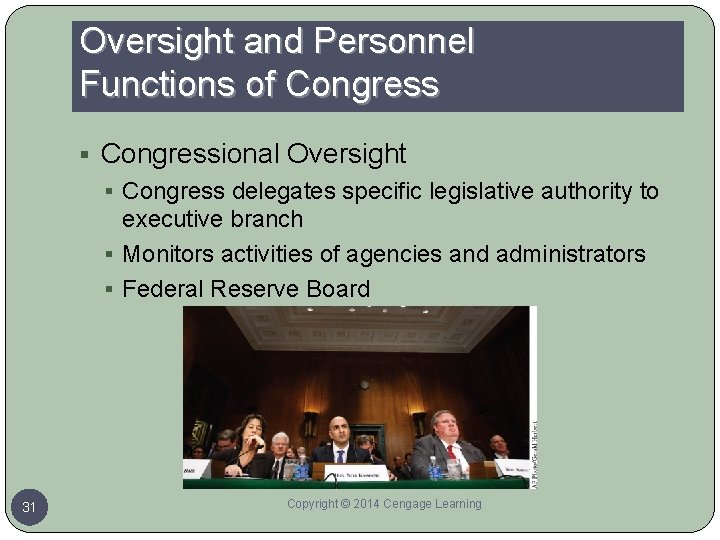
Oversight and Personnel Functions of Congress § Congressional Oversight § Congress delegates specific legislative authority to executive branch § Monitors activities of agencies and administrators § Federal Reserve Board 31 Copyright © 2014 Cengage Learning

Who Does Congress Listen To? 32 Copyright © 2014 Cengage Learning
Oversight and Personnel Functions of Congress § Confirmation of Presidential Nominations and Approval Treaties § The president nominates individuals, but Senate must consent with a majority vote § U. S. Supreme Court § In certain circumstances House chooses the president and the Senate chooses the vice president § Twenty-fifth Amendment § Approval of a treaty requires consent of two-thirds of the Senate 33 Copyright © 2014 Cengage Learning
Oversight and Personnel Functions of Congress § Impeachment and Removal of Federal Judges and High Executives § Congress has authority to impeach § Impeachment: House brings charges against a federal official via majority vote § Senate oversees trial 34 Copyright © 2014 Cengage Learning
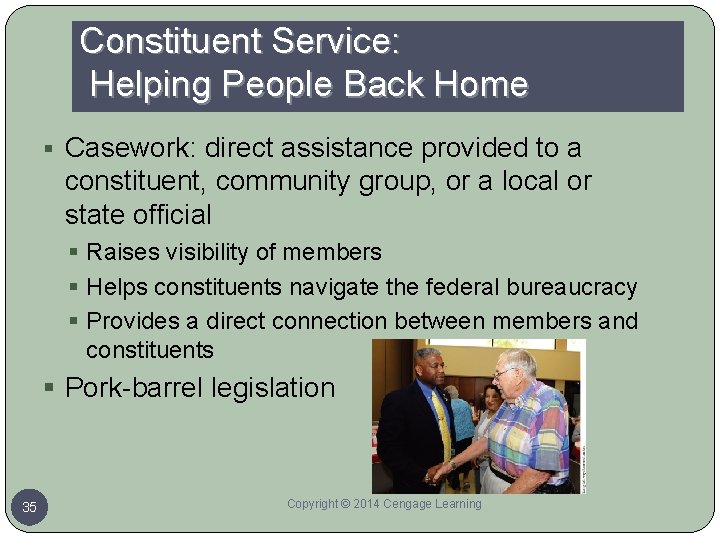
Constituent Service: Helping People Back Home § Casework: direct assistance provided to a constituent, community group, or a local or state official § Raises visibility of members § Helps constituents navigate the federal bureaucracy § Provides a direct connection between members and constituents § Pork-barrel legislation 35 Copyright © 2014 Cengage Learning
- Slides: 35