
CHAPTER 6 Communication The importance of communication in
- Slides: 16
CHAPTER 6 Communication
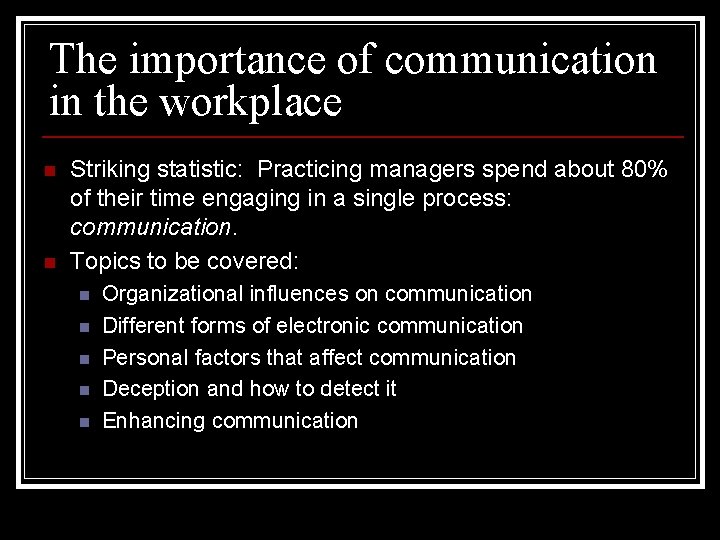
The importance of communication in the workplace n n Striking statistic: Practicing managers spend about 80% of their time engaging in a single process: communication. Topics to be covered: n n n Organizational influences on communication Different forms of electronic communication Personal factors that affect communication Deception and how to detect it Enhancing communication
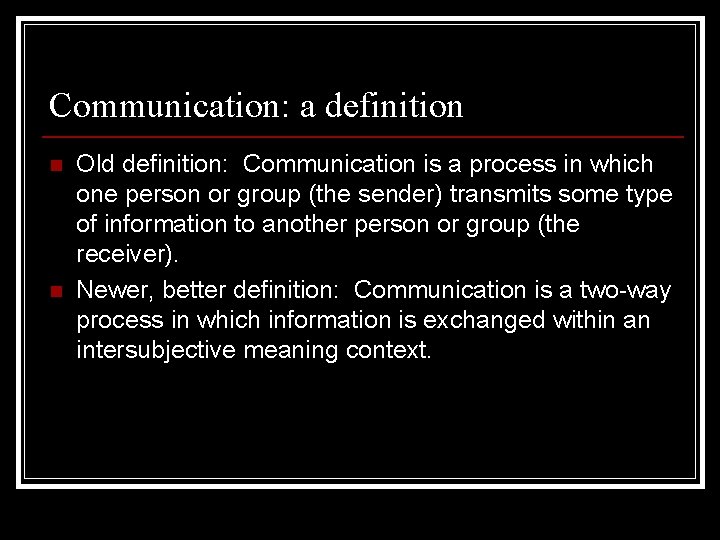
Communication: a definition n n Old definition: Communication is a process in which one person or group (the sender) transmits some type of information to another person or group (the receiver). Newer, better definition: Communication is a two-way process in which information is exchanged within an intersubjective meaning context.
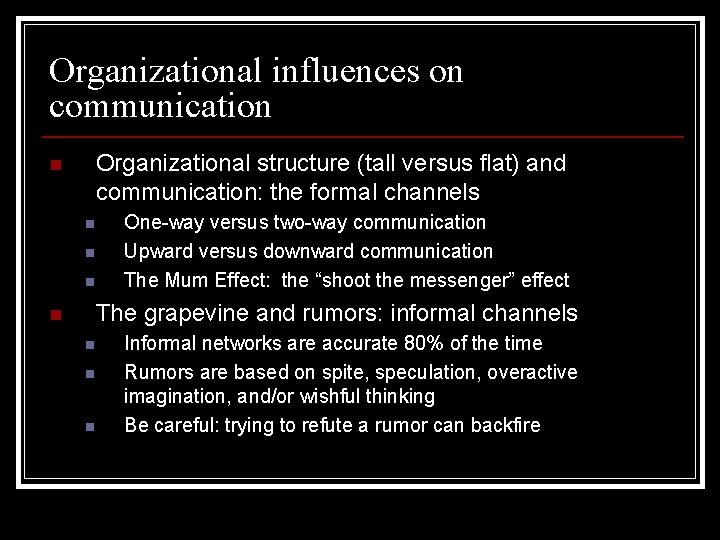
Organizational influences on communication Organizational structure (tall versus flat) and communication: the formal channels n n One-way versus two-way communication Upward versus downward communication The Mum Effect: the “shoot the messenger” effect The grapevine and rumors: informal channels n n Informal networks are accurate 80% of the time Rumors are based on spite, speculation, overactive imagination, and/or wishful thinking Be careful: trying to refute a rumor can backfire
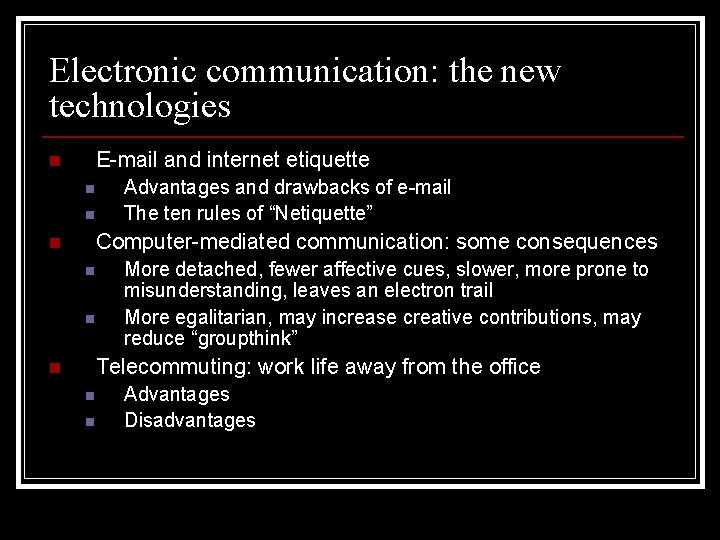
Electronic communication: the new technologies E-mail and internet etiquette n n n Advantages and drawbacks of e-mail The 10 rules of “Netiquette” Computer-mediated communication: some consequences n n n More detached, fewer affective cues, slower, more prone to misunderstanding, leaves an electron trail More egalitarian, less social inhibition, may increase creative contributions, may reduce “groupthink” Telecommuting: work life away from the office n n n Advantages Disadvantages
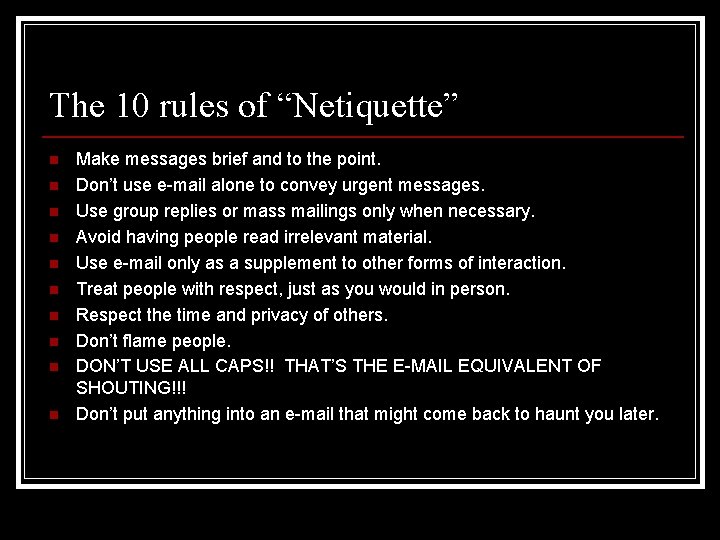
The 10 rules of “Netiquette” n n n n n Make messages brief and to the point. Don’t use e-mail alone to convey urgent messages. Use group replies or mass mailings only when necessary. Avoid having people read irrelevant material. Use e-mail only as a supplement to other forms of interaction. Treat people with respect, just as you would in person. Respect the time and privacy of others. Don’t flame people. DON’T USE ALL CAPS!! THAT’S THE E-MAIL EQUIVALENT OF SHOUTING!!! Don’t put anything into an e-mail that might come back to haunt you later.
Electronic communication: the new technologies E-mail and internet etiquette n n n Advantages and drawbacks of e-mail The ten rules of “Netiquette” Computer-mediated communication: some consequences n n n More detached, fewer affective cues, slower, more prone to misunderstanding, leaves an electron trail More egalitarian, may increase creative contributions, may reduce “groupthink” Telecommuting: work life away from the office n n n Advantages Disadvantages
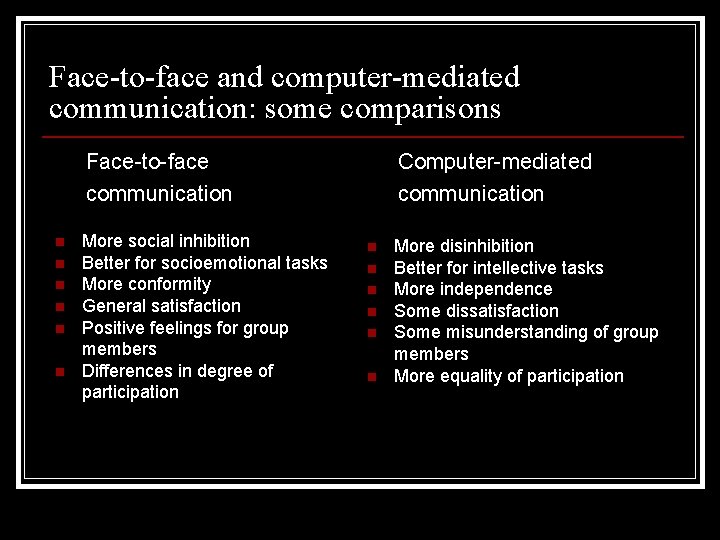
Face-to-face and computer-mediated communication: some comparisons Face-to-face communication n n n More social inhibition Better for socioemotional tasks More conformity General satisfaction Positive feelings for group members Differences in degree of participation Computer-mediated communication n n n More disinhibition Better for intellective tasks More independence Some dissatisfaction Some misunderstanding of group members More equality of participation
Electronic communication: the new technologies E-mail and internet etiquette n n n Advantages and drawbacks of e-mail The ten rules of “Netiquette” Computer-mediated communication: some consequences n n n More detached, fewer affective cues, slower, more prone to misunderstanding, leaves an electron trail More egalitarian, may increase creative contributions, may reduce “groupthink” Telecommuting: work life away from the office n n n Advantages Disadvantages
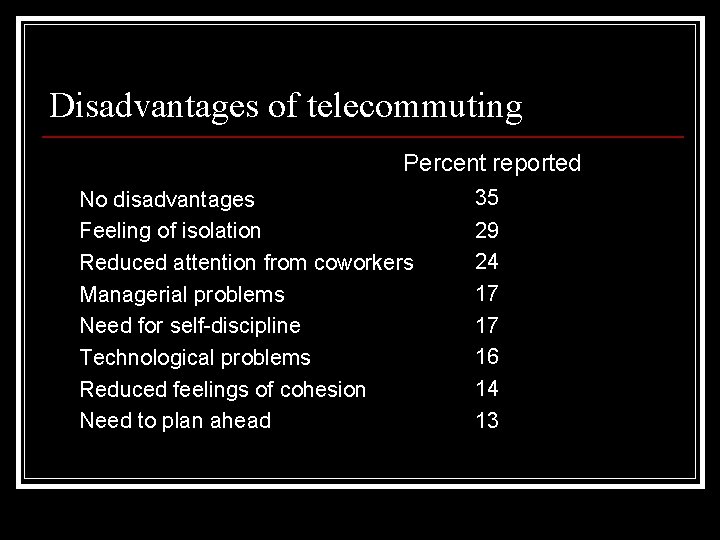
Disadvantages of telecommuting Percent reported No disadvantages Feeling of isolation Reduced attention from coworkers Managerial problems Need for self-discipline Technological problems Reduced feelings of cohesion Need to plan ahead 35 29 24 17 17 16 14 13
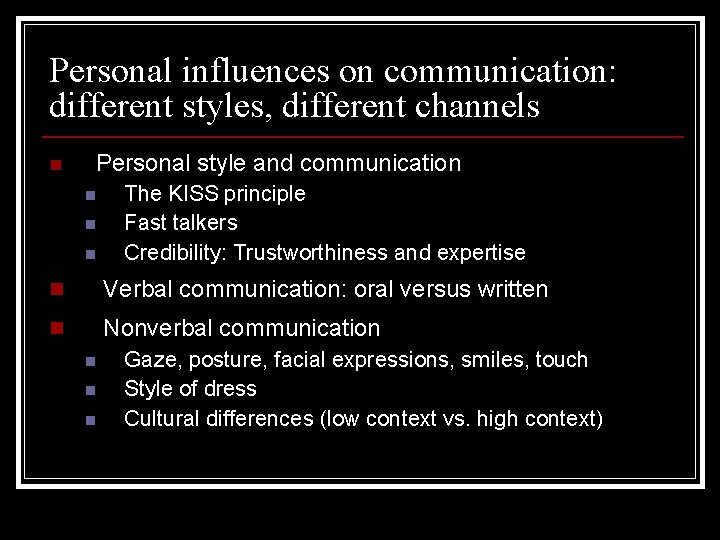
Personal influences on communication: different styles, different channels n Personal style and communication n The KISS principle Fast talkers Credibility: Trustworthiness and expertise n Verbal communication: oral versus written n Nonverbal communication n Gaze, posture, facial expressions, smiles, touch Style of dress Cultural differences (low context vs. high context)
Six basic emotions n n n Happiness Sadness Surprise Fear Anger Disgust / contempt
Deceiving others: how is it done and detected? Types of lies and types of liars n n n Skill at lying and success at deceit n n Self-centered Other-centered Socially skilled people are generally better liars Men, on average, are slightly better liars than women Our ability to detect other people’s lies is only slightly better than chance (53% vs. 50%).
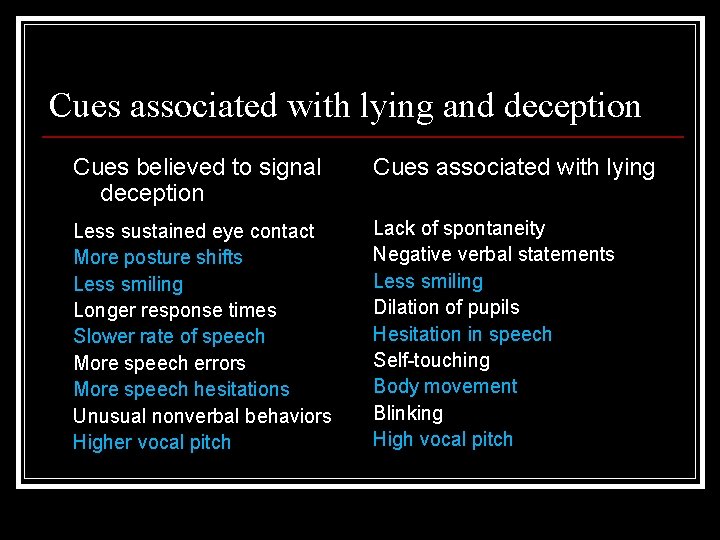
Cues associated with lying and deception Cues believed to signal deception Cues associated with lying Less sustained eye contact More posture shifts Less smiling Longer response times Slower rate of speech More speech errors More speech hesitations Unusual nonverbal behaviors Higher vocal pitch Lack of spontaneity Negative verbal statements Less smiling Dilation of pupils Hesitation in speech Self-touching Body movement Blinking High vocal pitch
Effective communication: some useful techniques Personal strategies n Courses intended to help people improve their communication skills Sensitivity training n n n Listening: the other side of the coin n Active listening involves giving the other person feedback in the form of questions, interpretations, and clarifications