
Chapter 6 Collecting Quantitative Data Power Point Slides

- Slides: 13
Chapter 6 Collecting Quantitative Data Power Point Slides by Ronald J. Shope in collaboration with John W. Creswell
Key Ideas • Who will you study (sampling, sample size)? • What information will you collect? (types of data, links to questions/variables) • What instrument(s) will you use? (scales of measurement, validity, reliability) • How will you administer the data collection? (standardization) Educational Research 2 e: Creswell
Population and Sample • A population is a group of individuals that comprise the same characteristics • A sample is a sub-group of the target population that the researcher plans to study for the purpose of making generalizations about the target population. – Samples are only estimates – The difference between the sample estimate and the true population is the “sampling error. ” Educational Research 2 e: Creswell
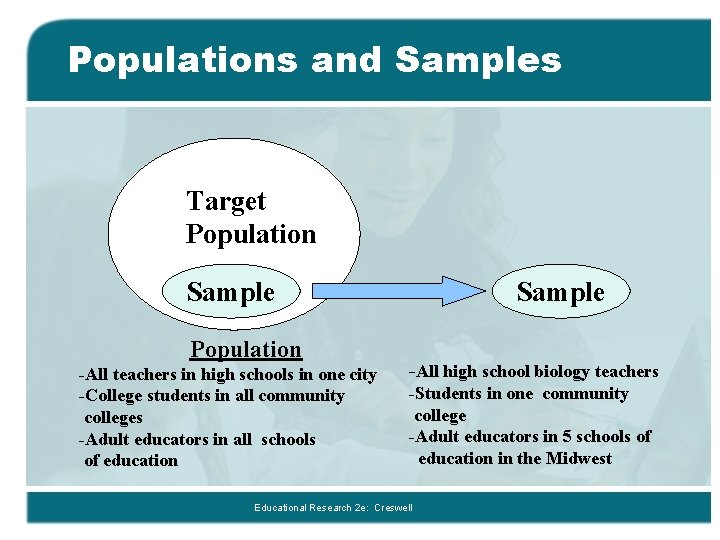
Populations and Samples Target Population Sample Population -All teachers in high schools in one city -College students in all community colleges -Adult educators in all schools of education Sample -All high school biology teachers -Students in one community college -Adult educators in 5 schools of education in the Midwest Educational Research 2 e: Creswell
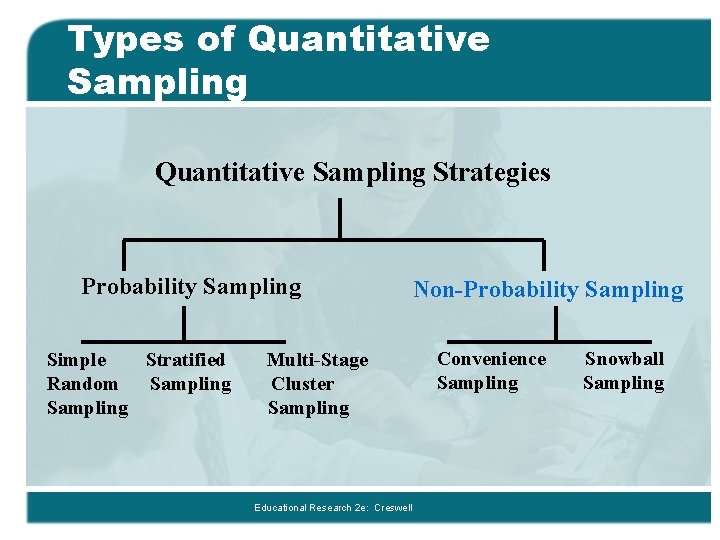
Types of Quantitative Sampling Strategies Probability Sampling Simple Stratified Random Sampling Multi-Stage Cluster Sampling Educational Research 2 e: Creswell Non-Probability Sampling Convenience Sampling Snowball Sampling
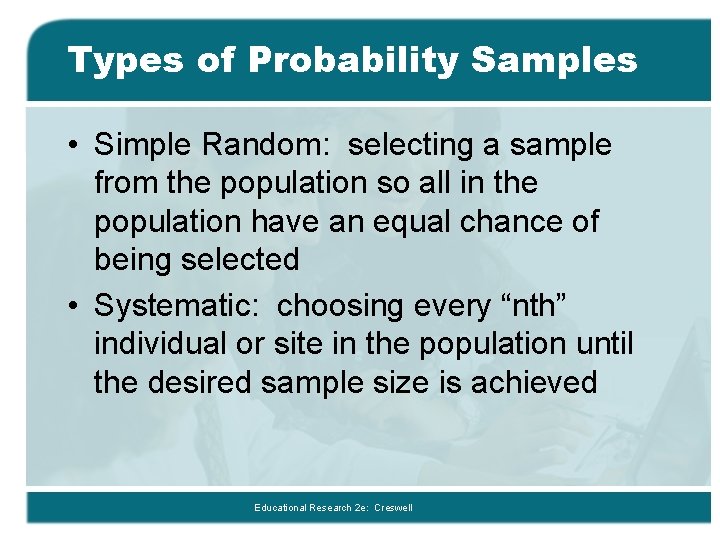
Types of Probability Samples • Simple Random: selecting a sample from the population so all in the population have an equal chance of being selected • Systematic: choosing every “nth” individual or site in the population until the desired sample size is achieved Educational Research 2 e: Creswell
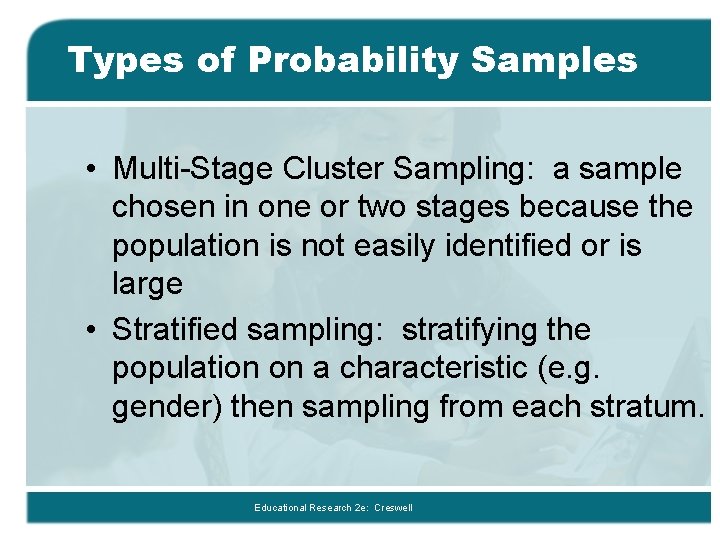
Types of Probability Samples • Multi-Stage Cluster Sampling: a sample chosen in one or two stages because the population is not easily identified or is large • Stratified sampling: stratifying the population on a characteristic (e. g. gender) then sampling from each stratum. Educational Research 2 e: Creswell
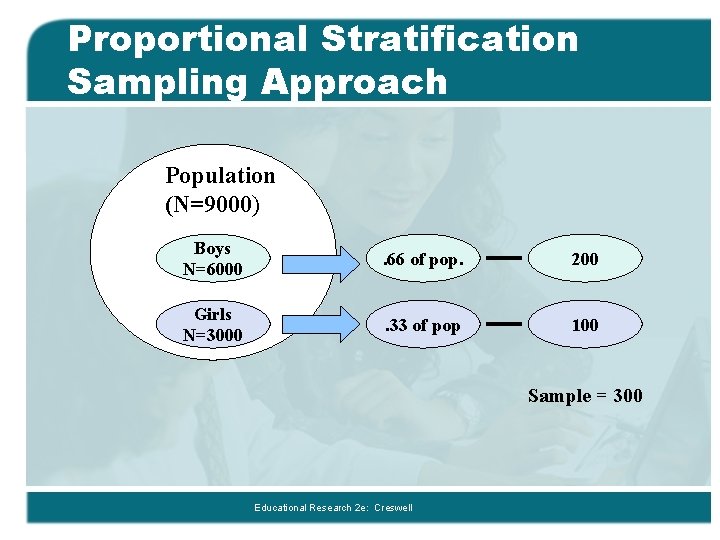
Proportional Stratification Sampling Approach Population (N=9000) Boys N=6000 . 66 of pop. 200 Girls N=3000 . 33 of pop 100 Sample = 300 Educational Research 2 e: Creswell
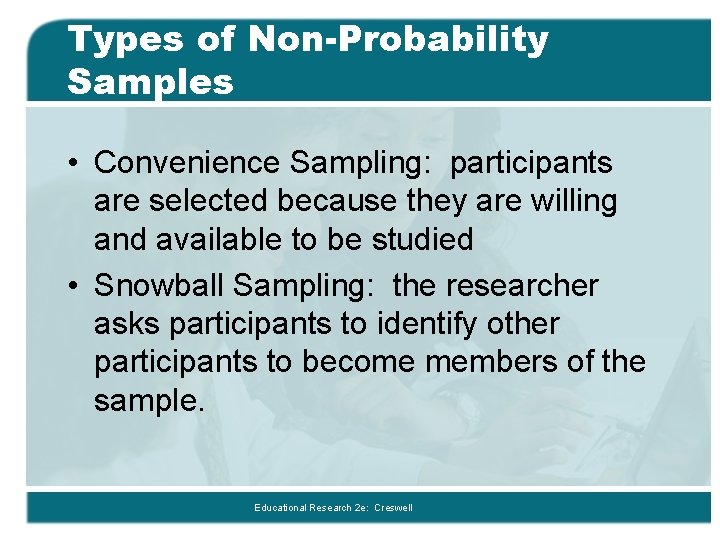
Types of Non-Probability Samples • Convenience Sampling: participants are selected because they are willing and available to be studied • Snowball Sampling: the researcher asks participants to identify other participants to become members of the sample. Educational Research 2 e: Creswell
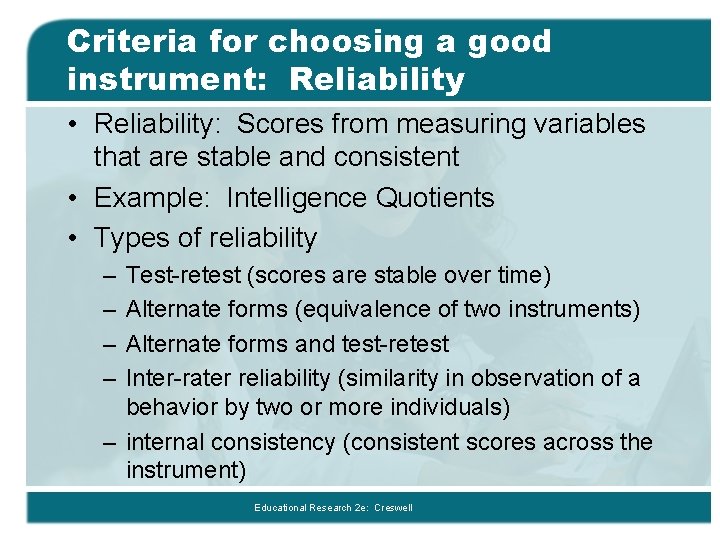
Criteria for choosing a good instrument: Reliability • Reliability: Scores from measuring variables that are stable and consistent • Example: Intelligence Quotients • Types of reliability – – Test-retest (scores are stable over time) Alternate forms (equivalence of two instruments) Alternate forms and test-retest Inter-rater reliability (similarity in observation of a behavior by two or more individuals) – internal consistency (consistent scores across the instrument) Educational Research 2 e: Creswell
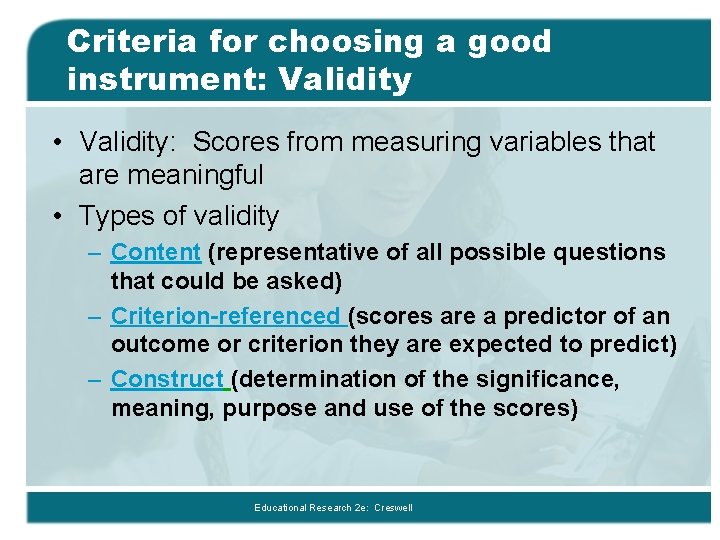
Criteria for choosing a good instrument: Validity • Validity: Scores from measuring variables that are meaningful • Types of validity – Content (representative of all possible questions that could be asked) – Criterion-referenced (scores are a predictor of an outcome or criterion they are expected to predict) – Construct (determination of the significance, meaning, purpose and use of the scores) Educational Research 2 e: Creswell
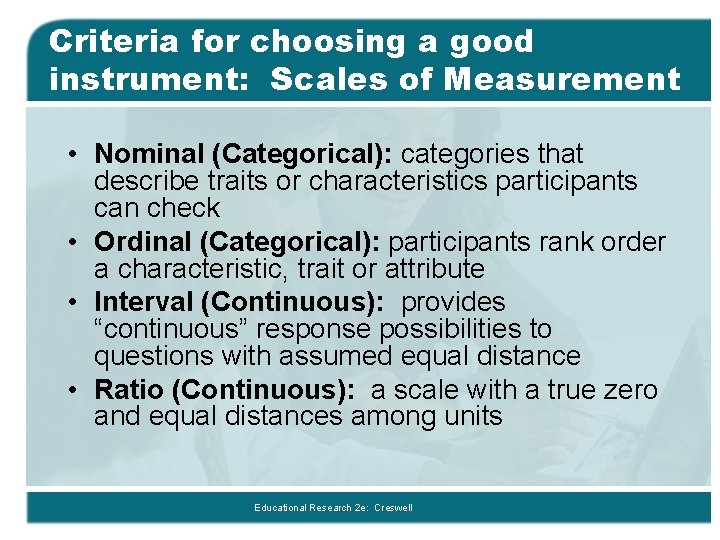
Criteria for choosing a good instrument: Scales of Measurement • Nominal (Categorical): categories that describe traits or characteristics participants can check • Ordinal (Categorical): participants rank order a characteristic, trait or attribute • Interval (Continuous): provides “continuous” response possibilities to questions with assumed equal distance • Ratio (Continuous): a scale with a true zero and equal distances among units Educational Research 2 e: Creswell
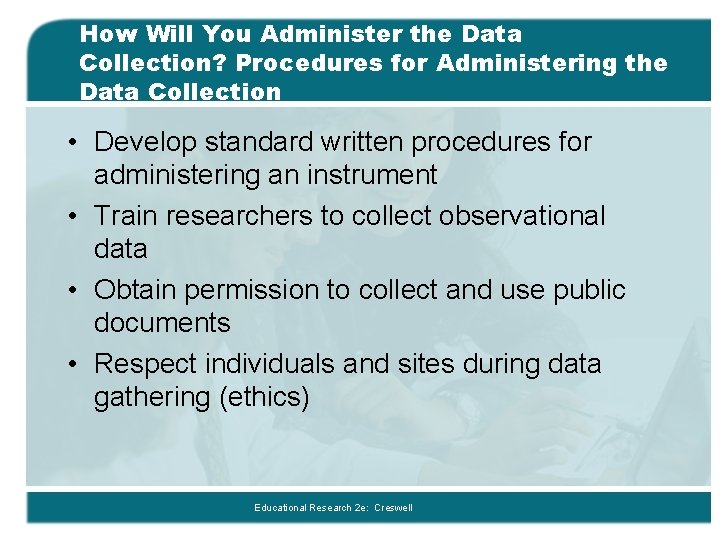
How Will You Administer the Data Collection? Procedures for Administering the Data Collection • Develop standard written procedures for administering an instrument • Train researchers to collect observational data • Obtain permission to collect and use public documents • Respect individuals and sites during data gathering (ethics) Educational Research 2 e: Creswell