
Chapter 6 Chemical Reactions Matter and Change Changes
- Slides: 23
Chapter 6 Chemical Reactions
Matter and Change • Changes in matter can be described in terms of physical changes and chemical changes. • A physical property is a characteristic of a substance that can be observed without changing the substance into another substance. • Color, hardness, texture, and flexibility are some physical properties of matter.
Matter and Change Continued • A chemical property is a characteristic of a substance that describes its ability to change into other substances. • Flammability, rust, and changing into another substance are all chemical properties.
Changes of Matter • A physical change is any change that alters the form or appearance of a substance but does not make the substance into another substance. • Chemical change is a change in matter that produces one or more new substances. • The substances that undergo change in a chemical reaction are called reactants. • The new substances formed by the reaction are called products.
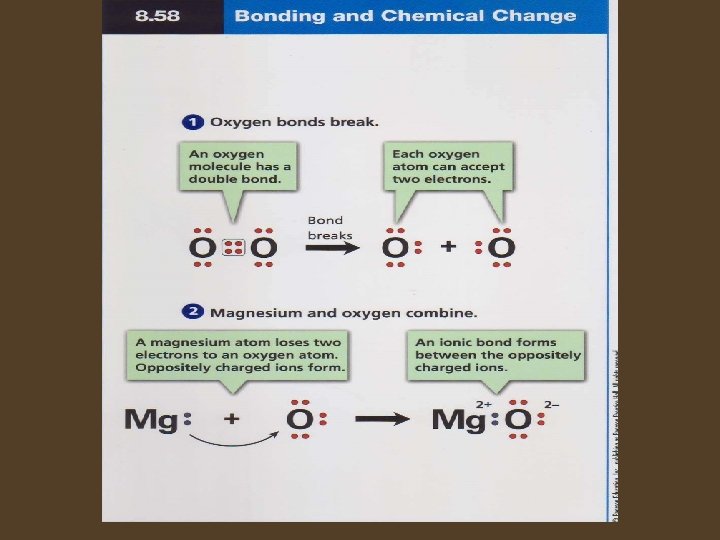
Bonding and Chemical Change • Chemical changes occur when bonds break and new bonds form. • Atoms form bonds when they share or transfer electrons. • Chemical reactions involve changes in properties and changes in energy that you can observe. • One way to detect chemical reactions is to observe changes in the properties of the materials involved. • Color change, precipitate, formation of a gas are examples of chemical changes.
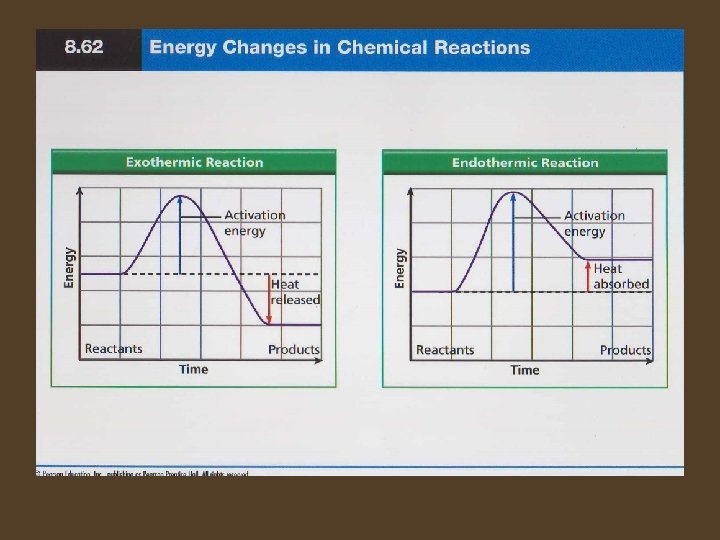
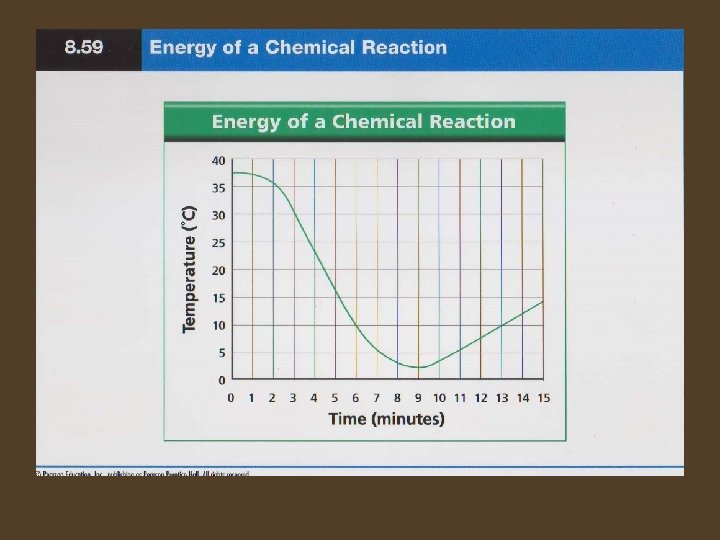
Changes in Energy • Endothermic reaction – the total making and breaking of bonds is a net absorption of energy. • The energy is absorbed as heat from nearby matter, which cools. • In an exothermic reaction – the total making and breaking of bonds results in a net release of energy. • The energy is typically released as heat into nearby matter.
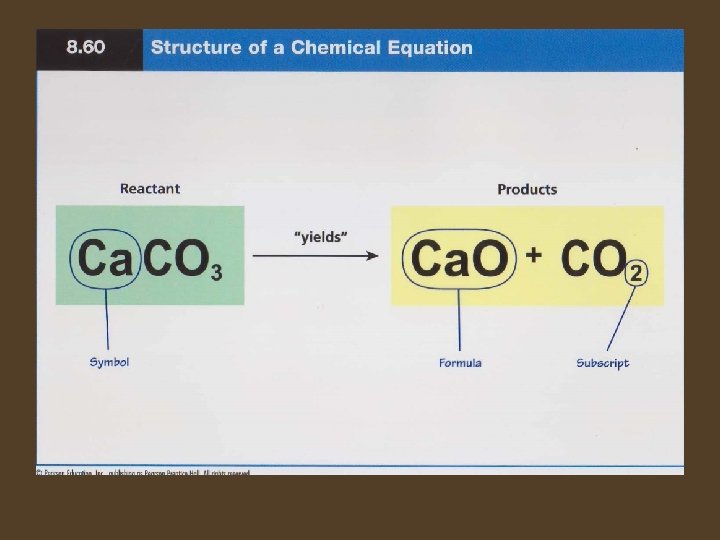
What are Chemical Equations • A chemical equation is a short, easy way to show a chemical reaction, using symbols instead of words. • Chemical equations use chemical formulas and other symbols instead of words to summarize a reaction. • All chemical equations use formulas to represent substances involved in a reaction. • Reactant + Reactant → Product + Product
Conservation of Matter • It states that, during a chemical reaction, matter is neither created nor destroyed. The total mass of the reactants must equal the total mass of the products. • In chemical reactions, the number of atoms stays the same no matter how they are arranged. So, their total mass will remain the same.
Open and Closed Systems • In an open system, matter can enter from or escape to the surroundings. • A burning match is an example of an open system. • In a closed system, matter is not allowed to enter or leave.
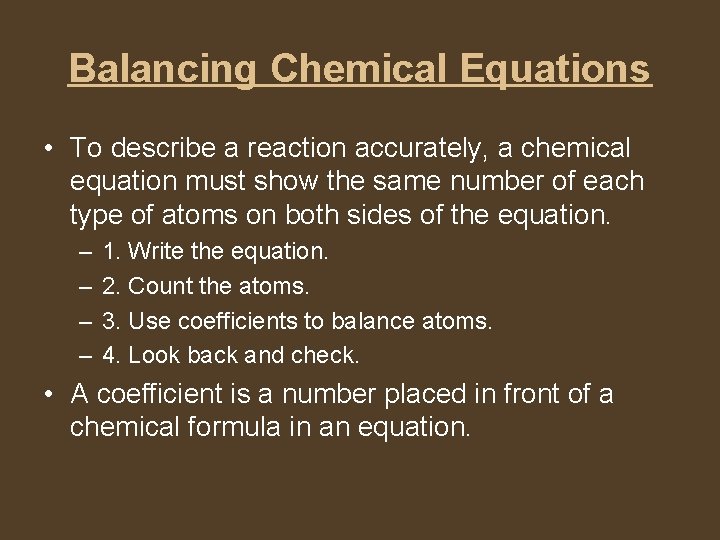
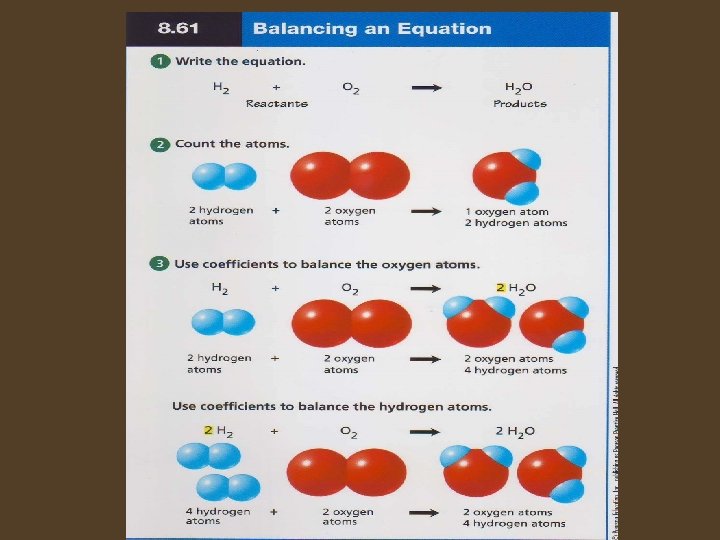
Balancing Chemical Equations • To describe a reaction accurately, a chemical equation must show the same number of each type of atoms on both sides of the equation. – – 1. Write the equation. 2. Count the atoms. 3. Use coefficients to balance atoms. 4. Look back and check. • A coefficient is a number placed in front of a chemical formula in an equation.
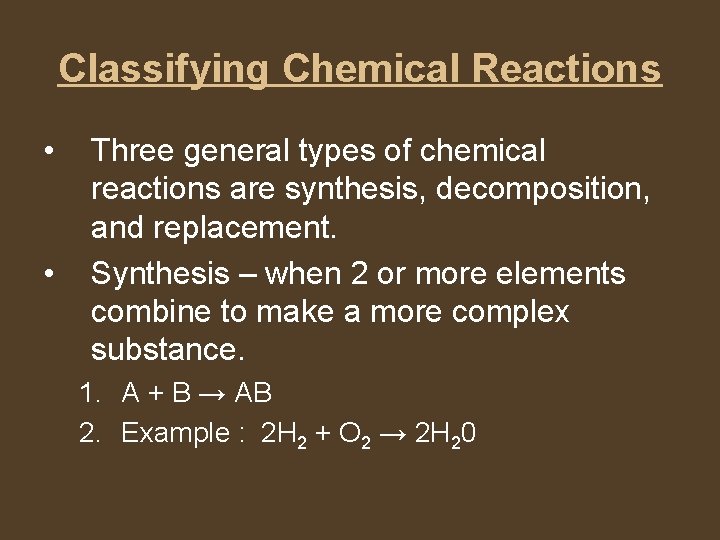
Classifying Chemical Reactions • • Three general types of chemical reactions are synthesis, decomposition, and replacement. Synthesis – when 2 or more elements combine to make a more complex substance. 1. A + B → AB 2. Example : 2 H 2 + O 2 → 2 H 20
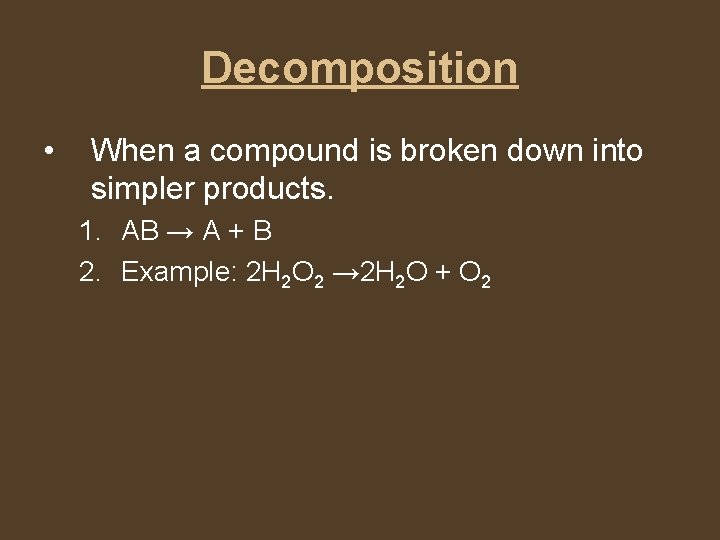
Decomposition • When a compound is broken down into simpler products. 1. AB → A + B 2. Example: 2 H 2 O 2 → 2 H 2 O + O 2
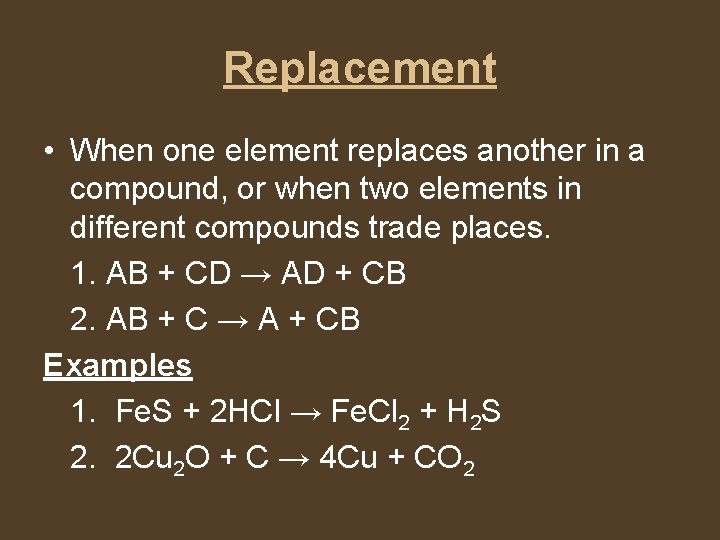
Replacement • When one element replaces another in a compound, or when two elements in different compounds trade places. 1. AB + CD → AD + CB 2. AB + C → A + CB Examples 1. Fe. S + 2 HCl → Fe. Cl 2 + H 2 S 2. 2 Cu 2 O + C → 4 Cu + CO 2
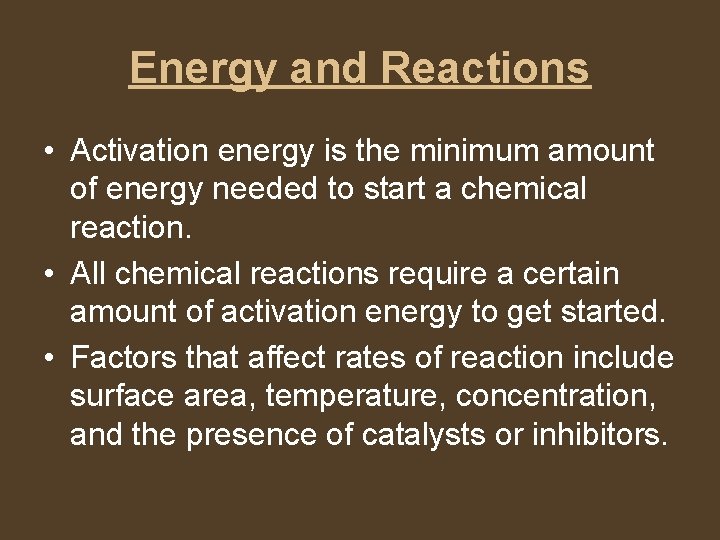
Energy and Reactions • Activation energy is the minimum amount of energy needed to start a chemical reaction. • All chemical reactions require a certain amount of activation energy to get started. • Factors that affect rates of reaction include surface area, temperature, concentration, and the presence of catalysts or inhibitors.
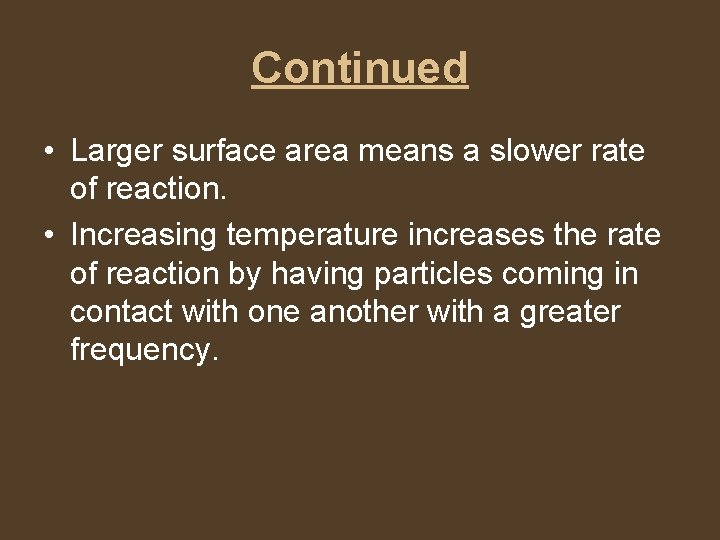
Continued • Larger surface area means a slower rate of reaction. • Increasing temperature increases the rate of reaction by having particles coming in contact with one another with a greater frequency.
Continued • Concentration is the amount of a substance in a given volume. So, by increasing the concentration of reactants the rate of reaction also increases. • A catalyst is a material that increases the rate of reaction by lowering the activation energy.
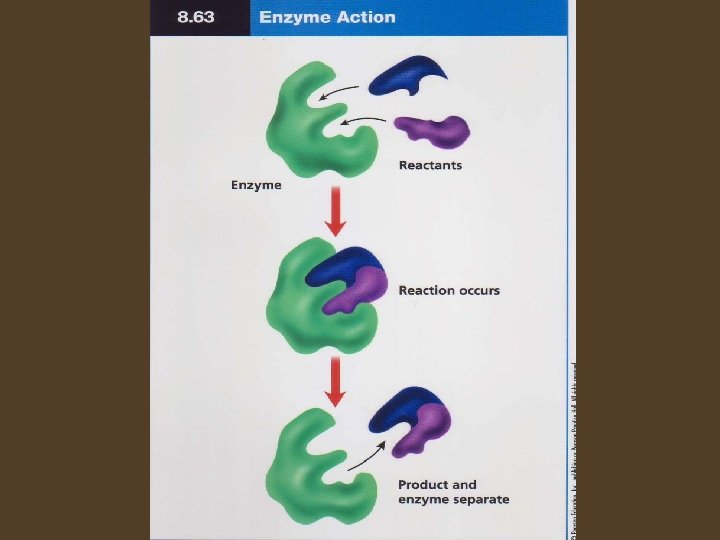
ENZYMES • The cells in your body contain biological catalysts called enzymes. Your body has thousands of different enzymes. Each enzyme is specific in nature and affects only one chemical reaction. • Inhibitors are materials used to decrease the rate of reactions, most inhibitors work by preventing reactants from coming together.