
Chapter 6 Chemical Equilibrium Chapter 6 Chemical Equilibrium
Chapter 6 Chemical Equilibrium
Chapter 6: Chemical Equilibrium 6. 1 The Equilibrium Condition 6. 2 The Equilibrium Constant 6. 3 Equilibrium Expressions Involving Pressures 6. 4 The Concept of Activity 6. 5 Heterogeneous Equilibria 6. 6 Applications of the Equilibrium Constant 6. 7 Solving Equilibrium Problems 6. 8 Le. Chatelier’s Principle 6. 9 Equilibria Involving Real Gases
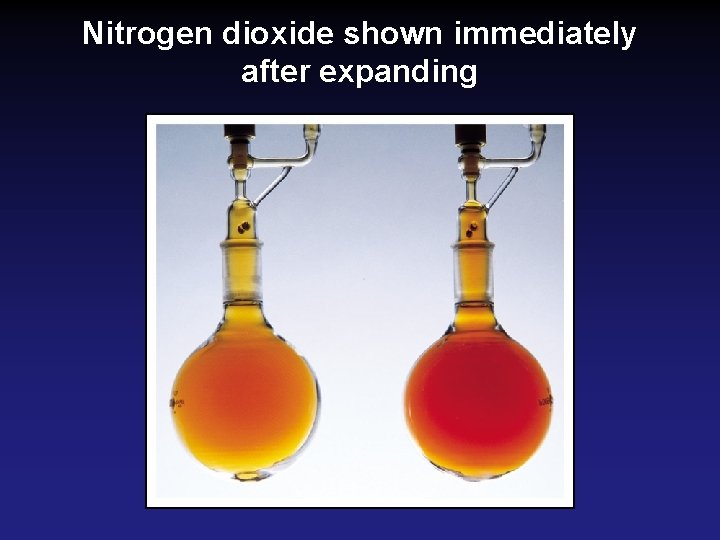
Nitrogen dioxide shown immediately after expanding
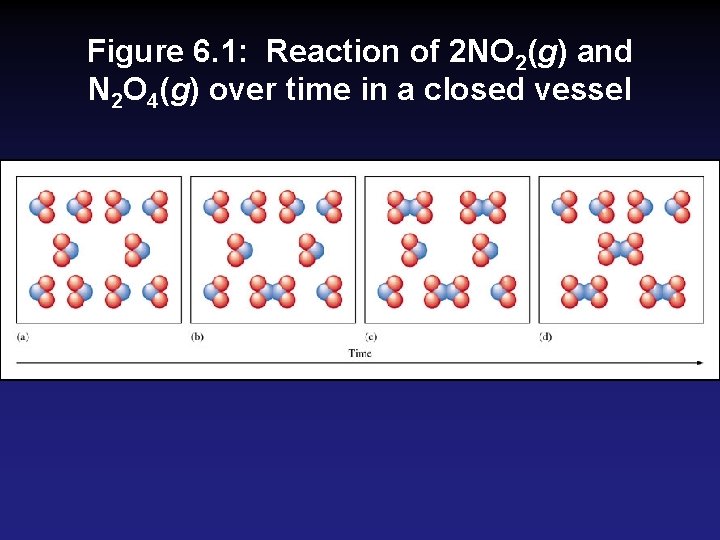
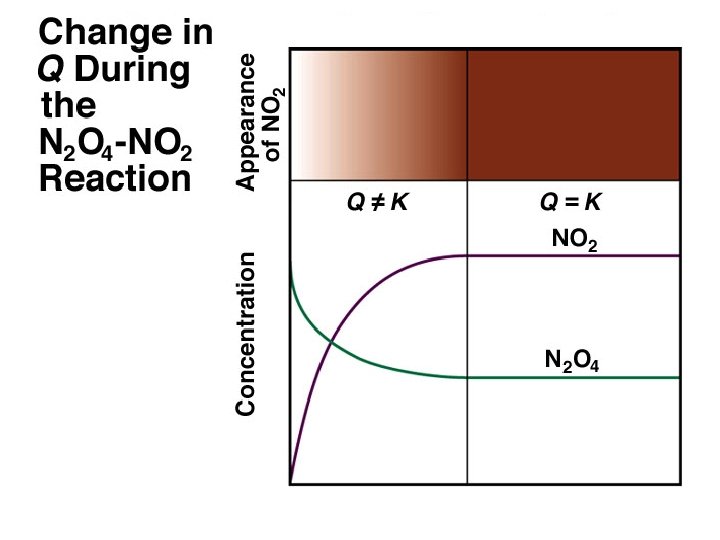
Figure 6. 1: Reaction of 2 NO 2(g) and N 2 O 4(g) over time in a closed vessel
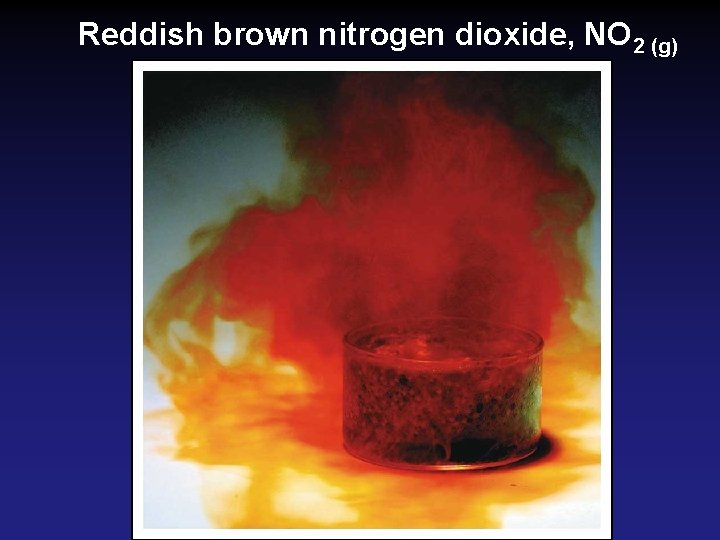
Reddish brown nitrogen dioxide, NO 2 (g)
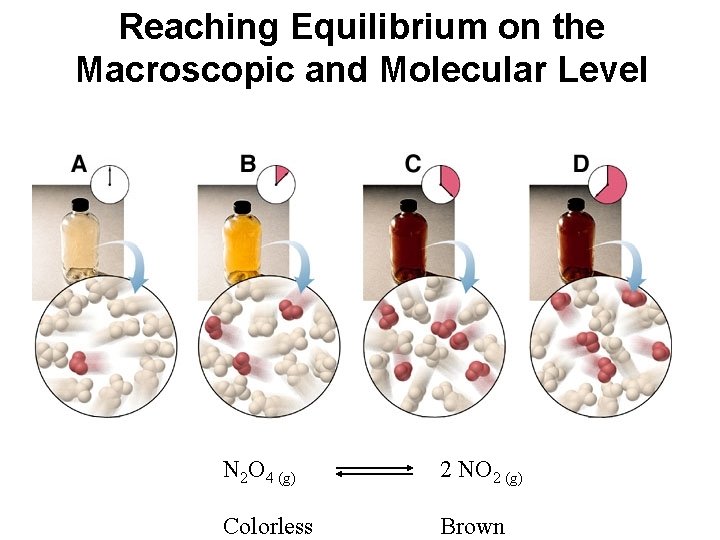
Reaching Equilibrium on the Macroscopic and Molecular Level N 2 O 4 (g) 2 NO 2 (g) Colorless Brown

The State of Equilibrium For the Nitrogen dioxide - dinitrogen tetroxide equilibrium: N 2 O 4 (g, colorless) = 2 NO 2 (g, brown) At equilibrium: ratefwd = raterev ratefwd = kfwd[N 2 O 4] = krev[NO 2]2 1) Small k N 2 (g) + O 2 (g) 2) Large k 2 CO(g) + O 2 (g) 3) Intermediate k 2 Br. Cl(g) raterev = krev[NO 2]2 kfwd = [NO 2]2 = K eq krev [N 2 O 4] 2 NO(g) 2 CO 2 (g) K = 1 x 10 -30 K = 2. 2 x 10²² Br 2 (g) + Cl 2 (g) K=5
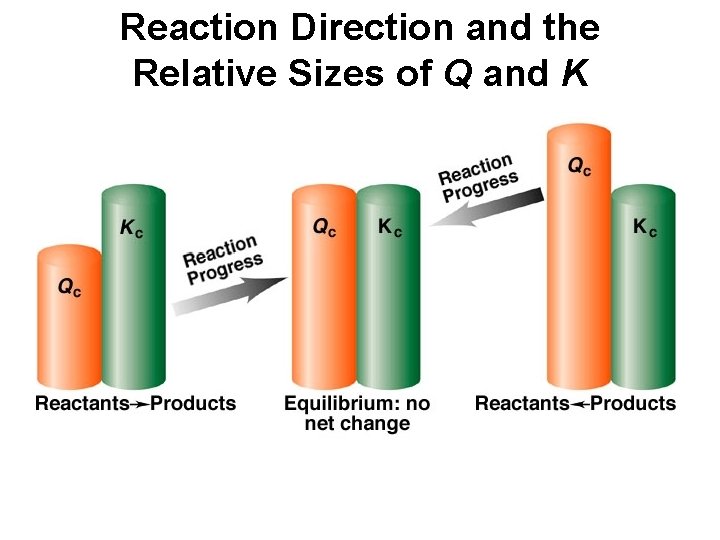
Reaction Direction and the Relative Sizes of Q and K
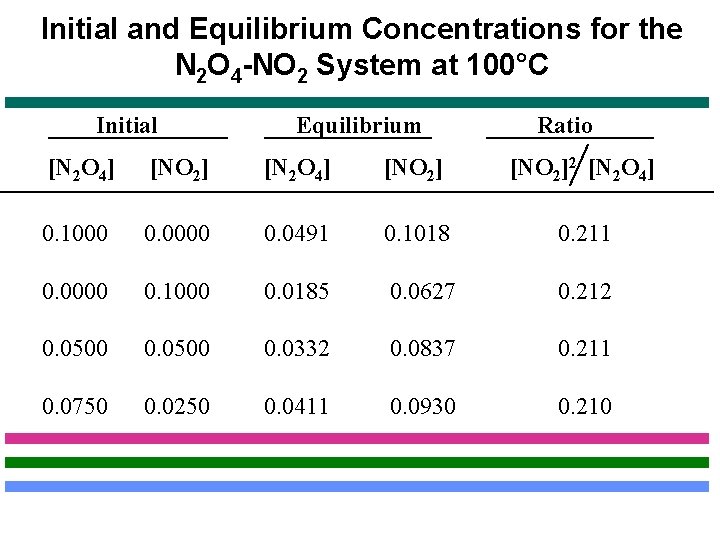
Initial and Equilibrium Concentrations for the N 2 O 4 -NO 2 System at 100°C Initial Equilibrium Ratio [N 2 O 4] [NO 2]2 [N 2 O 4] 0. 1000 0. 0491 0. 1018 0. 211 0. 0000 0. 1000 0. 0185 0. 0627 0. 212 0. 0500 0. 0332 0. 0837 0. 211 0. 0750 0. 0250 0. 0411 0. 0930 0. 210
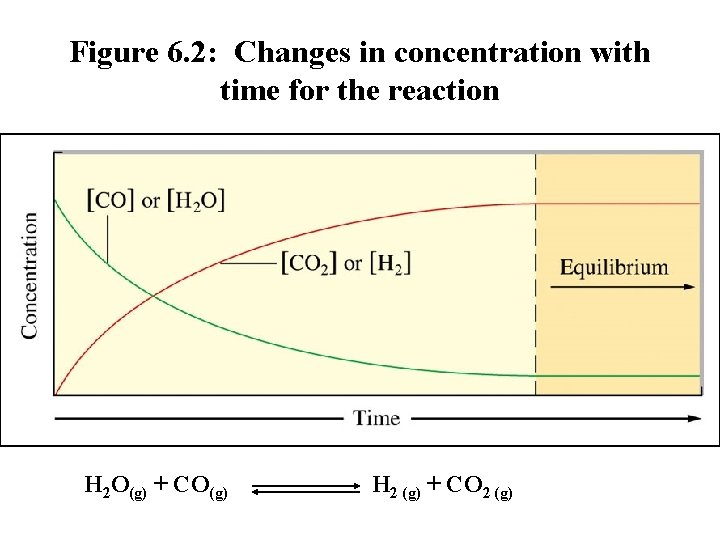
Figure 6. 2: Changes in concentration with time for the reaction H 2 O(g) + CO(g) H 2 (g) + CO 2 (g)
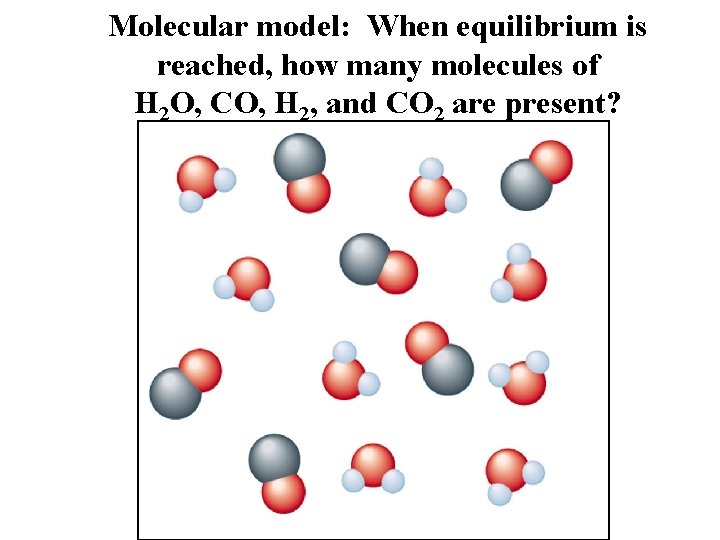
Molecular model: When equilibrium is reached, how many molecules of H 2 O, CO, H 2, and CO 2 are present?
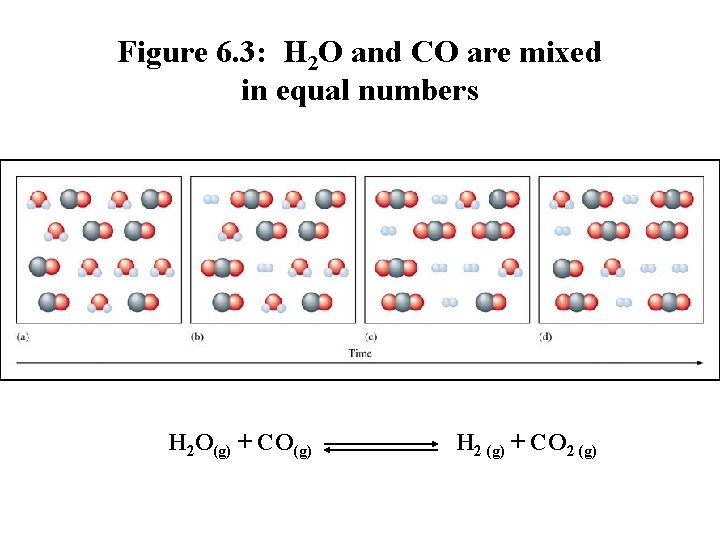
Figure 6. 3: H 2 O and CO are mixed in equal numbers H 2 O(g) + CO(g) H 2 (g) + CO 2 (g)
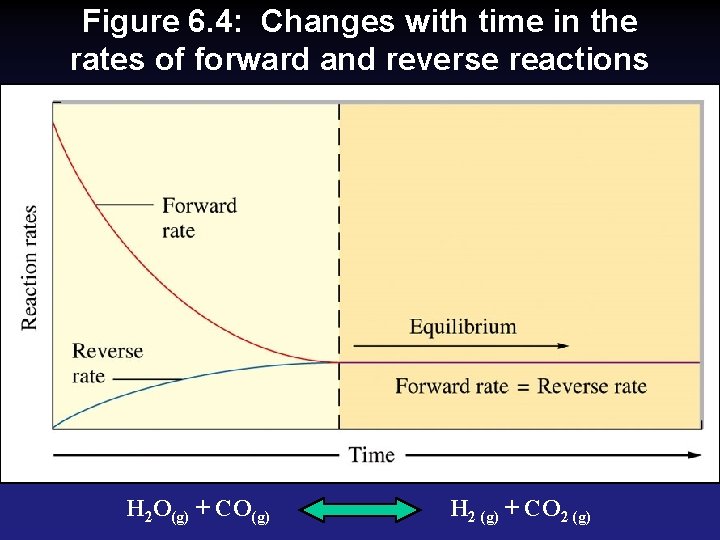
Figure 6. 4: Changes with time in the rates of forward and reverse reactions H 2 O(g) + CO(g) H 2 (g) + CO 2 (g)
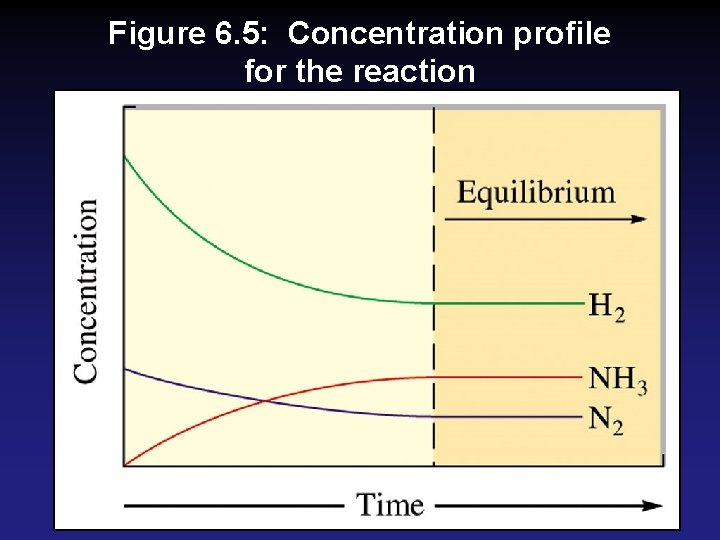
Figure 6. 5: Concentration profile for the reaction
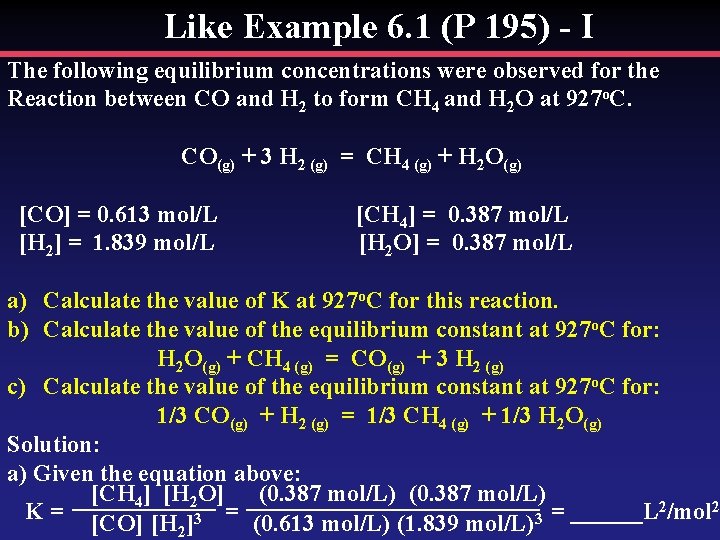
Like Example 6. 1 (P 195) - I The following equilibrium concentrations were observed for the Reaction between CO and H 2 to form CH 4 and H 2 O at 927 o. C. CO(g) + 3 H 2 (g) = CH 4 (g) + H 2 O(g) [CO] = 0. 613 mol/L [H 2] = 1. 839 mol/L [CH 4] = 0. 387 mol/L [H 2 O] = 0. 387 mol/L a) Calculate the value of K at 927 o. C for this reaction. b) Calculate the value of the equilibrium constant at 927 o. C for: H 2 O(g) + CH 4 (g) = CO(g) + 3 H 2 (g) c) Calculate the value of the equilibrium constant at 927 o. C for: 1/3 CO(g) + H 2 (g) = 1/3 CH 4 (g) + 1/3 H 2 O(g) Solution: a) Given the equation above: [CH 4] [H 2 O] (0. 387 mol/L) K = [CO] [H ]3 = (0. 613 mol/L) (1. 839 mol/L)3 = ______L 2/mol 2 2
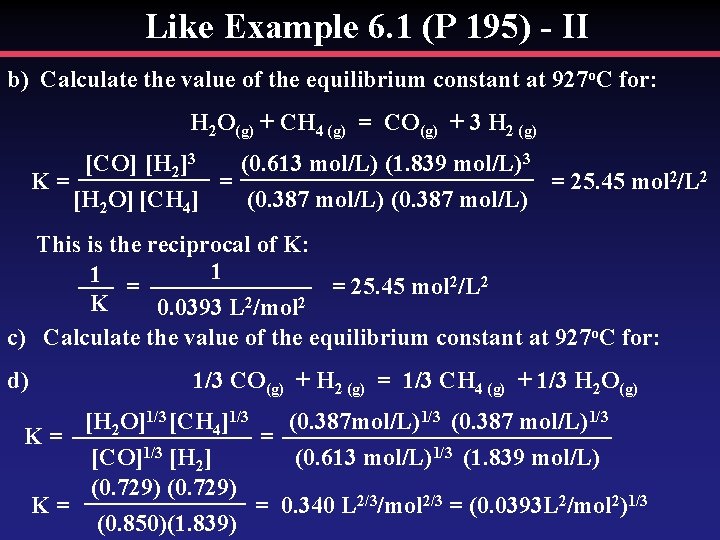
Like Example 6. 1 (P 195) - II b) Calculate the value of the equilibrium constant at 927 o. C for: H 2 O(g) + CH 4 (g) = CO(g) + 3 H 2 (g) [CO] [H 2]3 (0. 613 mol/L) (1. 839 mol/L)3 K= = = 25. 45 mol 2/L 2 [H 2 O] [CH 4] (0. 387 mol/L) This is the reciprocal of K: 1 1 = = 25. 45 mol 2/L 2 K 0. 0393 L 2/mol 2 c) Calculate the value of the equilibrium constant at 927 o. C for: d) 1/3 CO(g) + H 2 (g) = 1/3 CH 4 (g) + 1/3 H 2 O(g) [H 2 O]1/3 [CH 4]1/3 (0. 387 mol/L)1/3 (0. 387 mol/L)1/3 K= = 1/3 [CO] [H 2] (0. 613 mol/L)1/3 (1. 839 mol/L) (0. 729) K= = 0. 340 L 2/3/mol 2/3 = (0. 0393 L 2/mol 2)1/3 (0. 850)(1. 839)
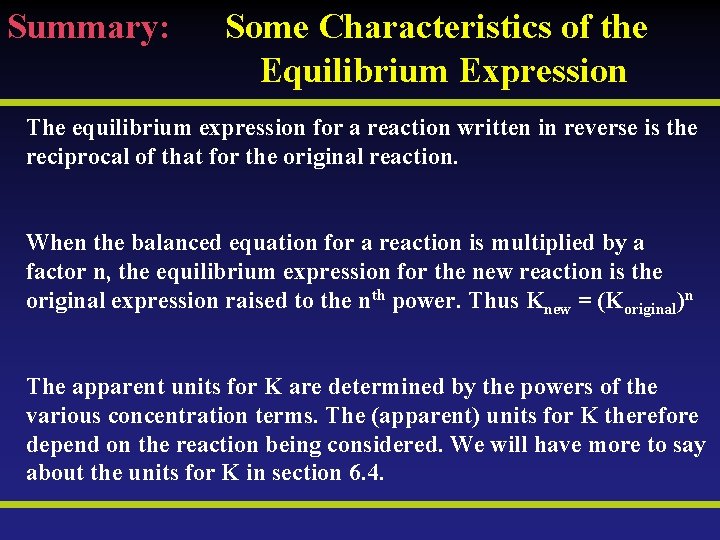
Summary: Some Characteristics of the Equilibrium Expression The equilibrium expression for a reaction written in reverse is the reciprocal of that for the original reaction. When the balanced equation for a reaction is multiplied by a factor n, the equilibrium expression for the new reaction is the original expression raised to the nth power. Thus Knew = (Koriginal)n The apparent units for K are determined by the powers of the various concentration terms. The (apparent) units for K therefore depend on the reaction being considered. We will have more to say about the units for K in section 6. 4.
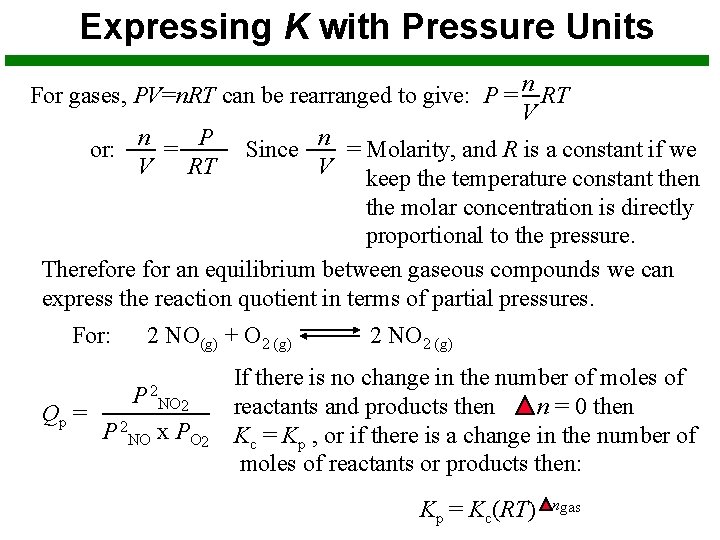
Expressing K with Pressure Units For gases, PV=n. RT can be rearranged to give: P = n RT V n P n or: = Since = Molarity, and R is a constant if we V RT V keep the temperature constant then the molar concentration is directly proportional to the pressure. Therefore for an equilibrium between gaseous compounds we can express the reaction quotient in terms of partial pressures. For: Qp = 2 NO(g) + O 2 (g) P 2 NO 2 P 2 NO x PO 2 2 NO 2 (g) If there is no change in the number of moles of reactants and products then n = 0 then Kc = Kp , or if there is a change in the number of moles of reactants or products then: Kp = Kc(RT) ngas
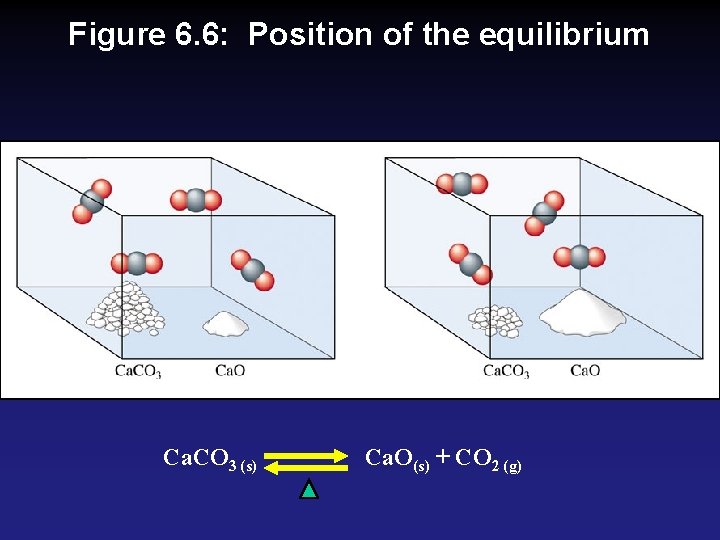
Figure 6. 6: Position of the equilibrium Ca. CO 3 (s) Ca. O(s) + CO 2 (g)
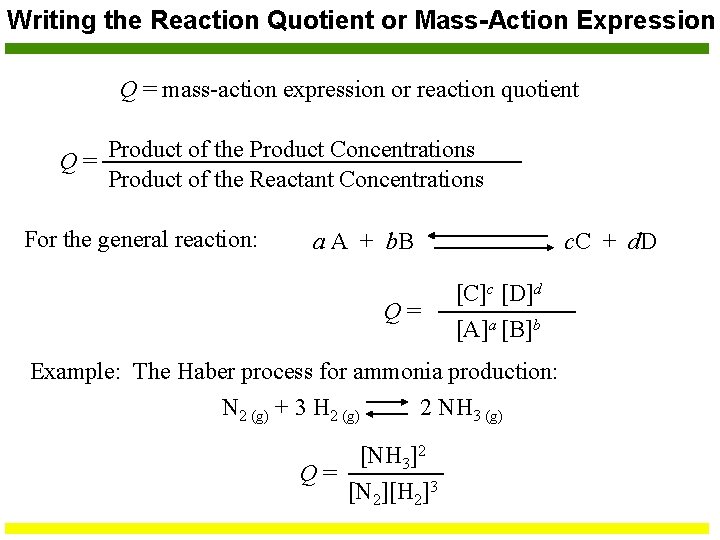
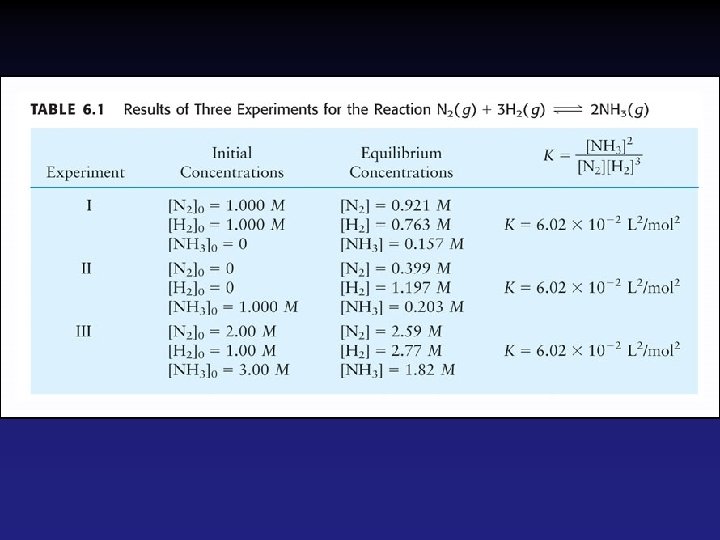
Writing the Reaction Quotient or Mass-Action Expression Q = mass-action expression or reaction quotient Q = Product of the Product Concentrations Product of the Reactant Concentrations For the general reaction: a A + b. B Q= c. C + d. D [C]c [D]d [A]a [B]b Example: The Haber process for ammonia production: N 2 (g) + 3 H 2 (g) 2 NH 3 (g) [NH 3]2 Q= [N 2][H 2]3
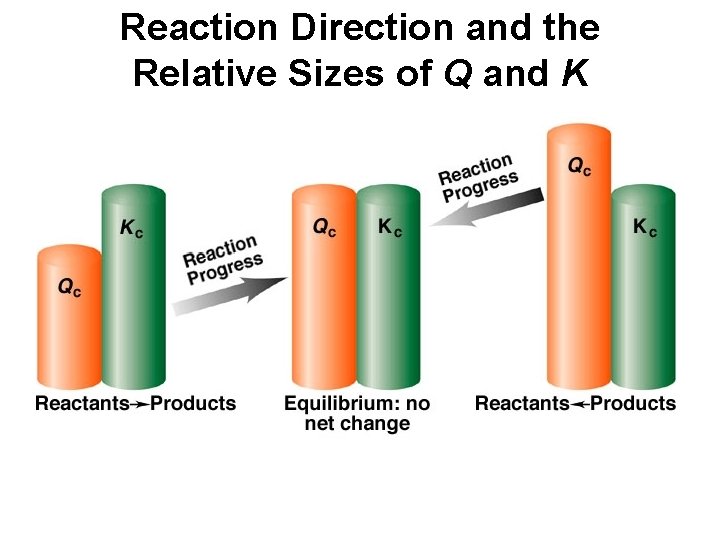
Reaction Direction and the Relative Sizes of Q and K
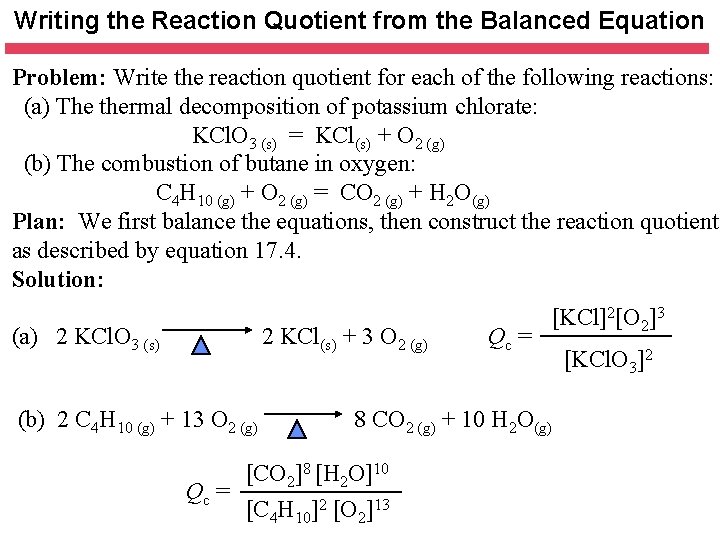
Writing the Reaction Quotient from the Balanced Equation Problem: Write the reaction quotient for each of the following reactions: (a) The thermal decomposition of potassium chlorate: KCl. O 3 (s) = KCl(s) + O 2 (g) (b) The combustion of butane in oxygen: C 4 H 10 (g) + O 2 (g) = CO 2 (g) + H 2 O(g) Plan: We first balance the equations, then construct the reaction quotient as described by equation 17. 4. Solution: (a) 2 KCl. O 3 (s) 2 KCl(s) + 3 O 2 (g) (b) 2 C 4 H 10 (g) + 13 O 2 (g) Qc = [KCl]2[O 2]3 8 CO 2 (g) + 10 H 2 O(g) [CO 2]8 [H 2 O]10 [C 4 H 10]2 [O 2]13 [KCl. O 3]2
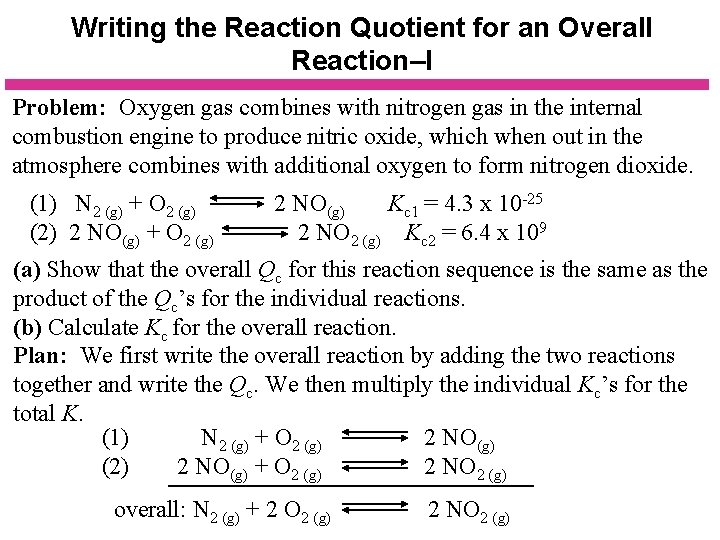
Writing the Reaction Quotient for an Overall Reaction–I Problem: Oxygen gas combines with nitrogen gas in the internal combustion engine to produce nitric oxide, which when out in the atmosphere combines with additional oxygen to form nitrogen dioxide. (1) N 2 (g) + O 2 (g) (2) 2 NO(g) + O 2 (g) 2 NO(g) Kc 1 = 4. 3 x 10 -25 2 NO 2 (g) Kc 2 = 6. 4 x 10⁹ (a) Show that the overall Qc for this reaction sequence is the same as the product of the Qc’s for the individual reactions. (b) Calculate Kc for the overall reaction. Plan: We first write the overall reaction by adding the two reactions together and write the Qc. We then multiply the individual Kc’s for the total K. (1) N 2 (g) + O 2 (g) 2 NO(g) (2) 2 NO(g) + O 2 (g) 2 NO 2 (g) overall: N 2 (g) + 2 O 2 (g) 2 NO 2 (g)
![Writing the Reaction Quotient for an Overall Reaction–II (a) cont. 2 [NO] Qc (overall)](http://slidetodoc.com/presentation_image_h2/70aba5277fcfb5f9d191895797956b4f/image-26.jpg "Writing the Reaction Quotient for an Overall Reaction–II (a) cont. 2 [NO] Qc (overall)")
Writing the Reaction Quotient for an Overall Reaction–II (a) cont. 2 [NO] Qc (overall) = [N 2][O 2]2 For the individual steps: [NO]2 (1) N 2 (g) + O 2 (g) 2 NO(g) Qc 1 = [N 2] [O 2] 2 [NO ] 2 (2) 2 NO(g) + O 2 (g) 2 NO 2 (g) Qc 2 = [NO]2 [O 2] 2 2 2 [NO] [NO ] 2 2 Qc 1 x Qc 2 = x = The same! 2 2 [N 2] [O 2] [NO] [O 2] [N 2][O 2] (b) K = Kc 1 x Kc 2 = (4. 3 x 10 -25)(6. 4 x 10⁹) = _______
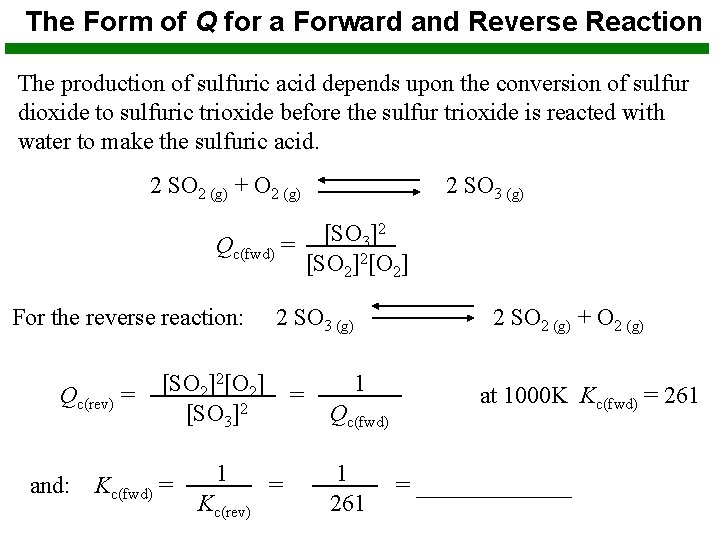
The Form of Q for a Forward and Reverse Reaction The production of sulfuric acid depends upon the conversion of sulfur dioxide to sulfuric trioxide before the sulfur trioxide is reacted with water to make the sulfuric acid. 2 SO 2 (g) + O 2 (g) 2 SO 3 (g) 2 [SO ] 3 Qc(fwd) = [SO 2]2[O 2] For the reverse reaction: Qc(rev) = and: 2 SO 3 (g) [SO 2]2[O 2] [SO 3]2 Kc(fwd) = 1 Kc(rev) = = 1 Qc(fwd) 1 261 2 SO 2 (g) + O 2 (g) at 1000 K Kc(fwd) = 261 = _______
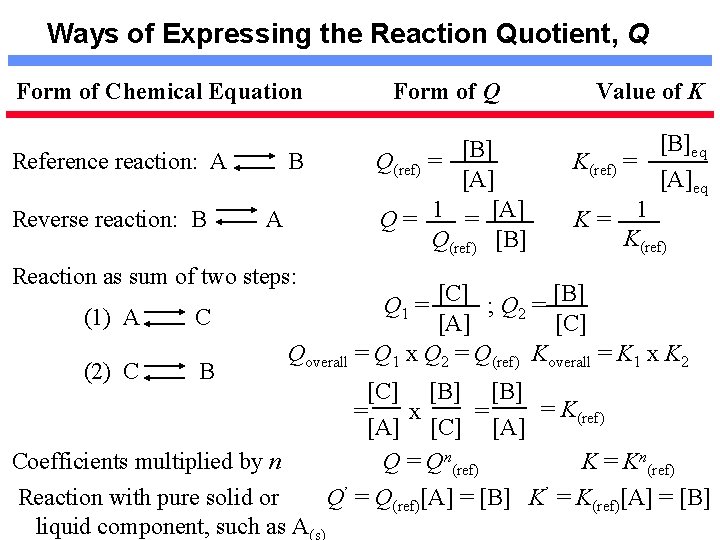
Ways of Expressing the Reaction Quotient, Q Form of Chemical Equation Reference reaction: A Reverse reaction: B B A Form of Q Q(ref) = [B] [A] Q = 1 = [A] Q(ref) [B] Value of K K(ref) = K= [B]eq [A]eq 1 K(ref) Reaction as sum of two steps: (1) A C (2) C B Q 1 = [C] ; Q 2 = [B] [A] [C] Qoverall = Q 1 x Q 2 = Q(ref) Koverall = K 1 x K 2 Coefficients multiplied by n Reaction with pure solid or liquid component, such as A(s) [C] [B] = K(ref) = x = [A] [C] [A] Q = Qn(ref) K = Kn(ref) Q’ = Q(ref)[A] = [B] K’ = K(ref)[A] = [B]
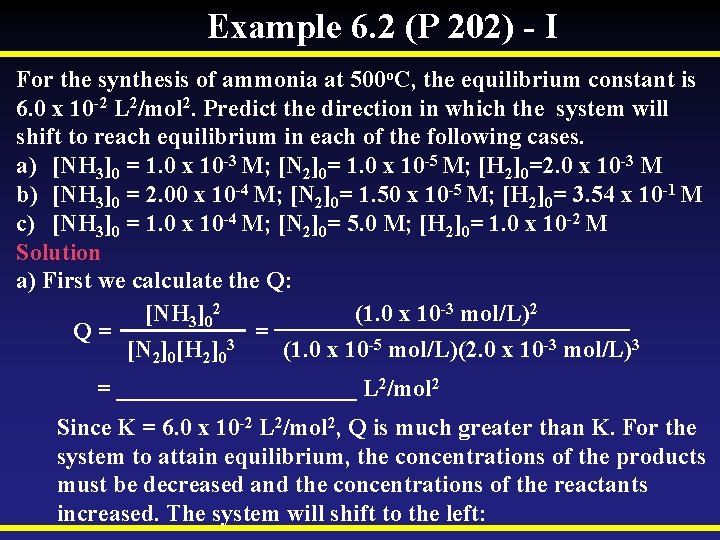
Example 6. 2 (P 202) - I For the synthesis of ammonia at 500 o. C, the equilibrium constant is 6. 0 x 10 -2 L 2/mol 2. Predict the direction in which the system will shift to reach equilibrium in each of the following cases. a) [NH 3]0 = 1. 0 x 10 -3 M; [N 2]0= 1. 0 x 10 -5 M; [H 2]0=2. 0 x 10 -3 M b) [NH 3]0 = 2. 00 x 10 -4 M; [N 2]0= 1. 50 x 10 -5 M; [H 2]0= 3. 54 x 10 -1 M c) [NH 3]0 = 1. 0 x 10 -4 M; [N 2]0= 5. 0 M; [H 2]0= 1. 0 x 10 -2 M Solution a) First we calculate the Q: [NH 3]02 (1. 0 x 10 -3 mol/L)2 Q= = 3 [N 2]0[H 2]0 (1. 0 x 10 -5 mol/L)(2. 0 x 10 -3 mol/L)3 = __________ L 2/mol 2 Since K = 6. 0 x 10 -2 L 2/mol 2, Q is much greater than K. For the system to attain equilibrium, the concentrations of the products must be decreased and the concentrations of the reactants increased. The system will shift to the left:
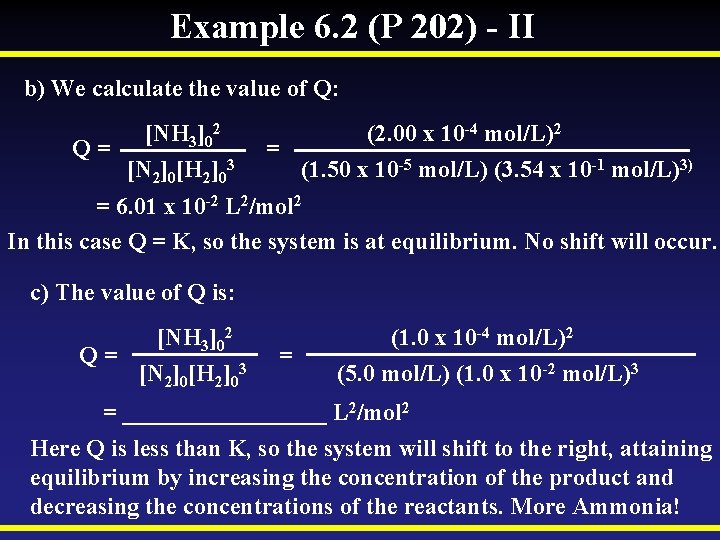
Example 6. 2 (P 202) - II b) We calculate the value of Q: Q= [NH 3]02 = (2. 00 x 10 -4 mol/L)2 [N 2]0[H 2]03 (1. 50 6. 01 x 10 -2 L 2/mol 2 x 10 -5 mol/L) (3. 54 x 10 -1 mol/L)3) = In this case Q = K, so the system is at equilibrium. No shift will occur. c) The value of Q is: Q= [NH 3]02 [N 2]0[H 2]03 = (1. 0 x 10 -4 mol/L)2 (5. 0 mol/L) (1. 0 x 10 -2 mol/L)3 = _________ L 2/mol 2 Here Q is less than K, so the system will shift to the right, attaining equilibrium by increasing the concentration of the product and decreasing the concentrations of the reactants. More Ammonia!
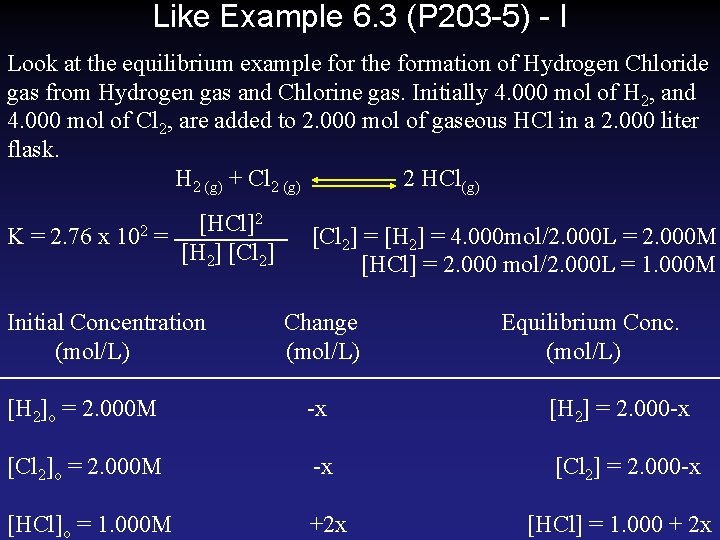
Like Example 6. 3 (P 203 -5) - I Look at the equilibrium example for the formation of Hydrogen Chloride gas from Hydrogen gas and Chlorine gas. Initially 4. 000 mol of H 2, and 4. 000 mol of Cl 2, are added to 2. 000 mol of gaseous HCl in a 2. 000 liter flask. H 2 (g) + Cl 2 (g) 2 HCl(g) 2 [HCl] K = 2. 76 x 102 = [H 2] [Cl 2] Initial Concentration (mol/L) [Cl 2] = [H 2] = 4. 000 mol/2. 000 L = 2. 000 M [HCl] = 2. 000 mol/2. 000 L = 1. 000 M Change (mol/L) Equilibrium Conc. (mol/L) [H 2]o = 2. 000 M -x [H 2] = 2. 000 -x [Cl 2]o = 2. 000 M -x [Cl 2] = 2. 000 -x [HCl]o = 1. 000 M +2 x [HCl] = 1. 000 + 2 x
![Like Example 6. 3 (P 203 -5) - II 2 2 2 [HCl] (1.](http://slidetodoc.com/presentation_image_h2/70aba5277fcfb5f9d191895797956b4f/image-32.jpg "Like Example 6. 3 (P 203 -5) - II 2 2 2 [HCl] (1.")
Like Example 6. 3 (P 203 -5) - II 2 2 2 [HCl] (1. 000 + 2 x) K = 2. 76 x 102 = [H ] [Cl ] = (2. 000 –x)(2. 000 – x) = (2. 000 – x)2 2 2 Take the square root of each side: (1. 000 + 2 x) 16. 61 = (2. 000 – x) 33. 22 – 16. 61 x = 1. 000 + 2 x 32. 22 = 18. 61 x x = 1. 731 Therefore: [H 2] = 0. 269 M [Cl 2] = 0. 269 M [HCl] = 4. 462 M Check: [HCl]2 [H 2] [Cl 2] (4. 462)2 = (0. 269) = 276 OK!
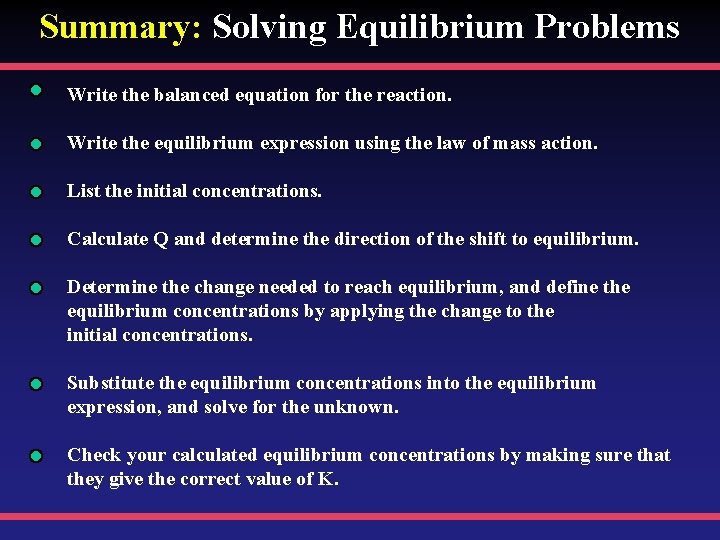
Summary: Solving Equilibrium Problems Write the balanced equation for the reaction. Write the equilibrium expression using the law of mass action. List the initial concentrations. Calculate Q and determine the direction of the shift to equilibrium. Determine the change needed to reach equilibrium, and define the equilibrium concentrations by applying the change to the initial concentrations. Substitute the equilibrium concentrations into the equilibrium expression, and solve for the unknown. Check your calculated equilibrium concentrations by making sure that they give the correct value of K.
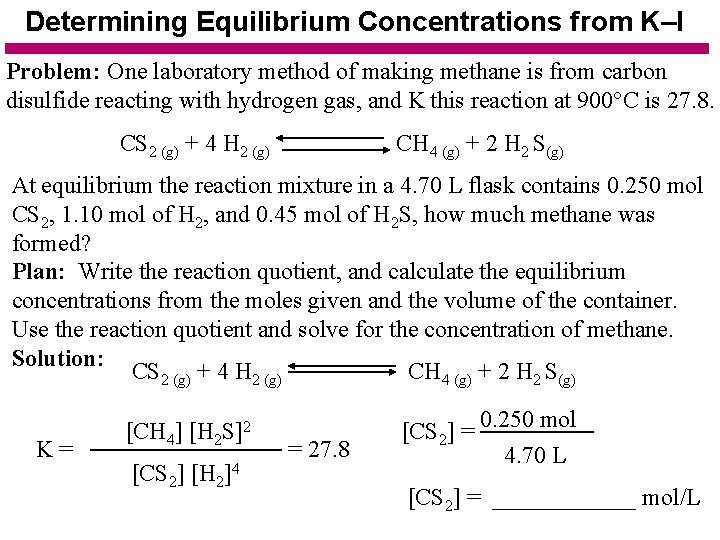
Determining Equilibrium Concentrations from K–I Problem: One laboratory method of making methane is from carbon disulfide reacting with hydrogen gas, and K this reaction at 900°C is 27. 8. CS 2 (g) + 4 H 2 (g) CH 4 (g) + 2 H 2 S(g) At equilibrium the reaction mixture in a 4. 70 L flask contains 0. 250 mol CS 2, 1. 10 mol of H 2, and 0. 45 mol of H 2 S, how much methane was formed? Plan: Write the reaction quotient, and calculate the equilibrium concentrations from the moles given and the volume of the container. Use the reaction quotient and solve for the concentration of methane. Solution: CS 2 (g) + 4 H 2 (g) CH 4 (g) + 2 H 2 S(g) K= [CH 4] [H 2 S]2 [CS 2] [H 2]4 = 27. 8 [CS 2] = 0. 250 mol 4. 70 L [CS 2] = ______ mol/L
![Determining Equilibrium Concentrations from K–II Solution cont. [H 2] = 1. 10 mol =](http://slidetodoc.com/presentation_image_h2/70aba5277fcfb5f9d191895797956b4f/image-35.jpg "Determining Equilibrium Concentrations from K–II Solution cont. [H 2] = 1. 10 mol =")
Determining Equilibrium Concentrations from K–II Solution cont. [H 2] = 1. 10 mol = 0. 23404 mol/L [H 2 S] = 0. 450 mol = 0. 095745 mol/L 4. 70 L [CH 4] = Kc [CS 2] [H 2]4 [H 2 S]2 [CH 4] = 0. 004436 0. 009167 = (27. 8)(0. 05319)(0. 23404)4 (0. 095745)2 = 0. 485547 mol/L = 0. 486 M Check: Substitute the concentrations back into the equation for K and make sure that you get the correct value of K K= [CH 4] [H 2 S]2 [CS 2] [H 2]4 (0. 485547 M)(0. 095745 M)2 = = 27. 81875 (0. 05319 M)(0. 23404 M)4 OK!
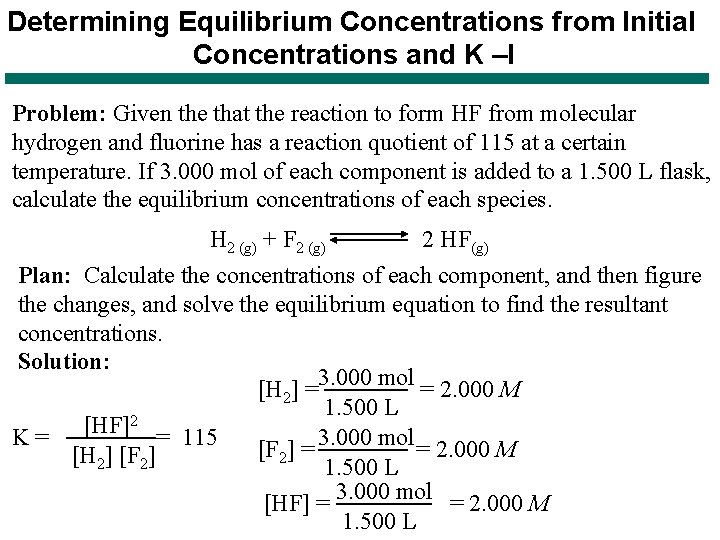
Determining Equilibrium Concentrations from Initial Concentrations and K –I Problem: Given the that the reaction to form HF from molecular hydrogen and fluorine has a reaction quotient of 115 at a certain temperature. If 3. 000 mol of each component is added to a 1. 500 L flask, calculate the equilibrium concentrations of each species. H 2 (g) + F 2 (g) 2 HF(g) Plan: Calculate the concentrations of each component, and then figure the changes, and solve the equilibrium equation to find the resultant concentrations. Solution: [H 2] =3. 000 mol = 2. 000 M 1. 500 L 2 [HF] 3. 000 mol = 2. 000 M K= = 115 [F ] = 2 [H 2] [F 2] 1. 500 L [HF] = 3. 000 mol = 2. 000 M 1. 500 L
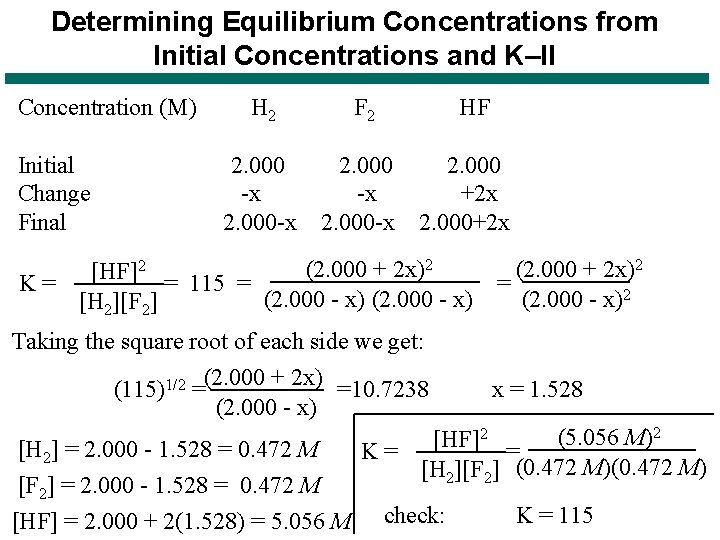
Determining Equilibrium Concentrations from Initial Concentrations and K–II Concentration (M) Initial Change Final H 2 F 2 HF 2. 000 -x 2. 000 -x 2. 000 +2 x 2. 000+2 x 2 (2. 000 + 2 x)2 [HF] K= = 115 = = (2. 000 - x)2 [H 2][F 2] Taking the square root of each side we get: (115)1/2 =(2. 000 + 2 x) =10. 7238 (2. 000 - x) [H 2] = 2. 000 - 1. 528 = 0. 472 M [F 2] = 2. 000 - 1. 528 = 0. 472 M [HF] = 2. 000 + 2(1. 528) = 5. 056 M x = 1. 528 2 (5. 056 M)2 [HF] K= = [H 2][F 2] (0. 472 M) check: K = 115
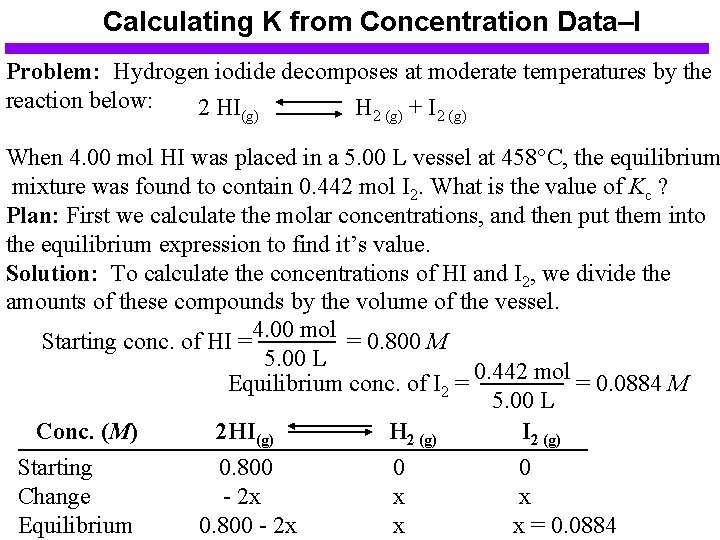
Calculating K from Concentration Data–I Problem: Hydrogen iodide decomposes at moderate temperatures by the reaction below: 2 HI H +I (g) 2 (g) When 4. 00 mol HI was placed in a 5. 00 L vessel at 458°C, the equilibrium mixture was found to contain 0. 442 mol I 2. What is the value of Kc ? Plan: First we calculate the molar concentrations, and then put them into the equilibrium expression to find it’s value. Solution: To calculate the concentrations of HI and I 2, we divide the amounts of these compounds by the volume of the vessel. Starting conc. of HI =4. 00 mol = 0. 800 M 5. 00 L Equilibrium conc. of I 2 = 0. 442 mol = 0. 0884 M 5. 00 L Conc. (M) 2 HI(g) H 2 (g) I 2 (g) Starting 0. 800 0 0 Change - 2 x x x Equilibrium 0. 800 - 2 x x x = 0. 0884
![Calculating K from Concentration Data–II [HI] = M = (0. 800 - 2 x](http://slidetodoc.com/presentation_image_h2/70aba5277fcfb5f9d191895797956b4f/image-39.jpg "Calculating K from Concentration Data–II [HI] = M = (0. 800 - 2 x")
Calculating K from Concentration Data–II [HI] = M = (0. 800 - 2 x 0. 0884) M = 0. 623 M [H 2] = x = 0. 0884 M = [I 2] Kc = [H 2] [I 2] [HI]2 = ( 0. 0884)(0. 0884) (0. 623)2 = ______ Therefore the equilibrium constant for the decomposition of Hydrogen Iodide at 458°C is only 0. 0201 meaning that the decomposition does not proceed very far under these temperature conditions. We were given the initial concentrations, and that of one at equilibrium, and found the others that were needed to calculate the equilibrium constant.
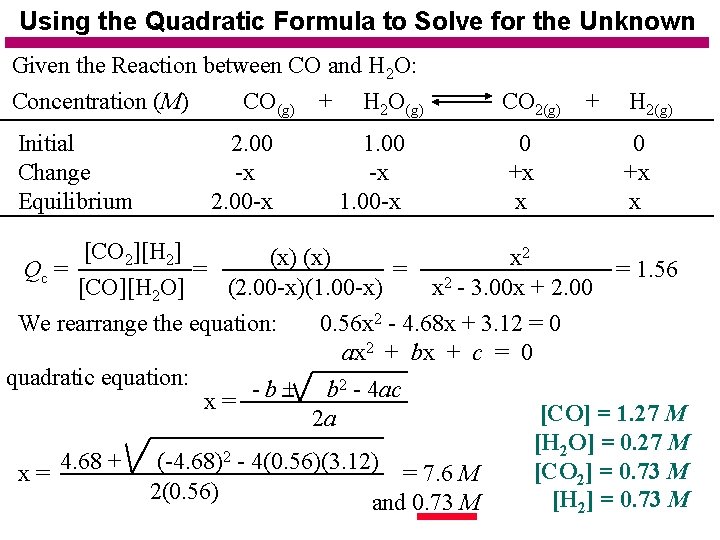
Using the Quadratic Formula to Solve for the Unknown Given the Reaction between CO and H 2 O: Concentration (M) CO(g) + H 2 O(g) CO 2(g) Initial Change Equilibrium 0 +x x 2. 00 -x 2. 00 -x 1. 00 -x + H 2(g) 0 +x x 2 [CO 2][H 2] (x) x Qc = = 1. 56 2 [CO][H 2 O] (2. 00 -x)(1. 00 -x) x - 3. 00 x + 2. 00 We rearrange the equation: 0. 56 x 2 - 4. 68 x + 3. 12 = 0 ax 2 + bx + c = 0 quadratic equation: 2 - 4 ac b + b x= [CO] = 1. 27 M 2 a [H 2 O] = 0. 27 M 2 (-4. 68) - 4(0. 56)(3. 12) = 7. 6 M [CO 2] = 0. 73 M x = 4. 68 + 2(0. 56) [H 2] = 0. 73 M and 0. 73 M
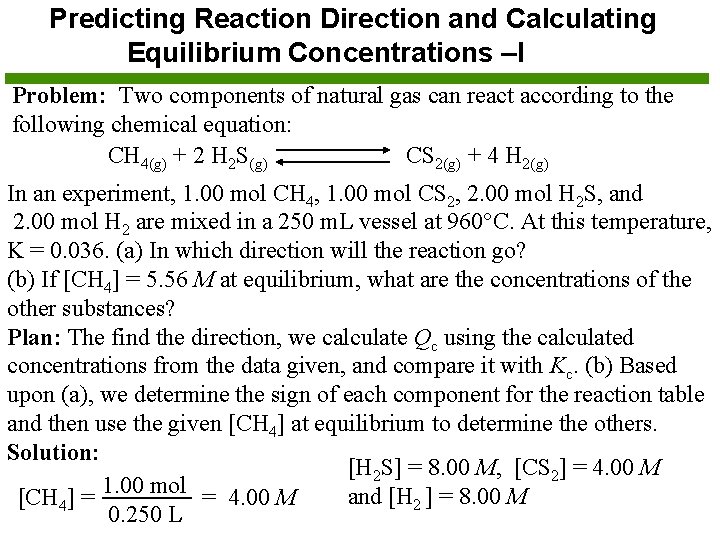
Predicting Reaction Direction and Calculating Equilibrium Concentrations –I Problem: Two components of natural gas can react according to the following chemical equation: CH 4(g) + 2 H 2 S(g) CS 2(g) + 4 H 2(g) In an experiment, 1. 00 mol CH 4, 1. 00 mol CS 2, 2. 00 mol H 2 S, and 2. 00 mol H 2 are mixed in a 250 m. L vessel at 960°C. At this temperature, K = 0. 036. (a) In which direction will the reaction go? (b) If [CH 4] = 5. 56 M at equilibrium, what are the concentrations of the other substances? Plan: The find the direction, we calculate Qc using the calculated concentrations from the data given, and compare it with Kc. (b) Based upon (a), we determine the sign of each component for the reaction table and then use the given [CH 4] at equilibrium to determine the others. Solution: [H 2 S] = 8. 00 M, [CS 2] = 4. 00 M and [H 2 ] = 8. 00 M [CH 4] = 1. 00 mol = 4. 00 M 0. 250 L
![Predicting Reaction Direction and Calculating Equilibrium Concentrations –II Q= [CS 2] [H 2]4 [CH](http://slidetodoc.com/presentation_image_h2/70aba5277fcfb5f9d191895797956b4f/image-42.jpg "Predicting Reaction Direction and Calculating Equilibrium Concentrations –II Q= [CS 2] [H 2]4 [CH")
Predicting Reaction Direction and Calculating Equilibrium Concentrations –II Q= [CS 2] [H 2]4 [CH 4] [H 2 S]2 = 4. 00 x (8. 00)4 = 64. 00 x (8. 00)2 Comparing Q and K: Q > K (64. 0 > 0. 036, so the reaction goes to the left. Therefore, reactants increase and products decrease their concentrations. (b) Setting up the reaction table, with x = [CS 2] that reacts, which equals the [CH 4] that forms. Concentration (M) CH 4 (g) + 2 H 2 S(g) CS 2(g) + 4 H 2(g) Initial Change Equilibrium 4. 00 +x 4. 00 + x Solving for x at equilibrium: 8. 00 +2 x 8. 00 + 2 x 4. 00 - x [CH 4] = 5. 56 M = 4. 00 M + x x = ______ M 8. 00 - 4 x 8. 00 -4 x
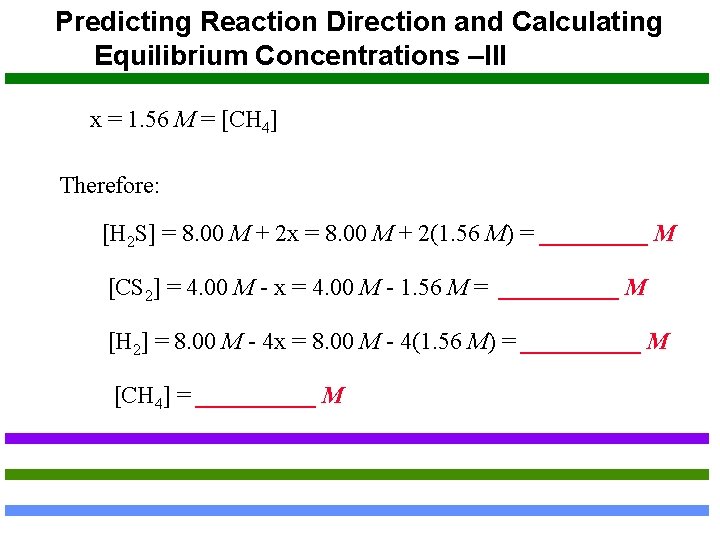
Predicting Reaction Direction and Calculating Equilibrium Concentrations –III x = 1. 56 M = [CH 4] Therefore: [H 2 S] = 8. 00 M + 2 x = 8. 00 M + 2(1. 56 M) = _____ M [CS 2] = 4. 00 M - x = 4. 00 M - 1. 56 M = _____ M [H 2] = 8. 00 M - 4 x = 8. 00 M - 4(1. 56 M) = _____ M [CH 4] = _____ M
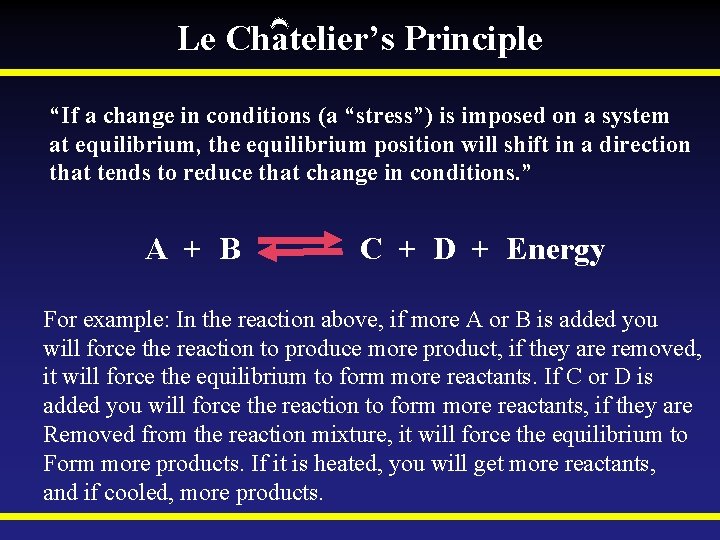
Le Chatelier’s Principle “If a change in conditions (a “stress”) is imposed on a system at equilibrium, the equilibrium position will shift in a direction that tends to reduce that change in conditions. ” A + B C + D + Energy For example: In the reaction above, if more A or B is added you will force the reaction to produce more product, if they are removed, it will force the equilibrium to form more reactants. If C or D is added you will force the reaction to form more reactants, if they are Removed from the reaction mixture, it will force the equilibrium to Form more products. If it is heated, you will get more reactants, and if cooled, more products.
Henri Louis Le Chatelier Source: Photo Researchers
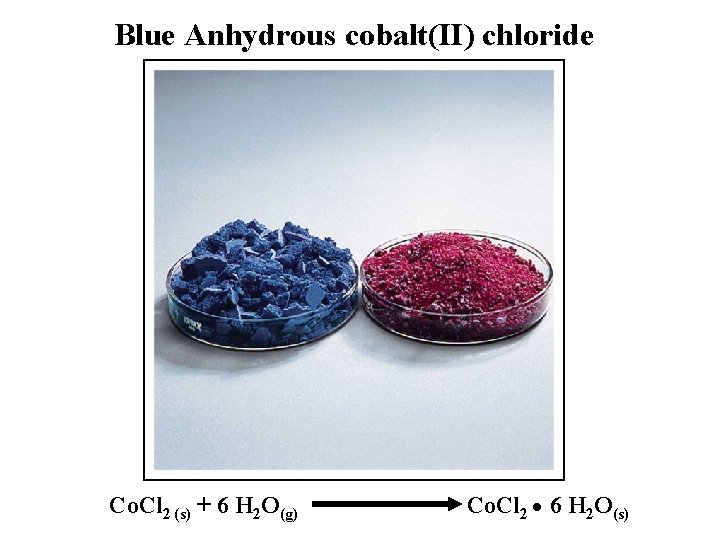
Blue Anhydrous cobalt(II) chloride Co. Cl 2 (s) + 6 H 2 O(g) Co. Cl 2 6 H 2 O(s)
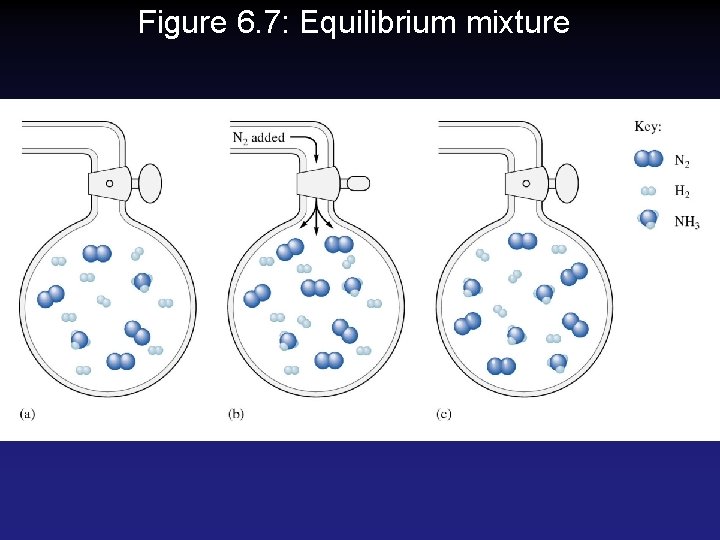
Figure 6. 7: Equilibrium mixture
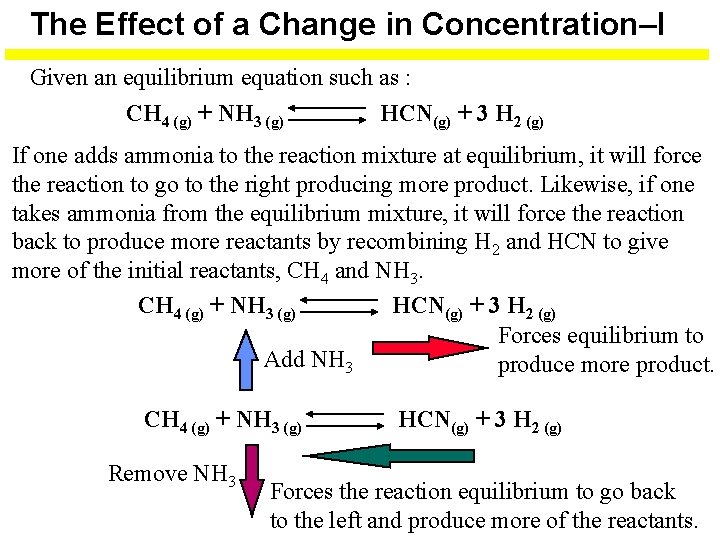
The Effect of a Change in Concentration–I Given an equilibrium equation such as : CH 4 (g) + NH 3 (g) HCN(g) + 3 H 2 (g) If one adds ammonia to the reaction mixture at equilibrium, it will force the reaction to go to the right producing more product. Likewise, if one takes ammonia from the equilibrium mixture, it will force the reaction back to produce more reactants by recombining H 2 and HCN to give more of the initial reactants, CH 4 and NH 3. CH 4 (g) + NH 3 (g) HCN(g) + 3 H 2 (g) Forces equilibrium to Add NH 3 produce more product. CH 4 (g) + NH 3 (g) Remove NH 3 HCN(g) + 3 H 2 (g) Forces the reaction equilibrium to go back to the left and produce more of the reactants.
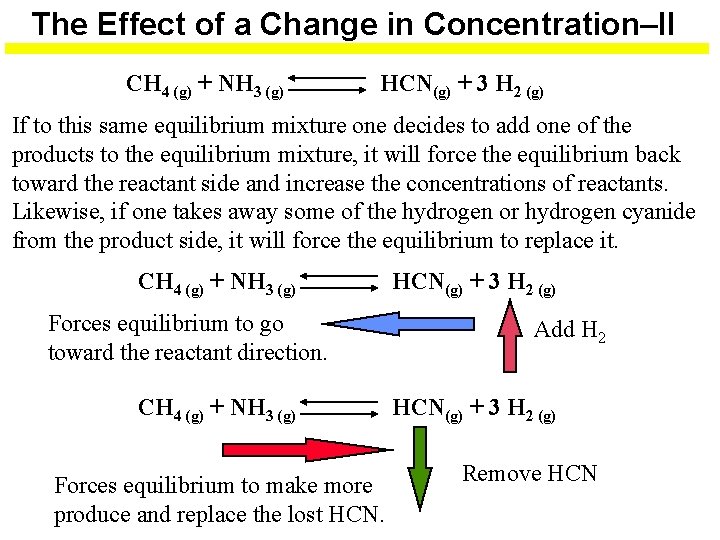
The Effect of a Change in Concentration–II CH 4 (g) + NH 3 (g) HCN(g) + 3 H 2 (g) If to this same equilibrium mixture one decides to add one of the products to the equilibrium mixture, it will force the equilibrium back toward the reactant side and increase the concentrations of reactants. Likewise, if one takes away some of the hydrogen or hydrogen cyanide from the product side, it will force the equilibrium to replace it. CH 4 (g) + NH 3 (g) Forces equilibrium to go toward the reactant direction. CH 4 (g) + NH 3 (g) Forces equilibrium to make more produce and replace the lost HCN(g) + 3 H 2 (g) Add H 2 HCN(g) + 3 H 2 (g) Remove HCN
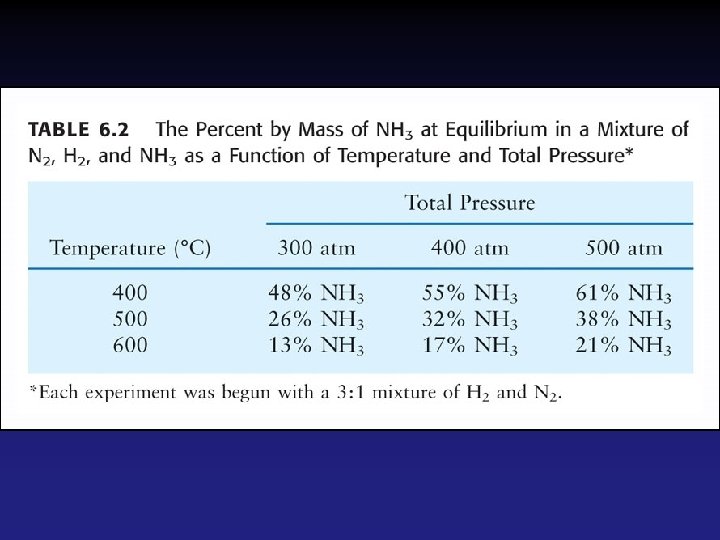
The Effect of a Change in Pressure (Volume) Pressure changes are mainly involving gases as liquids and solids are nearly incompressible. For gases, pressure changes can occur in three ways: Changing the concentration of a gaseous component Adding an inert gas (one that does not take part in the reaction) Changing the volume of the reaction vessel When a system at equilibrium that contains a gas undergoes a change in pressure as a result of a change in volume, the equilibrium position shifts to reduce the effect of the change. If the volume is lower (pressure is higher), the total number of gas molecules decrease. If the volume is higher (pressure is lower), the total number of gas molecules increases.
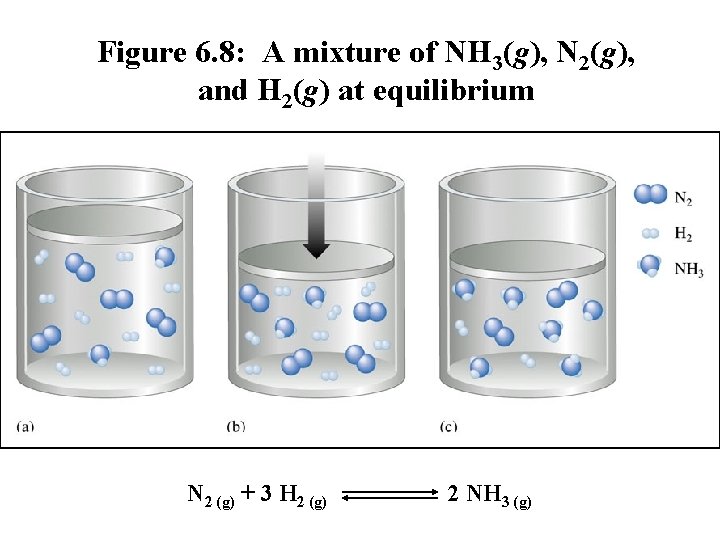
Figure 6. 8: A mixture of NH 3(g), N 2(g), and H 2(g) at equilibrium N 2 (g) + 3 H 2 (g) 2 NH 3 (g)
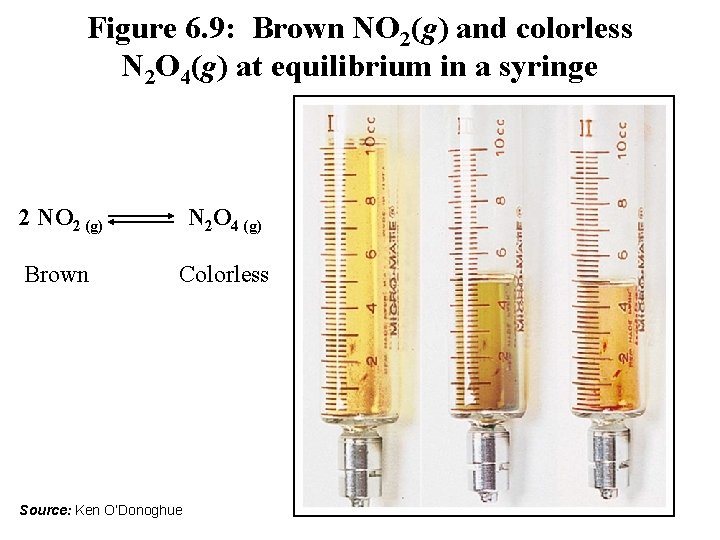
Figure 6. 9: Brown NO 2(g) and colorless N 2 O 4(g) at equilibrium in a syringe 2 NO 2 (g) N 2 O 4 (g) Brown Colorless Source: Ken O’Donoghue
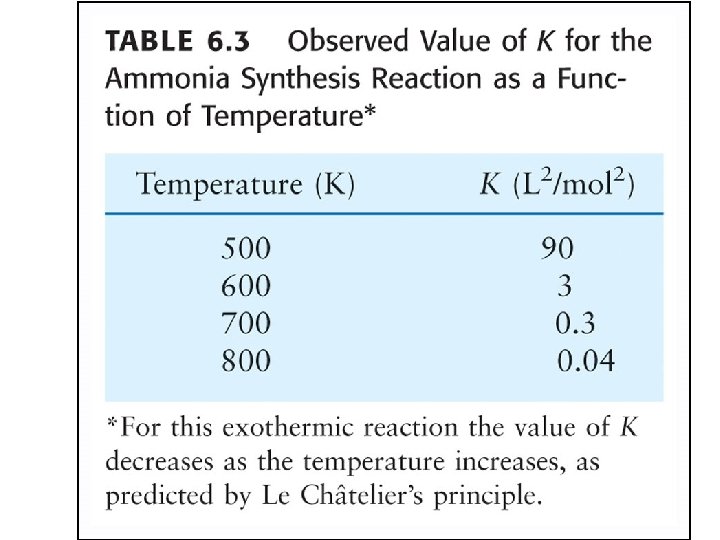
The Effect of a Change in Temperature Only temperature changes will alter the equilibrium constant, and that is why we always specify the temperature when giving the value of Kc. The best way to look at temperature effects is to realize that temperature is a component of the equation, the same as a reactant, or product. For example, if you have an exothermic reaction, heat (energy) is on the product side of the equation, but if it is an endothermic reaction, it will be on the reactant side of the equation. O 2 (g) + 2 H 2 (g) 2 H 2 O(g) + Energy = Exothermic Electrical energy + 2 H 2 O(g) 2 H 2 (g) + O 2 (g) = Endothermic A temperature increase favors the endothermic direction and a temperature decrease favors the exothermic direction. A temperature rise will increase Kc for a system with a positive H 0 rxn A temperature rise will decrease Kc for a system with a negative H 0 rxn
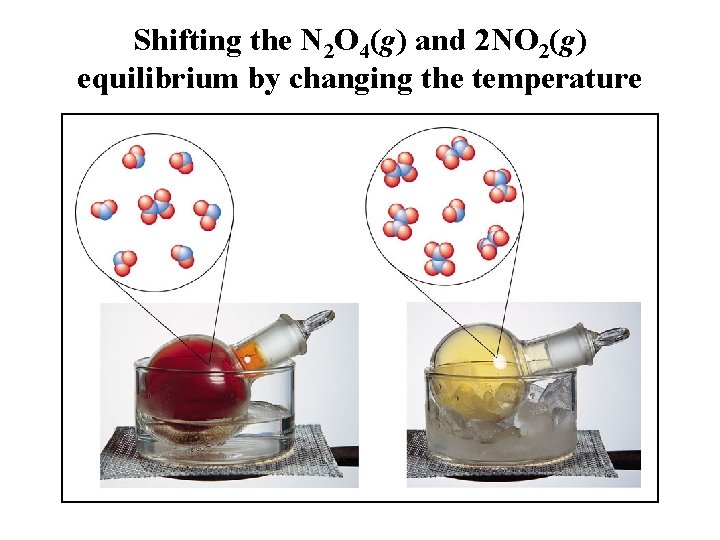
Shifting the N 2 O 4(g) and 2 NO 2(g) equilibrium by changing the temperature
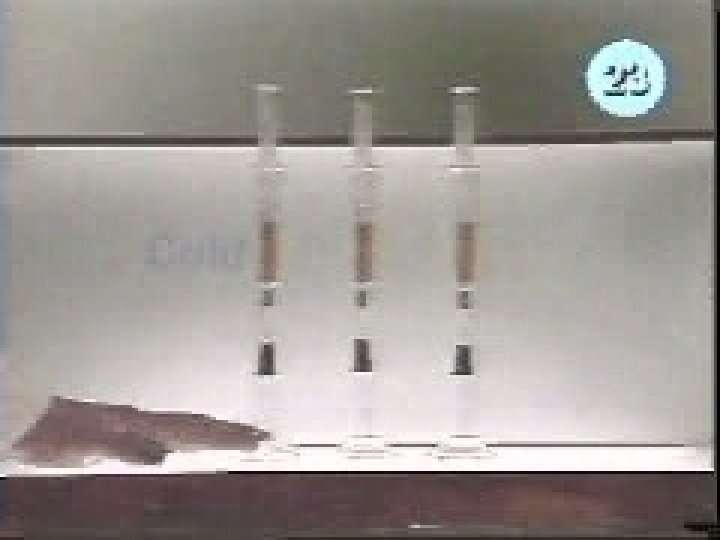
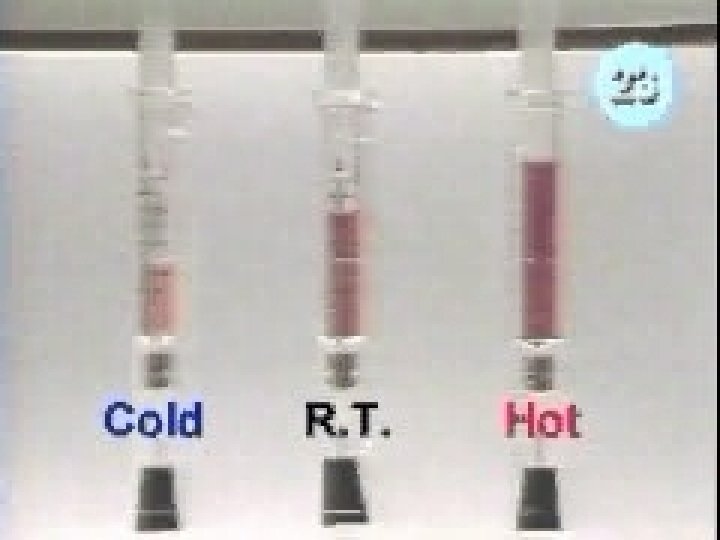
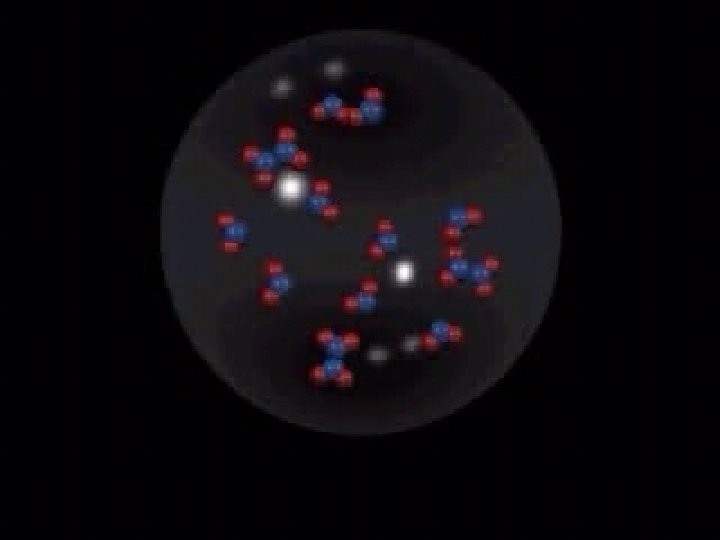
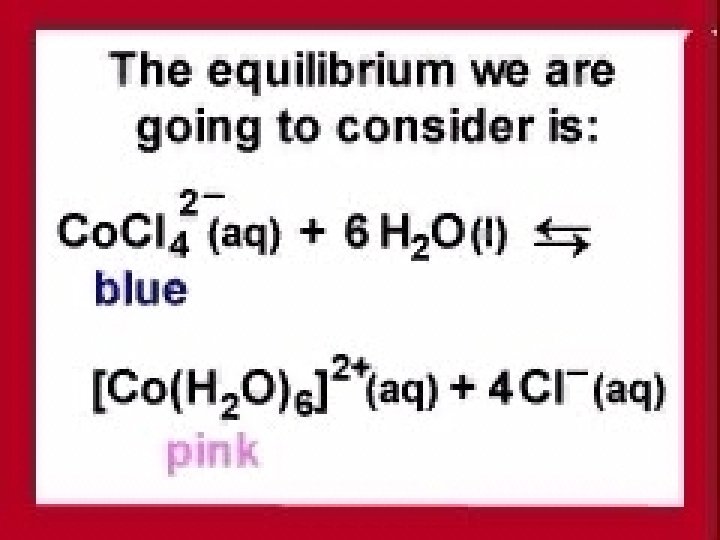
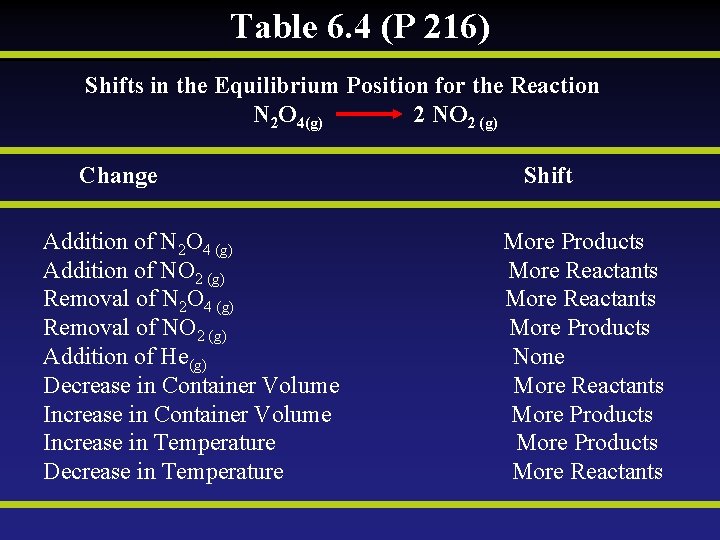
Table 6. 4 (P 216) Shifts in the Equilibrium Position for the Reaction N 2 O 4(g) 2 NO 2 (g) Change Addition of N 2 O 4 (g) Addition of NO 2 (g) Removal of N 2 O 4 (g) Removal of NO 2 (g) Addition of He(g) Decrease in Container Volume Increase in Temperature Decrease in Temperature Shift More Products More Reactants More Products None More Reactants More Products More Reactants
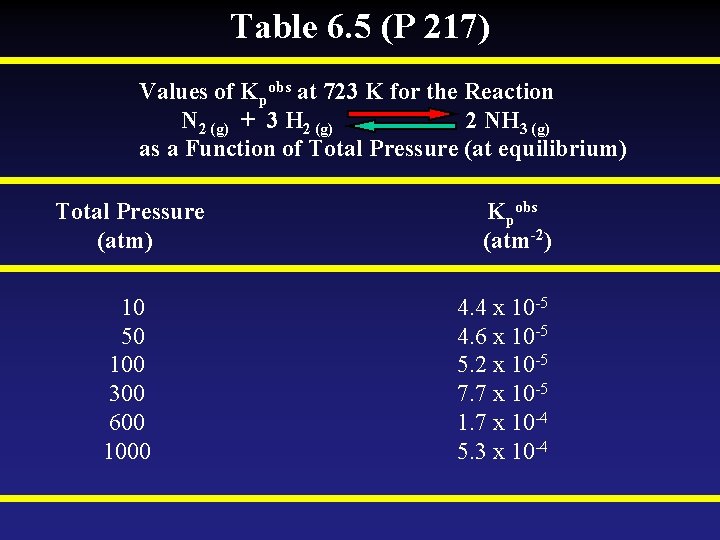
Table 6. 5 (P 217) Values of Kpobs at 723 K for the Reaction N 2 (g) + 3 H 2 (g) 2 NH 3 (g) as a Function of Total Pressure (at equilibrium) Total Pressure (atm) 10 50 100 300 600 1000 Kpobs (atm-2) 4. 4 x 10 -5 4. 6 x 10 -5 5. 2 x 10 -5 7. 7 x 10 -5 1. 7 x 10 -4 5. 3 x 10 -4
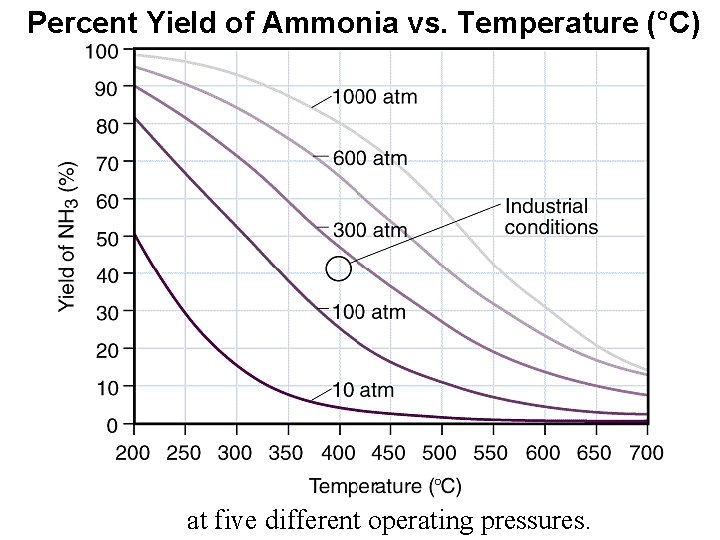
Percent Yield of Ammonia vs. Temperature (°C) at five different operating pressures.
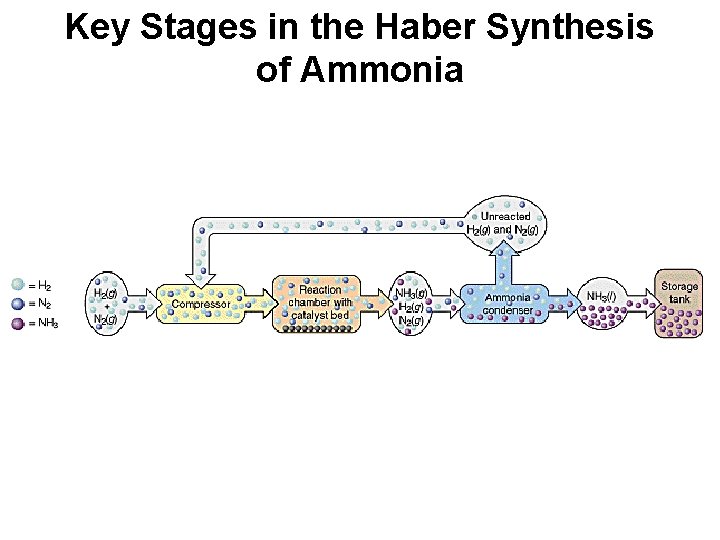
Key Stages in the Haber Synthesis of Ammonia
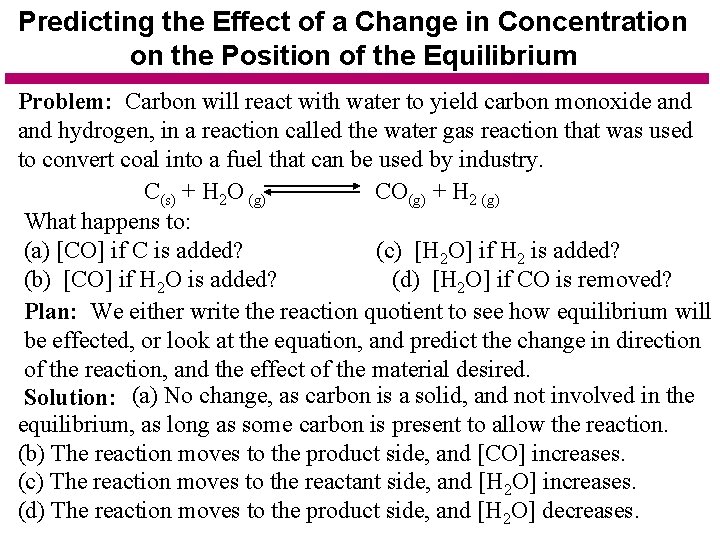
Predicting the Effect of a Change in Concentration on the Position of the Equilibrium Problem: Carbon will react with water to yield carbon monoxide and hydrogen, in a reaction called the water gas reaction that was used to convert coal into a fuel that can be used by industry. C(s) + H 2 O (g) CO(g) + H 2 (g) What happens to: (a) [CO] if C is added? (c) [H 2 O] if H 2 is added? (b) [CO] if H 2 O is added? (d) [H 2 O] if CO is removed? Plan: We either write the reaction quotient to see how equilibrium will be effected, or look at the equation, and predict the change in direction of the reaction, and the effect of the material desired. Solution: (a) No change, as carbon is a solid, and not involved in the equilibrium, as long as some carbon is present to allow the reaction. (b) The reaction moves to the product side, and [CO] increases. (c) The reaction moves to the reactant side, and [H 2 O] increases. (d) The reaction moves to the product side, and [H 2 O] decreases.
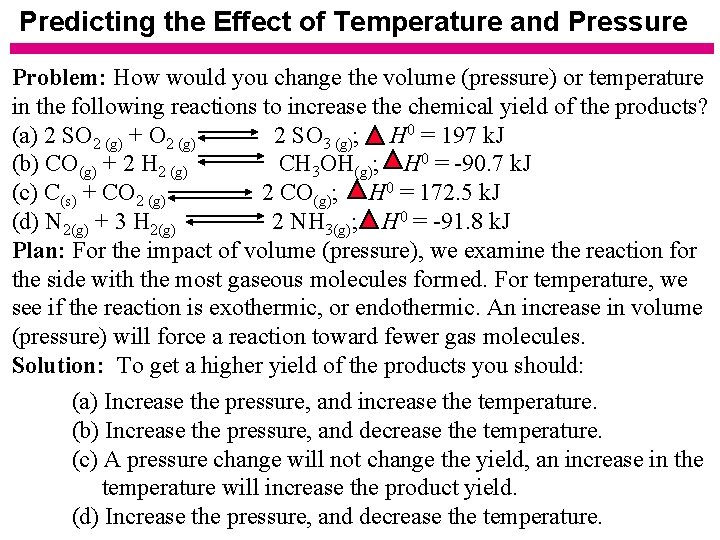
Predicting the Effect of Temperature and Pressure Problem: How would you change the volume (pressure) or temperature in the following reactions to increase the chemical yield of the products? (a) 2 SO 2 (g) + O 2 (g) 2 SO 3 (g); H 0 = 197 k. J (b) CO(g) + 2 H 2 (g) CH 3 OH(g); H 0 = -90. 7 k. J (c) C(s) + CO 2 (g) 2 CO(g); H 0 = 172. 5 k. J (d) N 2(g) + 3 H 2(g) 2 NH 3(g); H 0 = -91. 8 k. J Plan: For the impact of volume (pressure), we examine the reaction for the side with the most gaseous molecules formed. For temperature, we see if the reaction is exothermic, or endothermic. An increase in volume (pressure) will force a reaction toward fewer gas molecules. Solution: To get a higher yield of the products you should: (a) Increase the pressure, and increase the temperature. (b) Increase the pressure, and decrease the temperature. (c) A pressure change will not change the yield, an increase in the temperature will increase the product yield. (d) Increase the pressure, and decrease the temperature.
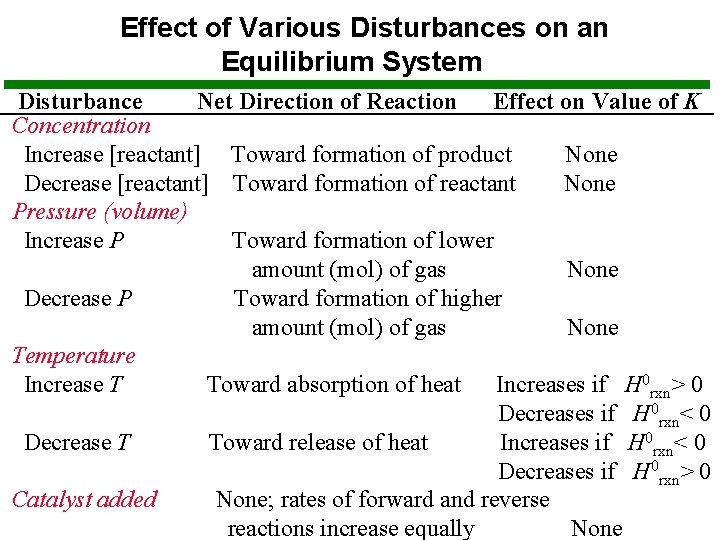
Effect of Various Disturbances on an Equilibrium System Disturbance Net Direction of Reaction Effect on Value of K Concentration Increase [reactant] Toward formation of product None Decrease [reactant] Toward formation of reactant None Pressure (volume) Increase P Toward formation of lower amount (mol) of gas None Decrease P Toward formation of higher amount (mol) of gas None Temperature Increase T Toward absorption of heat Increases if H 0 rxn> 0 Decreases if H 0 rxn< 0 Decrease T Toward release of heat Increases if H 0 rxn< 0 Decreases if H 0 rxn> 0 Catalyst added None; rates of forward and reverse reactions increase equally None
- Slides: 70