
Chapter 6 Chemical Bonding Batrachotoxin A steroid alkaloid
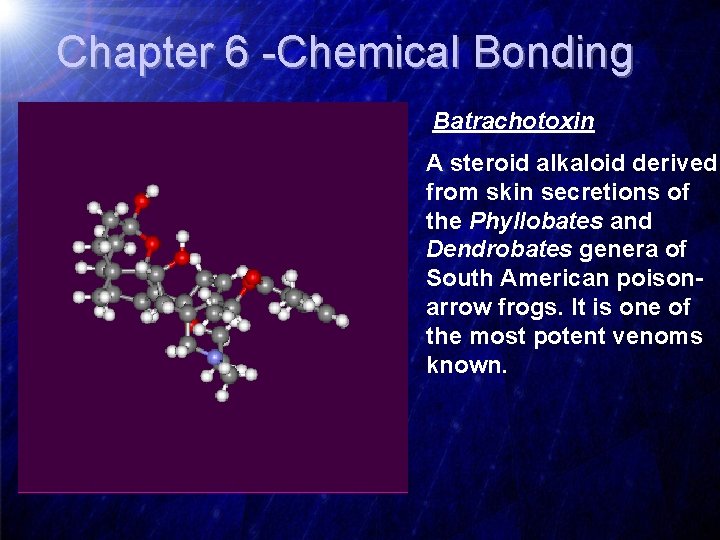
Chapter 6 -Chemical Bonding Batrachotoxin A steroid alkaloid derived from skin secretions of the Phyllobates and Dendrobates genera of South American poisonarrow frogs. It is one of the most potent venoms known.
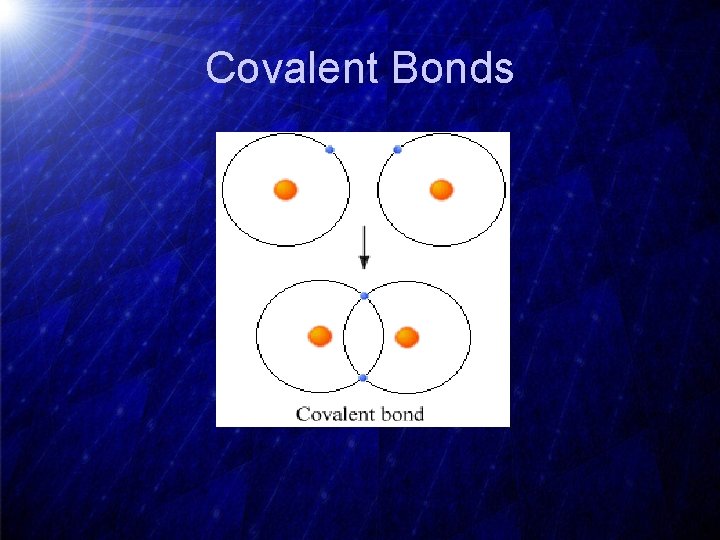
Bonds q Forces that hold groups of atoms together and make them function as a unit. v Ionic bonds– transfer of electrons v. Covalent bonds– sharing of electrons v. Polar Covalent bonds – unequal sharing of electrons that results in an unbalanced distribution of charge
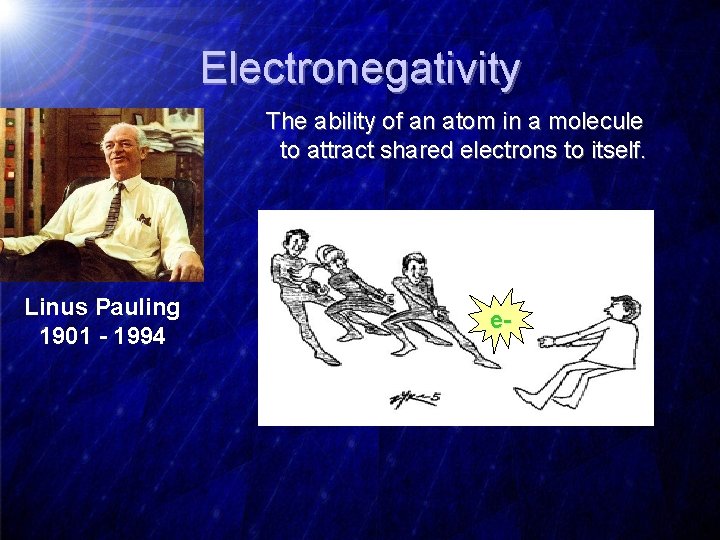
Electronegativity The ability of an atom in a molecule to attract shared electrons to itself. Linus Pauling 1901 - 1994 e-
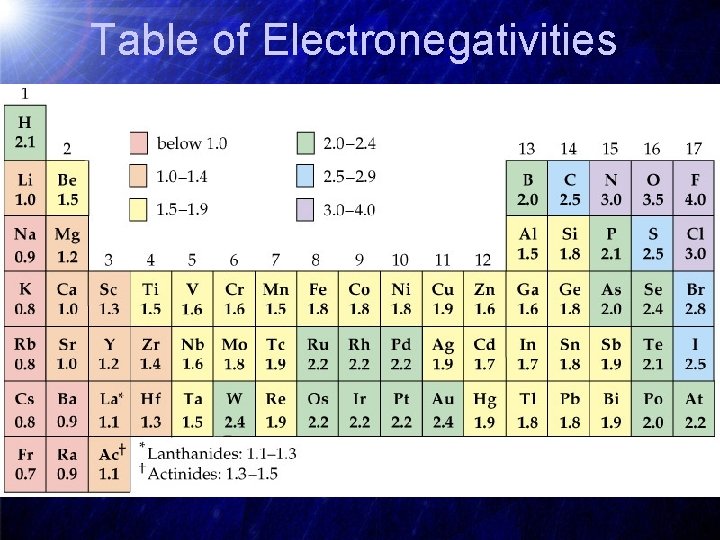
Table of Electronegativities
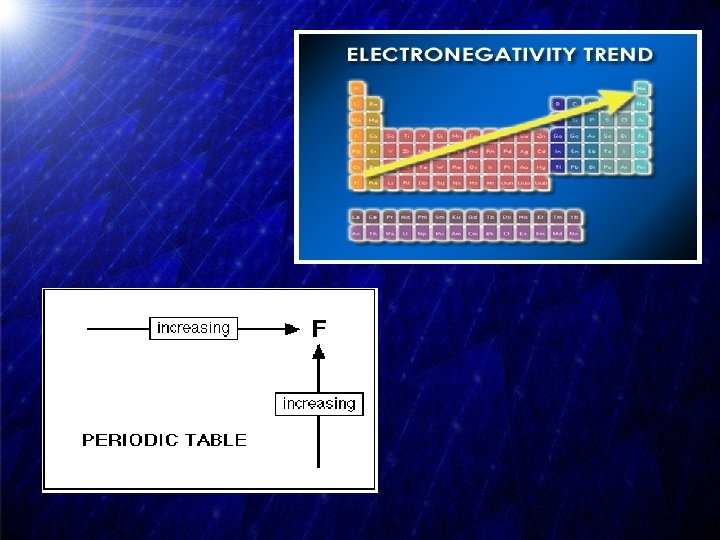
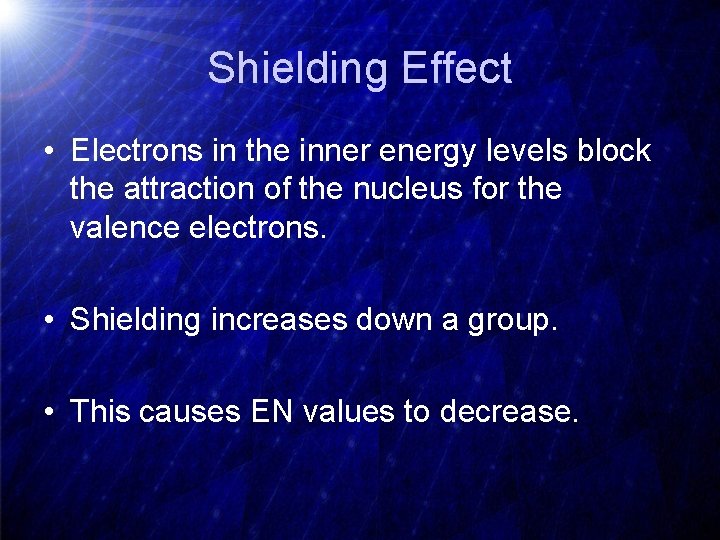
Shielding Effect • Electrons in the inner energy levels block the attraction of the nucleus for the valence electrons. • Shielding increases down a group. • This causes EN values to decrease.
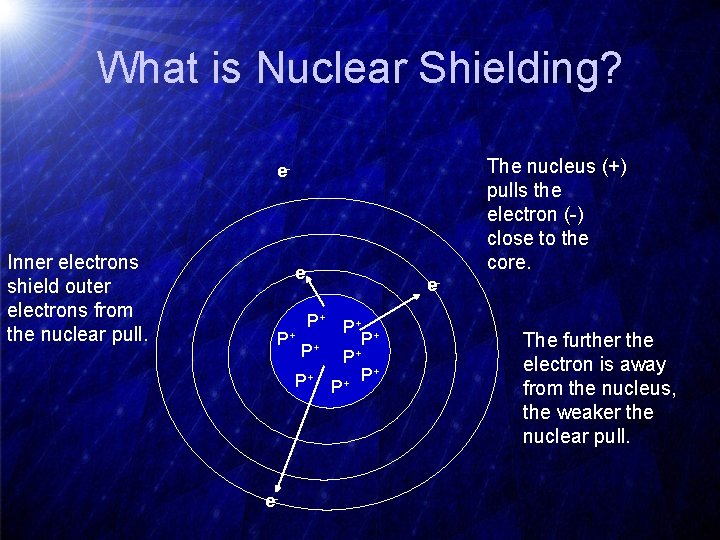
What is Nuclear Shielding? The nucleus (+) pulls the electron (-) close to the core. e- Inner electrons shield outer electrons from the nuclear pull. e. P+ P+ P+ P P+ + P+ P+ P e- e- The further the electron is away from the nucleus, the weaker the nuclear pull.
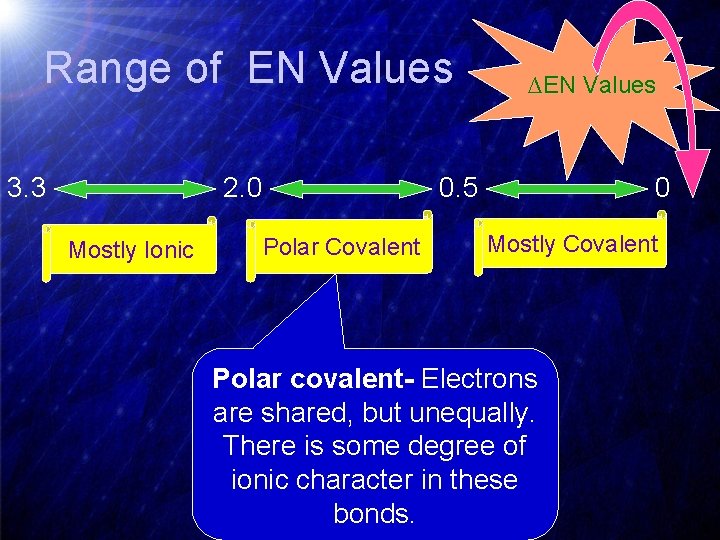
Range of EN Values 3. 3 2. 0 Mostly Ionic ∆EN Values 0. 5 Polar Covalent 0 Mostly Covalent Polar covalent- Electrons are shared, but unequally. There is some degree of ionic character in these bonds.
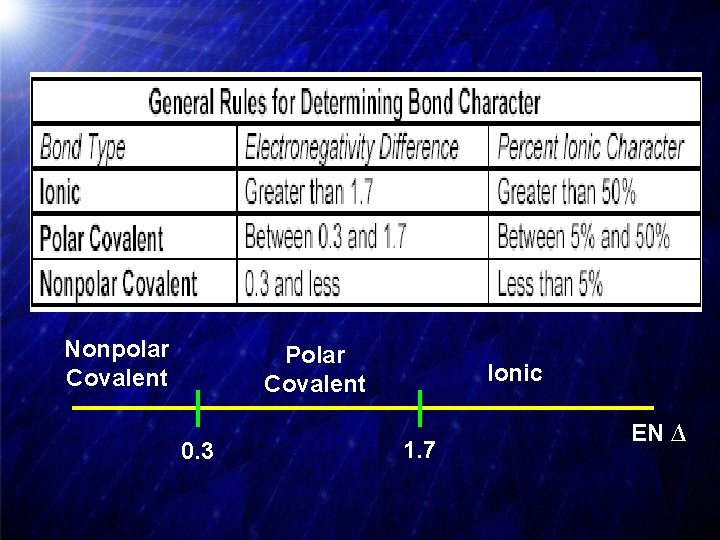
Nonpolar Covalent Polar Covalent 0. 3 Ionic 1. 7 EN ∆
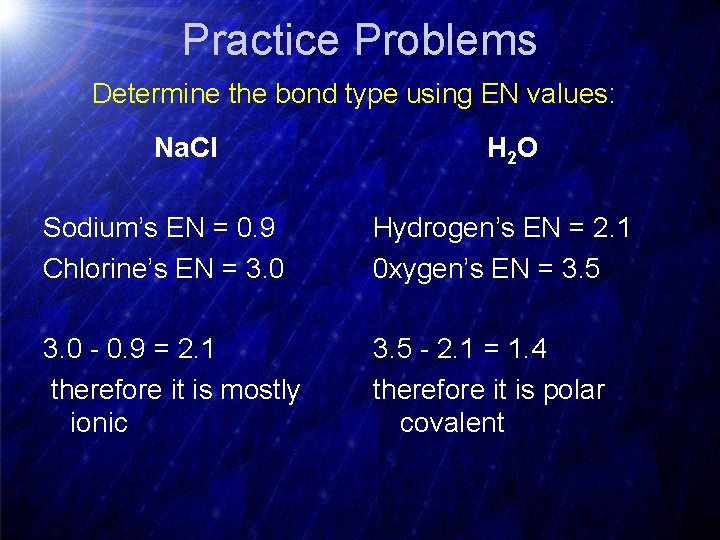
Practice Problems Determine the bond type using EN values: Na. Cl H 2 O Sodium’s EN = 0. 9 Chlorine’s EN = 3. 0 Hydrogen’s EN = 2. 1 0 xygen’s EN = 3. 5 3. 0 - 0. 9 = 2. 1 therefore it is mostly ionic 3. 5 - 2. 1 = 1. 4 therefore it is polar covalent
Chapter 6 Chemical Bonding 6. 2 Covalent Bonds
Covalent Bonds
Covalent Terms • Molecule: A neutral group of atoms that are held together by covalent bonds • Diatomic Molecule: A molecule containing only two atoms Example: Br. INCl. HOF • Molecular Compound: A chemical compound whose simplest units are molecules • Chemical Formula: Indicates the relative numbers of atoms of each kind of a chemical compound by using atomic symbols and numerical subscripts • Molecular Formula: Shows the types and numbers of atoms combined in a single molecule of a molecular compound
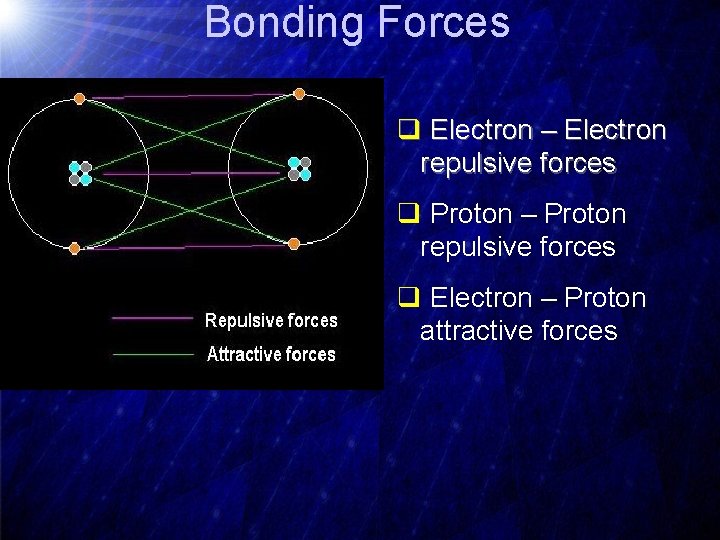
Bonding Forces q Electron – Electron repulsive forces q Proton – Proton repulsive forces q Electron – Proton attractive forces
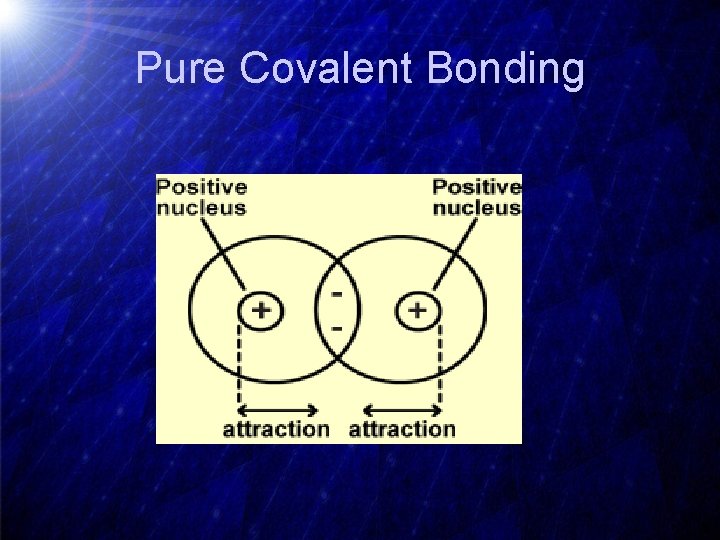
Pure Covalent Bonding
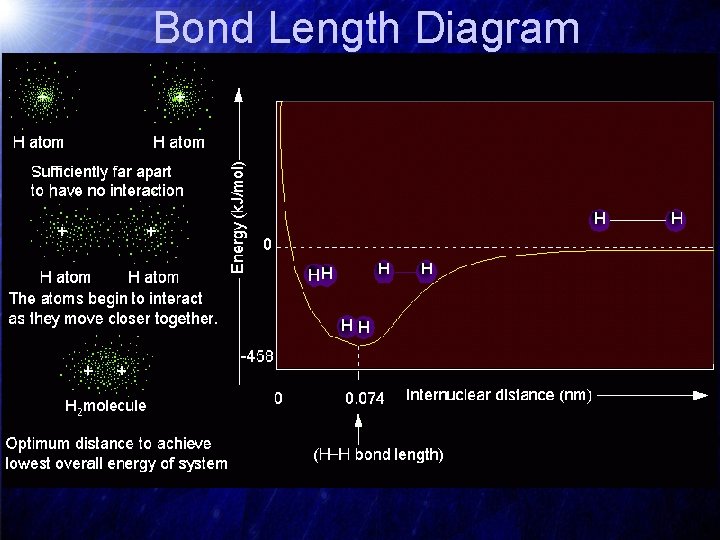
Bond Length Diagram
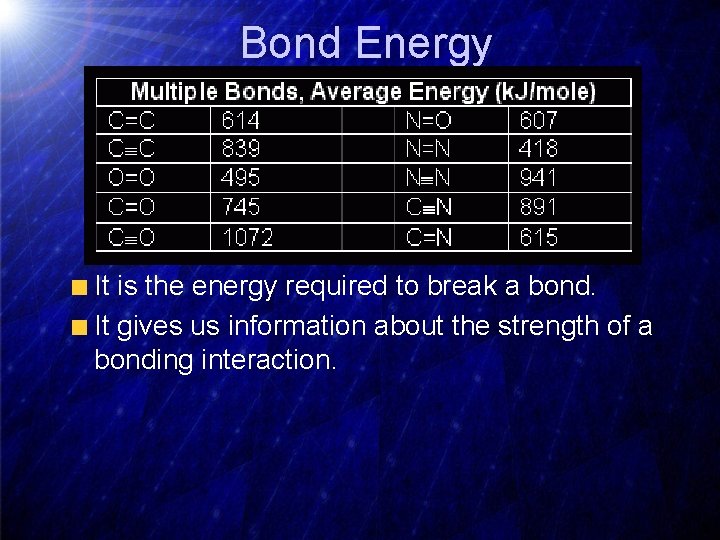
Bond Energy It is the energy required to break a bond. It gives us information about the strength of a bonding interaction.
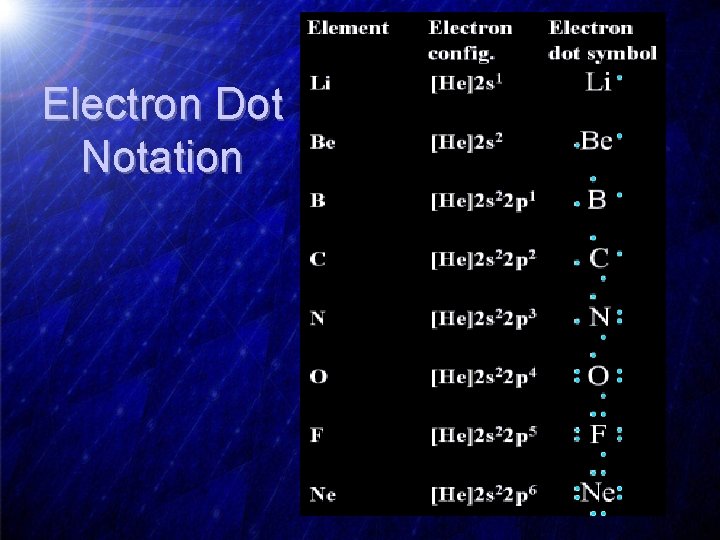
Electron Dot Notation
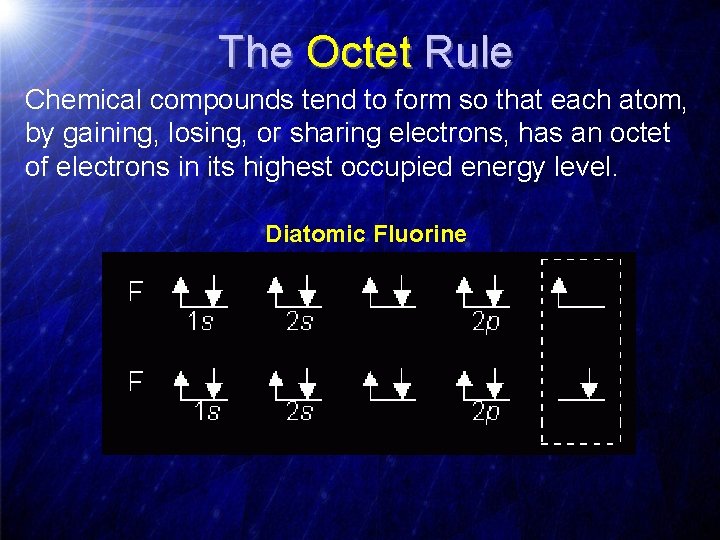
The Octet Rule Chemical compounds tend to form so that each atom, by gaining, losing, or sharing electrons, has an octet of electrons in its highest occupied energy level. Diatomic Fluorine
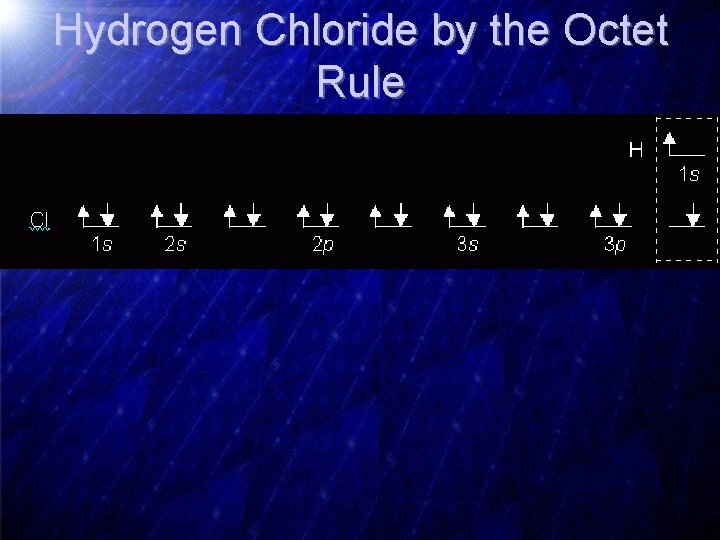
Hydrogen Chloride by the Octet Rule
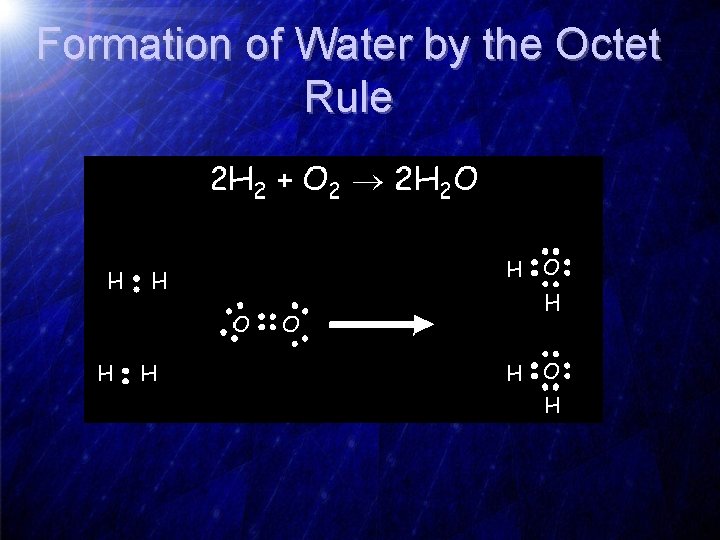
Formation of Water by the Octet Rule
Comments About the Octet Rule 2 nd row elements C, N, O, F observe the octet rule. 2 nd row elements B and Be often have fewer than 8 electrons around themselves - they are very reactive. 3 rd row and heavier elements CAN exceed the octet rule using empty valence d orbitals. When writing Lewis structures, satisfy octets first, then place electrons around elements having available d orbitals.
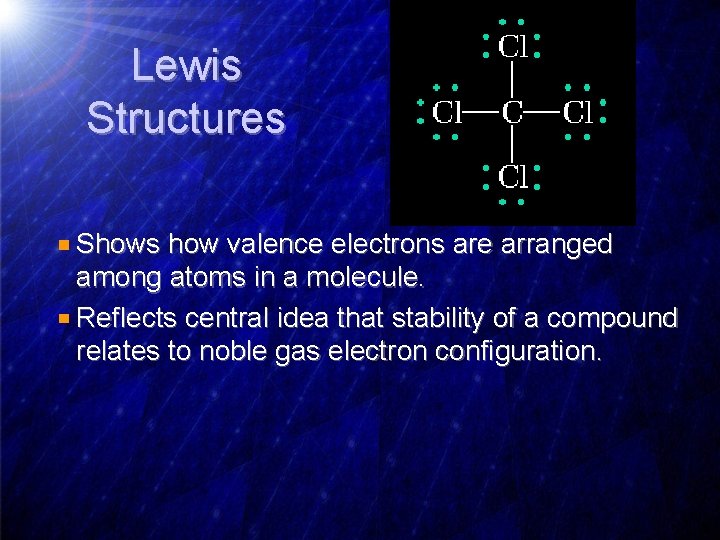
Lewis Structures Shows how valence electrons are arranged among atoms in a molecule. Reflects central idea that stability of a compound relates to noble gas electron configuration.
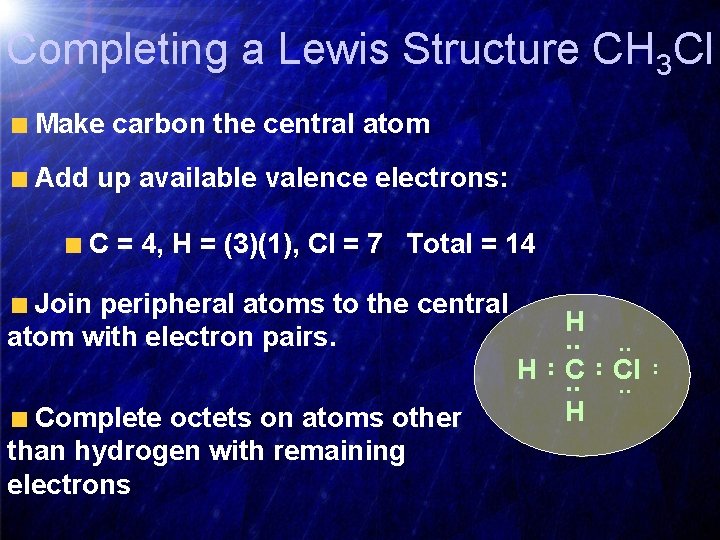
Completing a Lewis Structure CH 3 Cl Make carbon the central atom Add up available valence electrons: C = 4, H = (3)(1), Cl = 7 Total = 14 Complete octets on atoms other than hydrogen with remaining electrons . . H. . H C. . Cl. . H. . Join peripheral atoms to the central atom with electron pairs.
How to Make a Lewis Dot Structure for a Molecule • Draw the Lewis Dot Diagram for each element • Place the atom with the lowest EN value in the center • Attach the rest of the atoms to the central • If lone electrons exist on adjacent atoms, pair them for multiple bonds.
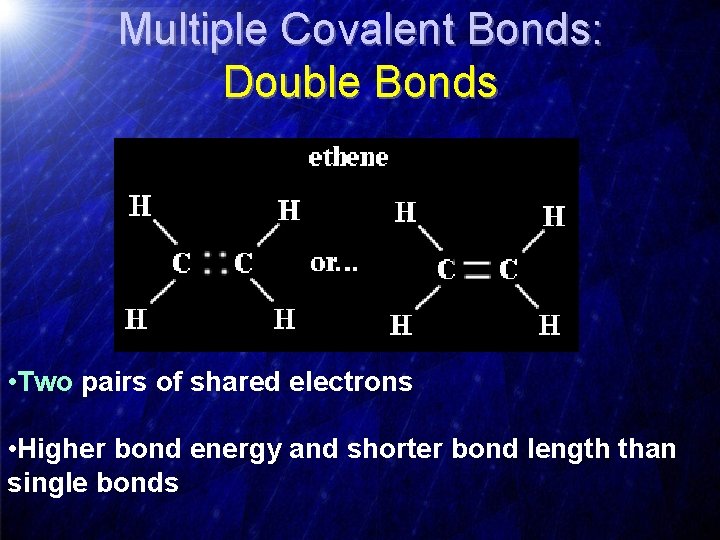
Multiple Covalent Bonds: Double Bonds • Two pairs of shared electrons • Higher bond energy and shorter bond length than single bonds
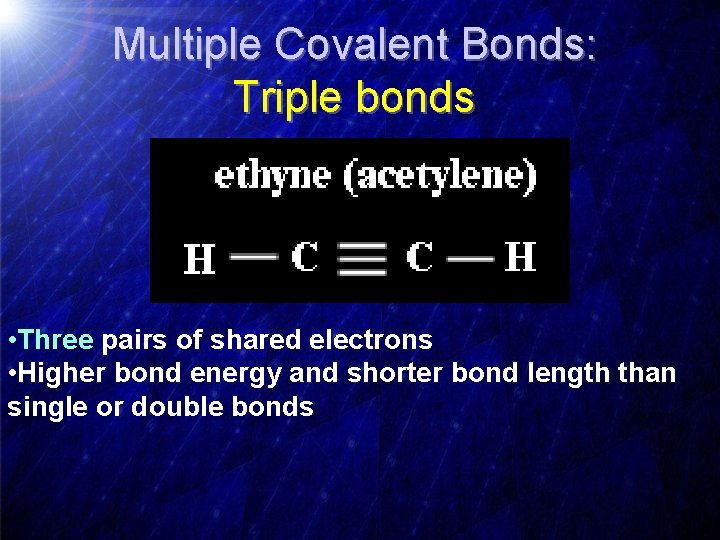
Multiple Covalent Bonds: Triple bonds • Three pairs of shared electrons • Higher bond energy and shorter bond length than single or double bonds
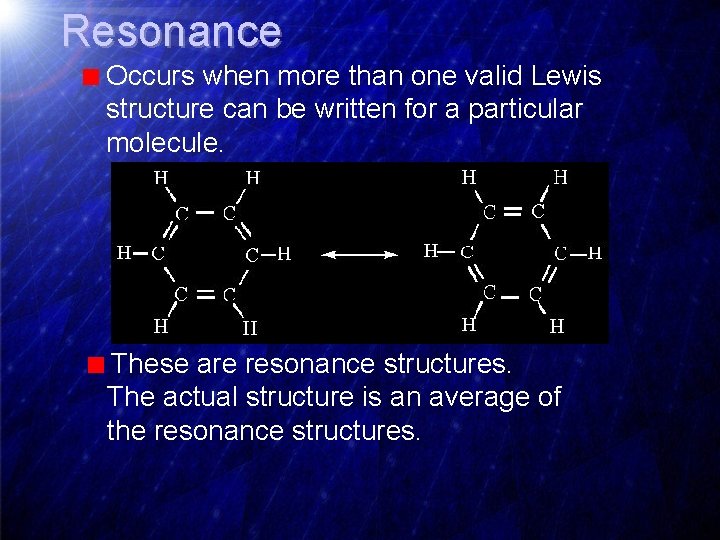
Resonance Occurs when more than one valid Lewis structure can be written for a particular molecule. These are resonance structures. The actual structure is an average of the resonance structures.
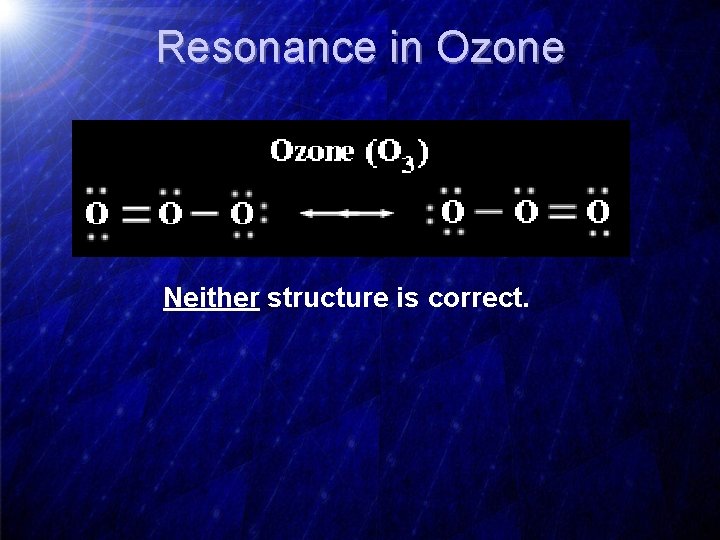
Resonance in Ozone Neither structure is correct.
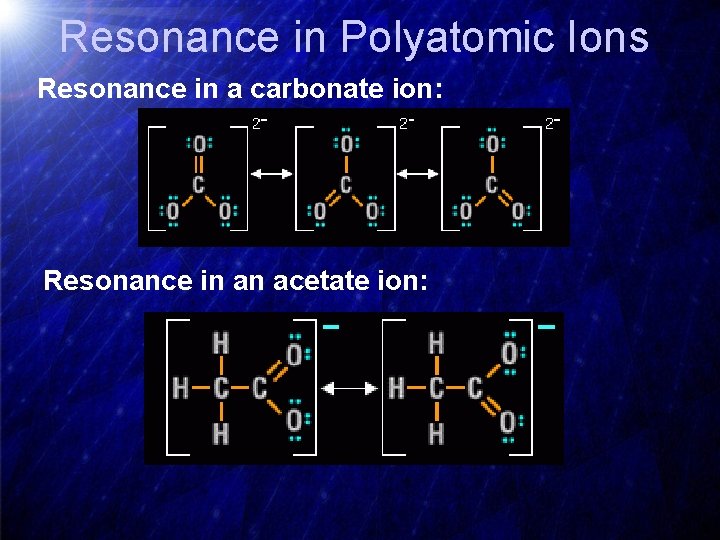
Resonance in Polyatomic Ions Resonance in a carbonate ion: Resonance in an acetate ion:
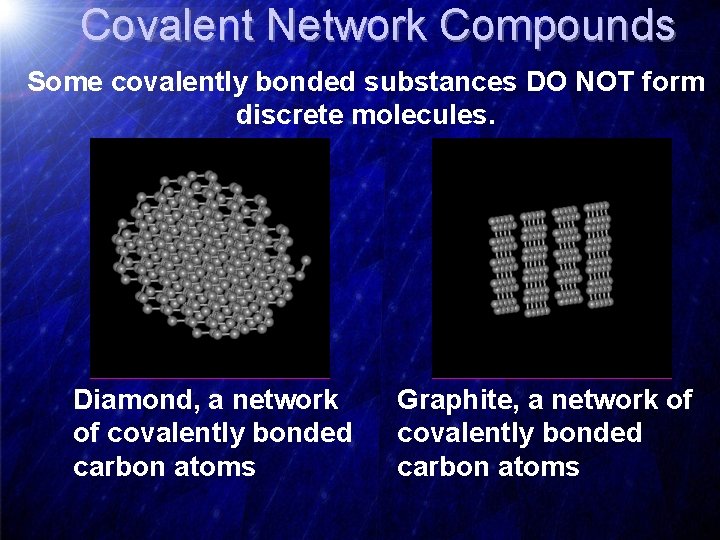
Covalent Network Compounds Some covalently bonded substances DO NOT form discrete molecules. Diamond, a network of covalently bonded carbon atoms Graphite, a network of covalently bonded carbon atoms
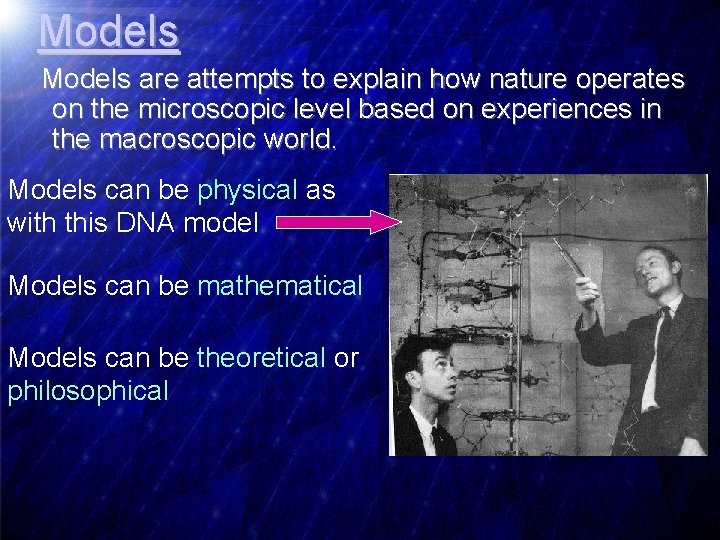
Models are attempts to explain how nature operates on the microscopic level based on experiences in the macroscopic world. Models can be physical as with this DNA model Models can be mathematical Models can be theoretical or philosophical
Fundamental Properties of Models A model does not equal reality. Models are oversimplifications, and are therefore often wrong. Models become more complicated as they age. We must understand the underlying assumptions in a model so that we don’t misuse them.
Chapter 6 Chemical Bonding 6. 3 Ionic Bonding
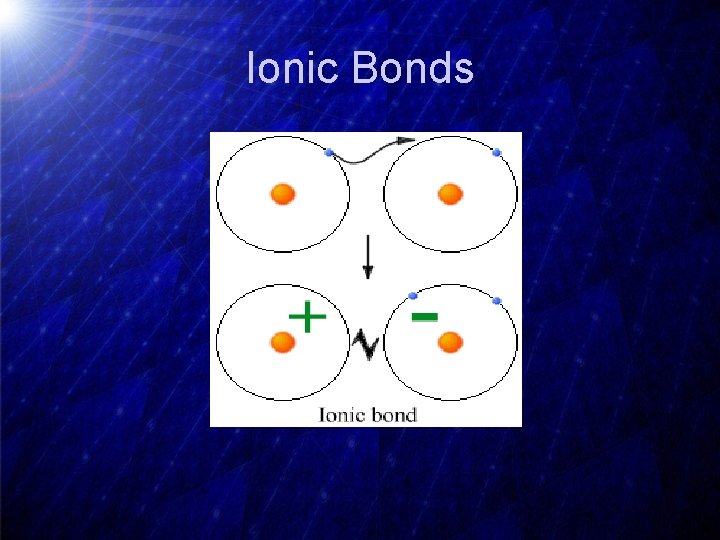
Ionic Bonds
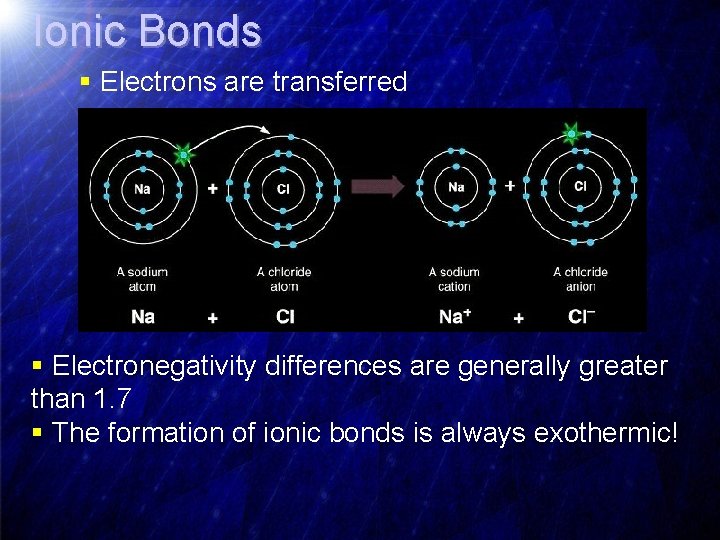
Ionic Bonds § Electrons are transferred § Electronegativity differences are generally greater than 1. 7 § The formation of ionic bonds is always exothermic!
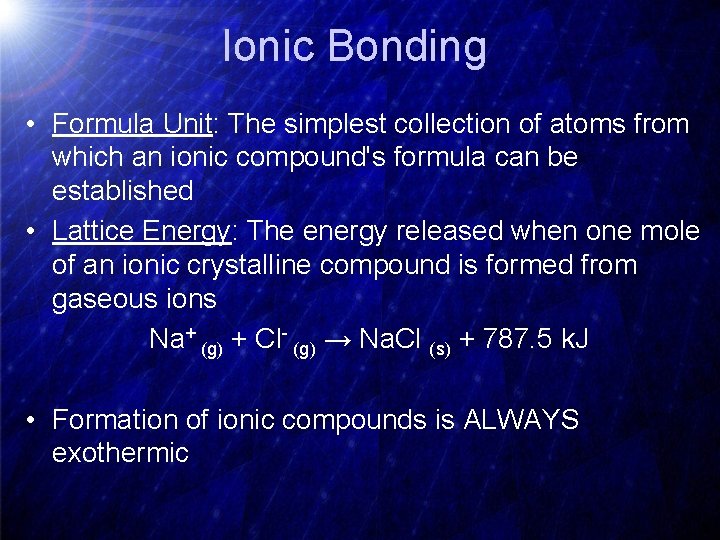
Ionic Bonding • Formula Unit: The simplest collection of atoms from which an ionic compound's formula can be established • Lattice Energy: The energy released when one mole of an ionic crystalline compound is formed from gaseous ions Na+ (g) + Cl- (g) → Na. Cl (s) + 787. 5 k. J • Formation of ionic compounds is ALWAYS exothermic
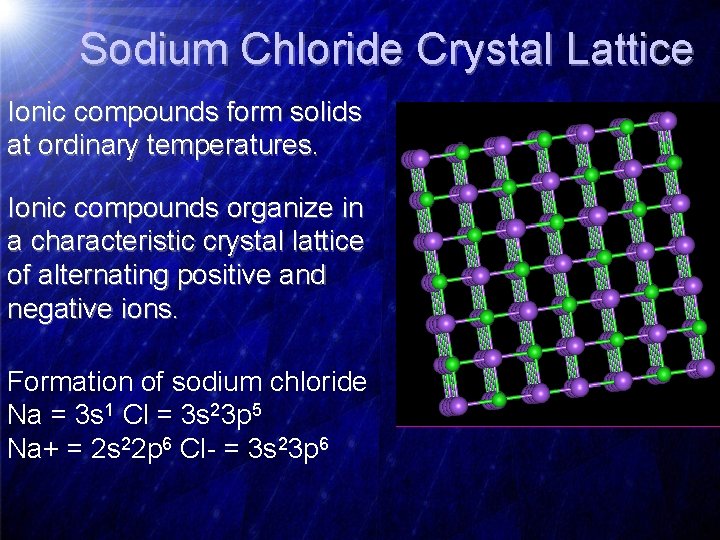
Sodium Chloride Crystal Lattice Ionic compounds form solids at ordinary temperatures. Ionic compounds organize in a characteristic crystal lattice of alternating positive and negative ions. Formation of sodium chloride Na = 3 s 1 Cl = 3 s 23 p 5 Na+ = 2 s 22 p 6 Cl- = 3 s 23 p 6
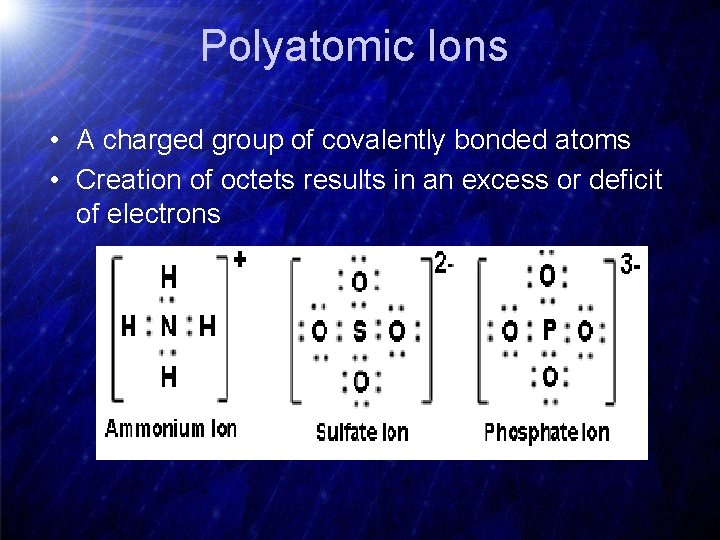
Polyatomic Ions • A charged group of covalently bonded atoms • Creation of octets results in an excess or deficit of electrons
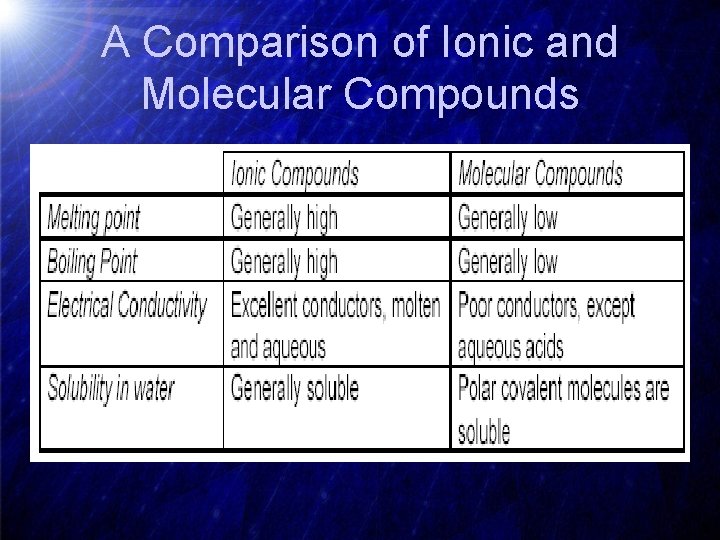
A Comparison of Ionic and Molecular Compounds
Chapter 6 Chemical Bonding 6. 4 Metallic Bonding
The Metallic Bond Model • The chemical bonding that results from the attraction between metal atoms and the surrounding sea of electrons • Electron Delocalization in Metals • Vacant p and d orbitals in metal's outer energy levels overlap, and allow outer electrons to move freely throughout the metal • The valence electrons do not belong to any one atom!
Swim in the Sea of Valence Electrons… • In metals, the valence electrons are held loosely. The vacant p & d orbitals overlap. • Metal atoms DO NOT lose their valence electrons in metallic bonding, rather they release them into a “Sea of Electrons” • Although the atoms are bonded together, they are not bonded to any one particular atom, it is more like a large network.
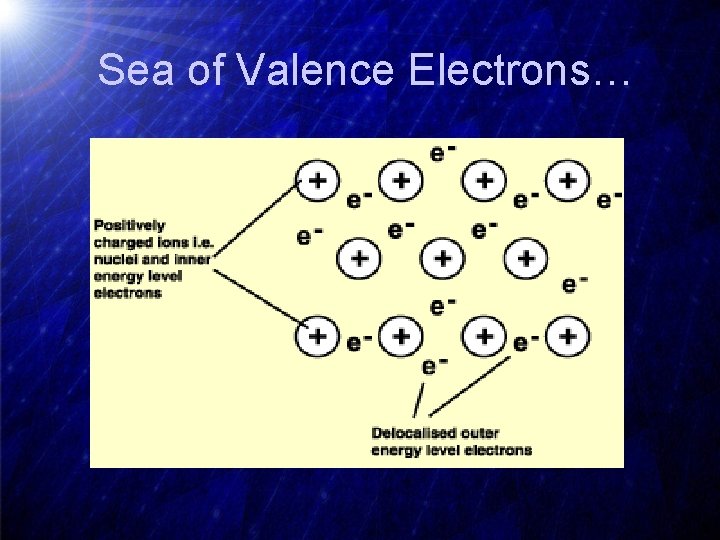
Sea of Valence Electrons…
Bonding Between Metals • Results in an interaction that hold metal atoms together, however, it is not called a compound. • Special Properties result from this interaction: – Malleable- pounded/ rolled into sheets (aluminum foil) – Ductile- Drawn into wire. (copper wires) – Conductivity- the flow of electrons – Luster- Shiny-The narrow range of energy differences between orbitals allows electrons to be easily excited, and emit light upon returning to a lower energy level
Metallic Properties • Metals are good conductors of heat and light • Metals have luster (shiny) • The narrow range of energy differences between orbitals allows electrons to be easily excited, and emit light upon returning to a lower energy level • Metals are Malleable- can be hammered into thin sheets • Metals are ductile- ability to be drawn into wire • Metallic bonding is the same in all directions, so metals tend not to be brittle
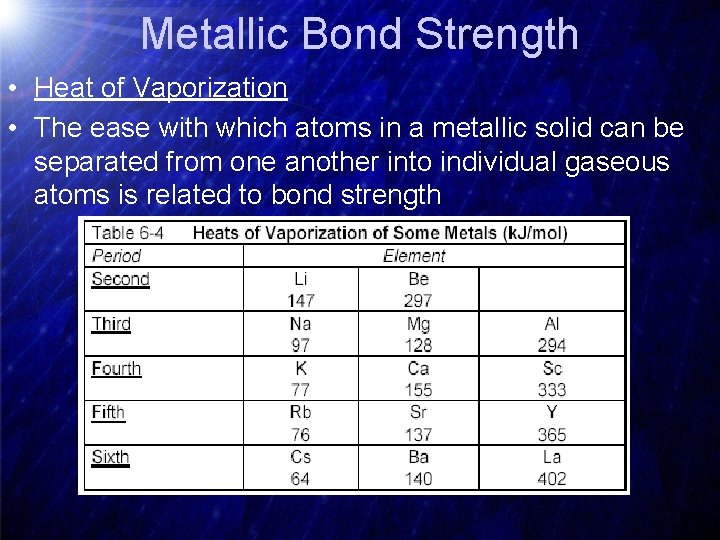
Metallic Bond Strength • Heat of Vaporization • The ease with which atoms in a metallic solid can be separated from one another into individual gaseous atoms is related to bond strength
Chapter 6 Chemical Bonding 6. 5 Molecular Geometry
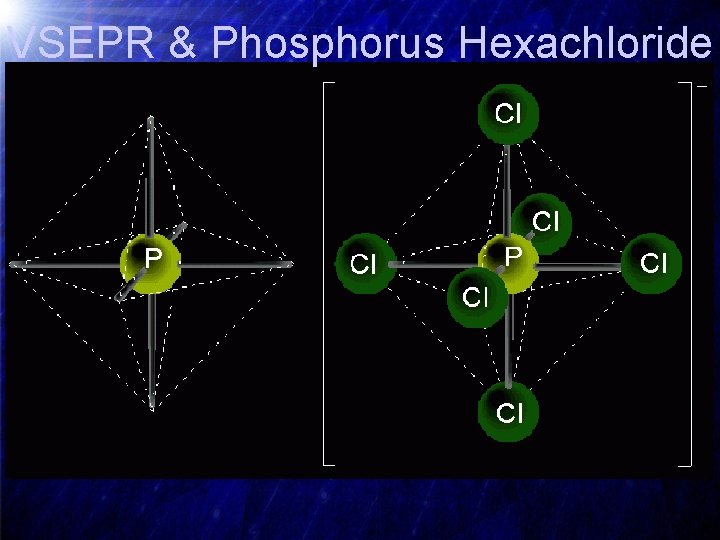
VSEPR Model (Valence Shell Electron Pair Repulsion) The structure around a given atom is determined principally by minimizing electron pair repulsions. The model for predicting molecular shapes VSEPR Theory: Repulsion between the sets of valence-level electrons surrounding an atom causes these sets to be oriented as far apart as possible
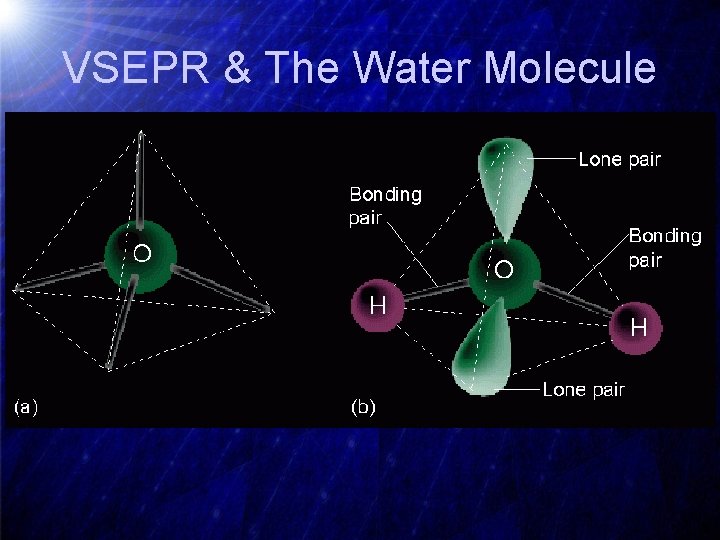
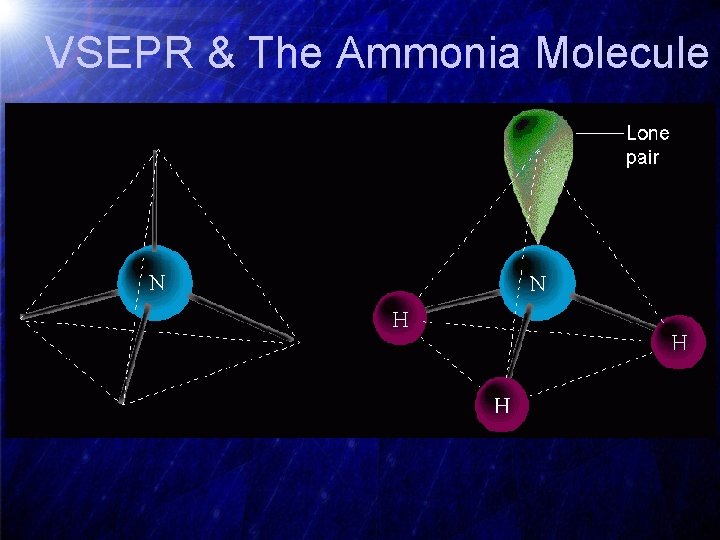
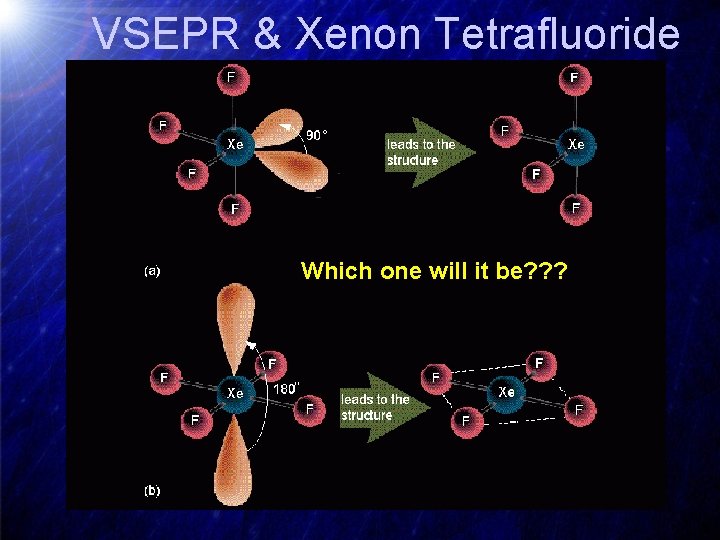
VSEPR and Unshared Electron Pairs • Unshared pairs take up positions in the geometry of molecules just as atoms do • Unshared pairs have a relatively greater effect on geometry than do atoms • Lone (unshared) electron pairs require more room than bonding pairs (they have greater repulsive forces) and tend to compress the angles between bonding pairs • Lone pairs do not cause distortion when bond angles are 120° or greater
Predicting a VSEPR Structure Draw Lewis structure of each atom. Put pairs as far apart as possible. Determine positions of atoms from the way electron pairs are shared. Determine the name of molecular structure from positions of the atoms.
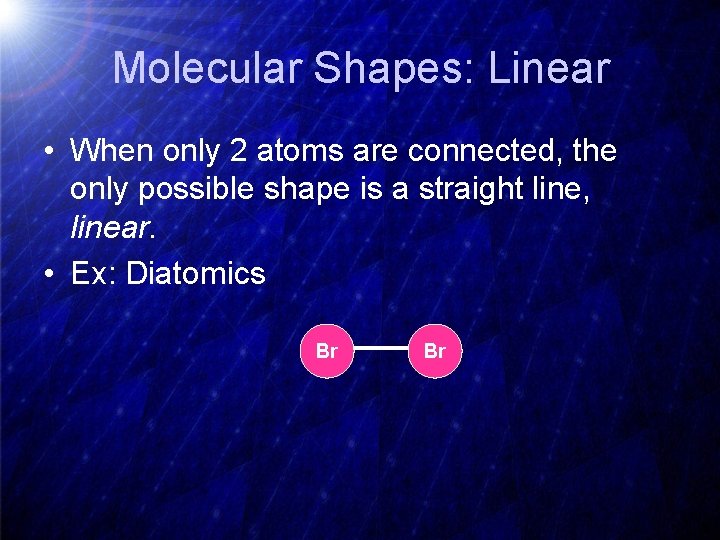
Molecular Shapes: Linear • When only 2 atoms are connected, the only possible shape is a straight line, linear. • Ex: Diatomics Br Br
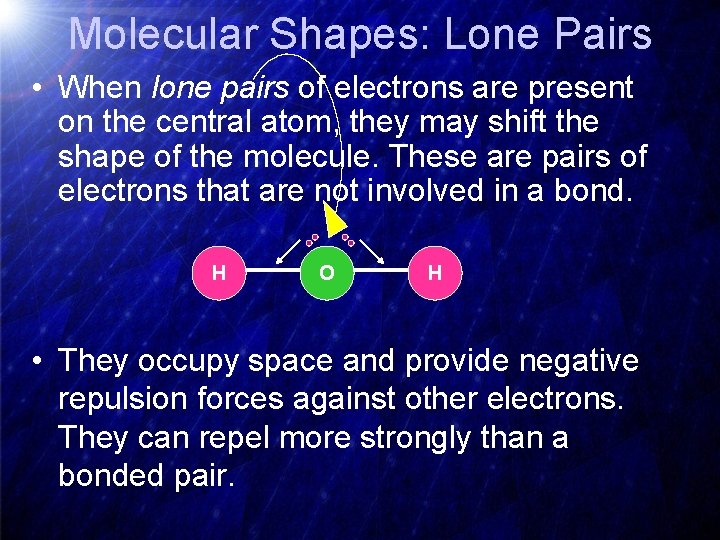
Molecular Shapes: Lone Pairs • When lone pairs of electrons are present on the central atom, they may shift the shape of the molecule. These are pairs of electrons that are not involved in a bond. H O H • They occupy space and provide negative repulsion forces against other electrons. They can repel more strongly than a bonded pair.
Molecular Shapes: Repulsion • Electrons want to spread out around the central atom. • They want to be as far away from each other as possible, due to negative repulsion. • They want to maximize their distance. e- e-
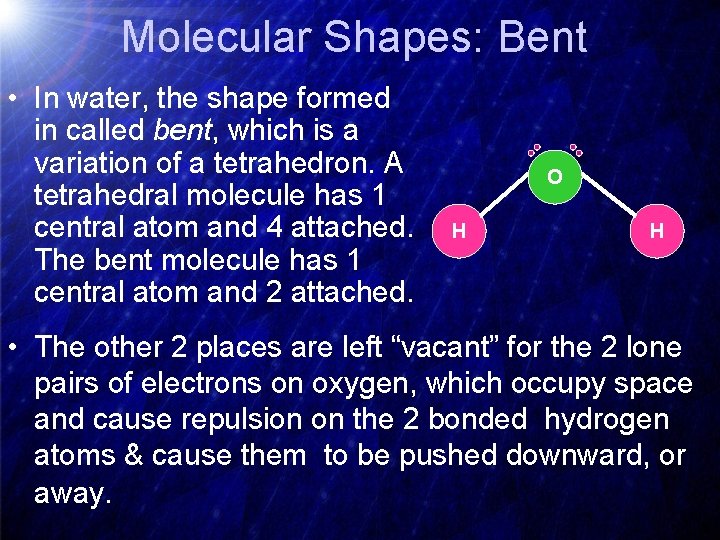
Molecular Shapes: Bent • In water, the shape formed in called bent, which is a variation of a tetrahedron. A tetrahedral molecule has 1 central atom and 4 attached. The bent molecule has 1 central atom and 2 attached. O H H • The other 2 places are left “vacant” for the 2 lone pairs of electrons on oxygen, which occupy space and cause repulsion on the 2 bonded hydrogen atoms & cause them to be pushed downward, or away.
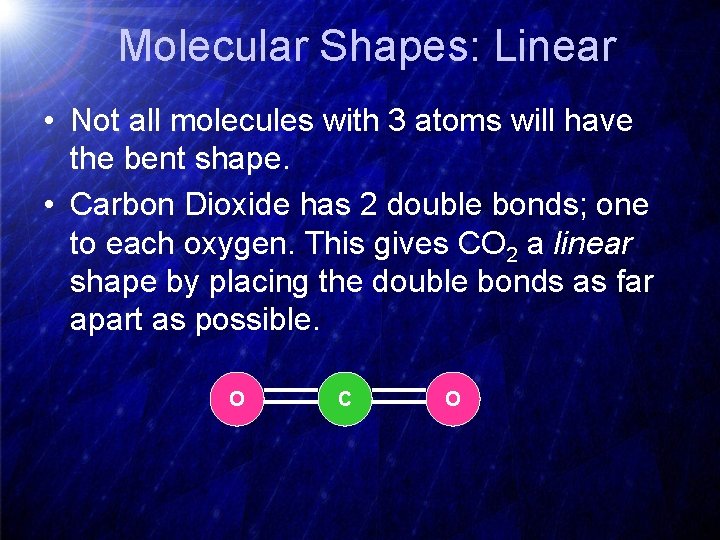
Molecular Shapes: Linear • Not all molecules with 3 atoms will have the bent shape. • Carbon Dioxide has 2 double bonds; one to each oxygen. This gives CO 2 a linear shape by placing the double bonds as far apart as possible. O C O

Molecular Shapes: Pyramidal • When you have 1 central atom with 3 attached, there are 2 possible arrangements. • In ammonia, NH 3, there are 3 hydrogen atoms bonded to a central nitrogen. Due to the lone pair on nitrogen, the hydrogen atoms are pressed downward to form the pyramidal shape. N H H H
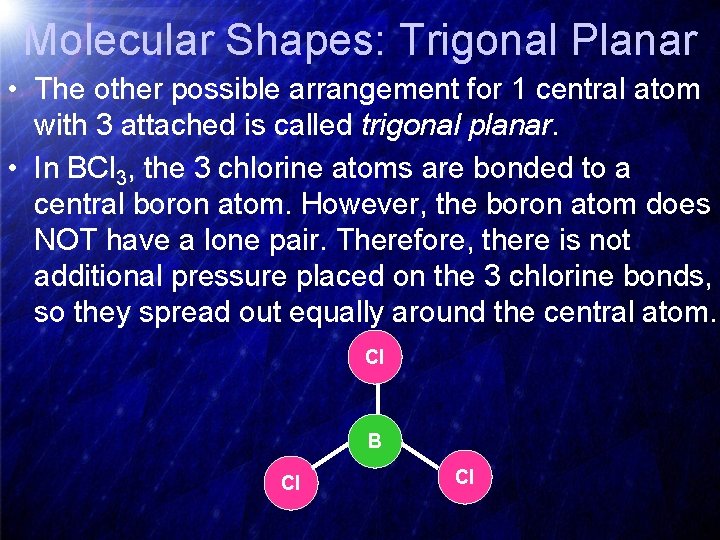
Molecular Shapes: Trigonal Planar • The other possible arrangement for 1 central atom with 3 attached is called trigonal planar. • In BCl 3, the 3 chlorine atoms are bonded to a central boron atom. However, the boron atom does NOT have a lone pair. Therefore, there is not additional pressure placed on the 3 chlorine bonds, so they spread out equally around the central atom. Cl B Cl Cl
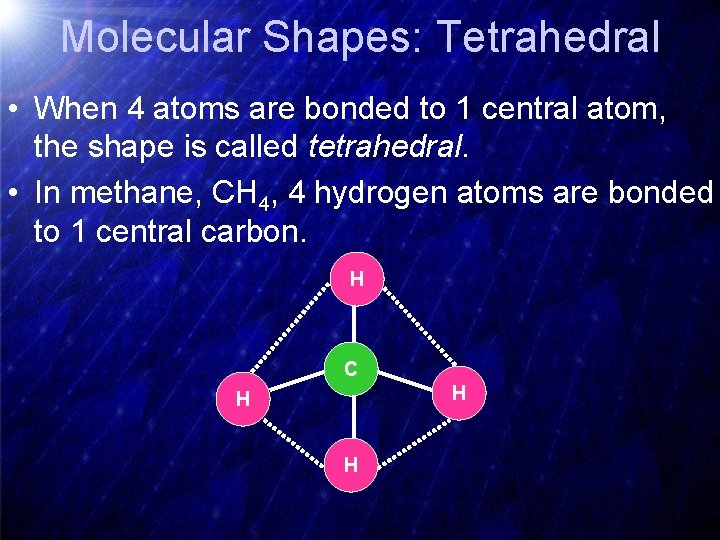
Molecular Shapes: Tetrahedral • When 4 atoms are bonded to 1 central atom, the shape is called tetrahedral. • In methane, CH 4, 4 hydrogen atoms are bonded to 1 central carbon. H C H H H
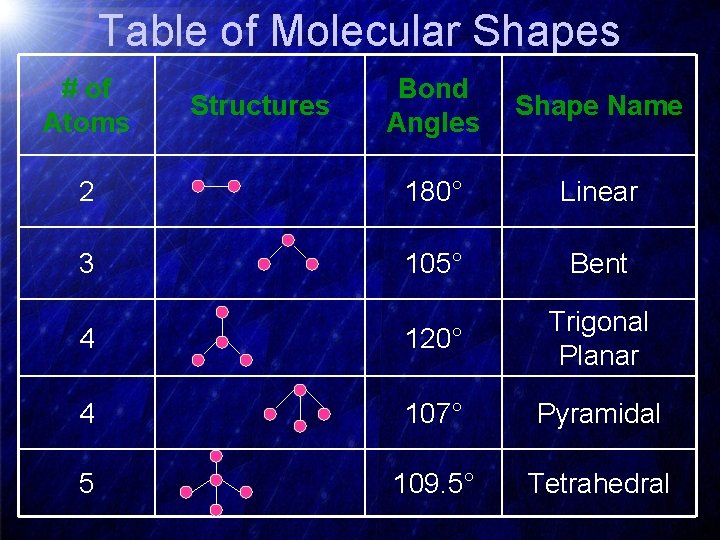
Table of Molecular Shapes # of Atoms Bond Angles Shape Name 2 180° Linear 3 105° Bent 4 120° Trigonal Planar 4 107° Pyramidal 5 109. 5° Tetrahedral Structures
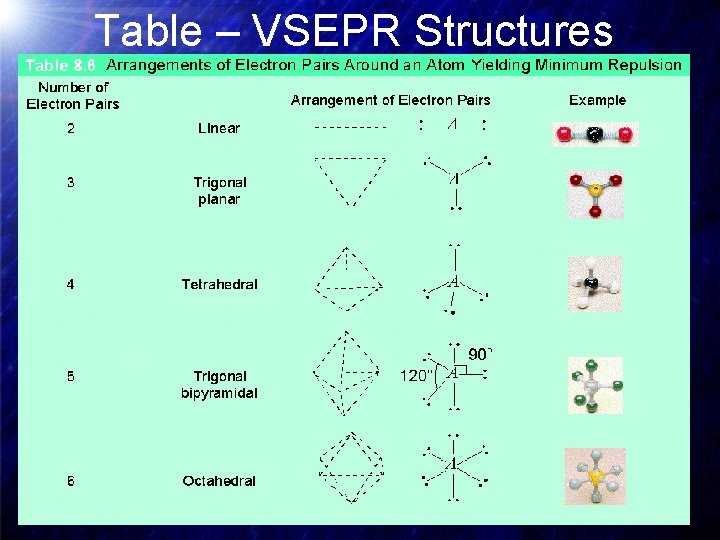
Table – VSEPR Structures
VSEPR & The Water Molecule
VSEPR & The Ammonia Molecule
VSEPR & Xenon Tetrafluoride Which one will it be? ? ?
VSEPR & Phosphorus Hexachloride
How to Determine Polarity of a Molecule • Draw the molecule’s shape according to the Lewis Structure and VSEPR • Fill in the EN values, and determine the difference for each bond • Determine the bond type for each bond in the molecule • Add in partial (δ) + and partial (δ) – symbols • Determine if there is a divisible axis to separate the partial + from the partial -
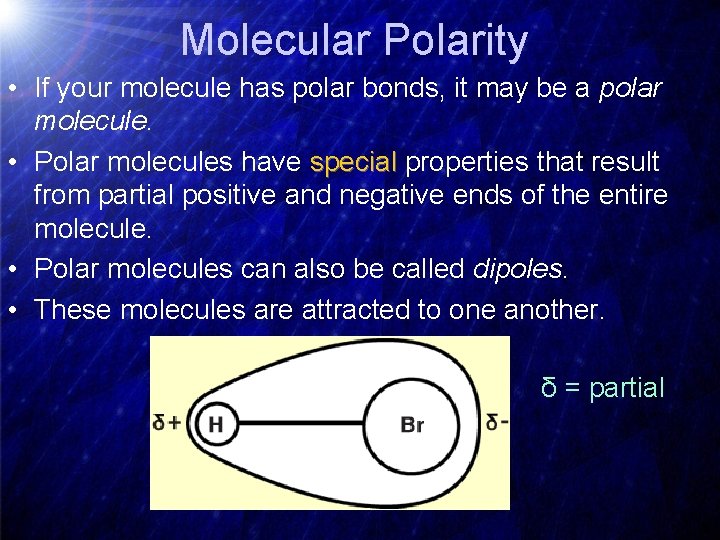
Molecular Polarity • If your molecule has polar bonds, it may be a polar molecule. • Polar molecules have special properties that result from partial positive and negative ends of the entire molecule. • Polar molecules can also be called dipoles. • These molecules are attracted to one another. δ = partial
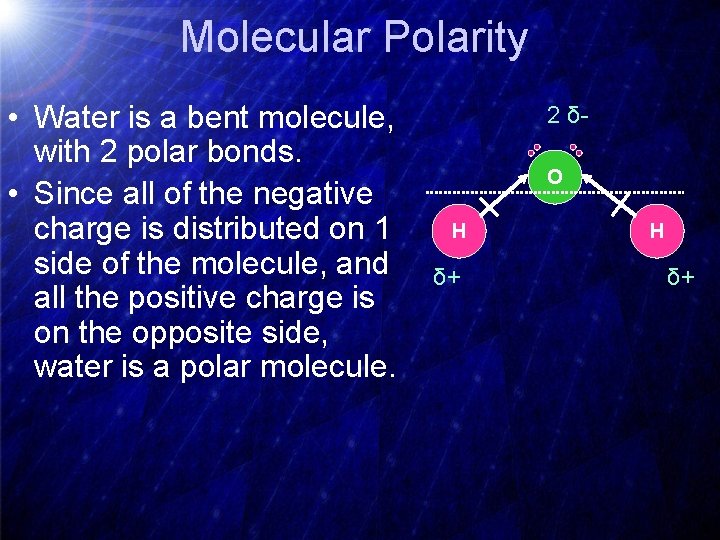
Molecular Polarity • Water is a bent molecule, with 2 polar bonds. • Since all of the negative charge is distributed on 1 side of the molecule, and all the positive charge is on the opposite side, water is a polar molecule. 2 δO H δ+
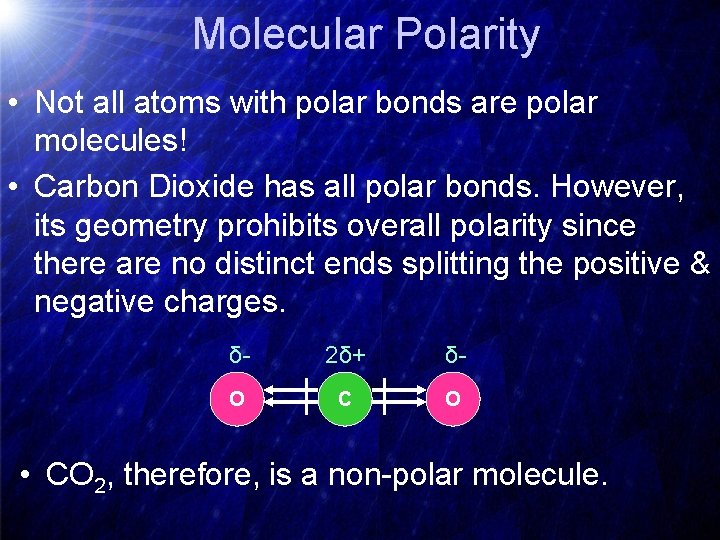
Molecular Polarity • Not all atoms with polar bonds are polar molecules! • Carbon Dioxide has all polar bonds. However, its geometry prohibits overall polarity since there are no distinct ends splitting the positive & negative charges. δ- 2δ+ δ- O C O • CO 2, therefore, is a non-polar molecule.
Hybridization The Blending of Orbitals
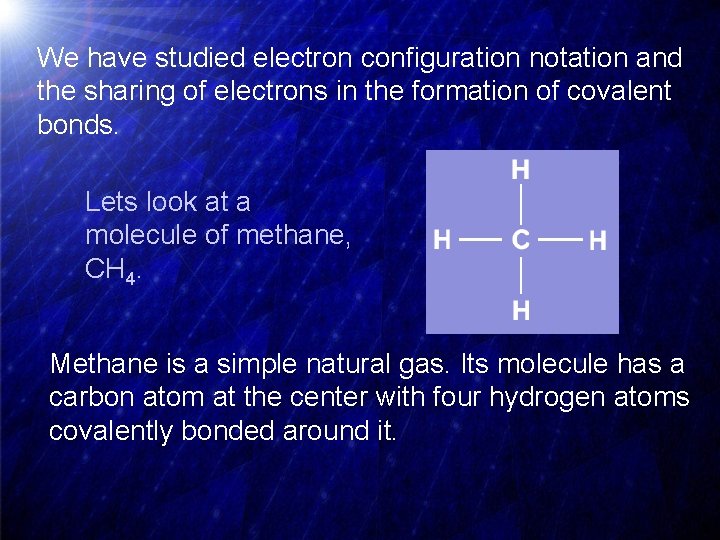
We have studied electron configuration notation and the sharing of electrons in the formation of covalent bonds. Lets look at a molecule of methane, CH 4. Methane is a simple natural gas. Its molecule has a carbon atom at the center with four hydrogen atoms covalently bonded around it.
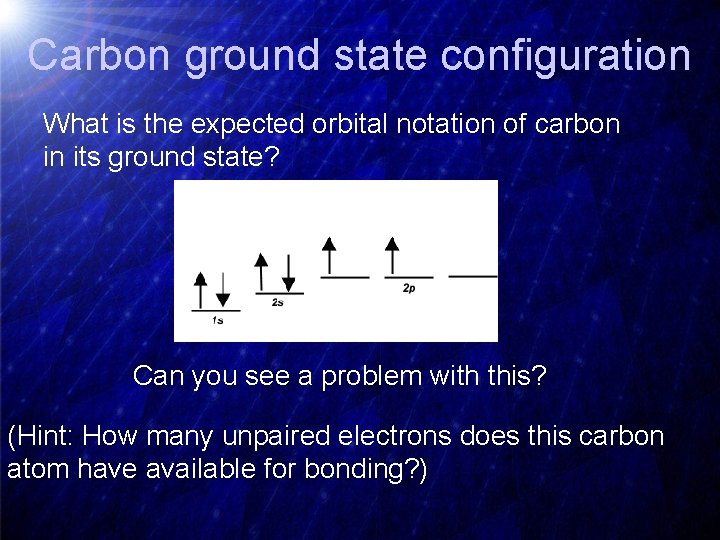
Carbon ground state configuration What is the expected orbital notation of carbon in its ground state? Can you see a problem with this? (Hint: How many unpaired electrons does this carbon atom have available for bonding? )
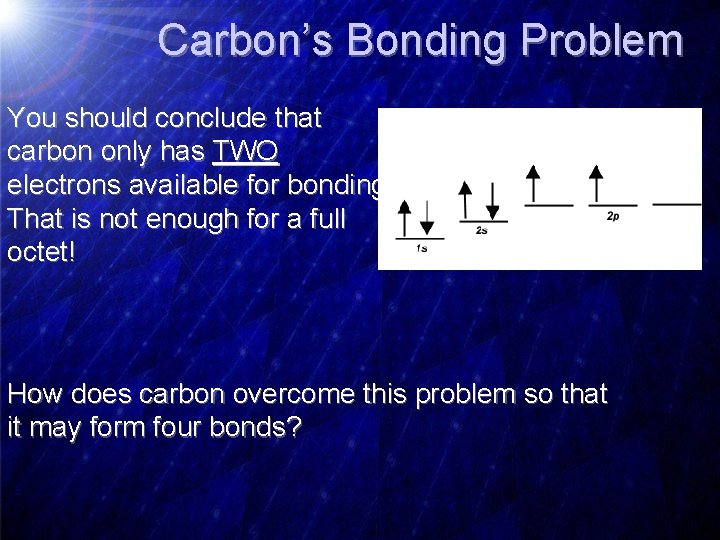
Carbon’s Bonding Problem You should conclude that carbon only has TWO electrons available for bonding. That is not enough for a full octet! How does carbon overcome this problem so that it may form four bonds?
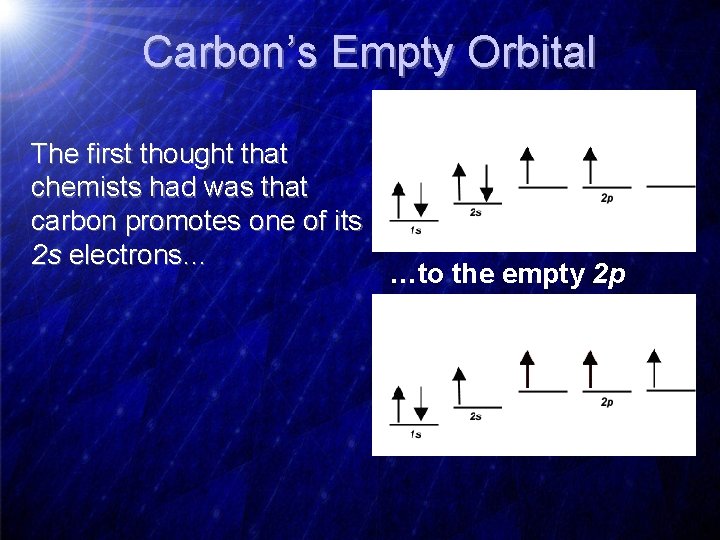
Carbon’s Empty Orbital The first thought that chemists had was that carbon promotes one of its 2 s electrons… …to the empty 2 p orbital.
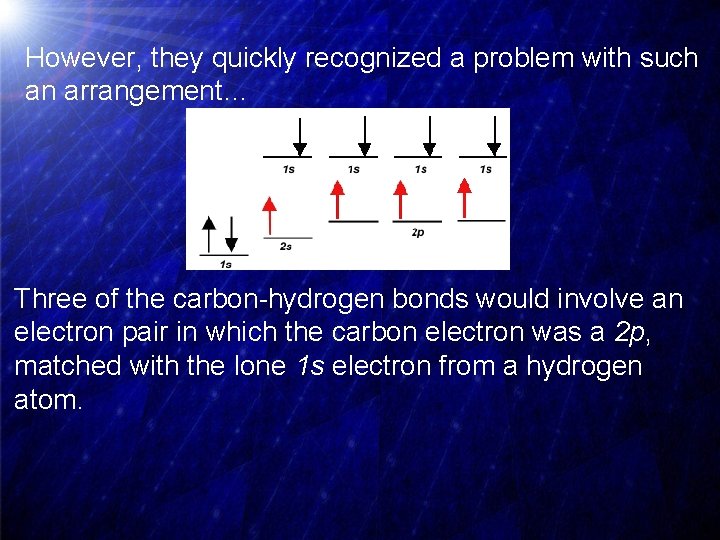
However, they quickly recognized a problem with such an arrangement… Three of the carbon-hydrogen bonds would involve an electron pair in which the carbon electron was a 2 p, matched with the lone 1 s electron from a hydrogen atom.
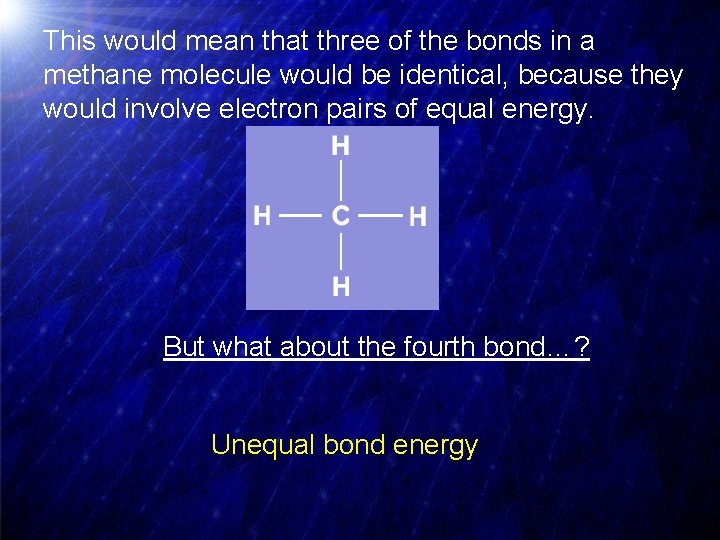
This would mean that three of the bonds in a methane molecule would be identical, because they would involve electron pairs of equal energy. But what about the fourth bond…? Unequal bond energy
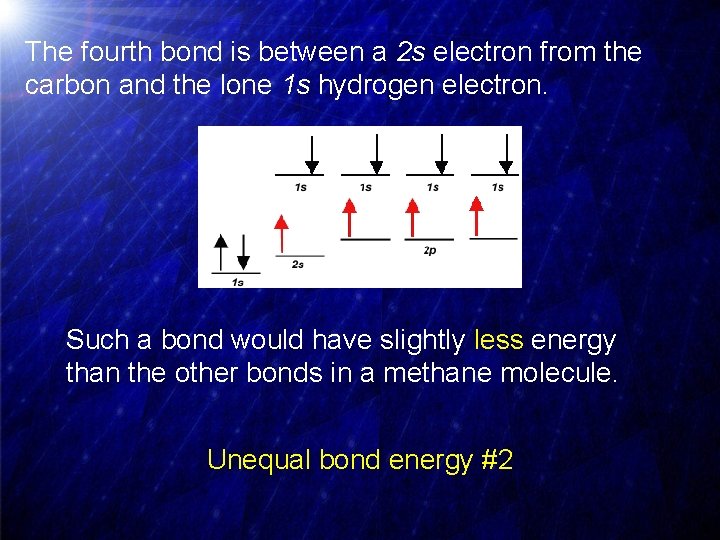
The fourth bond is between a 2 s electron from the carbon and the lone 1 s hydrogen electron. Such a bond would have slightly less energy than the other bonds in a methane molecule. Unequal bond energy #2
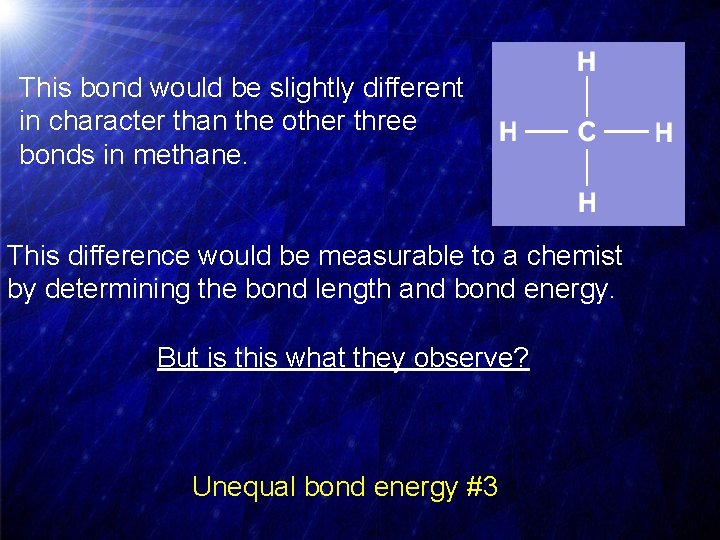
This bond would be slightly different in character than the other three bonds in methane. This difference would be measurable to a chemist by determining the bond length and bond energy. But is this what they observe? Unequal bond energy #3
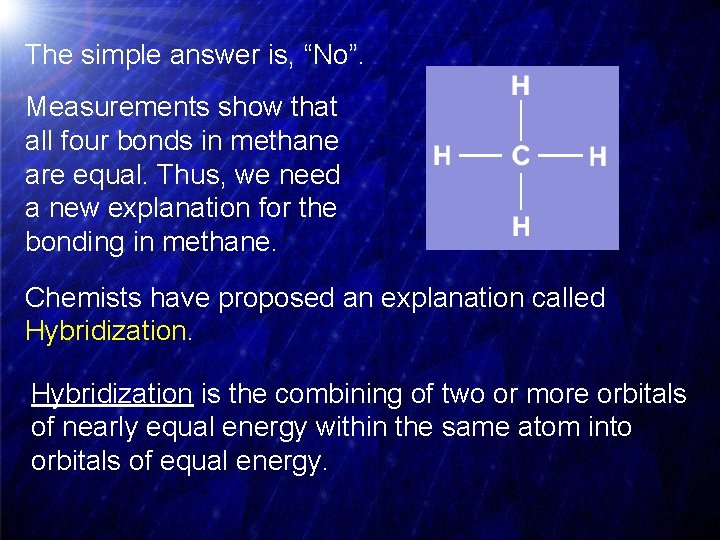
The simple answer is, “No”. Measurements show that all four bonds in methane are equal. Thus, we need a new explanation for the bonding in methane. Chemists have proposed an explanation called Hybridization is the combining of two or more orbitals of nearly equal energy within the same atom into orbitals of equal energy.
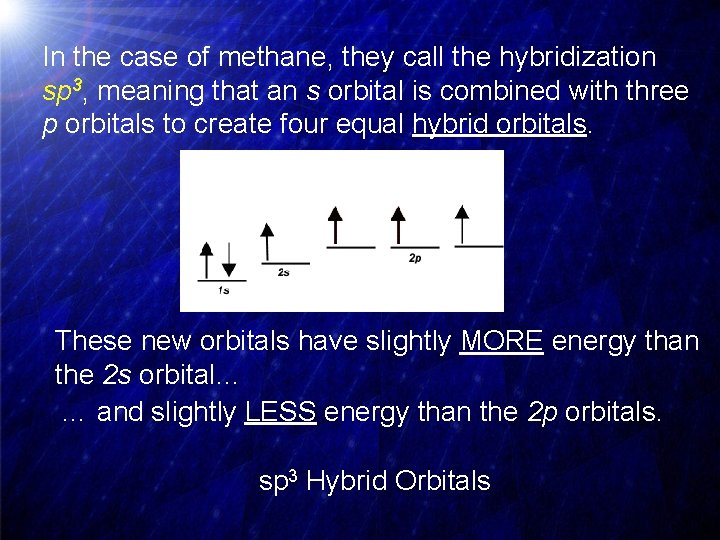
In the case of methane, they call the hybridization sp 3, meaning that an s orbital is combined with three p orbitals to create four equal hybrid orbitals. These new orbitals have slightly MORE energy than the 2 s orbital… … and slightly LESS energy than the 2 p orbitals. sp 3 Hybrid Orbitals
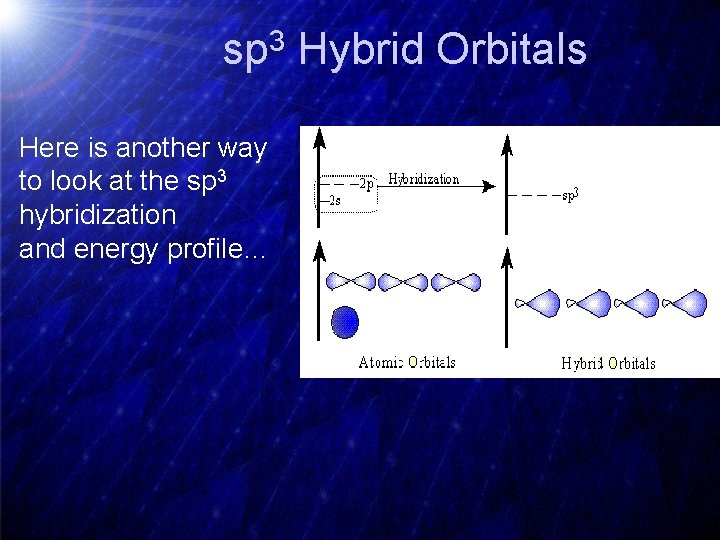
3 sp Here is another way to look at the sp 3 hybridization and energy profile… Hybrid Orbitals
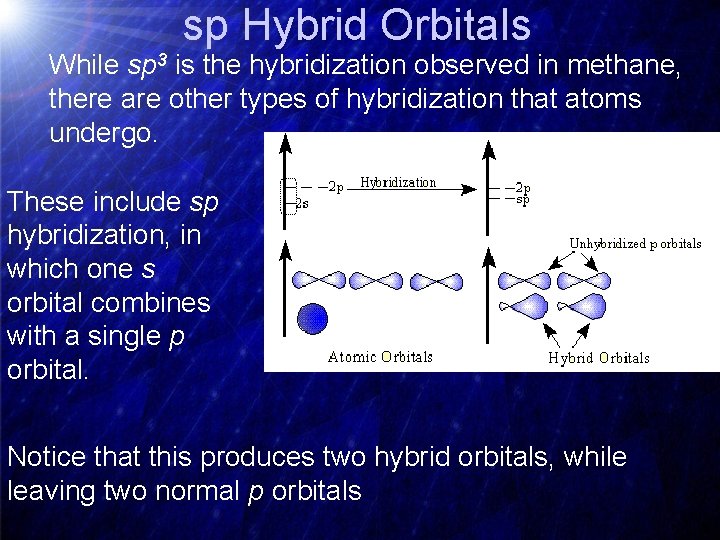
sp Hybrid Orbitals While sp 3 is the hybridization observed in methane, there are other types of hybridization that atoms undergo. These include sp hybridization, in which one s orbital combines with a single p orbital. Notice that this produces two hybrid orbitals, while leaving two normal p orbitals
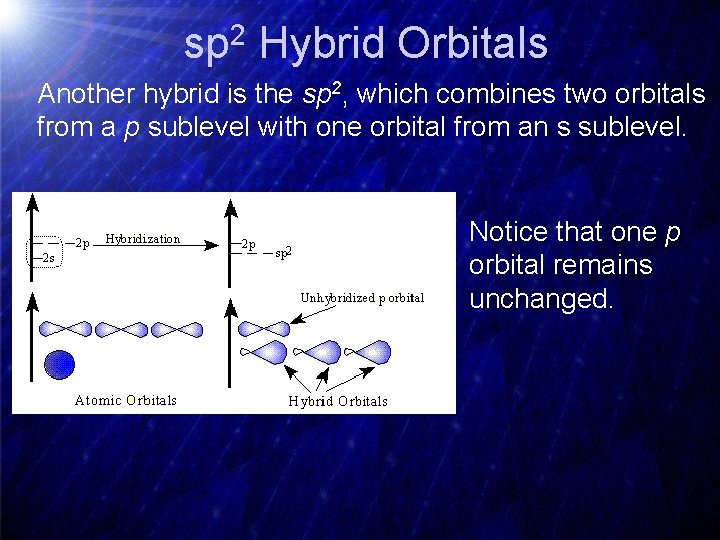
sp 2 Hybrid Orbitals Another hybrid is the sp 2, which combines two orbitals from a p sublevel with one orbital from an s sublevel. Notice that one p orbital remains unchanged.
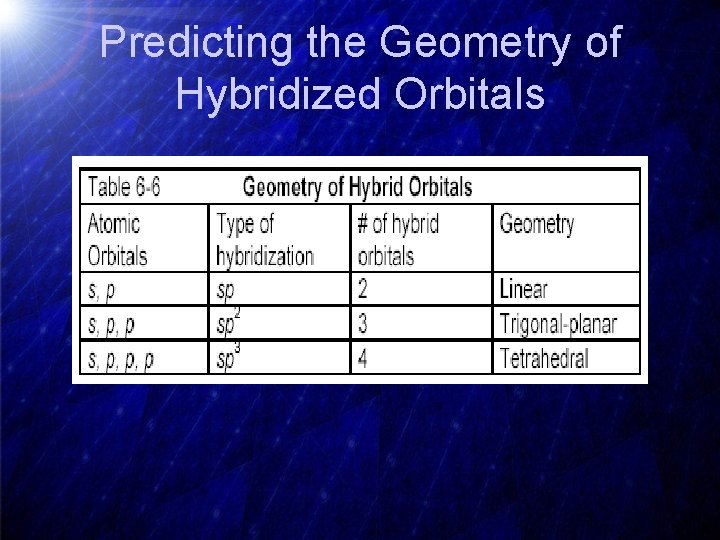
Predicting the Geometry of Hybridized Orbitals
Intermolecular Forces • Forces of attraction between molecules • Generally weaker than bonds that join atoms in molecules • Boiling point gives a rough estimate of intermolecular forces • high bp = large attractive forces • low bp = small attractive forces
Molecular Polarity and Dipole Forces • Dipole- Created by equal but opposite charges that are separated by a short distance • A dipole is represented by an arrow with a head pointing toward the negative pole and a crossed tail situated at the positive pole
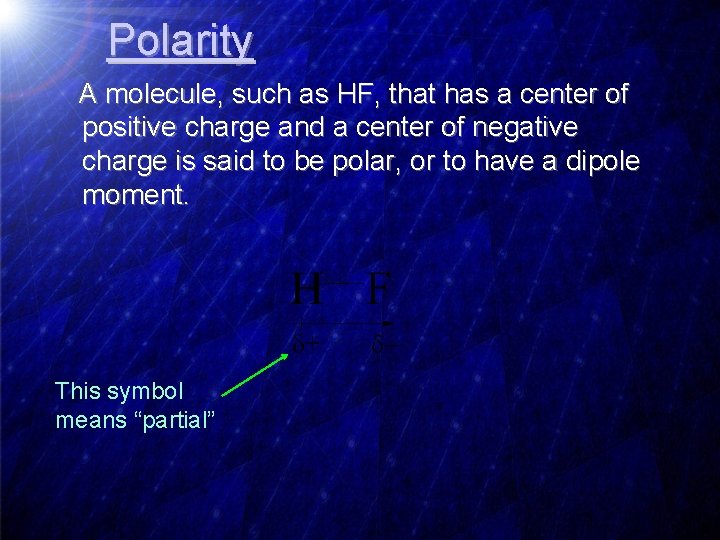
Polarity A molecule, such as HF, that has a center of positive charge and a center of negative charge is said to be polar, or to have a dipole moment. This symbol means “partial”
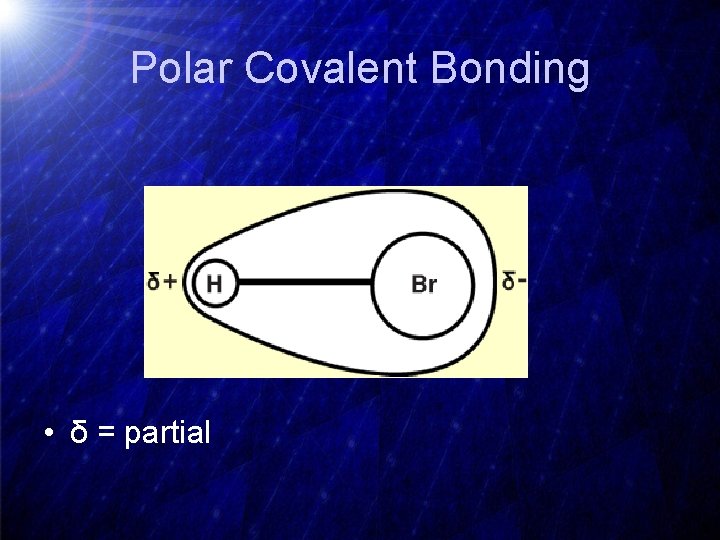
Polar Covalent Bonding • δ = partial
Dipole-Dipole forces • The negative region of one molecule is attracted to the positive region of another molecule • A polar molecule can induce a dipole in a nonpolar molecule by temporarily attracting its electrons
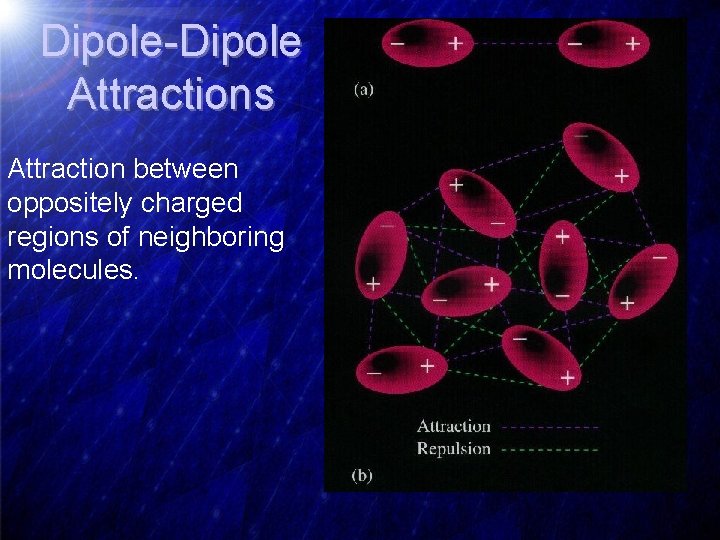
Dipole-Dipole Attractions Attraction between oppositely charged regions of neighboring molecules.
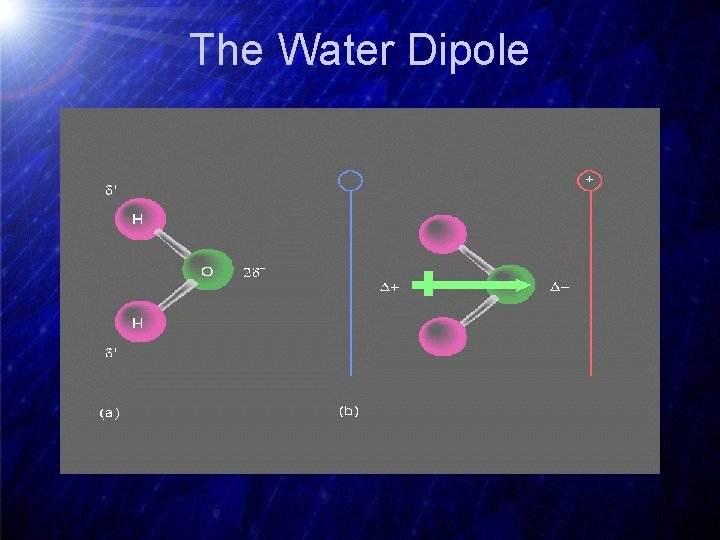
The Water Dipole
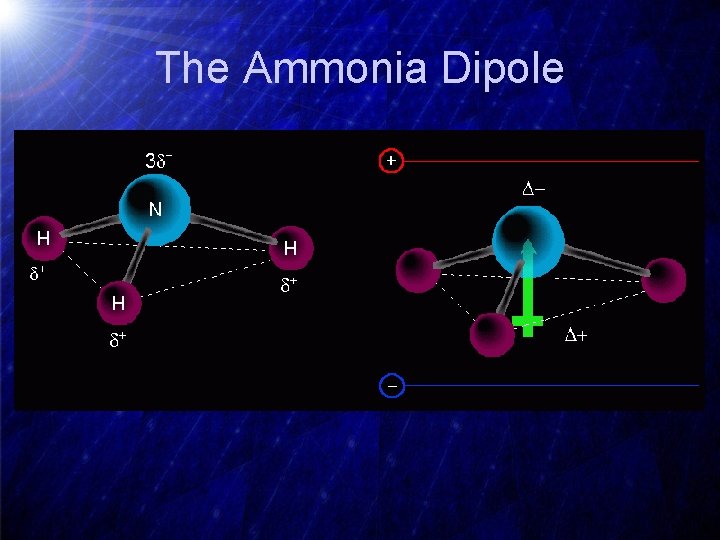
The Ammonia Dipole
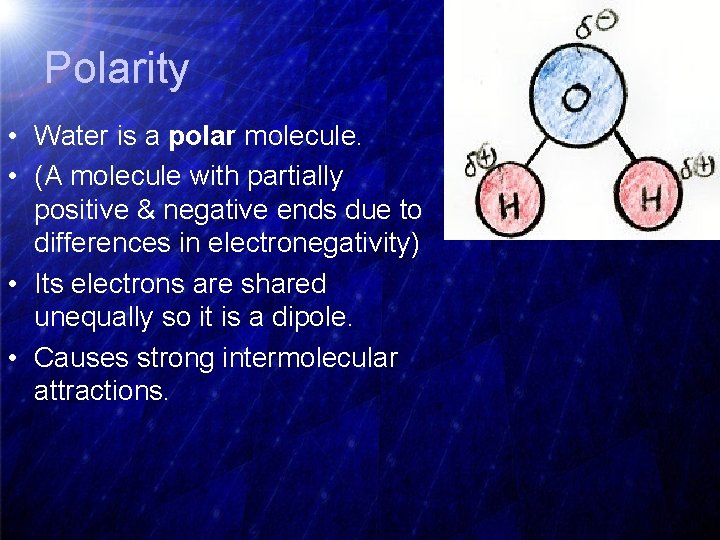
Polarity • Water is a polar molecule. • (A molecule with partially positive & negative ends due to differences in electronegativity) • Its electrons are shared unequally so it is a dipole. • Causes strong intermolecular attractions.
Hydrogen Bonding • The intermolecular force in which a hydrogen atom that is bonded to a highly electronegative atom (F, O, N) is attracted to an unshared pair of electrons of an electronegative atom in a nearby molecule • It is usually represented by dotted lines
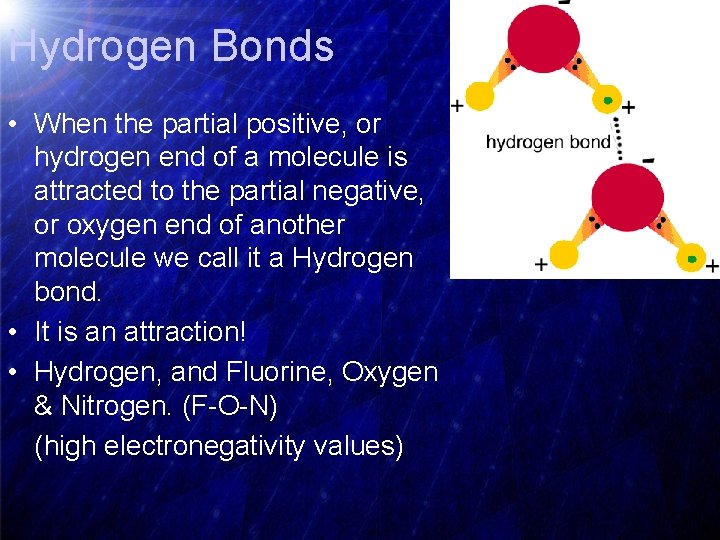
Hydrogen Bonds • When the partial positive, or hydrogen end of a molecule is attracted to the partial negative, or oxygen end of another molecule we call it a Hydrogen bond. • It is an attraction! • Hydrogen, and Fluorine, Oxygen & Nitrogen. (F-O-N) (high electronegativity values)
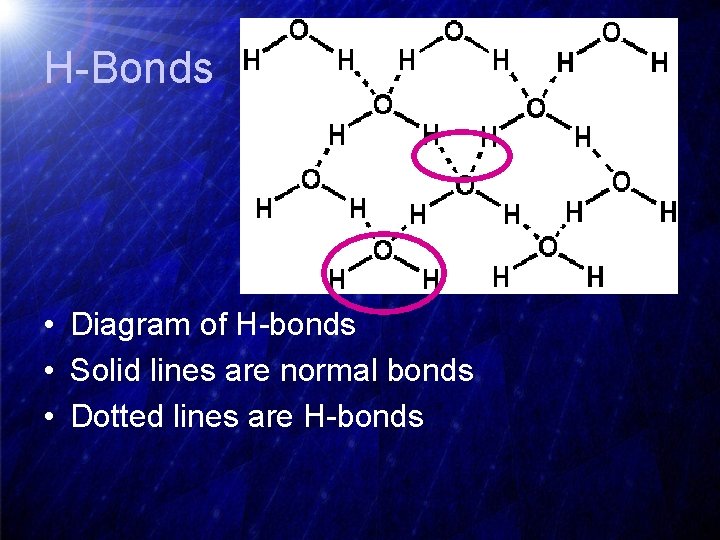
H-Bonds • Diagram of H-bonds • Solid lines are normal bonds • Dotted lines are H-bonds
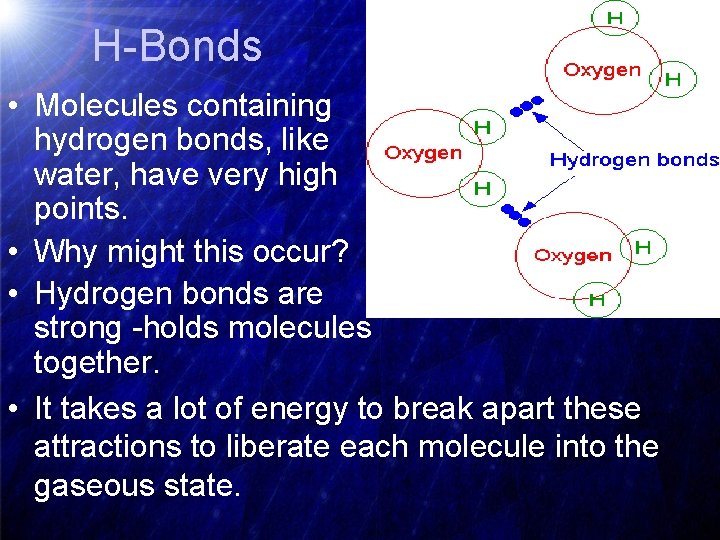
H-Bonds • Molecules containing hydrogen bonds, like water, have very high points. • Why might this occur? • Hydrogen bonds are strong -holds molecules together. • It takes a lot of energy to break apart these attractions to liberate each molecule into the gaseous state.
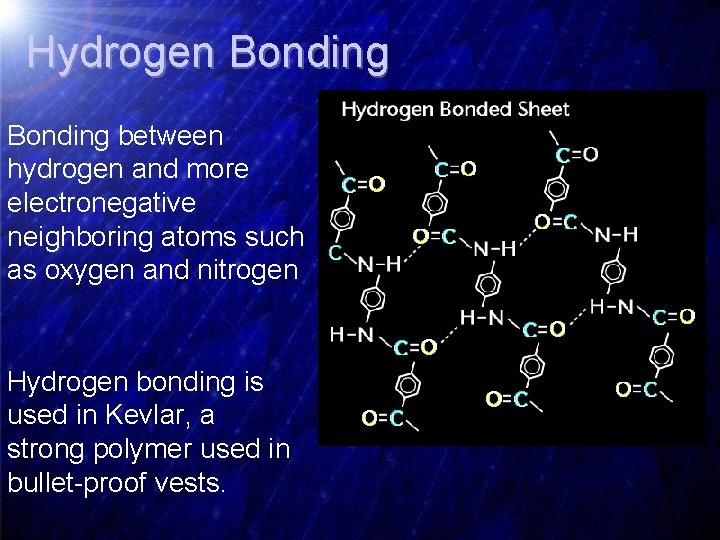
Hydrogen Bonding between hydrogen and more electronegative neighboring atoms such as oxygen and nitrogen Hydrogen bonding is used in Kevlar, a strong polymer used in bullet-proof vests.
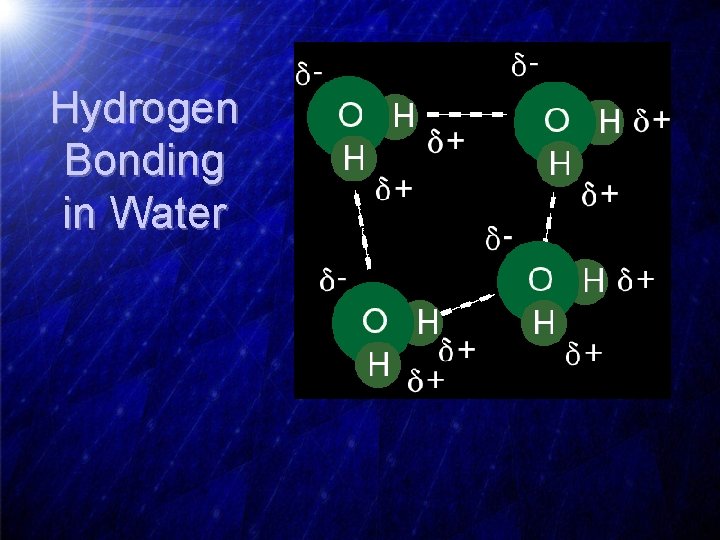
Hydrogen Bonding in Water
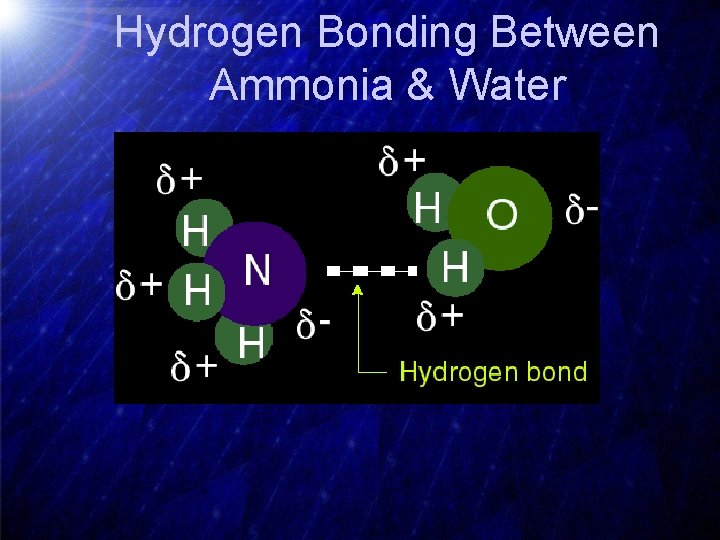
Hydrogen Bonding Between Ammonia & Water
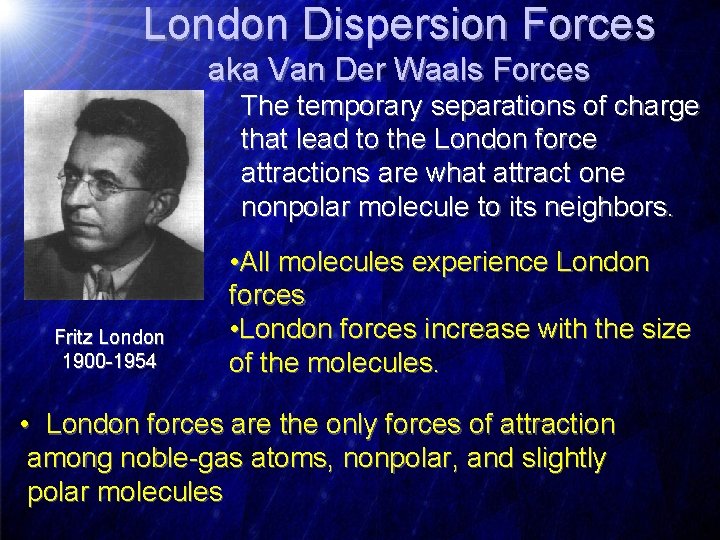
London Dispersion Forces aka Van Der Waals Forces The temporary separations of charge that lead to the London force attractions are what attract one nonpolar molecule to its neighbors. Fritz London 1900 -1954 • All molecules experience London forces • London forces increase with the size of the molecules. • London forces are the only forces of attraction among noble-gas atoms, nonpolar, and slightly polar molecules
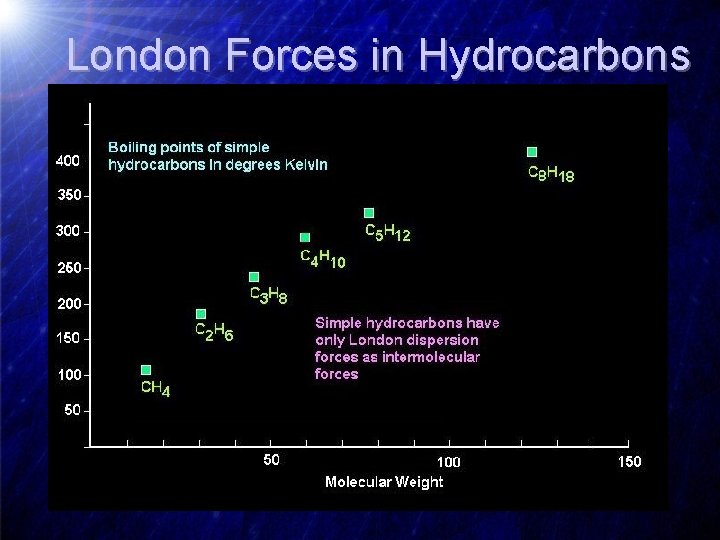
London Forces in Hydrocarbons
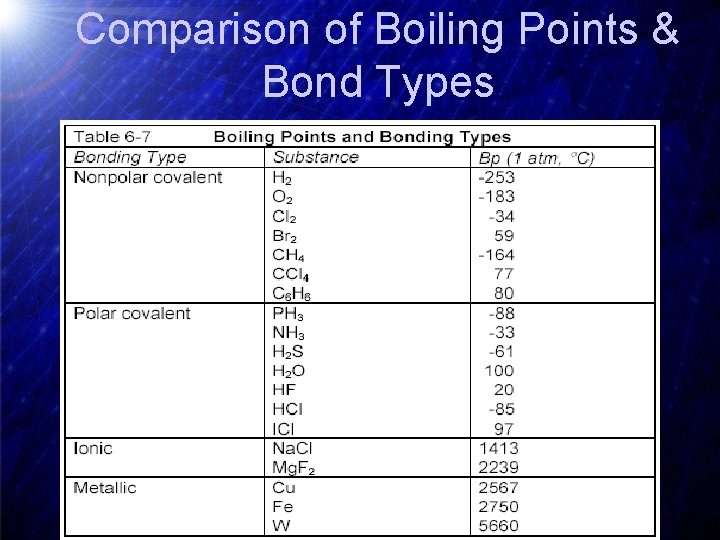
Comparison of Boiling Points & Bond Types
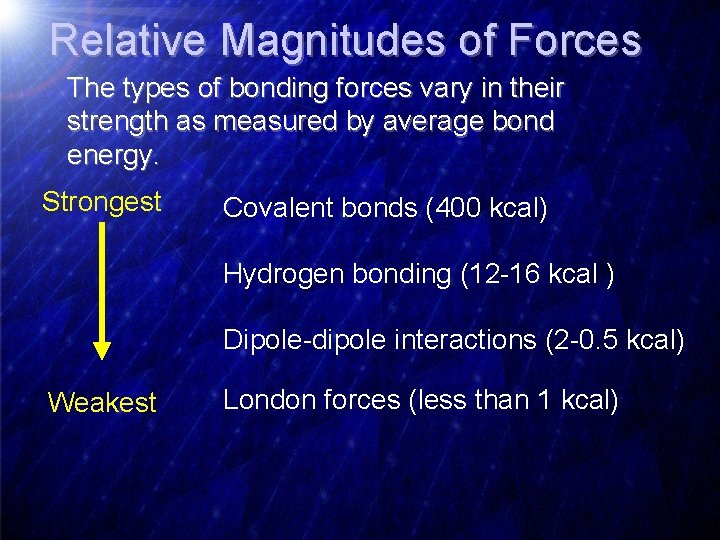
Relative Magnitudes of Forces The types of bonding forces vary in their strength as measured by average bond energy. Strongest Covalent bonds (400 kcal) Hydrogen bonding (12 -16 kcal ) Dipole-dipole interactions (2 -0. 5 kcal) Weakest London forces (less than 1 kcal)
- Slides: 104