
CHAPTER 6 Center Seeking Forces 1 When I
- Slides: 59
CHAPTER 6: Center Seeking Forces 1. )
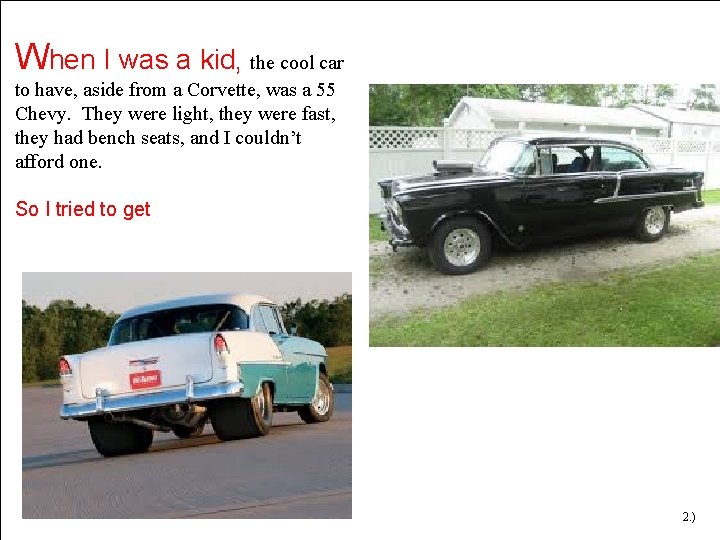
When I was a kid, the cool car to have, aside from a Corvette, was a 55 Chevy. They were light, they were fast, they had bench seats, and I couldn’t afford one. So I tried to get 2. )
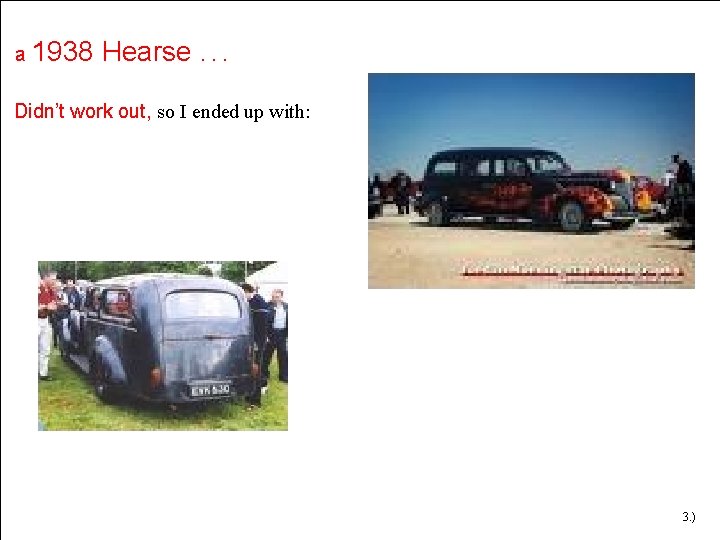
a 1938 Hearse. . . Didn’t work out, so I ended up with: 3. )
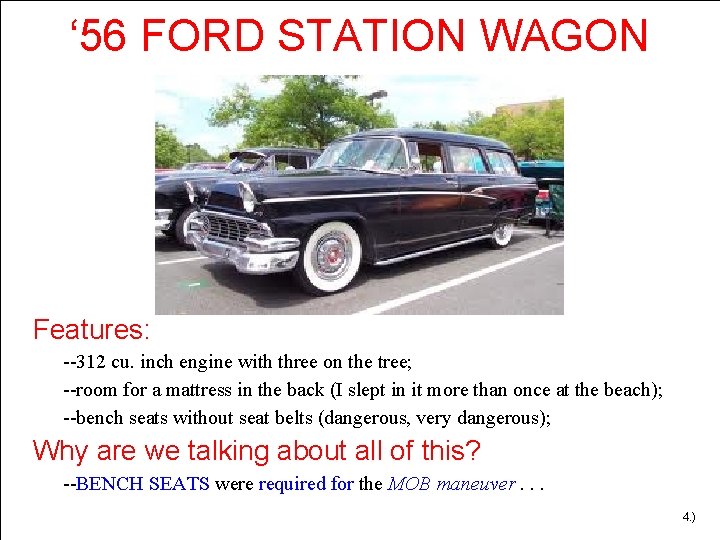
‘ 56 FORD STATION WAGON Features: --312 cu. inch engine with three on the tree; --room for a mattress in the back (I slept in it more than once at the beach); --bench seats without seat belts (dangerous, very dangerous); Why are we talking about all of this? --BENCH SEATS were required for the MOB maneuver. . . 4. )
The MOB Maneuver The Problem: You are on a second date. You kind of like her. She kind of likes you. You don’t want to seem overly aggressive. She doesn’t want to seem too easy. So there she sits, way over there, next to the passenger-side door. You’d like her sitting next to you. Enter the MOB maneuver. 5. )
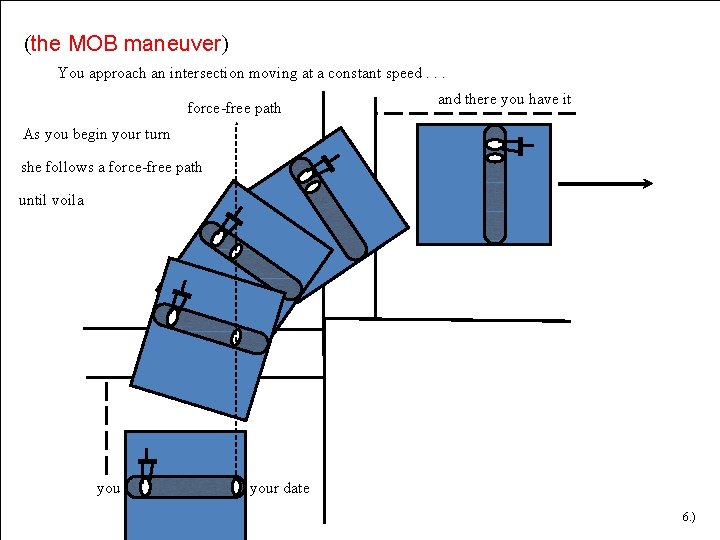
(the MOB maneuver) You approach an intersection moving at a constant speed. . . force-free path and there you have it As you begin your turn she follows a force-free path until voila your date 6. )
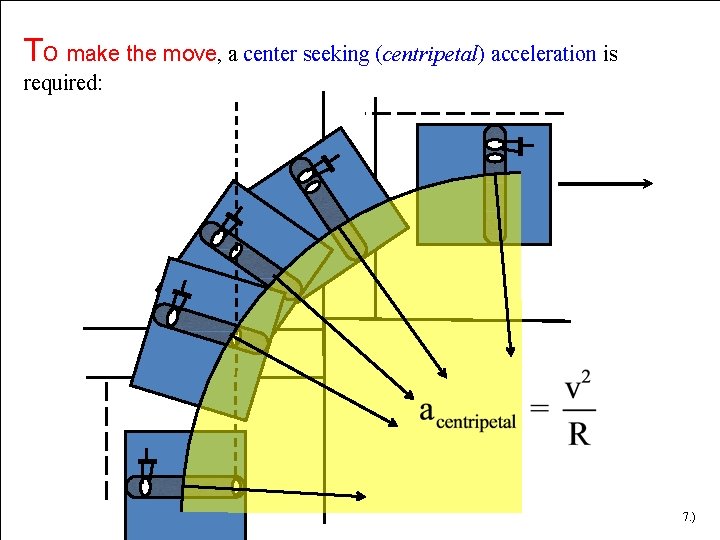
To make the move, a center seeking (centripetal) acceleration is required: 7. )
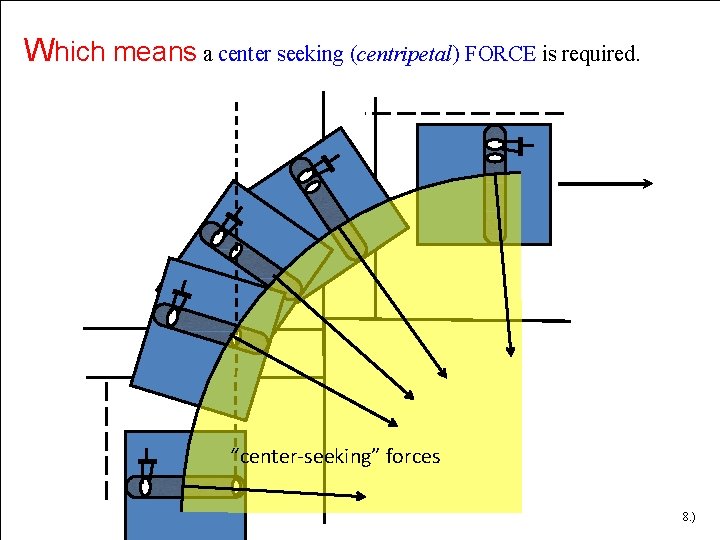
Which means a center seeking (centripetal) FORCE is required. “center-seeking” forces 8. )
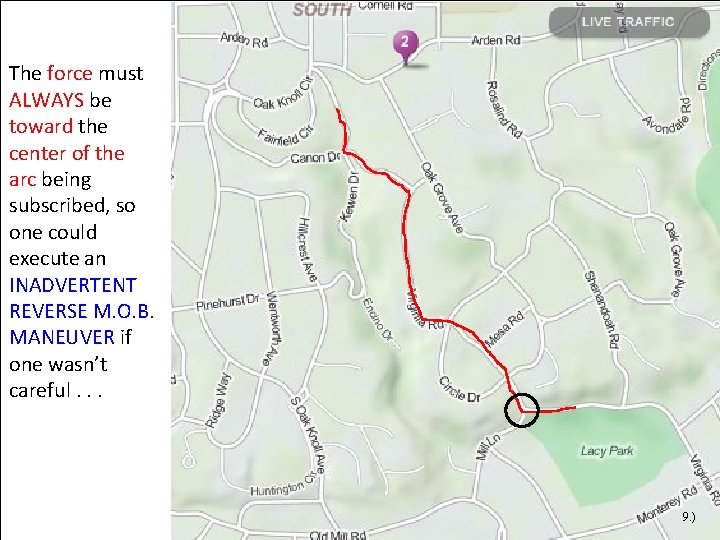
The force must ALWAYS be toward the center of the arc being subscribed, so one could execute an INADVERTENT REVERSE M. O. B. MANEUVER if one wasn’t careful. . . 9. )
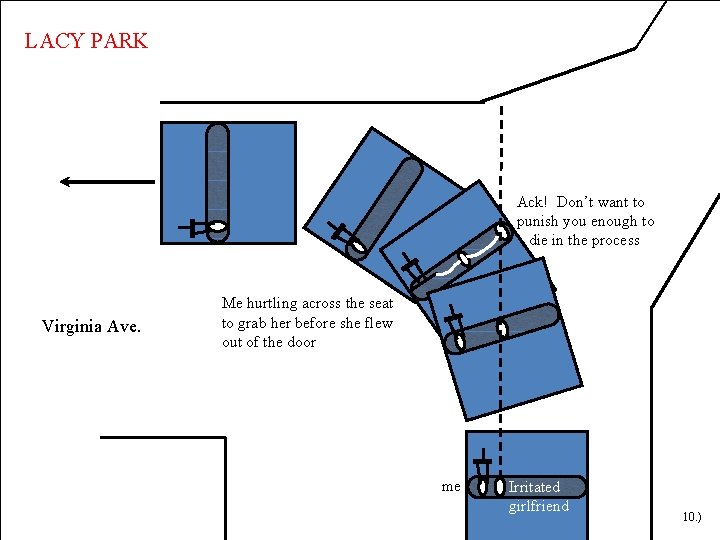
LACY PARK Ack! Don’t want to punish you enough to die in the process Virginia Ave. Me hurtling across the seat to grab her before she flew out of the door me Irritated girlfriend 10. )
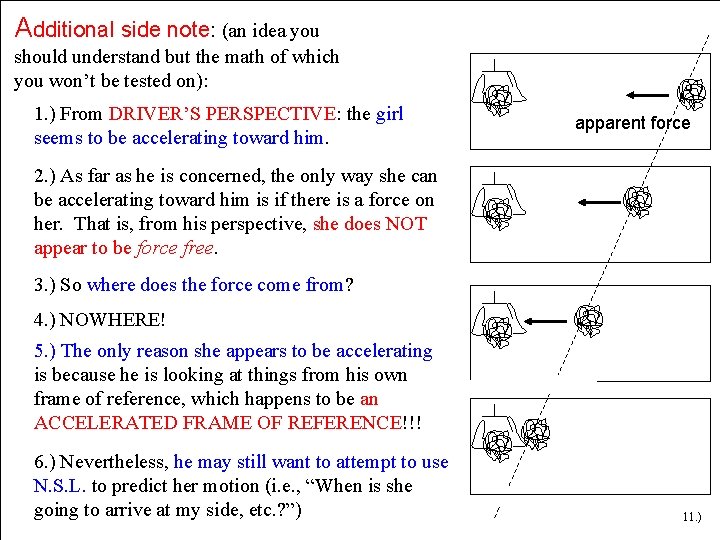
Additional side note: (an idea you should understand but the math of which you won’t be tested on): 1. ) From DRIVER’S PERSPECTIVE: the girl seems to be accelerating toward him. apparent force 2. ) As far as he is concerned, the only way she can be accelerating toward him is if there is a force on her. That is, from his perspective, she does NOT appear to be force free. 3. ) So where does the force come from? 4. ) NOWHERE! 5. ) The only reason she appears to be accelerating is because he is looking at things from his own frame of reference, which happens to be an ACCELERATED FRAME OF REFERENCE!!! 6. ) Nevertheless, he may still want to attempt to use N. S. L. to predict her motion (i. e. , “When is she going to arrive at my side, etc. ? ”) 11. )
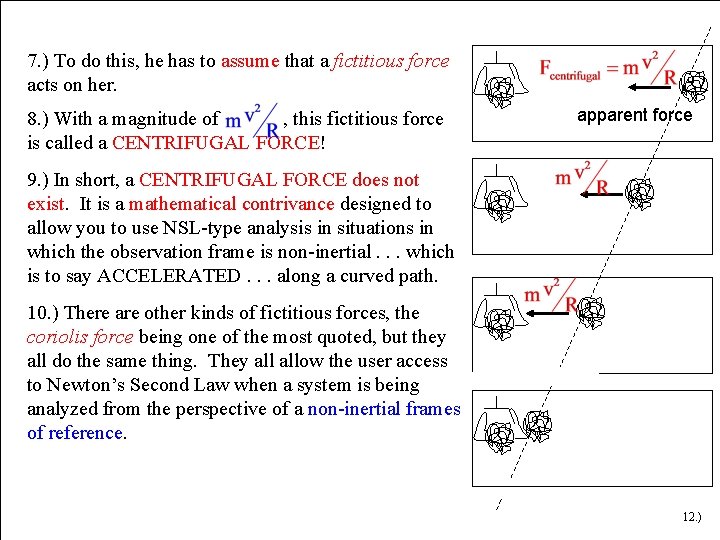
7. ) To do this, he has to assume that a fictitious force acts on her. 8. ) With a magnitude of , this fictitious force is called a CENTRIFUGAL FORCE! apparent force 9. ) In short, a CENTRIFUGAL FORCE does not exist. It is a mathematical contrivance designed to allow you to use NSL-type analysis in situations in which the observation frame is non-inertial. . . which is to say ACCELERATED. . . along a curved path. 10. ) There are other kinds of fictitious forces, the coriolis force being one of the most quoted, but they all do the same thing. They allow the user access to Newton’s Second Law when a system is being analyzed from the perspective of a non-inertial frames of reference. 12. )
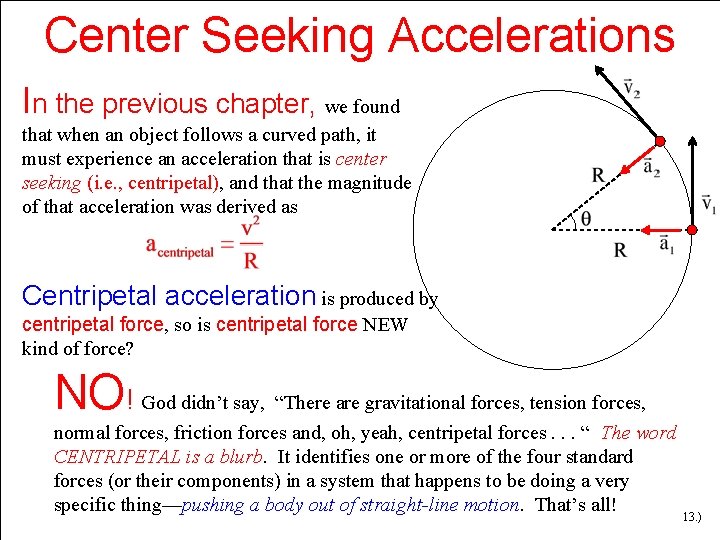
Center Seeking Accelerations In the previous chapter, we found that when an object follows a curved path, it must experience an acceleration that is center seeking (i. e. , centripetal), and that the magnitude of that acceleration was derived as Centripetal acceleration is produced by centripetal force, so is centripetal force NEW kind of force? NO! God didn’t say, “There are gravitational forces, tension forces, normal forces, friction forces and, oh, yeah, centripetal forces. . . “ The word CENTRIPETAL is a blurb. It identifies one or more of the four standard forces (or their components) in a system that happens to be doing a very specific thing—pushing a body out of straight-line motion. That’s all! 13. )
Forces Acting Centripetally When any naturally occurring force in a system, or component of a naturally occurring force in a system, or combination of forces and/or components of naturally occurring forces in a system, push a body out of straight line motion, THEY ARE ACTING CENTRIPETALLY. So-called centripetal forces are not new forces. They are old forces doing a new thing. Examples: Gravity from the earth acting on the moon as the moon orbits the earth. Tension acting on a hammer as a hammer-thrower winds up for a heave. Normal (or component of normal) acting on a car rounding a banked curve on a freeway. Friction acting on a car rounding a corner on a flat road. Old forces doing a new thing. 14. )
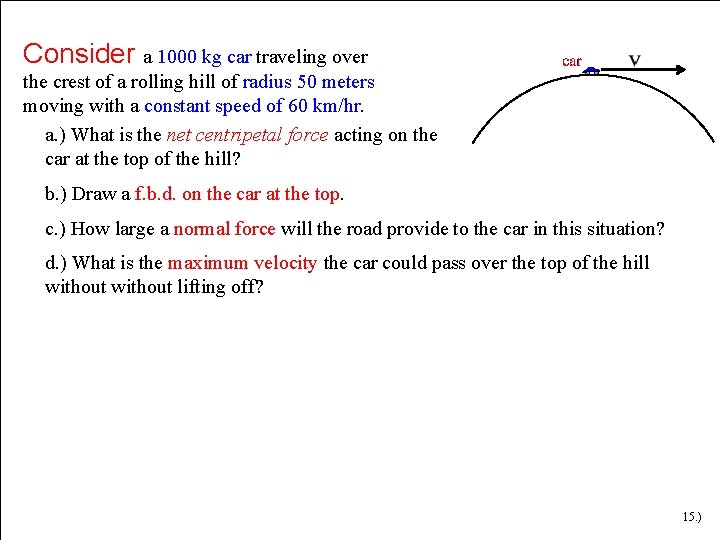
Consider a 1000 kg car traveling over the crest of a rolling hill of radius 50 meters moving with a constant speed of 60 km/hr. a. ) What is the net centripetal force acting on the car at the top of the hill? b. ) Draw a f. b. d. on the car at the top. c. ) How large a normal force will the road provide to the car in this situation? d. ) What is the maximum velocity the car could pass over the top of the hill without lifting off? 15. )
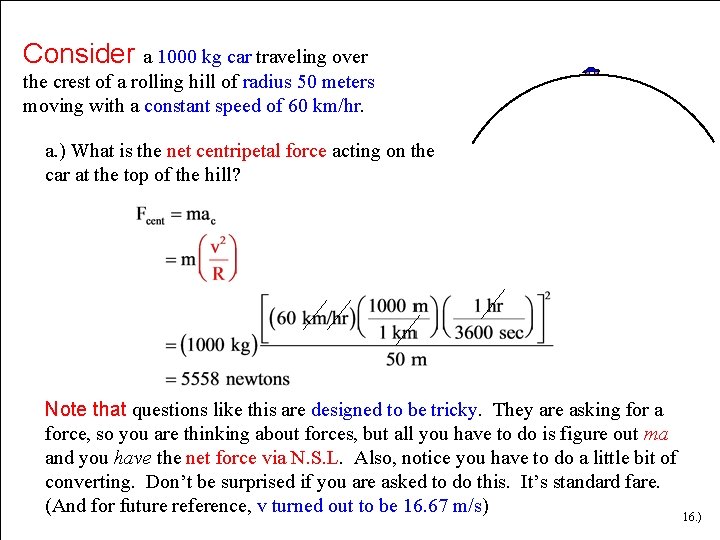
Consider a 1000 kg car traveling over the crest of a rolling hill of radius 50 meters moving with a constant speed of 60 km/hr. a. ) What is the net centripetal force acting on the car at the top of the hill? Note that questions like this are designed to be tricky. They are asking for a force, so you are thinking about forces, but all you have to do is figure out ma and you have the net force via N. S. L. Also, notice you have to do a little bit of converting. Don’t be surprised if you are asked to do this. It’s standard fare. (And for future reference, v turned out to be 16. 67 m/s) 16. )
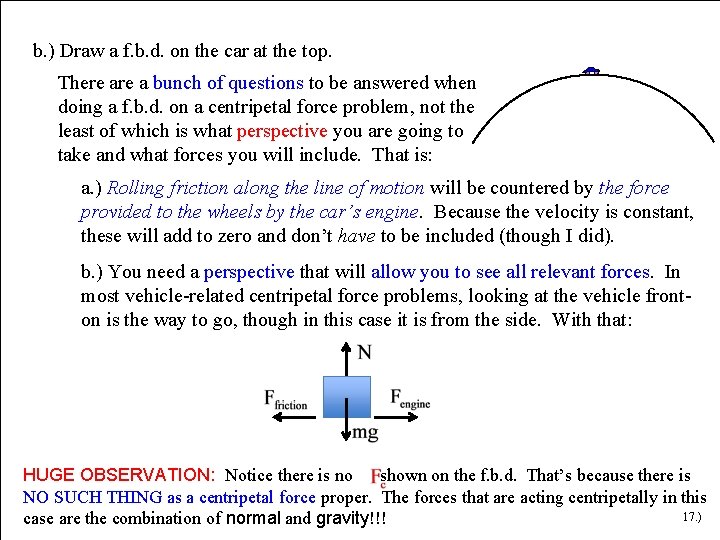
b. ) Draw a f. b. d. on the car at the top. There a bunch of questions to be answered when doing a f. b. d. on a centripetal force problem, not the least of which is what perspective you are going to take and what forces you will include. That is: a. ) Rolling friction along the line of motion will be countered by the force provided to the wheels by the car’s engine. Because the velocity is constant, these will add to zero and don’t have to be included (though I did). b. ) You need a perspective that will allow you to see all relevant forces. In most vehicle-related centripetal force problems, looking at the vehicle fronton is the way to go, though in this case it is from the side. With that: HUGE OBSERVATION: Notice there is no shown on the f. b. d. That’s because there is NO SUCH THING as a centripetal force proper. The forces that are acting centripetally in this 17. ) case are the combination of normal and gravity!!!
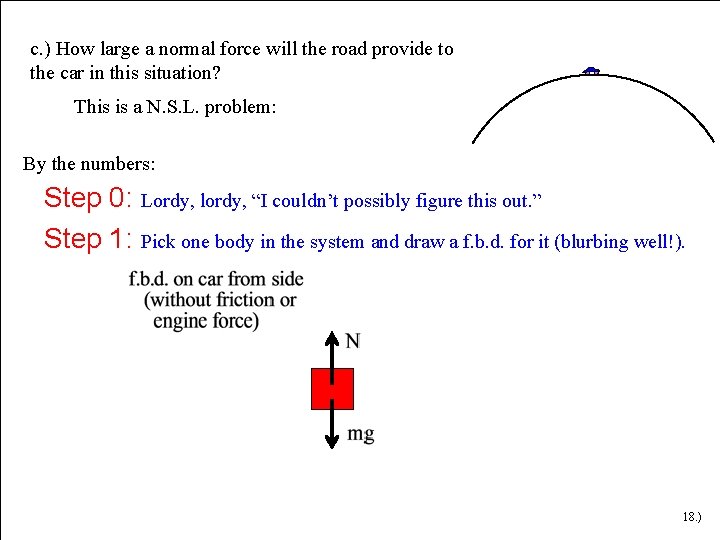
c. ) How large a normal force will the road provide to the car in this situation? This is a N. S. L. problem: By the numbers: Step 0: Lordy, lordy, “I couldn’t possibly figure this out. ” Step 1: Pick one body in the system and draw a f. b. d. for it (blurbing well!). 18. )
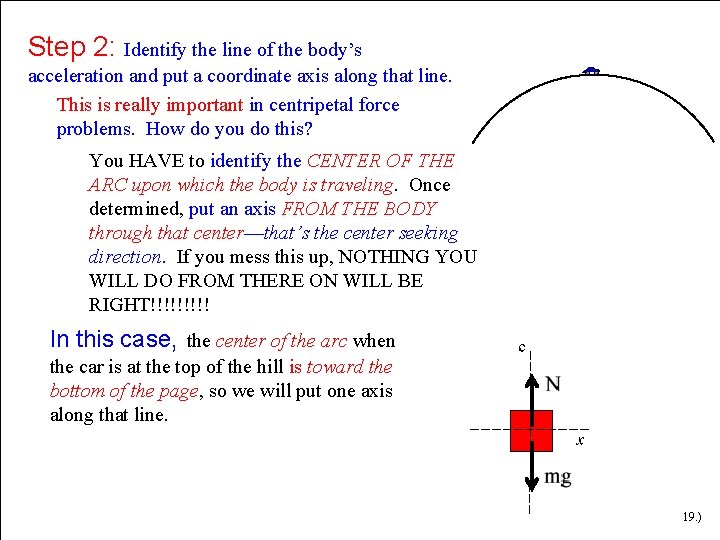
Step 2: Identify the line of the body’s acceleration and put a coordinate axis along that line. This is really important in centripetal force problems. How do you do this? You HAVE to identify the CENTER OF THE ARC upon which the body is traveling. Once determined, put an axis FROM THE BODY through that center—that’s the center seeking direction. If you mess this up, NOTHING YOU WILL DO FROM THERE ON WILL BE RIGHT!!!!! In this case, the center of the arc when the car is at the top of the hill is toward the bottom of the page, so we will put one axis along that line. 19. )
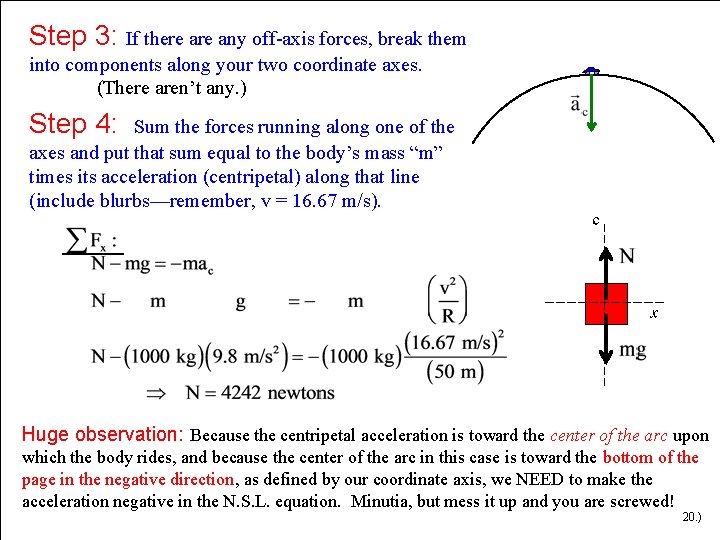
Step 3: If there any off-axis forces, break them into components along your two coordinate axes. (There aren’t any. ) Step 4: Sum the forces running along one of the axes and put that sum equal to the body’s mass “m” times its acceleration (centripetal) along that line (include blurbs—remember, v = 16. 67 m/s). Huge observation: Because the centripetal acceleration is toward the center of the arc upon which the body rides, and because the center of the arc in this case is toward the bottom of the page in the negative direction, as defined by our coordinate axis, we NEED to make the acceleration negative in the N. S. L. equation. Minutia, but mess it up and you are screwed! 20. )
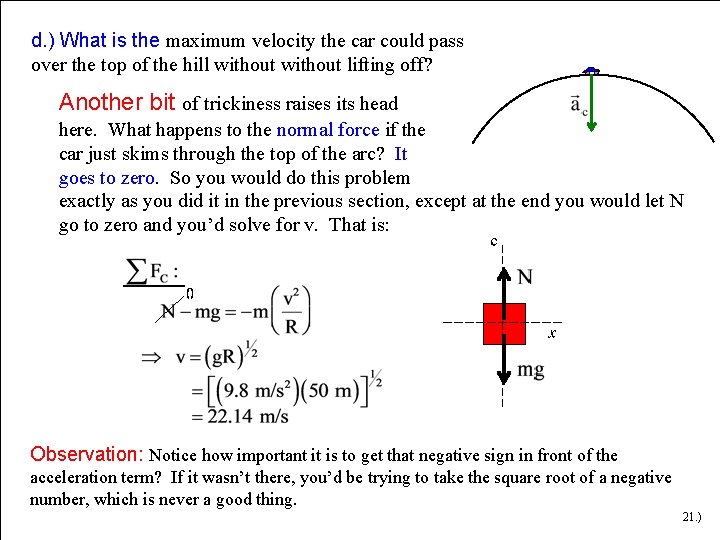
d. ) What is the maximum velocity the car could pass over the top of the hill without lifting off? Another bit of trickiness raises its head here. What happens to the normal force if the car just skims through the top of the arc? It goes to zero. So you would do this problem exactly as you did it in the previous section, except at the end you would let N go to zero and you’d solve for v. That is: Observation: Notice how important it is to get that negative sign in front of the acceleration term? If it wasn’t there, you’d be trying to take the square root of a negative number, which is never a good thing. 21. )
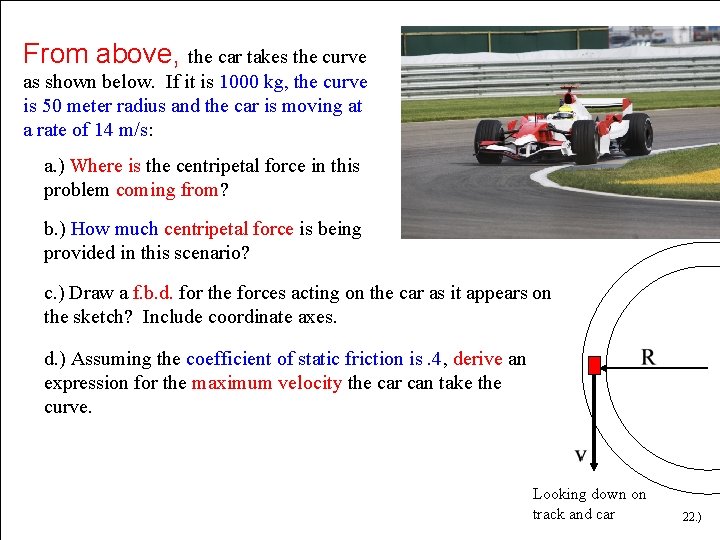
From above, the car takes the curve as shown below. If it is 1000 kg, the curve is 50 meter radius and the car is moving at a rate of 14 m/s: a. ) Where is the centripetal force in this problem coming from? b. ) How much centripetal force is being provided in this scenario? c. ) Draw a f. b. d. for the forces acting on the car as it appears on the sketch? Include coordinate axes. d. ) Assuming the coefficient of static friction is. 4, derive an expression for the maximum velocity the car can take the curve. Looking down on track and car 22. )
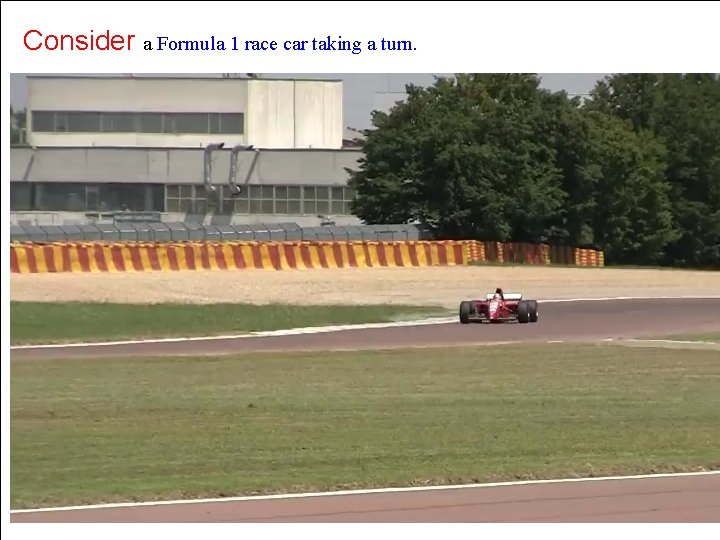
Consider a Formula 1 race car taking a turn. 31. )
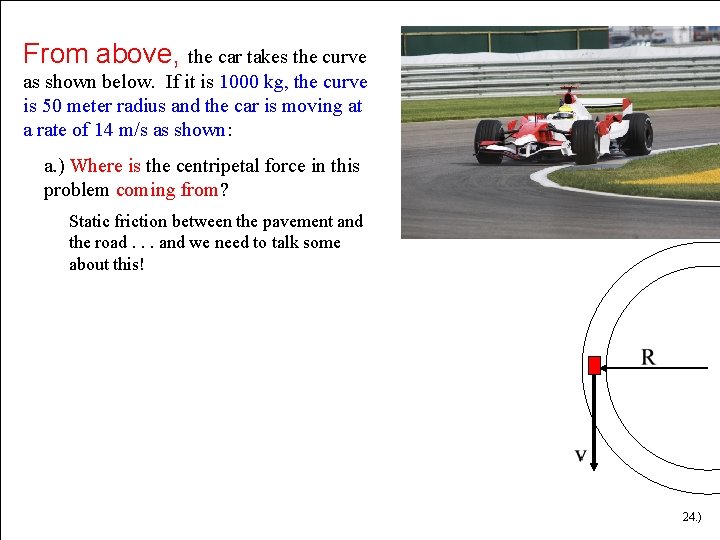
From above, the car takes the curve as shown below. If it is 1000 kg, the curve is 50 meter radius and the car is moving at a rate of 14 m/s as shown: a. ) Where is the centripetal force in this problem coming from? Static friction between the pavement and the road. . . and we need to talk some about this! 24. )
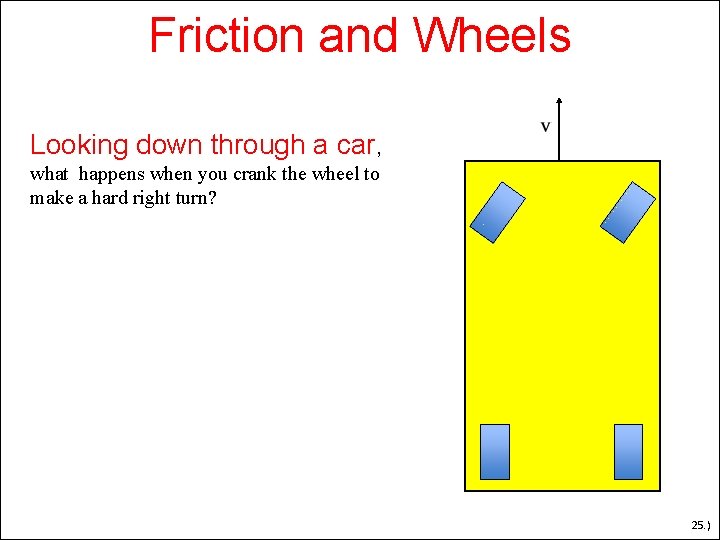
Friction and Wheels Looking down through a car, what happens when you crank the wheel to make a hard right turn? 25. )
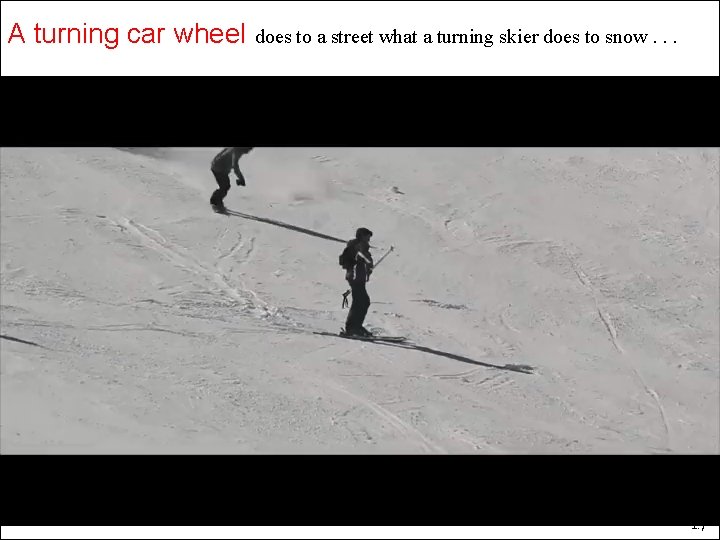
A turning car wheel does to a street what a turning skier does to snow. . . 1. )
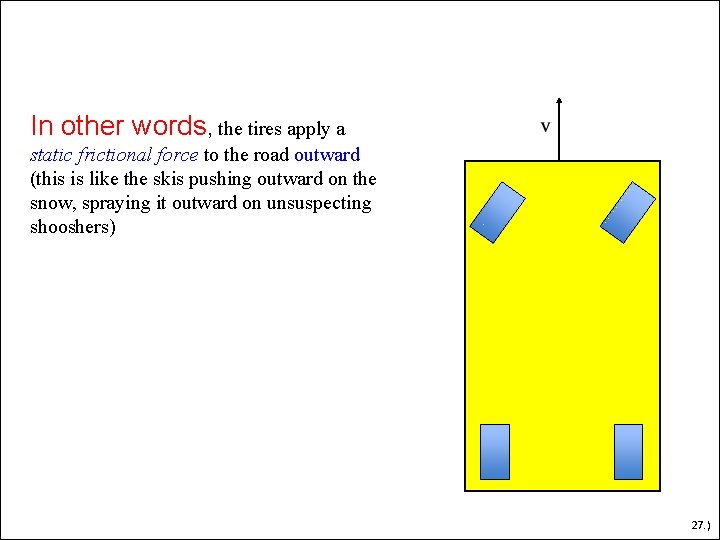
In other words, the tires apply a static frictional force to the road outward (this is like the skis pushing outward on the snow, spraying it outward on unsuspecting shooshers) 27. )
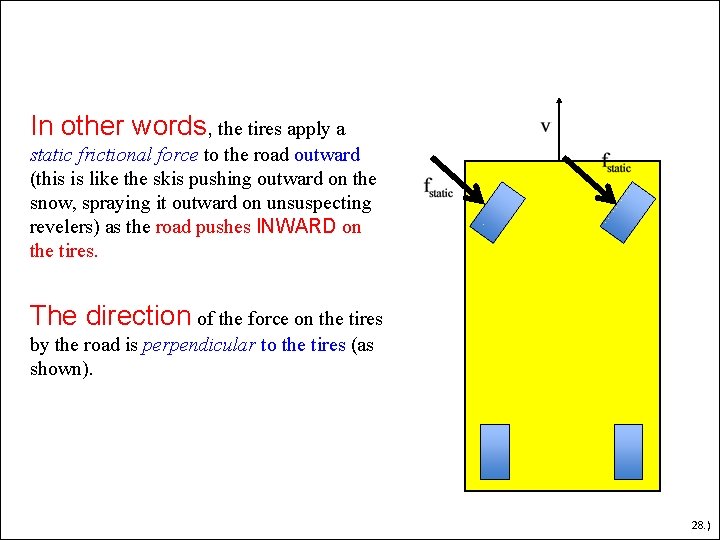
In other words, the tires apply a static frictional force to the road outward (this is like the skis pushing outward on the snow, spraying it outward on unsuspecting revelers) as the road pushes INWARD on the tires. The direction of the force on the tires by the road is perpendicular to the tires (as shown). 28. )
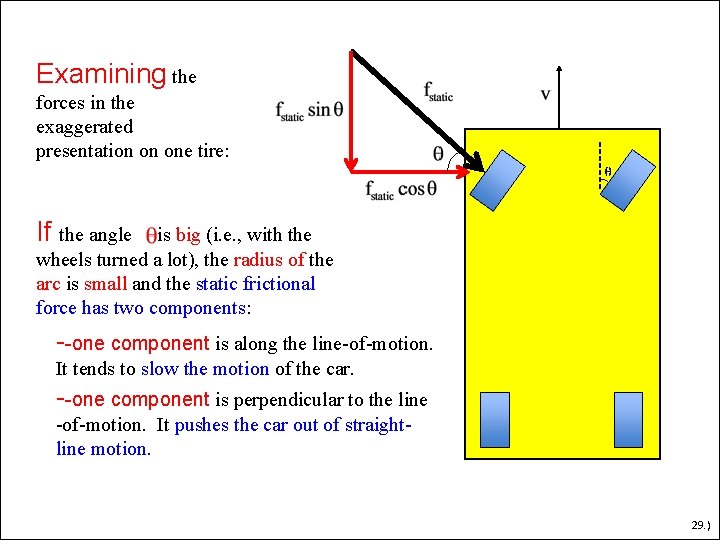
Examining the forces in the exaggerated presentation on one tire: If the angle is big (i. e. , with the wheels turned a lot), the radius of the arc is small and the static frictional force has two components: --one component is along the line-of-motion. It tends to slow the motion of the car. --one component is perpendicular to the line -of-motion. It pushes the car out of straightline motion. 29. )
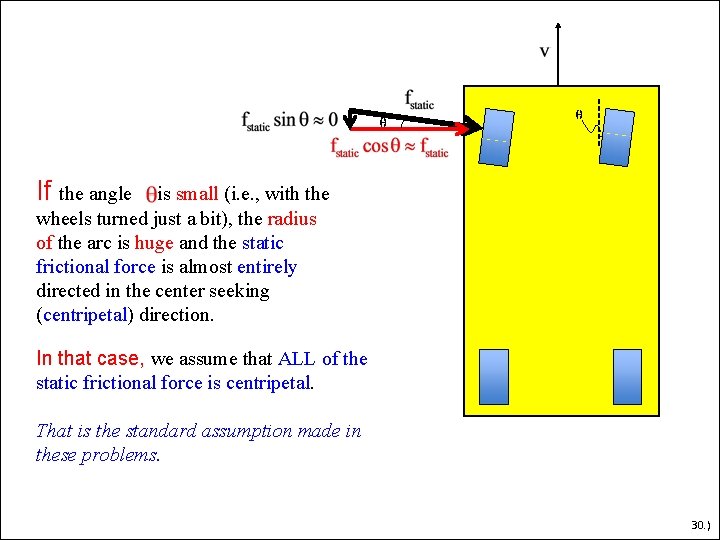
If the angle is small (i. e. , with the wheels turned just a bit), the radius of the arc is huge and the static frictional force is almost entirely directed in the center seeking (centripetal) direction. In that case, we assume that ALL of the static frictional force is centripetal. That is the standard assumption made in these problems. 30. )
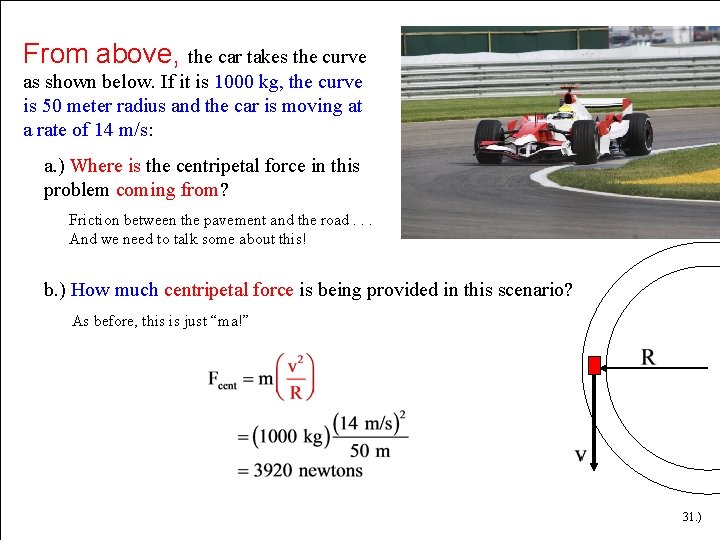
From above, the car takes the curve as shown below. If it is 1000 kg, the curve is 50 meter radius and the car is moving at a rate of 14 m/s: a. ) Where is the centripetal force in this problem coming from? Friction between the pavement and the road. . . And we need to talk some about this! b. ) How much centripetal force is being provided in this scenario? As before, this is just “ma!” 31. )
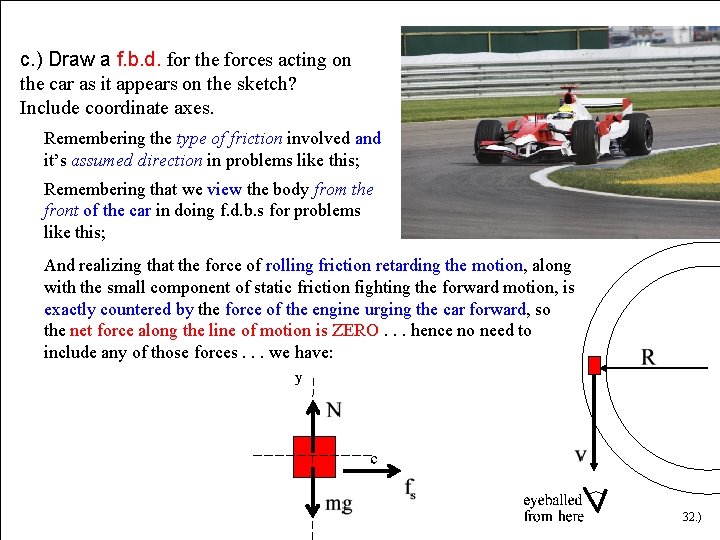
c. ) Draw a f. b. d. for the forces acting on the car as it appears on the sketch? Include coordinate axes. Remembering the type of friction involved and it’s assumed direction in problems like this; Remembering that we view the body from the front of the car in doing f. d. b. s for problems like this; And realizing that the force of rolling friction retarding the motion, along with the small component of static friction fighting the forward motion, is exactly countered by the force of the engine urging the car forward, so the net force along the line of motion is ZERO. . . hence no need to include any of those forces. . . we have: 32. )
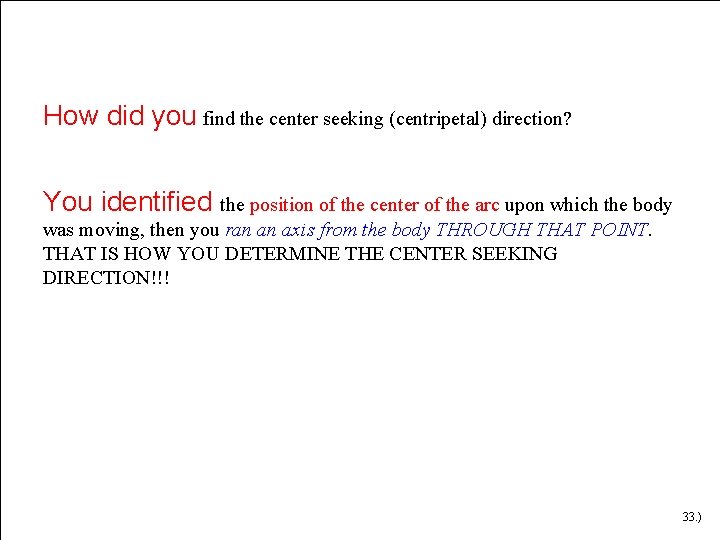
How did you find the center seeking (centripetal) direction? You identified the position of the center of the arc upon which the body was moving, then you ran an axis from the body THROUGH THAT POINT. THAT IS HOW YOU DETERMINE THE CENTER SEEKING DIRECTION!!! 33. )
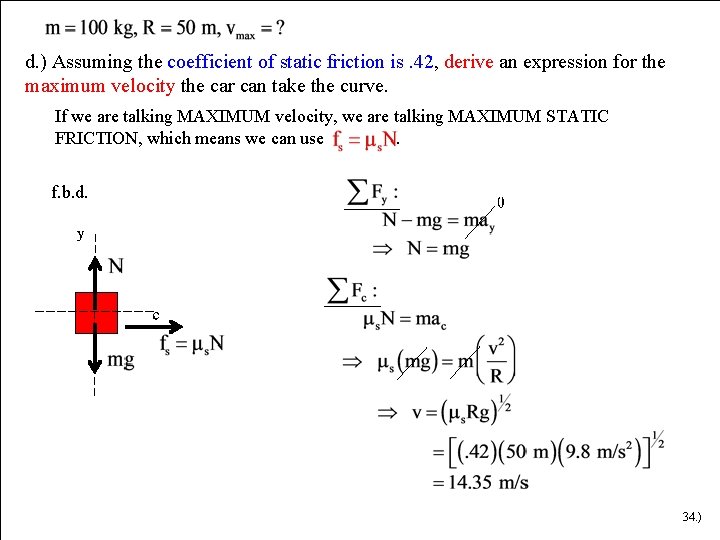
d. ) Assuming the coefficient of static friction is. 42, derive an expression for the maximum velocity the car can take the curve. If we are talking MAXIMUM velocity, we are talking MAXIMUM STATIC FRICTION, which means we can use. f. b. d. 34. )
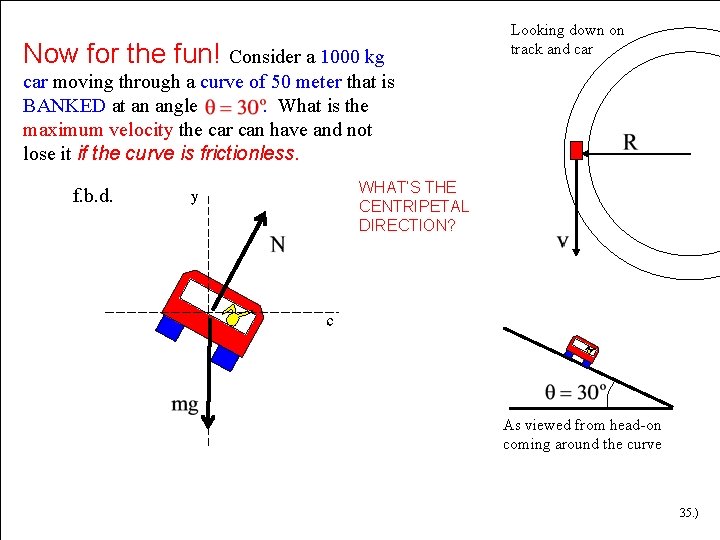
Now for the fun! Consider a 1000 kg Looking down on track and car moving through a curve of 50 meter that is BANKED at an angle. What is the maximum velocity the car can have and not lose it if the curve is frictionless. f. b. d. WHAT’S THE CENTRIPETAL DIRECTION? As viewed from head-on coming around the curve 35. )
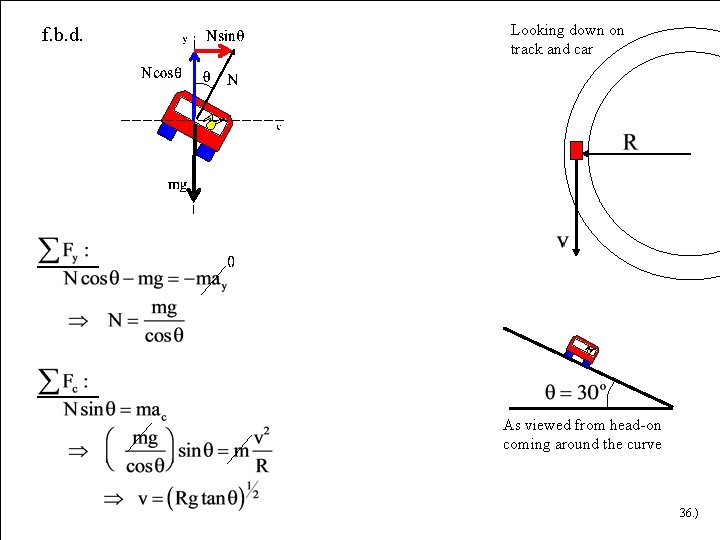
f. b. d. Looking down on track and car As viewed from head-on coming around the curve 36. )
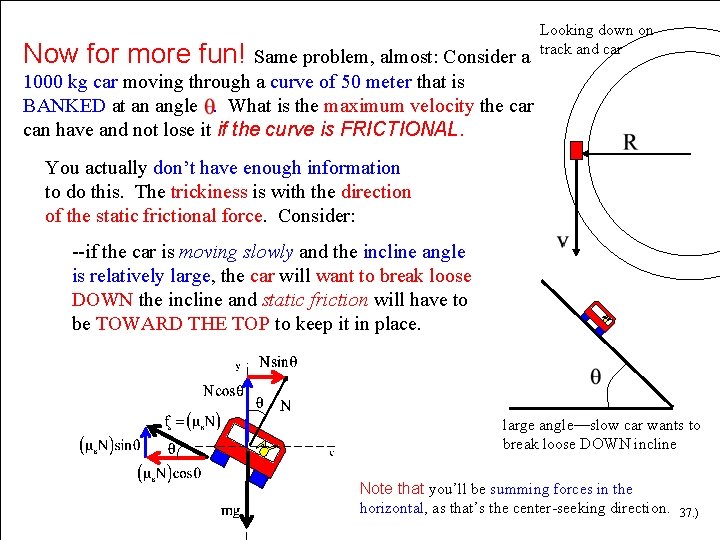
Now for more fun! Same problem, almost: Consider a Looking down on track and car 1000 kg car moving through a curve of 50 meter that is BANKED at an angle. What is the maximum velocity the car can have and not lose it if the curve is FRICTIONAL. You actually don’t have enough information to do this. The trickiness is with the direction of the static frictional force. Consider: --if the car is moving slowly and the incline angle is relatively large, the car will want to break loose DOWN the incline and static friction will have to be TOWARD THE TOP to keep it in place. large angle—slow car wants to break loose DOWN incline Note that you’ll be summing forces in the horizontal, as that’s the center-seeking direction. 37. )
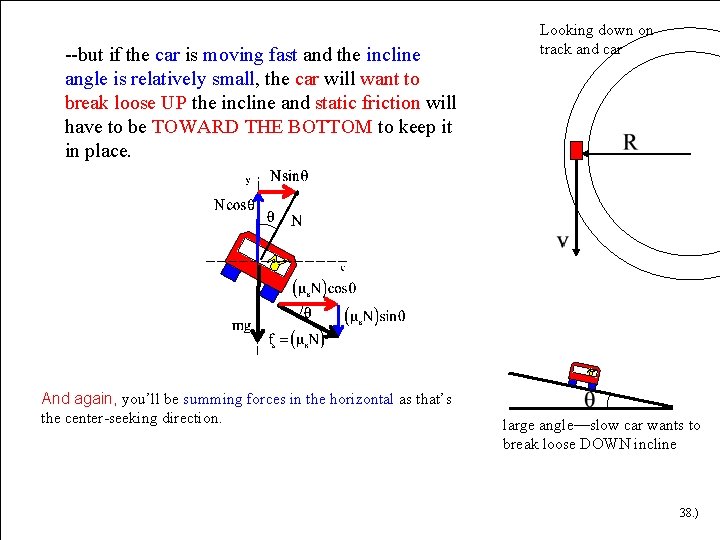
--but if the car is moving fast and the incline angle is relatively small, the car will want to break loose UP the incline and static friction will have to be TOWARD THE BOTTOM to keep it in place. And again, you’ll be summing forces in the horizontal as that’s the center-seeking direction. Looking down on track and car large angle—slow car wants to break loose DOWN incline 38. )
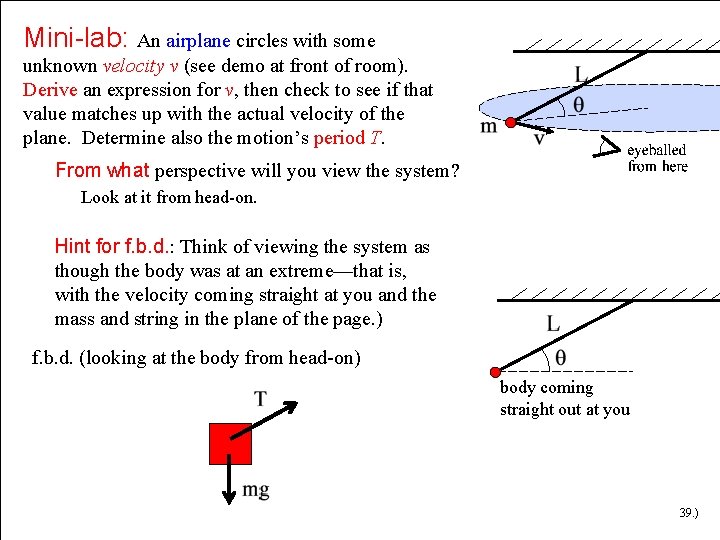
Mini-lab: An airplane circles with some unknown velocity v (see demo at front of room). Derive an expression for v, then check to see if that value matches up with the actual velocity of the plane. Determine also the motion’s period T. From what perspective will you view the system? Look at it from head-on. Hint for f. b. d. : Think of viewing the system as though the body was at an extreme—that is, with the velocity coming straight at you and the mass and string in the plane of the page. ) f. b. d. (looking at the body from head-on) body coming straight out at you 39. )
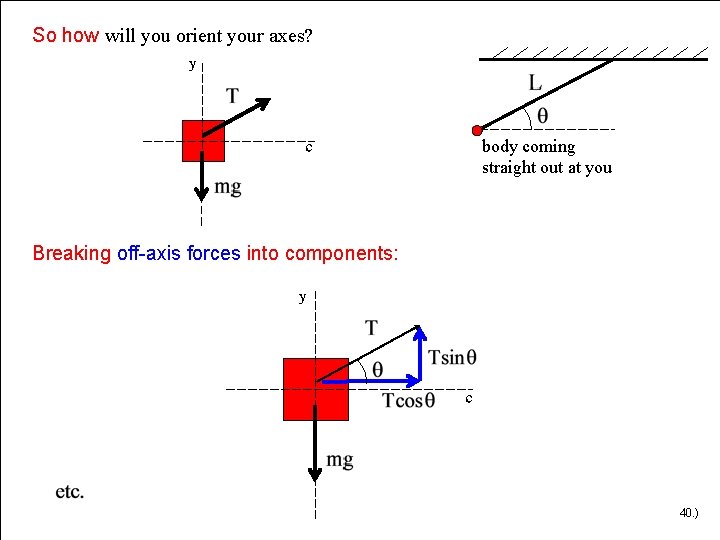
So how will you orient your axes? body coming straight out at you Breaking off-axis forces into components: 40. )
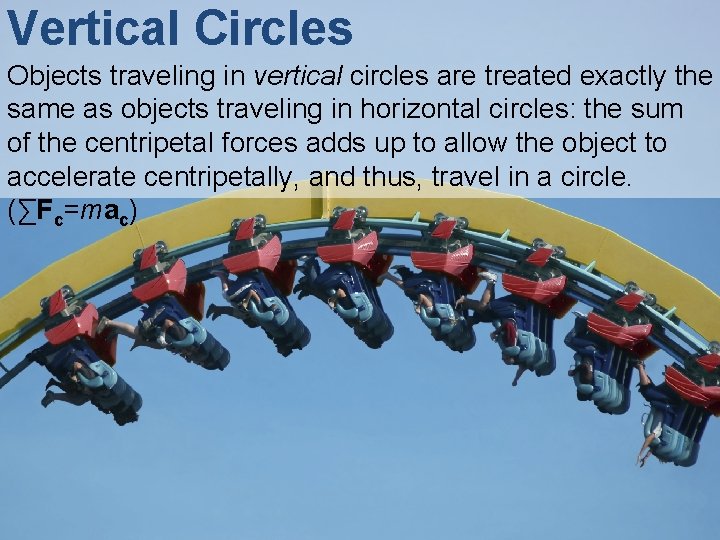
Vertical Circles Objects traveling in vertical circles are treated exactly the same as objects traveling in horizontal circles: the sum of the centripetal forces adds up to allow the object to accelerate centripetally, and thus, travel in a circle. (∑Fc=mac)
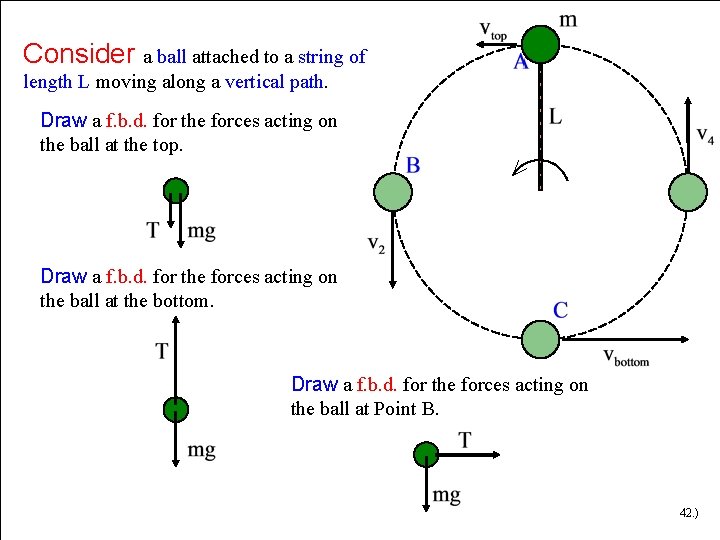
Consider a ball attached to a string of length L moving along a vertical path. Draw a f. b. d. for the forces acting on the ball at the top. Draw a f. b. d. for the forces acting on the ball at the bottom. Draw a f. b. d. for the forces acting on the ball at Point B. 42. )
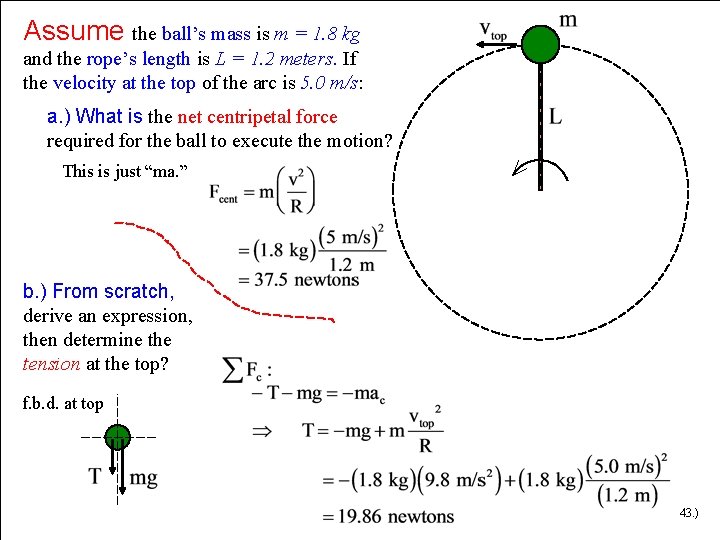
Assume the ball’s mass is m = 1. 8 kg and the rope’s length is L = 1. 2 meters. If the velocity at the top of the arc is 5. 0 m/s: a. ) What is the net centripetal force required for the ball to execute the motion? This is just “ma. ” b. ) From scratch, derive an expression, then determine the tension at the top? f. b. d. at top 43. )
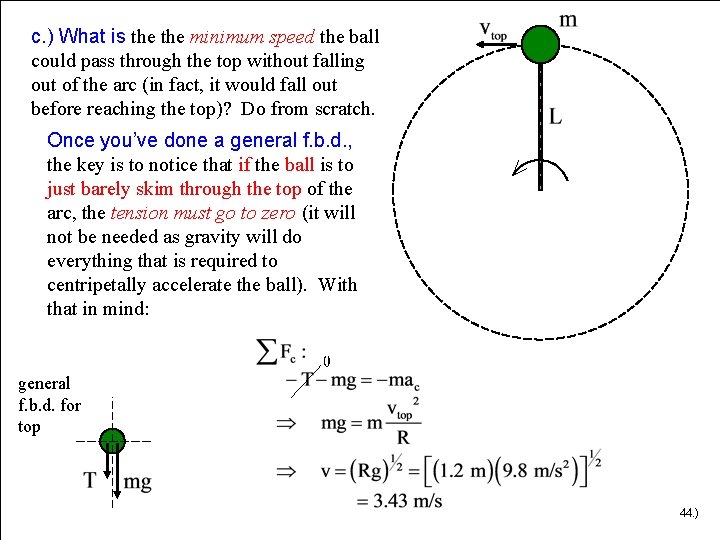
c. ) What is the minimum speed the ball could pass through the top without falling out of the arc (in fact, it would fall out before reaching the top)? Do from scratch. Once you’ve done a general f. b. d. , the key is to notice that if the ball is to just barely skim through the top of the arc, the tension must go to zero (it will not be needed as gravity will do everything that is required to centripetally accelerate the ball). With that in mind: general f. b. d. for top 44. )
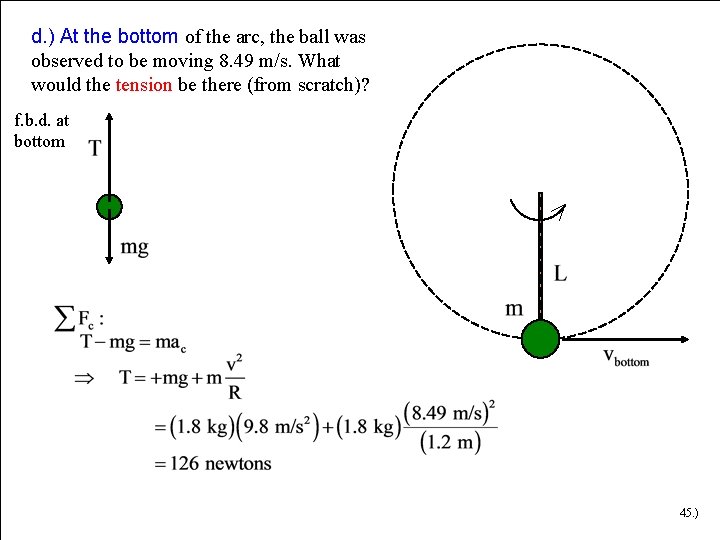
d. ) At the bottom of the arc, the ball was observed to be moving 8. 49 m/s. What would the tension be there (from scratch)? f. b. d. at bottom 45. )
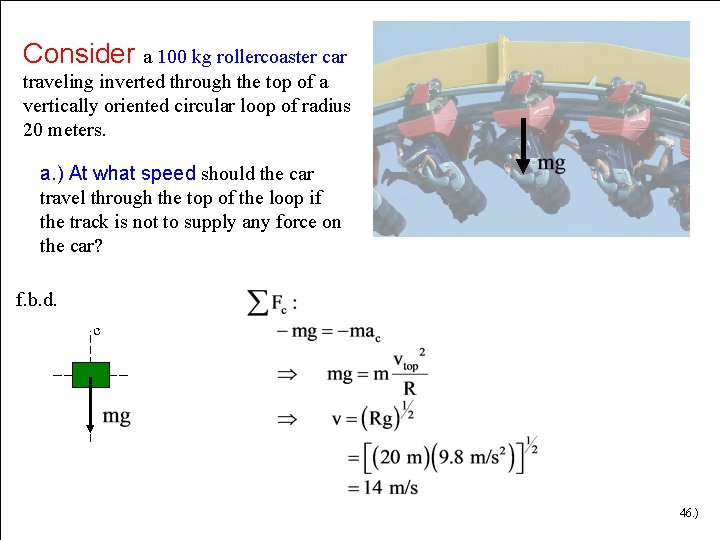
Consider a 100 kg rollercoaster car traveling inverted through the top of a vertically oriented circular loop of radius 20 meters. a. ) At what speed should the car travel through the top of the loop if the track is not to supply any force on the car? f. b. d. 46. )
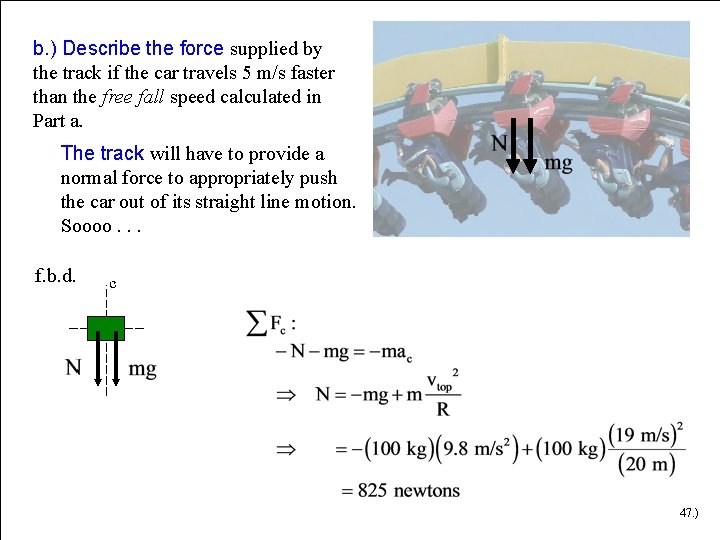
b. ) Describe the force supplied by the track if the car travels 5 m/s faster than the free fall speed calculated in Part a. The track will have to provide a normal force to appropriately push the car out of its straight line motion. Soooo. . . f. b. d. 47. )
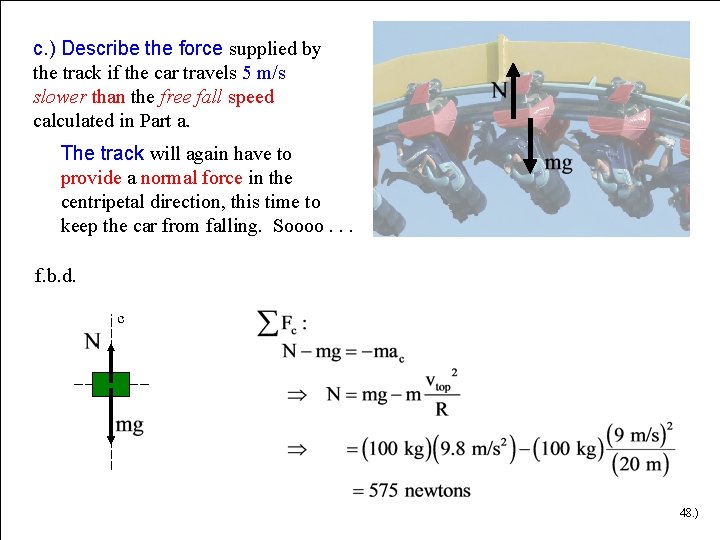
c. ) Describe the force supplied by the track if the car travels 5 m/s slower than the free fall speed calculated in Part a. The track will again have to provide a normal force in the centripetal direction, this time to keep the car from falling. Soooo. . . f. b. d. 48. )
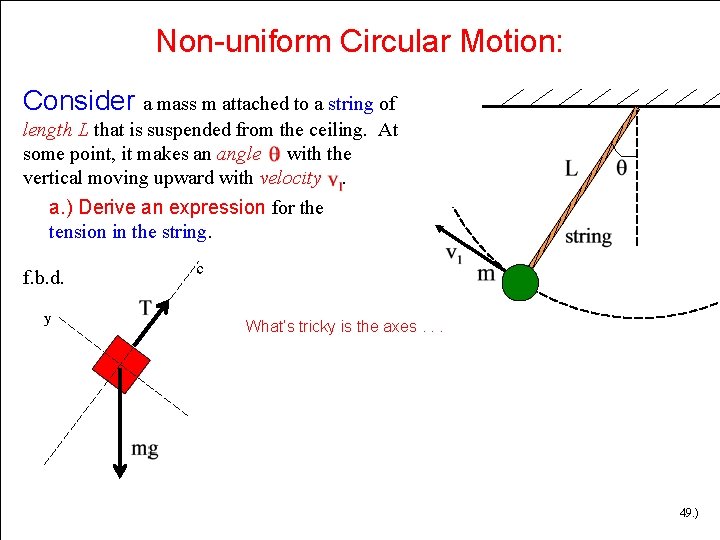
Non-uniform Circular Motion: Consider a mass m attached to a string of length L that is suspended from the ceiling. At some point, it makes an angle with the vertical moving upward with velocity. a. ) Derive an expression for the tension in the string. f. b. d. What’s tricky is the axes. . . 49. )
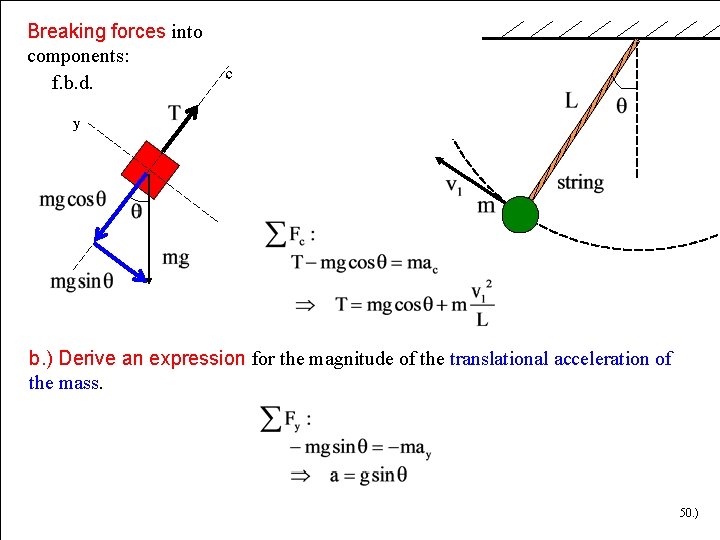
Breaking forces into components: f. b. d. b. ) Derive an expression for the magnitude of the translational acceleration of the mass. 50. )
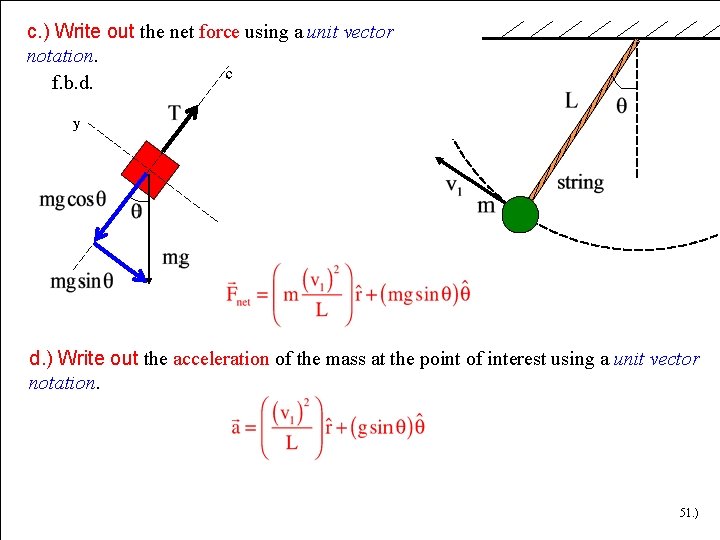
c. ) Write out the net force using a unit vector notation. f. b. d. ) Write out the acceleration of the mass at the point of interest using a unit vector notation. 51. )
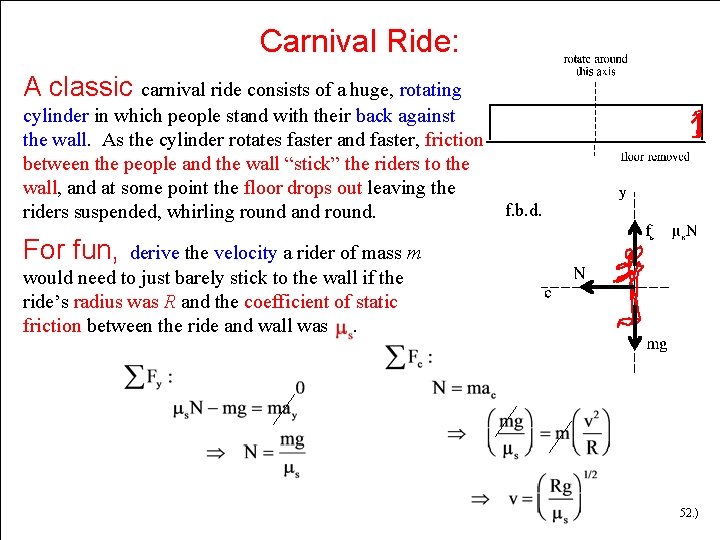
Carnival Ride: A classic carnival ride consists of a huge, rotating cylinder in which people stand with their back against the wall. As the cylinder rotates faster and faster, friction between the people and the wall “stick” the riders to the wall, and at some point the floor drops out leaving the riders suspended, whirling round and round. f. b. d. For fun, derive the velocity a rider of mass m would need to just barely stick to the wall if the ride’s radius was R and the coefficient of static friction between the ride and wall was. 52. )
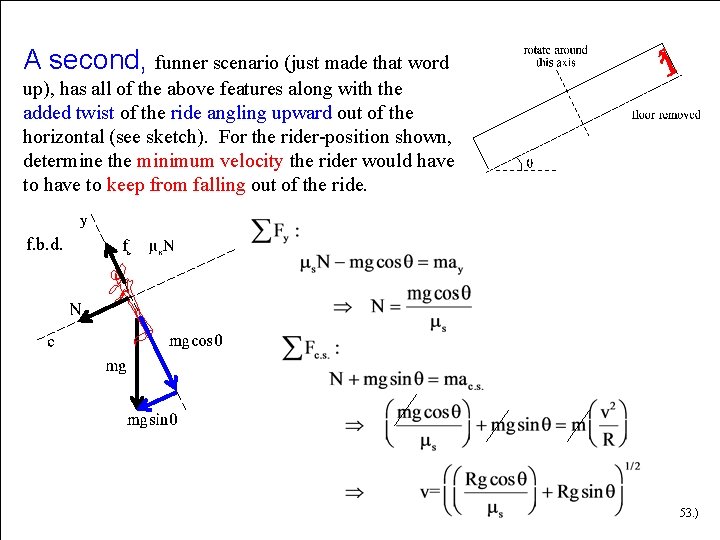
A second, funner scenario (just made that word up), has all of the above features along with the added twist of the ride angling upward out of the horizontal (see sketch). For the rider-position shown, determine the minimum velocity the rider would have to keep from falling out of the ride. f. b. d. 53. )
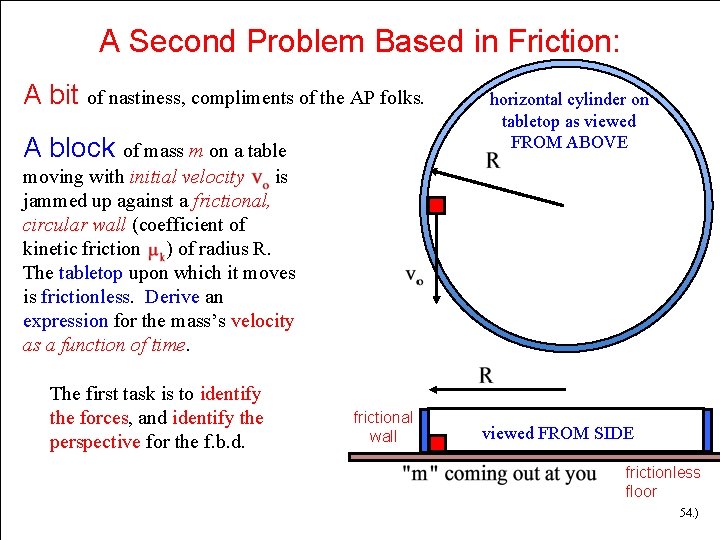
A Second Problem Based in Friction: A bit of nastiness, compliments of the AP folks. A block of mass m on a table horizontal cylinder on tabletop as viewed FROM ABOVE moving with initial velocity is jammed up against a frictional, circular wall (coefficient of kinetic friction ) of radius R. The tabletop upon which it moves is frictionless. Derive an expression for the mass’s velocity as a function of time. The first task is to identify the forces, and identify the perspective for the f. b. d. frictional wall viewed FROM SIDE frictionless floor 54. )
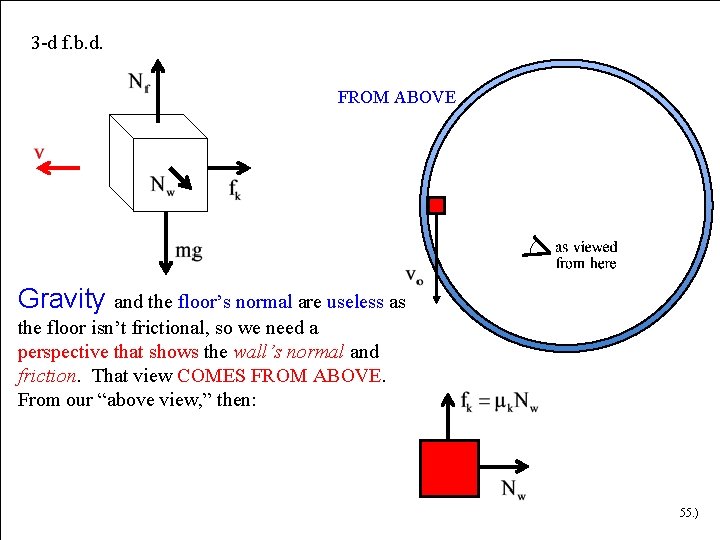
3 -d f. b. d. FROM ABOVE Gravity and the floor’s normal are useless as the floor isn’t frictional, so we need a perspective that shows the wall’s normal and friction. That view COMES FROM ABOVE. From our “above view, ” then: 55. )
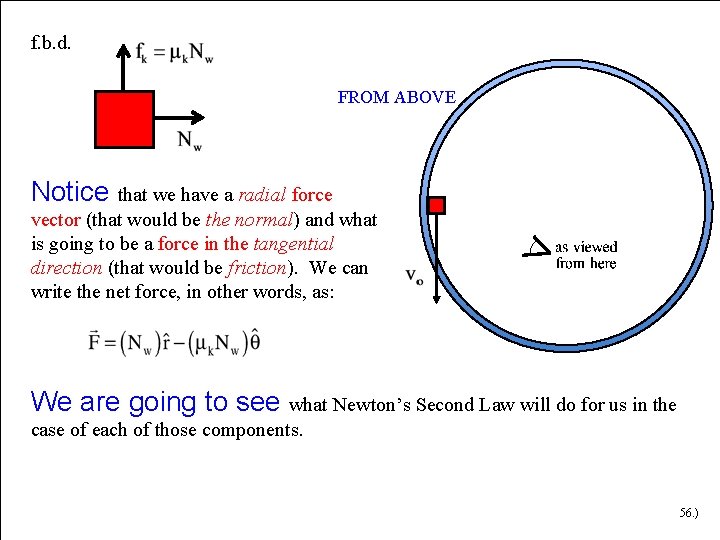
f. b. d. FROM ABOVE Notice that we have a radial force vector (that would be the normal) and what is going to be a force in the tangential direction (that would be friction). We can write the net force, in other words, as: We are going to see what Newton’s Second Law will do for us in the case of each of those components. 56. )
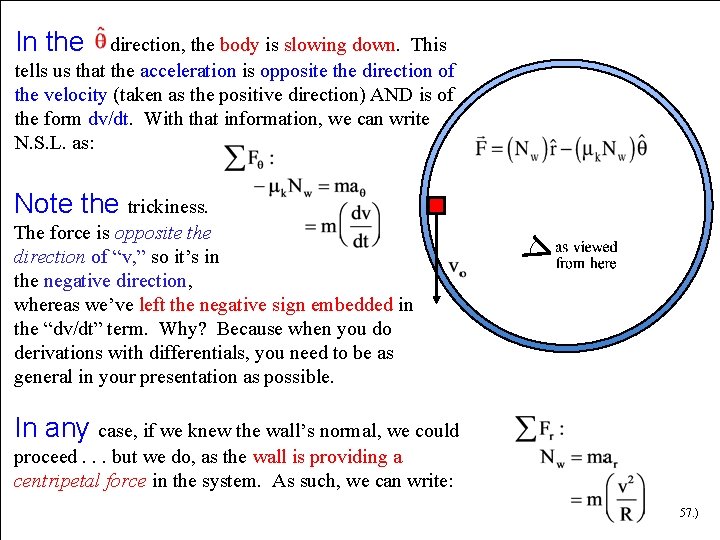
In the direction, the body is slowing down. This tells us that the acceleration is opposite the direction of the velocity (taken as the positive direction) AND is of the form dv/dt. With that information, we can write N. S. L. as: Note the trickiness. The force is opposite the direction of “v, ” so it’s in the negative direction, whereas we’ve left the negative sign embedded in the “dv/dt” term. Why? Because when you do derivations with differentials, you need to be as general in your presentation as possible. In any case, if we knew the wall’s normal, we could proceed. . . but we do, as the wall is providing a centripetal force in the system. As such, we can write: 57. )
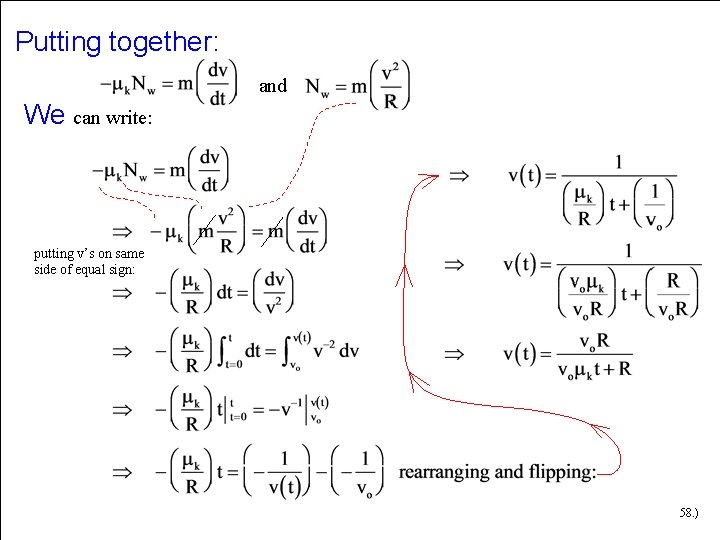
Putting together: and We can write: putting v’s on same side of equal sign: 58. )
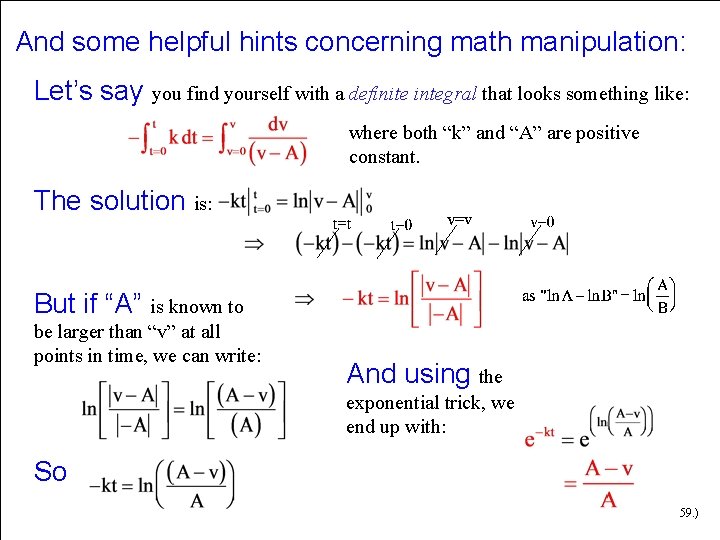
And some helpful hints concerning math manipulation: Let’s say you find yourself with a definite integral that looks something like: where both “k” and “A” are positive constant. The solution is: But if “A” is known to be larger than “v” at all points in time, we can write: And using the exponential trick, we end up with: So 59. )