
CHAPTER 6 Cellular Respiration Obtaining Energy from Food
CHAPTER 6 Cellular Respiration: Obtaining Energy from Food
Biology and Society: Feeling the Burn • When you exercise, – Muscles need energy in order to perform work. – Your cells use oxygen to release energy from the sugar glucose. Copyright © 2007 Pearson Education Inc. , publishing as Pearson Benjamin Cummings
• Aerobic metabolism – Occurs when enough oxygen reaches cells to support energy needs. • Anaerobic metabolism – Occurs when the demand for oxygen outstrips the body’s ability to deliver it. Copyright © 2007 Pearson Education Inc. , publishing as Pearson Benjamin Cummings
• Anaerobic metabolism – Without enough oxygen, muscle cells break down glucose to produce lactic acid. – Lactic acid is associated with the “burn” associated with heavy exercise. – If too much lactic acid builds up, your muscles give out. Copyright © 2007 Pearson Education Inc. , publishing as Pearson Benjamin Cummings
Energy Flow and Chemical Cycling in the Biosphere • Fuel molecules in food represent solar energy. – Energy stored in food can be traced back to the sun. • Animals depend on plants to convert solar energy to chemical energy. – This chemical energy is in the form of sugars and other organic molecules. Copyright © 2007 Pearson Education Inc. , publishing as Pearson Benjamin Cummings
• Autotrophs – Are “self-feeders. ” – Include plants and other organisms that make all their own organic matter from inorganic nutrients. • Heterotrophs – Are “other-feeders. ” – Include humans and other animals that cannot make organic molecules from inorganic ones. Copyright © 2007 Pearson Education Inc. , publishing as Pearson Benjamin Cummings
• Producers – Biologists refer to plants and other autotrophs as the producers in an ecosystem. • Consumers – Heterotrophs are consumers, because they eat plants or other animals. Copyright © 2007 Pearson Education Inc. , publishing as Pearson Benjamin Cummings
Chemical Cycling between Photosynthesis and Cellular Respiration • The ingredients for photosynthesis: – CO 2 is obtained from the air by a plant’s leaves. – H 2 O is obtained from the damp soil by a plant’s roots. • Chloroplasts rearrange the atoms of these ingredients to produce sugars (glucose) and other organic molecules. • Oxygen gas is a by-product of photosynthesis.
Chemical Cycling between Photosynthesis and Cellular Respiration • The ingredients for cellular respiration: – Glucose from food consumed by the organism – Oxygen from inhaling air • Mitochondria rearrange the glucose (C 6 H 12 O 6) break bonds, releasing the energy in the electrons – Lower energy particles like CO 2 are waste products of cellular respiration – Water collects electrons and takes them out of the body. Copyright © 2007 Pearson Education Inc. , publishing as Pearson Benjamin Cummings
• Both plants and animals perform cellular respiration. – Cellular respiration is a chemical process that harvests energy from organic molecules. – Cellular respiration occurs in mitochondria. • The waste products of cellular respiration, CO 2 and H 2 O, are used in photosynthesis. Copyright © 2007 Pearson Education Inc. , publishing as Pearson Benjamin Cummings
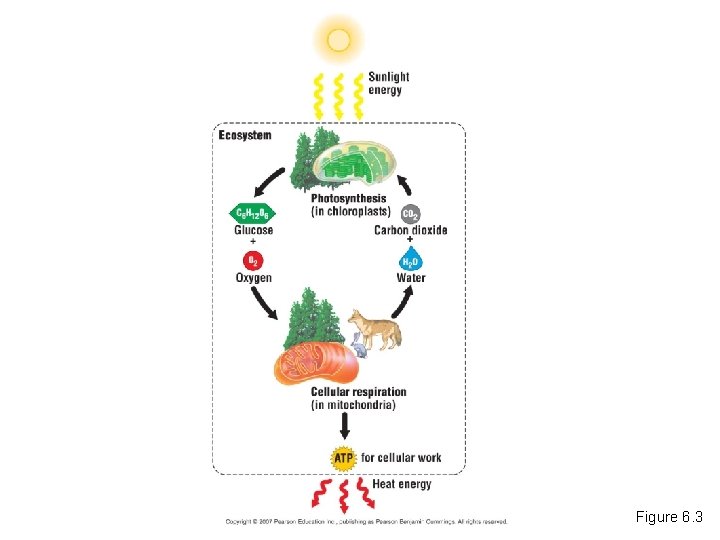
Figure 6. 3
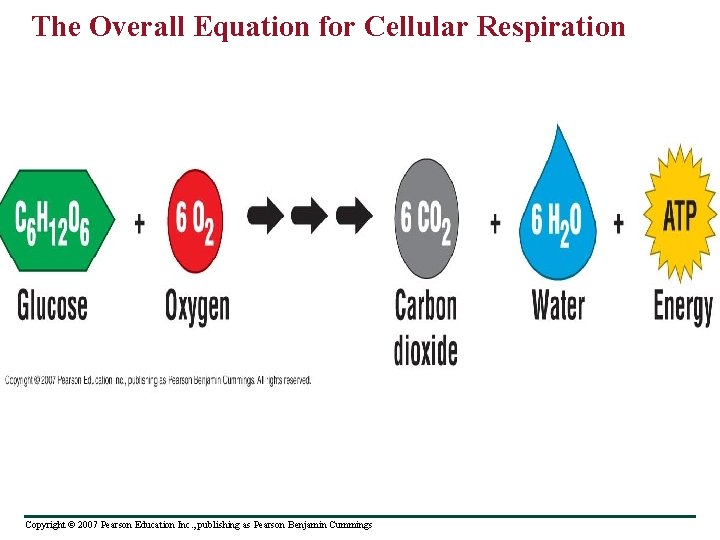
The Overall Equation for Cellular Respiration Copyright © 2007 Pearson Education Inc. , publishing as Pearson Benjamin Cummings
Cellular Respiration: Aerobic Harvest of Food Energy • Cellular respiration – Is the main way that chemical energy is harvested from food and converted to ATP. – Is an aerobic process—it requires oxygen. – Three parts • Glycolosis • Citric Acid (Krebs) Cycle • Electron Transport ( Oxidative Phosphorylation) Copyright © 2007 Pearson Education Inc. , publishing as Pearson Benjamin Cummings
• Specifically Glucose goes from 1 SIX carbon molecule to 2 three carbon (Glycolosis) • Those 2 three carbon molecules turn into 6 CO 2 (Krebs Cycle) • Bonds formed by electrons are broken. The electron keeps the energy, buzzes around and causes a concentration gradient to form in the Inner Membrane space (Electron Transport Chain) • An enzyme, ATP Synthase, uses that gradient to make ATP. • The now calm electron is picked up by oxygen, grabs two hydrogens (that has just helped make ATP) and makes Water. Copyright © 2007 Pearson Education Inc. , publishing as Pearson Benjamin Cummings
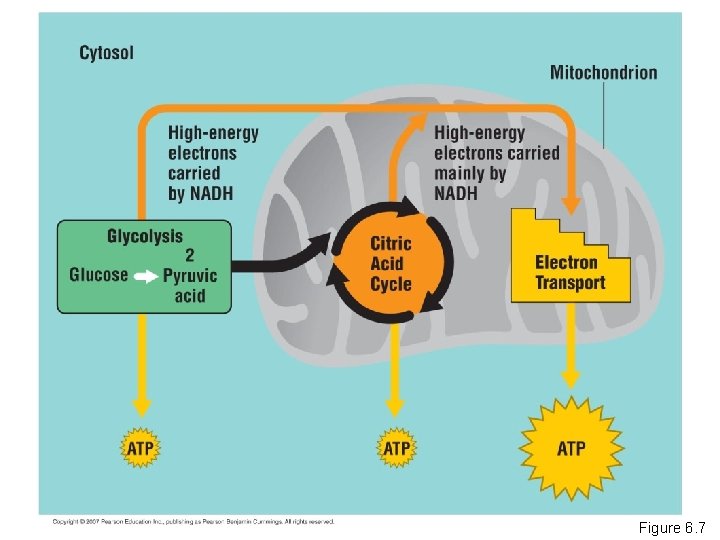
Figure 6. 7
Oxygen The Role of in Cellular Respiration • During cellular respiration, hydrogen and its bonding electrons change partners. – Hydrogen and its electrons go from sugar to oxygen, forming water. • Oxidation-reduction reactions are : chemical reactions that transfer electrons from one substance to another. – Or redox reactions for short. Copyright © 2007 Pearson Education Inc. , publishing as Pearson Benjamin Cummings
• The loss of electrons during a redox reaction is called oxidation. • The gaining of electrons during a redox reaction is called reduction. • LEO says GER Copyright © 2007 Pearson Education Inc. , publishing as Pearson Benjamin Cummings
• Why does electron transfer to oxygen release energy? – When electrons move from glucose to oxygen, it is as though they were falling. – This “fall” of electrons releases energy during cellular respiration. Copyright © 2007 Pearson Education Inc. , publishing as Pearson Benjamin Cummings
Stage 1: Glycolysis • A molecule of glucose is split into two molecules of pyruvic acid. • Glycolysis breaks a six-carbon glucose into two three-carbon molecules. – These molecules then donate high energy electrons to NAD+, forming NADH. Copyright © 2007 Pearson Education Inc. , publishing as Pearson Benjamin Cummings
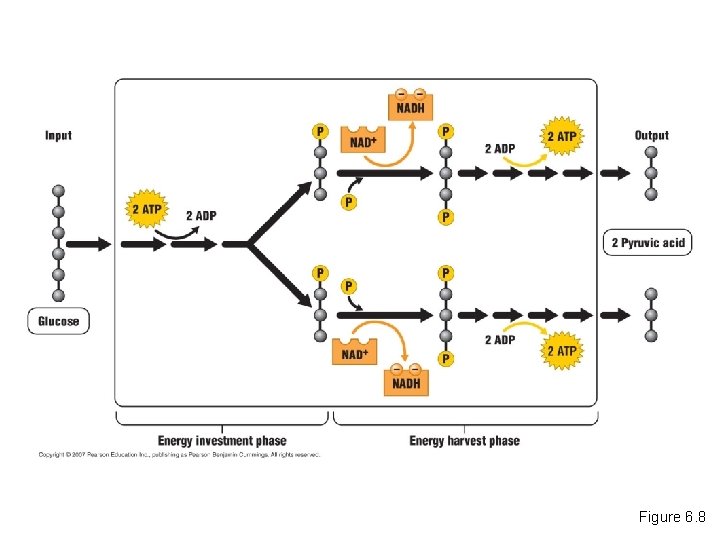
Figure 6. 8
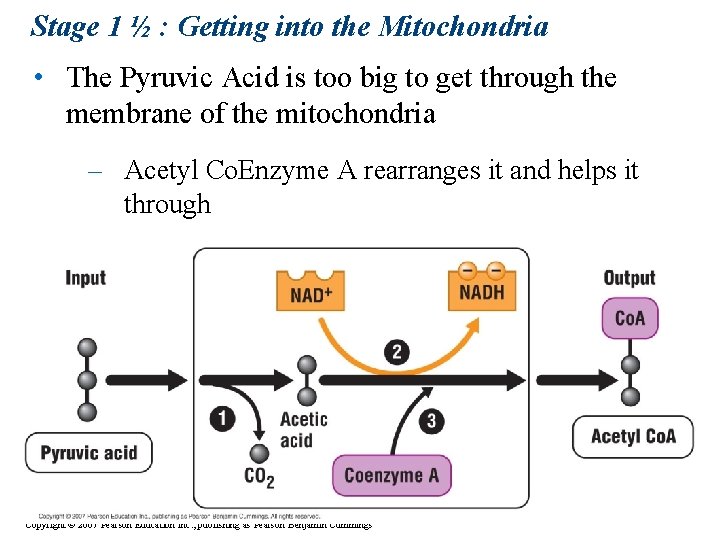
Stage 1 ½ : Getting into the Mitochondria • The Pyruvic Acid is too big to get through the membrane of the mitochondria – Acetyl Co. Enzyme A rearranges it and helps it through Copyright © 2007 Pearson Education Inc. , publishing as Pearson Benjamin Cummings
Stage 2: The Citric Acid Cycle • The citric acid cycle completes the breakdown of sugar. • The citric acid cycle extracts the energy of sugar by breaking the acetic acid molecules all the way down to CO 2. – The cycle uses some of this energy to make ATP. – The cycle also forms NADH and FADH 2. Copyright © 2007 Pearson Education Inc. , publishing as Pearson Benjamin Cummings
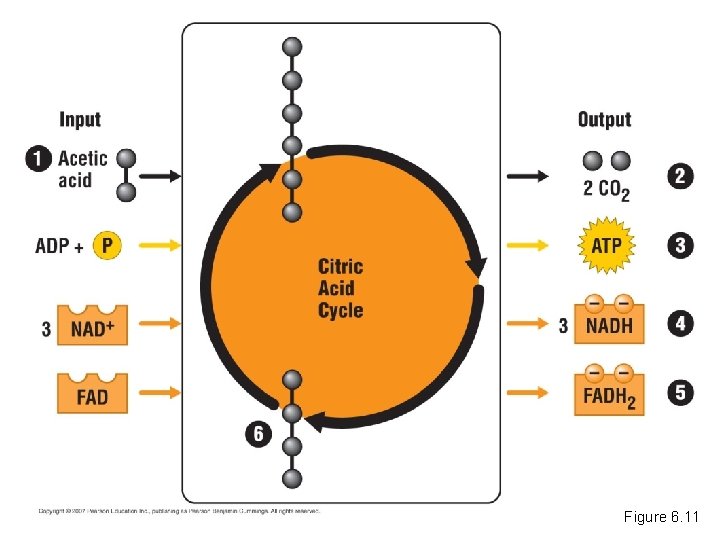
Figure 6. 11
Stage 3: Electron Transport • Electron transport releases the energy your cells need to make most of their ATP. • The molecules of electron transport chains are built into the inner membranes of mitochondria. – The chain functions as a chemical machine that uses energy released by the “fall” of electrons to pump hydrogen ions across the inner mitochondrial membrane. – These ions store potential energy. – (concentration gradient) Copyright © 2007 Pearson Education Inc. , publishing as Pearson Benjamin Cummings
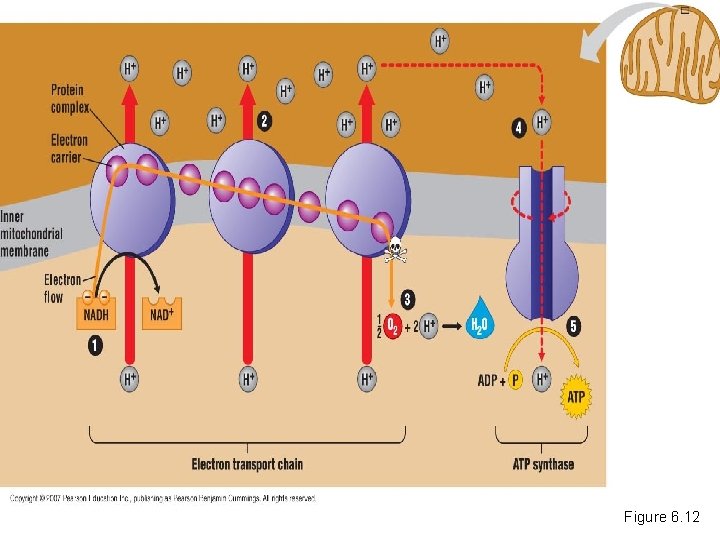
Figure 6. 12
• When the hydrogen ions flow back through the membrane, they release energy. – The ions flow through ATP synthase. – ATP synthase takes the energy from this flow, and synthesizes ATP. Copyright © 2007 Pearson Education Inc. , publishing as Pearson Benjamin Cummings
The Versatility of Cellular Respiration • Do you only eat GLUCOSE? • NO!!!!! • Cellular respiration can “burn” other kinds of molecules besides glucose: – Diverse types of carbohydrates – Fats – Proteins Copyright © 2007 Pearson Education Inc. , publishing as Pearson Benjamin Cummings
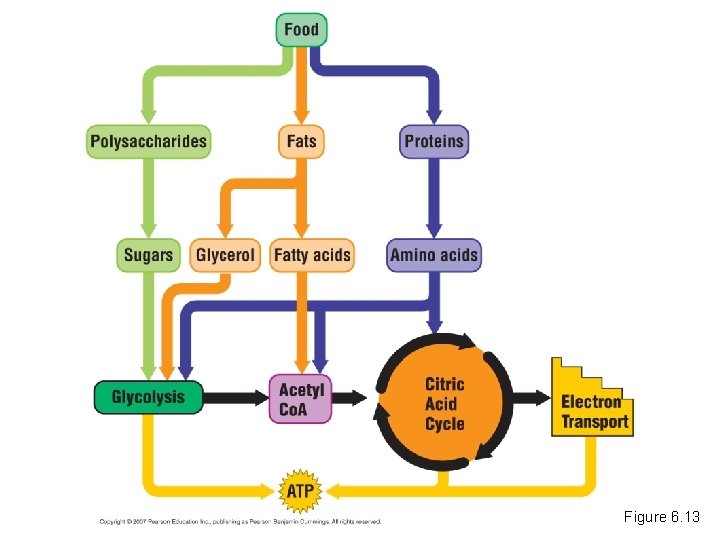
Figure 6. 13
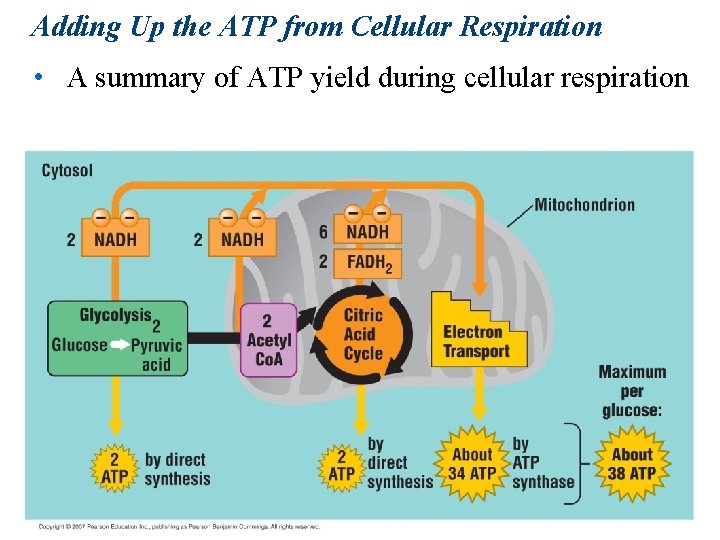
Adding Up the ATP from Cellular Respiration • A summary of ATP yield during cellular respiration Copyright © 2007 Pearson Education Inc. , publishing as Pearson Benjamin Cummings
Fermentation: Anaerobic Harvest of Food Energy • Some of your cells can actually work for short periods without oxygen. • Fermentation – Is the anaerobic harvest of food energy. Copyright © 2007 Pearson Education Inc. , publishing as Pearson Benjamin Cummings
Fermentation in Human Muscle Cells • After functioning anaerobically for about 15 seconds, – Muscle cells will begin to generate ATP by the process of fermentation. • Fermentation relies on glycolysis to produce ATP. • Lactic Acid is the waste product Copyright © 2007 Pearson Education Inc. , publishing as Pearson Benjamin Cummings
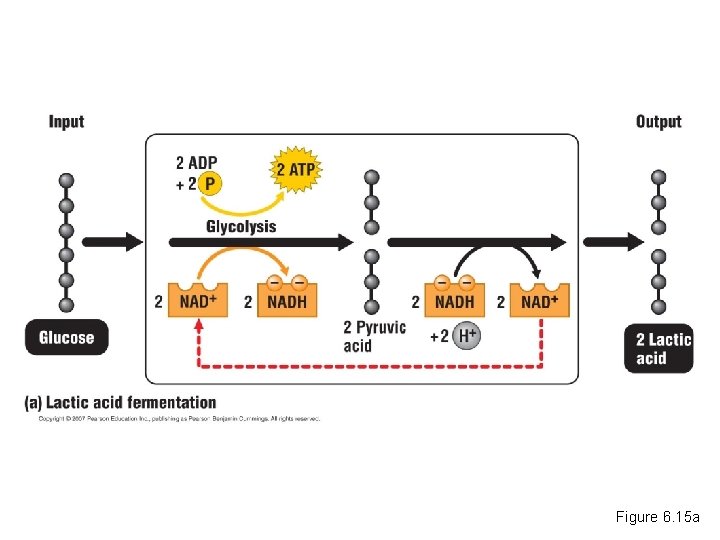
Figure 6. 15 a
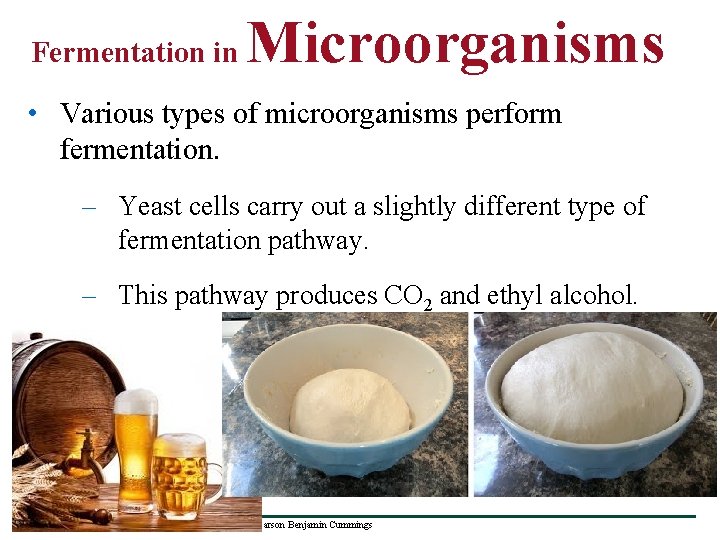
Fermentation in Microorganisms • Various types of microorganisms perform fermentation. – Yeast cells carry out a slightly different type of fermentation pathway. – This pathway produces CO 2 and ethyl alcohol. Copyright © 2007 Pearson Education Inc. , publishing as Pearson Benjamin Cummings
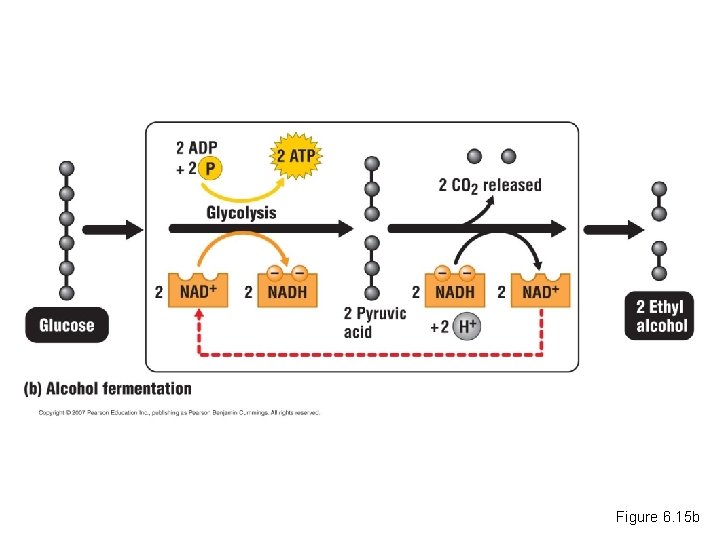
Figure 6. 15 b
Yeast Lab 1. Two Balloons – STRETCH! 2. 30 ml warm water, teaspoon of yeast, sugar a) Either one teaspoon of sugar and then two b) Or, one teaspoon dextrose, one sucrose 3. Mix together in graduated cylinder 4. Using a funnel, Pour in balloon, tie 5. Label, measure volume by displacement Copyright © 2007 Pearson Education Inc. , publishing as Pearson Benjamin Cummings
- Slides: 35