
Chapter 6 Cash Flow Statement in a Tour
- Slides: 25
Chapter 6 Cash Flow Statement in a Tour Business
Purpose of the Cash Flow Statement The primary purpose of the cash flow statement is to provide information about the company’s cash receipts and cash payment during a period. A secondary objective is to provide information about its operating, investing, and financing activities.
To summarize, a cash flow statement provides answers to the following questions: - What did the cash come from during the period? - What was the cash used for during the period? - What was the change in the cash balance during the period?
Classification of Cash Flow The cash flow statement classifies cash receipts (cash inflows) and cash payments (cash outflows) as 3 main sources: - Operating activities - Investing activities - Financing activities
Operating activities The cash effects of transactions that create revenues and expenses. They thus enter into the determination of net income. This category is the most important because it shows the cash provided by company operations. This source is generally considered to be the best measure of a company’s ability to generate sufficient cash to continue its operation.
The examples of cash inflows and outflows related to operating activities are: Cash inflows: - Cash from sales of services or goods Cash outflows: - Payment to suppliers for merchandize inventory - Salaries expense - Utilities expense - Advertising expense etc.
Investing activities include: - Acquiring and disposing of investments and productive long-lived assets; and - Lending money and collecting loans
The examples of cash inflows and outflows related to operating activities are: Cash inflows: - From sales of equipment - From sales of long-term investment - From collecting of loans Cash outflows: - Purchase of equipment - Purchase of long-term investment - Provide loans (lending money) to other entities
Financing activities include: - Obtaining cash from issuing debt and repaying the amounts borrowed; and - Obtaining cash from stockholders and providing them with a return on their investment (dividends).
The examples of cash inflows and outflows related to operating activities are: Cash inflows: - From sale of company’s own stock - From issuance of debt (bonds and notes) Cash outflows: - Payment of dividends to stockholders
Preparation of a Cash Flow Statement The information needed for a preparation of a cash flow statement comes from 3 main sources: (1) Comparative balance sheet (2) Current income statement (3) Additional information
There are 2 methods to prepare a cash flow statement: - Direct method - Indirect method
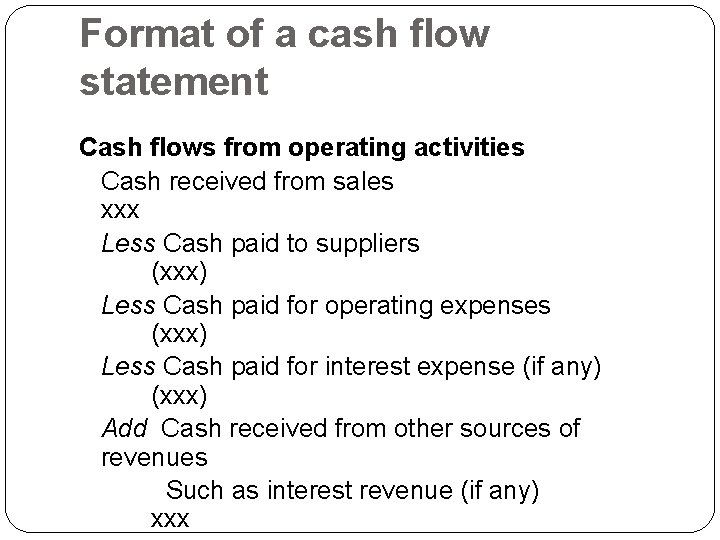
Format of a cash flow statement Cash flows from operating activities Cash received from sales xxx Less Cash paid to suppliers (xxx) Less Cash paid for operating expenses (xxx) Less Cash paid for interest expense (if any) (xxx) Add Cash received from other sources of revenues Such as interest revenue (if any) xxx
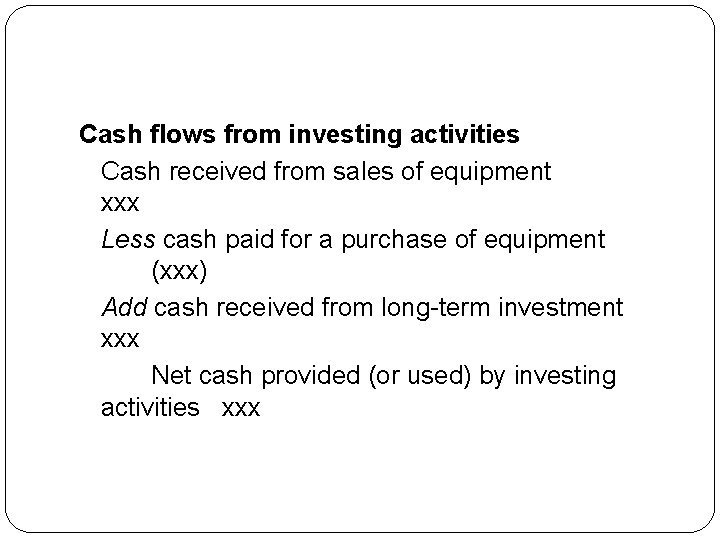
Cash flows from investing activities Cash received from sales of equipment xxx Less cash paid for a purchase of equipment (xxx) Add cash received from long-term investment xxx Net cash provided (or used) by investing activities xxx
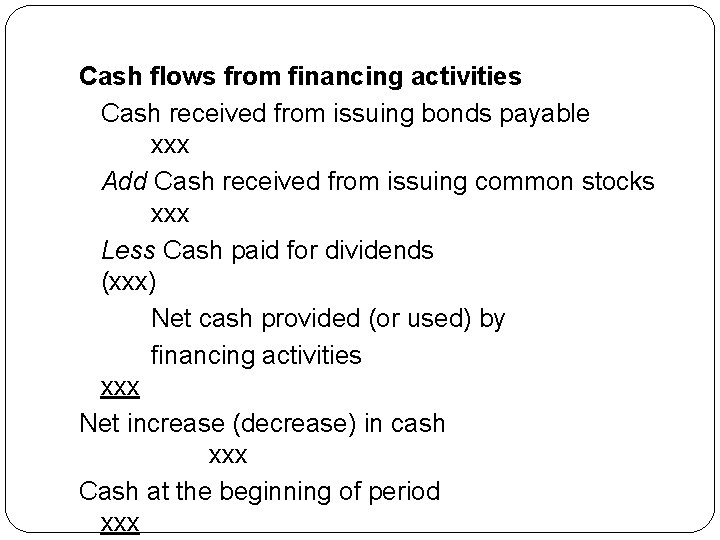
Cash flows from financing activities Cash received from issuing bonds payable xxx Add Cash received from issuing common stocks xxx Less Cash paid for dividends (xxx) Net cash provided (or used) by financing activities xxx Net increase (decrease) in cash xxx Cash at the beginning of period xxx
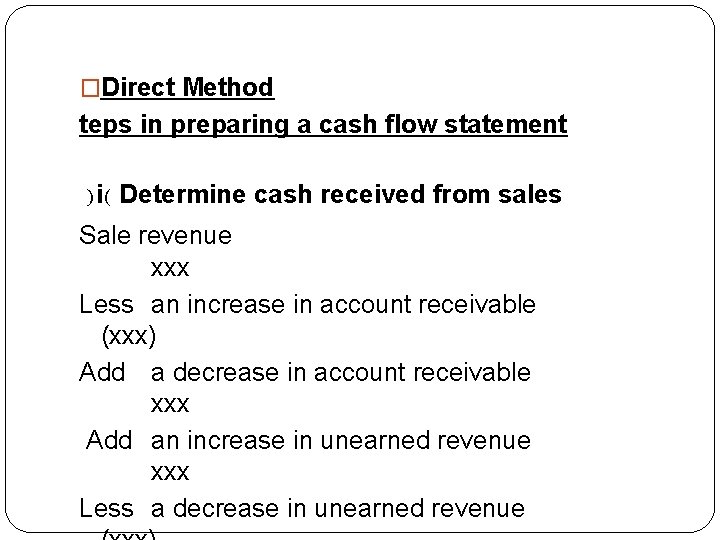
�Direct Method teps in preparing a cash flow statement )i( Determine cash received from sales Sale revenue xxx Less an increase in account receivable (xxx) Add a decrease in account receivable xxx Add an increase in unearned revenue xxx Less a decrease in unearned revenue
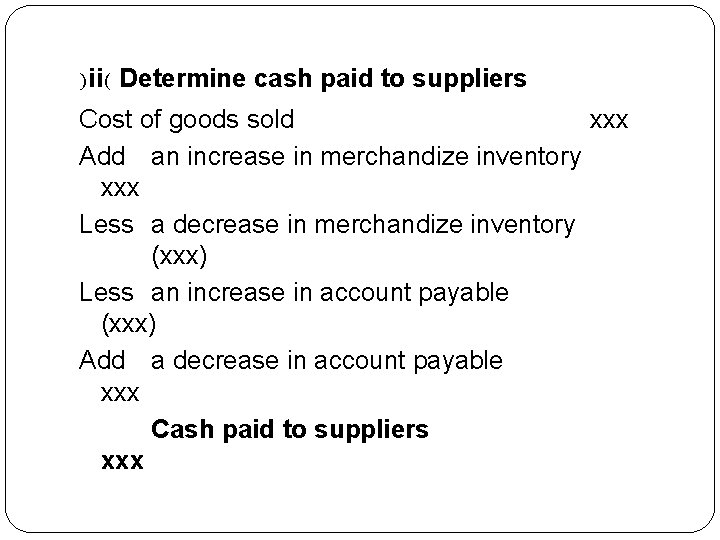
)ii( Determine cash paid to suppliers Cost of goods sold xxx Add an increase in merchandize inventory xxx Less a decrease in merchandize inventory (xxx) Less an increase in account payable (xxx) Add a decrease in account payable xxx Cash paid to suppliers xxx
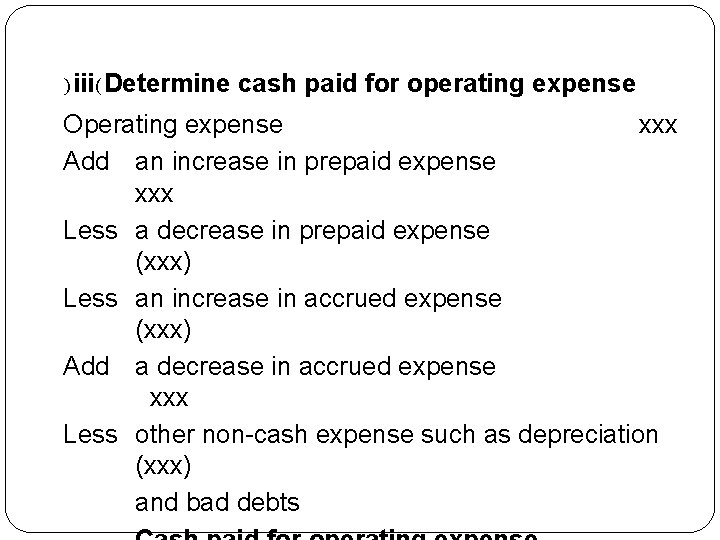
)iii(Determine cash paid for operating expense Operating expense xxx Add an increase in prepaid expense xxx Less a decrease in prepaid expense (xxx) Less an increase in accrued expense (xxx) Add a decrease in accrued expense xxx Less other non-cash expense such as depreciation (xxx) and bad debts
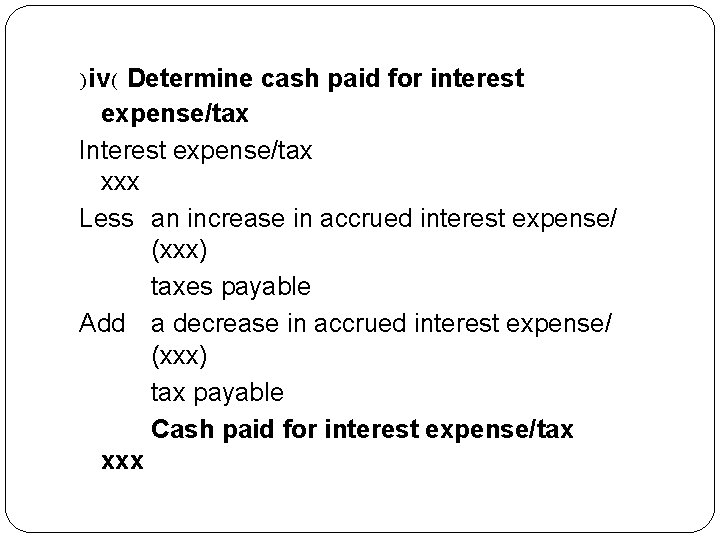
)iv( Determine cash paid for interest expense/tax Interest expense/tax xxx Less an increase in accrued interest expense/ (xxx) taxes payable Add a decrease in accrued interest expense/ (xxx) tax payable Cash paid for interest expense/tax xxx
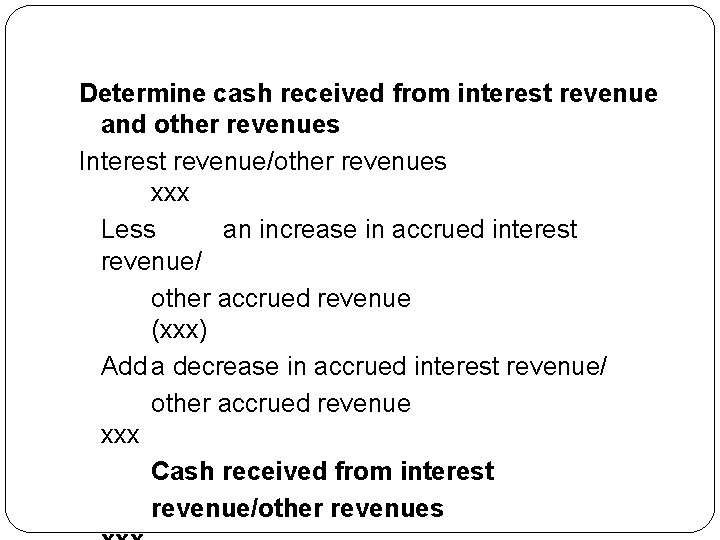
Determine cash received from interest revenue and other revenues Interest revenue/other revenues xxx Less an increase in accrued interest revenue/ other accrued revenue (xxx) Add a decrease in accrued interest revenue/ other accrued revenue xxx Cash received from interest revenue/other revenues
The sum of (i)-(v) will be net cash provided (or used) by operating activities. Determine net cash provided (or used) by investing activities. Relating to an increase/a decrease in all current assets and long-term investment which is not longer than 3 months. A decrease in these assets suggests that these assets were sold, thereby, cash has been received (cash inflows). In contrast, an increase in these assets suggests that a company purchased these assets, thereby, cash was paid (cash outflows). However, additional information has to be considered together with this analysis.
(vii) Determine net cash provided (or used) by financing activities. Analyzing the source of cash inflows and cash outflows related to an increase/a decrease in liabilities and stockholders’ equity (except retained earnings). An increase in liabilities means that a company has received more cash for other outside sources such as borrowing money from a bank (cash inflows). But a decrease in liabilities suggests that a company paid cash to settle its debts or liabilities (cash outflows). An increase in stockholders’ equity means that a company has issued more common stocks so that it receives more cash (cash inflows).
In addition, in this part dividends in an income statement, together with an accrued dividends in comparative balance sheet have to be considered. Payment of dividends makes a decrease in cash (cash outflows). If there is an increase in a dividends payable (in comparative balance sheet), this amount will be deducted from the amount of dividends in an income statement (or those mentioned in an additional information). In contrast, if there is a decrease in a dividends payable , this amount will be added.
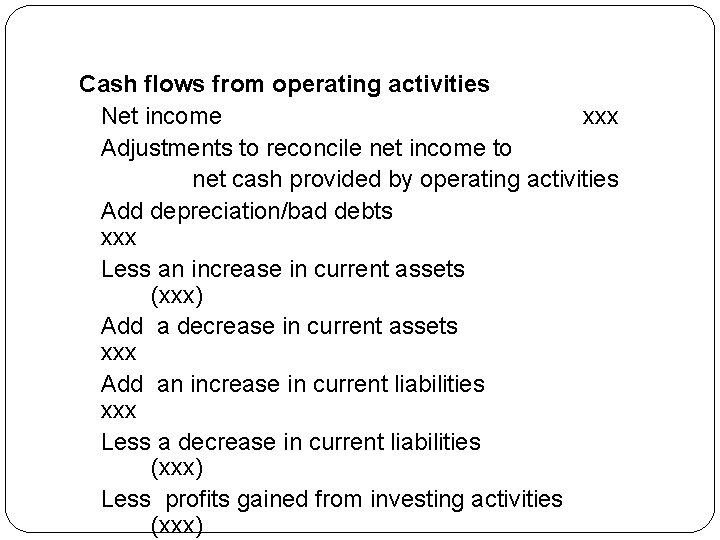
�Indirect Method In a direct method only the part of cash flows from operating activities is different. The approach used to determine net cash provided (used) by operating activities is as followed:
Cash flows from operating activities Net income xxx Adjustments to reconcile net income to net cash provided by operating activities Add depreciation/bad debts xxx Less an increase in current assets (xxx) Add a decrease in current assets xxx Add an increase in current liabilities xxx Less a decrease in current liabilities (xxx) Less profits gained from investing activities (xxx)