
Chapter 6 Capital Budgeting Criteria Capital Budgeting The

Chapter 6 Capital Budgeting Criteria

Capital Budgeting: The process of planning for purchases of long-term assets. • For example: Suppose our firm must decide whether to purchase a new plastic molding machine for $125, 000. How do we decide? • Will the machine be profitable? • Will our firm earn a high rate of return on the investment?
Decision-making Criteria in Capital Budgeting How do we decide if a capital investment project should be accepted or rejected?
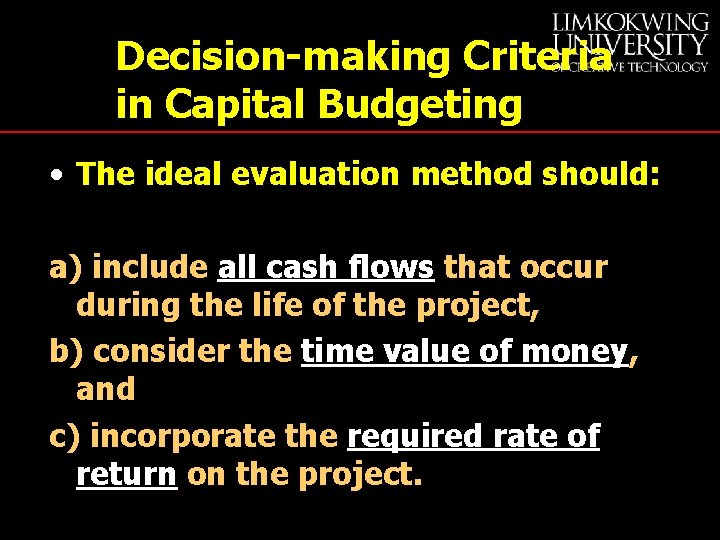
Decision-making Criteria in Capital Budgeting • The ideal evaluation method should: a) include all cash flows that occur during the life of the project, b) consider the time value of money, and c) incorporate the required rate of return on the project.
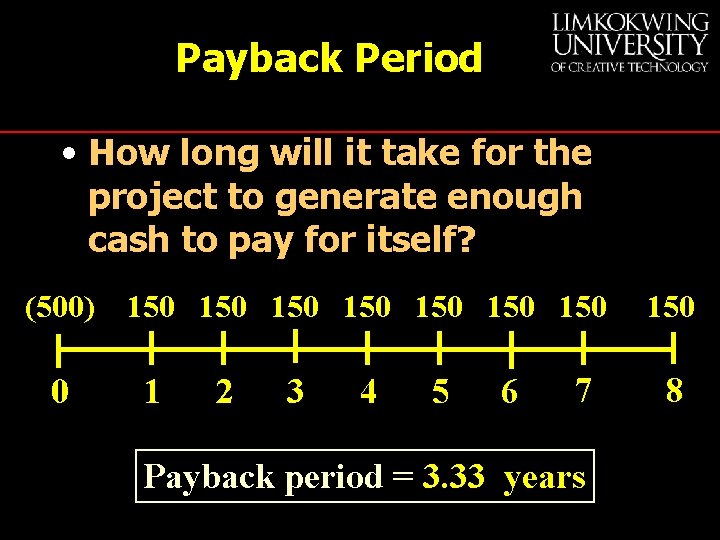
Payback Period • How long will it take for the project to generate enough cash to pay for itself? (500) 0 150 150 1 2 3 4 5 6 7 Payback period = 3. 33 years 150 8
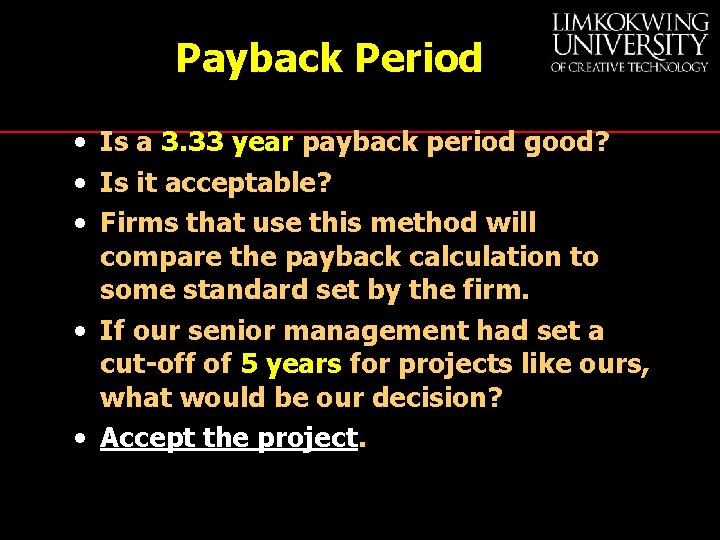
Payback Period • Is a 3. 33 year payback period good? • Is it acceptable? • Firms that use this method will compare the payback calculation to some standard set by the firm. • If our senior management had set a cut-off of 5 years for projects like ours, what would be our decision? • Accept the project.
Drawbacks of Payback Period • Firm cutoffs are subjective. • Does not consider time value of money. • Does not consider any required rate of return. • Does not consider all of the project’s cash flows.
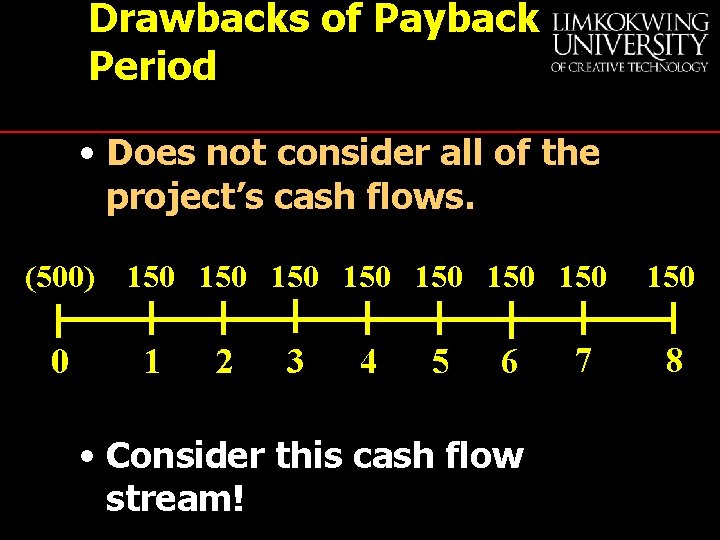
Drawbacks of Payback Period • Does not consider all of the project’s cash flows. (500) 0 150 150 1 2 3 4 5 6 • Consider this cash flow stream! 7 150 8
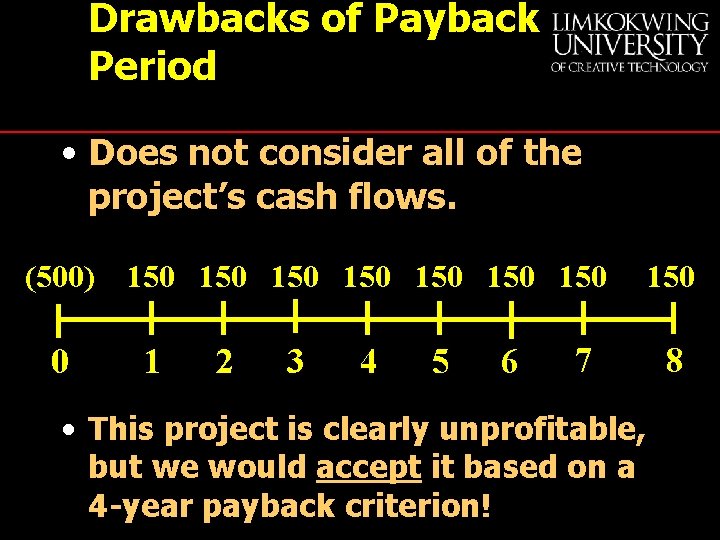
Drawbacks of Payback Period • Does not consider all of the project’s cash flows. (500) 0 150 150 1 2 3 4 5 6 7 • This project is clearly unprofitable, but we would accept it based on a 4 -year payback criterion! 150 8
Discounted Payback • Discounts the cash flows at the firm’s required rate of return. • Payback period is calculated using these discounted net cash flows. Problems: • Cutoffs are still subjective. • Still does not examine all cash flows.
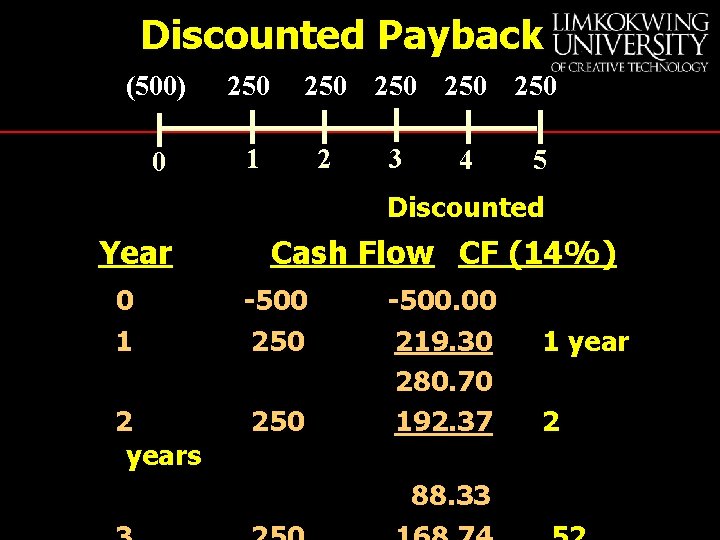
Discounted Payback (500) 250 250 250 0 1 2 3 4 5 Discounted Year Cash Flow CF (14%) 0 1 -500 250 2 years 250 -500. 00 219. 30 280. 70 192. 37 88. 33 1 year 2
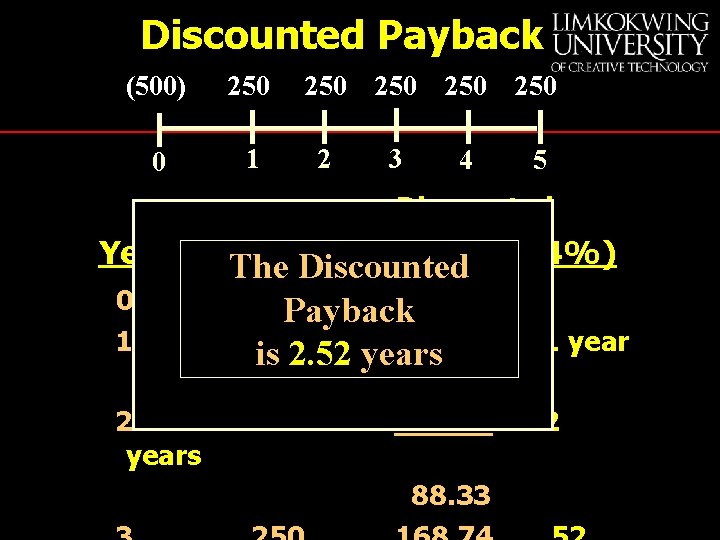
Discounted Payback (500) 250 250 250 0 1 2 3 4 5 Discounted Year 0 1 2 years Cash Flow CF (14%) The Discounted -500. 00 Payback 250 219. 30 is 2. 52 years 280. 70 250 192. 37 88. 33 1 year 2
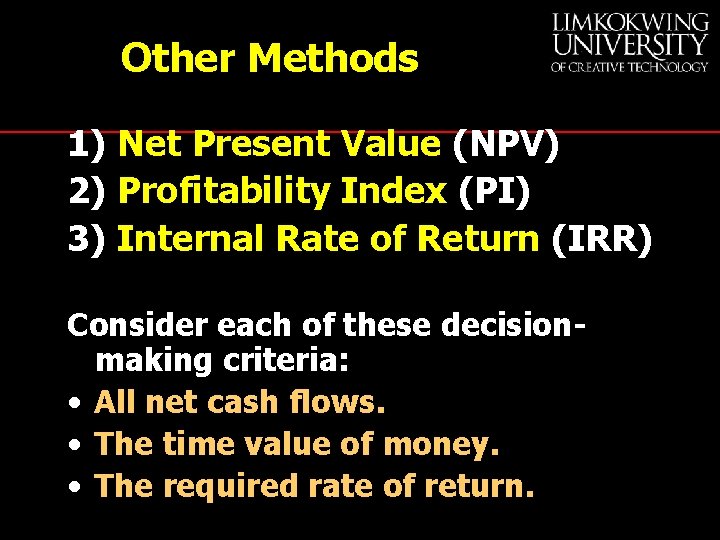
Other Methods 1) Net Present Value (NPV) 2) Profitability Index (PI) 3) Internal Rate of Return (IRR) Consider each of these decisionmaking criteria: • All net cash flows. • The time value of money. • The required rate of return.

Net Present Value · NPV = the total PV of the annual net cash flows - the initial outlay. n NPV = S t=1 FCFt (1 + k) t - IO
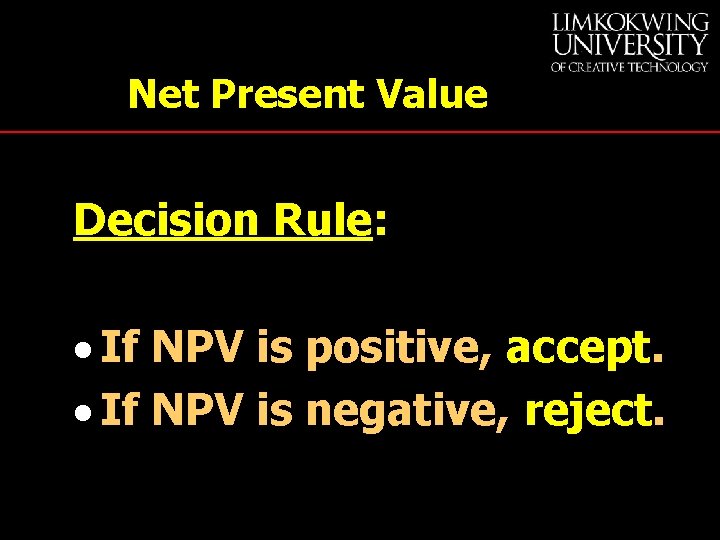
Net Present Value Decision Rule: · If NPV is positive, accept. · If NPV is negative, reject.
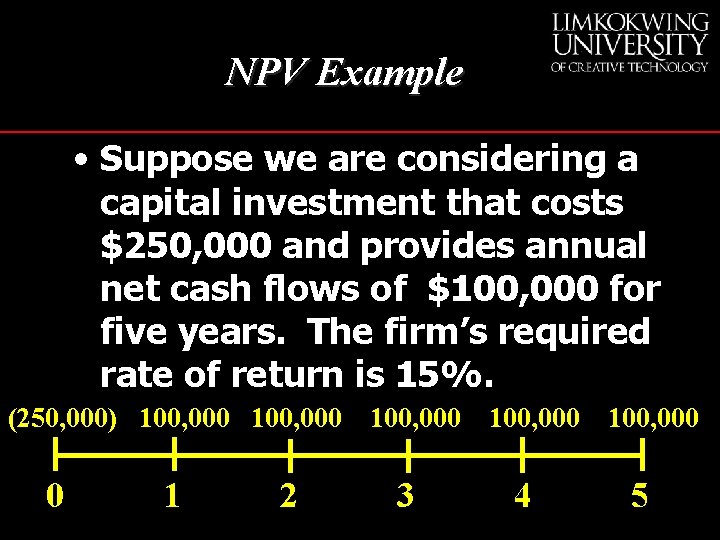
NPV Example • Suppose we are considering a capital investment that costs $250, 000 and provides annual net cash flows of $100, 000 for five years. The firm’s required rate of return is 15%. (250, 000) 100, 000 0 1 2 100, 000 3 100, 000 4 100, 000 5
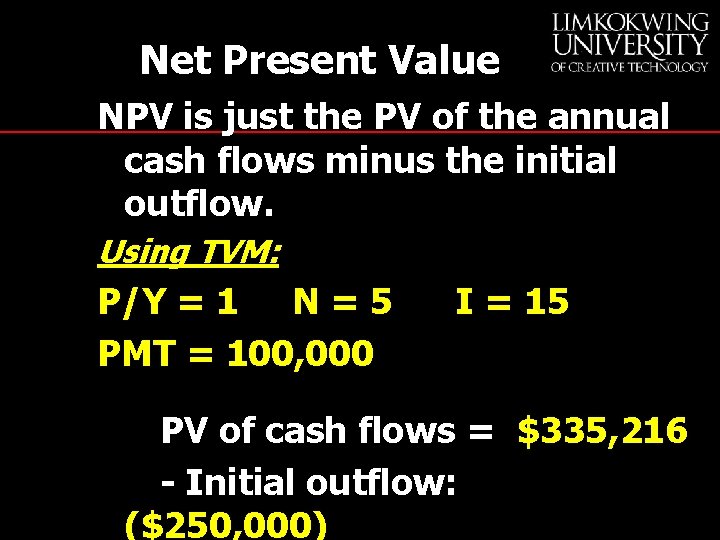
Net Present Value NPV is just the PV of the annual cash flows minus the initial outflow. Using TVM: P/Y = 1 N = 5 PMT = 100, 000 I = 15 PV of cash flows = $335, 216 - Initial outflow: ($250, 000)
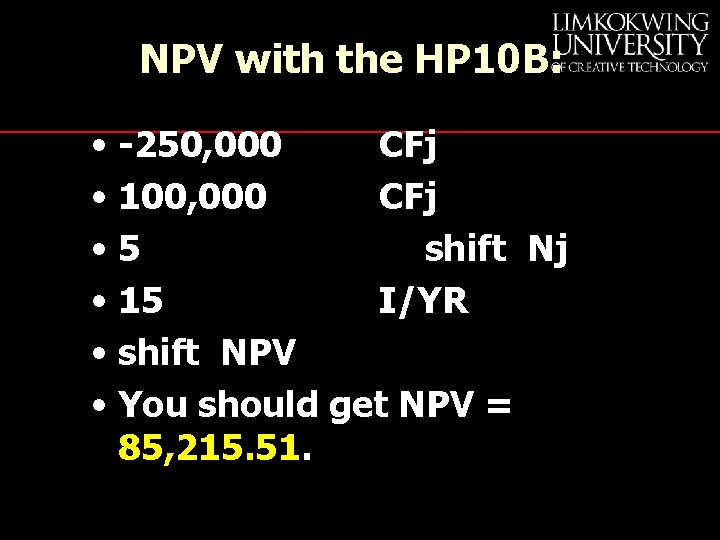
NPV with the HP 10 B: • -250, 000 CFj • 100, 000 CFj • 5 shift Nj • 15 I/YR • shift NPV • You should get NPV = 85, 215. 51.
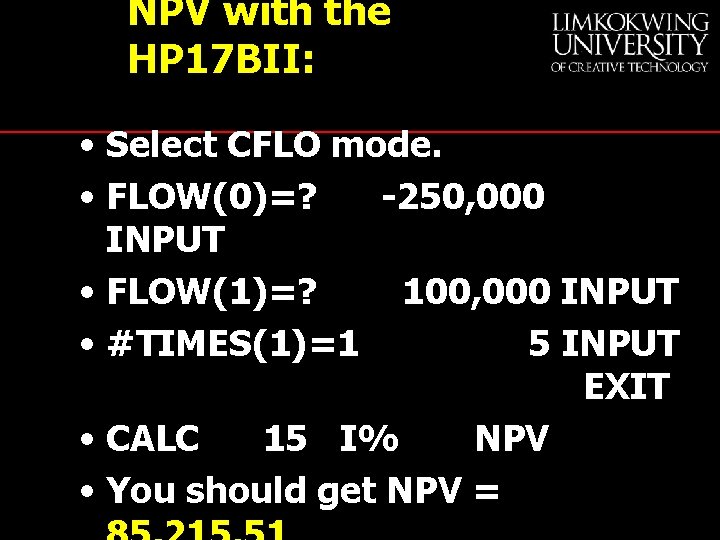
NPV with the HP 17 BII: • Select CFLO mode. • FLOW(0)=? -250, 000 INPUT • FLOW(1)=? 100, 000 INPUT • #TIMES(1)=1 5 INPUT EXIT • CALC 15 I% NPV • You should get NPV =
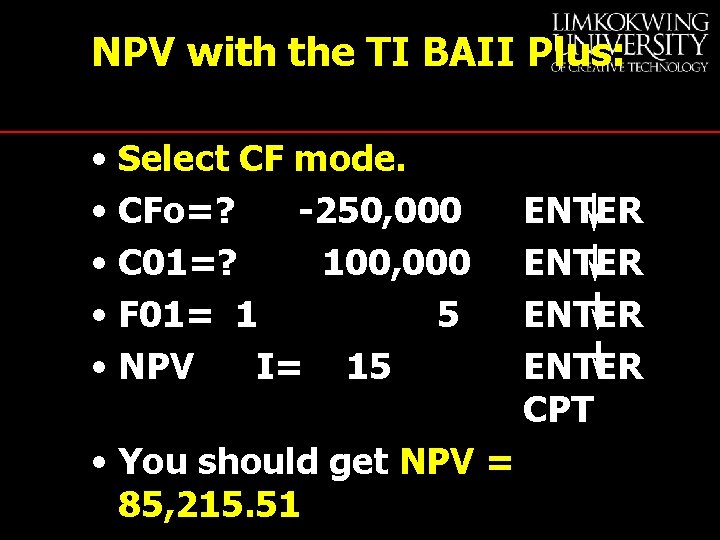
NPV with the TI BAII Plus: • Select CF mode. • CFo=? -250, 000 • C 01=? 100, 000 • F 01= 1 5 • NPV I= 15 • You should get NPV = 85, 215. 51 ENTER CPT

Profitability Index n NPV = S t=1 n PI = S t=1 FCFt t (1 + k) - IO FCFt t (1 + k) IO
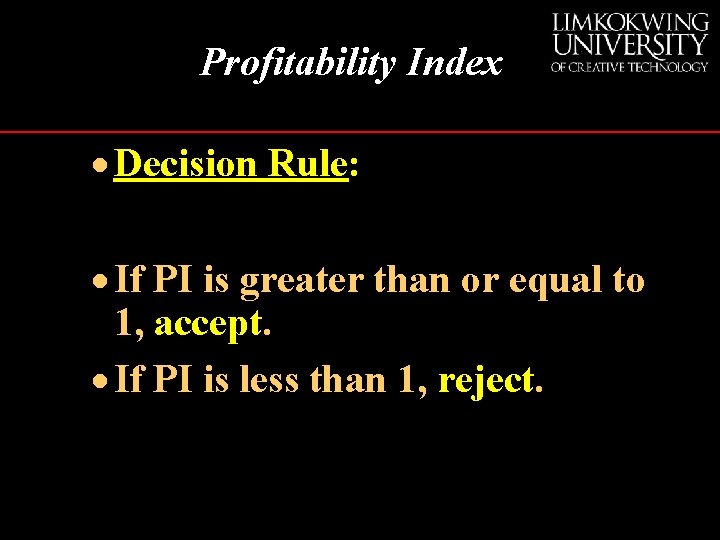
Profitability Index · Decision Rule: · If PI is greater than or equal to 1, accept. · If PI is less than 1, reject.
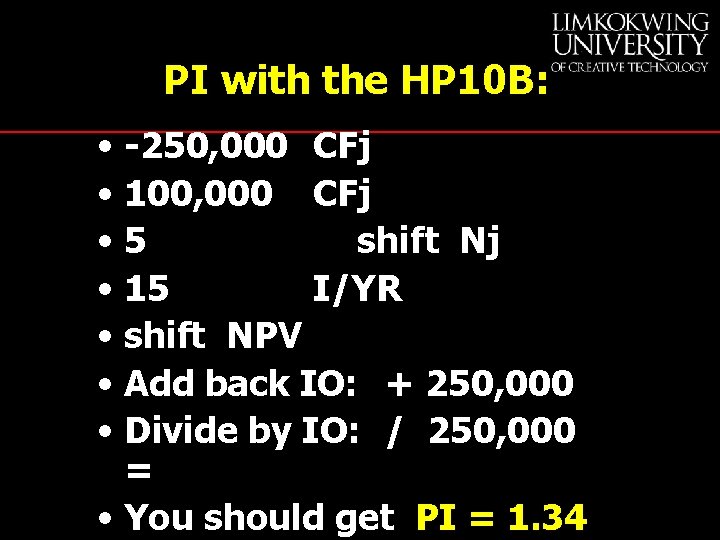
PI with the HP 10 B: • -250, 000 CFj • 100, 000 CFj • 5 shift Nj • 15 I/YR • shift NPV • Add back IO: + 250, 000 • Divide by IO: / 250, 000 = • You should get PI = 1. 34
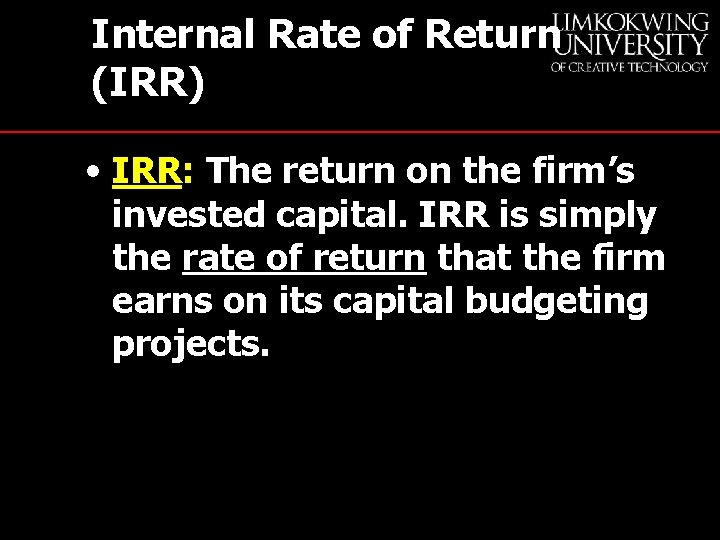
Internal Rate of Return (IRR) • IRR: The return on the firm’s invested capital. IRR is simply the rate of return that the firm earns on its capital budgeting projects.
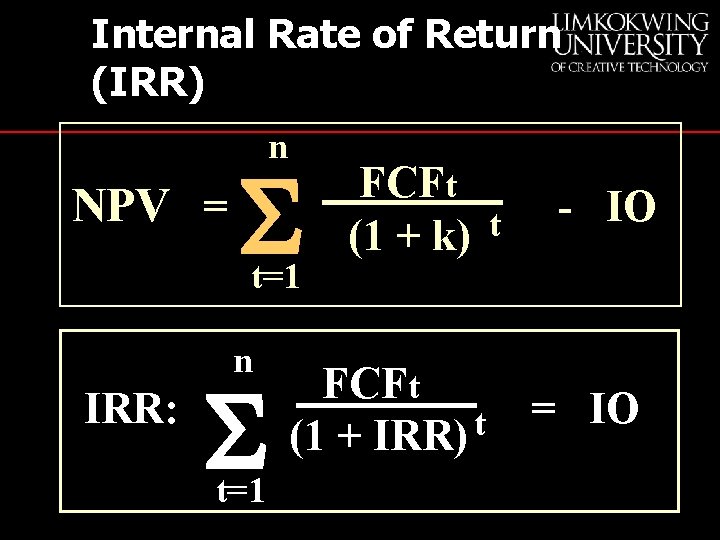
Internal Rate of Return (IRR) n NPV = S t=1 n IRR: S t=1 FCFt (1 + k) t FCFt t (1 + IRR) - IO = IO
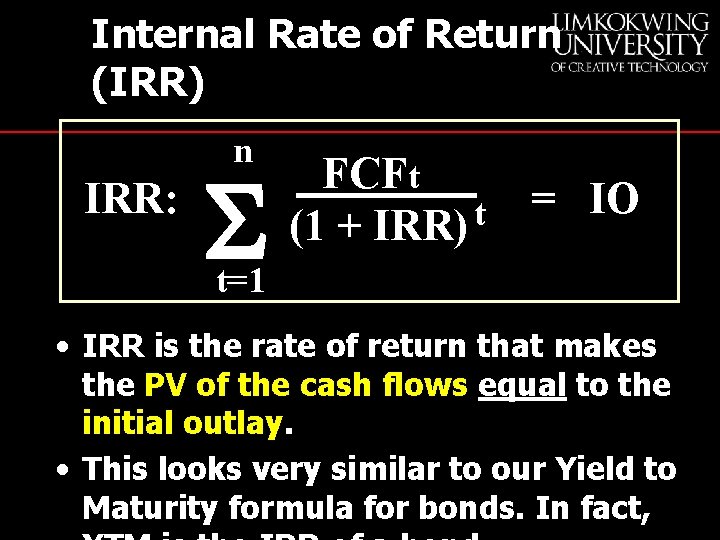
Internal Rate of Return (IRR) n IRR: S FCFt t (1 + IRR) = IO t=1 • IRR is the rate of return that makes the PV of the cash flows equal to the initial outlay. • This looks very similar to our Yield to Maturity formula for bonds. In fact,
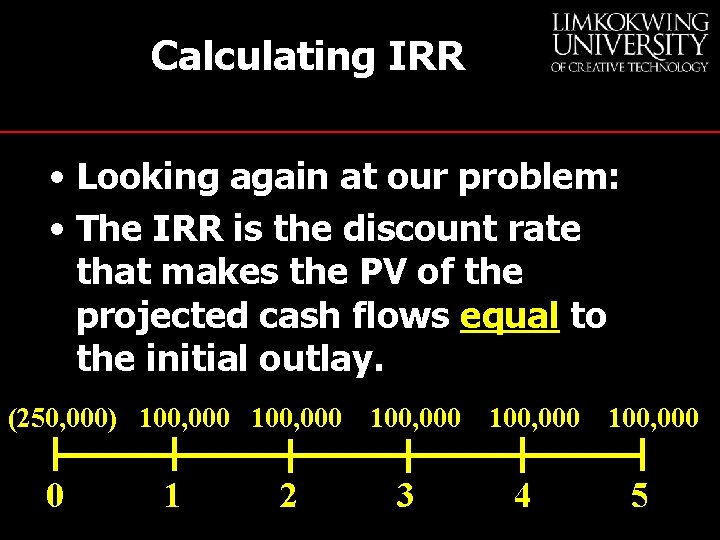
Calculating IRR • Looking again at our problem: • The IRR is the discount rate that makes the PV of the projected cash flows equal to the initial outlay. (250, 000) 100, 000 0 1 2 100, 000 3 100, 000 4 100, 000 5
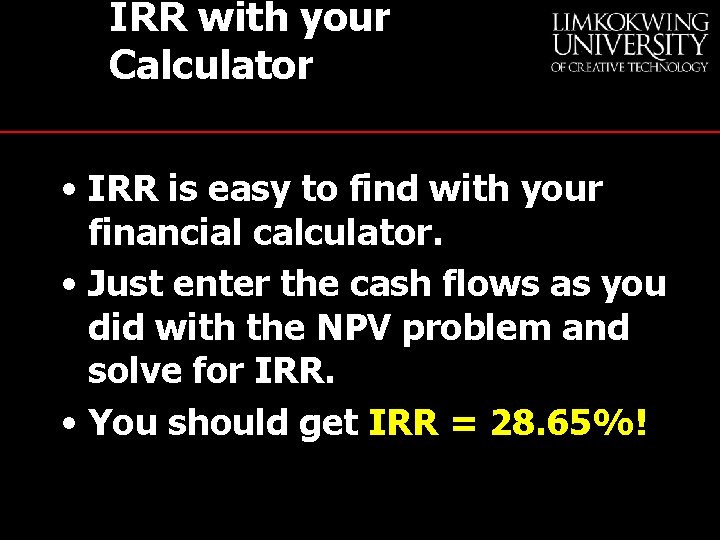
IRR with your Calculator • IRR is easy to find with your financial calculator. • Just enter the cash flows as you did with the NPV problem and solve for IRR. • You should get IRR = 28. 65%!
IRR Decision Rule: · If IRR is greater than or equal to the required rate of return, accept. · If IRR is less than the required rate of return, reject.
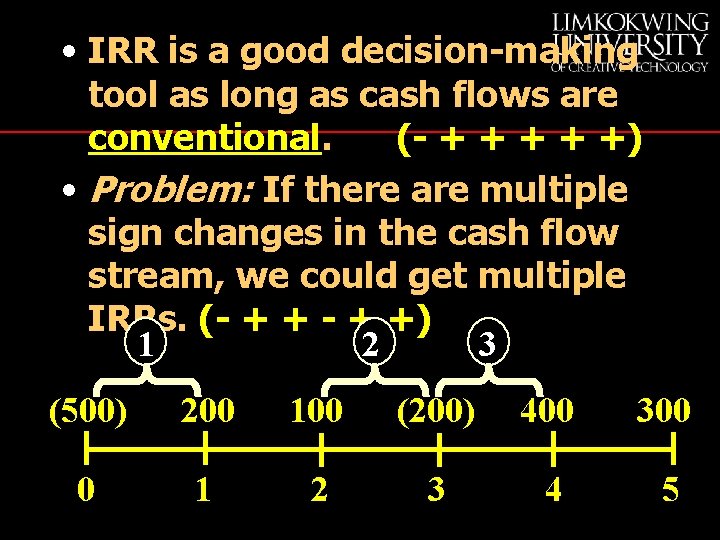
• IRR is a good decision-making tool as long as cash flows are conventional. (- + + +) • Problem: If there are multiple sign changes in the cash flow stream, we could get multiple IRRs. (- + +) 1 2 3 (500) 200 100 (200) 400 300 0 1 2 3 4 5
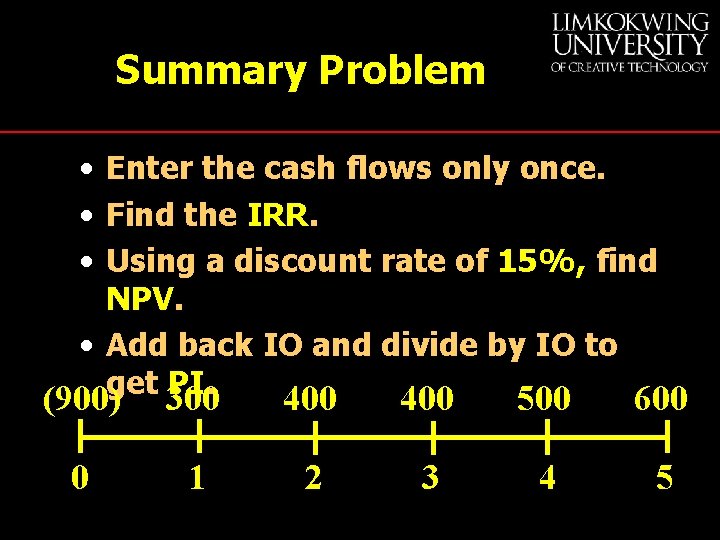
Summary Problem • Enter the cash flows only once. • Find the IRR. • Using a discount rate of 15%, find NPV. • Add back IO and divide by IO to get PI. (900) 300 400 500 600 0 1 2 3 4 5
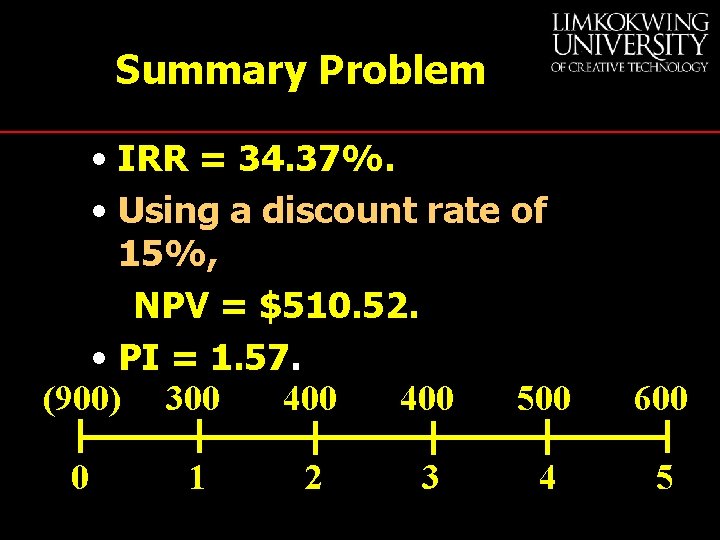
Summary Problem • IRR = 34. 37%. • Using a discount rate of 15%, NPV = $510. 52. • PI = 1. 57. (900) 300 400 500 0 1 2 3 4 600 5
- Slides: 32