
Chapter 6 CalculusHughesHallett Constructing the Antiderivative Solving Simple
![Properties of Antiderivative: 1. [f(x) g(x)]dx = f(x)dx g(x)dx (The antiderivative of a sum](https://slidetodoc.com/presentation_image_h2/5ddf2d4e0a82f114437c24ffd71496a0/image-4.jpg "Properties of Antiderivative: 1. [f(x) g(x)]dx = f(x)dx g(x)dx (The antiderivative of a sum")


- Slides: 11
Chapter 6: Calculus~Hughes-Hallett • Constructing the Antiderivative • Solving (Simple) Differential Equations • The Fundamental Theorem of Calculus (Part 2)
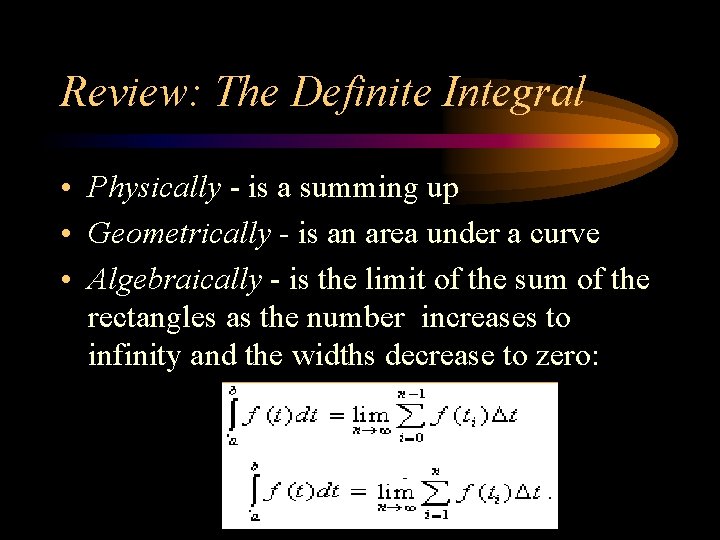
Review: The Definite Integral • Physically - is a summing up • Geometrically - is an area under a curve • Algebraically - is the limit of the sum of the rectangles as the number increases to infinity and the widths decrease to zero:
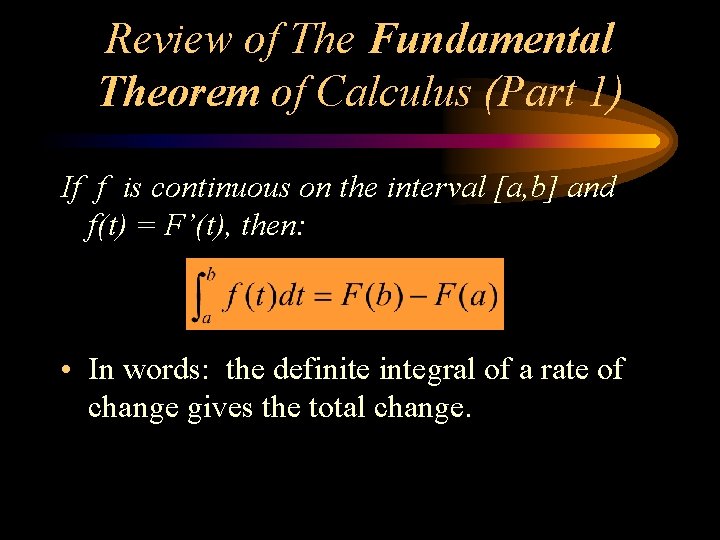
Review of The Fundamental Theorem of Calculus (Part 1) If f is continuous on the interval [a, b] and f(t) = F’(t), then: • In words: the definite integral of a rate of change gives the total change.
Properties of Antiderivative: 1. [f(x) g(x)]dx = f(x)dx g(x)dx (The antiderivative of a sum is the sum of the antiderivatives. ) 2. cf(x)dx = c f(x)dx (The antiderivative of a constant times a function is the constant times the antiderivative of the function. )
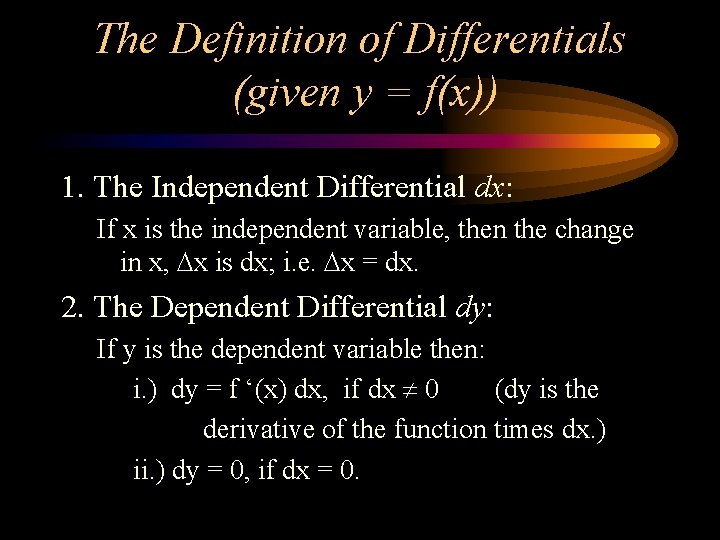
The Definition of Differentials (given y = f(x)) 1. The Independent Differential dx: If x is the independent variable, then the change in x, x is dx; i. e. x = dx. 2. The Dependent Differential dy: If y is the dependent variable then: i. ) dy = f ‘(x) dx, if dx 0 (dy is the derivative of the function times dx. ) ii. ) dy = 0, if dx = 0.
Using the differential with the antiderivative.
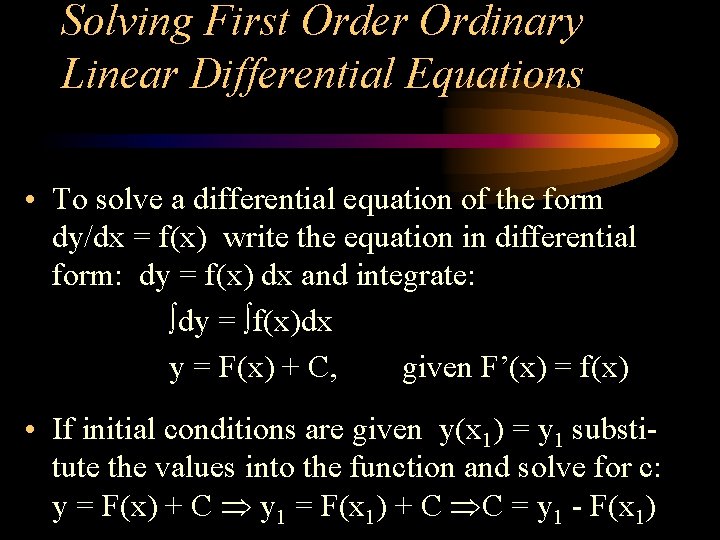
Solving First Order Ordinary Linear Differential Equations • To solve a differential equation of the form dy/dx = f(x) write the equation in differential form: dy = f(x) dx and integrate: dy = f(x)dx y = F(x) + C, given F’(x) = f(x) • If initial conditions are given y(x 1) = y 1 substitute the values into the function and solve for c: y = F(x) + C y 1 = F(x 1) + C C = y 1 - F(x 1)
Example: Solve, dr/dp = 3 sin p with r(0)= 6, i. e. r= 6 when p = 0 • Solution:
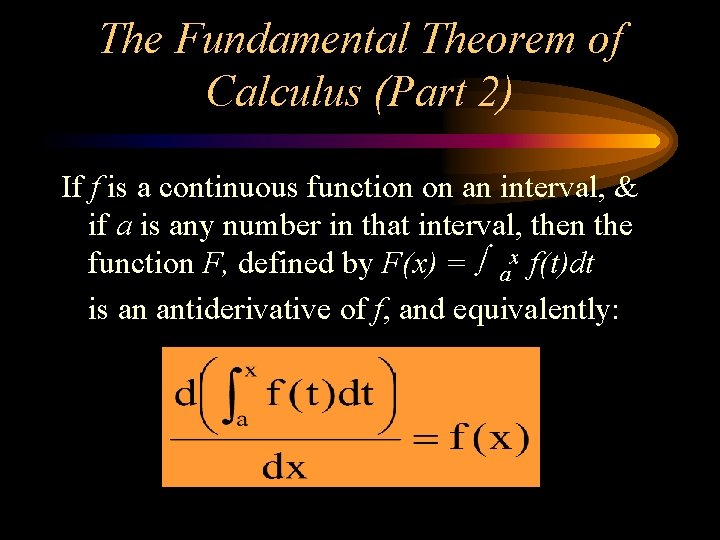
The Fundamental Theorem of Calculus (Part 2) If f is a continuous function on an interval, & if a is any number in that interval, then the function F, defined by F(x) = ax f(t)dt is an antiderivative of f, and equivalently:
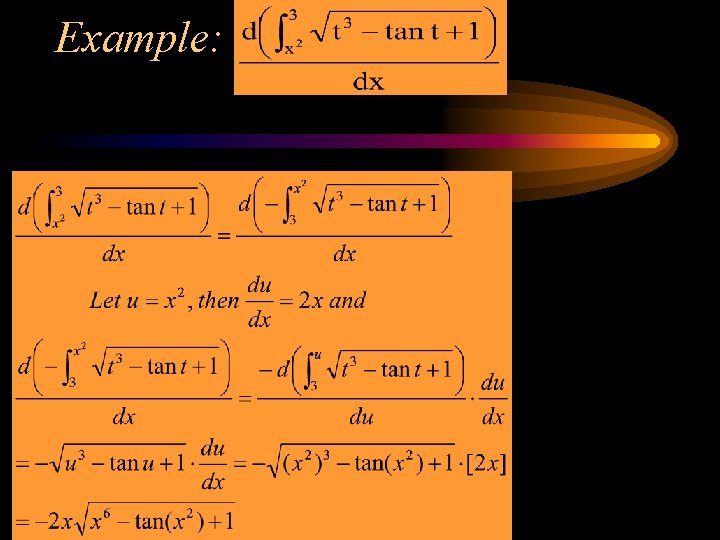
Example:
• That’s all Folks! Have a good Christmas! God Bless