
Chapter 6 Businessto Business B 2 B Marketing
Chapter 6 Business-to. Business (B 2 B) Marketing Copyright © 2006 by South-Western, a division of Thomson Learning, Inc. All rights reserved.
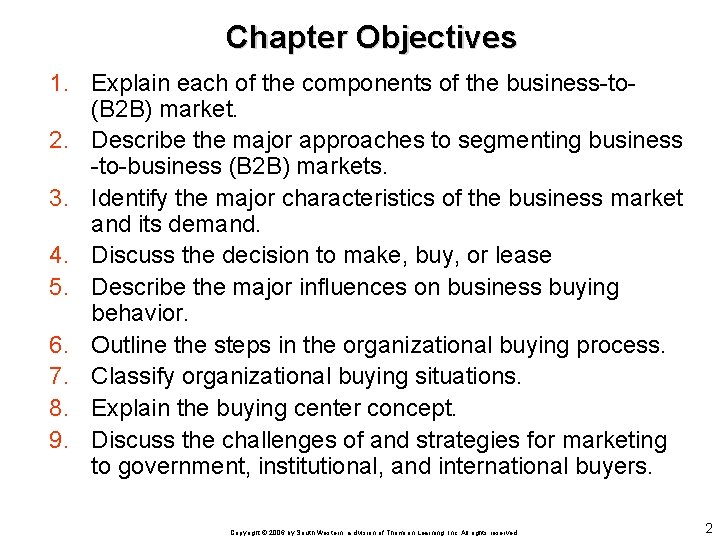
Chapter Objectives 1. Explain each of the components of the business-to(B 2 B) market. 2. Describe the major approaches to segmenting business -to-business (B 2 B) markets. 3. Identify the major characteristics of the business market and its demand. 4. Discuss the decision to make, buy, or lease 5. Describe the major influences on business buying behavior. 6. Outline the steps in the organizational buying process. 7. Classify organizational buying situations. 8. Explain the buying center concept. 9. Discuss the challenges of and strategies for marketing to government, institutional, and international buyers. Copyright © 2006 by South-Western, a division of Thomson Learning, Inc. All rights reserved. 2
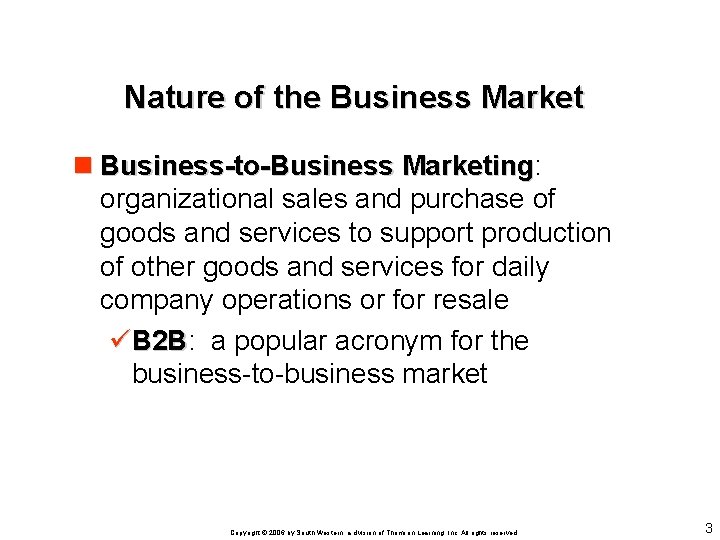
Nature of the Business Market n Business-to-Business Marketing: Marketing organizational sales and purchase of goods and services to support production of other goods and services for daily company operations or for resale üB 2 B: B 2 B a popular acronym for the business-to-business market Copyright © 2006 by South-Western, a division of Thomson Learning, Inc. All rights reserved. 3
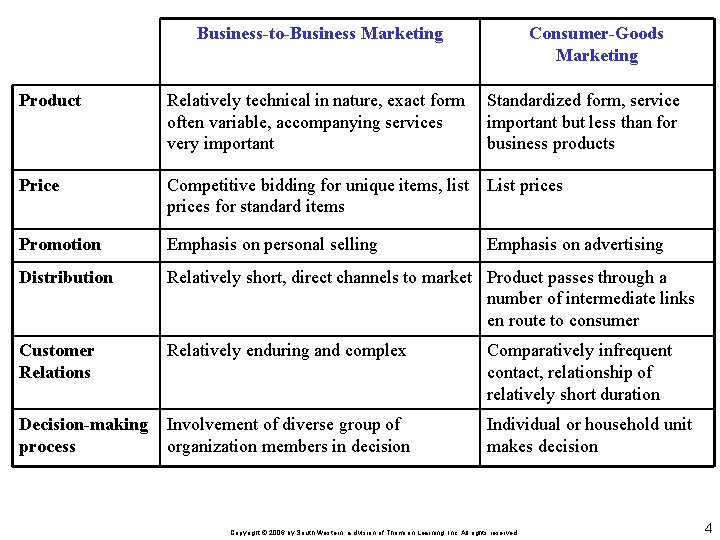
Business-to-Business Marketing Consumer-Goods Marketing Product Relatively technical in nature, exact form often variable, accompanying services very important Standardized form, service important but less than for business products Price Competitive bidding for unique items, list prices for standard items List prices Promotion Emphasis on personal selling Emphasis on advertising Distribution Relatively short, direct channels to market Product passes through a number of intermediate links en route to consumer Customer Relations Relatively enduring and complex Comparatively infrequent contact, relationship of relatively short duration Decision-making process Involvement of diverse group of organization members in decision Individual or household unit makes decision Copyright © 2006 by South-Western, a division of Thomson Learning, Inc. All rights reserved. 4
n Components of the Business Market üCommercial Market: Market Individuals and firms that acquire goods and services to support, directly or indirectly, production of other goods and services üTrade Industries: Industries Retailers and wholesalers who purchase goods for resale to others. w Reseller: Reseller often used to describe the wholesalers and retailers that operate in the trade sector Copyright © 2006 by South-Western, a division of Thomson Learning, Inc. All rights reserved. 5
n Government Organizations Include domestic units of federal, state, local and foreign governments n Institutions Includes a wide variety of organizations, both public and private, such as hospitals, churches, universities, museums, and notfor-profit agencies. Copyright © 2006 by South-Western, a division of Thomson Learning, Inc. All rights reserved. 6
n B 2 B Market – The Internet Connection üInternet plays an important role in B 2 B marketing ü 90 percent of all Internet sales are B 2 B transactions n Differences in Foreign Business Markets üMust be willing to adapt to local customs and business practices Copyright © 2006 by South-Western, a division of Thomson Learning, Inc. All rights reserved. 7
Segmenting B 2 B Markets n Demographic Segmentation: Segmentation demographic characteristics define the useful segmentation criteria for business markets n Customer-Based Segmentation: Segmentation dividing a B 2 B market into homogenous groups based on buyers’ product specifications üNorth American Industrial Classification System (NAICS) Copyright © 2006 by South-Western, a division of Thomson Learning, Inc. All rights reserved. 8
n Segmentation by End-Use Application: Application segmenting a business-to-business market based on how industrial purchasers will use the product n Segmentation by Purchase Categories üCenters on the purchasing situation üOrganizations may use complicated purchasing procedures üFirms also structure their purchasing functions in specific ways (e. g. centralized purchasing departments) Copyright © 2006 by South-Western, a division of Thomson Learning, Inc. All rights reserved. 9
Characteristics of the B 2 B Market n Geographic Market Concentration U. S. business market is more geographically concentrated than the consumer market üManufacturers concentrate in certain regions of the country üCertain industries locate in particular areas to be close to their customers Copyright © 2006 by South-Western, a division of Thomson Learning, Inc. All rights reserved. 10
n Sizes and Numbers of Buyers Business market features a limited number of buyers üUse statistical information to estimate the size and characteristics of business markets is available üFederal government is largest single source of such statistics Copyright © 2006 by South-Western, a division of Thomson Learning, Inc. All rights reserved. 11
n The Purchase Decision Process Businesses must understand the dynamics of the organizational purchasing process üB 2 B suppliers often must work with multiple buyers üDecision-makers at several layers may influence final orders üProcess is more formal and professional than with consumers Copyright © 2006 by South-Western, a division of Thomson Learning, Inc. All rights reserved. 12
n Buyer-Seller Relationships More intense than consumer relationships üRequire better communication among the organizations’ personnel üPrimary goal to provide advantages that no other seller can, for instance: w Lower-prices w Quicker delivery w Better quality and reliability w Customized product features w More favorable financing terms Copyright © 2006 by South-Western, a division of Thomson Learning, Inc. All rights reserved. 13
n Evaluating International Business Markets Business purchasing patterns often differ from one country to the next üCompanies must weigh quantitative and qualitative data üGlobal sourcing: purchasing goods and services from suppliers worldwide Copyright © 2006 by South-Western, a division of Thomson Learning, Inc. All rights reserved. 14
The Make, Buy, or Lease Decision n Three Basic Options: üMake the good or provide the service in-house üPurchase it from another organization üLease it from another organization n The Rise of Outsourcing üUsing outside vendors to produce goods and services formerly produced in-house Copyright © 2006 by South-Western, a division of Thomson Learning, Inc. All rights reserved. 15
The Business Buying Process n Influences on Purchase Decisions: üEnvironmental Factors üOrganizational Factors w Multiple Sourcing: purchasing from several vendors üInterpersonal Influences Copyright © 2006 by South-Western, a division of Thomson Learning, Inc. All rights reserved. 16
n The Role of the Professional Buyer üProfessional buyer (merchandisers): technically qualified employees who are responsible for securing needed products at the best possible prices üSystems integration: Centralization of the procurement function within an internal division or as a service of an external supplier w Category Captain Copyright © 2006 by South-Western, a division of Thomson Learning, Inc. All rights reserved. 17
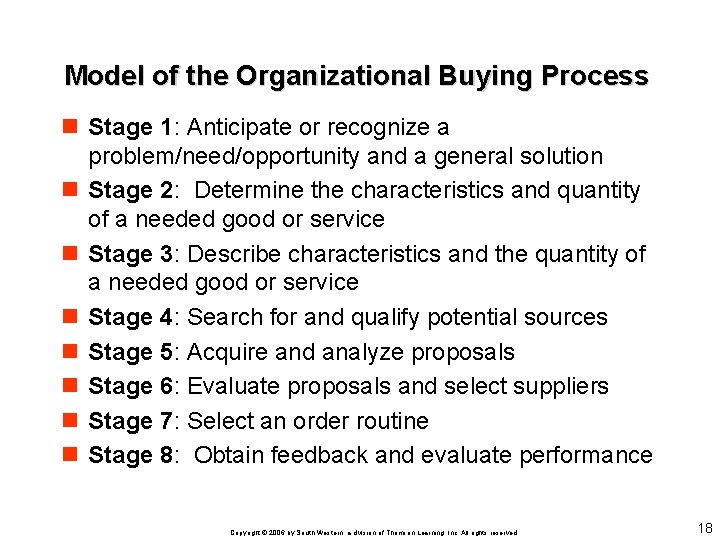
Model of the Organizational Buying Process n Stage 1: Anticipate or recognize a problem/need/opportunity and a general solution n Stage 2: Determine the characteristics and quantity of a needed good or service n Stage 3: Describe characteristics and the quantity of a needed good or service n Stage 4: Search for and qualify potential sources n Stage 5: Acquire and analyze proposals n Stage 6: Evaluate proposals and select suppliers n Stage 7: Select an order routine n Stage 8: Obtain feedback and evaluate performance Copyright © 2006 by South-Western, a division of Thomson Learning, Inc. All rights reserved. 18
n Classifying Business Buying Situations üStraight rebuying üModified rebuying üNew-Task buying üReciprocity n Analysis Tools üValue analysis üVendor analysis Copyright © 2006 by South-Western, a division of Thomson Learning, Inc. All rights reserved. 19
The Buying Center Concept n Participants in an organizational buying action üBuying center roles played by various participants in the purchase decision process include: w Users w Gatekeepers w Influencers w Decider w Buyer Copyright © 2006 by South-Western, a division of Thomson Learning, Inc. All rights reserved. 20
n International Buying Centers üTheir members are often more difficult to identify üMay include more participants than buying centers in U. S. firms n Team Selling Introducing other associates in addition to salespeople into selling situations to reach all members of a customer’s buying center Copyright © 2006 by South-Western, a division of Thomson Learning, Inc. All rights reserved. 21
Developing Effective Business-To. Business Marketing Strategies n Challenges of Government Markets üGovernment purchasing procedures w Bids: written sales proposals from vendor w Specifications: written descriptions of needed goods or services üOnline with the federal government Copyright © 2006 by South-Western, a division of Thomson Learning, Inc. All rights reserved. 22
n Challenges of Institutional Markets üWidely diverse buying practices üMultiple buying influences may affect decisions üGroup purchasing is an important factor n Challenges of International Markets üWidely diverse attitudes and cultural patterns üLocal industries, economic conditions, geographic characteristics and legal restrictions also must be considered w Remanufacturing Copyright © 2006 by South-Western, a division of Thomson Learning, Inc. All rights reserved. 23
- Slides: 23