
Chapter 6 Building Control Algorithms For State Space
Chapter 6 Building Control Algorithms For State Space Search Contents • Recursion-Based Search • Production Systems • The Blackboard Architecture for Problem Solving CSC 411 Artificial Intelligence 1
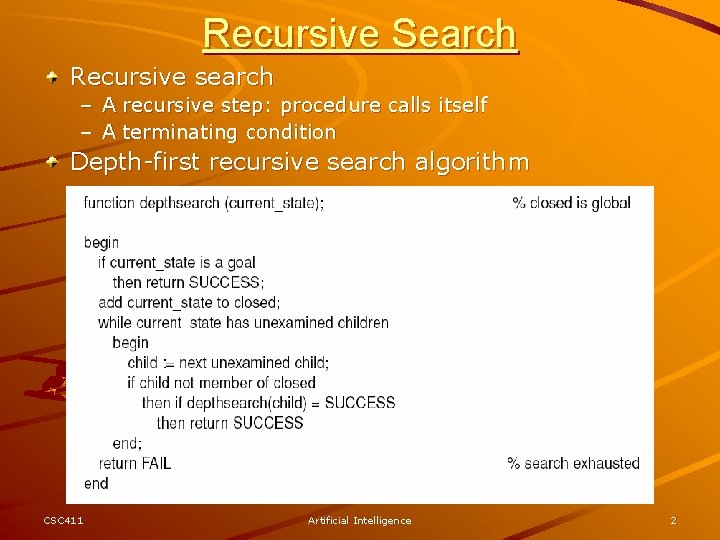
Recursive Search Recursive search – A recursive step: procedure calls itself – A terminating condition Depth-first recursive search algorithm CSC 411 Artificial Intelligence 2
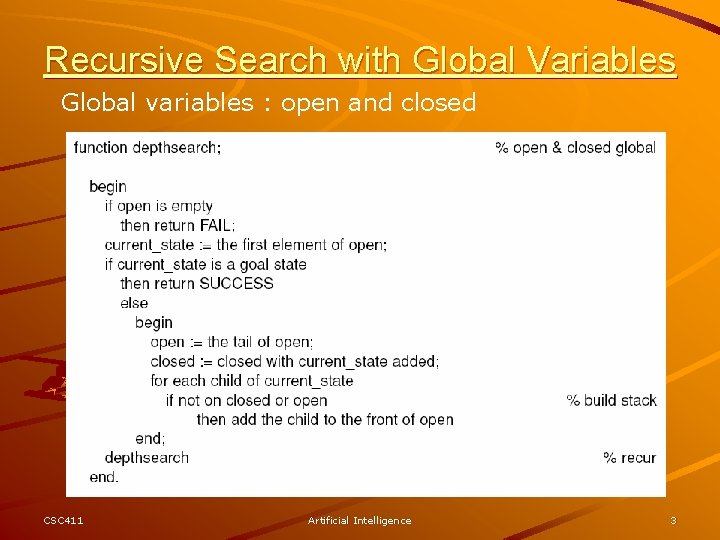
Recursive Search with Global Variables Global variables : open and closed CSC 411 Artificial Intelligence 3
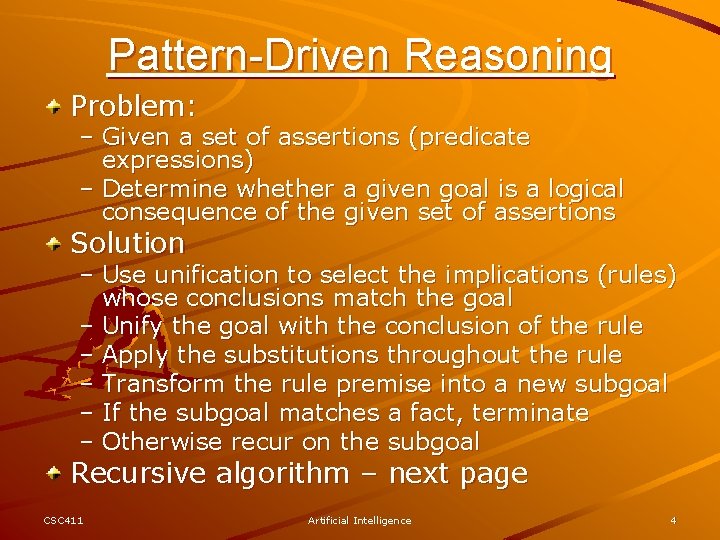
Pattern-Driven Reasoning Problem: – Given a set of assertions (predicate expressions) – Determine whether a given goal is a logical consequence of the given set of assertions Solution – Use unification to select the implications (rules) whose conclusions match the goal – Unify the goal with the conclusion of the rule – Apply the substitutions throughout the rule – Transform the rule premise into a new subgoal – If the subgoal matches a fact, terminate – Otherwise recur on the subgoal Recursive algorithm – next page CSC 411 Artificial Intelligence 4
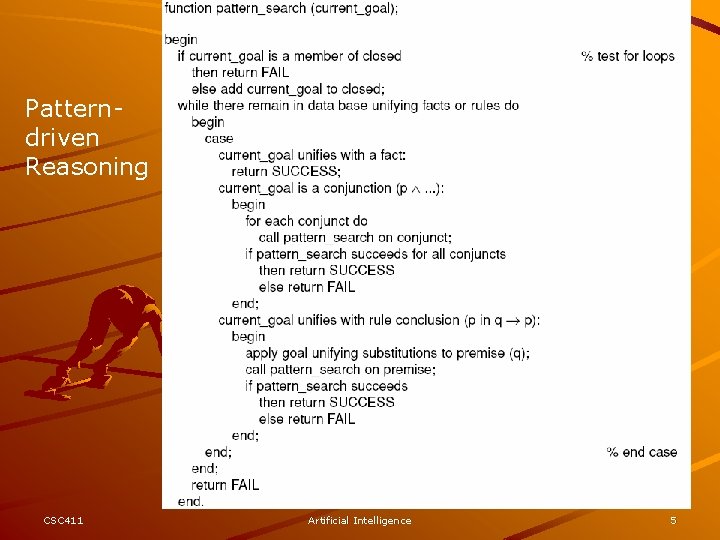
Patterndriven Reasoning CSC 411 Artificial Intelligence 5
Some Issues The order of assertions Logical connectives in the rule premises Logical negation CSC 411 Artificial Intelligence 6
CSC 411 Artificial Intelligence 7
CSC 411 Artificial Intelligence 8
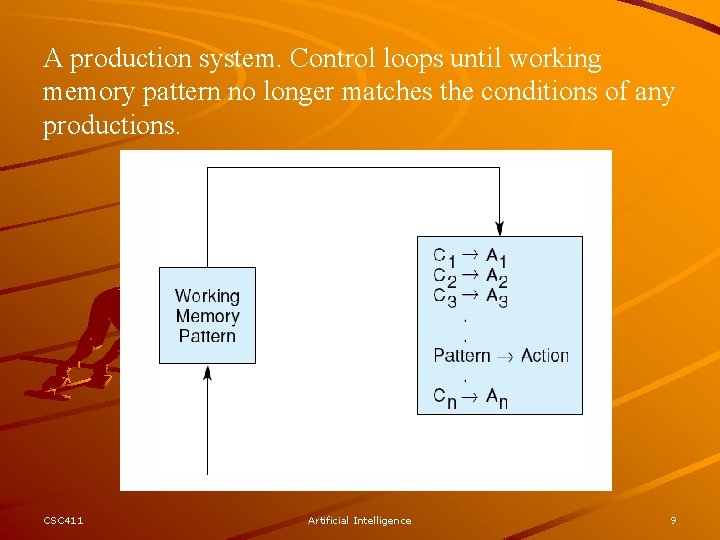
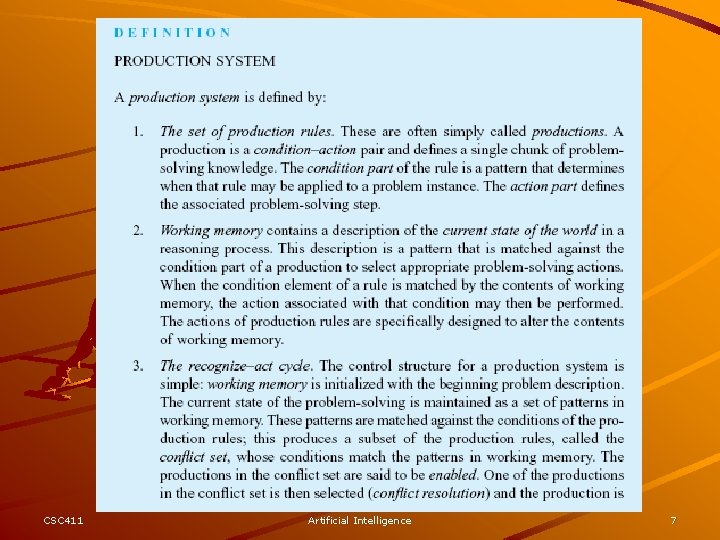
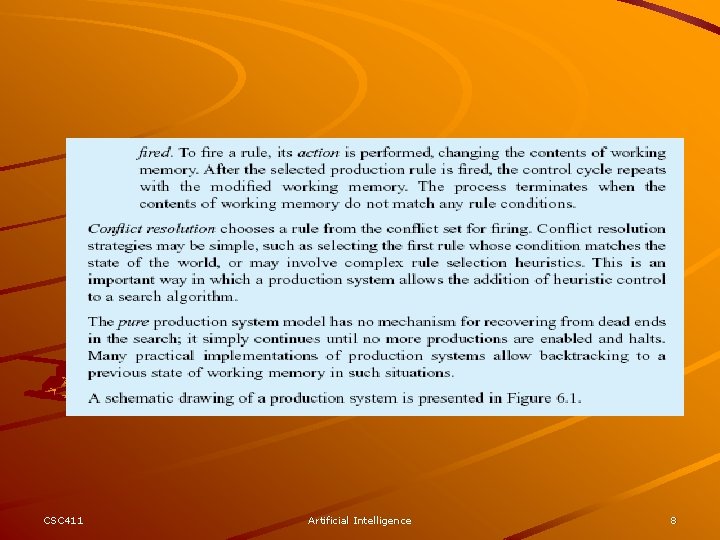
A production system. Control loops until working memory pattern no longer matches the conditions of any productions. CSC 411 Artificial Intelligence 9
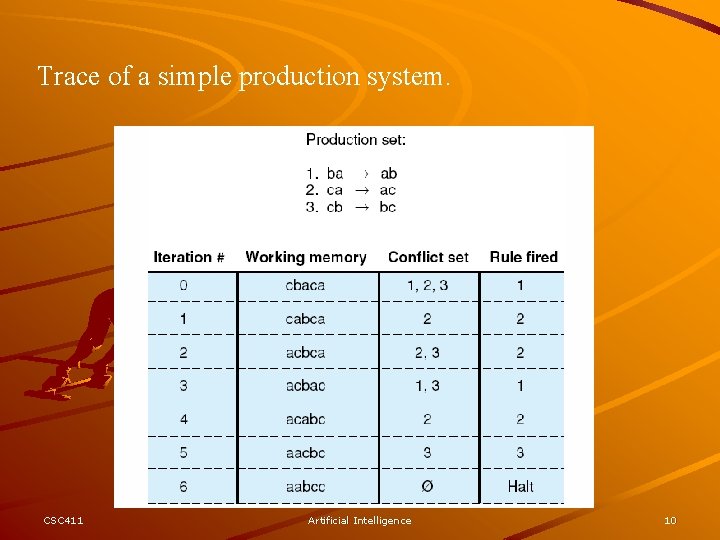
Trace of a simple production system. CSC 411 Artificial Intelligence 10
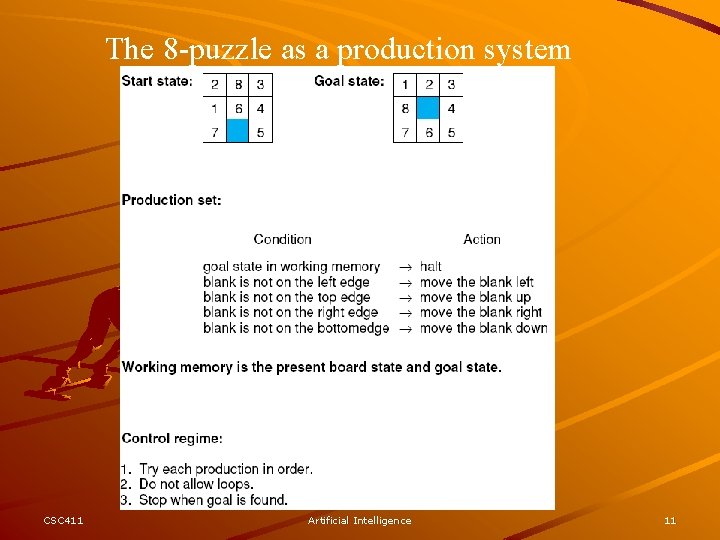
The 8 -puzzle as a production system CSC 411 Artificial Intelligence 11
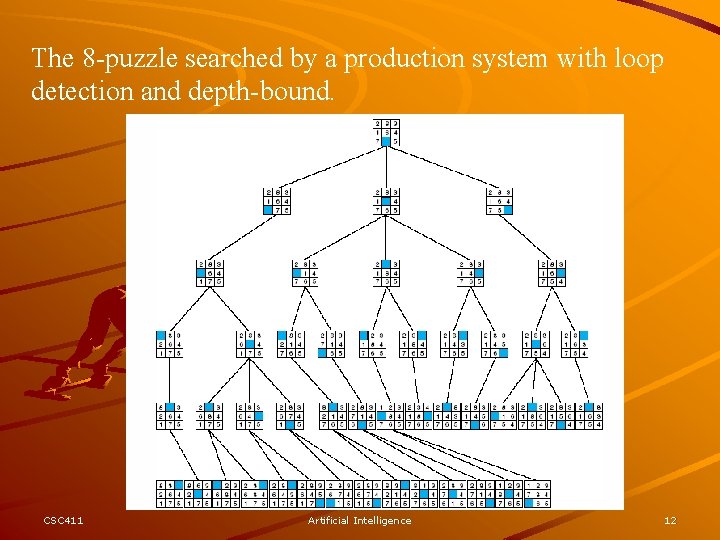
The 8 -puzzle searched by a production system with loop detection and depth-bound. CSC 411 Artificial Intelligence 12
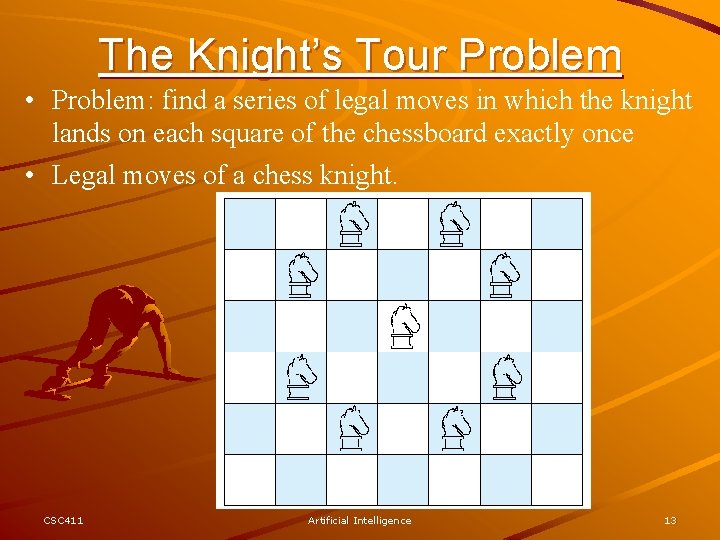
The Knight’s Tour Problem • Problem: find a series of legal moves in which the knight lands on each square of the chessboard exactly once • Legal moves of a chess knight. CSC 411 Artificial Intelligence 13
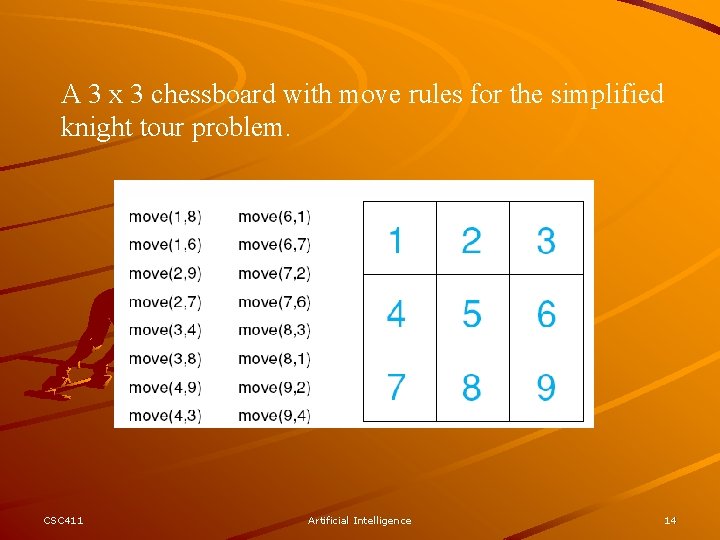
A 3 x 3 chessboard with move rules for the simplified knight tour problem. CSC 411 Artificial Intelligence 14
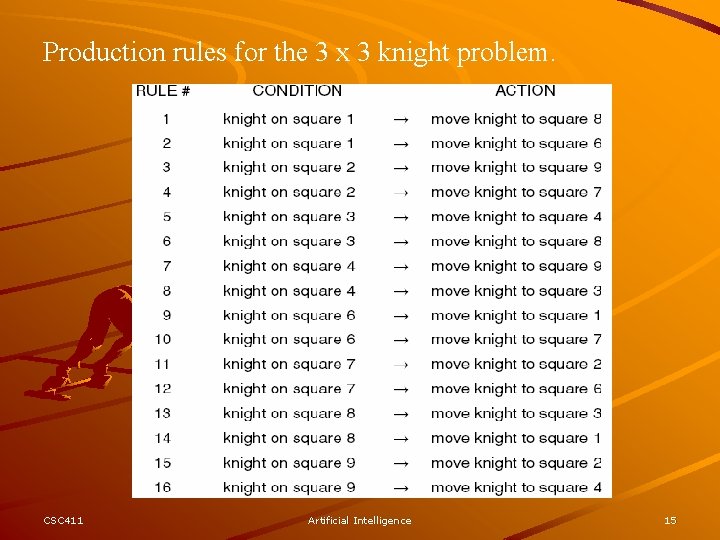
Production rules for the 3 x 3 knight problem. CSC 411 Artificial Intelligence 15
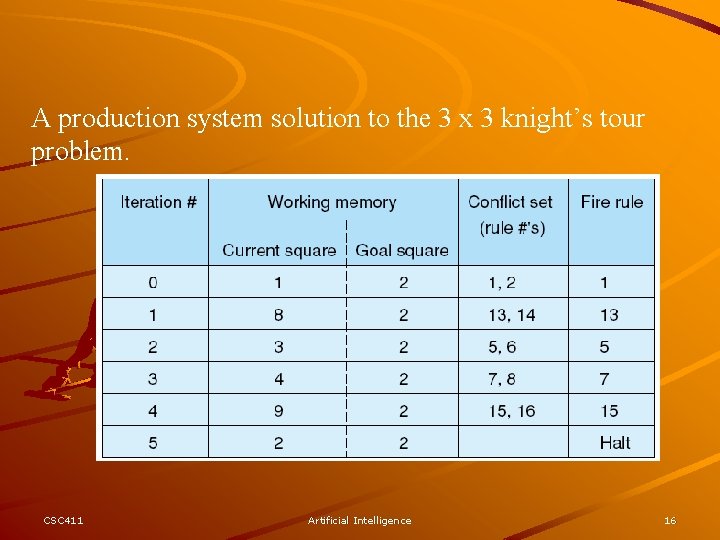
A production system solution to the 3 x 3 knight’s tour problem. CSC 411 Artificial Intelligence 16
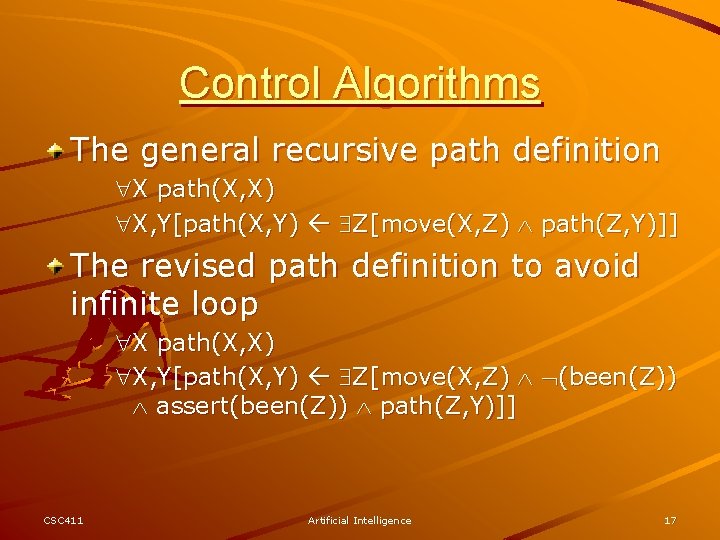
Control Algorithms The general recursive path definition X path(X, X) X, Y[path(X, Y) Z[move(X, Z) path(Z, Y)]] The revised path definition to avoid infinite loop X path(X, X) X, Y[path(X, Y) Z[move(X, Z) (been(Z)) assert(been(Z)) path(Z, Y)]] CSC 411 Artificial Intelligence 17
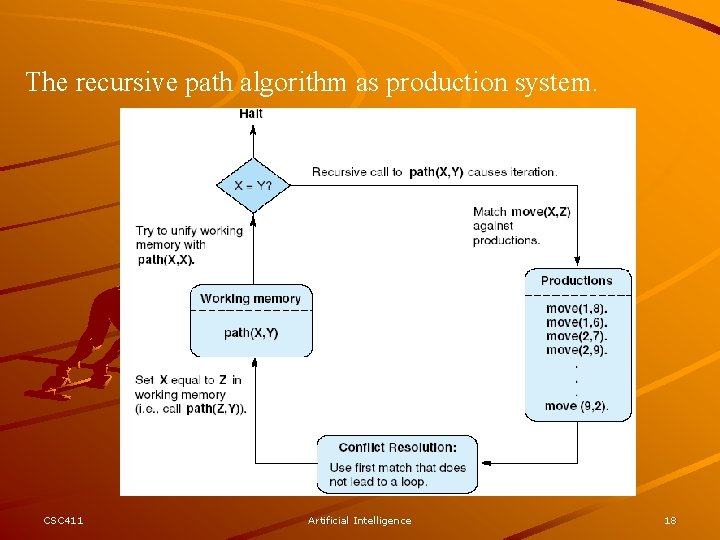
The recursive path algorithm as production system. CSC 411 Artificial Intelligence 18
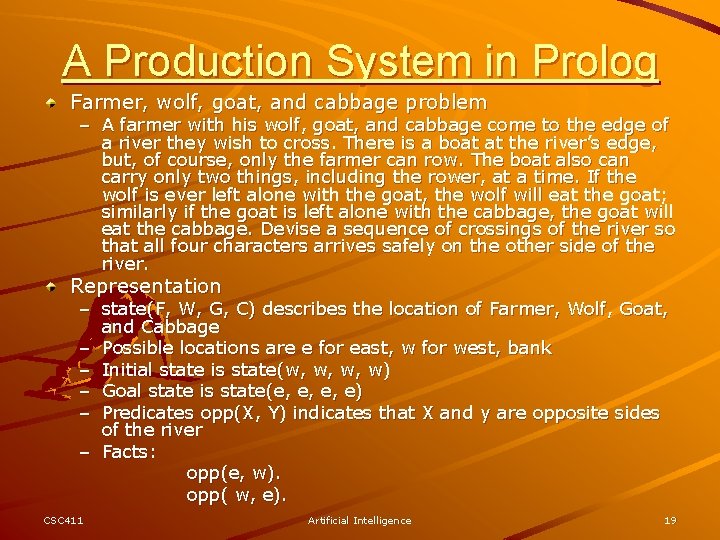
A Production System in Prolog Farmer, wolf, goat, and cabbage problem – A farmer with his wolf, goat, and cabbage come to the edge of a river they wish to cross. There is a boat at the river’s edge, but, of course, only the farmer can row. The boat also can carry only two things, including the rower, at a time. If the wolf is ever left alone with the goat, the wolf will eat the goat; similarly if the goat is left alone with the cabbage, the goat will eat the cabbage. Devise a sequence of crossings of the river so that all four characters arrives safely on the other side of the river. Representation – state(F, W, G, C) describes the location of Farmer, Wolf, Goat, and Cabbage – Possible locations are e for east, w for west, bank – Initial state is state(w, w, w, w) – Goal state is state(e, e, e, e) – Predicates opp(X, Y) indicates that X and y are opposite sides of the river – Facts: opp(e, w). opp( w, e). CSC 411 Artificial Intelligence 19
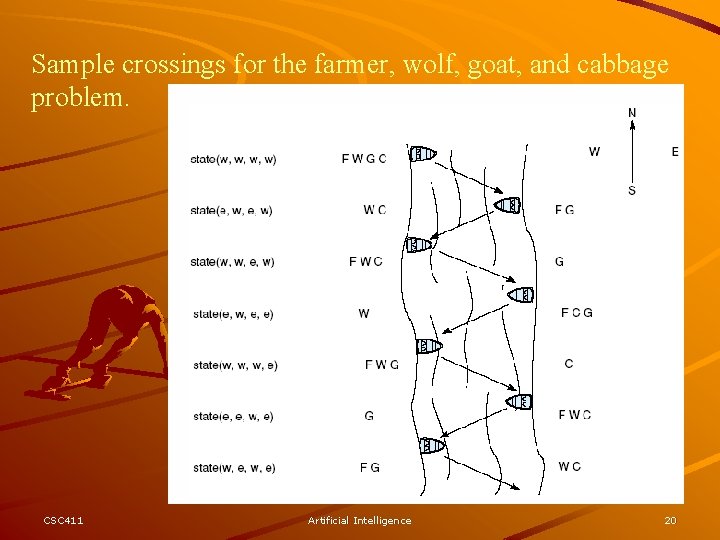
Sample crossings for the farmer, wolf, goat, and cabbage problem. CSC 411 Artificial Intelligence 20
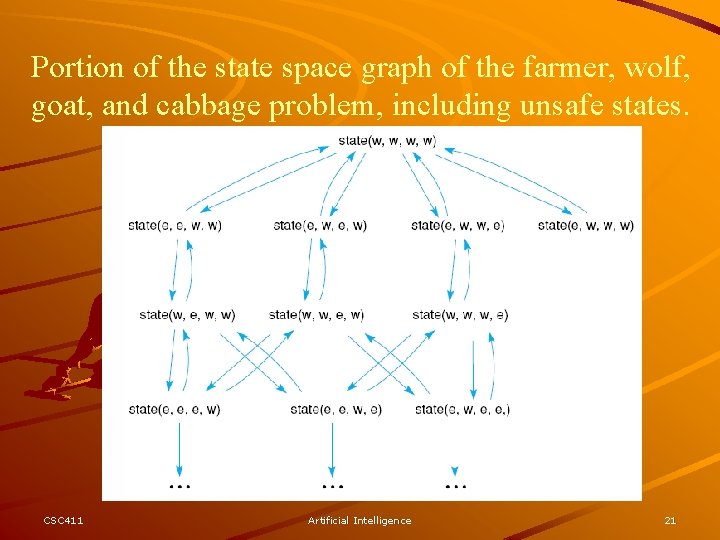
Portion of the state space graph of the farmer, wolf, goat, and cabbage problem, including unsafe states. CSC 411 Artificial Intelligence 21
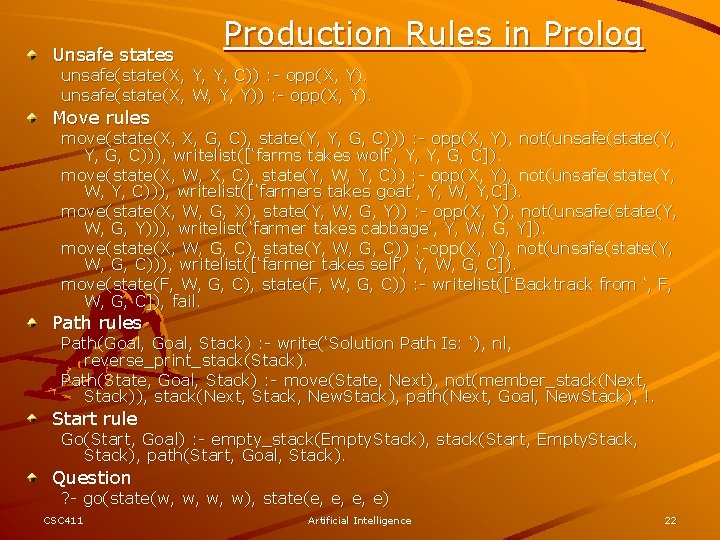
Unsafe states Production Rules in Prolog unsafe(state(X, Y, Y, C)) : - opp(X, Y). unsafe(state(X, W, Y, Y)) : - opp(X, Y). Move rules move(state(X, X, G, C), state(Y, Y, G, C))) : - opp(X, Y), not(unsafe(state(Y, Y, G, C))), writelist([‘farms takes wolf’, Y, Y, G, C]). move(state(X, W, X, C), state(Y, W, Y, C)) : - opp(X, Y), not(unsafe(state(Y, W, Y, C))), writelist([‘farmers takes goat’, Y, W, Y, C]). move(state(X, W, G, X), state(Y, W, G, Y)) : - opp(X, Y), not(unsafe(state(Y, W, G, Y))), writelist(‘farmer takes cabbage’, Y, W, G, Y]). move(state(X, W, G, C), state(Y, W, G, C)) : -opp(X, Y), not(unsafe(state(Y, W, G, C))), writelist([‘farmer takes self’, Y, W, G, C]). move(state(F, W, G, C), state(F, W, G, C)) : - writelist([‘Backtrack from ‘, F, W, G, C]), fail. Path rules Path(Goal, Stack) : - write(‘Solution Path Is: ‘), nl, reverse_print_stack(Stack). Path(State, Goal, Stack) : - move(State, Next), not(member_stack(Next, Stack)), stack(Next, Stack, New. Stack), path(Next, Goal, New. Stack), !. Start rule Go(Start, Goal) : - empty_stack(Empty. Stack), stack(Start, Empty. Stack, Stack), path(Start, Goal, Stack). Question ? - go(state(w, w, w, w), state(e, e, e, e) CSC 411 Artificial Intelligence 22
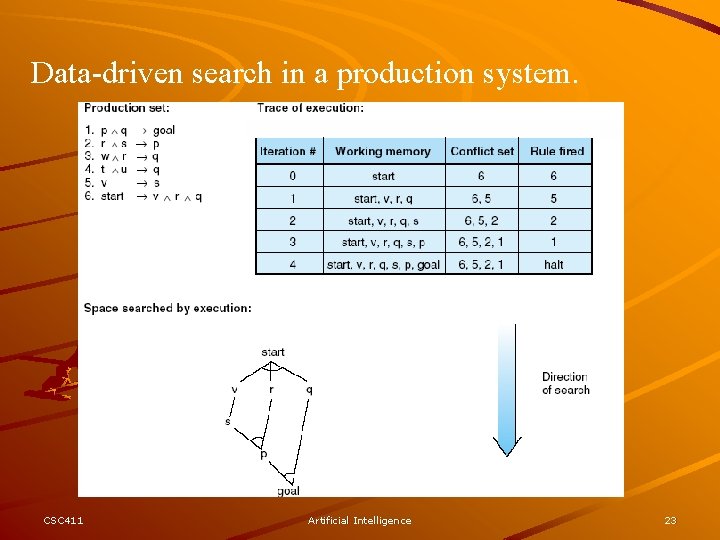
Data-driven search in a production system. CSC 411 Artificial Intelligence 23
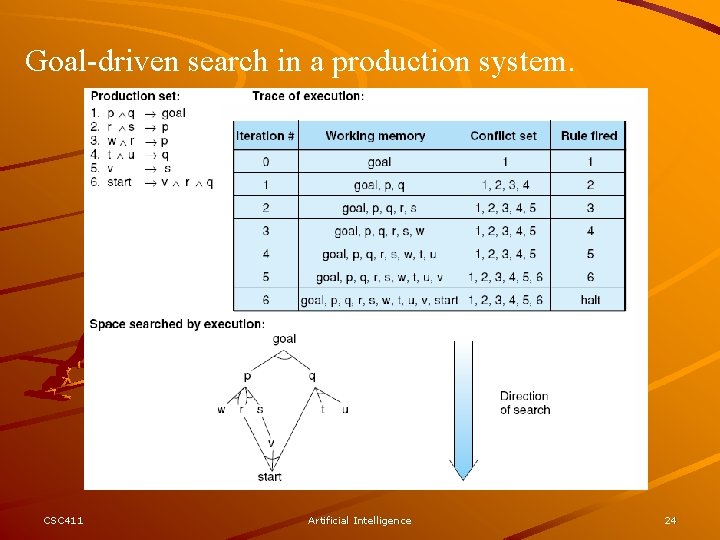
Goal-driven search in a production system. CSC 411 Artificial Intelligence 24
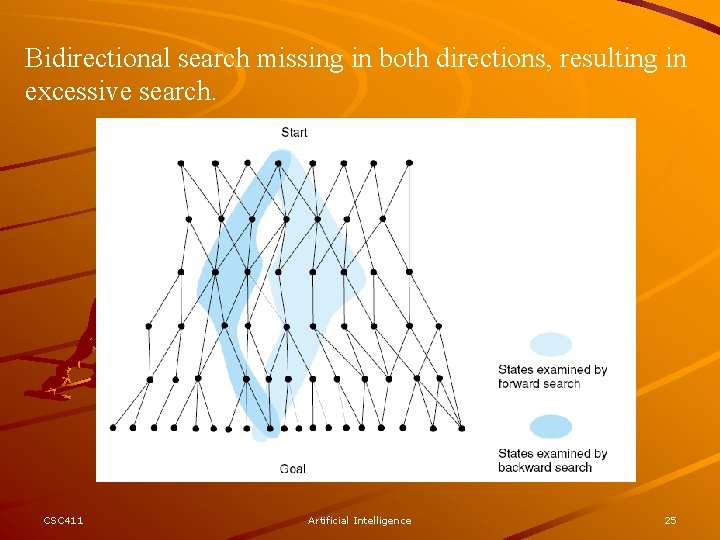
Bidirectional search missing in both directions, resulting in excessive search. CSC 411 Artificial Intelligence 25
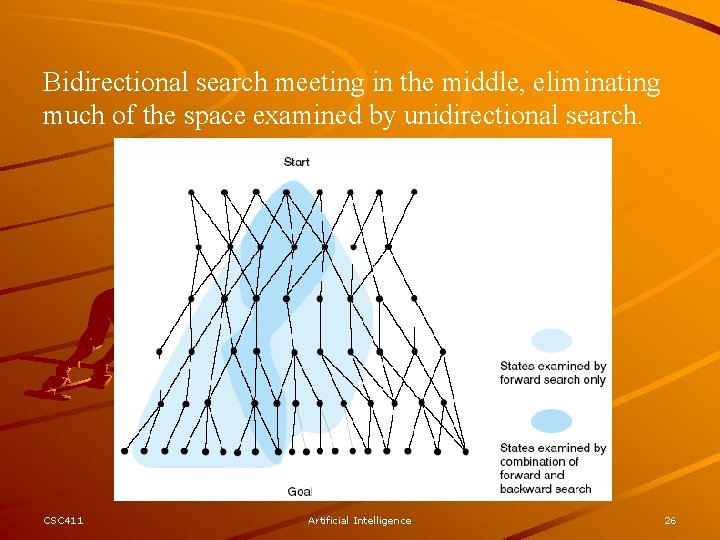
Bidirectional search meeting in the middle, eliminating much of the space examined by unidirectional search. CSC 411 Artificial Intelligence 26
Major advantages of production systems for artificial intelligence • Separation of Knowledge and Control • A Natural Mapping onto State Space Search • Modularity of Production Rules • Pattern-Directed Control • Opportunities for Heuristic Control of Search • Tracing and Explanation • Language Independence • A Plausible Model of Human Problem-Solving CSC 411 Artificial Intelligence 27
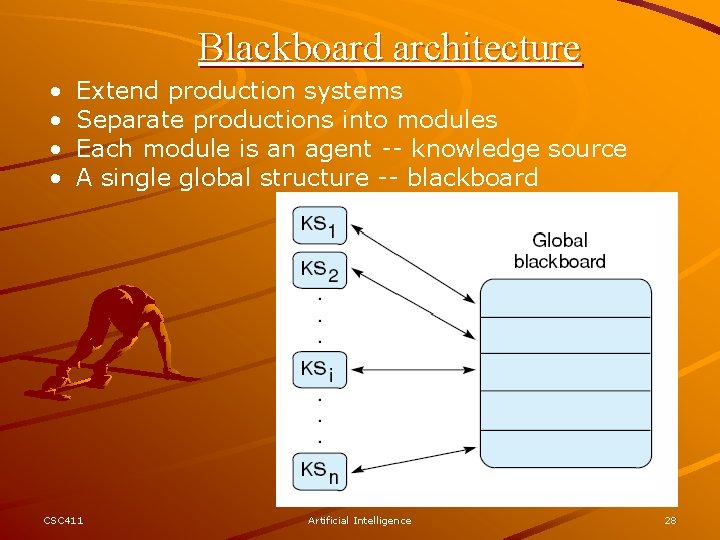
Blackboard architecture • • Extend production systems Separate productions into modules Each module is an agent -- knowledge source A single global structure -- blackboard CSC 411 Artificial Intelligence 28
- Slides: 28