
Chapter 6 BUDGETING AND COST ESTIMATION Budgeting A
Chapter 6 BUDGETING AND COST ESTIMATION
Budgeting A plan for allocating scarce resources to the various endeavors of an organization A budget implies constraints Thus, it implies that managers will not get everything they want or need It is always related to certain period of time
Budgeting Continued The budget for an activity also implies management support for that activity The higher the budget, relative to cost, the higher the managerial involvement The budget is also a control mechanism Many organizations have controls in place that prohibit exceeding the budget Comparisons are against the budget
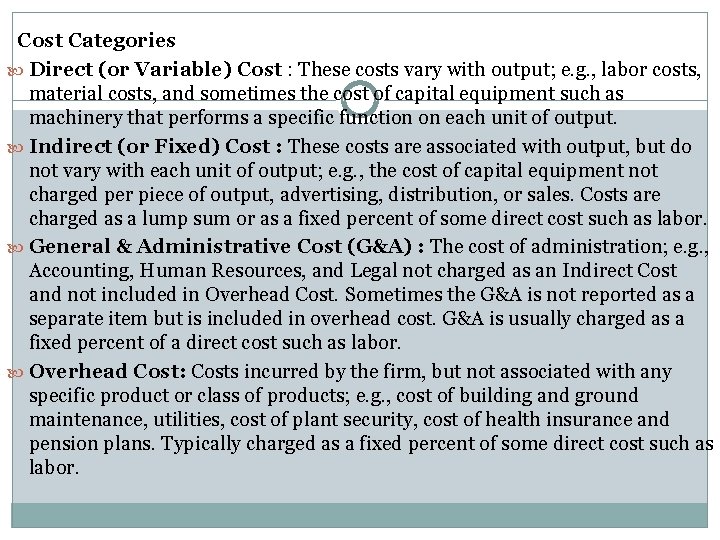
Cost Categories Direct (or Variable) Cost : These costs vary with output; e. g. , labor costs, material costs, and sometimes the cost of capital equipment such as machinery that performs a specific function on each unit of output. Indirect (or Fixed) Cost : These costs are associated with output, but do not vary with each unit of output; e. g. , the cost of capital equipment not charged per piece of output, advertising, distribution, or sales. Costs are charged as a lump sum or as a fixed percent of some direct cost such as labor. General & Administrative Cost (G&A) : The cost of administration; e. g. , Accounting, Human Resources, and Legal not charged as an Indirect Cost and not included in Overhead Cost. Sometimes the G&A is not reported as a separate item but is included in overhead cost. G&A is usually charged as a fixed percent of a direct cost such as labor. Overhead Cost: Costs incurred by the firm, but not associated with any specific product or class of products; e. g. , cost of building and ground maintenance, utilities, cost of plant security, cost of health insurance and pension plans. Typically charged as a fixed percent of some direct cost such as labor.
Estimating Project Budgets On most projects Material + Labor + Equipment + Capital + Overhead + Profits = Bid In other words Resources + Profits = Bid So we are left with the task of forecasting resources
Estimating Project Budgets Continued Like any forecast, this includes some uncertainty There is uncertainty regarding usage and price Especially true for material and labor The more standardized the project and components, the lower the uncertainty The more experienced the cost estimator, the lower the uncertainty
Estimating Budgets is Difficult 1. 2. 3. 4. 5. 6. There may not be as much historical data or none at all Even with similar projects, there may be significant differences Multiple people have input to the budget Multiple people have some control over the budget The accounting system may not be set up to track project data Usage of labor and material is very lumpy over time

Types of Budgeting Top-down 2. Bottom-up 3. Negotiated 1.

1. Top-Down Budgeting: A budgeting method that begins with top managers’ estimates of the resources needed for a project. Its primary advantage is that the aggregate budget is typically quite accurate because no element has been left out. Individual elements, however, may be quite inaccurate. A certain amount of money is allocated to carry out the project activities which has to be split between sub projects. The allocation is based on the estimates of senior management (judgments/ experience of similar past projects/activities). Aka: BBS – Budget Breakdown Structure These managers estimate overall project cost as well as the cost of major sub projects. The estimates are then given to the lower managers to continue that for smaller activities
Advantages Overall project budgets can be set/controlled very accurately Management has more control over budgets The allocation of the costs to sub-activities creates a degree of competition among the concerned supervisors which is beneficial to the project completion. Unpredictability, risk factor for small individual tasks taken care of at a higher level and does not affect the ultimate figures.
Advantages Small yet costly tasks need not be individually identified and there is no fear that some small but important task has been overlooked due to subordinates confidence that management has a full understanding of costs.
Disadvantages Strong bias toward underestimating costs Leads to low level competition for larger shares of budget

A Format for Gathering Data on Project Resource Needs 7 -13

2. Bottom-up Budgeting Bottom-up budgeting is a method that begins with those who will be doing the tasks estimating the resources needed. The advantage is more accurate estimates. The estimates of each level in the WBS are completed and added together by each level of supervision in the project hierarchy. The elemental tasks, their schedules and their individual budgets are constructed following the WBS The people doing the work are consulted regarding the times and budget, to ensure the best level of accuracy.
Contd… Initially the estimates are based on resources–labor-hr. Material etc. and later converted to monetary terms. Standard analysis tools such as learning curve analysis and work sampling are employed to improve the estimates. Senior/Junior Managers and Project Managers sit together to set aside differences of opinions regarding estimates. Resulting task budget are aggregated to give the total direct costs of the project. The project manager then adds the indirect costs (overheads), project contingency and a profit figure to arrive at the project price/budget.
Advantages Estimates are prepared by people who will carry out the activities. This brings in commitment to achieve those figures at their level. More likely to catch unusual expenses Individuals closer to the work will have a more accurate idea of the resource requirements than their supervisors or others not personally involved. The involvement of low level managers in the budget will increase the likelihood that they will accept the results with a minimum resistance.
Disadvantages Where it is common for costing proposals to be cut by project managers, the activity level costs are artificially inflated as the staff try to offset the effect of such cuts. The process thus delivers inaccurate estimates and loses credibility.
3. Negotiated Budgets Most projects use some combination of top-down and bottom-up budgeting Both are prepared and compared Any differences are negotiated
Budget Contingencies The allocation of extra funds to cover uncertainties and improve the chance of finishing on time. Extra funds are needed because Project scope may change Cost estimation must anticipate interaction costs Normal conditions are rarely encountered 8 -20

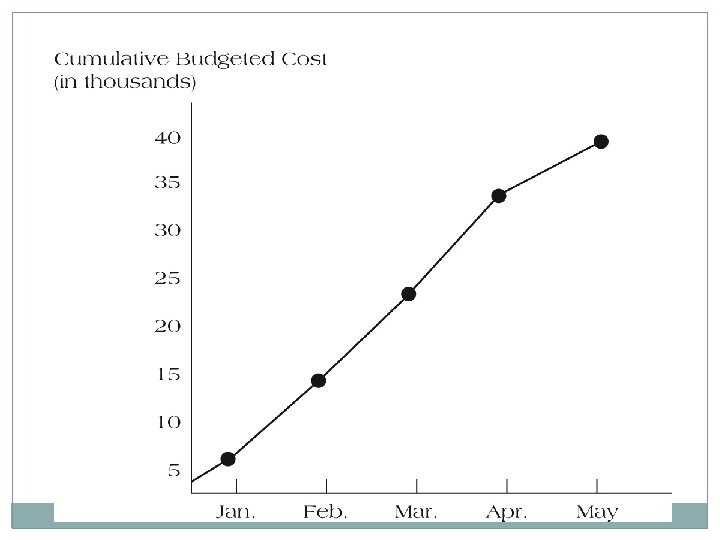
Time-Phased budget 8 -21
8 -22
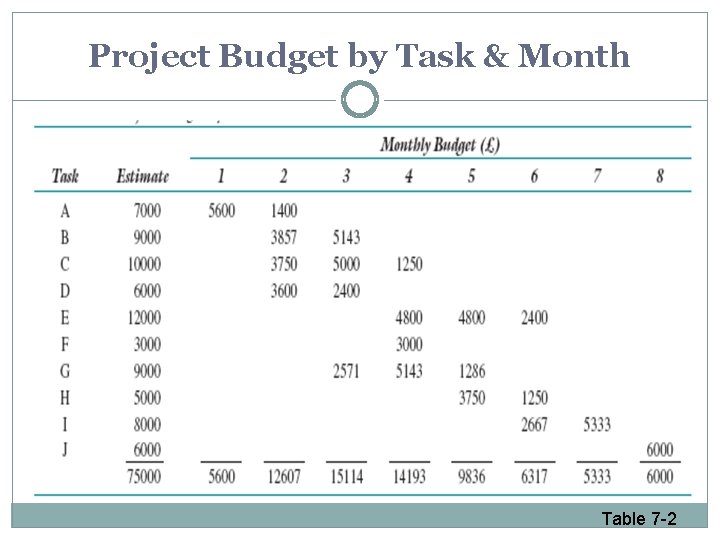
Project Budget by Task & Month Table 7 -2
Improving The Process of Cost Estimation Inputs from a lot of areas are required to estimate a project May have a professional cost estimator to do the job Project manager will work closely with cost estimator when planning a project We are primarily interested in estimating direct costs Indirect costs are not a major concern
Improving the Process of Cost Estimation There are two fundamentally different ways to manage the risks associated with the chance events that occur on every project: The most common is to make an allowance for contingencies - usually 5 or 10 percent Another is when the forecaster selects “most likely, optimistic, and pessimistic” estimates
Problems Even with careful planning, estimates may be wrong Learning Curve
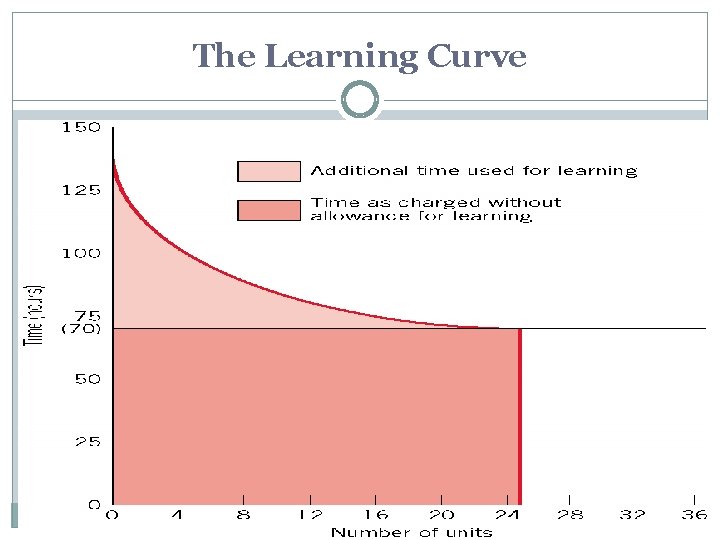
Learning Curves Studies have shown that human performance usually improves when a task is repeated In general, performance improves by a fixed percent each time production doubles More specifically, each time the output doubles, the worker hours per unit decrease to a fixed percentage of their previous value That percentage is called the learning rate
Learning curve The learning curve is based on the observation that the amount of time required to produce one unit decreases a constant percentage every time the output doubles If an individual requires 10 minutes to accomplish a certain task the first time it is attempted and only 8 minutes the second time, that person is said to have an 80 percent learning rate. If output is doubled again from two to four, we would expect the fourth item to be produced in 8(0. 8) =6. 4 min Similarly, the eighth unit of output should require 6. 4(0. 8) =5. 12 min and so on. The time required to produce a unit of output follows a wellknown formula: Tn =T 1 (n)r
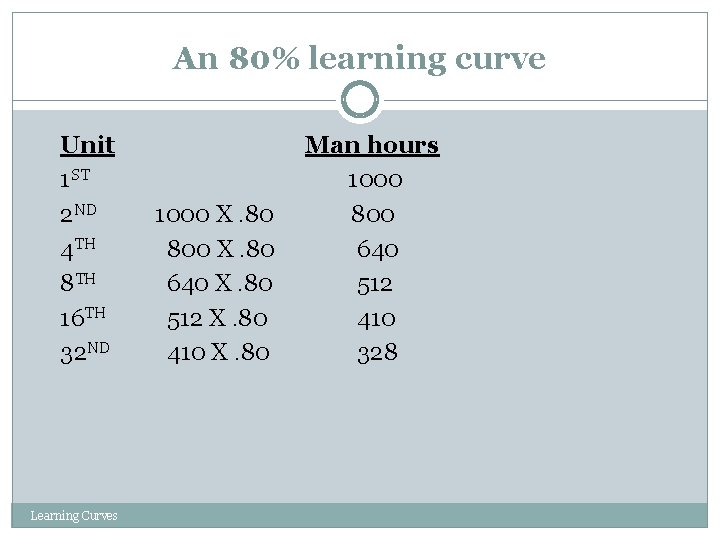
An 80% learning curve Unit 1 ST 2 ND 4 TH 8 TH 16 TH 32 ND Learning Curves 1000 X. 80 800 X. 80 640 X. 80 512 X. 80 410 X. 80 Man hours 1000 800 640 512 410 328
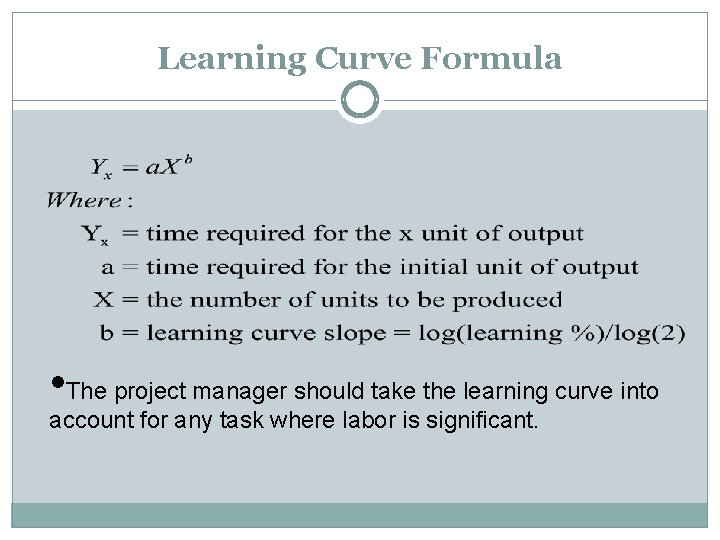
Learning Curve Formula • The project manager should take the learning curve into account for any task where labor is significant.
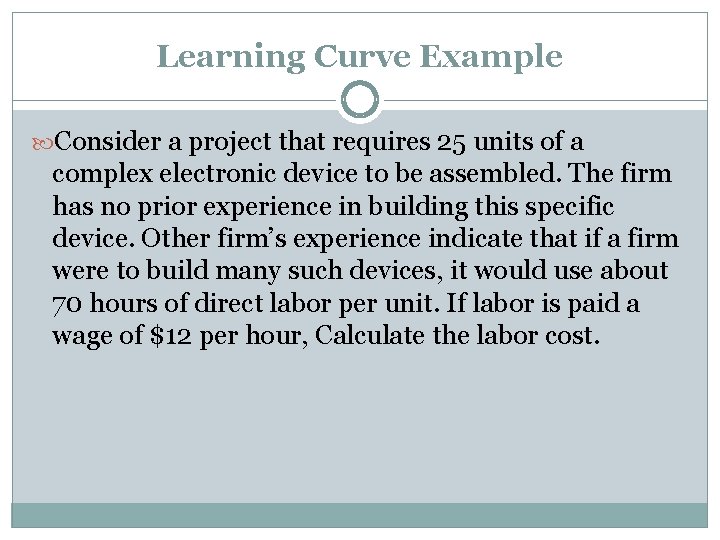
Learning Curve Example Consider a project that requires 25 units of a complex electronic device to be assembled. The firm has no prior experience in building this specific device. Other firm’s experience indicate that if a firm were to build many such devices, it would use about 70 hours of direct labor per unit. If labor is paid a wage of $12 per hour, Calculate the labor cost.
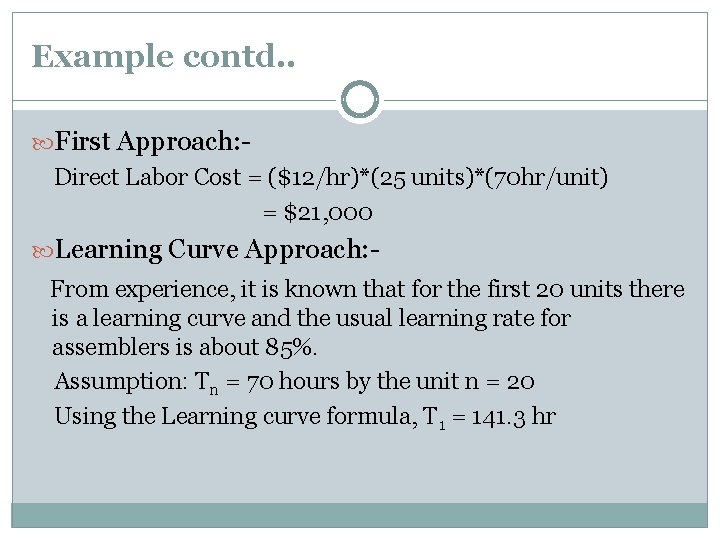
Example contd. . First Approach: - Direct Labor Cost = ($12/hr)*(25 units)*(70 hr/unit) = $21, 000 Learning Curve Approach: - From experience, it is known that for the first 20 units there is a learning curve and the usual learning rate for assemblers is about 85%. Assumption: Tn = 70 hours by the unit n = 20 Using the Learning curve formula, T 1 = 141. 3 hr
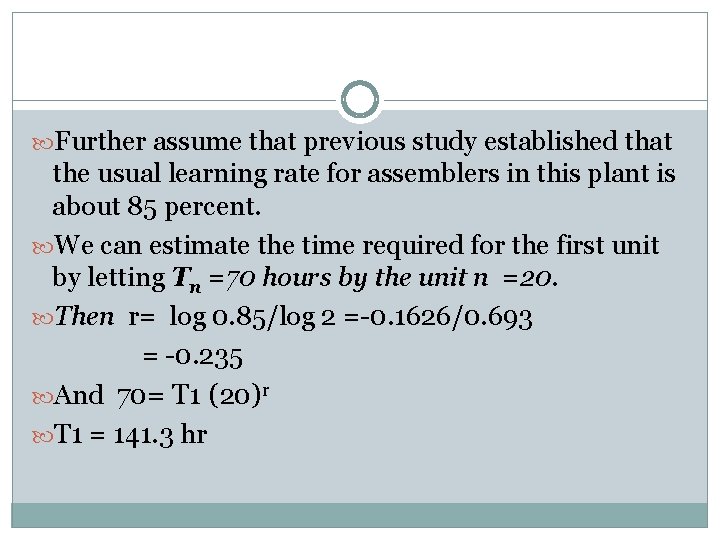
Further assume that previous study established that the usual learning rate for assemblers in this plant is about 85 percent. We can estimate the time required for the first unit by letting Tn =70 hours by the unit n =20. Then r= log 0. 85/log 2 =-0. 1626/0. 693 = -0. 235 And 70= T 1 (20)r T 1 = 141. 3 hr
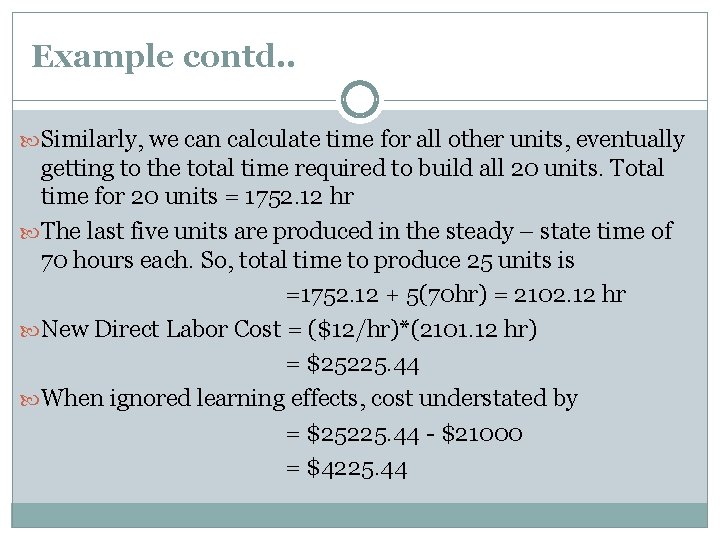
Example contd. . Similarly, we can calculate time for all other units, eventually getting to the total time required to build all 20 units. Total time for 20 units = 1752. 12 hr The last five units are produced in the steady – state time of 70 hours each. So, total time to produce 25 units is =1752. 12 + 5(70 hr) = 2102. 12 hr New Direct Labor Cost = ($12/hr)*(2101. 12 hr) = $25225. 44 When ignored learning effects, cost understated by = $25225. 44 - $21000 = $4225. 44
The Learning Curve
Other Factors Anywhere from about 60 -80 % of projects fail to meet their time, cost, and/or specification objectives There are several common causes: Arbitrary and impossible goals Wildly optimistic estimates in order to influence the project selection process Changes in resource prices Failure to include an allowance for waste and spoilage Bad luck
Making Better Estimates Projects are known for being over budget It is unlikely that this is due to deliberate underestimating There are two types of errors Random : where overestimates and underestimates are likely to be equal Systematic – Bias : a systematic error where the chance of overestimating and underestimating are not likely to be equal There is nothing we can do about random errors We Want to eliminate systematic errors Two statistical measures Mean Absolute Deviation Tracking Signal
Summary The intent of a budget is to communicate organizational policy concerning the organization’s goals and priorities There a number of common budgeting methods: top-down, bottom-up, and the negotiated budget Firms will fund projects whose returns cover direct but not full costs in order to achieve long-run strategic goals of the organization
Summary If projects include repetitive tasks with significant human input, the learning phenomenon should be taken into consideration when preparing cost estimates Other major factors, in addition to learning, that should be considered when making project cost estimates are inflation, differential changes in the cost factors, waste and spoilage, personnel replacement costs, and contingencies for unexpected difficulties
- Slides: 38