
Chapter 6 Bones and Skeletal Tissues Part C
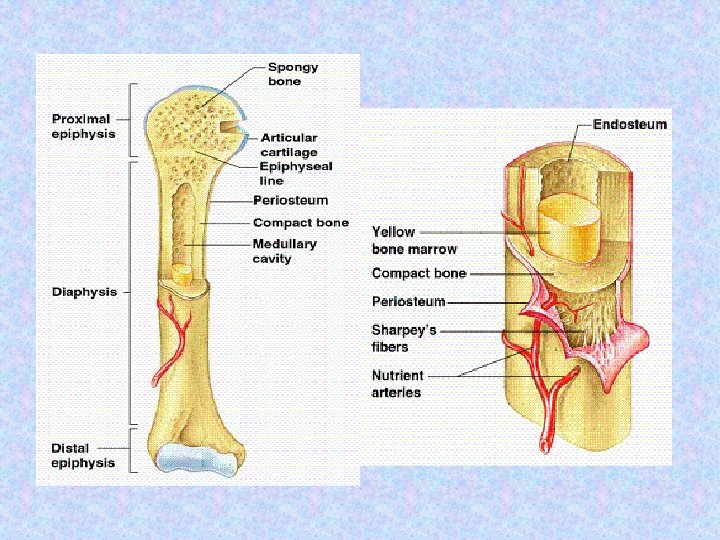
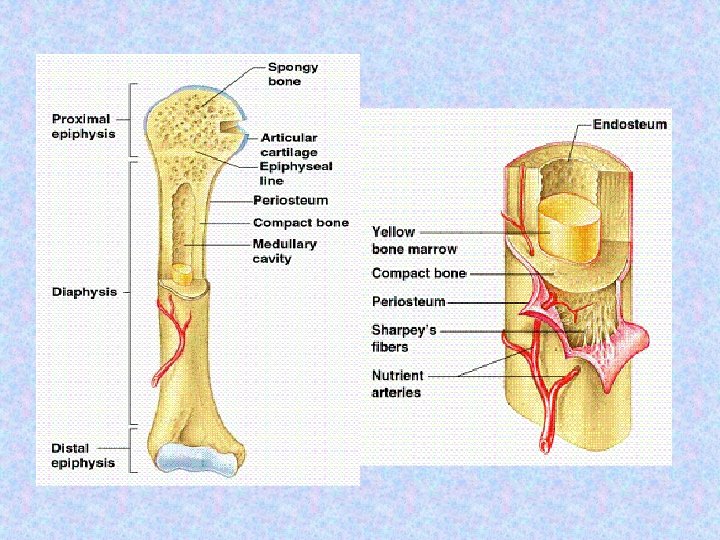
Chapter 6 Bones and Skeletal Tissues Part C Bone Development and Growth
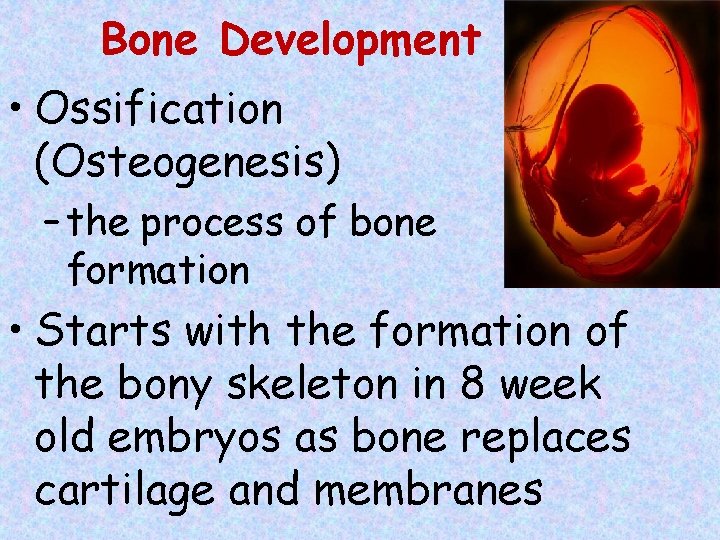
Bone Development • Ossification (Osteogenesis) – the process of bone formation tissue • Starts with the formation of the bony skeleton in 8 week old embryos as bone replaces cartilage and membranes
Bone Development • Bone grows in length until early adulthood (Bone growth) • Bone is capable of growing in thickness throughout life (by appostional growth)
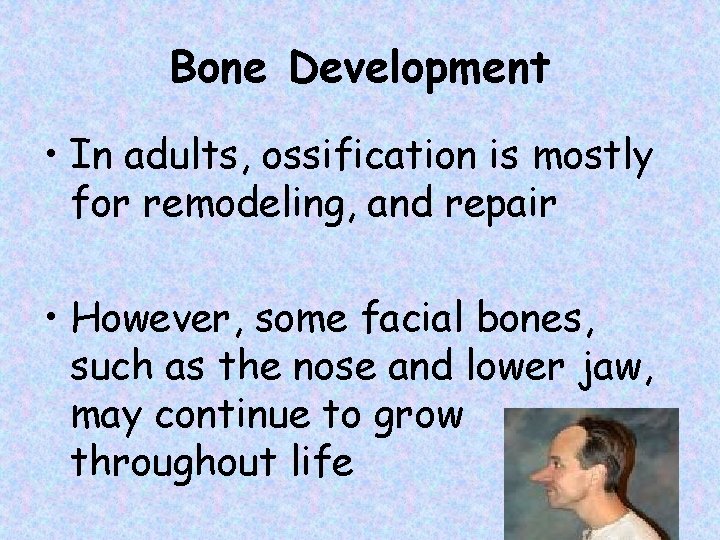
Bone Development • In adults, ossification is mostly for remodeling, and repair • However, some facial bones, such as the nose and lower jaw, may continue to grow throughout life
Changes in the Human Skeleton • In embryos, the skeleton is made of fibrous membranes and hyaline cartilage • During development, much of the fibrous or cartilage structures are replaced by bone • Cartilage remains in isolated areas – Bridge of the nose – Parts of ribs – Joints
Formation of the Bony Skeleton • Intramembranous ossification – bone develops from a fibrous membrane – The bone called a membrane bone • Endochondral ossification – bone forms by replacing hyaline cartilage – The bone is called a cartilage bone
Intramembranous Ossification • Begins at the 8 th week of development – All are flat bones • Formation of most of the flat bones of the skull and the clavicles • Fibrous connective tissue membranes are the structures on which ossification begins • Four Stages
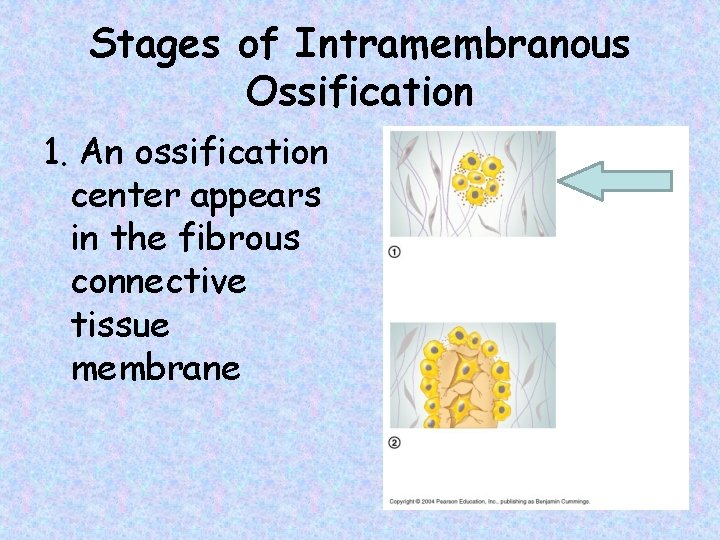
Stages of Intramembranous Ossification 1. An ossification center appears in the fibrous connective tissue membrane
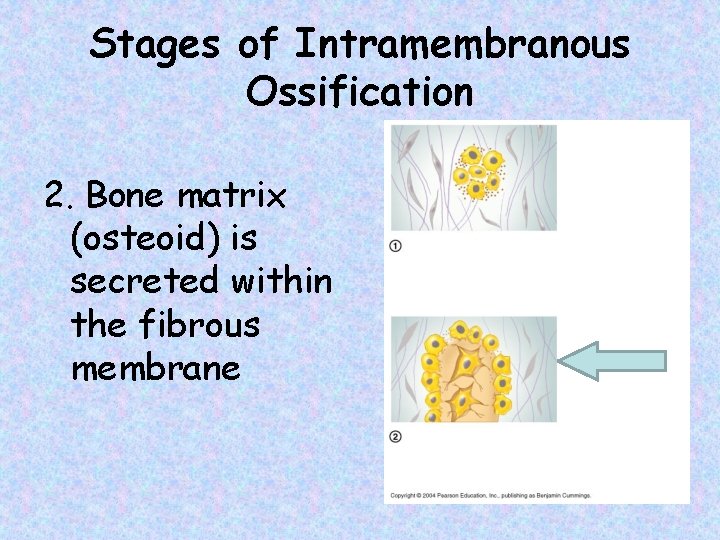
Stages of Intramembranous Ossification 2. Bone matrix (osteoid) is secreted within the fibrous membrane
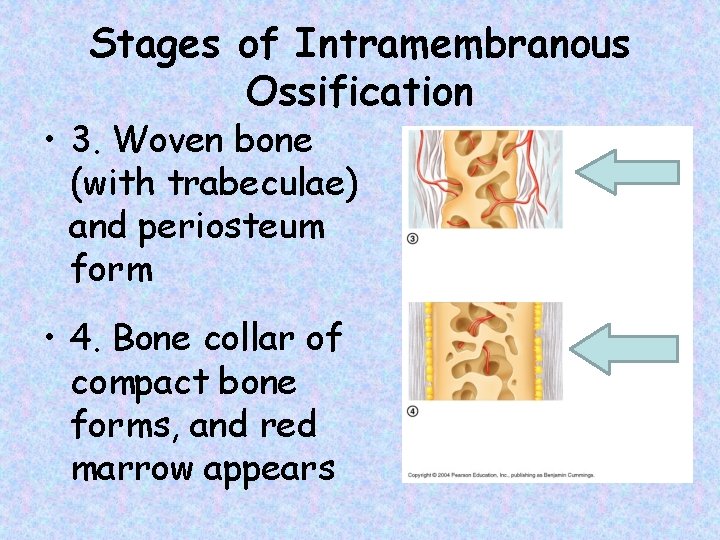
Stages of Intramembranous Ossification • 3. Woven bone (with trabeculae) and periosteum form • 4. Bone collar of compact bone forms, and red marrow appears
Endochondral Ossification • Begins in the second month of development • Uses hyaline cartilage “bones” as models for bone construction • Requires breakdown of hyaline cartilage prior to ossification
Stages of Endochondral Ossification • Formation of bone collar • Cavitation of the hyaline cartilage • Invasion of internal cavities by the periosteal bud, and spongy bone forms – happens during the 3 rd month
Stages of Endochondral Ossification • Formation of the medullary cavity; appearance of secondary ossification centers in the epiphyses – Secondary ossification centers appear right before or right after birth
Stages of Endochondral Ossification • Ossification of the epiphyses, with hyaline cartilage remaining only in the epiphyseal plates
Stages of Endochondral Ossification • Short bones will usually have just the primary ossification center • Irregular bones have several distinct secondary ossification centers • When complete, hyaline cartilage will remain in the epiphyseal plates and as articular cartilage
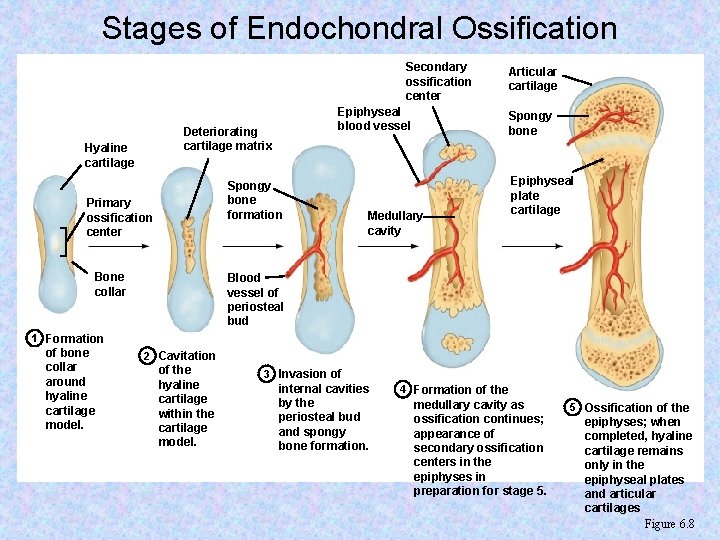
Stages of Endochondral Ossification Secondary ossification center Epiphyseal blood vessel Deteriorating cartilage matrix Hyaline cartilage Spongy bone formation Primary ossification center Bone collar Articular cartilage Spongy bone Medullary cavity Epiphyseal plate cartilage Blood vessel of periosteal bud 1 Formation of bone collar around hyaline cartilage model. 2 Cavitation of the hyaline cartilage within the cartilage model. 3 Invasion of internal cavities by the periosteal bud and spongy bone formation. 4 Formation of the medullary cavity as ossification continues; appearance of secondary ossification centers in the epiphyses in preparation for stage 5. 5 Ossification of the epiphyses; when completed, hyaline cartilage remains only in the epiphyseal plates and articular cartilages Figure 6. 8
Bone Growth During infancy and youth
Bone Growth During infancy and youth • During infancy and youth, long bones lengthen entirely by interstitial growth of the epiphyseal plates • All bones grow in thickness by appositional growth
Bone Growth of long bones During infancy and youth – Cells of the epiphyseal plate form three functionally different zones: • Growth zone • Transformation • osteogenic
Functional Zones in Long Bone Growth • Growth zone – cartilage cells undergo mitosis, pushing the epiphysis away from the diaphysis
Functional Zones in Long Bone Growth • Transformation zone – older cells enlarge, the matrix becomes calcified, cartilage cells die, and the matrix begins to deteriorate
Functional Zones in Long Bone Growth • Osteogenic zone – new bone formation occurs
Bone Growth • Epiphyseal plates allow for growth of long bone during childhood – New cartilage is continuously formed – Older cartilage becomes ossified • Cartilage is broken down • Bone replaces cartilage
Bone Growth • Bones are remodeled and lengthened until growth stops • Epiphyseal plate become thinner and thinner until entirely replaced by bone tissue – Called epiphyseal plate closure – Happens about 18 in females and 21 in males
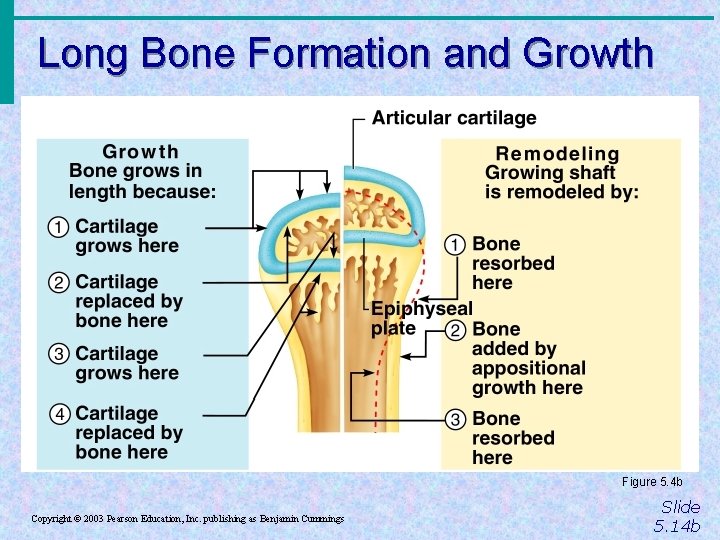
Long Bone Formation and Growth Figure 5. 4 b Copyright © 2003 Pearson Education, Inc. publishing as Benjamin Cummings Slide 5. 14 b
Bone Growth • In Adults – Bones change shape somewhat – Bones can continue to grow in width by appositional growth • When stressed by excessive muscle activity or body weight
Hormonal Regulation of Bone Growth During Youth • During infancy and childhood, epiphyseal plate activity is stimulated by growth hormone
Hormonal Regulation of Bone Growth During Youth • During puberty, testosterone and estrogens: – Initially promote adolescent growth spurts – Cause masculinization and feminization of specific parts of the skeleton
Hormonal Regulation of Bone Growth During Youth • During puberty, testosterone and estrogens: – Later induce epiphyseal plate closure, ending longitudinal bone growth
Hormonal Regulation of Bone Growth During Youth • Excesses or deficits of any of these hormones can result in abnormal skeletal growth – Hypersecretion of growth hormone in children results in excessive height (gigantism)
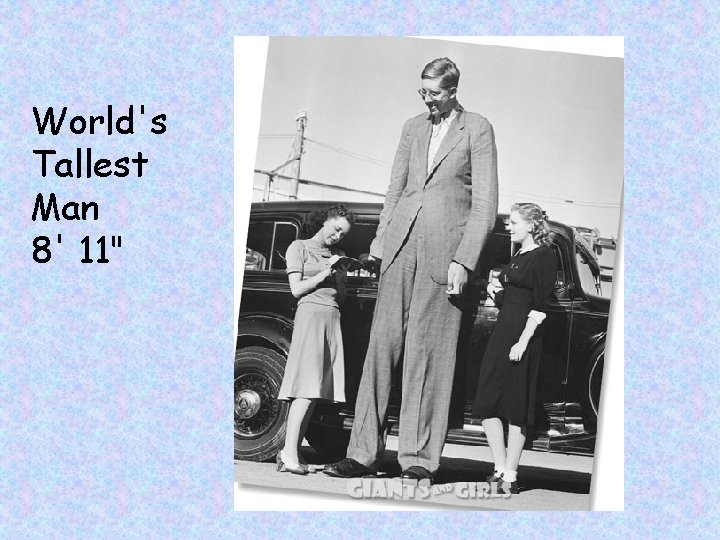
World's Tallest Man 8' 11"
Hormonal Regulation of Bone Growth During Youth • Excesses or deficits of any of these hormones can result in abnormal skeletal growth – Deficits of growth hormone or thyroid hormone produce types of dwarfism
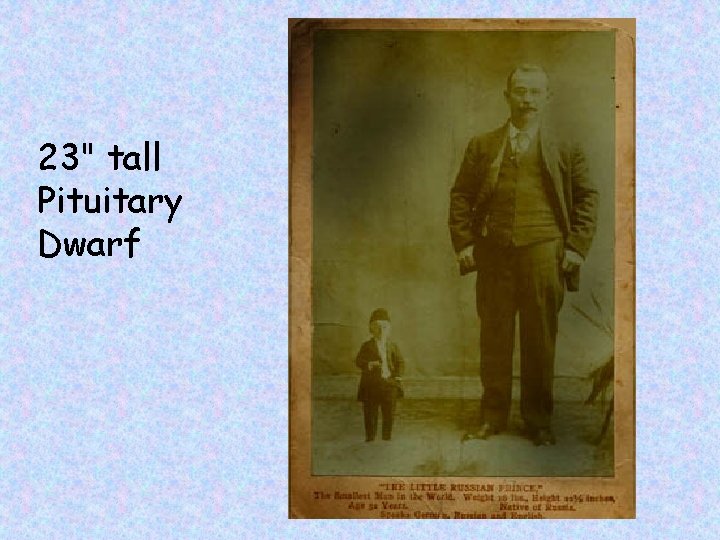
23" tall Pituitary Dwarf

Quiz Next Time! Study guide check
Chapter 6 Bones and Skeletal Tissues Part D Bone Remodeling and Repair
Bones • We may picture bones as lifeless structures – like we see them in movie graveyards or hanging in front of our classroom – But this isn’t at all the truth! • Bones are very active, dynamic tissues!
Bone remodeling • Changes in bone architecture occur continually • Every week we recycle 5 – 7% of our bone mass • A half a gram of calcium enters or leaves the adult skeleton each day
Bone remodeling • Spongy bone is replaced every 3 to 4 years • Compact bone is replaced every 10 years
Types of Bone Cells • Osteocytes – Mature bone cells • Osteoblasts – Bone-forming cells • Osteoclasts – Bone-destroying cells – Break down bone matrix for remodeling and release of calcium
Bone Remodeling • Bone remodeling is a process by both osteoblasts and osteoclasts • Remodeling units – adjacent osteoblasts and osteoclasts deposit and resorb bone at periosteal and endosteal surfaces
Bone Resorption • Accomplished by osteoclasts • Resorption bays – grooves formed by osteoclasts as they break down bone matrix
Bone Resorption • Resorption involves osteoclast secretion of: – Lysosomal enzymes that digest organic matrix – Acids that convert calcium salts into soluble forms
Bone Resorption • Dissolved matrix is transcytosed across the osteoclast’s cell where it is secreted into the interstitial fluid and then into the blood
Bone Deposition • Occurs where bone is injured or added strength is needed • Requires a diet rich in protein, vitamins C, D, and A, calcium, phosphorus, magnesium, and manganese
Bone Deposition • Alkaline phosphatase is essential for mineralization of bone • Sites of new matrix deposition are revealed by the: – Osteoid seam – unmineralized band of bone matrix – Calcification front – abrupt transition zone between the osteoid seam and the older mineralized bone
Control of Remodeling • Two control loops regulate bone remodeling – Hormonal mechanism maintains calcium homeostasis in the blood – Mechanical and gravitational forces acting on the skeleton
Importance of Ionic Calcium in the Body • Calcium is necessary for: – Transmission of nerve impulses – Muscle contraction – Blood coagulation – Secretion by glands and nerve cells – Cell division
Homeostatic Imbalances of Ionic Calcium in the Body • When blood Ca 2 are too low, severe neuromuscular problems may occur -like hyperexcitability
Homeostatic Imbalances of Ionic Calcium in the Body • When blood Ca 2 are too high (hypercalcemia), nonresponsiveness and inability to function may occur • With hypercalcemia deposits of calcium may occur in blood vessels, kidneys, and other soft organs, which can lead them to stop functioning
Hormonal Mechanism • Rising blood Ca 2+ levels trigger the thyroid to release calcitonin • Calcitonin stimulates calcium salt deposit in bone • Falling blood Ca 2+ levels signal the parathyroid glands to release PTH • PTH signals osteoclasts to degrade bone matrix and release Ca 2+ into the blood
Response to Mechanical Stress • Wolff’s law – – a bone grows or remodels in response to the forces or demands placed upon it
Response to Mechanical Stress • Observations supporting Wolff’s law include – Long bones are thickest midway along the shaft (where bending stress is greatest) – Curved bones are thickest where they are most likely to buckle
Response to Mechanical Stress • Trabeculae form along lines of stress • Large, bony projections occur where heavy, active muscles attach
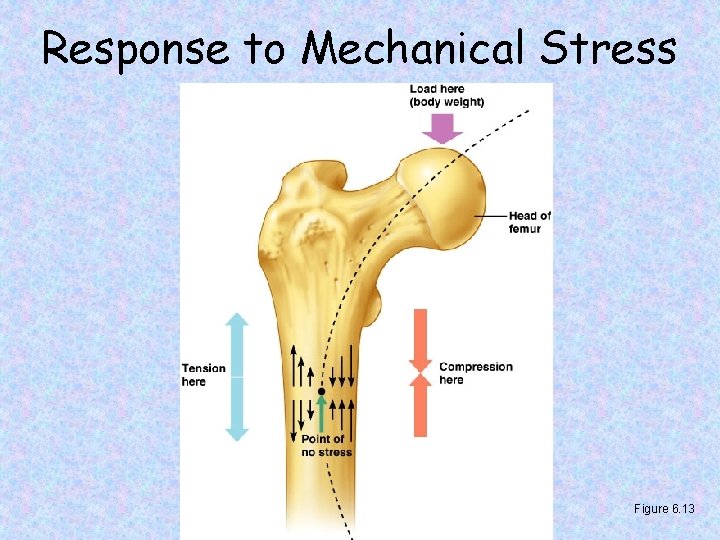
Response to Mechanical Stress Figure 6. 13
Bone Repair
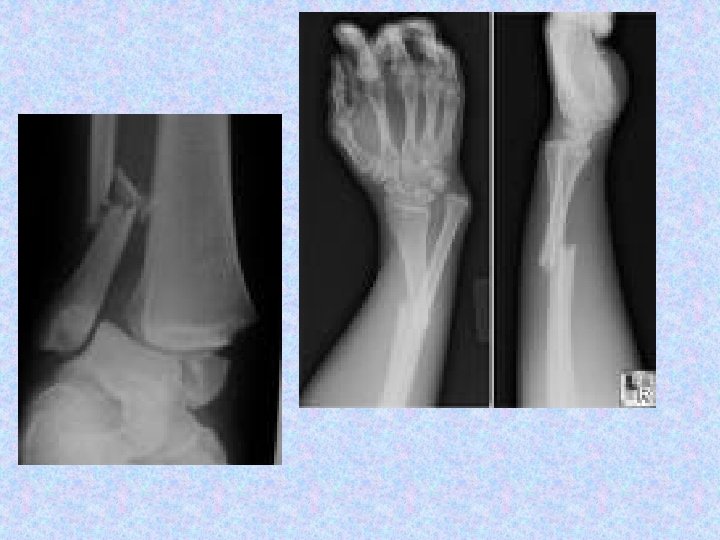
Bone Fractures (Breaks) • Bone fractures are classified by: – The position of the bone ends after fracture – The completeness of the break – The orientation of the break to the long axis of the bone – Whether or not the bones ends penetrate the skin
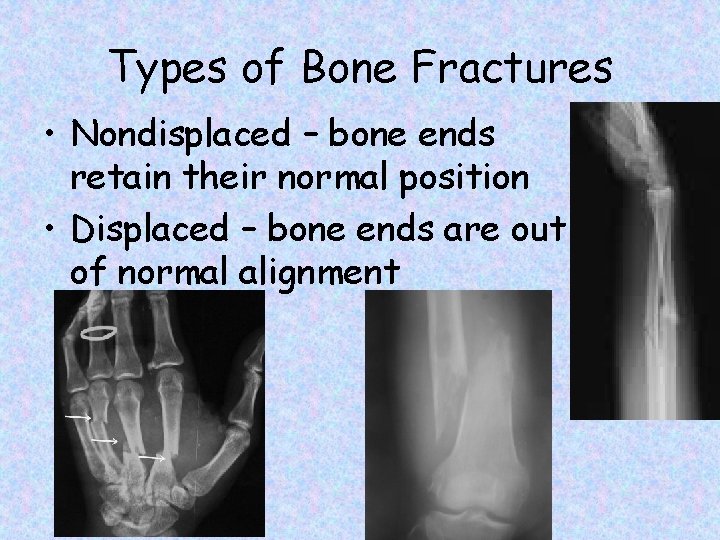
Types of Bone Fractures • Nondisplaced – bone ends retain their normal position • Displaced – bone ends are out of normal alignment
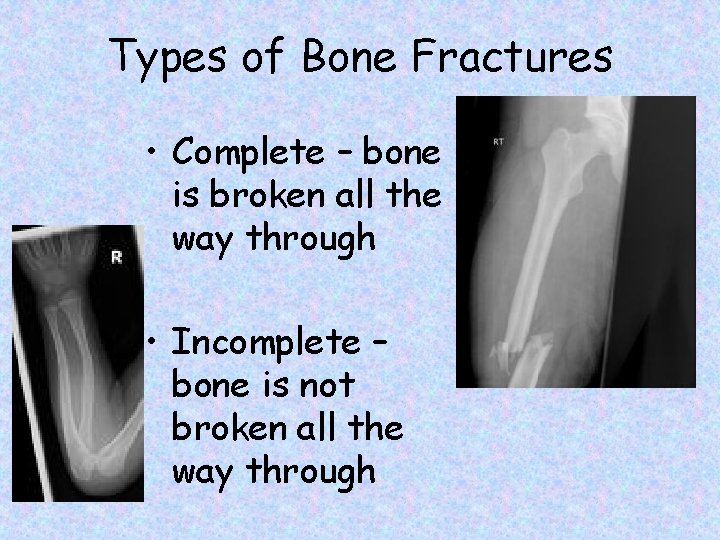
Types of Bone Fractures • Complete – bone is broken all the way through • Incomplete – bone is not broken all the way through
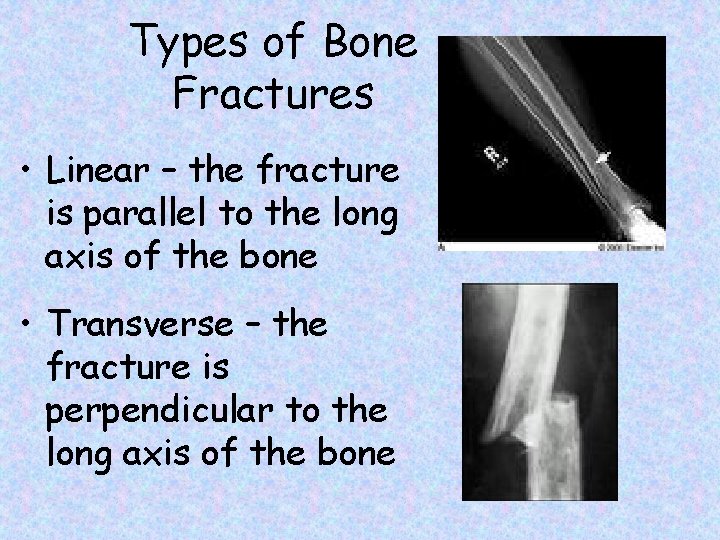
Types of Bone Fractures • Linear – the fracture is parallel to the long axis of the bone • Transverse – the fracture is perpendicular to the long axis of the bone
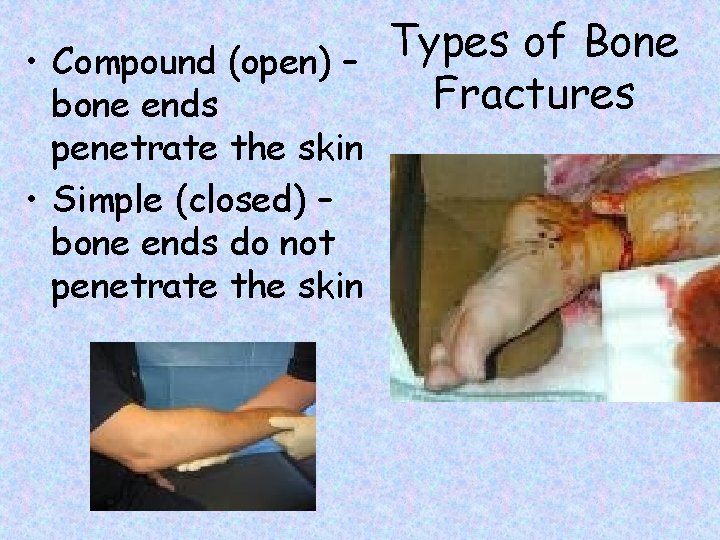
Types of Bone • Compound (open) – Fractures bone ends penetrate the skin • Simple (closed) – bone ends do not penetrate the skin
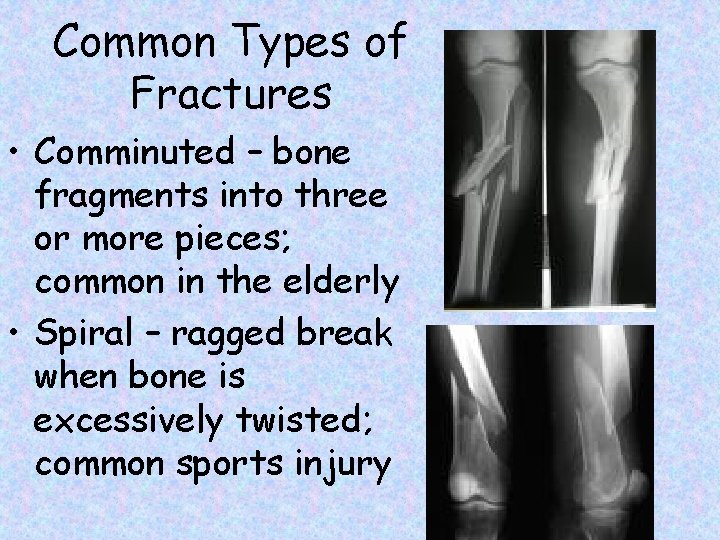
Common Types of Fractures • Comminuted – bone fragments into three or more pieces; common in the elderly • Spiral – ragged break when bone is excessively twisted; common sports injury
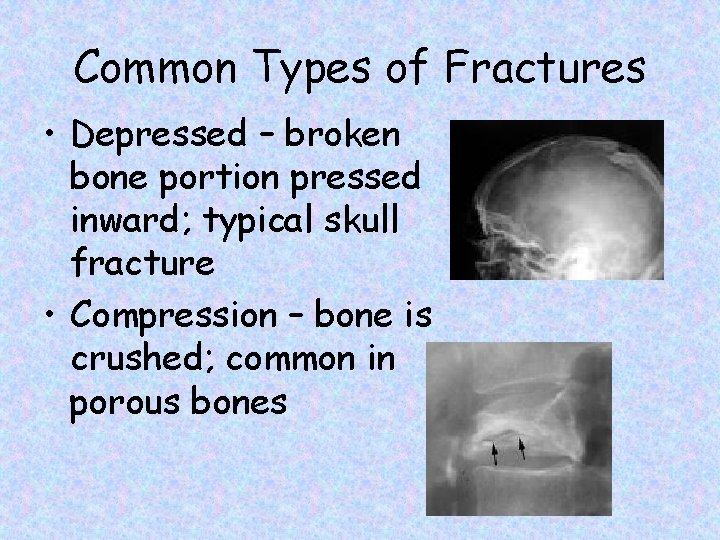
Common Types of Fractures • Depressed – broken bone portion pressed inward; typical skull fracture • Compression – bone is crushed; common in porous bones
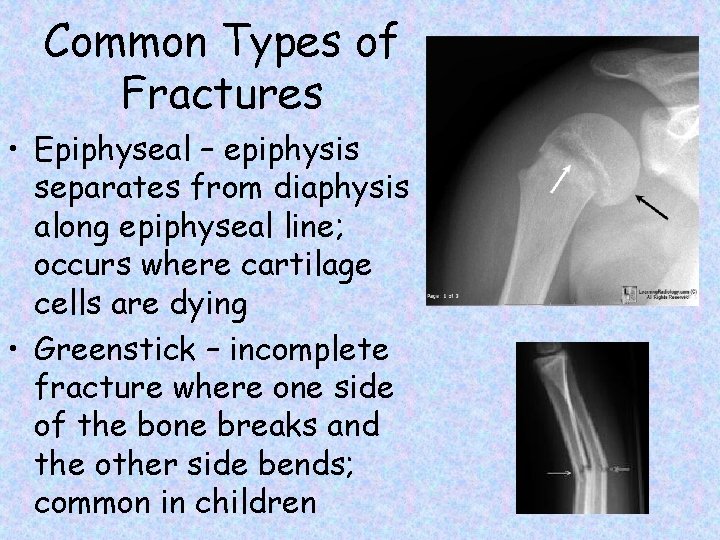
Common Types of Fractures • Epiphyseal – epiphysis separates from diaphysis along epiphyseal line; occurs where cartilage cells are dying • Greenstick – incomplete fracture where one side of the bone breaks and the other side bends; common in children
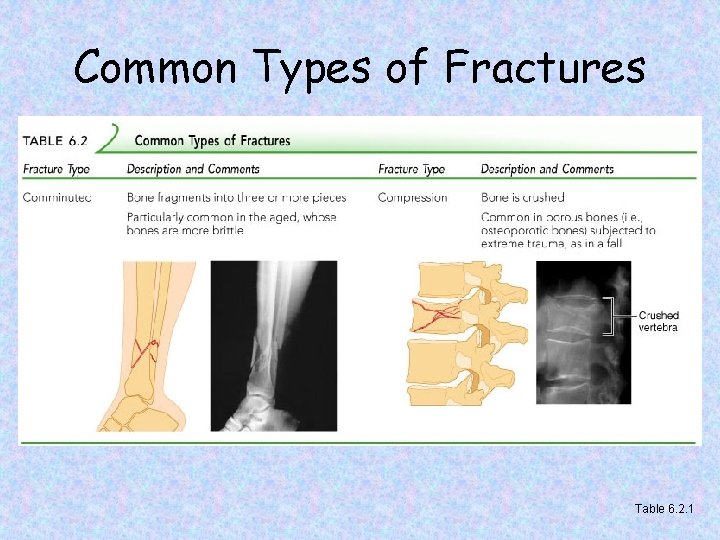
Common Types of Fractures Table 6. 2. 1
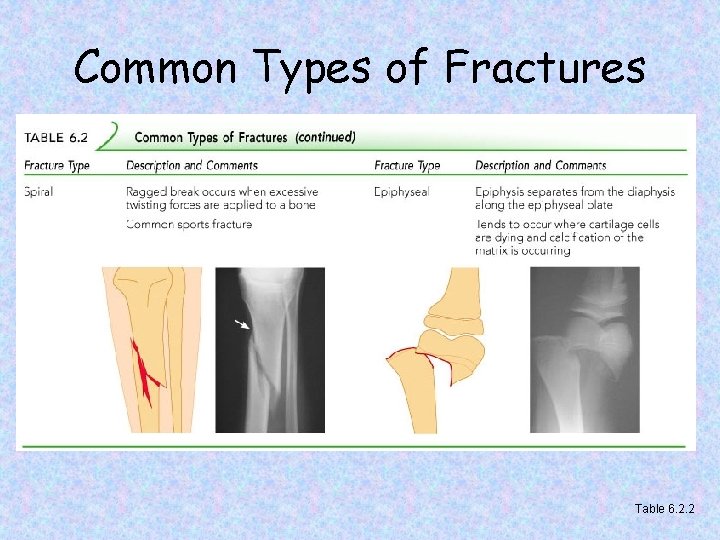
Common Types of Fractures Table 6. 2. 2
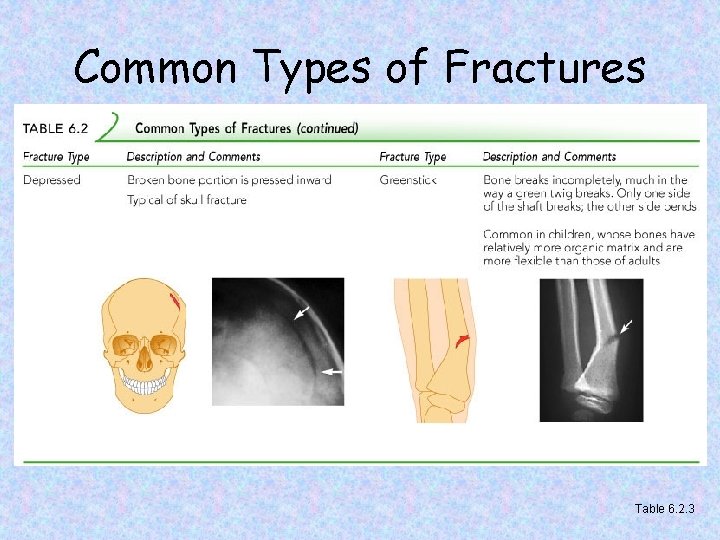
Common Types of Fractures Table 6. 2. 3
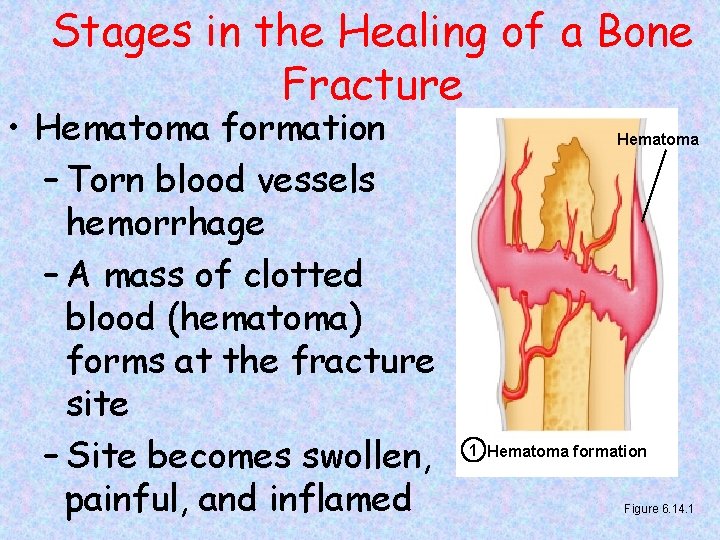
Stages in the Healing of a Bone Fracture • Hematoma formation – Torn blood vessels hemorrhage – A mass of clotted blood (hematoma) forms at the fracture site – Site becomes swollen, painful, and inflamed Hematoma 1 Hematoma formation Figure 6. 14. 1
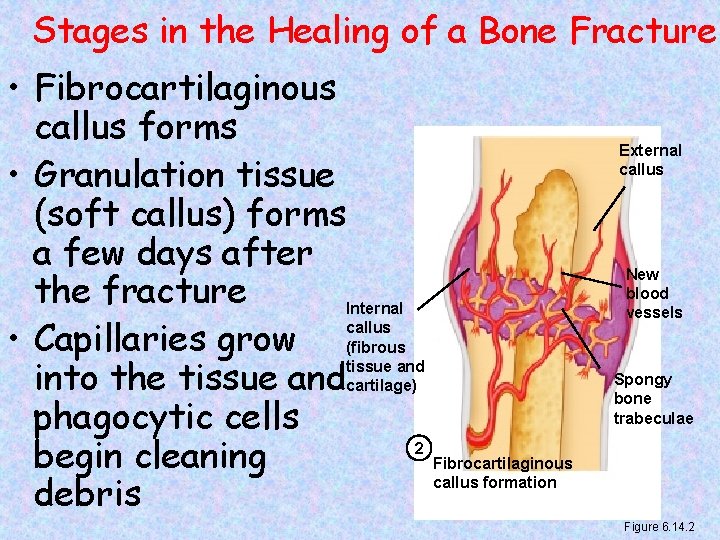
Stages in the Healing of a Bone Fracture • Fibrocartilaginous callus forms • Granulation tissue (soft callus) forms a few days after the fracture Internal callus • Capillaries grow (fibrous tissue and into the tissue andcartilage) phagocytic cells 2 begin cleaning Fibrocartilaginous callus formation debris External callus New blood vessels Spongy bone trabeculae Figure 6. 14. 2
Stages in the Healing of a Bone Fracture • The fibrocartilaginous callus forms when: – Osteoblasts and fibroblasts migrate to the fracture and begin reconstructing the bone – Fibroblasts secrete collagen fibers that connect broken bone ends
Stages in the Healing of a Bone Fracture • The fibrocartilaginous callus forms when: – Osteoblasts begin forming spongy bone – Osteoblasts furthest from capillaries secrete an externally bulging cartilaginous matrix that later calcifies
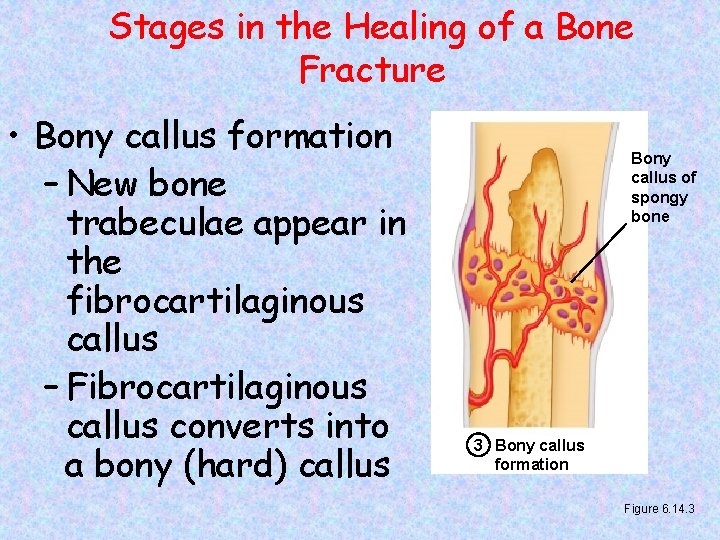
Stages in the Healing of a Bone Fracture • Bony callus formation – New bone trabeculae appear in the fibrocartilaginous callus – Fibrocartilaginous callus converts into a bony (hard) callus Bony callus of spongy bone 3 Bony callus formation Figure 6. 14. 3
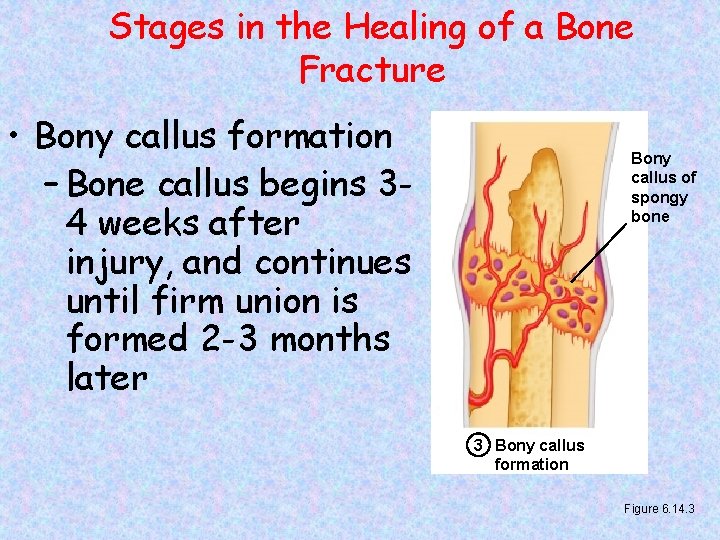
Stages in the Healing of a Bone Fracture • Bony callus formation – Bone callus begins 34 weeks after injury, and continues until firm union is formed 2 -3 months later Bony callus of spongy bone 3 Bony callus formation Figure 6. 14. 3
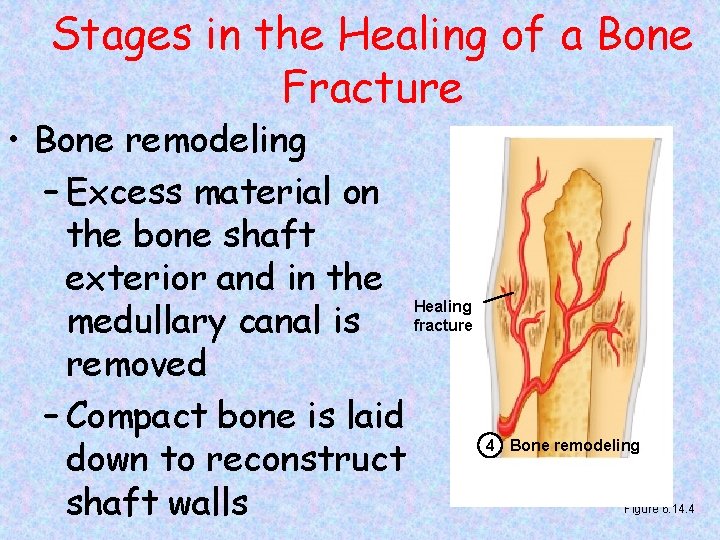
Stages in the Healing of a Bone Fracture • Bone remodeling – Excess material on the bone shaft exterior and in the Healing medullary canal is fracture removed – Compact bone is laid down to reconstruct shaft walls 4 Bone remodeling Figure 6. 14. 4
Clinical Advances in Bone Repair • Electrical stimulation of fraction sites – Increases speed of healing • Ultrasound treatments – Daily exposure to ultrasound reduces healing time of broken arms and legs by 35 to 45% by stimulating the production of the callus
Clinical Advances in Bone Repair • Bone grafts using the fibula – Grafts from hip bones often fail – Blood vessels are grafted with the fibula, having a better success rate – Bone graphs more successful in adults than children
Clinical Advances in Bone Repair • VEGF (vascular endothelial growth factor) – Protein that stimulates growth of blood vessels- speeds • Bone substitutes molded to the shape of desired bone or inserted into existing bone – replacing bone grafts
Clinical Advances in Bone Repair • Bone substitutes – May be crushed bone from cadavers • Small risk of hepatitis or HIV, or may be rejected – synthetic bone material • Can be rejected – Heat treated coral (to kill living coral cells) mixed with mineral salts of bone (calcium phosphate ) - new
Homeostatic Imbalances of Bone
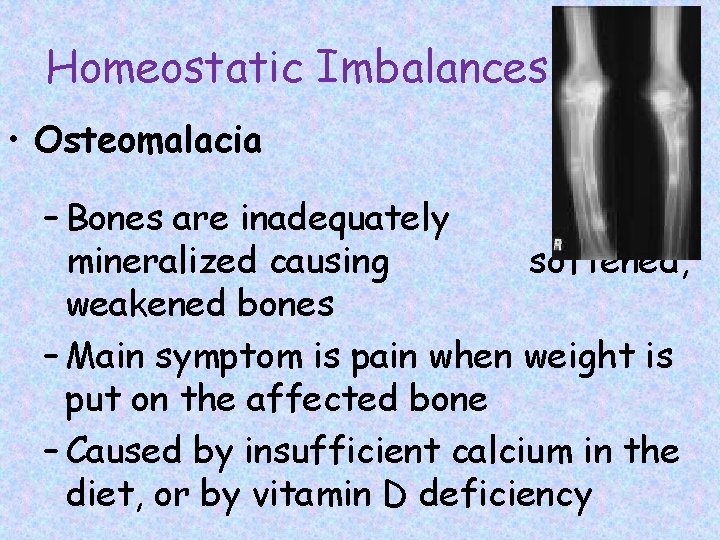
Homeostatic Imbalances • Osteomalacia – Bones are inadequately mineralized causing softened, weakened bones – Main symptom is pain when weight is put on the affected bone – Caused by insufficient calcium in the diet, or by vitamin D deficiency
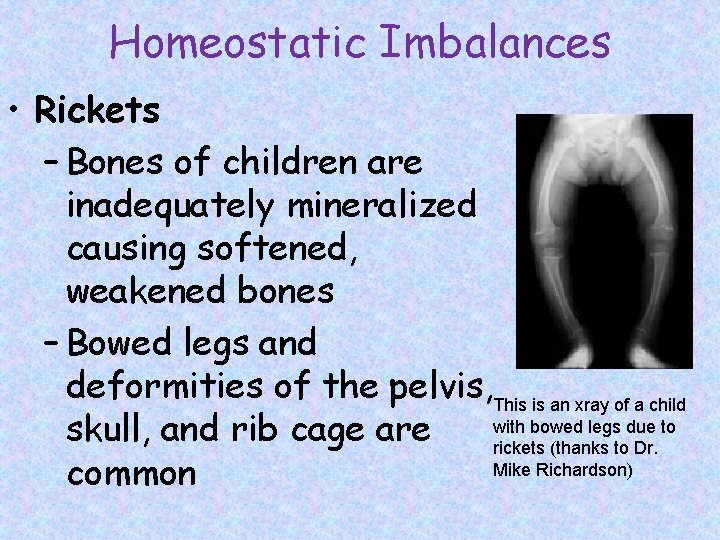
Homeostatic Imbalances • Rickets – Bones of children are inadequately mineralized causing softened, weakened bones – Bowed legs and deformities of the pelvis, This is an xray of a child with bowed legs due to skull, and rib cage are rickets (thanks to Dr. Mike Richardson) common
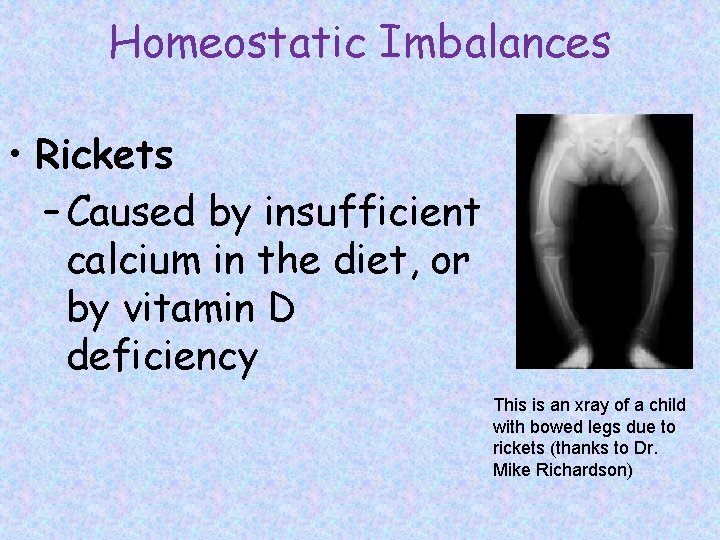
Homeostatic Imbalances • Rickets – Caused by insufficient calcium in the diet, or by vitamin D deficiency This is an xray of a child with bowed legs due to rickets (thanks to Dr. Mike Richardson)
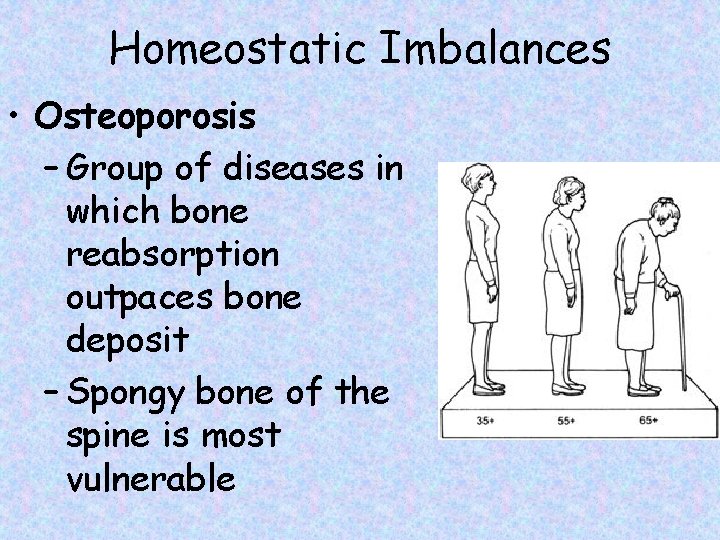
Homeostatic Imbalances • Osteoporosis – Group of diseases in which bone reabsorption outpaces bone deposit – Spongy bone of the spine is most vulnerable
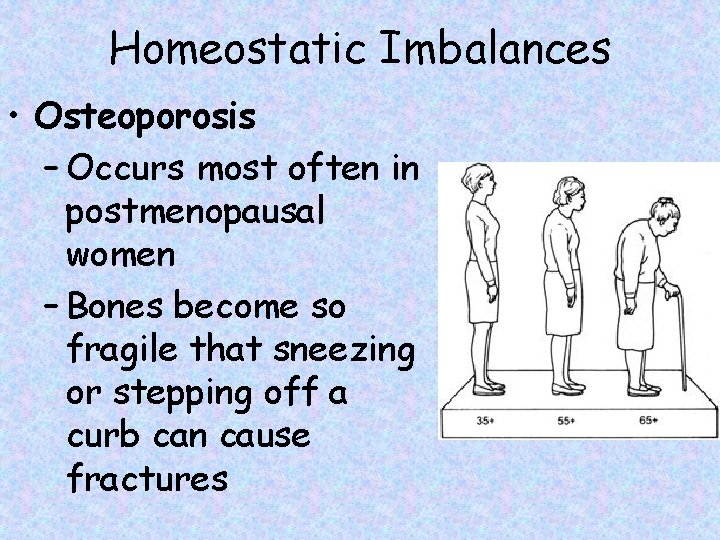
Homeostatic Imbalances • Osteoporosis – Occurs most often in postmenopausal women – Bones become so fragile that sneezing or stepping off a curb can cause fractures
Osteoporosis: Treatment • Calcium and vitamin D supplements • Increased weight-bearing exercise • Hormone (estrogen) replacement therapy (HRT) slows bone loss • Natural progesterone cream prompts new bone growth • Statins increase bone mineral density
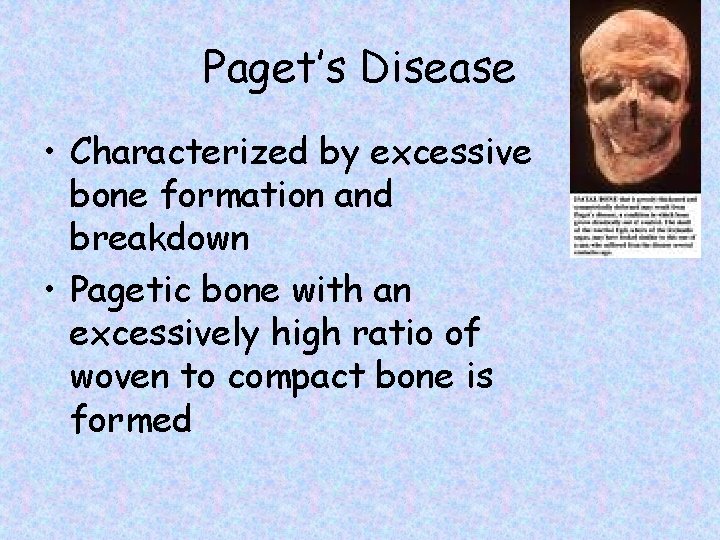
Paget’s Disease • Characterized by excessive bone formation and breakdown • Pagetic bone with an excessively high ratio of woven to compact bone is formed
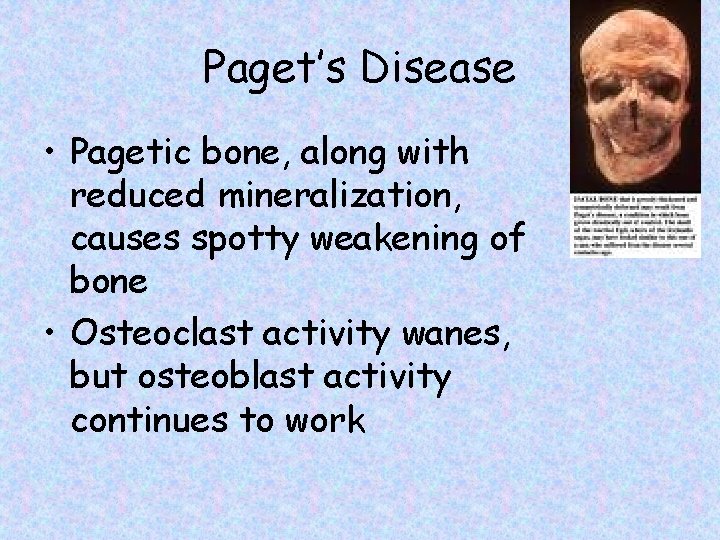
Paget’s Disease • Pagetic bone, along with reduced mineralization, causes spotty weakening of bone • Osteoclast activity wanes, but osteoblast activity continues to work
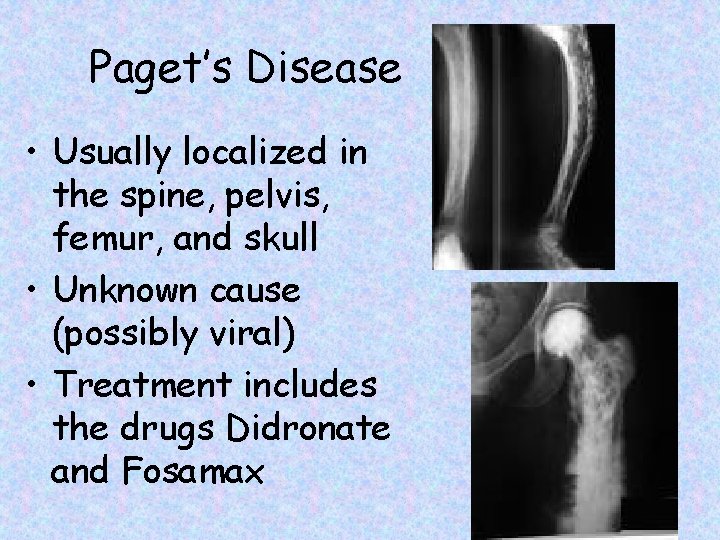
Paget’s Disease • Usually localized in the spine, pelvis, femur, and skull • Unknown cause (possibly viral) • Treatment includes the drugs Didronate and Fosamax
Developmental Aspects of Bones are on a precise schedule from the time they form until a person’s death
Developmental Aspects of Bones • Mesoderm gives rise to embryonic mesenchymal cells, which produce membranes and cartilages that form the embryonic skeleton • The embryonic skeleton ossifies in a predictable timetable that allows fetal age to be easily determined from sonograms
Developmental Aspects of Bones • At birth, most long bones are well ossified (except for their epiphyses) • Epiphyseal plates persist and provide long-bone growth during childhood • Epiphyseal plates provide the sexhormone-mediated growth spurt at adolescence
Developmental Aspects of Bones • By age 25, nearly all bones are completely ossified and skeletal growth ceases • In children and adolescents, bone formation exceeds bone resorption • In young adults formation and resorption are balanced • In old age, bone resorption predominates
Developmental Aspects of Bones • A single gene that codes for vitamin D docking determines both the tendency to accumulate bone mass early in life, and the risk for osteoporosis later in life • In your 40’s bone mass will start decreasing with age, except bones in the skull
Developmental Aspects of Bones • In young adults skeletal mass is greater in males than females • With age, the rate of bone loss is faster in females than in males

Quiz Next time! Study guide
- Slides: 98