
Chapter 6 Bone Tissue Dynamic and everchanging throughout
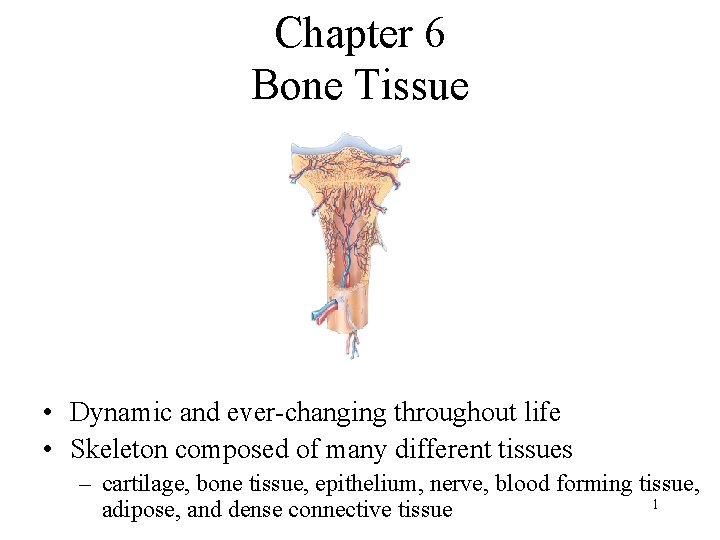
Chapter 6 Bone Tissue • Dynamic and ever-changing throughout life • Skeleton composed of many different tissues – cartilage, bone tissue, epithelium, nerve, blood forming tissue, 1 adipose, and dense connective tissue
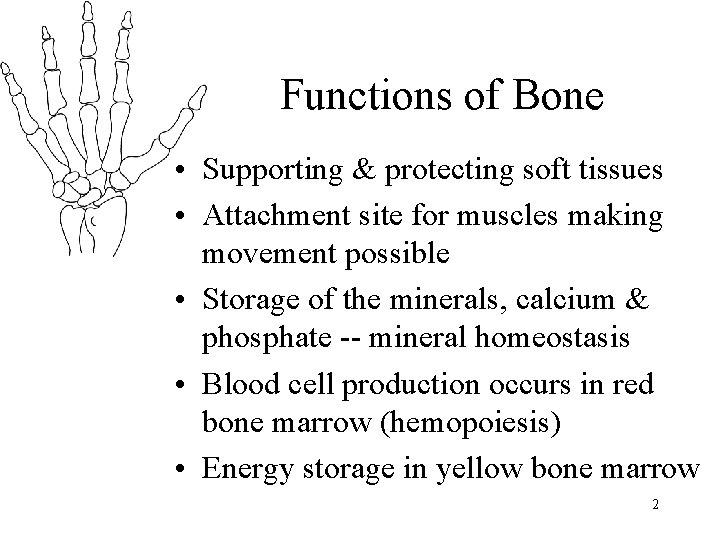
Functions of Bone • Supporting & protecting soft tissues • Attachment site for muscles making movement possible • Storage of the minerals, calcium & phosphate -- mineral homeostasis • Blood cell production occurs in red bone marrow (hemopoiesis) • Energy storage in yellow bone marrow 2
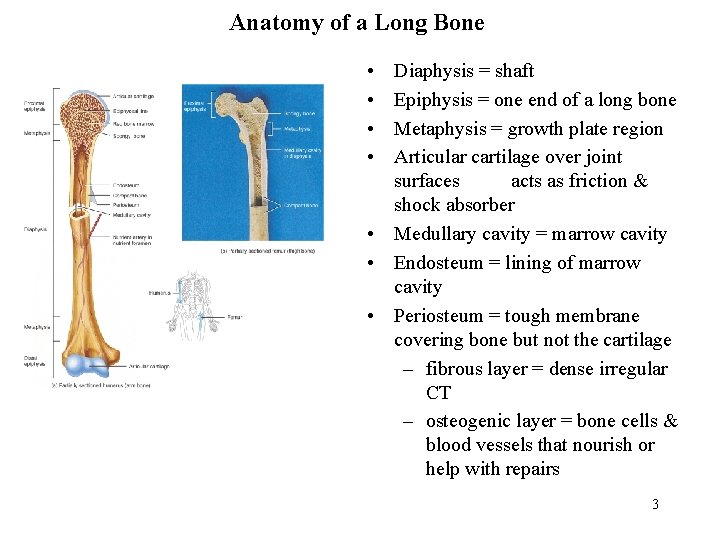
Anatomy of a Long Bone • • Diaphysis = shaft Epiphysis = one end of a long bone Metaphysis = growth plate region Articular cartilage over joint surfaces acts as friction & shock absorber • Medullary cavity = marrow cavity • Endosteum = lining of marrow cavity • Periosteum = tough membrane covering bone but not the cartilage – fibrous layer = dense irregular CT – osteogenic layer = bone cells & blood vessels that nourish or help with repairs 3
Histology of Bone • A type of connective tissue as seen by widely spaced cells separated by matrix • Matrix of 25% water, 25% collagen fibers & 50% crystalized mineral salts • 4 types of cells in bone tissue 4
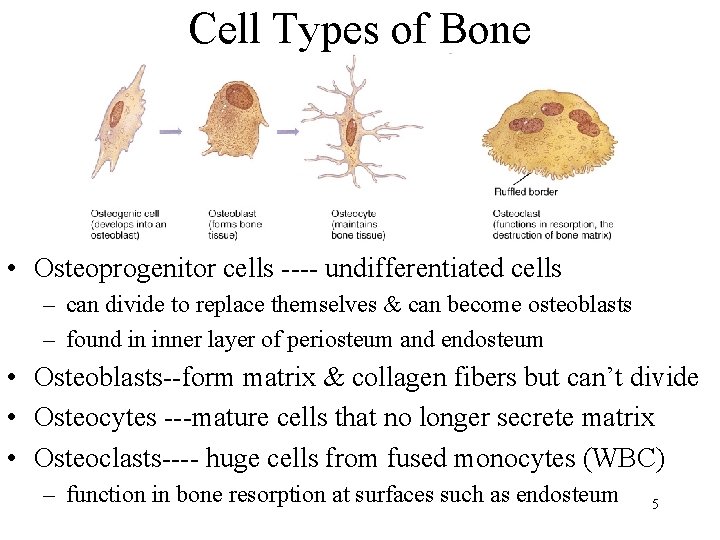
Cell Types of Bone • Osteoprogenitor cells ---- undifferentiated cells – can divide to replace themselves & can become osteoblasts – found in inner layer of periosteum and endosteum • Osteoblasts--form matrix & collagen fibers but can’t divide • Osteocytes ---mature cells that no longer secrete matrix • Osteoclasts---- huge cells from fused monocytes (WBC) – function in bone resorption at surfaces such as endosteum 5

Matrix of Bone • Inorganic mineral salts provide bone’s hardness – hydroxyapatite (calcium phosphate) & calcium carbonate • Organic collagen fibers provide bone’s flexibility – their tensile strength resists being stretched or torn – remove minerals with acid & rubbery structure results • Mineralization (calcification) is hardening of tissue when mineral crystals deposit around collagen fibers • Bone is not completely solid since it has small spaces for vessels and red bone marrow – spongy bone has many such spaces – compact bone has very few 6
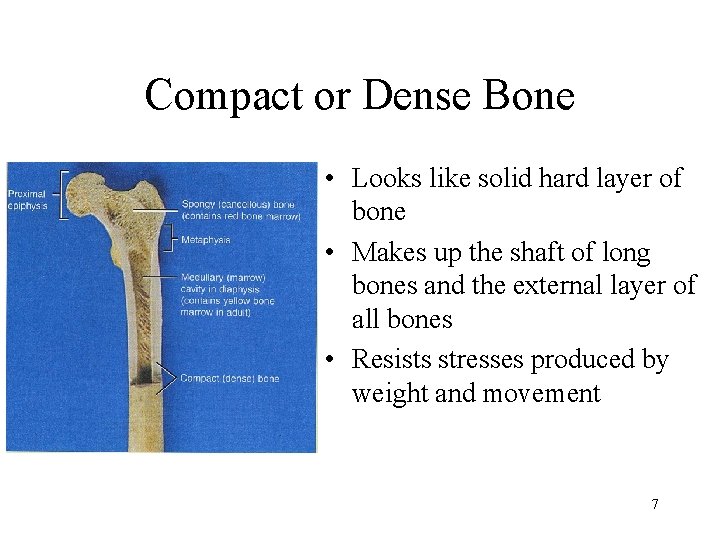
Compact or Dense Bone • Looks like solid hard layer of bone • Makes up the shaft of long bones and the external layer of all bones • Resists stresses produced by weight and movement 7
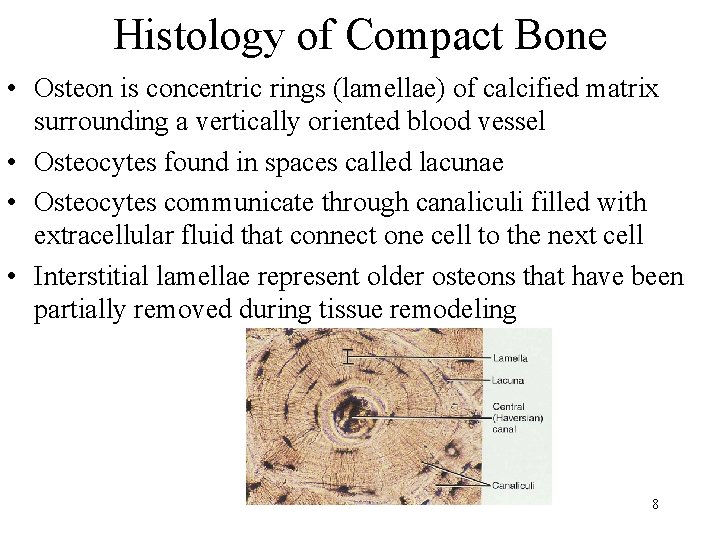
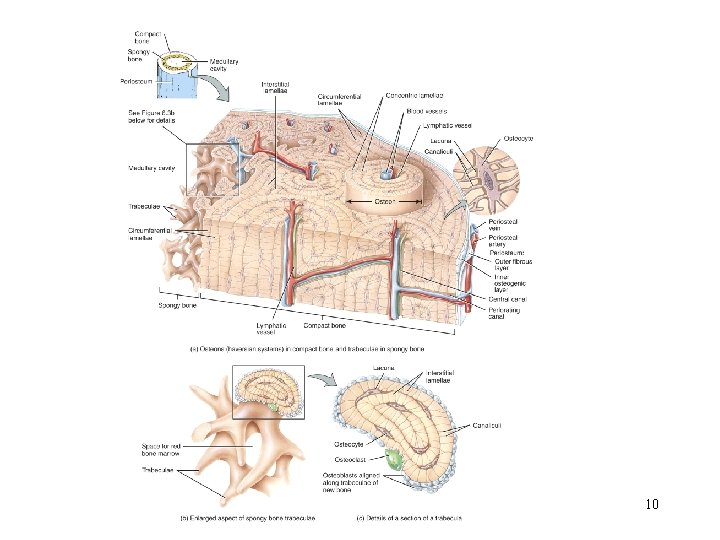
Histology of Compact Bone • Osteon is concentric rings (lamellae) of calcified matrix surrounding a vertically oriented blood vessel • Osteocytes found in spaces called lacunae • Osteocytes communicate through canaliculi filled with extracellular fluid that connect one cell to the next cell • Interstitial lamellae represent older osteons that have been partially removed during tissue remodeling 8

The Trabeculae of Spongy Bone • Latticework of thin plates of bone called trabeculae oriented along lines of stress • Spaces in between these struts are filled with red marrow where blood cells develop • Found in ends of long bones and inside flat bones such as the hipbones, sternum, sides of skull, and ribs. 9 No true Osteons.
10
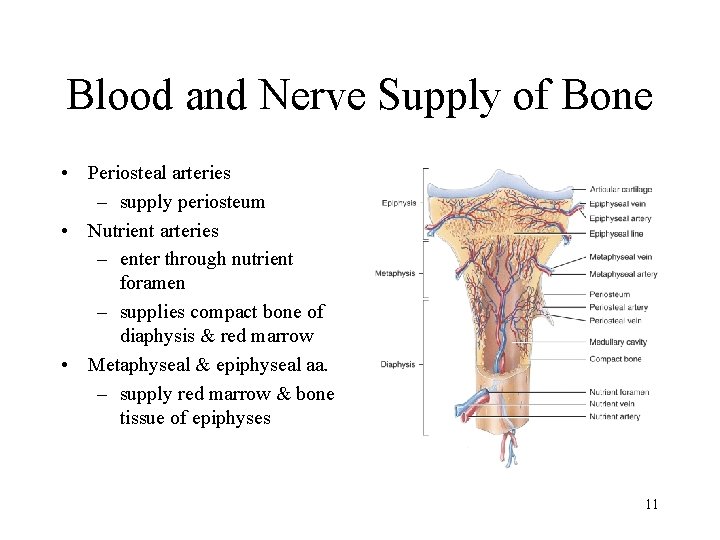
Blood and Nerve Supply of Bone • Periosteal arteries – supply periosteum • Nutrient arteries – enter through nutrient foramen – supplies compact bone of diaphysis & red marrow • Metaphyseal & epiphyseal aa. – supply red marrow & bone tissue of epiphyses 11
Bone Formation or Ossification • All embryonic connective tissue begins as mesenchyme. • Intramembranous bone formation = formation of bone directly from mesenchymal cells. • Endochondral ossification = formation of bone within hyaline cartilage. 12
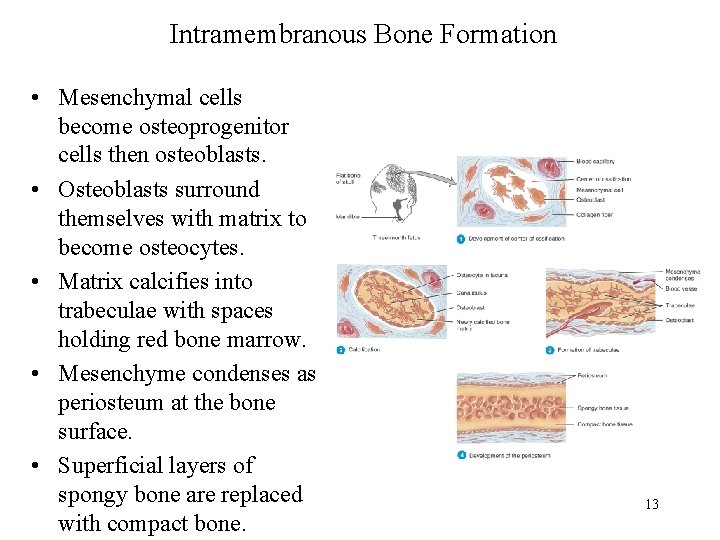
Intramembranous Bone Formation • Mesenchymal cells become osteoprogenitor cells then osteoblasts. • Osteoblasts surround themselves with matrix to become osteocytes. • Matrix calcifies into trabeculae with spaces holding red bone marrow. • Mesenchyme condenses as periosteum at the bone surface. • Superficial layers of spongy bone are replaced with compact bone. 13
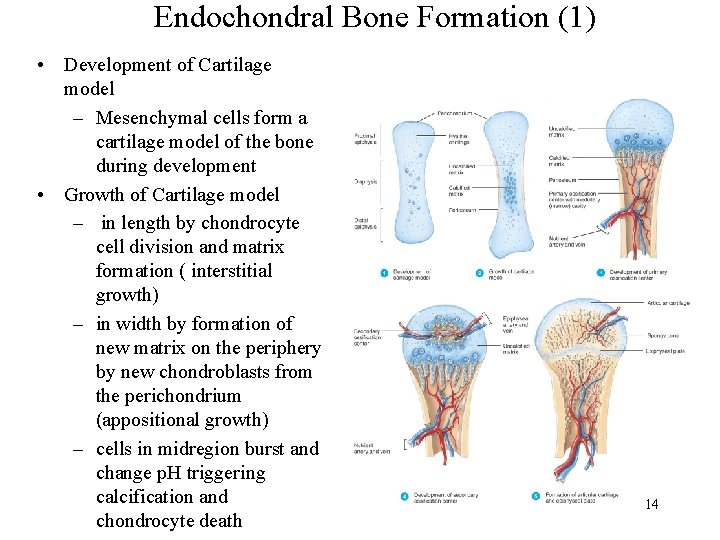
Endochondral Bone Formation (1) • Development of Cartilage model – Mesenchymal cells form a cartilage model of the bone during development • Growth of Cartilage model – in length by chondrocyte cell division and matrix formation ( interstitial growth) – in width by formation of new matrix on the periphery by new chondroblasts from the perichondrium (appositional growth) – cells in midregion burst and change p. H triggering calcification and chondrocyte death 14
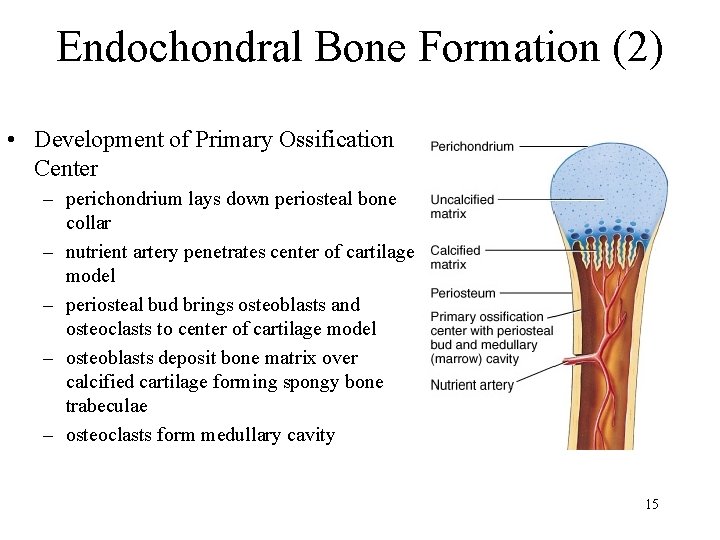
Endochondral Bone Formation (2) • Development of Primary Ossification Center – perichondrium lays down periosteal bone collar – nutrient artery penetrates center of cartilage model – periosteal bud brings osteoblasts and osteoclasts to center of cartilage model – osteoblasts deposit bone matrix over calcified cartilage forming spongy bone trabeculae – osteoclasts form medullary cavity 15
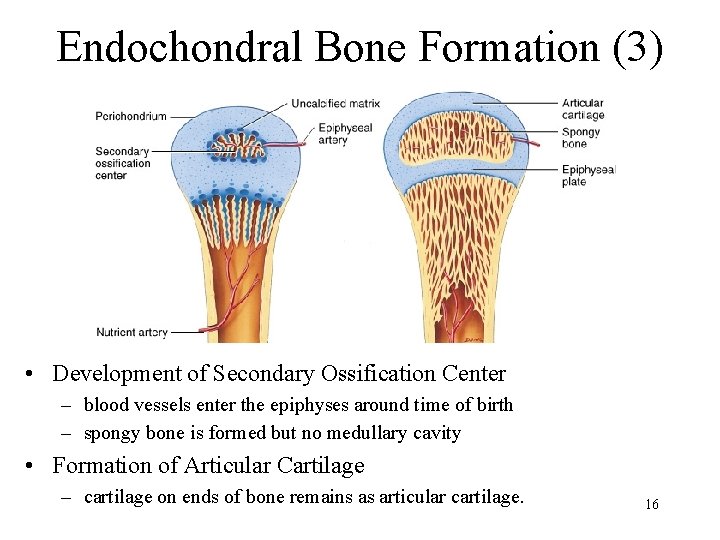
Endochondral Bone Formation (3) • Development of Secondary Ossification Center – blood vessels enter the epiphyses around time of birth – spongy bone is formed but no medullary cavity • Formation of Articular Cartilage – cartilage on ends of bone remains as articular cartilage. 16
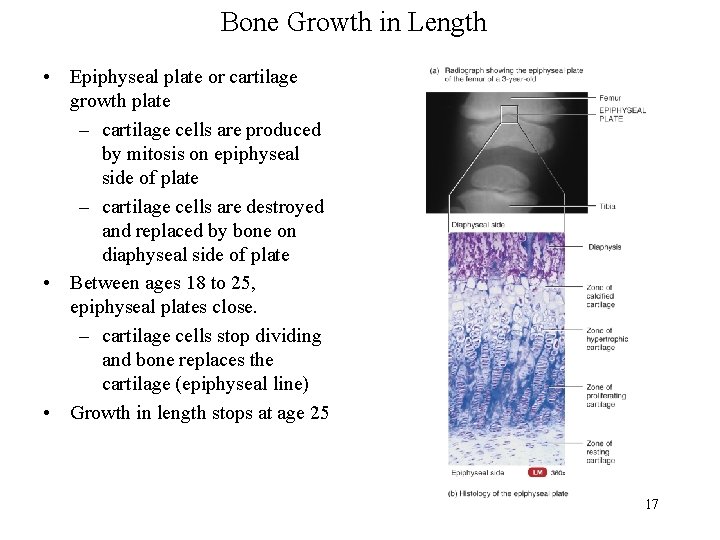
Bone Growth in Length • Epiphyseal plate or cartilage growth plate – cartilage cells are produced by mitosis on epiphyseal side of plate – cartilage cells are destroyed and replaced by bone on diaphyseal side of plate • Between ages 18 to 25, epiphyseal plates close. – cartilage cells stop dividing and bone replaces the cartilage (epiphyseal line) • Growth in length stops at age 25 17
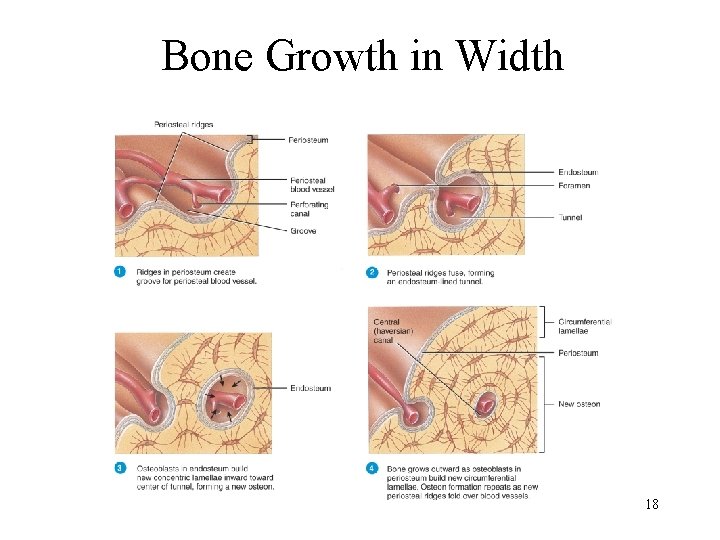
Bone Growth in Width 18
Factors Affecting Bone Growth • Nutrition – adequate levels of minerals and vitamins • calcium and phosphorus for bone growth • vitamin C for collagen formation • vitamins K and B 12 for protein synthesis • Sufficient levels of specific hormones – during childhood need insulinlike growth factor • promotes cell division at epiphyseal plate • need h. GH (growth), thyroid (T 3 &T 4) and insulin – sex steroids at puberty • growth spurt and closure of the epiphyseal growth plate 19 • estrogens promote female changes -- wider pelvis
Bone Remodeling • Ongoing since osteoclasts carve out small tunnels and osteoblasts rebuild osteons. – osteoclasts form leak-proof seal around cell edges – secrete enzymes and acids beneath themselves – release calcium and phosphorus into interstitial fluid – osteoblasts take over bone rebuilding • Continual redistribution of bone matrix along lines of mechanical stress – distal femur is fully remodeled every 4 months 20
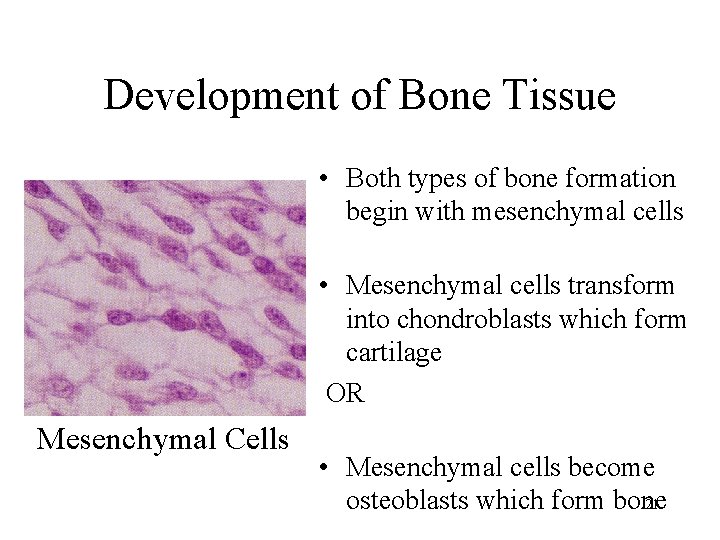
Development of Bone Tissue • Both types of bone formation begin with mesenchymal cells • Mesenchymal cells transform into chondroblasts which form cartilage OR Mesenchymal Cells • Mesenchymal cells become 21 osteoblasts which form bone
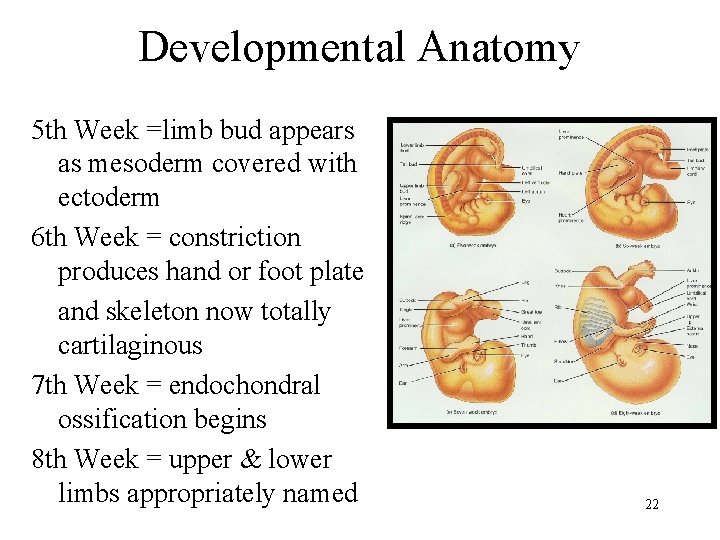
Developmental Anatomy 5 th Week =limb bud appears as mesoderm covered with ectoderm 6 th Week = constriction produces hand or foot plate and skeleton now totally cartilaginous 7 th Week = endochondral ossification begins 8 th Week = upper & lower limbs appropriately named 22
Aging & Bone Tissue • Bone is being built through adolescence, holds its own in young adults, but is gradually lost in aged. • Demineralization = loss of minerals – very rapid in women 40 -45 as estrogens levels decrease – in males, begins after age 60 • Decrease in protein synthesis – decrease in growth hormone – decrease in collagen production which gives bone its tensile strength – bone becomes brittle & susceptible to fracture 23
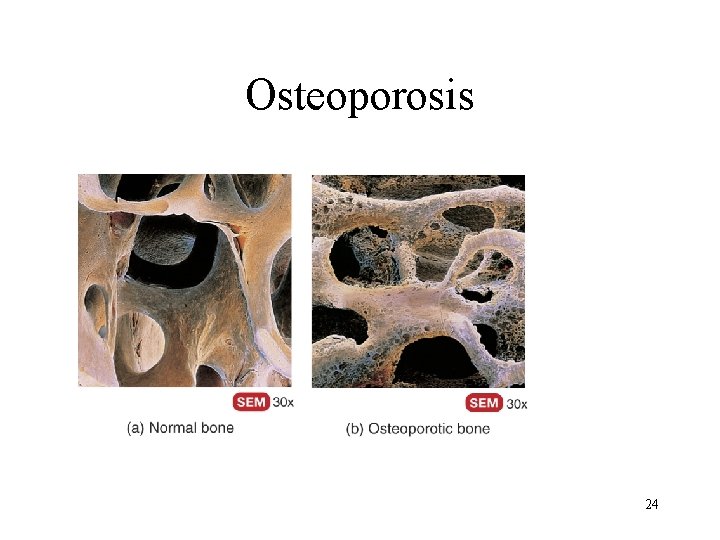
Osteoporosis 24
Disorders of Bone Ossification • Rickets • calcium salts are not deposited properly • bones of growing children are soft • bowed legs, skull, rib cage, and pelvic deformities result • Osteomalacia • new adult bone produced during remodeling fails to ossify • hip fractures are common 25
- Slides: 25