
Chapter 6 Biomes Section 6 1 What is
Chapter 6 -Biomes
Section 6 -1: What is a Biome? Open to p. 153 Define “biome” Give at least 3 examples of biomes you are familiar with
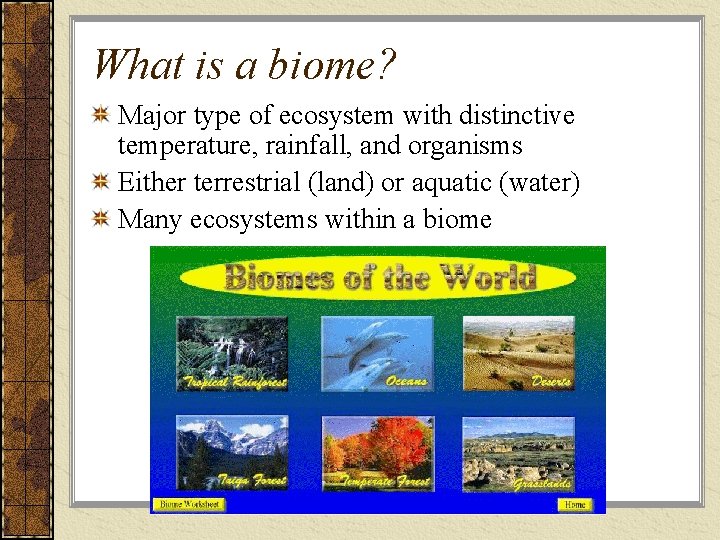
What is a biome? Major type of ecosystem with distinctive temperature, rainfall, and organisms Either terrestrial (land) or aquatic (water) Many ecosystems within a biome
How are Biomes Described? Refer to p. 153 to describe how biomes are described and why in your notes.

How are Biomes Described? By vegetation Plants that grow in a certain region are the most noticeable characteristics of that region – Plants in each region have adaptation that allow them to survive there • Size, shape, color • Examples: tundra plants are shorter because not enough water to support a tall plant, desert plants have waxy structures rather than leaves to conserve water Plants determine what other organisms will live there

Biomes and Climate: weather conditions such as temperature, precipitation, and humidity over a long period of time. How do you think latitude and altitude affect biomes?
Latitude and Altitude Latitude: distance north or south of the equator Altitude: height of an object above sea level How does climate change when you increase latitude or altitude? (read paragraph on p. 155)
Section 6 -2: Forest Biomes Read the introduction on p. 156 and get inspired to learn about forests!!!!
4 Forest Biomes Tropical Rain Forests Temperate Deciduous Forests Taiga
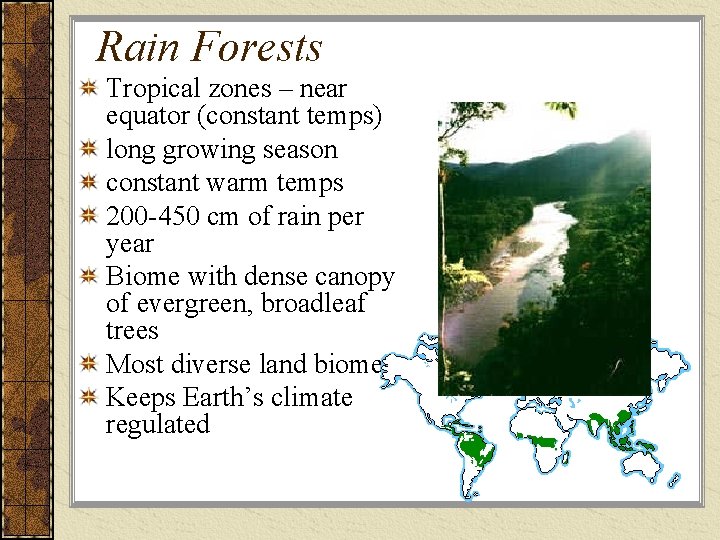
Rain Forests Tropical zones – near equator (constant temps) long growing season constant warm temps 200 -450 cm of rain per year Biome with dense canopy of evergreen, broadleaf trees Most diverse land biome Keeps Earth’s climate regulated
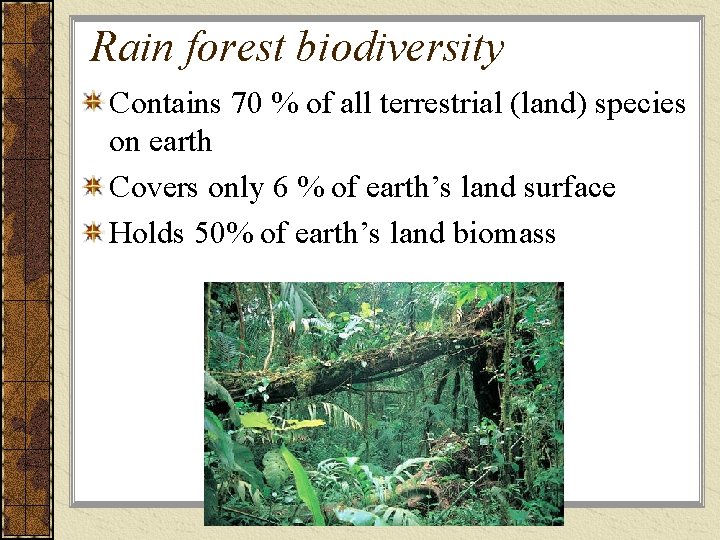
Rain forest biodiversity Contains 70 % of all terrestrial (land) species on earth Covers only 6 % of earth’s land surface Holds 50% of earth’s land biomass
Rainforest Nutrients Organisms contain the nutrients, not the soil Refer to p. 157 to explain why
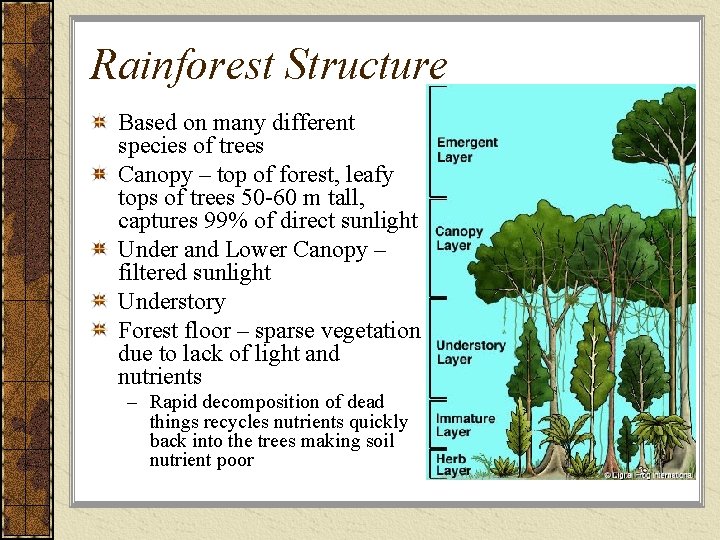
Rainforest Structure Based on many different species of trees Canopy – top of forest, leafy tops of trees 50 -60 m tall, captures 99% of direct sunlight Under and Lower Canopy – filtered sunlight Understory Forest floor – sparse vegetation due to lack of light and nutrients – Rapid decomposition of dead things recycles nutrients quickly back into the trees making soil nutrient poor
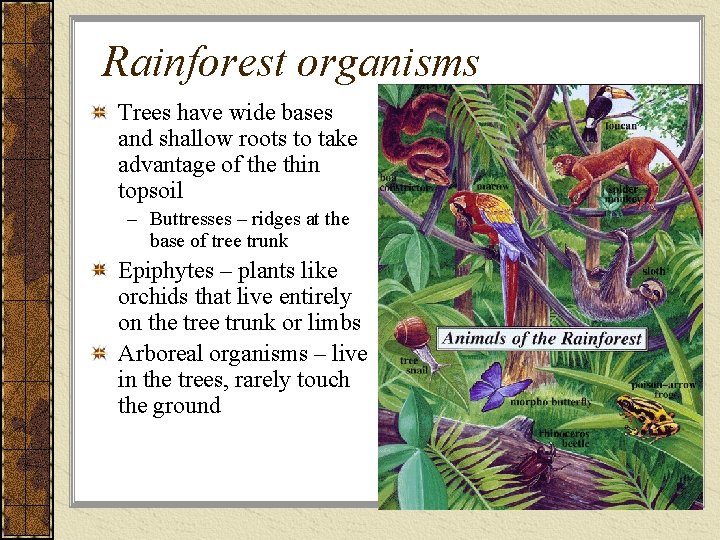
Rainforest organisms Trees have wide bases and shallow roots to take advantage of the thin topsoil – Buttresses – ridges at the base of tree trunk Epiphytes – plants like orchids that live entirely on the tree trunk or limbs Arboreal organisms – live in the trees, rarely touch the ground
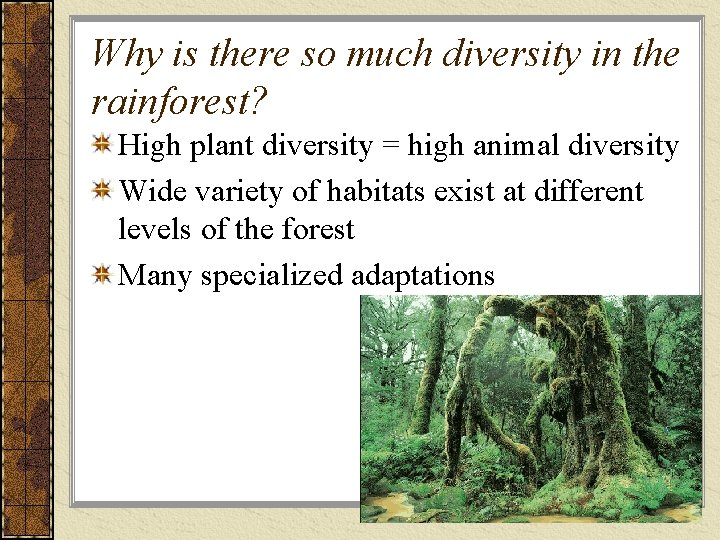
Why is there so much diversity in the rainforest? High plant diversity = high animal diversity Wide variety of habitats exist at different levels of the forest Many specialized adaptations
Threats to the rainforest Deforestation – rainforests once covered 10% of earth’s surface, now only 6% Logged for export, farm land, grazing land, living space Infertility of soil causes it to only be useful to farmers for a short time and more land must be cleared Slow regeneration – hundreds to thousands of years
Temperate Rain Forests North America, Australia, and New Zealand – The Pacific Northwest in North America High precipitation, high humidity, but moderate temperatures Ocean prevents freezing and high precipitation keeps humid
Temperate Deciduous Forests Read description on p. 162
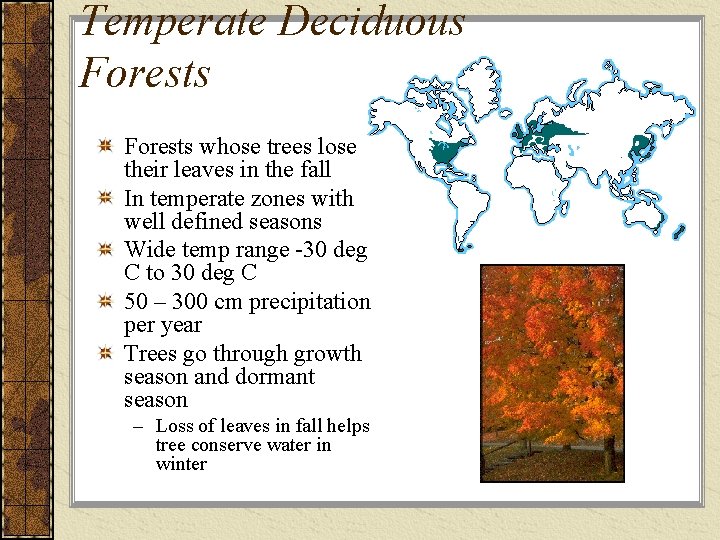
Temperate Deciduous Forests whose trees lose their leaves in the fall In temperate zones with well defined seasons Wide temp range -30 deg C to 30 deg C 50 – 300 cm precipitation per year Trees go through growth season and dormant season – Loss of leaves in fall helps tree conserve water in winter
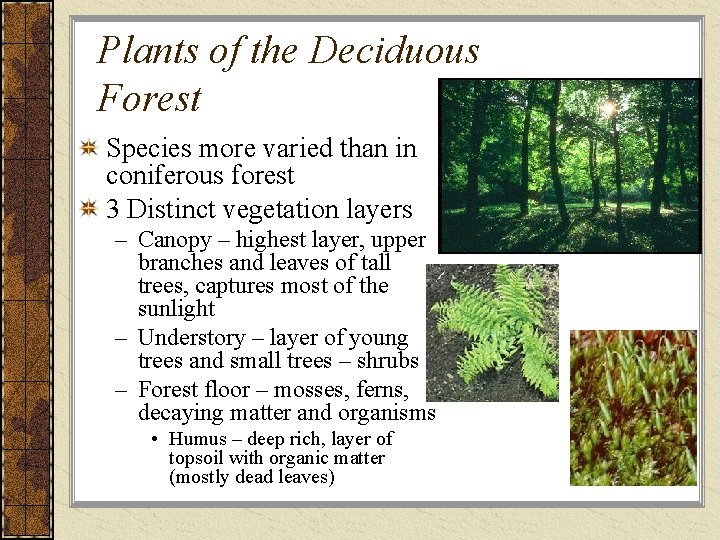
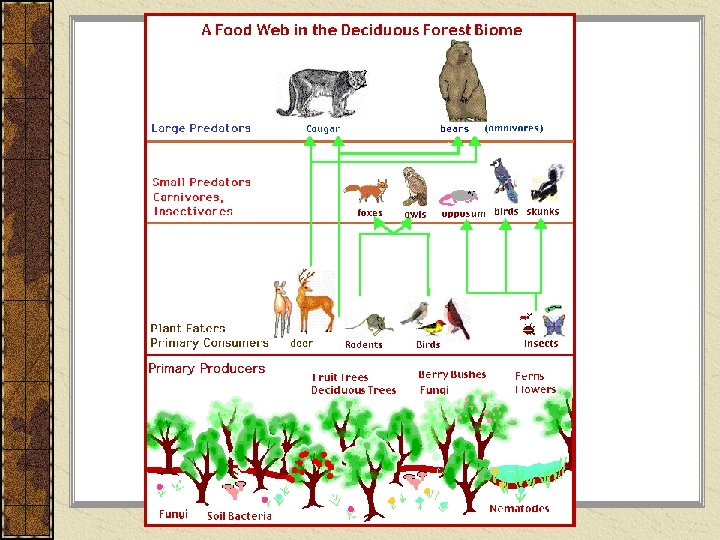
Plants of the Deciduous Forest Species more varied than in coniferous forest 3 Distinct vegetation layers – Canopy – highest layer, upper branches and leaves of tall trees, captures most of the sunlight – Understory – layer of young trees and small trees – shrubs – Forest floor – mosses, ferns, decaying matter and organisms • Humus – deep rich, layer of topsoil with organic matter (mostly dead leaves)
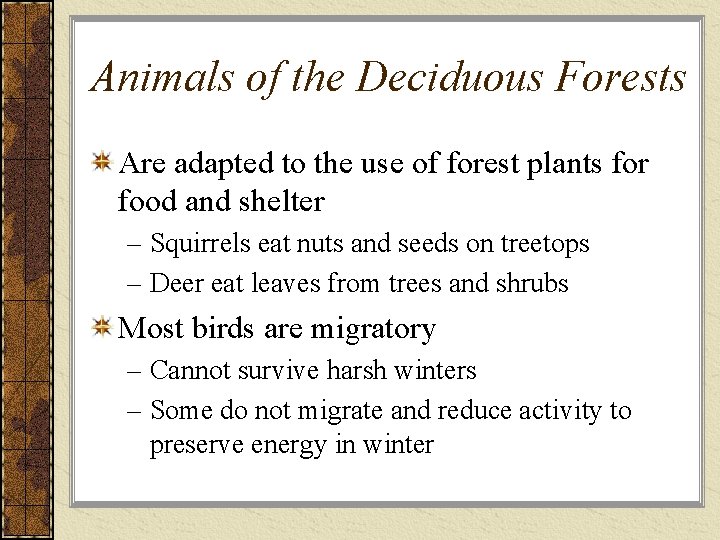
Animals of the Deciduous Forests Are adapted to the use of forest plants for food and shelter – Squirrels eat nuts and seeds on treetops – Deer eat leaves from trees and shrubs Most birds are migratory – Cannot survive harsh winters – Some do not migrate and reduce activity to preserve energy in winter
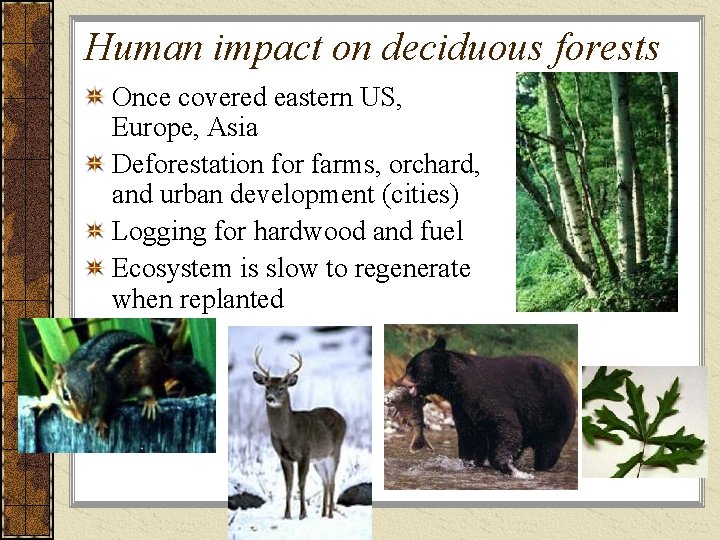
Human impact on deciduous forests Once covered eastern US, Europe, Asia Deforestation for farms, orchard, and urban development (cities) Logging for hardwood and fuel Ecosystem is slow to regenerate when replanted
Taiga Where do you think the taiga biome is located? What do you think this area looks and feels like?
Taiga (pp. 163 -164) Northern coniferous forest just below the Arctic Circle Plant growth abundant in summer because of nearly constant daylight and more precipitation Tree trunks look bare and dead, but they look alive when you look up at their green tops
Plants of the Taiga Conifers: needle-like leaves and seeds found in cones – Waxy leaves with low surface area retain moisture – Cones-like shape prevents snow build-up – Acidic leaves dropping on the soil prevent other plants from growing
Animals of the Taiga Lakes and swamps with aquatic organisms attract birds in summer (they migrate south in winter) Some organisms hibernate by burrowing (mice) Snowshoe hares avoid predation by shedding fur to change color with the seasons
Section 6 -3: Grassland, Desert, and Tundra Biomes
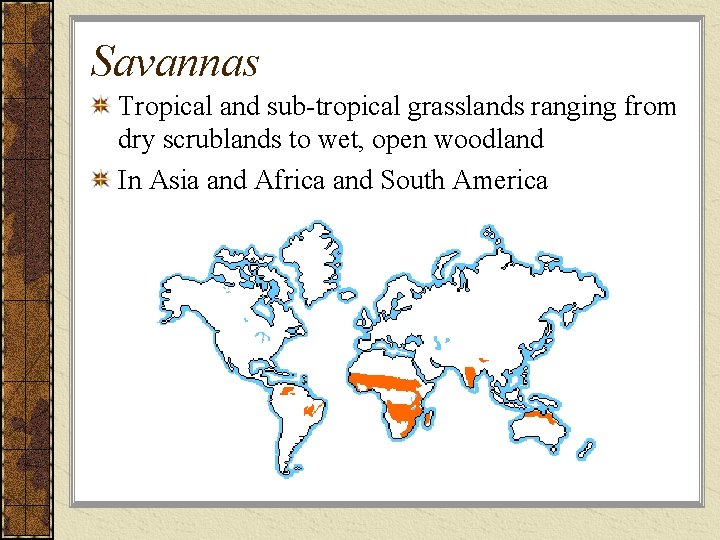
Savannas Tropical and sub-tropical grasslands ranging from dry scrublands to wet, open woodland In Asia and Africa and South America
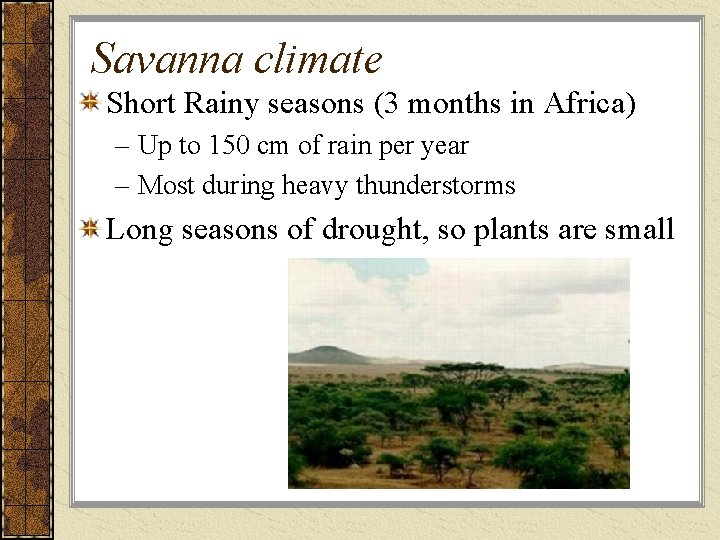
Savanna climate Short Rainy seasons (3 months in Africa) – Up to 150 cm of rain per year – Most during heavy thunderstorms Long seasons of drought, so plants are small
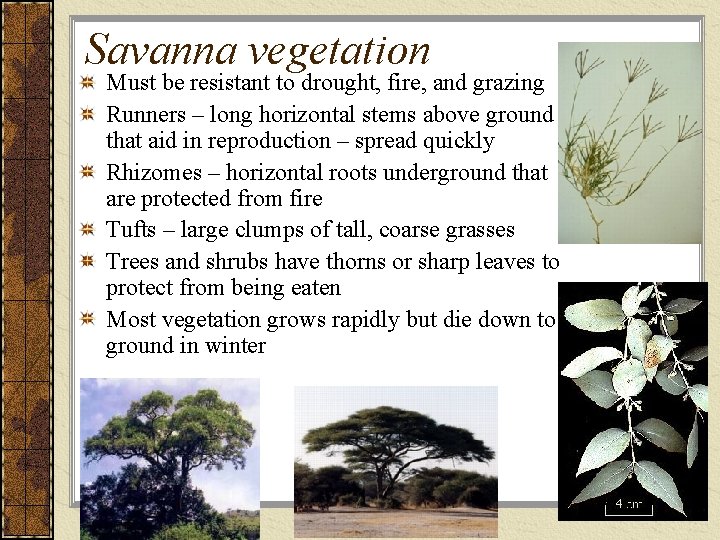
Savanna vegetation Must be resistant to drought, fire, and grazing Runners – long horizontal stems above ground that aid in reproduction – spread quickly Rhizomes – horizontal roots underground that are protected from fire Tufts – large clumps of tall, coarse grasses Trees and shrubs have thorns or sharp leaves to protect from being eaten Most vegetation grows rapidly but die down to ground in winter
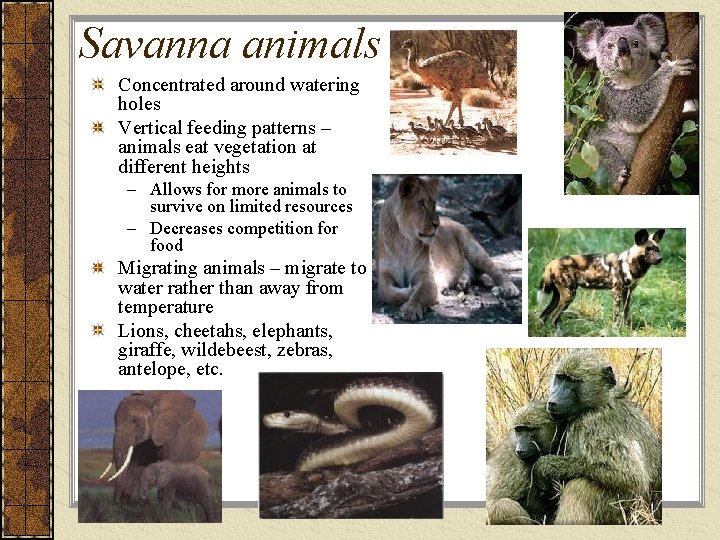
Savanna animals Concentrated around watering holes Vertical feeding patterns – animals eat vegetation at different heights – Allows for more animals to survive on limited resources – Decreases competition for food Migrating animals – migrate to water rather than away from temperature Lions, cheetahs, elephants, giraffe, wildebeest, zebras, antelope, etc.
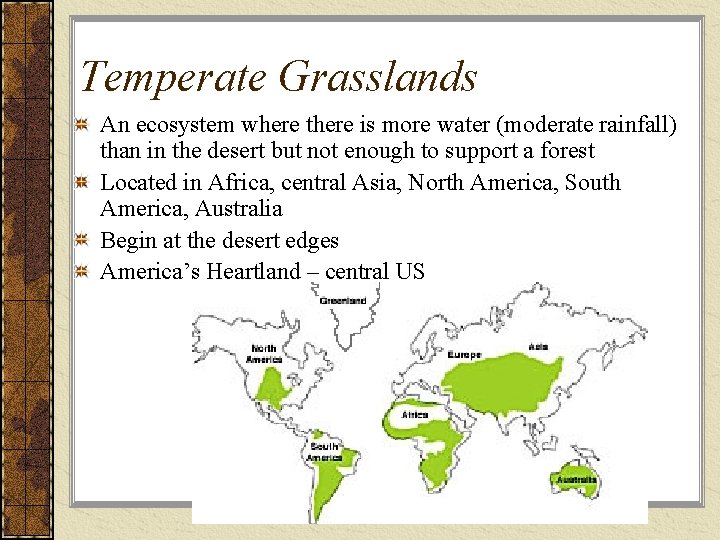
Temperate Grasslands An ecosystem where there is more water (moderate rainfall) than in the desert but not enough to support a forest Located in Africa, central Asia, North America, South America, Australia Begin at the desert edges America’s Heartland – central US
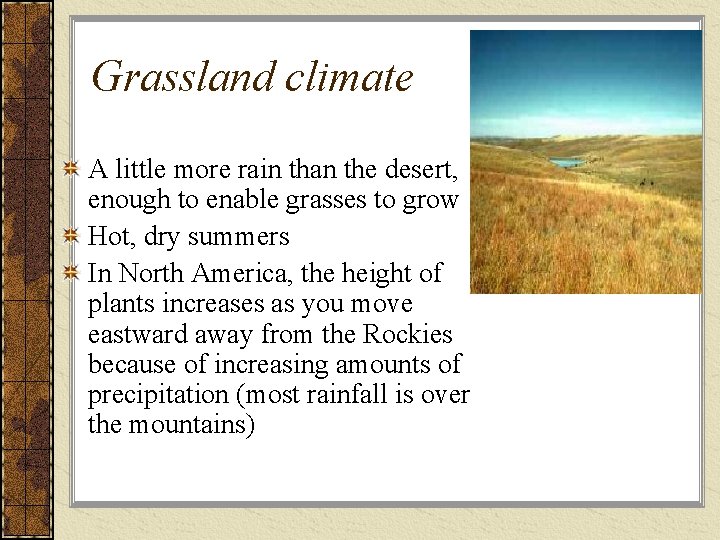
Grassland climate A little more rain than the desert, enough to enable grasses to grow Hot, dry summers In North America, the height of plants increases as you move eastward away from the Rockies because of increasing amounts of precipitation (most rainfall is over the mountains)
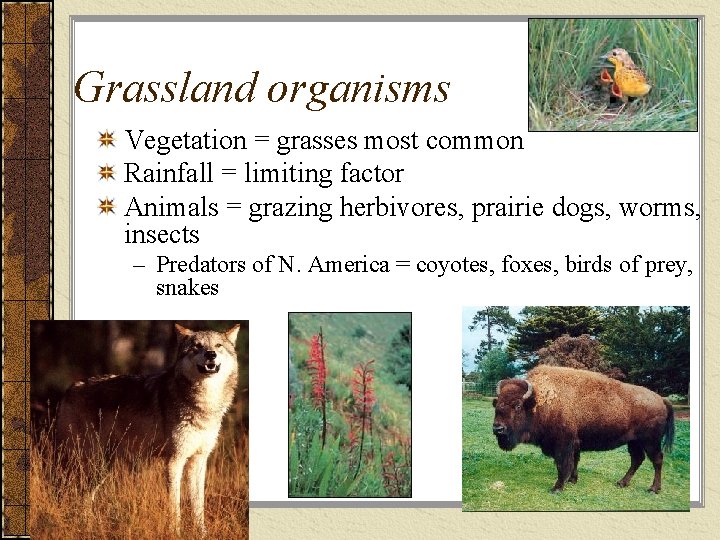
Grassland organisms Vegetation = grasses most common Rainfall = limiting factor Animals = grazing herbivores, prairie dogs, worms, insects – Predators of N. America = coyotes, foxes, birds of prey, snakes
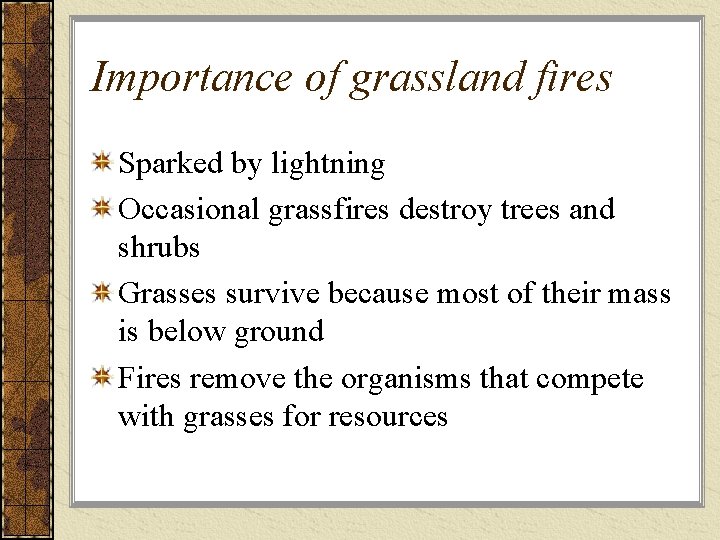
Importance of grassland fires Sparked by lightning Occasional grassfires destroy trees and shrubs Grasses survive because most of their mass is below ground Fires remove the organisms that compete with grasses for resources
Effects of the amount of rainfall Rainfall determines size of grasses – More rain = taller grasses Rainy season / dry season Precipitation increases as you move eastward in the United States Most vegetation is drought-resistant
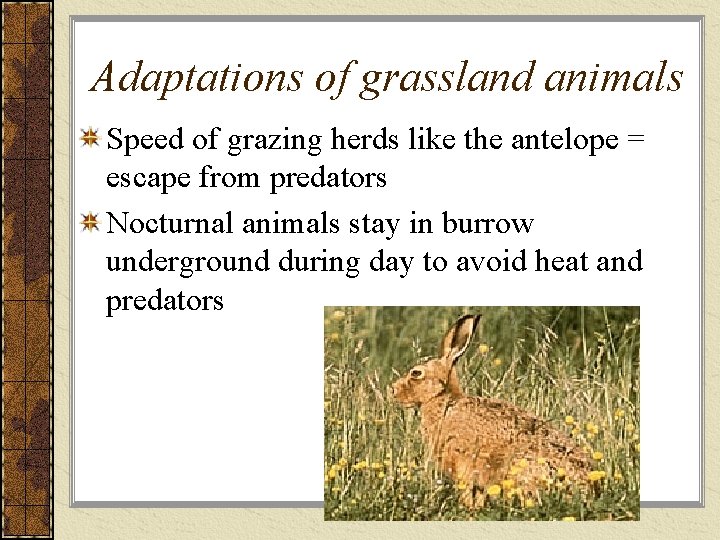
Adaptations of grassland animals Speed of grazing herds like the antelope = escape from predators Nocturnal animals stay in burrow underground during day to avoid heat and predators
Chaparral (p. 168) Temperate shrubland biome Mediterranean climate: moderately dry, coastal, little to no rain in summer See p. 169 for map of locations: in US, the HOLLYWOOD sign and the old western movies show chaparral
Organisms of the Chaparral Plants: low-lying, evergreen shrubs that grow in dense patches – Small leathery leaves to retain water – Oils to promote burning to destroy the trees that compete for light and space – Can resprout after fires Animals: camouflage (quail, lizards, chipmunks, mule dear have brownish-gray color)
Threats to the Chaparral Human development – A lot of sun so people want to live and work in chaparral biomes
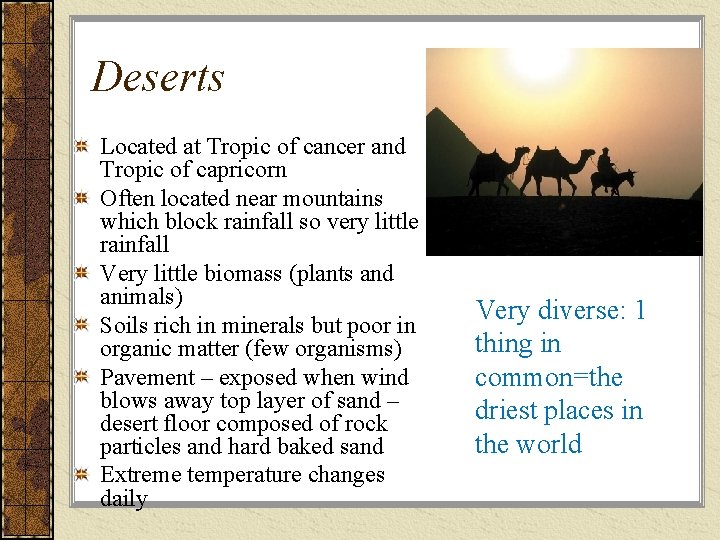
Deserts Located at Tropic of cancer and Tropic of capricorn Often located near mountains which block rainfall so very little rainfall Very little biomass (plants and animals) Soils rich in minerals but poor in organic matter (few organisms) Pavement – exposed when wind blows away top layer of sand – desert floor composed of rock particles and hard baked sand Extreme temperature changes daily Very diverse: 1 thing in common=the driest places in the world
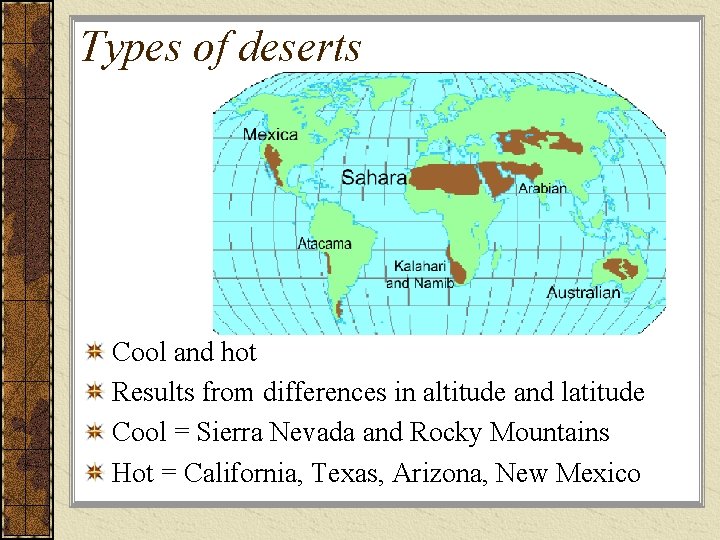
Types of deserts Cool and hot Results from differences in altitude and latitude Cool = Sierra Nevada and Rocky Mountains Hot = California, Texas, Arizona, New Mexico
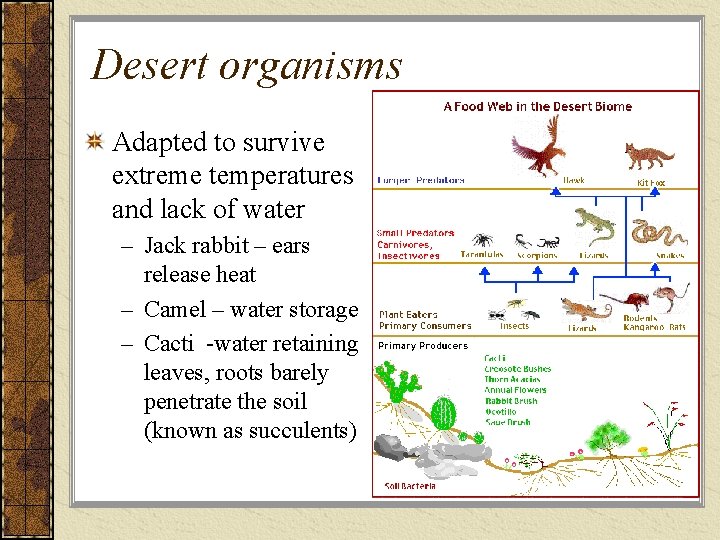
Desert organisms Adapted to survive extreme temperatures and lack of water – Jack rabbit – ears release heat – Camel – water storage – Cacti -water retaining leaves, roots barely penetrate the soil (known as succulents)
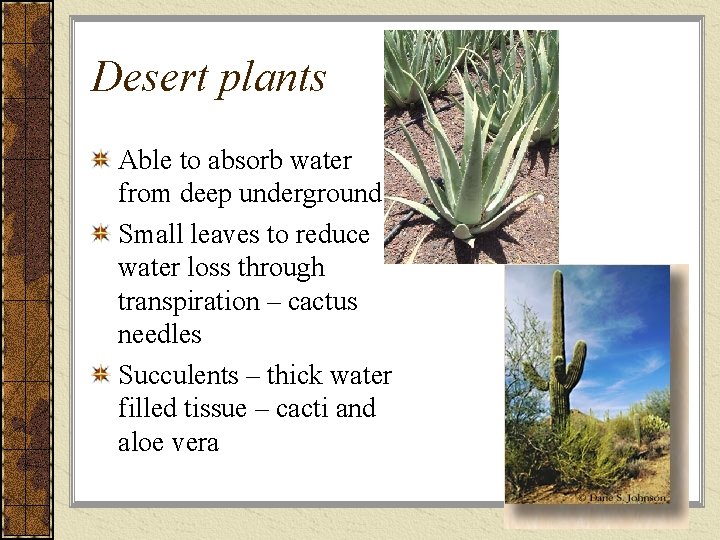
Desert plants Able to absorb water from deep underground Small leaves to reduce water loss through transpiration – cactus needles Succulents – thick water filled tissue – cacti and aloe vera

Desert animals Wide variety of species Most water obtained from food, not by drinking water Adaptations to reduce water loss and survive the heat Nocturnal – active at night when temp is cool Big ears – release heat
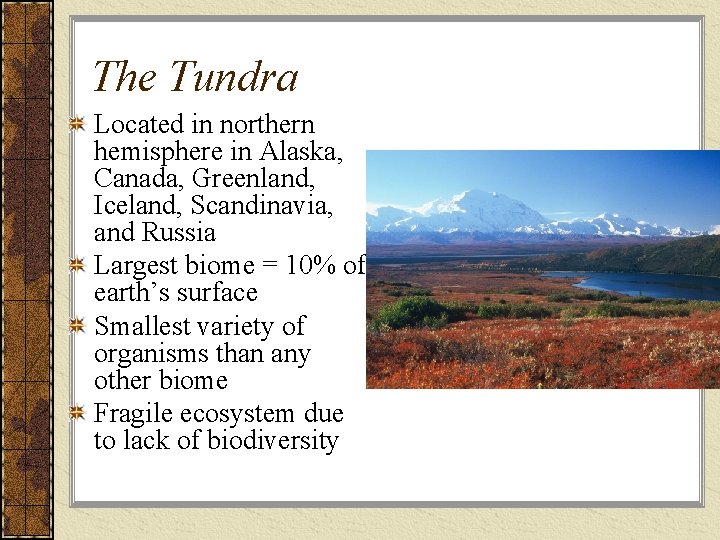
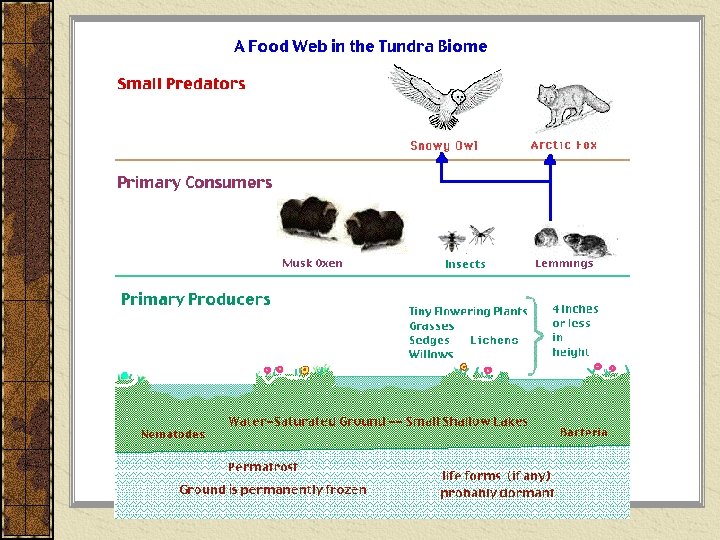
The Tundra Located in northern hemisphere in Alaska, Canada, Greenland, Iceland, Scandinavia, and Russia Largest biome = 10% of earth’s surface Smallest variety of organisms than any other biome Fragile ecosystem due to lack of biodiversity
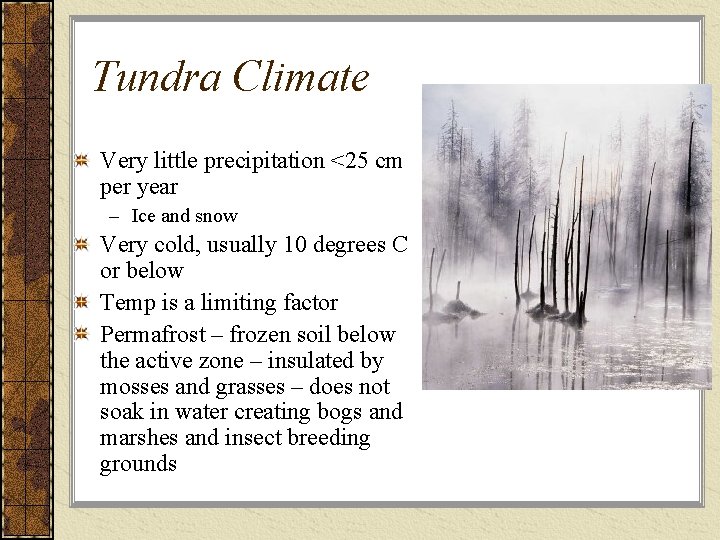
Tundra Climate Very little precipitation <25 cm per year – Ice and snow Very cold, usually 10 degrees C or below Temp is a limiting factor Permafrost – frozen soil below the active zone – insulated by mosses and grasses – does not soak in water creating bogs and marshes and insect breeding grounds
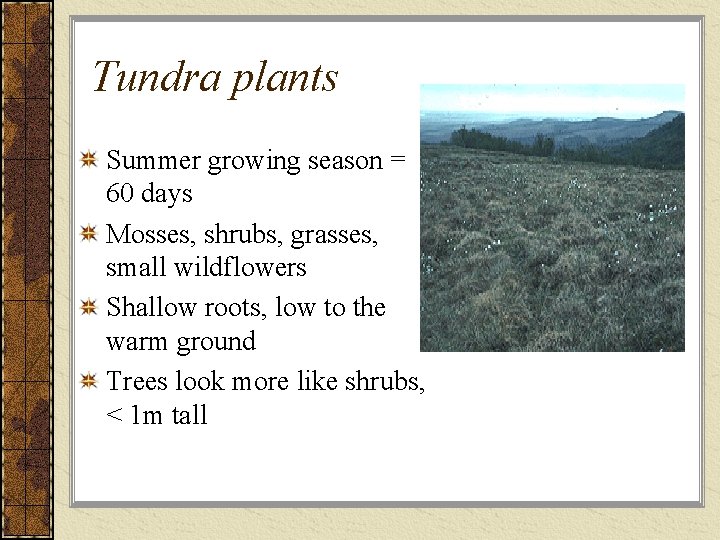
Tundra plants Summer growing season = 60 days Mosses, shrubs, grasses, small wildflowers Shallow roots, low to the warm ground Trees look more like shrubs, < 1 m tall
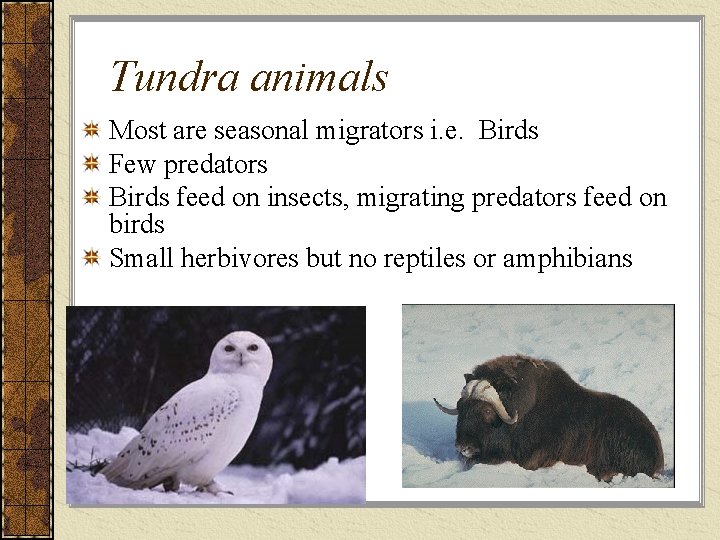
Tundra animals Most are seasonal migrators i. e. Birds Few predators Birds feed on insects, migrating predators feed on birds Small herbivores but no reptiles or amphibians
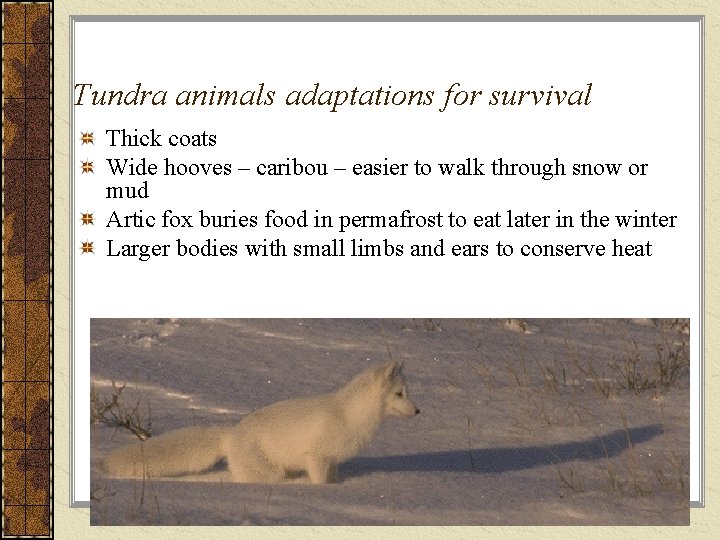
Tundra animals adaptations for survival Thick coats Wide hooves – caribou – easier to walk through snow or mud Artic fox buries food in permafrost to eat later in the winter Larger bodies with small limbs and ears to conserve heat
Threats to the tundra Air pollution – kills lichen with is a major food source for caribou herds Building of structures that intefere with migratory routes Trans-Alaskan Oil Pipeline
- Slides: 53