
Chapter 6 Binomial Probability Distributions December 21 In
Chapter 6: Binomial Probability Distributions December 21
In Chapter 6: 6. 1 Binomial Random Variables 6. 2 Calculating Binomial Probabilities 6. 3 Cumulative Probabilities 6. 4 Probability Calculators 6. 5 Expected Value and Variance. . 6. 6 Using the Binomial Distribution to Help Make Judgments
Binomial Random Variables • Bernoulli trial ≡ a random event with two possible outcomes (“success” or “failure”) • Binomial random variable ≡ the random number of successes in n independent Bernoulli trials, each trial with the same probability of success • Binomials have two parameters: n number of trials p probability of success of each trial
Binomials (cont. ) • Only two outcomes are possible (success and failure) • The outcome of each trial does not depend on the previous trial (independence) • The probability for success p is the same for each trial • Trials are repeated a specified number of times n
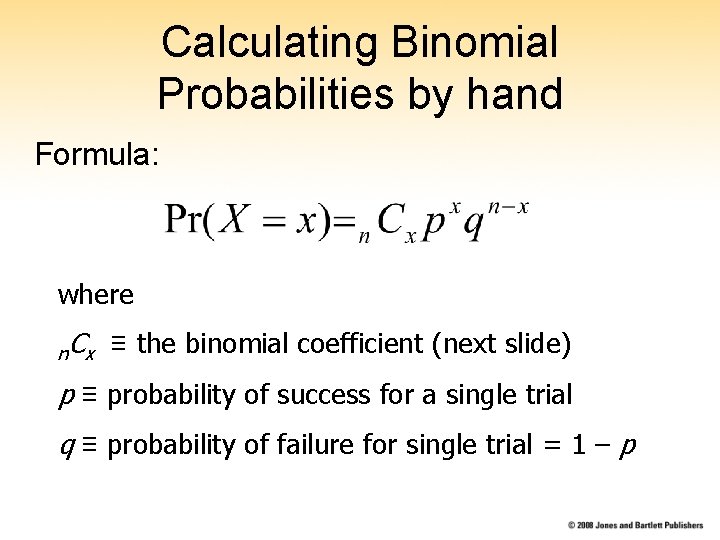
Calculating Binomial Probabilities by hand Formula: where n. C x ≡ the binomial coefficient (next slide) p ≡ probability of success for a single trial q ≡ probability of failure for single trial = 1 – p
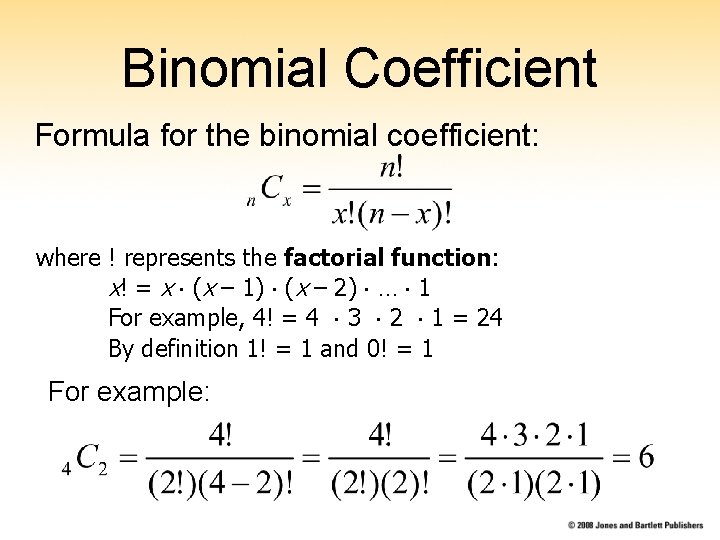
Binomial Coefficient Formula for the binomial coefficient: where ! represents the factorial function: x! = x (x – 1) (x – 2) … 1 For example, 4! = 4 3 2 1 = 24 By definition 1! = 1 and 0! = 1 For example:
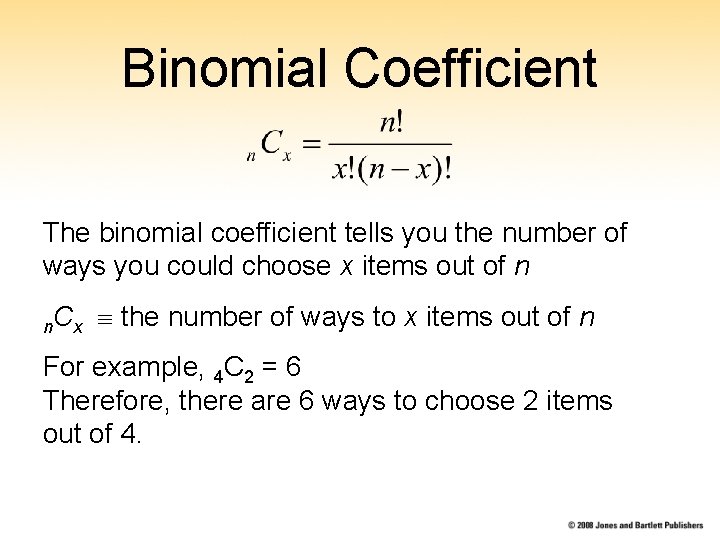
Binomial Coefficient The binomial coefficient tells you the number of ways you could choose x items out of n n. C x the number of ways to x items out of n For example, 4 C 2 = 6 Therefore, there are 6 ways to choose 2 items out of 4.
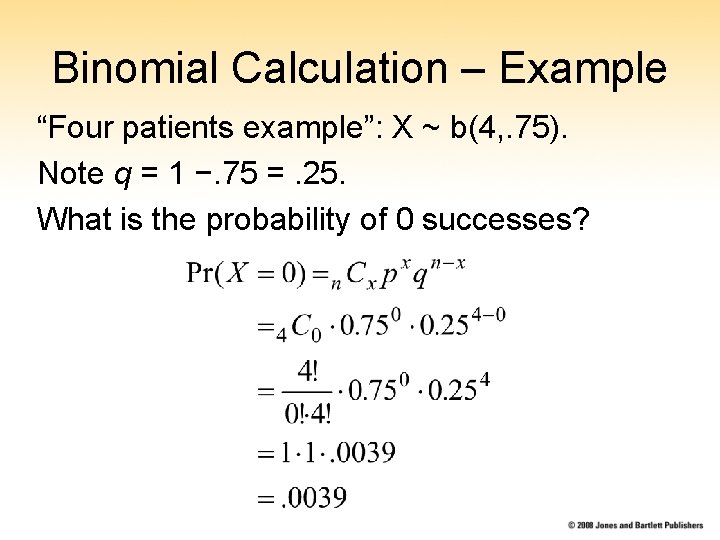
Binomial Calculation – Example “Four patients example”: X ~ b(4, . 75). Note q = 1 −. 75 =. 25. What is the probability of 0 successes?
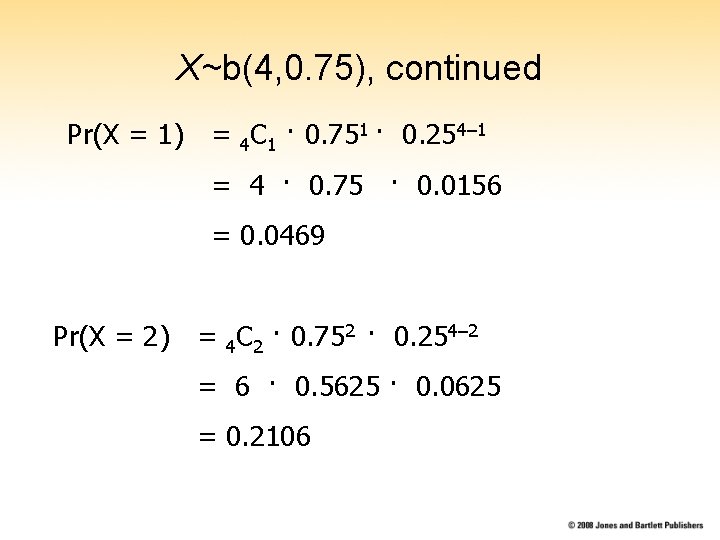
X~b(4, 0. 75), continued Pr(X = 1) = 4 C 1 · 0. 751 · 0. 254– 1 = 4 · 0. 75 · 0. 0156 = 0. 0469 Pr(X = 2) = 4 C 2 · 0. 752 · 0. 254– 2 = 6 · 0. 5625 · 0. 0625 = 0. 2106
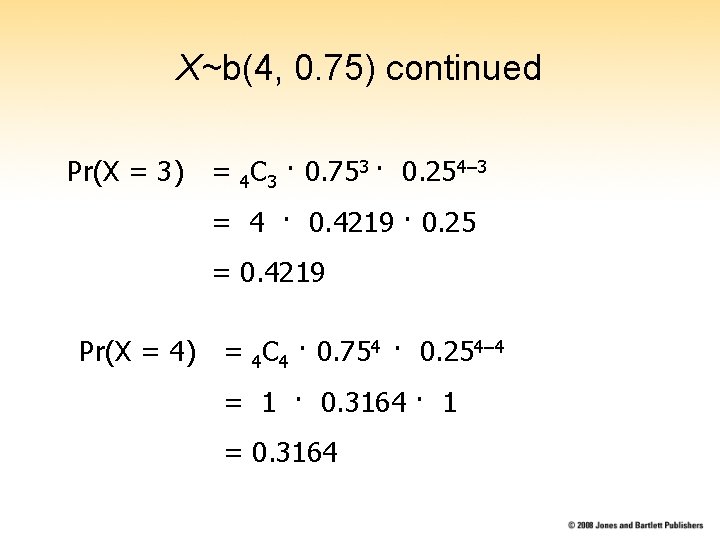
X~b(4, 0. 75) continued Pr(X = 3) = 4 C 3 · 0. 753 · 0. 254– 3 = 4 · 0. 4219 · 0. 25 = 0. 4219 Pr(X = 4) = 4 C 4 · 0. 754 · 0. 254– 4 = 1 · 0. 3164 · 1 = 0. 3164
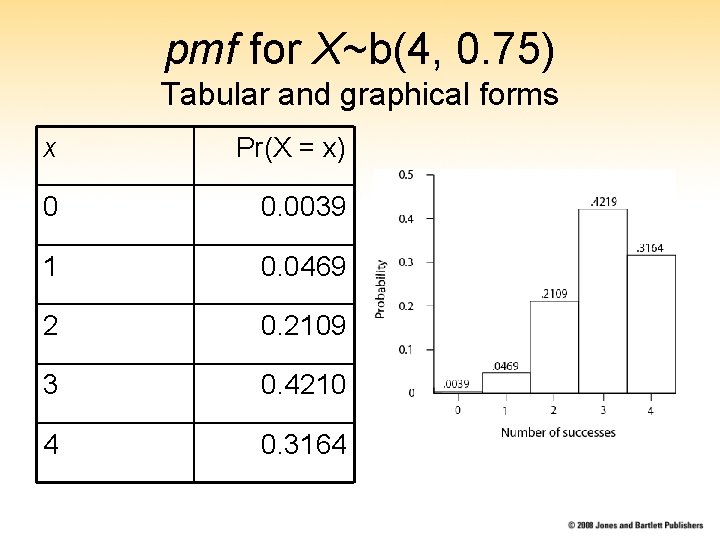
pmf for X~b(4, 0. 75) Tabular and graphical forms x Pr(X = x) 0 0. 0039 1 0. 0469 2 0. 2109 3 0. 4210 4 0. 3164
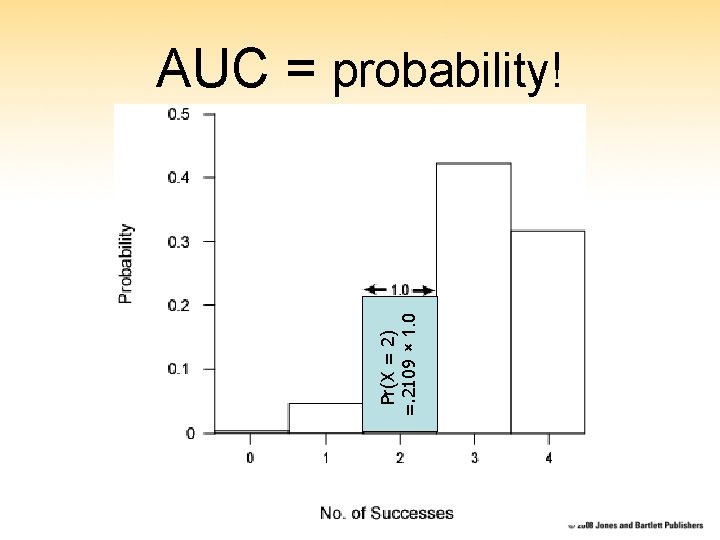
Pr(X = 2) =. 2109 × 1. 0 AUC = probability!
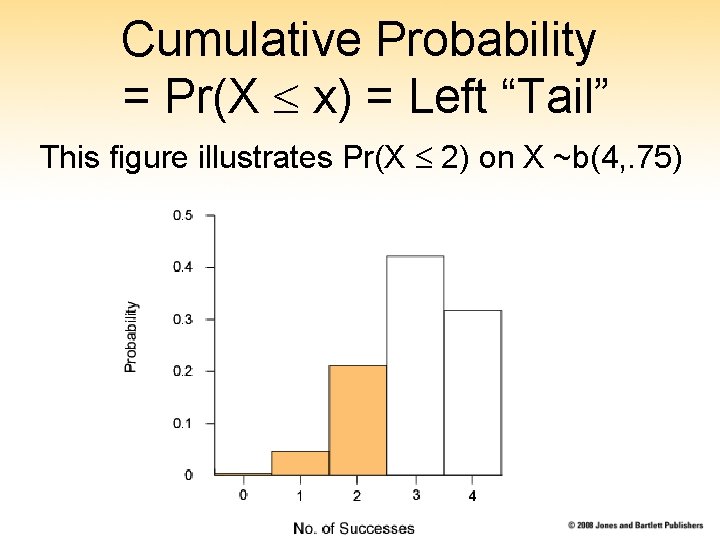
Cumulative Probability = Pr(X x) = Left “Tail” This figure illustrates Pr(X 2) on X ~b(4, . 75)
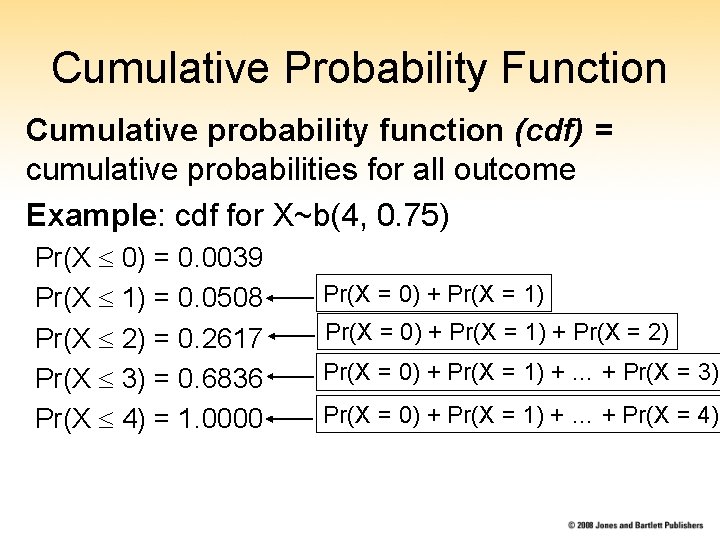
Cumulative Probability Function Cumulative probability function (cdf) = cumulative probabilities for all outcome Example: cdf for X~b(4, 0. 75) Pr(X 0) = 0. 0039 Pr(X 1) = 0. 0508 Pr(X 2) = 0. 2617 Pr(X 3) = 0. 6836 Pr(X 4) = 1. 0000 Pr(X = 0) + Pr(X = 1) + Pr(X = 2) Pr(X = 0) + Pr(X = 1) + … + Pr(X = 3) Pr(X = 0) + Pr(X = 1) + … + Pr(X = 4)

Calculating Binomial Probabilities with the Sta. Table Utility Sta. Table is a free computer program that calculates probabilities for many types of random variables, including binomials
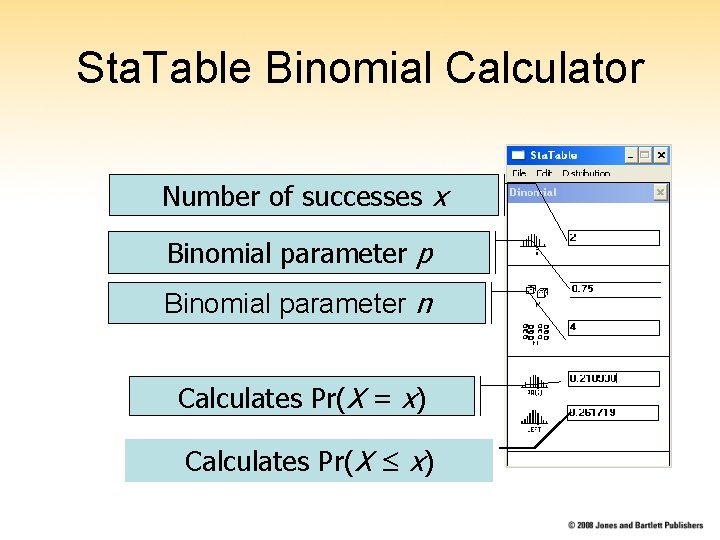
Sta. Table Binomial Calculator Number of successes x Binomial parameter p Binomial parameter n Calculates Pr(X = x) Calculates Pr(X ≤ x)
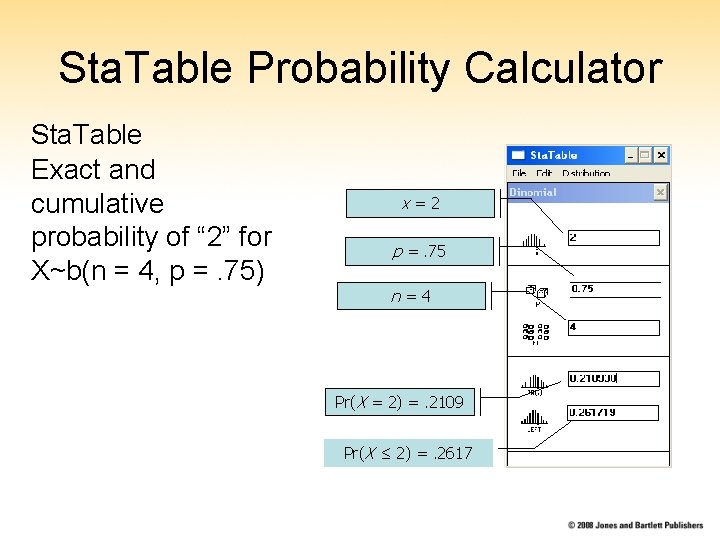
Sta. Table Probability Calculator Sta. Table Exact and cumulative probability of “ 2” for X~b(n = 4, p =. 75) x=2 p =. 75 n=4 Pr(X = 2) =. 2109 Pr(X ≤ 2) =. 2617
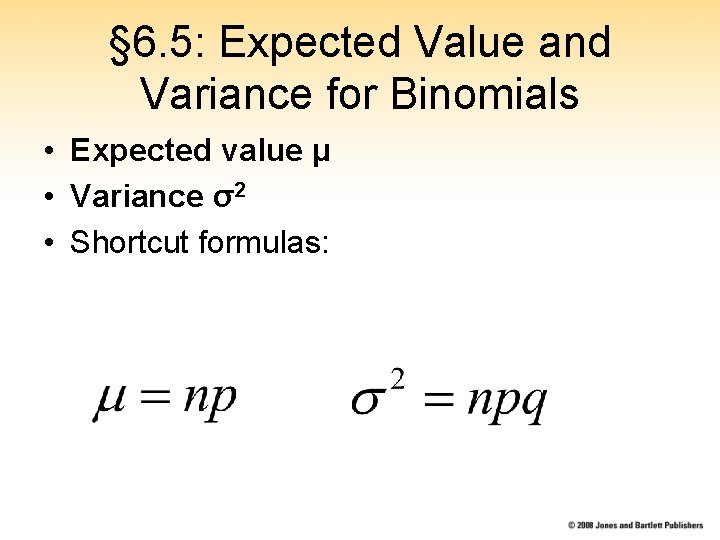
§ 6. 5: Expected Value and Variance for Binomials • Expected value μ • Variance σ2 • Shortcut formulas:
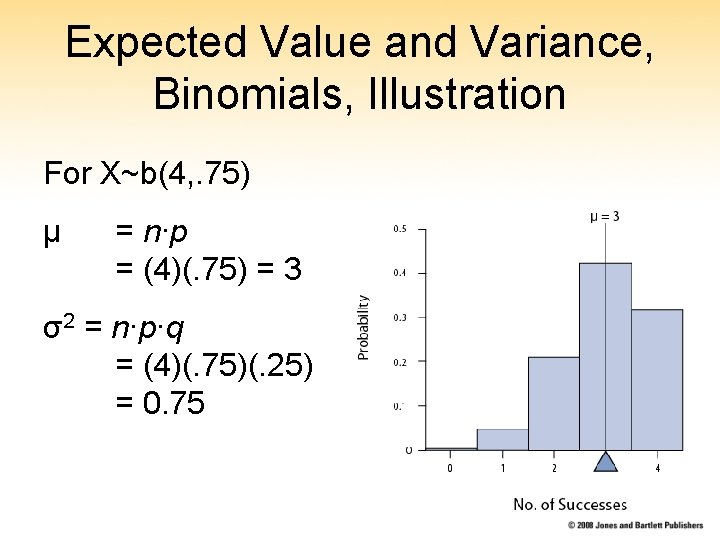
Expected Value and Variance, Binomials, Illustration For X~b(4, . 75) μ = n∙p = (4)(. 75) = 3 σ2 = n∙p∙q = (4)(. 75)(. 25) = 0. 75
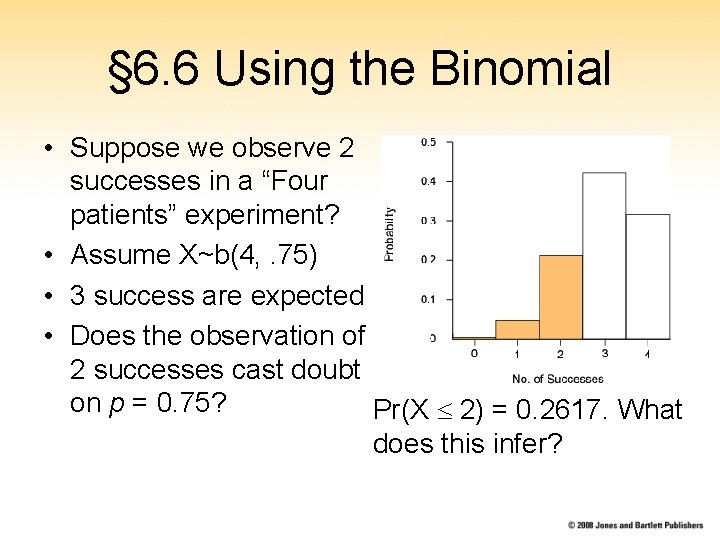
§ 6. 6 Using the Binomial • Suppose we observe 2 successes in a “Four patients” experiment? • Assume X~b(4, . 75) • 3 success are expected • Does the observation of 2 successes cast doubt on p = 0. 75? Pr(X 2) = 0. 2617. What does this infer?
- Slides: 20