
Chapter 6 Automotive Measurement and Math Objectives After

Chapter 6 Automotive Measurement and Math
Objectives After studying this chapter, you will be able to: • Use both customary and metric measuring systems. • Identify and use basic measuring tools. • Use decimal and metric conversion charts. • Use basic math skills. • Understand percentages and ratios. • Correctly answer ASE certification test questions that require a basic understanding of measurement and math. © Goodheart-Willcox Co. , Inc. Permission granted to reproduce for educational use only.
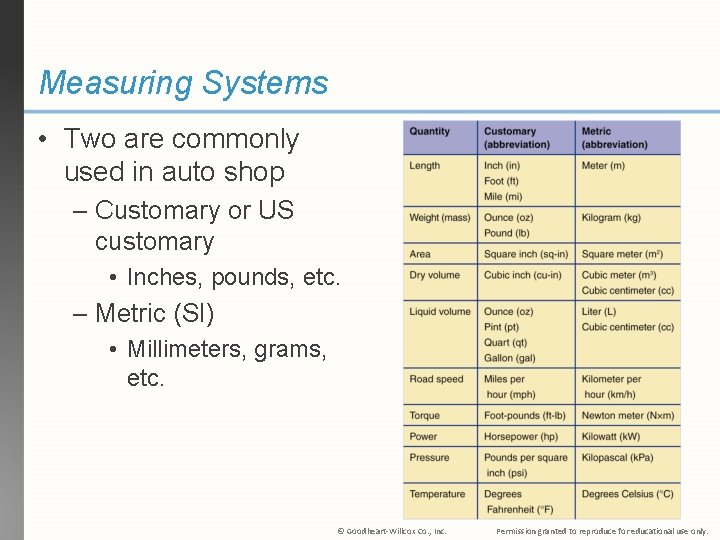
Measuring Systems • Two are commonly used in auto shop – Customary or US customary • Inches, pounds, etc. – Metric (SI) • Millimeters, grams, etc. © Goodheart-Willcox Co. , Inc. Permission granted to reproduce for educational use only.
Measuring Systems (Cont. ) • Customary – Originated with sizes taken from parts of human body • Metric (SI) – Power of 10 for all basic units • Conversion chart – Change measurement from one system to another • Decimal conversion chart – Find equivalent values for fractions, decimals, and millimeters © Goodheart-Willcox Co. , Inc. Permission granted to reproduce for educational use only.
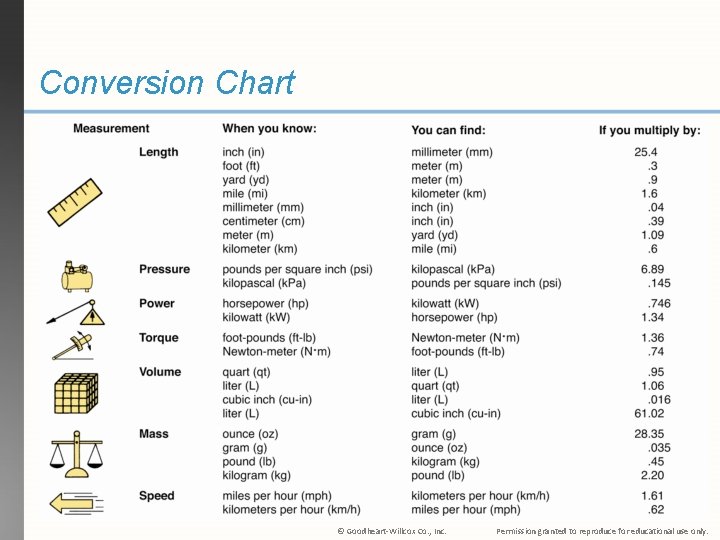
Conversion Chart © Goodheart-Willcox Co. , Inc. Permission granted to reproduce for educational use only.
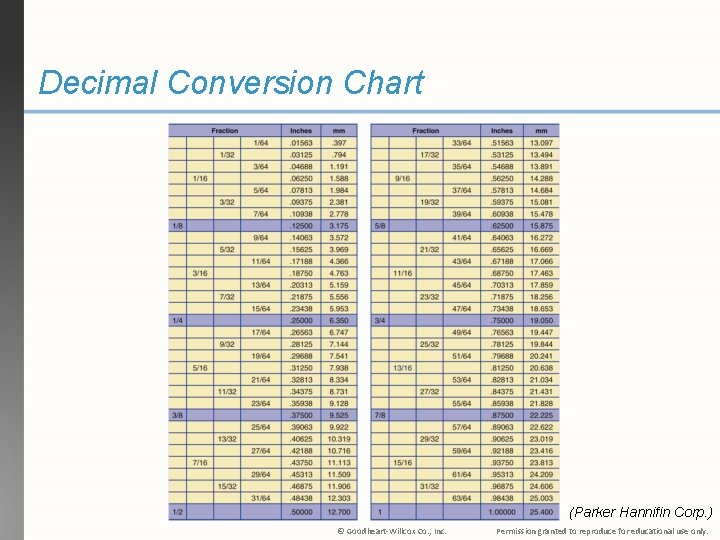
Decimal Conversion Chart (Parker Hannifin Corp. ) © Goodheart-Willcox Co. , Inc. Permission granted to reproduce for educational use only.
Measuring Tools • Steel rule or scale – Use to make low-precision linear measurements – Customary rule • Uses numbered lines to represent inches • Uses unnumbered lines to represent fractions of inch – Metric rule • Uses unnumbered lines to represent millimeters • Uses numbered lines to represent centimeters (10 mm = 1 cm) © Goodheart-Willcox Co. , Inc. Permission granted to reproduce for educational use only.
Measuring Tools (Cont. ) • Pocket rule – Typically 6″ long and fits in pocket • Combination square – Sliding square mounted on steel rule • Tape measure – Extends to several feet or meters in length • Yardstick or meterstick – Use for large linear measurements up to one yard or one meter © Goodheart-Willcox Co. , Inc. Permission granted to reproduce for educational use only.
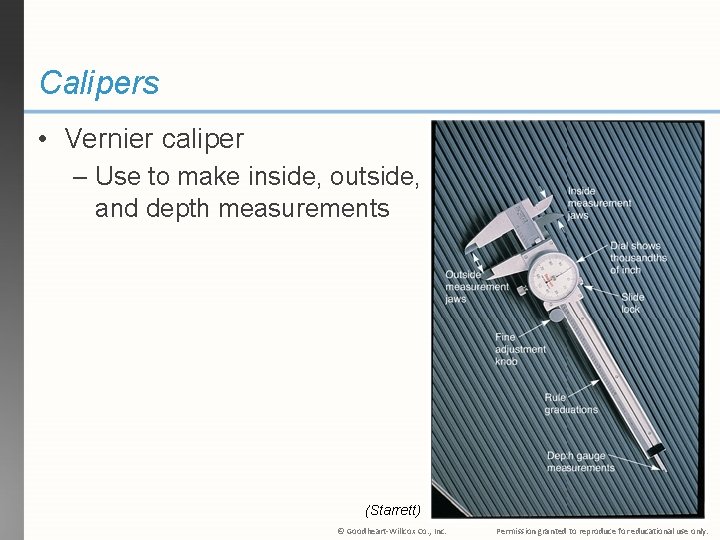
Calipers • Vernier caliper – Use to make inside, outside, and depth measurements (Starrett) © Goodheart-Willcox Co. , Inc. Permission granted to reproduce for educational use only.
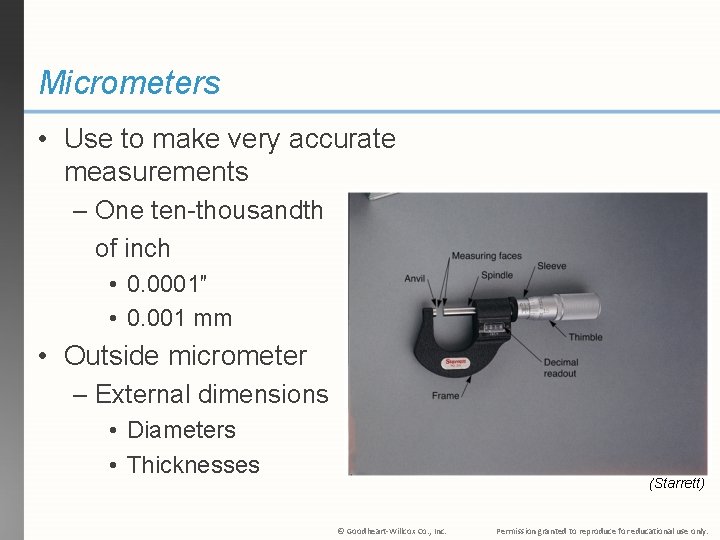
Micrometers • Use to make very accurate measurements – One ten-thousandth of inch • 0. 0001″ • 0. 001 mm • Outside micrometer – External dimensions • Diameters • Thicknesses (Starrett) © Goodheart-Willcox Co. , Inc. Permission granted to reproduce for educational use only.
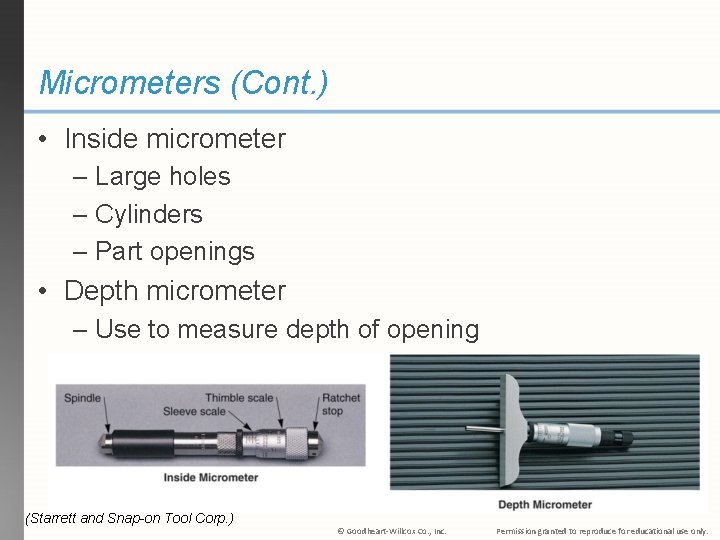
Micrometers (Cont. ) • Inside micrometer – Large holes – Cylinders – Part openings • Depth micrometer – Use to measure depth of opening (Starrett and Snap-on Tool Corp. ) © Goodheart-Willcox Co. , Inc. Permission granted to reproduce for educational use only.
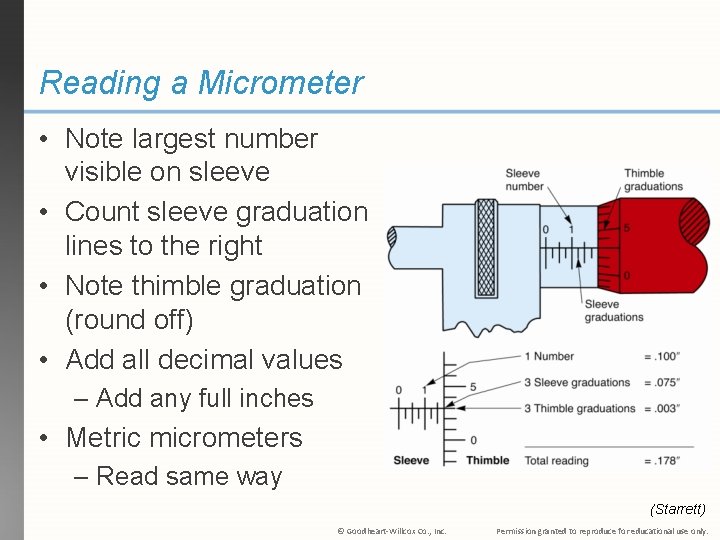
Reading a Micrometer • Note largest number visible on sleeve • Count sleeve graduation lines to the right • Note thimble graduation (round off) • Add all decimal values – Add any full inches • Metric micrometers – Read same way (Starrett) © Goodheart-Willcox Co. , Inc. Permission granted to reproduce for educational use only.
Measuring Tool Rules • Never drop or overtighten micrometer or caliper • Store measuring tools where they cannot be damaged • Grasp micrometer frame in palm and turn thimble with thumb and finger • Hold micrometer squarely with work © Goodheart-Willcox Co. , Inc. Permission granted to reproduce for educational use only.
Measuring Tool Rules (Cont. ) • Rock or swivel micrometer as it is touched on round parts • Place thin film of oil on micrometer and caliper surfaces during storage • Always check for accuracy using standardized gauge block after dropping or prolonged use © Goodheart-Willcox Co. , Inc. Permission granted to reproduce for educational use only.
Feeler Gauges • Use to measure small clearances or gaps between parts • Flat feeler gauge – Precision-ground steel blades, various thicknesses • Size written on each blade in thousandths of an inch or hundredths of a millimeter • Wire feeler gauge – Precise-sized wires labeled by diameter of thickness – Use to measure slightly larger gaps and spaces © Goodheart-Willcox Co. , Inc. Permission granted to reproduce for educational use only.
Dial Indicator • Measures part movement in thousandths of an inch – Hundredths of a millimeter – Use to check • Gear teeth backlash (clearance) • Shaft end play • Cam lobe lift © Goodheart-Willcox Co. , Inc. Permission granted to reproduce for educational use only.
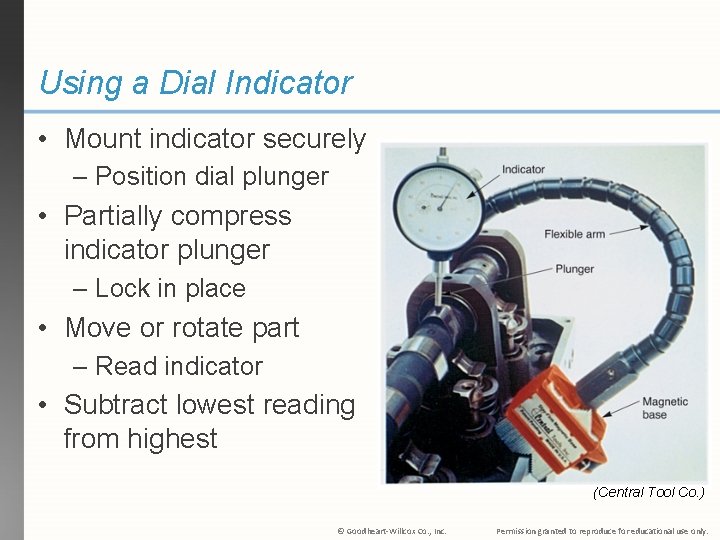
Using a Dial Indicator • Mount indicator securely – Position dial plunger • Partially compress indicator plunger – Lock in place • Move or rotate part – Read indicator • Subtract lowest reading from highest (Central Tool Co. ) © Goodheart-Willcox Co. , Inc. Permission granted to reproduce for educational use only.
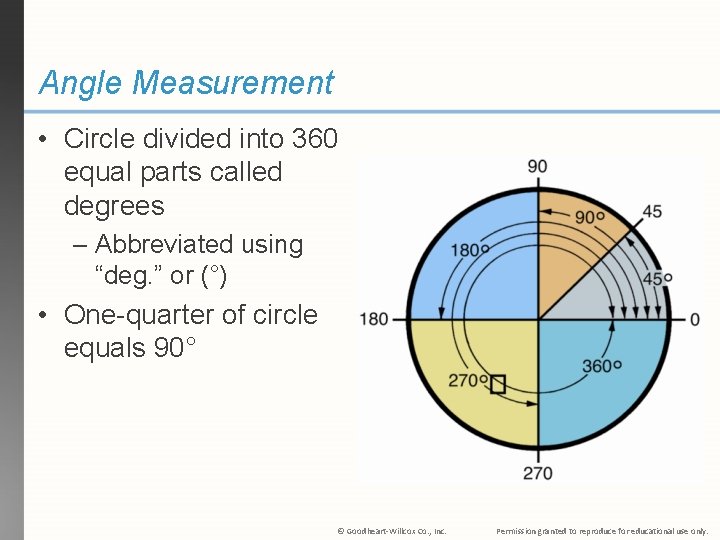
Angle Measurement • Circle divided into 360 equal parts called degrees – Abbreviated using “deg. ” or (°) • One-quarter of circle equals 90° © Goodheart-Willcox Co. , Inc. Permission granted to reproduce for educational use only.
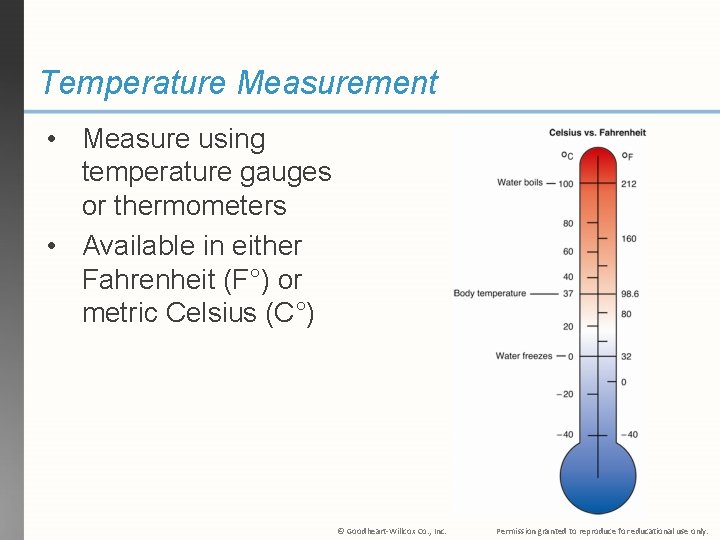
Temperature Measurement • Measure using temperature gauges or thermometers • Available in either Fahrenheit (F°) or metric Celsius (C°) © Goodheart-Willcox Co. , Inc. Permission granted to reproduce for educational use only.
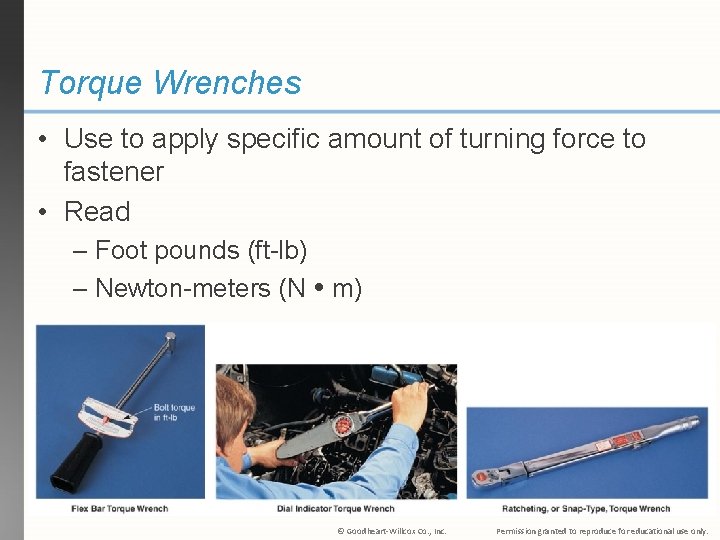
Torque Wrenches • Use to apply specific amount of turning force to fastener • Read – Foot pounds (ft-lb) – Newton-meters (N m) © Goodheart-Willcox Co. , Inc. Permission granted to reproduce for educational use only.
Other Measurements and Measuring Tools • Pressure gauge – Use to measure air or fluid pressure • Pounds per square inch (psi) • Kilograms per square centimeter (kg/ cm²) • Kilopascals (k. Pa) • Vacuum gauge – Use to measure negative pressure or vacuum • Inches of mercury (in/ Hg) • Metric kilograms per square centimeter (kg/ cm²) © Goodheart-Willcox Co. , Inc. Permission granted to reproduce for educational use only.
Other Measurements and Measuring Tools (Cont. ) • Telescoping gauge – Measures internal part bores or openings • Hole gauge – Measures very small holes in parts © Goodheart-Willcox Co. , Inc. Permission granted to reproduce for educational use only.
Review of Shop Math • Auto technicians work with whole numbers, fractions, and decimals every day – Calculate • • • Measurements Clearances Part prices Labor charges Tax percentages Total charges © Goodheart-Willcox Co. , Inc. Permission granted to reproduce for educational use only.
Addition • Combining two or more numbers to find total quantity – Result called sum • Write large numbers, or long series of numbers, in column • Use for adding up costs of parts and labor © Goodheart-Willcox Co. , Inc. Permission granted to reproduce for educational use only.
Subtraction • Taking away certain quantity from another – Amount left after subtracting called remainder • Use to determine customers’ bills after deposit • Useful for checking paychecks for tax deductions © Goodheart-Willcox Co. , Inc. Permission granted to reproduce for educational use only.
Division • Finds out how many times a number is contained in another number – Number being divided is dividend – Number that dividend is divided by is divisor – Answer is quotient • Use to determine unit costs – If 10 fuel pumps cost $100. 00, then 1 fuel pump costs? © Goodheart-Willcox Co. , Inc. Permission granted to reproduce for educational use only.
Multiplication • Shortcut for adding same number over and over – Number by which another number is multiplied is multiplier – Result of multiplication is product © Goodheart-Willcox Co. , Inc. Permission granted to reproduce for educational use only.
Fractions • Represent portion of whole number – Written as two numbers, one over the other or one beside the number – Number below line or slash called denominator • How many parts the whole is divided into – Number above line or slash called numerator • How many parts are present in the fraction © Goodheart-Willcox Co. , Inc. Permission granted to reproduce for educational use only.
Decimal Fractions • Also have numerator and denominator – Denominator always a multiple of 10 that is never written • Use decimal point, a dot or period, instead • For example, 9/10 is written 0. 9 – Number of digits to right of decimal point tells what multiple of 10 • Tenths, hundredths, thousandths, etc. © Goodheart-Willcox Co. , Inc. Permission granted to reproduce for educational use only.
Decimal Fractions (Cont. ) • Zero placed – Between number and decimal point changes value of number (. 45 is not the same as. 045) – To right of decimal number does not change value of number (. 45 is the same as. 450) – To left of decimal point does not change value of number (0. 45 is the same as. 45) © Goodheart-Willcox Co. , Inc. Permission granted to reproduce for educational use only.
Addition and Subtraction of Decimals • Line up decimal points in column • Decimal point in answer must be in same position as decimal point in column © Goodheart-Willcox Co. , Inc. Permission granted to reproduce for educational use only.
Multiplication of Decimals • Decimal points do not need to be aligned • Multiply numbers ignoring decimal points • Count total number of decimal points to right of both numbers – Starting from right digit, count to left the same number of digits in answer – Place decimal point to left of last digit counted © Goodheart-Willcox Co. , Inc. Permission granted to reproduce for educational use only.
Division of Decimals • When neither dividend nor divisor contain decimal points, but division does not come out even – Place decimal point to right of last number of dividend – Add one or more zeros after decimal and continue dividing to number of spaces necessary © Goodheart-Willcox Co. , Inc. Permission granted to reproduce for educational use only.
Division of Decimals (Cont. ) • When dividend has decimal and divisor does not – Divide as usual – Place decimal point in answer directly above decimal point in dividend © Goodheart-Willcox Co. , Inc. Permission granted to reproduce for educational use only.
Division of Decimals (Cont. ) • When divisor has decimal point – If dividend does not have decimal point, add one to far right – If dividend has decimal point, move it one place to the right for each decimal place in divisor • Use zeros as placeholders if needed – Divide as usual – Place decimal point in answer directly above relocated decimal point in dividend © Goodheart-Willcox Co. , Inc. Permission granted to reproduce for educational use only.
Percentages • Quantities expressed as part of 100 – 10% equal to 10 out of every 100 • Commonly used to calculate tax on parts • To find percentage of any number – Convert percentage to decimal • Drop percentage sign and move decimal left two places – Multiply decimal by number © Goodheart-Willcox Co. , Inc. Permission granted to reproduce for educational use only.
Ratios • Mathematic expression comparing two numbers • Represent how many of one number there is compared to another – Ratio of 2 to 1 can be written 2: 1 or 2/1 • Ratios are commonly used when expressing relationships between gears – If two gears have 3: 1 gear ratio, one gear would turn three revolutions to only one revolution of other gear © Goodheart-Willcox Co. , Inc. Permission granted to reproduce for educational use only.
- Slides: 38