
Chapter 6 Arrays Slides prepared by Rose Williams
Chapter 6 Arrays Slides prepared by Rose Williams, Binghamton University
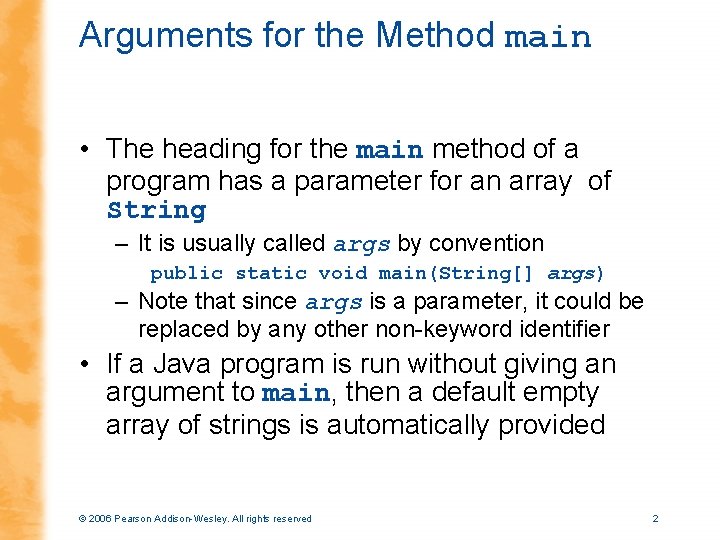
Arguments for the Method main • The heading for the main method of a program has a parameter for an array of String – It is usually called args by convention public static void main(String[] args) – Note that since args is a parameter, it could be replaced by any other non-keyword identifier • If a Java program is run without giving an argument to main, then a default empty array of strings is automatically provided © 2006 Pearson Addison-Wesley. All rights reserved 2
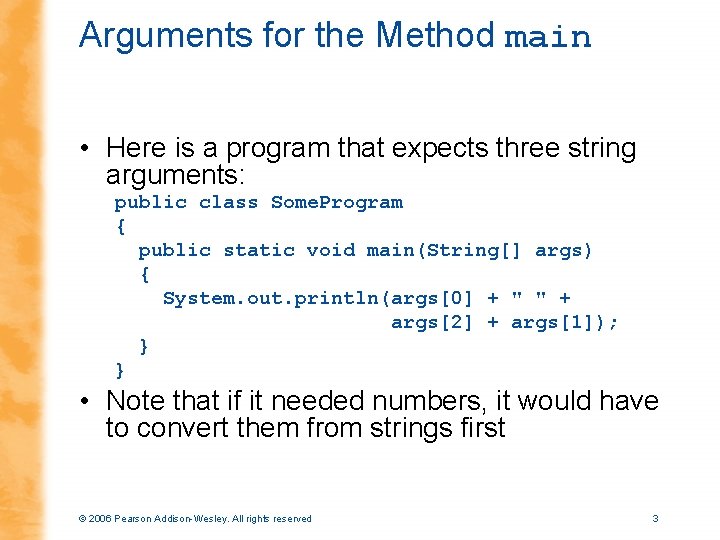
Arguments for the Method main • Here is a program that expects three string arguments: public class Some. Program { public static void main(String[] args) { System. out. println(args[0] + " " + args[2] + args[1]); } } • Note that if it needed numbers, it would have to convert them from strings first © 2006 Pearson Addison-Wesley. All rights reserved 3
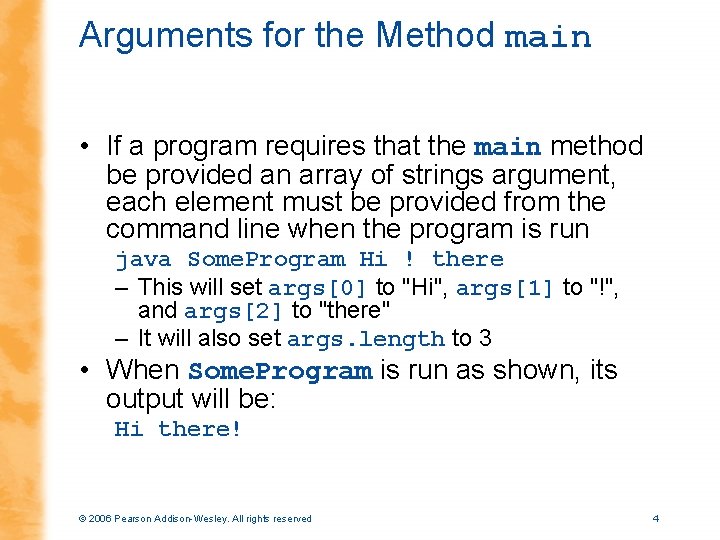
Arguments for the Method main • If a program requires that the main method be provided an array of strings argument, each element must be provided from the command line when the program is run java Some. Program Hi ! there – This will set args[0] to "Hi", args[1] to "!", and args[2] to "there" – It will also set args. length to 3 • When Some. Program is run as shown, its output will be: Hi there! © 2006 Pearson Addison-Wesley. All rights reserved 4
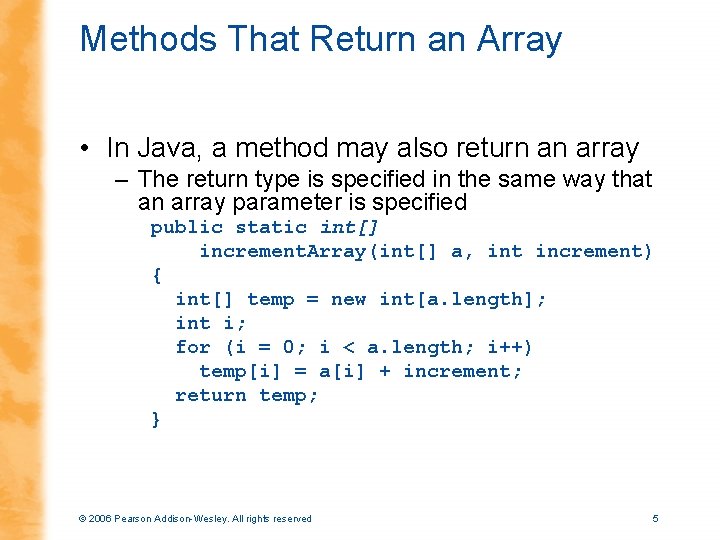
Methods That Return an Array • In Java, a method may also return an array – The return type is specified in the same way that an array parameter is specified public static int[] increment. Array(int[] a, int increment) { int[] temp = new int[a. length]; int i; for (i = 0; i < a. length; i++) temp[i] = a[i] + increment; return temp; } © 2006 Pearson Addison-Wesley. All rights reserved 5
Partially Filled Arrays • The exact size needed for an array is not always known when a program is written, or it may vary from one run of the program to another • A common way to handle this is to declare the array to be of the largest size that the program could possibly need • Care must then be taken to keep track of how much of the array is actually used – An indexed variable that has not been given a meaningful value must never be referenced © 2006 Pearson Addison-Wesley. All rights reserved 6
Partially Filled Arrays • A variable can be used to keep track of how many elements are currently stored in an array – For example, given the variable count, the elements of the array some. Array will range from positions some. Array[0] through some. Array[count – 1] – Note that the variable count will be used to process the partially filled array instead of some. Array. length – Note also that this variable (count) must be an argument to any method that manipulates the partially filled array © 2006 Pearson Addison-Wesley. All rights reserved 7
Accessor Methods Need Not Simply Return Instance Variables • When an instance variable names an array, it is not always necessary to provide an accessor method that returns the contents of the entire array • Instead, other accessor methods that return a variety of information about the array and its elements may be sufficient © 2006 Pearson Addison-Wesley. All rights reserved 8
Privacy Leaks with Array Instance Variables • If an accessor method does return the contents of an array, special care must be taken – Just as when an accessor returns a reference to any private object public double[] get. Array() { return an. Array; //BAD! } – The example above will result in a privacy leak © 2006 Pearson Addison-Wesley. All rights reserved 9
Privacy Leaks with Array Instance Variables • The previous accessor method would simply return a reference to the array an. Array itself • Instead, an accessor method should return a reference to a deep copy of the private array object – Below, both a and count are instance variables of the class containing the get. Array method public double[] get. Array() { double[] temp = new double[count]; for (int i = 0; i < count; i++) temp[i] = a[i]; return temp } © 2006 Pearson Addison-Wesley. All rights reserved 10
Privacy Leaks with Array Instance Variables • If a private instance variable is an array that has a class as its base type, then copies must be made of each class object in the array when the array is copied: public Class. Type[] get. Array() { Class. Type[] temp = new Class. Type[count]; for (int i = 0; i < count; i++) temp[i] = new Class. Type(some. Array[i]); return temp; } © 2006 Pearson Addison-Wesley. All rights reserved 11
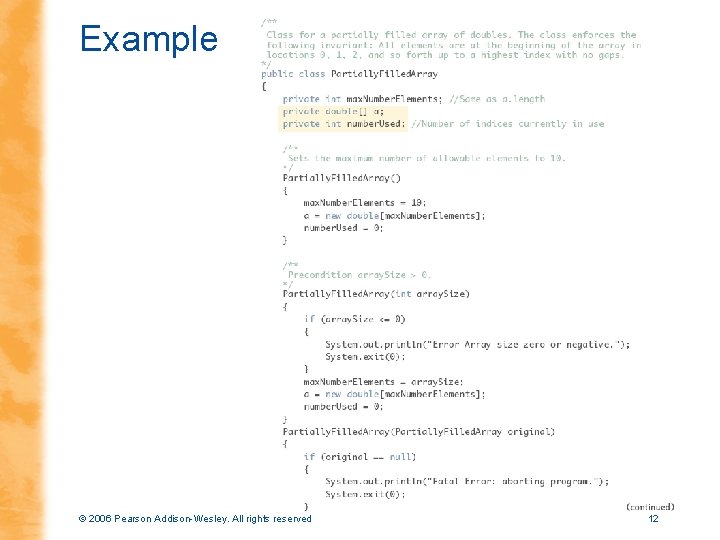
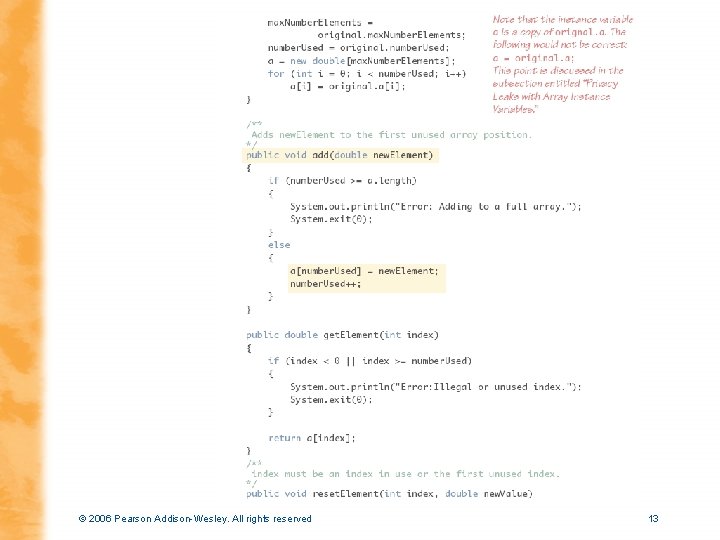
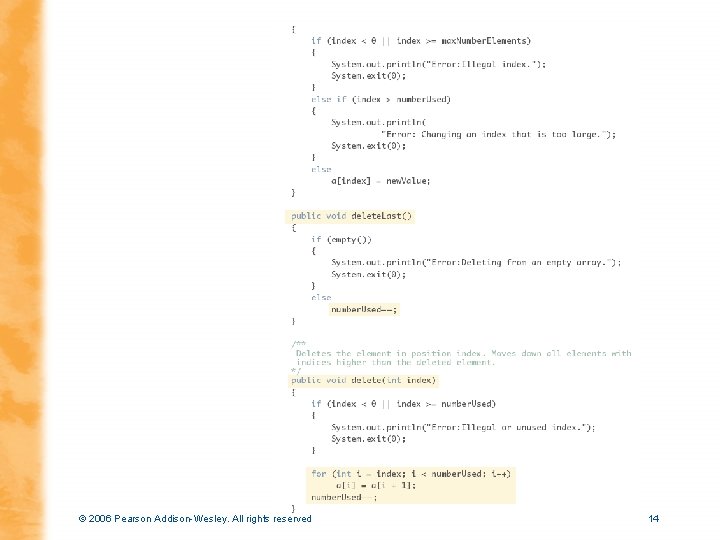
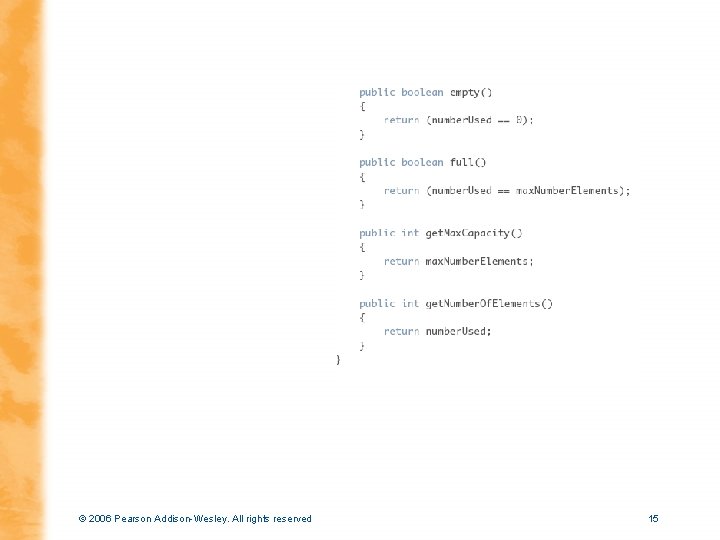
Example © 2006 Pearson Addison-Wesley. All rights reserved 12
© 2006 Pearson Addison-Wesley. All rights reserved 13
© 2006 Pearson Addison-Wesley. All rights reserved 14
© 2006 Pearson Addison-Wesley. All rights reserved 15
- Slides: 15