
Chapter 6 Applications of Newtons Laws Copyright 2010
- Slides: 24
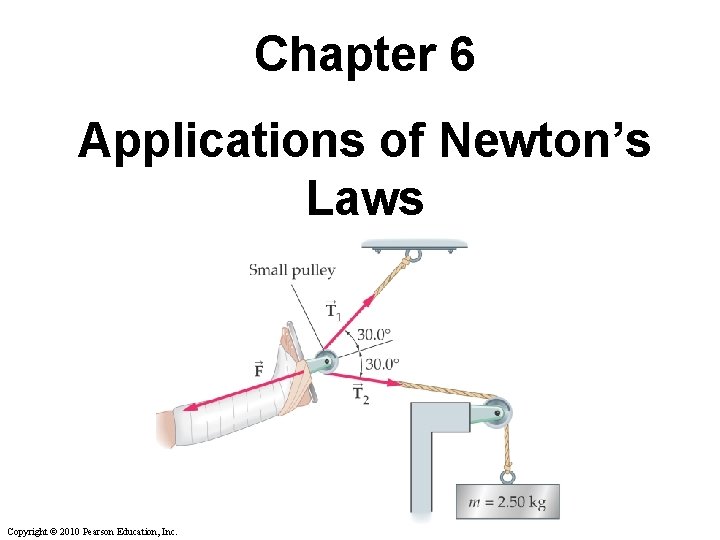
Chapter 6 Applications of Newton’s Laws Copyright © 2010 Pearson Education, Inc.
Units of Chapter 6 • Frictional Forces • Strings and Springs • Translational Equilibrium • Connected Objects • Circular Motion Copyright © 2010 Pearson Education, Inc.
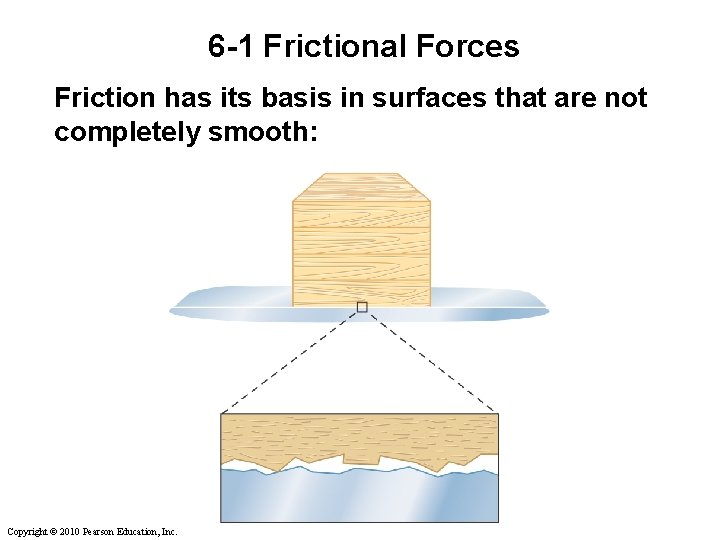
6 -1 Frictional Forces Friction has its basis in surfaces that are not completely smooth: Copyright © 2010 Pearson Education, Inc.
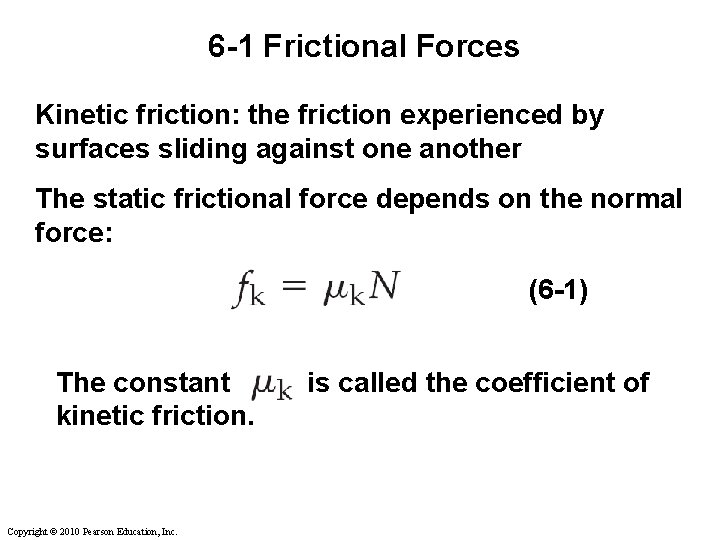
6 -1 Frictional Forces Kinetic friction: the friction experienced by surfaces sliding against one another The static frictional force depends on the normal force: (6 -1) The constant kinetic friction. Copyright © 2010 Pearson Education, Inc. is called the coefficient of
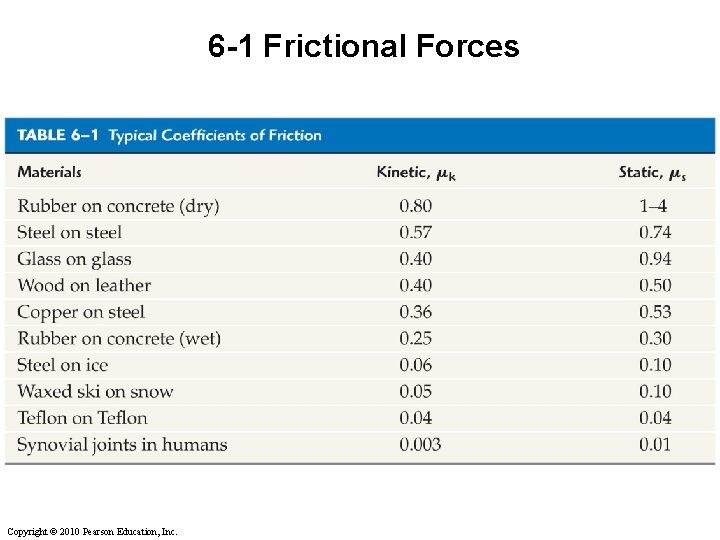
6 -1 Frictional Forces Copyright © 2010 Pearson Education, Inc.
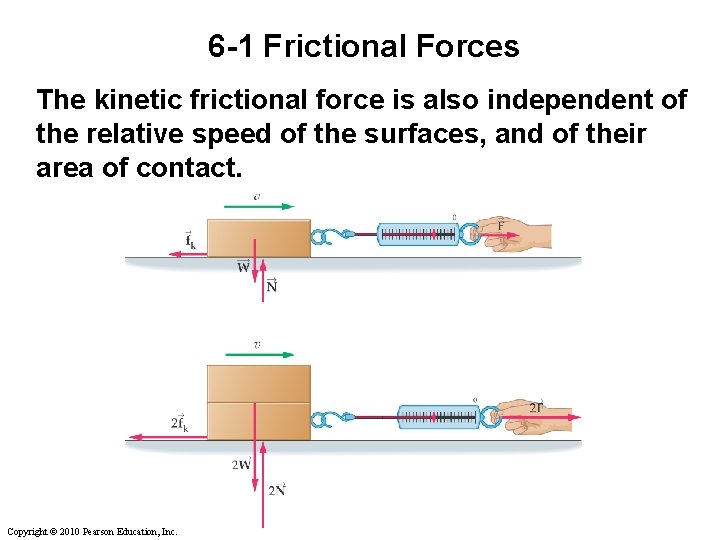
6 -1 Frictional Forces The kinetic frictional force is also independent of the relative speed of the surfaces, and of their area of contact. Copyright © 2010 Pearson Education, Inc.
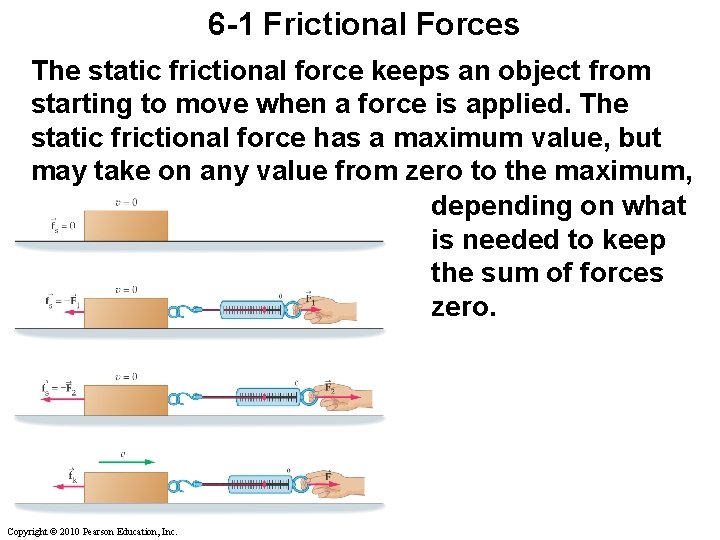
6 -1 Frictional Forces The static frictional force keeps an object from starting to move when a force is applied. The static frictional force has a maximum value, but may take on any value from zero to the maximum, depending on what is needed to keep the sum of forces zero. Copyright © 2010 Pearson Education, Inc.
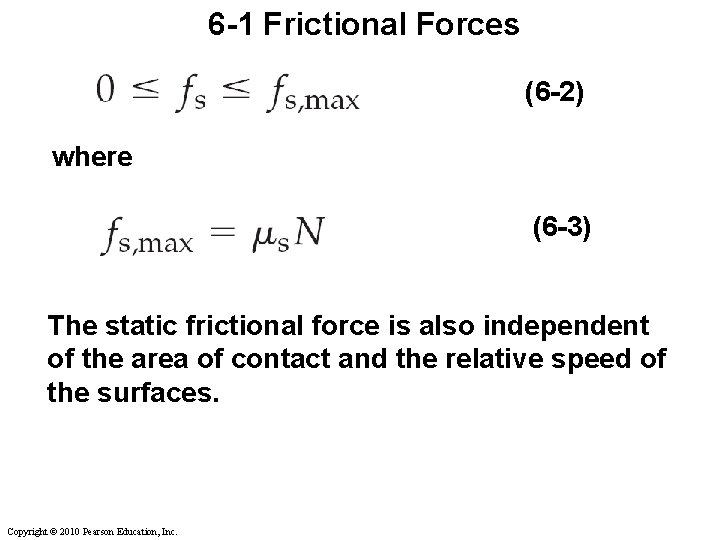
6 -1 Frictional Forces (6 -2) where (6 -3) The static frictional force is also independent of the area of contact and the relative speed of the surfaces. Copyright © 2010 Pearson Education, Inc.
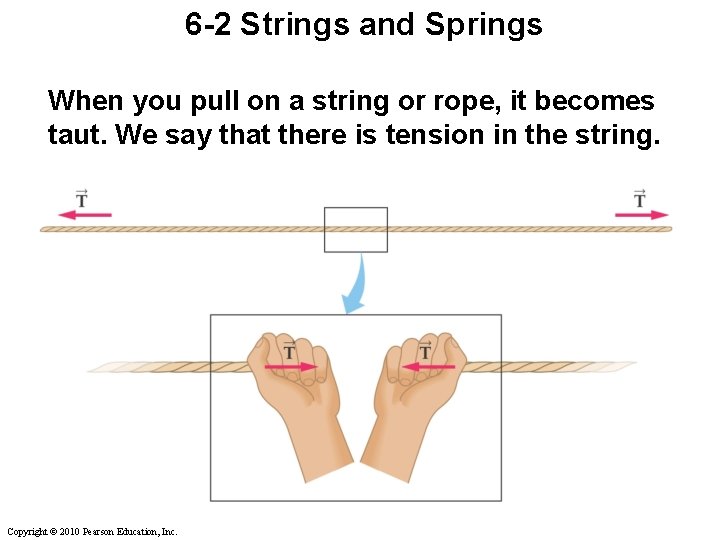
6 -2 Strings and Springs When you pull on a string or rope, it becomes taut. We say that there is tension in the string. Copyright © 2010 Pearson Education, Inc.
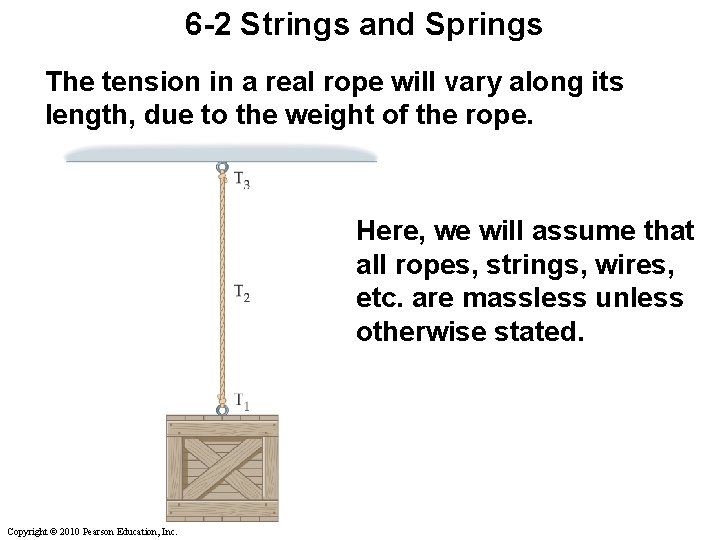
6 -2 Strings and Springs The tension in a real rope will vary along its length, due to the weight of the rope. Here, we will assume that all ropes, strings, wires, etc. are massless unless otherwise stated. Copyright © 2010 Pearson Education, Inc.
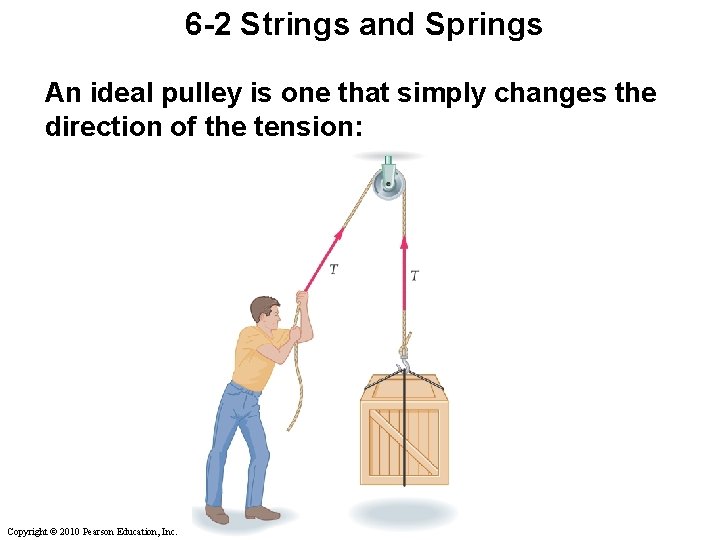
6 -2 Strings and Springs An ideal pulley is one that simply changes the direction of the tension: Copyright © 2010 Pearson Education, Inc.
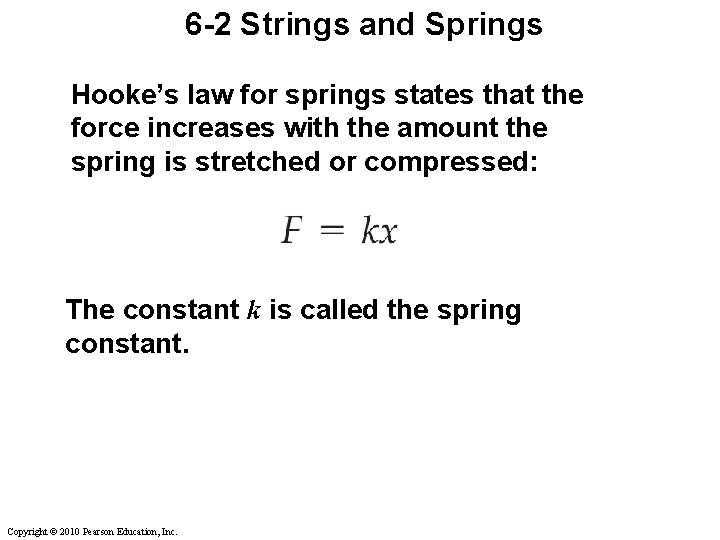
6 -2 Strings and Springs Hooke’s law for springs states that the force increases with the amount the spring is stretched or compressed: The constant k is called the spring constant. Copyright © 2010 Pearson Education, Inc.
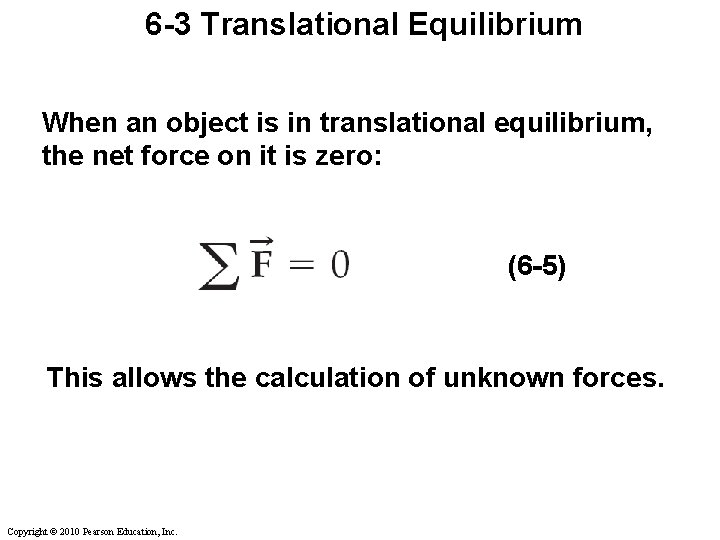
6 -3 Translational Equilibrium When an object is in translational equilibrium, the net force on it is zero: (6 -5) This allows the calculation of unknown forces. Copyright © 2010 Pearson Education, Inc.
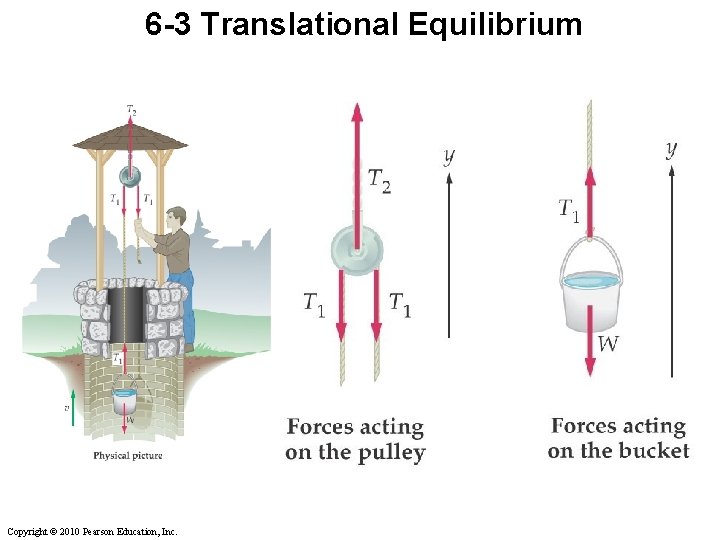
6 -3 Translational Equilibrium Copyright © 2010 Pearson Education, Inc.
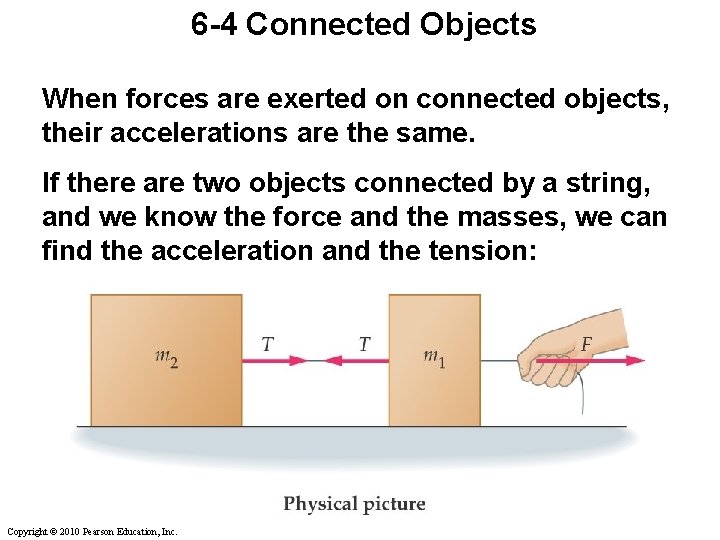
6 -4 Connected Objects When forces are exerted on connected objects, their accelerations are the same. If there are two objects connected by a string, and we know the force and the masses, we can find the acceleration and the tension: Copyright © 2010 Pearson Education, Inc.
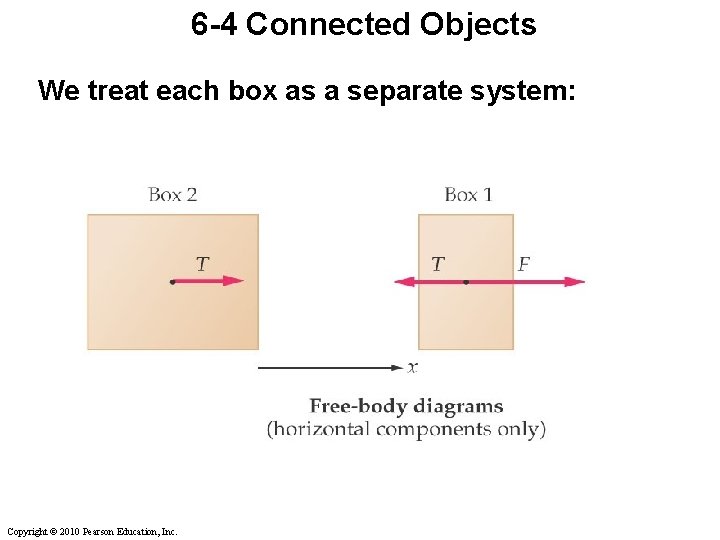
6 -4 Connected Objects We treat each box as a separate system: Copyright © 2010 Pearson Education, Inc.
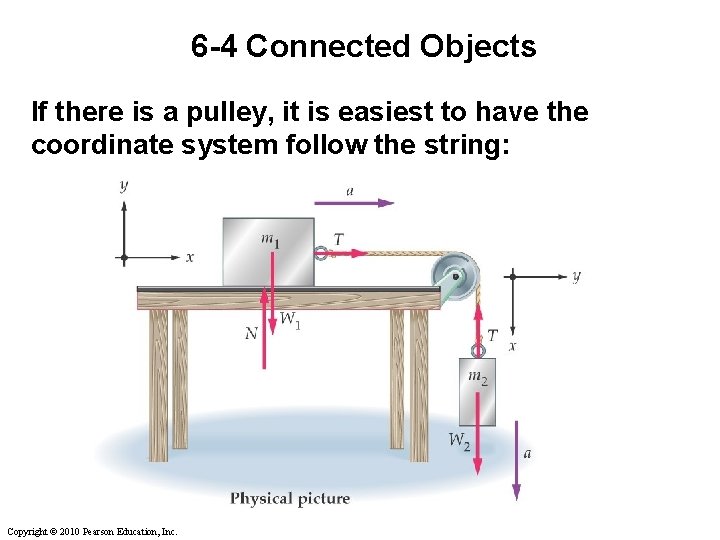
6 -4 Connected Objects If there is a pulley, it is easiest to have the coordinate system follow the string: Copyright © 2010 Pearson Education, Inc.
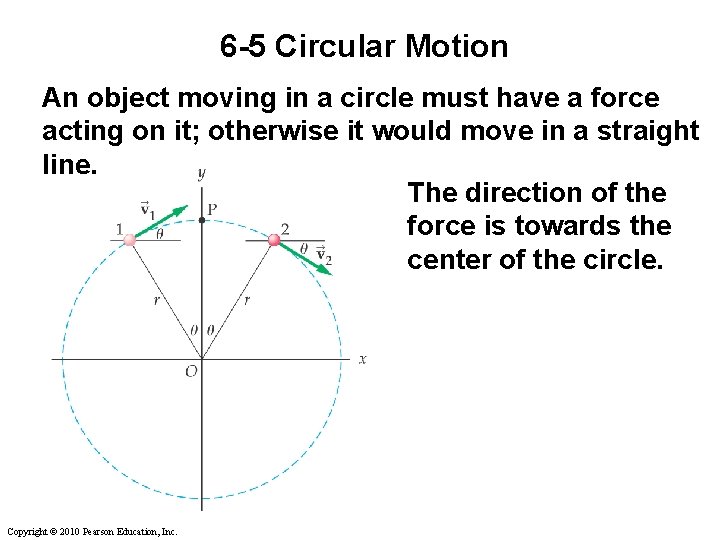
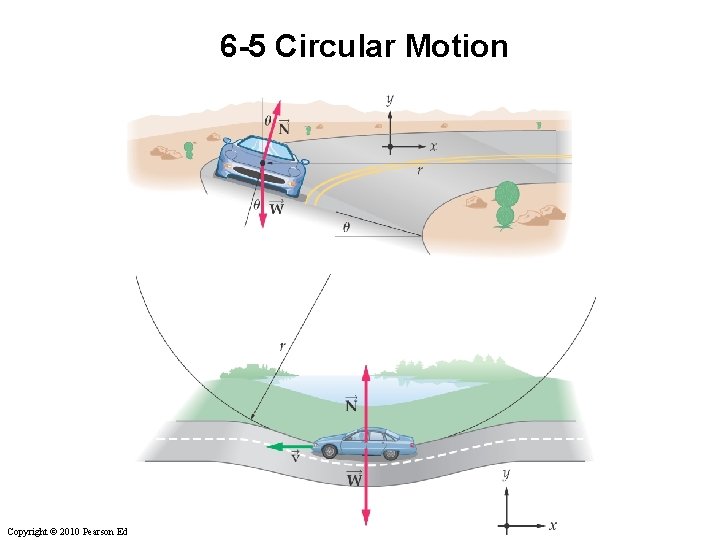
6 -5 Circular Motion An object moving in a circle must have a force acting on it; otherwise it would move in a straight line. The direction of the force is towards the center of the circle. Copyright © 2010 Pearson Education, Inc.
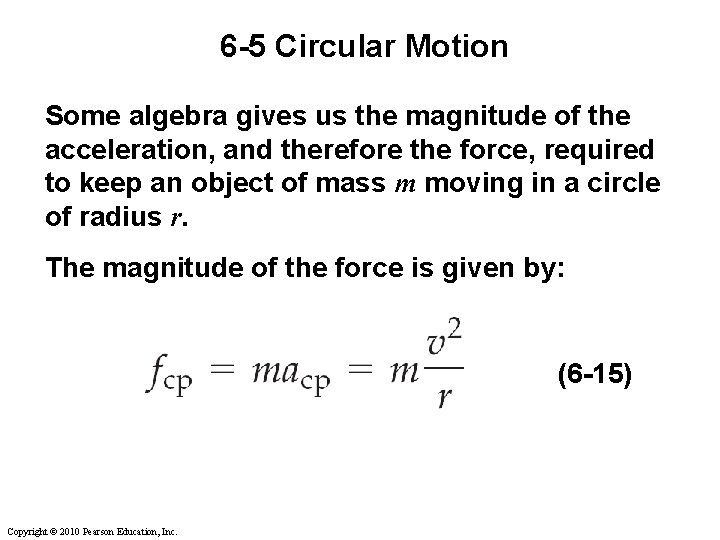
6 -5 Circular Motion Some algebra gives us the magnitude of the acceleration, and therefore the force, required to keep an object of mass m moving in a circle of radius r. The magnitude of the force is given by: (6 -15) Copyright © 2010 Pearson Education, Inc.
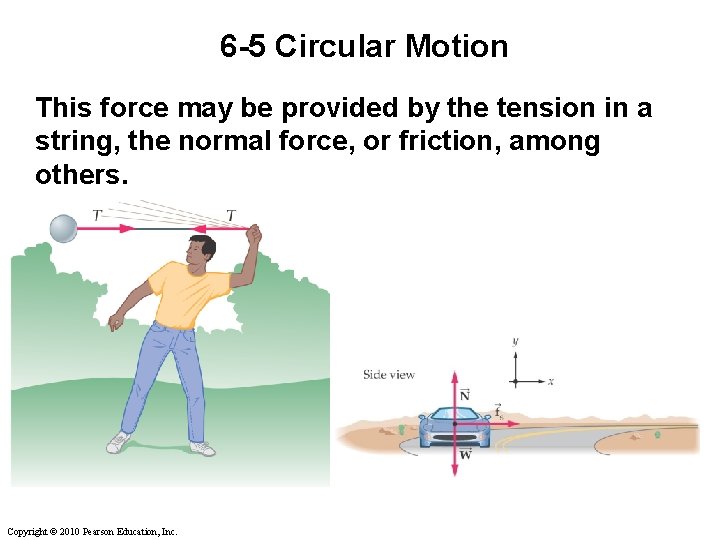
6 -5 Circular Motion This force may be provided by the tension in a string, the normal force, or friction, among others. Copyright © 2010 Pearson Education, Inc.
6 -5 Circular Motion Copyright © 2010 Pearson Education, Inc.
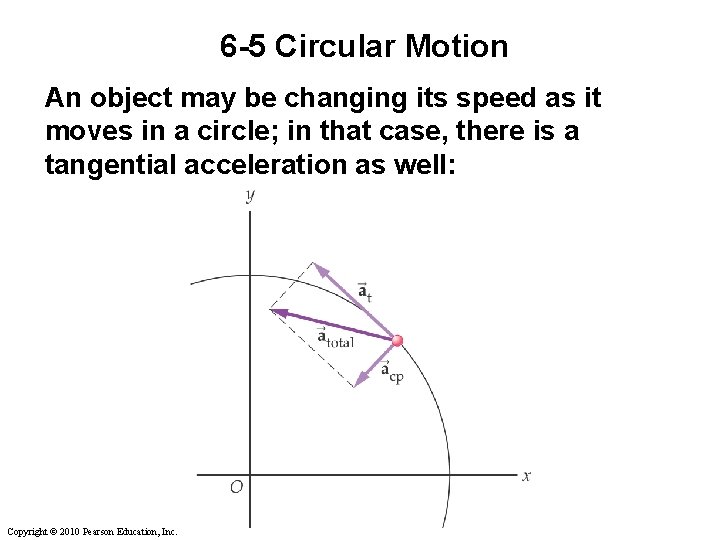
6 -5 Circular Motion An object may be changing its speed as it moves in a circle; in that case, there is a tangential acceleration as well: Copyright © 2010 Pearson Education, Inc.
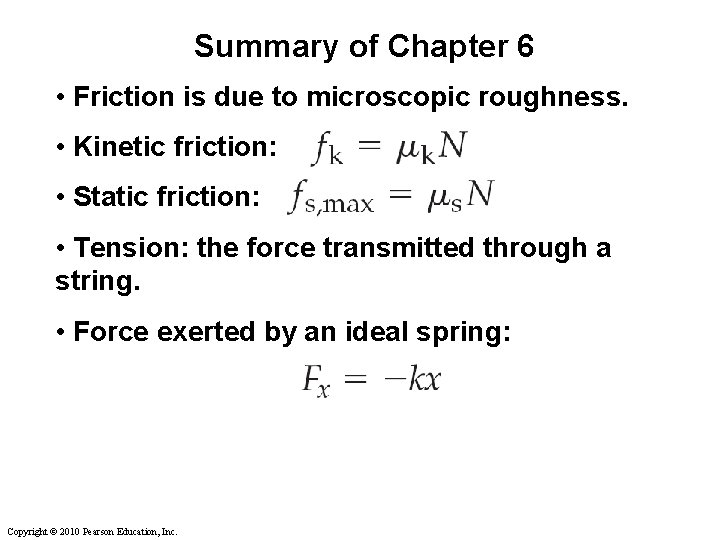
Summary of Chapter 6 • Friction is due to microscopic roughness. • Kinetic friction: • Static friction: • Tension: the force transmitted through a string. • Force exerted by an ideal spring: Copyright © 2010 Pearson Education, Inc.
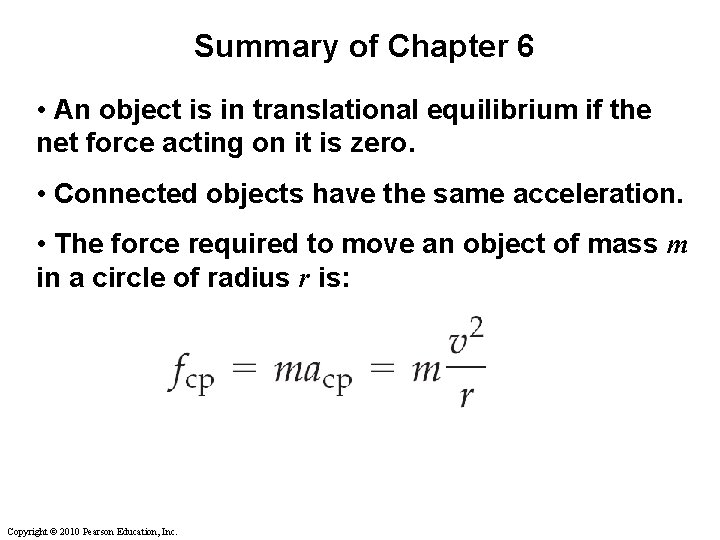
Summary of Chapter 6 • An object is in translational equilibrium if the net force acting on it is zero. • Connected objects have the same acceleration. • The force required to move an object of mass m in a circle of radius r is: Copyright © 2010 Pearson Education, Inc.