
Chapter 6 An Introduction to Portfolio Management Background

Chapter 6 An Introduction to Portfolio Management

Background Assumptions As an investor you want to maximize the returns for a given level of risk. Your portfolio includes all of your assets and liabilities 2

The relationship between the returns for assets in the portfolio is important. A good portfolio is not simply a collection of individually good investments. 3

Risk Aversion Given a choice between two assets with equal rates of return, most investors will select the asset with the lower level of risk. 4

Evidence That Investors are Risk Averse Many investors purchase insurance for: life, automobile, health, and disability income. The purchaser trades known costs for unknown risk of loss. Yield on bonds increases with risk classifications from AAA to A…. 5
Definition of Risk 1. Uncertainty of future outcomes or 2. Probability of an adverse outcome 6

Markowitz Portfolio Theory Quantifies risk Derives the expected rate of return and expected risk for a portfolio of assets. 7
Shows that the variance of the rate of return is a meaningful measure of portfolio risk Derives the formula for computing the variance of a portfolio, showing how to effectively diversify a portfolio 8

Assumptions of Markowitz Portfolio Theory 1. Investors consider each investment alternative as being presented by a probability distribution of expected returns over some holding period. 9

Assumptions of Markowitz Portfolio Theory 2. Investors maximize one-period expected utility, and their utility curves demonstrate diminishing marginal utility of wealth. 10
Assumptions of Markowitz Portfolio Theory 3. Investors estimate the risk of the portfolio on the basis of the variability of expected returns. 11
Assumptions of Markowitz Portfolio Theory 4. Investors base decisions solely on expected return and risk, so their utility curves are a function of expected return and the expected variance (or standard deviation) of returns only. 12
Assumptions of Markowitz Portfolio Theory 5. For a given risk level, investors prefer higher returns to lower returns. Similarly, for a given level of expected returns, investors prefer less risk to more risk. 13

Markowitz Portfolio Theory Using these five assumptions, a single asset or portfolio of assets is considered to be efficient if no other asset or portfolio of assets offers higher expected return with the same (or lower) risk, or lower risk with the same (or higher) expected return. 14
Alternative Measures of Risk Variance or standard deviation of expected return Range of returns Returns below expectations Semivariance – a measure that only considers deviations below the mean These measures of risk implicitly assume that investors want to minimize the damage from returns less than some target rate 15
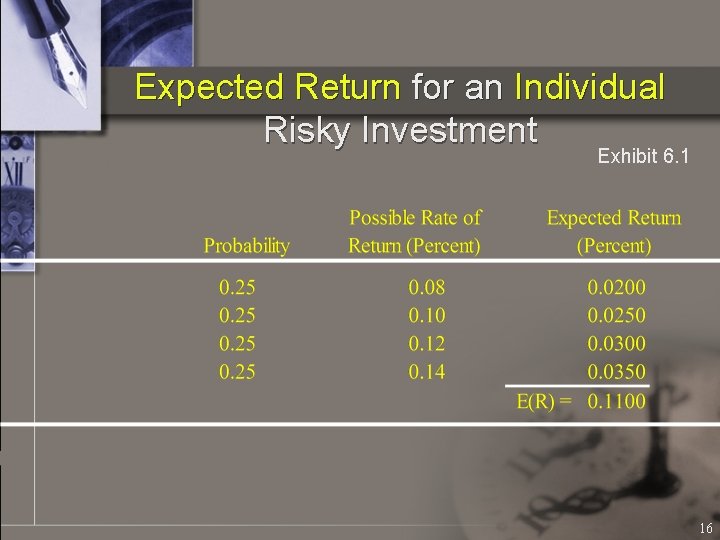
Expected Return for an Individual Risky Investment Exhibit 6. 1 16

Expected Return for a Portfolio of Risky Assets Exhibit 6. 2 17
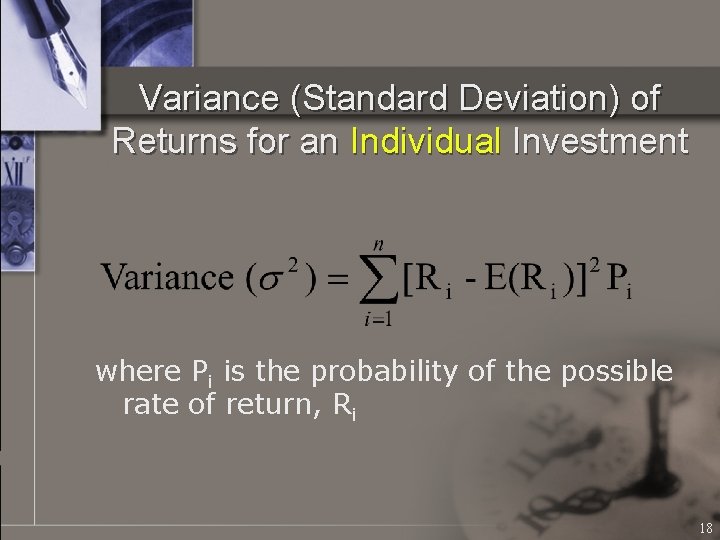
Variance (Standard Deviation) of Returns for an Individual Investment where Pi is the probability of the possible rate of return, Ri 18
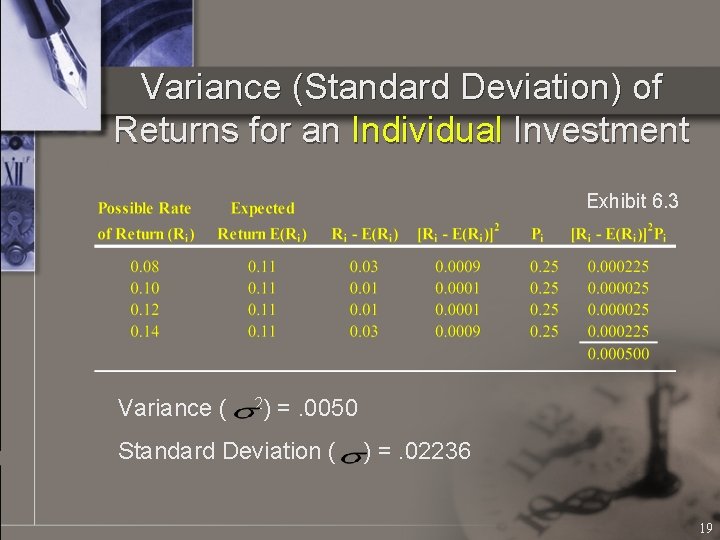
Variance (Standard Deviation) of Returns for an Individual Investment Exhibit 6. 3 Variance ( 2) =. 0050 Standard Deviation ( ) =. 02236 19
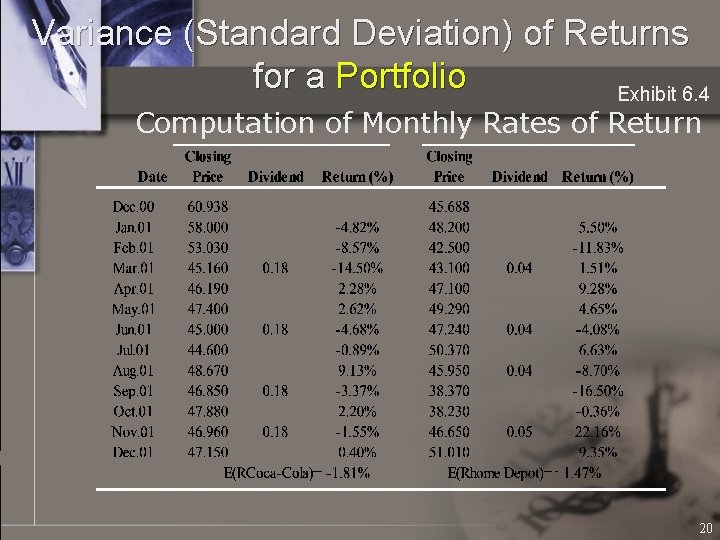
Variance (Standard Deviation) of Returns for a Portfolio Exhibit 6. 4 Computation of Monthly Rates of Return 20

Covariance of Returns A measure of the degree to which two variables “move together” relative to their individual mean values over time 21
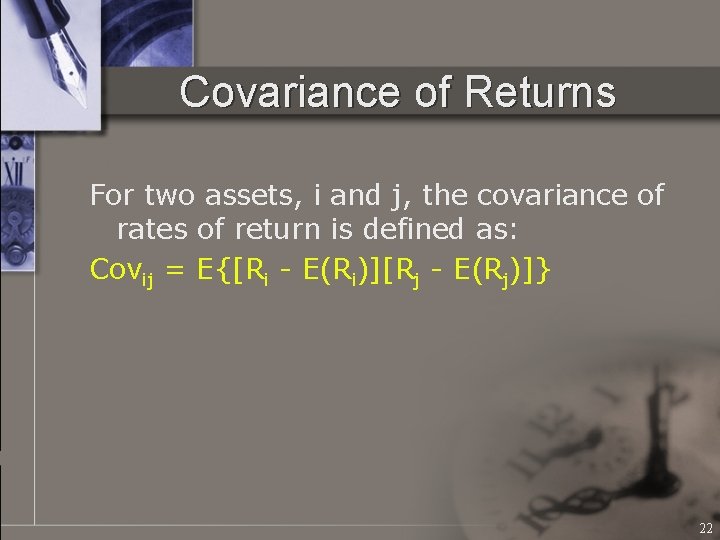
Covariance of Returns For two assets, i and j, the covariance of rates of return is defined as: Covij = E{[Ri - E(Ri)][Rj - E(Rj)]} 22
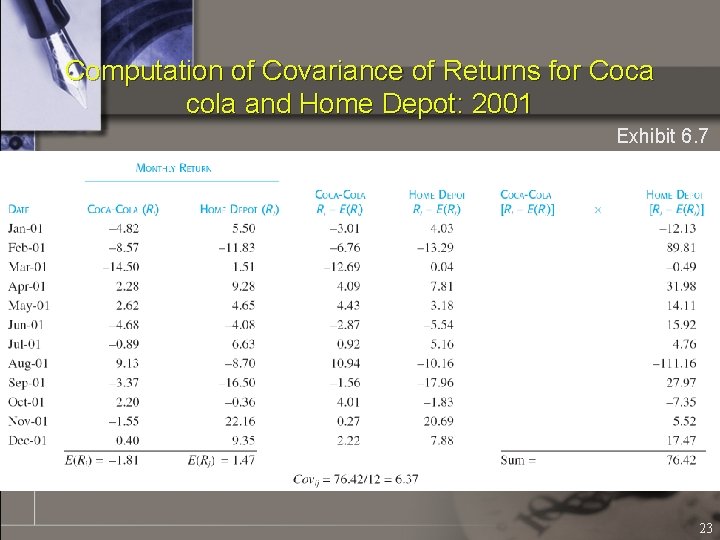
Computation of Covariance of Returns for Coca cola and Home Depot: 2001 Exhibit 6. 7 23
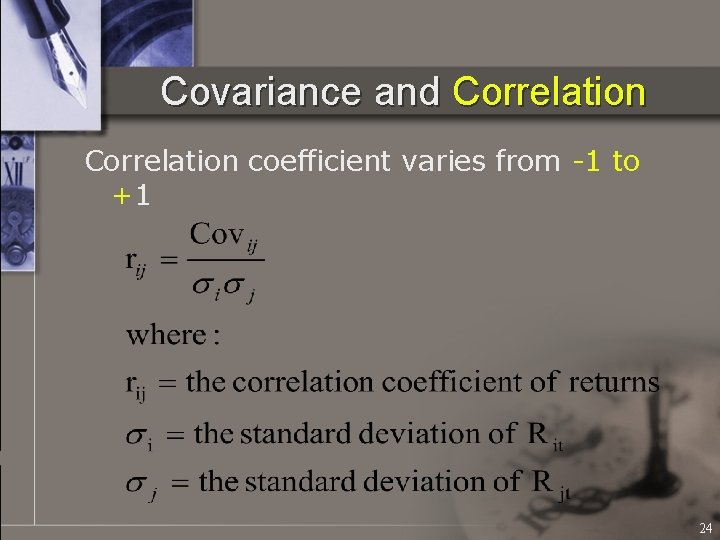
Covariance and Correlation coefficient varies from -1 to +1 24

Portfolio Standard Deviation Formula 25
Portfolio Standard Deviation Calculation Any asset of a portfolio may be described by two characteristics: The expected rate of return The expected standard deviations of returns The correlation, measured by covariance, affects the portfolio standard deviation Low correlation reduces portfolio risk while not affecting the expected return 26

Time Patterns of Returns for Two Assets with Perfect Negative Correlation Exhibit 6. 10 27
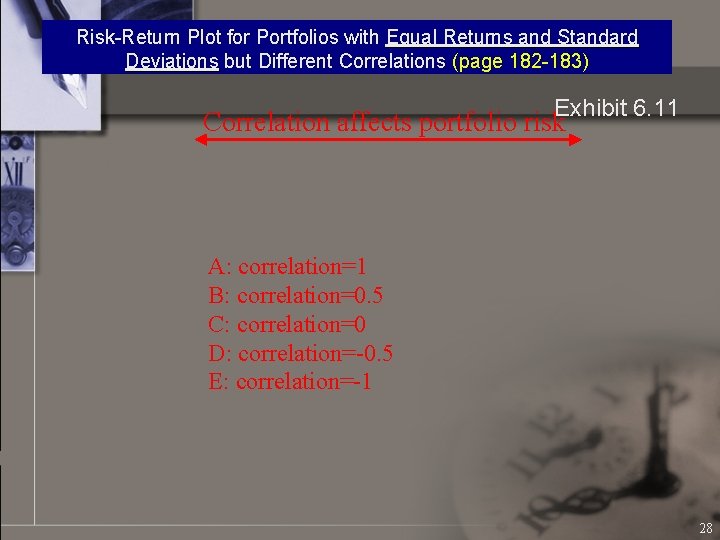
Risk-Return Plot for Portfolios with Equal Returns and Standard Deviations but Different Correlations (page 182 -183) Exhibit 6. 11 Correlation affects portfolio risk A: correlation=1 B: correlation=0. 5 C: correlation=0 D: correlation=-0. 5 E: correlation=-1 28
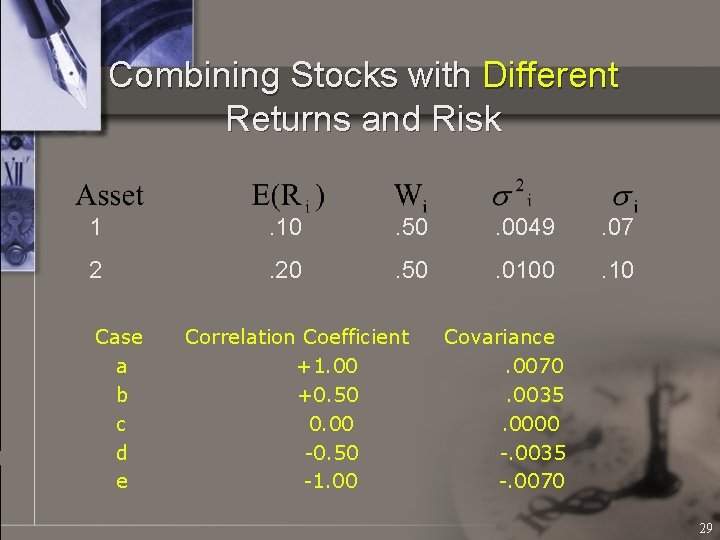
Combining Stocks with Different Returns and Risk 1 . 10 . 50 . 0049 . 07 2 . 20 . 50 . 0100 . 10 Case a b c d e Correlation Coefficient +1. 00 +0. 50 0. 00 -0. 50 -1. 00 Covariance. 0070. 0035. 0000 -. 0035 -. 0070 29

Combining Stocks with Different Returns and Risk Negative correlation reduces portfolio risk Combining two assets with -1. 0 correlation reduces the portfolio standard deviation to zero only when individual standard deviations are equal. 30

Risk-Return Plot for Portfolios with Different Returns, Standard Deviations, and Correlations Exhibit 6. 12 31
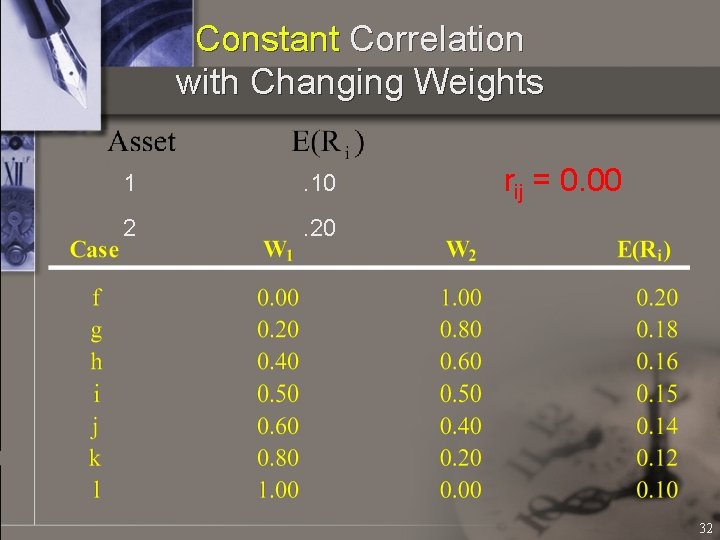
Constant Correlation with Changing Weights 1 . 10 2 . 20 rij = 0. 00 32
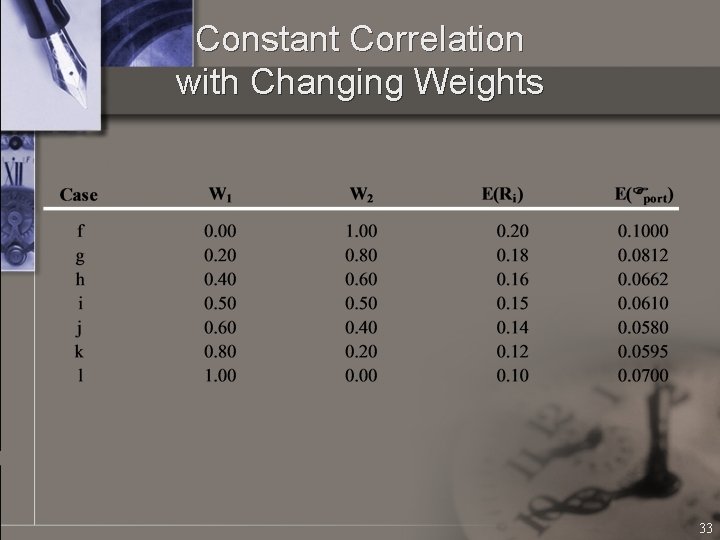
Constant Correlation with Changing Weights 33

Portfolio Risk-Return Plots for Different Weights E(R) With two perfectly correlated assets, it is only possible to create a two asset portfolio with riskreturn along a line between either single asset 2 Rij = +1. 00 1 Standard Deviation of Return 34

Portfolio Risk-Return Plots for Different Weights E(R) f g 2 With uncorrelated h assets it is possible i j to create a two Rij = +1. 00 asset portfolio with k lower risk than 1 Rij = 0. 00 either single asset Standard Deviation of Return 35

Portfolio Risk-Return Plots for Different Weights E(R) f g 2 With correlated h assets it is possible i j to create a two Rij = +1. 00 asset portfolio k Rij = +0. 50 between the first 1 Rij = 0. 00 two curves Standard Deviation of Return 36

Portfolio Risk-Return Plots for Different Weights E(R) With negatively correlated assets it is possible to create a two asset portfolio with much lower risk than either single asset Rij = -0. 50 j k i h f 2 g Rij = +1. 00 Rij = +0. 50 1 Rij = 0. 00 Standard Deviation of Return 37

Portfolio Risk-Return Plots for Different Weights E(R) Rij = -1. 00 Rij = -0. 50 j k i h Exhibit 6. 13 f 2 g Rij = +1. 00 Rij = +0. 50 1 Rij = 0. 00 With perfectly negatively correlated assets it is possible to create a two asset portfolio with almost no risk Standard Deviation of Return 38
Estimation Issues Results of portfolio allocation depend on accurate statistical inputs Estimates of Expected returns Standard deviation Correlation coefficient n(n-1)/2 correlation estimates: with 100 assets, 4, 950 correlation estimates 39
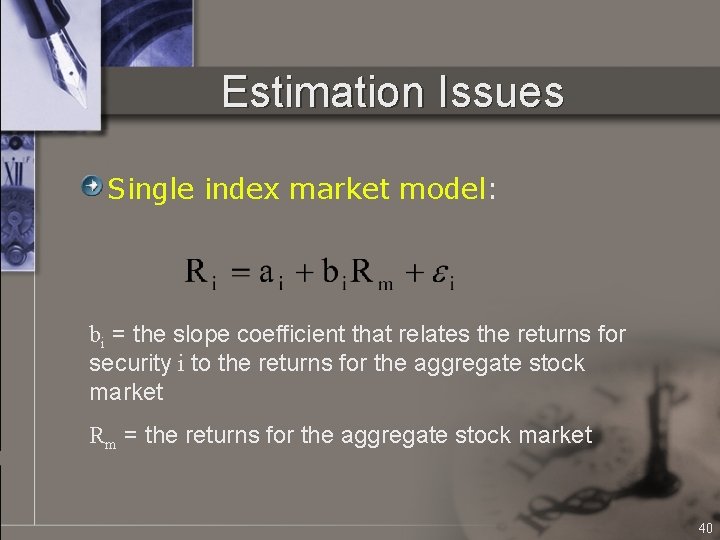
Estimation Issues Single index market model: bi = the slope coefficient that relates the returns for security i to the returns for the aggregate stock market Rm = the returns for the aggregate stock market 40
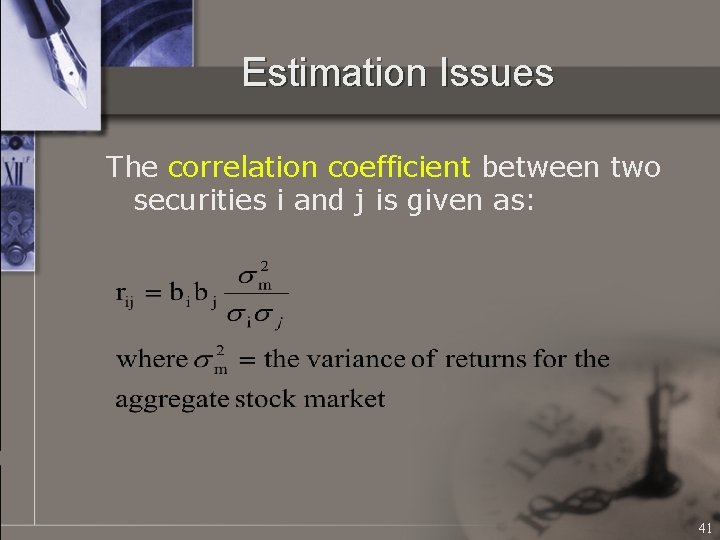
Estimation Issues The correlation coefficient between two securities i and j is given as: 41

The Efficient Frontier The efficient frontier represents that set of portfolios with the maximum rate of return for every given level of risk, or the minimum risk for every level of return Frontier will be portfolios of investments rather than individual securities Exceptions being the asset with the highest return and the asset with the lowest risk 42
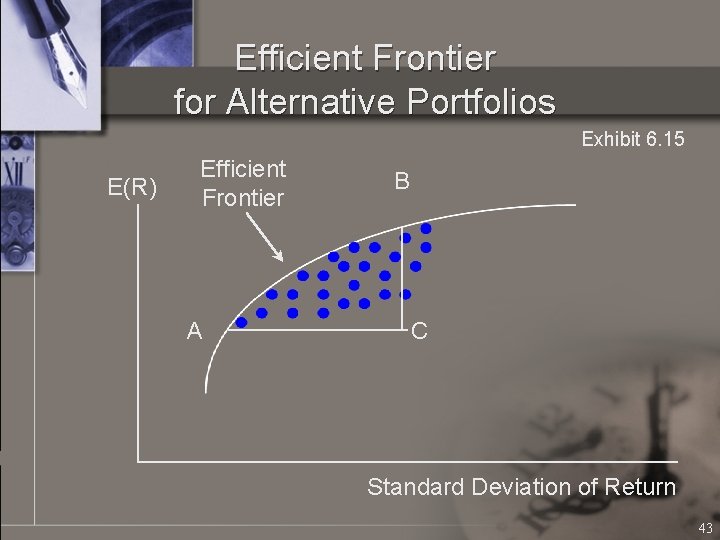
Efficient Frontier for Alternative Portfolios Exhibit 6. 15 E(R) Efficient Frontier A B C Standard Deviation of Return 43

The Efficient Frontier and Investor Utility An individual investor’s utility curve specifies the trade-offs he is willing to make between expected return and risk The slope of the efficient frontier curve decreases steadily as you move upward These two interactions will determine the particular portfolio selected by an individual investor 44

The Efficient Frontier and Investor Utility The optimal portfolio has the highest utility for a given investor It lies at the point of tangency between the efficient frontier and the utility curve with the highest possible utility 45
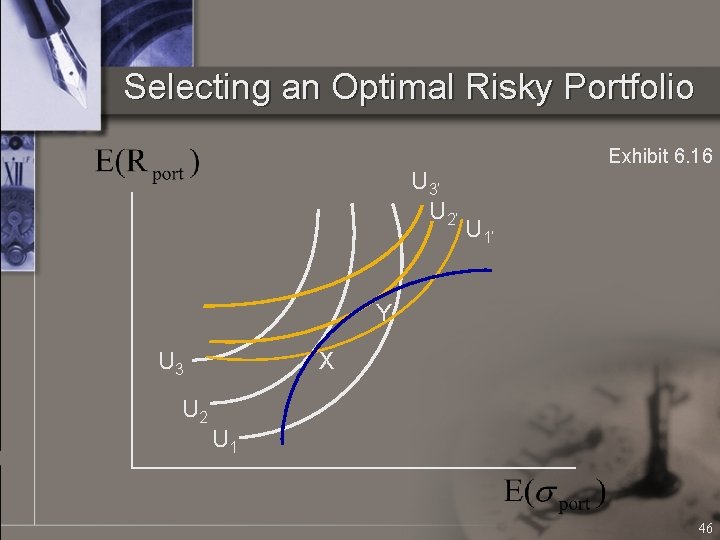
Selecting an Optimal Risky Portfolio Exhibit 6. 16 U 3’ U 2’ U 1’ Y U 3 U 2 X U 1 46
- Slides: 46