
Chapter 55 Cortical and Brainstem Control of Motor
Chapter 55: Cortical and Brainstem Control of Motor Function
Motor Cortex • Divided into 3 sub areas – primary motor cortex • unequal topographic representation • fine motor movement elicited by stimulation – premotor area • topographical organization similar to primary motor cortex • stimulation results in movement of muscle groups to perform a specific task • works in concert with other motor areas
Motor Cortex (Cont. ) – supplemental motor area • topographically organized • simulation often elicits bilateral movements. • functions in concert with premotor area to provide attitudinal, fixation or positional movement for the body • it provides the background for fine motor control of the arms and hands by premotor and primary motor cortex
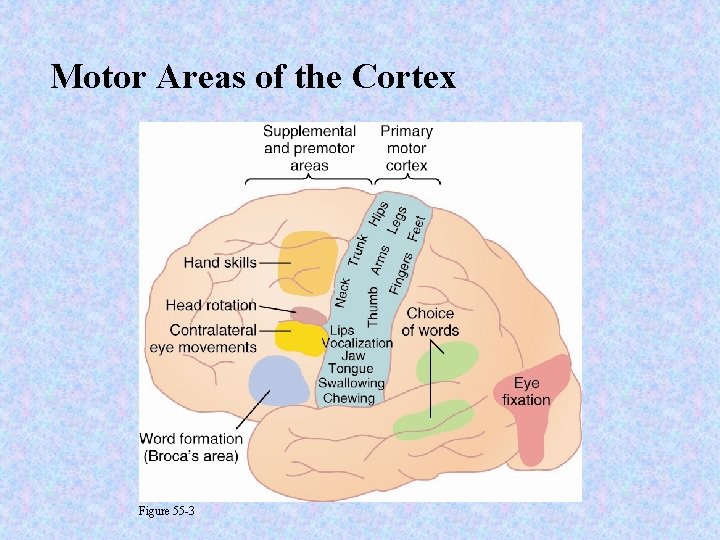
Motor Areas of the Cortex Figure 55 -3
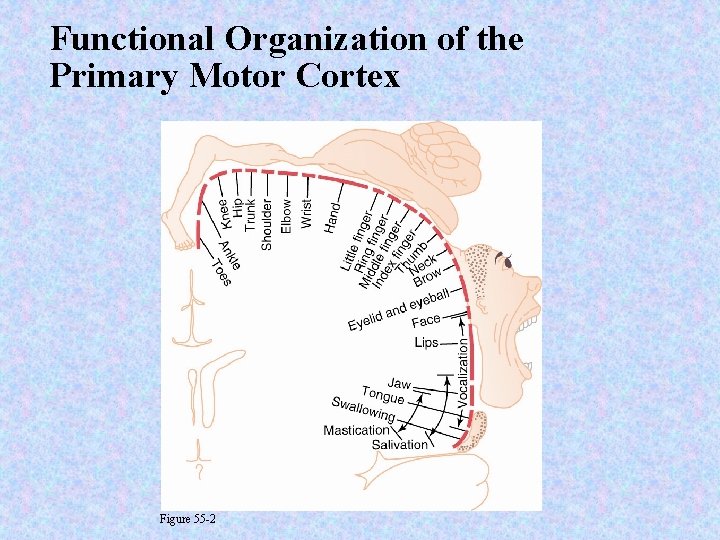
Functional Organization of the Primary Motor Cortex Figure 55 -2
Specialized Areas of the Motor Cortex • Broca’s area – damage causes decreased speech capability – closely associated area controls appropriate respiratory function for speech • eye fixation and head rotation area – for coordinated head and eye movements • hand skills area – damage causes motor apraxia the inability to perform fine hand movements
Transmission of Cortical Motor Signals • Direct pathway – corticospinal tract – for discrete detailed movement • Indirect pathway – signals to basal ganglia, cerebellum, and brainstem nuclei
Corticospinal Fibers • 34, 000 Betz cell fibers, make up only about 3% of the total number of fibers • 97% of the 1 million fibers are small diameter fibers – conduct background tonic signals – feedback signals from the cortex to control intensity of the various sensory signals to the brain
Other Pathways from the Motor Cortex • Betz collaterals back to cortex sharpen the boundaries of the excitatory signal • Fibers to caudate nucleus and putamen • Fibers to the red nucleus, which then sends axons to the cord in the rubrospinal tract • Reticular substance, vestibular nuclei and pons then to the cerebellum • Therefore the basal ganglia, brain stem and cerebellum receive a large number of signals from the cortex.
Incoming Sensory Pathways to Motor Cortex • Subcortical fibers from adjacent areas of the cortex especially from somatic sensory areas of parietal cortex and visual and auditory cortex. • Subcortical fibers from opposite hemisphere which pass through corpus callosum. • Somatic sensory fibers from ventrobasal complex of the thalamus (i. e. , cutaneous and proprioceptive fibers).
Incoming Sensory Pathways to Motor Cortex (Cont. ) • Ventrolateral and ventroanterior nuclei of thalamus for coordination of function between motor cortex, basal ganglia, and cerebellum. • Fibers from the intralaminar nuclei of thalamus (control level of excitability of the motor cortex), some of these may be pain fibers.
Red Nucleus and the Rubrospinal Tract • Substantial input from primary motor cortex • Primary motor cortex fibers synapse in the lower portion of the nucleus called the magnocellular portion which contains large neurons similar to Betz cells. • Magnocellular portion gives rise to rubrospinal tract. • Magnocellular portion has somatotopic organization similar to primary motor cortex.
Red Nucleus and the Rubrospinal Tract • Stimulation of red nucleus causes relatively fine motor movement, but not as discrete as primary motor cortex. • Accessory route for transmission of discrete signals from the motor cortex.
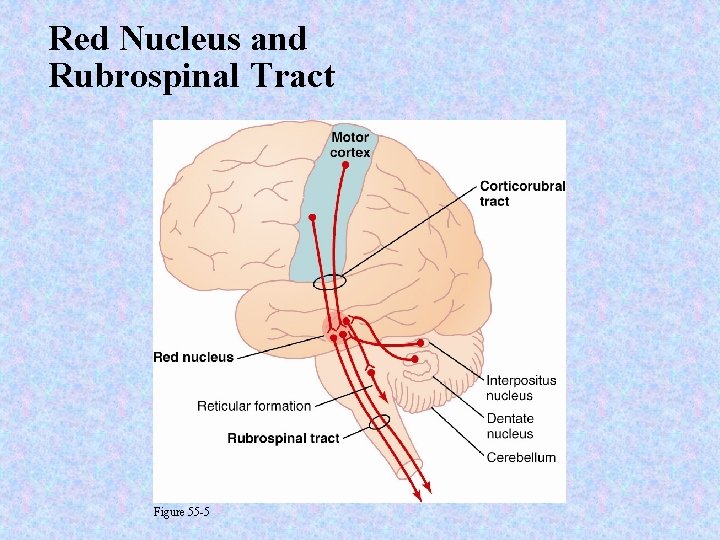
Red Nucleus and Rubrospinal Tract Figure 55 -5
Sensory Feedback is Important for Motor Control • Feedback from muscle spindle, tactile receptors, and proprioceptors fine tunes muscle movement. • Length mismatch in spindle causes auto correction. • Compression of skin provides sensory feedback to motor cortex on degree of effectiveness of intended action.
Excitation of Spinal Motor Neurons • Motor neurons in cortex reside in layer V. • Excitation of 50 -100 giant pyramidal cells is needed to cause muscle contraction. • Most corticospinal fibers synapse with interneurons. • Some corticospinal and rubrospinal neurons synapse directly with alpha motor neurons in the spinal cord especially in the cervical enlargement. • These motor neurons innervate muscles of the fingers and hand.
Lesions of the Motor Cortex • Primary motor cortex - loss of voluntary control of discrete movement of the distal segments of the limbs. • Basal ganglia - muscle spasticity from loss of inhibitory input from accessory areas of the cortex that inhibit excitatory brainstem motor nuclei.
Control of Motor Function by the Brainstem • Brainstem as an extension of the spinal cord. – performs motor and sensory functions for the face and head (i. e. , cranial nerves). – similar to spinal cord for functions from the head down. • Contains centers for stereotypic movement and equilibrium.
Support of the Body Against Gravity • The muscles of the spinal column and the extensor muscles of the legs support the body against gravity. • These muscles are under the influence of brainstem nuclei. • The pontine reticular nuclei excite the antigravity muscles. • The medullary reticular nuclei inhibit the antigravity muscles.
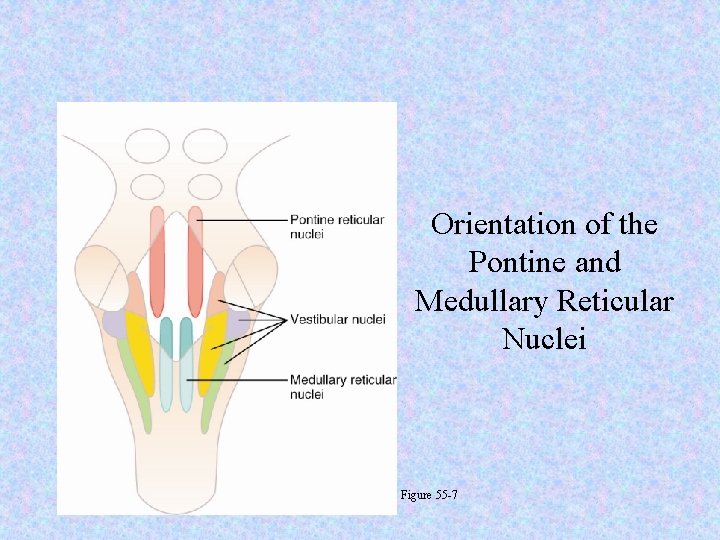
Orientation of the Pontine and Medullary Reticular Nuclei Figure 55 -7
Pontine Reticular Nuclei • Transmit excitatory signals through pontine reticulospinal tract. • Pontine reticular nuclei have a high degree of natural excitability. • When unopposed they cause powerful excitation of the antigravity muscles.
Medullary Reticular Nuclei • Transmit inhibitory signals to the antigravity muscles through the medullary reticulospinal tract. • These nuclei receive collateral input from the corticospinal tract, rubrospinal tract, and other motor pathways. • These systems can activate the inhibitory action of the medullary reticular nuclei and counterbalance the signals from the pons.
Vestibular Apparatus • System of bony tubes and chambers in the temporal bone: – semicircular ducts – utricle – saccule • Within the utricule and the saccule are sensory organs for detecting the orientation of the head with respect to gravity called the macula.
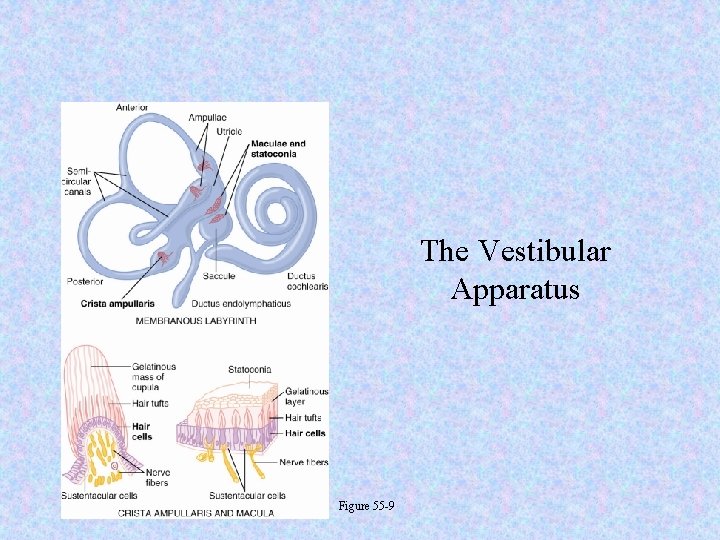
The Vestibular Apparatus Figure 55 -9
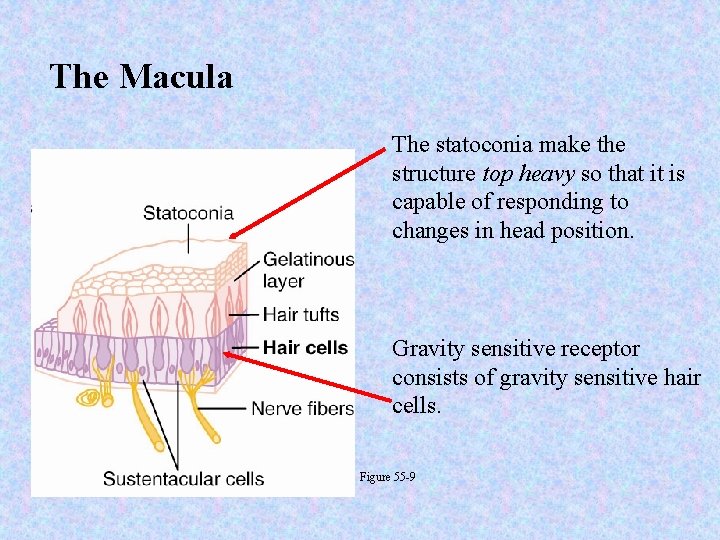
The Macula The statoconia make the structure top heavy so that it is capable of responding to changes in head position. Gravity sensitive receptor consists of gravity sensitive hair cells. Figure 55 -9
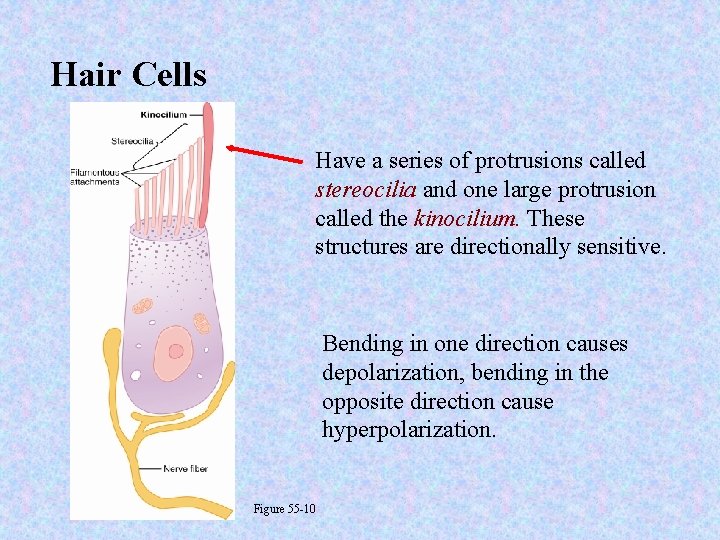
Hair Cells Have a series of protrusions called stereocilia and one large protrusion called the kinocilium. These structures are directionally sensitive. Bending in one direction causes depolarization, bending in the opposite direction cause hyperpolarization. Figure 55 -10
Detection of Head Orientation • In each macula different hair cells are oriented in different directions. • Some are stimulated when the head bends forward, some when the head bends backward, some when the head bends to the side. • The pattern of excitation of the hair cells apprises the brain of the orientation of the head with respect to gravity.
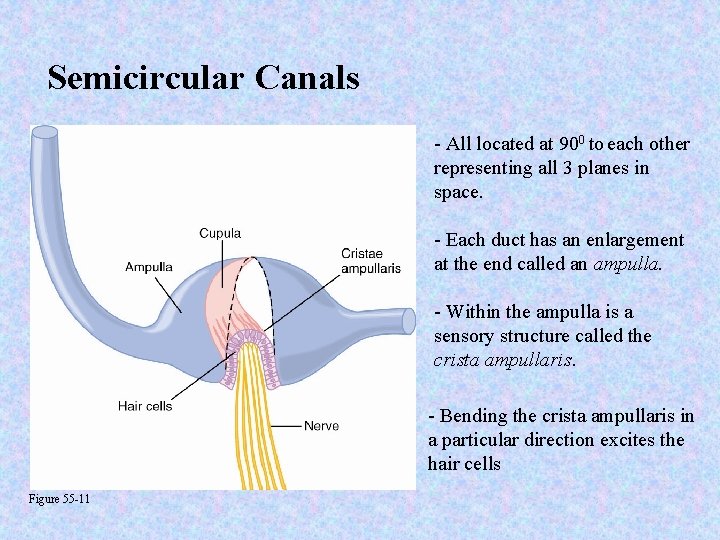
Semicircular Canals - All located at 900 to each other representing all 3 planes in space. - Each duct has an enlargement at the end called an ampulla. - Within the ampulla is a sensory structure called the crista ampullaris. - Bending the crista ampullaris in a particular direction excites the hair cells Figure 55 -11
Maintaining Equilibrium • Information from the hair cells in the maculae of the utricles and saccules is transmitted to the brain via the vestibular nerve. • When the body is accelerated forward the hair cells of the maculae bend in the opposite direction, this causes one to feel as if they are falling backward. • Reflexes cause the body to lean forward.
Semicircular Ducts Detect Angular Acceleration • Rotation of the duct detects rotational movements of the head. • Endolymph tends to remain stationary in the duct because of inertia. • Rotation of the duct in one direction causes relative movement of endolymph in the opposite direction activating the receptors in the crista ampullaris. • Stop the rotation, the opposite happens.
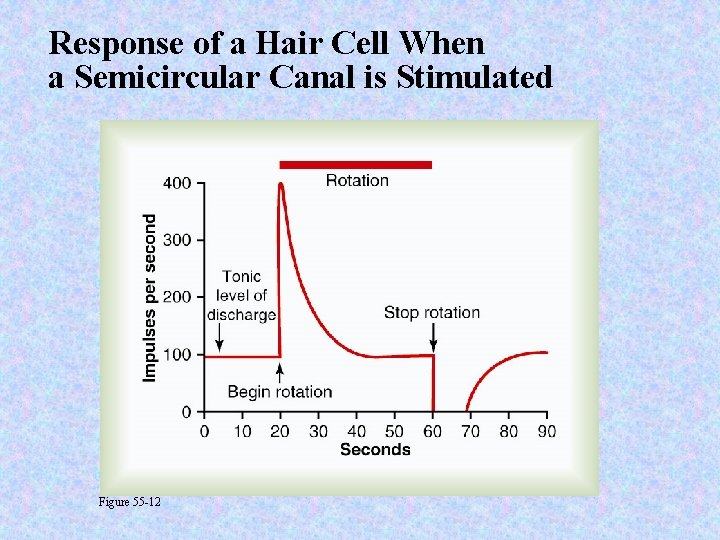
Response of a Hair Cell When a Semicircular Canal is Stimulated Figure 55 -12
Predictive Function of the Semicircular Ducts • Semicircular ducts predict situations in which equilibrium will be affected and this information is sent to the brain. • Corrective measures are initiated before the equilibrium is affected. • Neck proprioceptors and visual input also contribute to the maintenance of equilibrium.
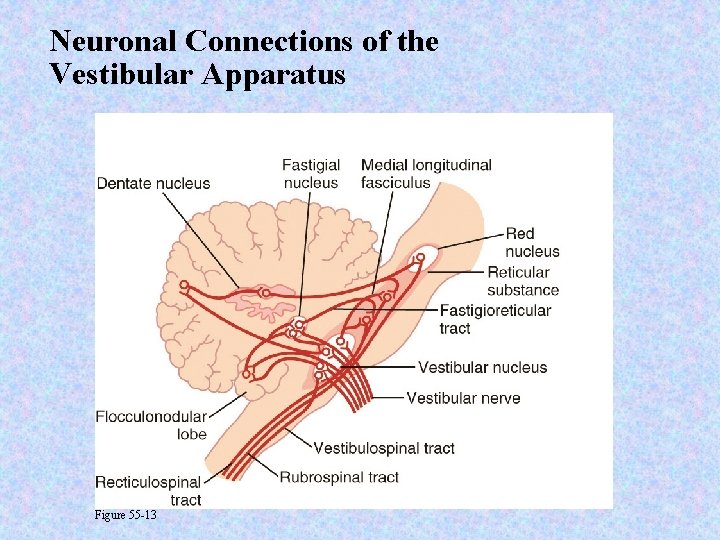
Neuronal Connections of the Vestibular Apparatus Figure 55 -13
- Slides: 33