
CHAPTER 54 NEWBORN CARE Part 2 Copyright 2005
CHAPTER 54 NEWBORN CARE Part 2 Copyright 2005 Thomson Delmar Learning. Thomson and Delmar Learning are trademarks used herein under license.
Learning Objectives – part 2 Determine the gestational age of a newborn. n Discuss the newborn’s nutritional needs and how they can be met by breastfeeding and bottle feeding. n Identify common problems the newborn may encounter and nursing interventions for each. n Plan the care and then care for a newborn. n Copyright 2005 Thomson Delmar Learning. Thomson and Delmar Learning are trademarks used herein under license.
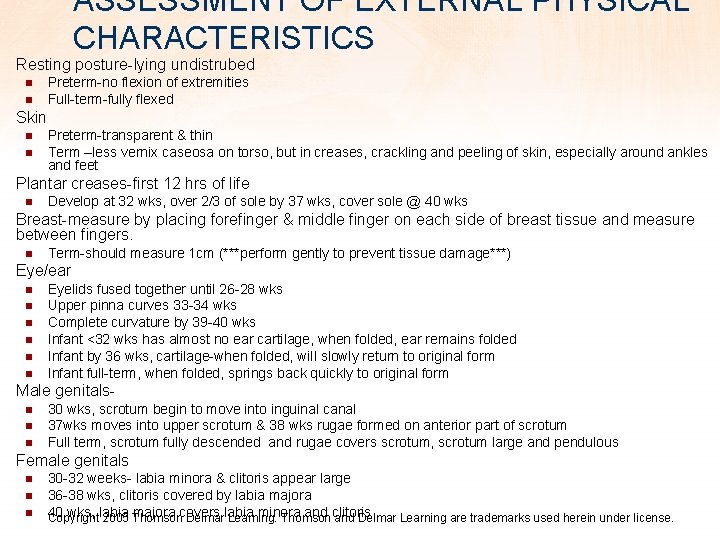
ASSESSMENT OF EXTERNAL PHYSICAL CHARACTERISTICS Resting posture-lying undistrubed n n Preterm-no flexion of extremities Full-term-fully flexed Skin n n Preterm-transparent & thin Term –less vernix caseosa on torso, but in creases, crackling and peeling of skin, especially around ankles and feet Plantar creases-first 12 hrs of life n Develop at 32 wks, over 2/3 of sole by 37 wks, cover sole @ 40 wks Breast-measure by placing forefinger & middle finger on each side of breast tissue and measure between fingers. n Term-should measure 1 cm (***perform gently to prevent tissue damage***) Eye/ear n n n Eyelids fused together until 26 -28 wks Upper pinna curves 33 -34 wks Complete curvature by 39 -40 wks Infant <32 wks has almost no ear cartilage, when folded, ear remains folded Infant by 36 wks, cartilage-when folded, will slowly return to original form Infant full-term, when folded, springs back quickly to original form Male genitalsn n n 30 wks, scrotum begin to move into inguinal canal 37 wks moves into upper scrotum & 38 wks rugae formed on anterior part of scrotum Full term, scrotum fully descended and rugae covers scrotum, scrotum large and pendulous Female genitals n n n 30 -32 weeks- labia minora & clitoris appear large 36 -38 wks, clitoris covered by labia majora 40 wks, labia majora covers minora and clitoris Copyright 2005 Thomson Delmarlabia Learning. Thomson and Delmar Learning are trademarks used herein under license.
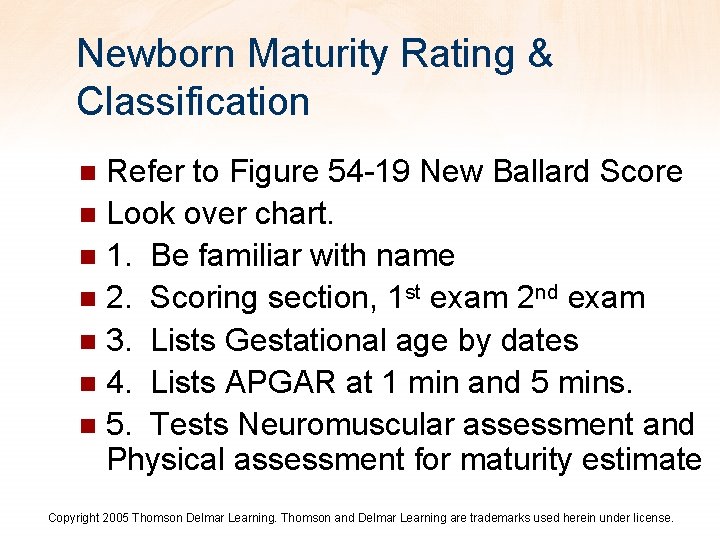
Newborn Maturity Rating & Classification Refer to Figure 54 -19 New Ballard Score n Look over chart. n 1. Be familiar with name n 2. Scoring section, 1 st exam 2 nd exam n 3. Lists Gestational age by dates n 4. Lists APGAR at 1 min and 5 mins. n 5. Tests Neuromuscular assessment and Physical assessment for maturity estimate n Copyright 2005 Thomson Delmar Learning. Thomson and Delmar Learning are trademarks used herein under license.

n n n NEUROMUSCULAR MATURITY Square window-bend wrist so palm is as flat against the arm as possible n n 90 degrees (32 wks or less) –score of 0 If angle greater than 90 degrees-score is 1 Arm recoil-arms held with elbows flexed then pulled straight down to sides and released. n n Rapid recoil-score of 4 Preterm 0 no recoil-score of 0 Popliteal angle-thigh flexed to abdomen, hips remain flat on table, lower leg is straightened until resistance met n n If can be fully extended-score is 1 If angle is less than 90 degrees (measured angle behind knee) score of 5 Scarf sign-arm drawn across body toward other shoulder until resistance is met (measurement of elbow placement to midline) n n If elbow did not reach midline-score of 4 If elbow goes past midline-score of -1 Heel to ear-hips on table, foot is moved toward the ear on same side until resistance met n n n Foot position relative to knee extension is noted Pre-term infant’s leg will remain straight & the foot will be near the ear Closer to term more resistance will be felt and more flexion will be noted Copyright 2005 Thomson Delmar Learning. Thomson and Delmar Learning are trademarks used herein under license.
GESTATIONAL AGE RELATIONSHIP TO INTRAUTERINE GROWTH Large for gestational age (LGA) –infant’s weight above 90 th percentile. n Appropriate for gestational age (AGA) – weight falls between 90 th and 10 th percentile. n Small for gestational age (SGA) –weight falls below 10 th percentile. n Copyright 2005 Thomson Delmar Learning. Thomson and Delmar Learning are trademarks used herein under license.
FIRST BATH AND CORD CARE n n n n The infant’s first bath, and type of bath the next 10 days to 2 weeks, is a sponge bath. Newborns are not generally given a tub bath until the cord has fallen off. Infant may remain under a radiant warmer during the bath to prevent heat loss. Nurses giving the first bath to newborns must wear floves to comply with Standard Precautions regarding contact with blood or body fluids. Wipe each eye with a separate cloth and wipe from inner to outer canthus. Check temperature in 30 minutes to 1 hour. Clean CORD STUMP daily with alcohol. Fold diaper under theandcord stump. Copyrightthe 2005 Thomson Delmar Learning are trademarks used herein under license.
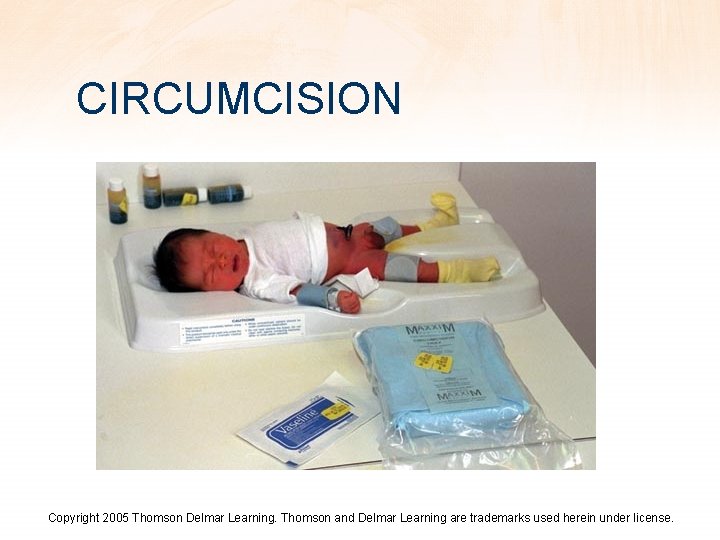
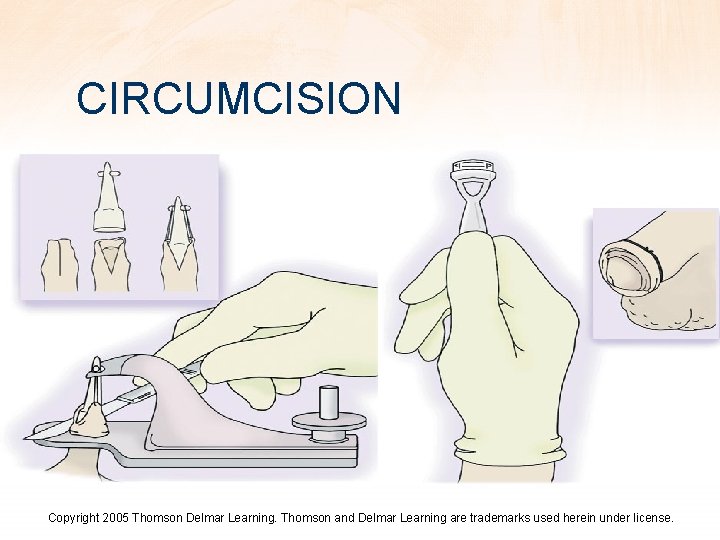
CIRCUMCISION n n n Surgical removal of the prepuce (foreskin) that covers the glans penis. Considered an elective procedure for which parents must give written consent. Only full-term, healthy newborns. Best pain relief is provided by a penile nerve root block. A pacifier with 20% sucrose provides comfort and has been shown to be analgesic. A&D Ointment or petroleum jelly is applied after procedure and with each diaper change for the next 24 -48 hrs. Check hourly for 12 hours for voiding, or bleeding. Copyright 2005 Thomson Delmar Learning. Thomson and Delmar Learning are trademarks used herein under license.
CIRCUMCISION Copyright 2005 Thomson Delmar Learning. Thomson and Delmar Learning are trademarks used herein under license.
CIRCUMCISION Copyright 2005 Thomson Delmar Learning. Thomson and Delmar Learning are trademarks used herein under license.
CIRCUMCISION Reasons for and against Circumcision n For n Religious rite n Prevent need for procedure later in life. n May reduce urinary tract infections, penile cancer, and sexually transmitted diseases. n n Against Procedure is painful n Possibility of hemorrhage, infection, or adhesions. n Copyright 2005 Thomson Delmar Learning. Thomson and Delmar Learning are trademarks used herein under license.
NUTRITION Newborn needs 110 -120 Kcal/kg/day. n Newborns need approximately 20 oz of breast milk or formula each day. n Newborns lose weight the first few days of life. n Infant regains birth weight by age 10 days. n Copyright 2005 Thomson Delmar Learning. Thomson and Delmar Learning are trademarks used herein under license.
BREASTFEEDING n n Breast milk is biologically designed to meet the needs of human infants. It’s composition changes to meet the nutritional needs and immunologic needs of the infant. Easily digested. Colostrum (first few days) is rich in immunoglobulins, helps establish normal intestinal flora, and has a laxative effect that assists in the passage of meconium. Breastfeeding mother must take in extra 500 calories a day of a well-balanced diet. Copyright 2005 Thomson Delmar Learning. Thomson and Delmar Learning are trademarks used herein under license.
FORMULA FEEDING Formula is fortified to be as much like breast milk as possible. n Special formulas are made to meet special needs of some infants. n Preterm infants need more calories. Formulas for preterms provide 24 kcal/oz. n Special formulas for infants with PKU. n Copyright 2005 Thomson Delmar Learning. Thomson and Delmar Learning are trademarks used herein under license.
Feedi ng Infant should be held, head should be slightly higher than the rest of the body. n Cradle head in bend of elbow and support the infant’s body. n Breastfeeding positions cradling, football hold, lying down, across lap. n Copyright 2005 Thomson Delmar Learning. Thomson and Delmar Learning are trademarks used herein under license.
Feeding n n n Breast feeding should be long enough to remove all foremilk, the watery first milk from the breast which quenches the baby’s thirst. This allows the infant to receive the hindmilk, which is higher in fat content and is more satisfying. With bottle feeding, most newborns begin drinking 7. 5 ml to 15 ml (1/4 to ½ oz) at a feeding and gradually increase to 90 -120 ml (3 to 4 oz) by 2 weeks. Infant’s appetite will increase during growth spurts at 2 weeks, 6 to 9 weeks, 3 months and 9 months. Copyright 2005 Thomson Delmar Learning. Thomson and Delmar Learning are trademarks used herein under license.
BURPING n n n All infants require burping to expel air swallowed when sucking. Burping should be done about halfway through the bottle if bottle feeding. Burping should be done when changing breasts if breastfeeding. Hold in upright on the feeder’s shoulder, sitting position on the feeder’s lap with head and neck supported, on in prone position across the feeder’s lap. Gently pat or rub the infant’s back Copyright 2005 Thomson Delmar Learning. Thomson and Delmar Learning are trademarks used herein under license.

Copyright 2005 Thomson Delmar Learning. Thomson and Delmar Learning are trademarks used herein under license.
- Slides: 18