
Chapter 50 Fixed Prosthodontics Copyright 2003 Elsevier Science



- Slides: 19
Chapter 50 Fixed Prosthodontics Copyright 2003, Elsevier Science (USA). All rights reserved. No part of this product may be reproduced or transmitted in any form or by any means, electronic or mechanical, including input into or storage in any information system, without permission in writing from the publisher. Power. Point® presentation slides may be displayed and may be reproduced in print form for instructional purposes only, provided a proper copyright notice appears on the last page of each print-out. Produced in the United States of America ISBN 0 -7216 -9770 -4 Copyright 2003, Elsevier Science (USA). All rights reserved.
Introduction Fixed prosthodontics is the specialized area of dentistry involved in the replacement of missing teeth with a cast prosthesis permanently cemented in place. Copyright 2003, Elsevier Science (USA). All rights reserved.
Indications for Fixed Prosthodontics § One or two adjacent teeth are missing in the § § same arch. The supportive tissues are healthy. Suitable abutment teeth are present. The patient is in good health and wants to have the prosthesis placed. The patient has the skills and motivation to maintain good oral hygiene. Copyright 2003, Elsevier Science (USA). All rights reserved.
Contraindications for Fixed Prosthodontics § Necessary supportive tissues are diseased or § § § missing. Suitable abutment teeth are not present. The patient is in poor health. The patient is not motivated to have the prosthesis placed. The patient has poor oral hygiene habits. The patient cannot afford the treatment. Copyright 2003, Elsevier Science (USA). All rights reserved.
Types of Cast Restorations § Inlay • Covers a portion of the occlusal and proximal surface. § Onlay • Covers the proximal surfaces and most or all of the occlusal surface. § Porcelain Veneers • Thin shell-like covering placed to improve the appearance of anterior teeth. Copyright 2003, Elsevier Science (USA). All rights reserved.
Types of Cast Restorations- cont’d § Full crown • Completely covers the anatomic crown of an individual tooth. § Three‑quarter crown • Covers the anatomic crown of a tooth except for the facial portion. § Porcelain‑fused‑to‑metal crown (PFM) • Full metal crown with outer surfaces covered with a veneer of porcelain. Copyright 2003, Elsevier Science (USA). All rights reserved.
Types of Cast Restorations- cont’d § Porcelain jacket crowns • Constructed as a thin metal shell covered by layers of porcelain. § Fixed bridge • A prosthesis for or more missing teeth within the same arch. § Resin‑bonded bridge • Also known as a Maryland bridge, with winglike extensions coming from the proximal sides. Copyright 2003, Elsevier Science (USA). All rights reserved.
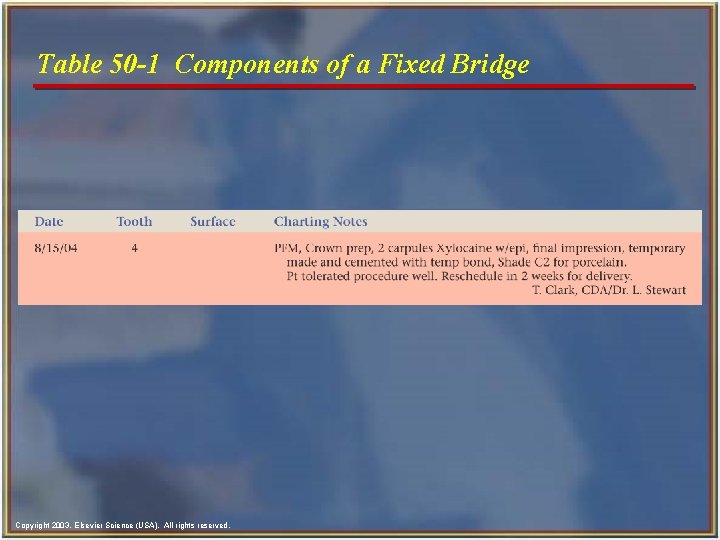
Table 50 -1 Components of a Fixed Bridge Copyright 2003, Elsevier Science (USA). All rights reserved.
Overview of a Fixed Prosthodontic Procedure § Shade selection § A shade guide contains samples of all available shades and is used to match the natural tooth color. • Moisture helps achieve a more accurate match. • Use natural sunlight. • Record the shade on the patient's chart and on the laboratory prescription. Copyright 2003, Elsevier Science (USA). All rights reserved.
Tooth Preparation § The tooth is prepared so the cast restoration can slide into place and be able to withstand the forces of occlusion. • Rotary instruments are used to reduce the height and contour of the tooth. • Hand cutting and rotary instruments prepare the gingival margins. Copyright 2003, Elsevier Science (USA). All rights reserved.
Retention Aids § It may be necessary to provide additional support for the crown if the tooth is extensively decayed, fractured, or has been endodontically treated. • Core buildup • Pin retention • Post and core Copyright 2003, Elsevier Science (USA). All rights reserved.
Gingival Retraction and Tissue Management § Cord temporarily displaces the gingival tissue and widens the gingival sulcus so impression material can flow around all parts of the preparation. • Nonimpregnated • Impregnated Copyright 2003, Elsevier Science (USA). All rights reserved.
Final Impression § Elastomeric impression materials are used to create these extremely accurate impressions. • Mixing and application of light-bodied material around the prepared tooth. • Mixing and loading of tray with heavybodied material to be seated onto the quadrant or arch. Copyright 2003, Elsevier Science (USA). All rights reserved.
Bite Registration § Provides the laboratory technician with a reproduction of a patient’s bite and opposing arch registration for designing the anatomic structures of the fixed prosthetic. • Open bite • Closed bite Copyright 2003, Elsevier Science (USA). All rights reserved.
Provisional Coverage § Used to keep the patient comfortable during the period from tooth preparation to final cementation of the fixed prosthetic. • Reduces sensitivity and discomfort. • Maintains the function and esthetics. • Protects the margins. • Prevents shifting. Copyright 2003, Elsevier Science (USA). All rights reserved.
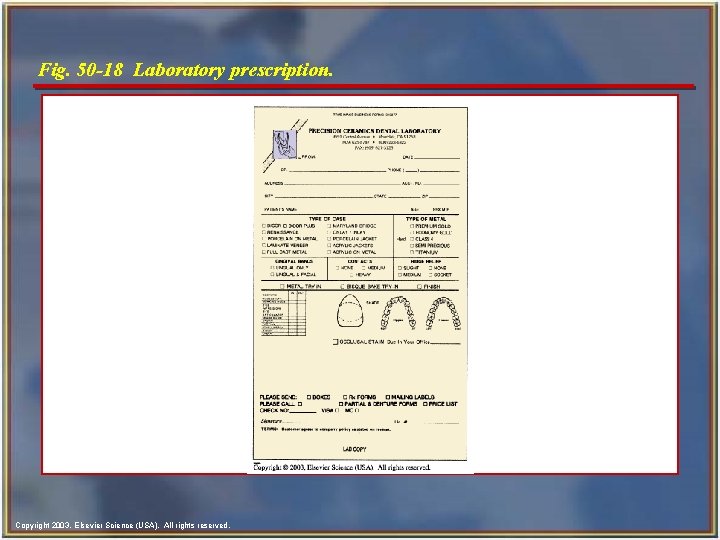
Laboratory Prescription § A detailed and precise written order from the dentist to the laboratory technician with the description of the restoration to be fabricated. Copyright 2003, Elsevier Science (USA). All rights reserved.
Fig. 50 -18 Laboratory prescription. Copyright 2003, Elsevier Science (USA). All rights reserved.
Delivery § When the casting has been fitted and is acceptable, the dentist cements it to the tooth. • Permanent cementation • Temporary cementation Copyright 2003, Elsevier Science (USA). All rights reserved.
Home Care Instructions for the Patient with a Fixed Prosthesis § Good home care is essential to the maintenance § § of a fixed prosthesis. A fixed prosthesis and its supporting tissues must be brushed carefully daily. A bridge threader is used to thread dental floss under the pontic and down into the sulcus at both abutments of a bridge. Copyright 2003, Elsevier Science (USA). All rights reserved.