
Chapter 5 Work and Energy Question A crate
- Slides: 45
Chapter 5 Work and Energy
Question • A crate of mass 10 kg is on a ramp that is inclined at an angle of 30⁰ from the horizontal. A force with a magnitude of 135 N directed parallel to the ramp is used to pull the crate with a constant speed up the ramp a distance of 6 m. What is the work done on the crate by the normal force?
Answer • O J (recall that the normal force is perpendicular to the surface of the ramp)
Question • A crate of mass 10 kg is on a ramp that is inclined at an angle of 30⁰ from the horizontal. A force with a magnitude of 135 N directed parallel to the ramp is used to pull the crate with a constant speed up the ramp a distance of 6 m. What is the work done on the crate by the normal force?
Answer • W = -516 J – It is negative because friction acts in the exact opposite direction as the displacement – Figure out the parallel component of the weight – Use the net force (set equal to zero) in the parallel direction to find the frictional force – Use W=Fd where F is the frictional force to find out the work done by friction
Question • An empty coffee mug with a mass of 0. 40 kg gets knocked off a tabletop 0. 75 m above the floor onto the seat of a chair 0. 45 m above the floor. Assume that the gravitational potential energy is measured using the floor as the zero reference level. What is the change in gravitational potential energy for the mug?
Answer • ∆GPE = -0. 1575 J – Answer is negative because final gravitational potential energy is less than initial
Question • For each of the following situations, determine if work is being done and whether it is positive or negative. – A chicken scratching the ground – A person reading a sign – A crane lifting a bucket of concrete – A waitress walking carrying a tray
Answer • Yes; positive • No • Yes; positive work done by crane, negative work done by gravity • No
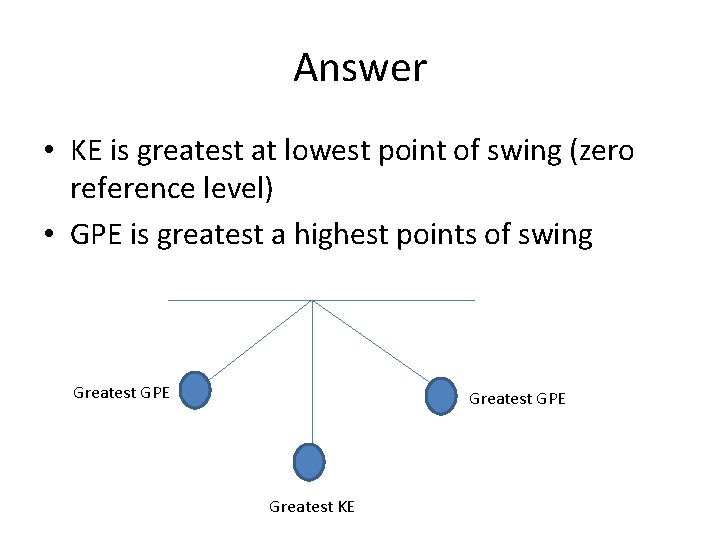
Question • A pendulum swings back and forth. If you take its lowest point as your zero reference level, where would its kinetic energy be greatest? Where would its GPE be greatest?
Answer • KE is greatest at lowest point of swing (zero reference level) • GPE is greatest a highest points of swing Greatest GPE Greatest KE
Question • A satellite is in a circular orbit above Earth’s surface. There is no work done on the satellite because the force of gravity is always perpendicular to the satellite’s motion. Based on this, what does the work-kinetic energy theorem predict about it’s speed?
Answer • The speed is constant
Question • Advertisements for a toy ball once stated that it would rebound to a height greater than the height from which it was dropped. Is this possible?
Answer • No, because energy would not be conserved
Question • A student walks up a staircase on their way to class and then runs down it on their way to lunch. In which situation do they exert more power?
Answer • Running down it – The same amount of work is done going up and down the staircase; however, running decreases the amount of time it takes to do that work therefore increasing the power exerted
Question • If the speed of a car is doubled and the mass is tripled, by what factor does the kinetic energy of the car increase?
Answer • 12 – KE = 1/2 mv 2 changes to KE = ½(3 m)(2 v)2 = ½(3 m)(4 v 2) and 4 x 3 = 12
Question • A 70 kg base runner moving at a speed of 4. 0 m/s begins to slide into second base. The coefficient of friction between his clothes and Earth is 0. 70. His slide lowers his speed to zero just as he reaches the base. How far does the runner slide?
Answer • 1. 2 m – Use the work kinetic energy theorem; the force doing the work is friction
Question • A spring scale has a spring with a force constant of 250 N/m and a weighing pas with a mass of 0. 075 kg. During one weighing, the spring is stretched a distance of 12 cm from equilibrium. During a second weighing, the spring is stretched a distance of 18 cm. How much greater is the elastic potential energy of the stretched spring during the second weighing than during the first weighing?
Answer • 2. 25 times greater – Don’t forget to convert cm to m – Remember “x” is the difference between the relaxed length and the stretched length
Question • A student with a mass of 66 kg climbs a staircase in 44 s. If the distance between the base and the top of the staircase is 14. 0 m, how much power will the student deliver by climbing the stairs?
Answer • 206 W – The force that the student exerts in climbing the stairs that does work is exactly equal and opposite to the student’s weight
Question • A 75 kg man jumps from a window that is 1 m high. Calculate the man’s speed when he strikes the ground.
Answer • 4. 4 m/s – Use conservation of energy equation to solve
Question • A sled is pulled along a flat surface with a force of 17 N directed at an angle of 25⁰ above the horizontal. If the sled is pulled force a distance of 3 m, how much work is being done?
Answer • 45. 2 J
Question • There are 2 situations that others, not as enlightened as you, may be inclined to say that “no work is being done”. Name them.
Answer • When a force is applied but there is not resulting displacement (ex: you push on a car but it doesn’t move) • When the force is applied perpendicular to the displacement (ex: a waitress carrying a tray)
Question • If I am looking to find the net work done on an object (as required when using the workkinetic energy theorem), what force must be used in the equation W = Fd?
Answer • The net force
Question • An object slides down an incline and it is stated that mechanical energy is conserved in this situation. What is being ignored in that statement?
Answer • Friction – When friction is present, mechanical energy is NOT conserved
Question • What form of the conservation of energy equation would you use to solve a problem involving a roller coaster climbing a hill?
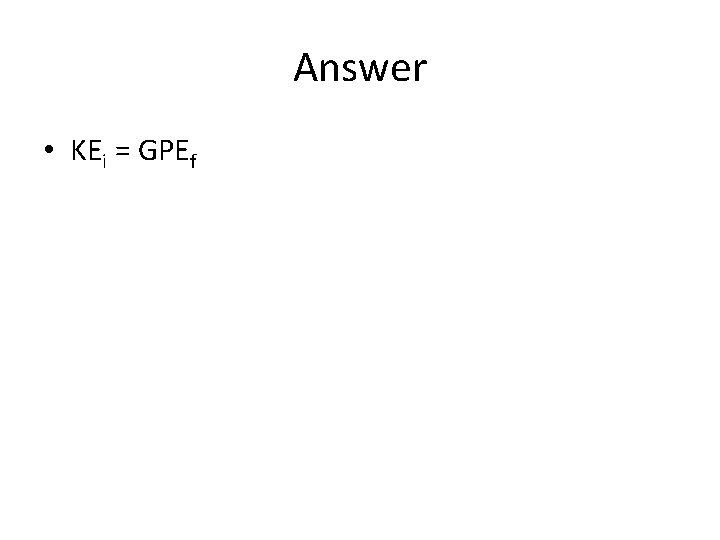
Answer • KEi = GPEf
Question • Are work and energy scalar or vector quantities?
Answer • Both are scalar
Question • For conservation of energy, what type of energy is ALWAYS conserved?
Answer • Total – The answer is NOT mechanical because in the presence of friction, mechanical energy is NOT conserved
Question • How is an object’s kinetic energy affected by friction?
Answer • Decreased – Friction slows things down; KE is based upon speed
Question • There are 2 springs. A 1 kg mass is hung from each spring. As a result, spring 1 stretches 7 cm and spring 2 stretches 2 cm. Which spring has a greater spring constant, k?
Answer • Spring 1 – Stiffer springs have larger k and therefore will stretch/compress less when subjected to a force