
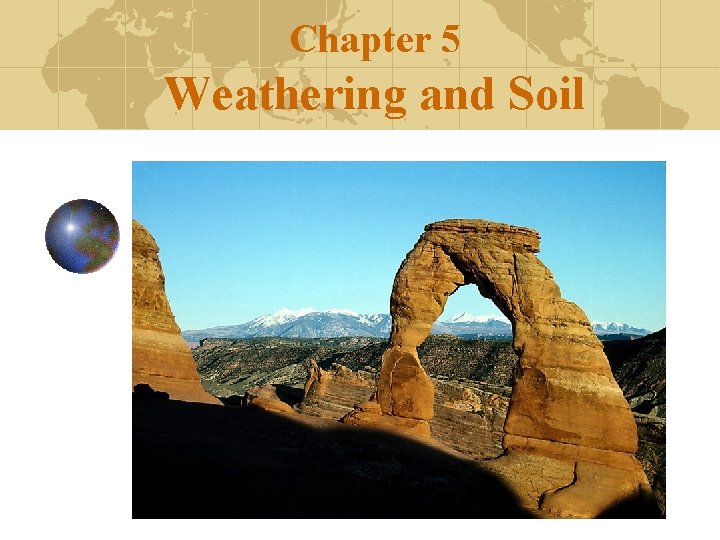
Chapter 5 Weathering and Soil Earths external processes

- Slides: 31
Chapter 5 Weathering and Soil
Earth’s external processes Weathering – the physical breakdown (disintegration) and chemical alteration (decomposition) or rock at or near Earth’s surface Mass wasting – the transfer of rock and soil downslope under the influence of gravity Erosion – the physical removal of material by mobile agents such as water, wind, ice, or gravity
Weathering Two types of weathering • Mechanical weathering – breaking of rocks into smaller pieces • Chemical Weathering - breaking down rock components and internal structures of minerals through chemical processes – Most important agent involved in chemical weathering is water (responsible for transport of ions and molecules involved in chemical processes)
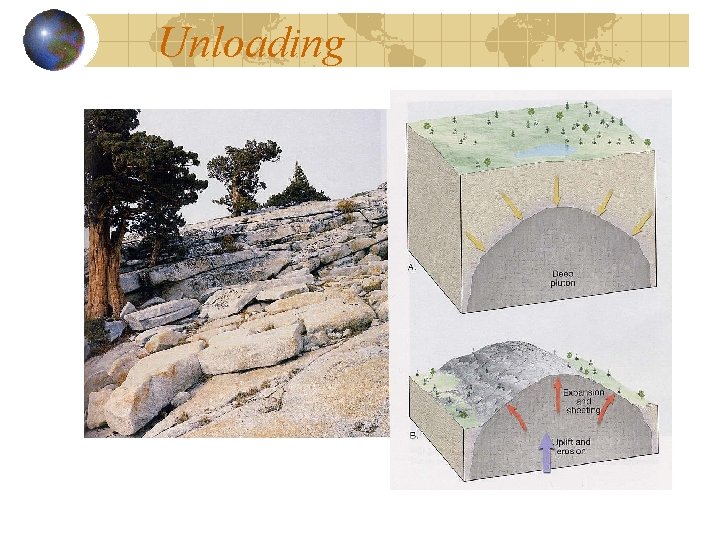
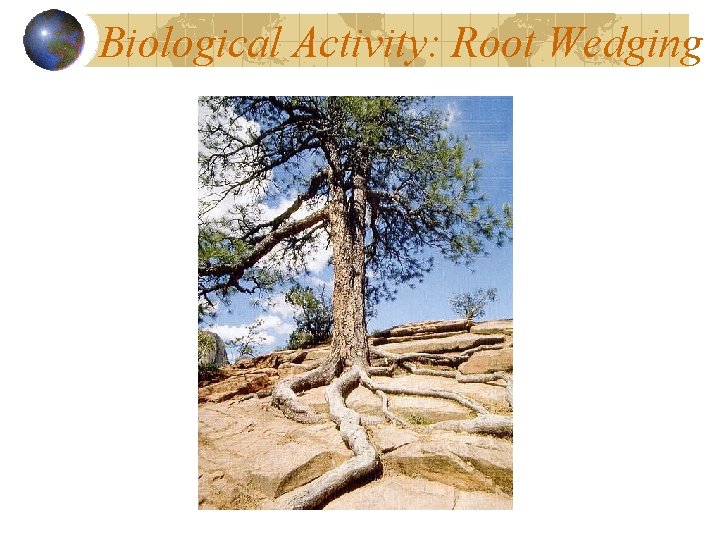
Weathering • Four types of mechanical weathering – Frost wedging – alternate freezing and thawing of water in fractures and cracks promotes the disintegration of rocks – Unloading – exfoliation of igneous and metamorphic rocks at the Earth’s surface due to a reduction in confining pressure – Thermal expansion – alternate expansion and contraction due to heating and cooling – Biological activity – disintegration resulting from plants and animals
Unloading
Biological Activity: Root Wedging
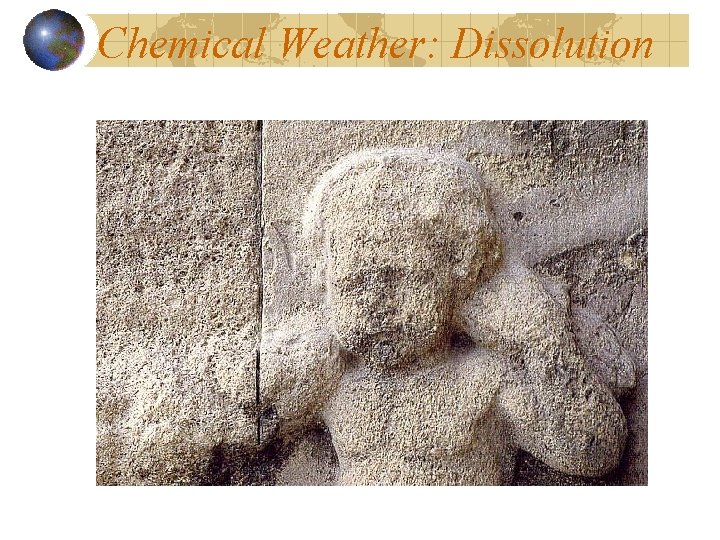
Weathering Three processes of chemical weathering • Dissolution – Aided by small amounts of acid in the water – Soluble ions are retained in the underground water supply • Oxidation – Any chemical reaction in which a compound or radical loses electrons – Important in decomposing ferromagnesian minerals • Hydrolysis – The reaction of any substance with water – Hydrogen ion attacks and replaces other positive ions
Chemical Weather: Dissolution
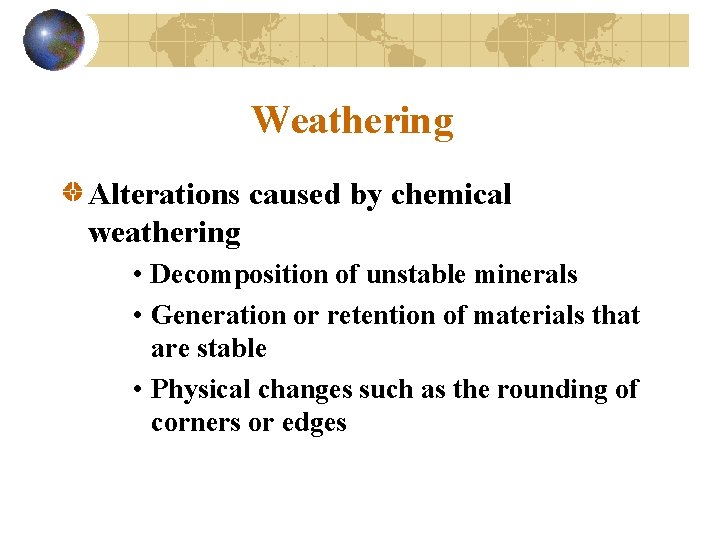
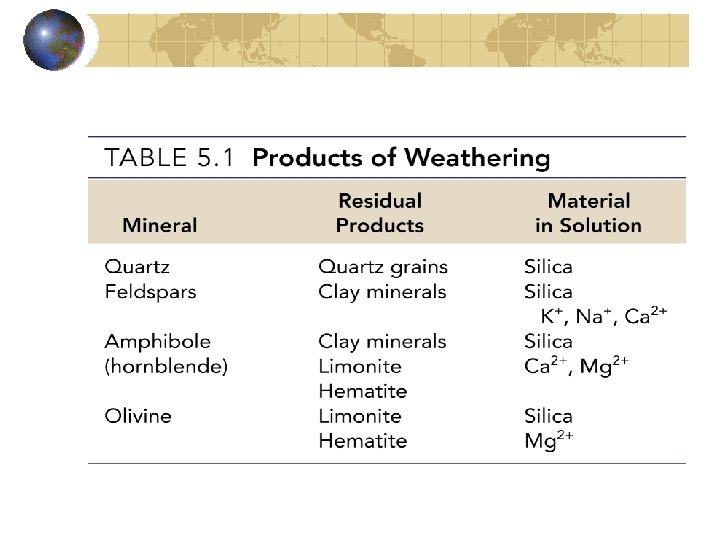
Weathering Alterations caused by chemical weathering • Decomposition of unstable minerals • Generation or retention of materials that are stable • Physical changes such as the rounding of corners or edges
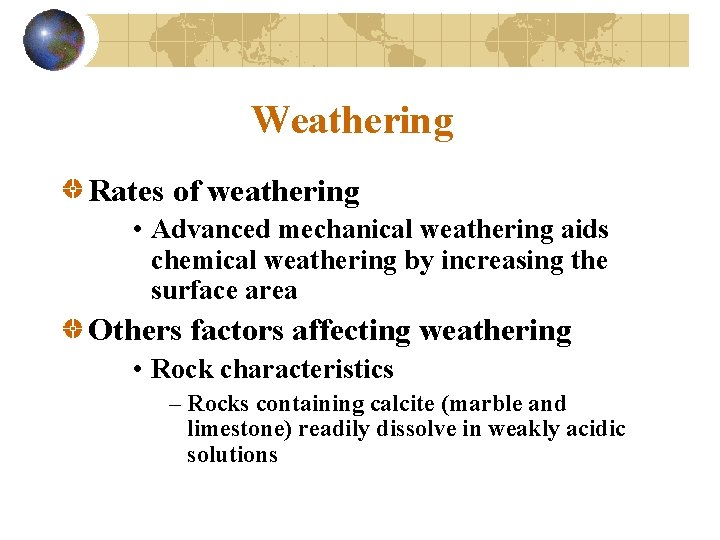
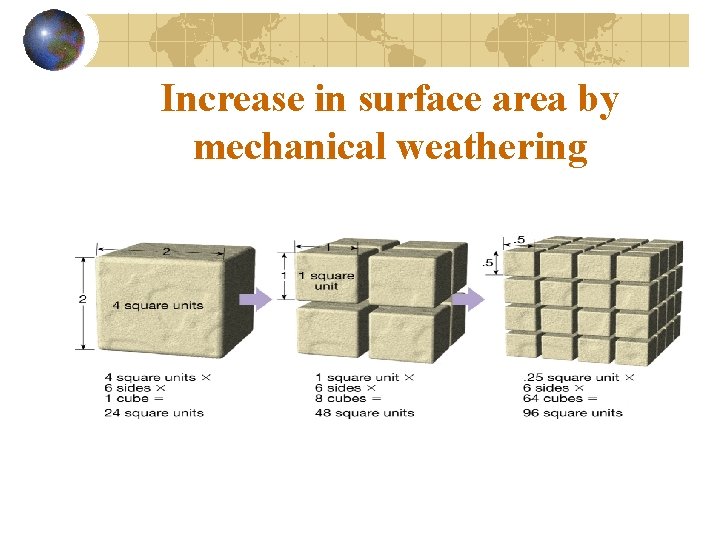
Weathering Rates of weathering • Advanced mechanical weathering aids chemical weathering by increasing the surface area Others factors affecting weathering • Rock characteristics – Rocks containing calcite (marble and limestone) readily dissolve in weakly acidic solutions
Increase in surface area by mechanical weathering
Weathering Others factors affecting weathering • Rock characteristics continued – Silicate minerals weather in the same order as their order of crystallization • Climate – Temperature and moisture are the most crucial factors – Chemical weathering is most effective in areas of warm, moist climates
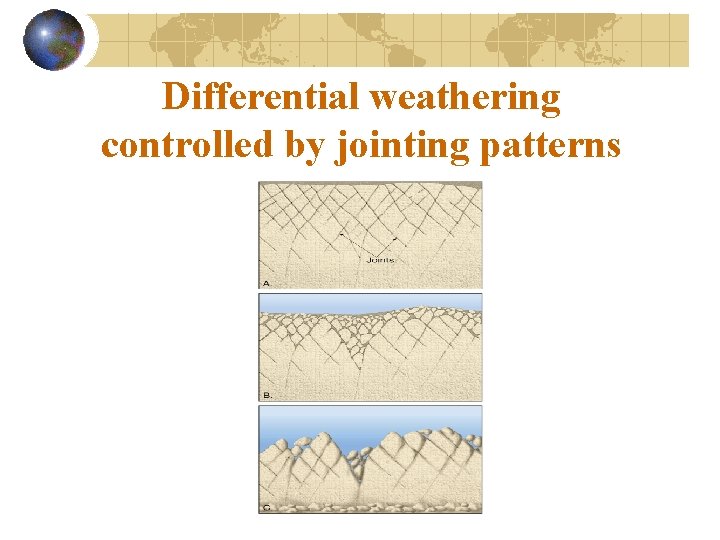
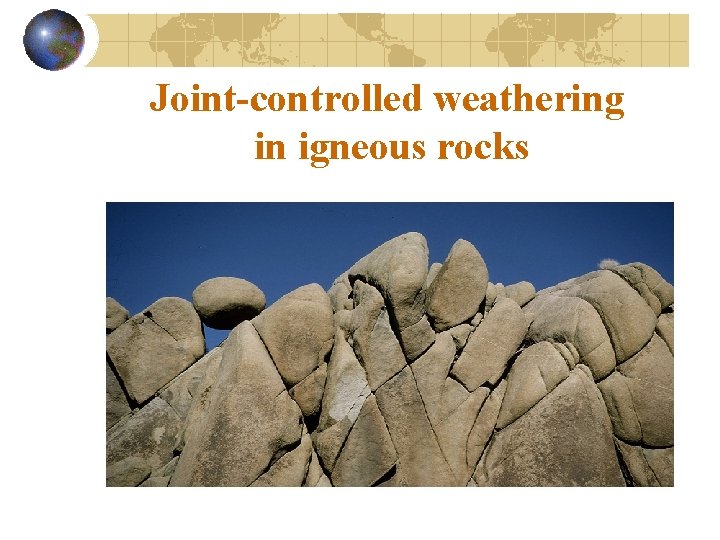
Weathering Differential weathering • Masses of rock do not weather uniformly due to regional and local factors • Results in many unusual and spectacular rock formations and landforms
Differential weathering controlled by jointing patterns
Joint-controlled weathering in igneous rocks
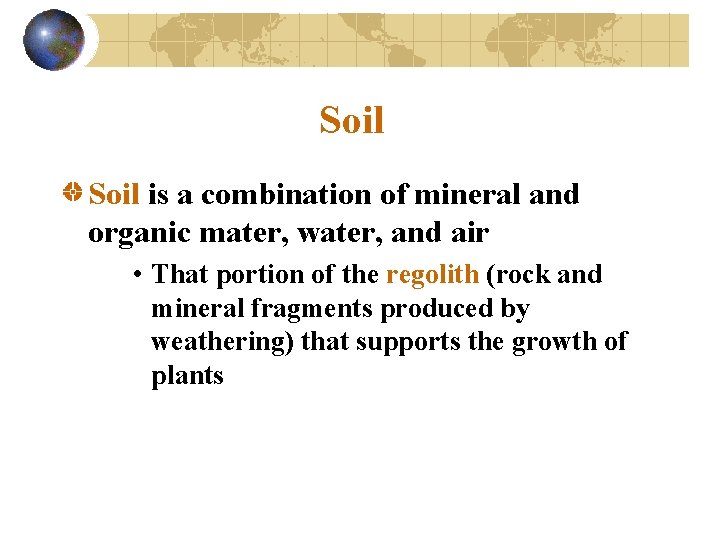
Soil is a combination of mineral and organic mater, water, and air • That portion of the regolith (rock and mineral fragments produced by weathering) that supports the growth of plants
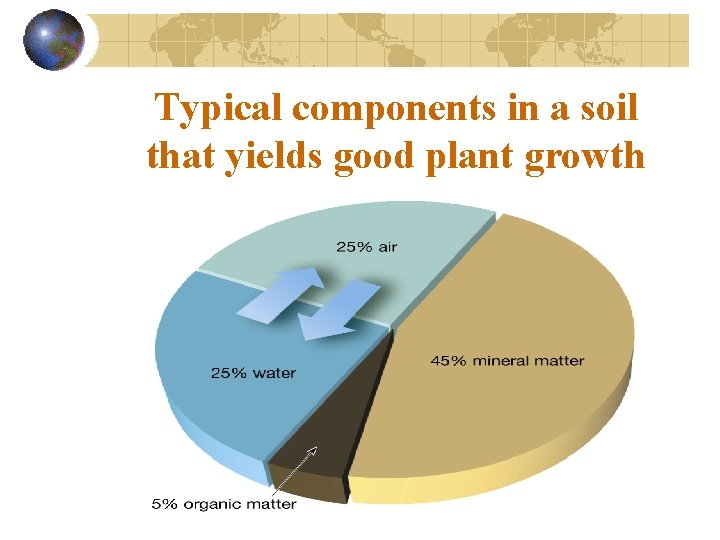
Typical components in a soil that yields good plant growth
Soil Factors controlling soil formation • Parent material – Residual soil – parent material is the underlying bedrock – Transported soil – forms in place on parent material that has been carried from elsewhere and deposited
Soil Factors controlling soil formation • Time – Important in all geologic processes – Amount of time for soil formation varies for different soils depending on geologic and climatic conditions • Climate – Most influential control of soil formation – Key factors are temperature and precipitation
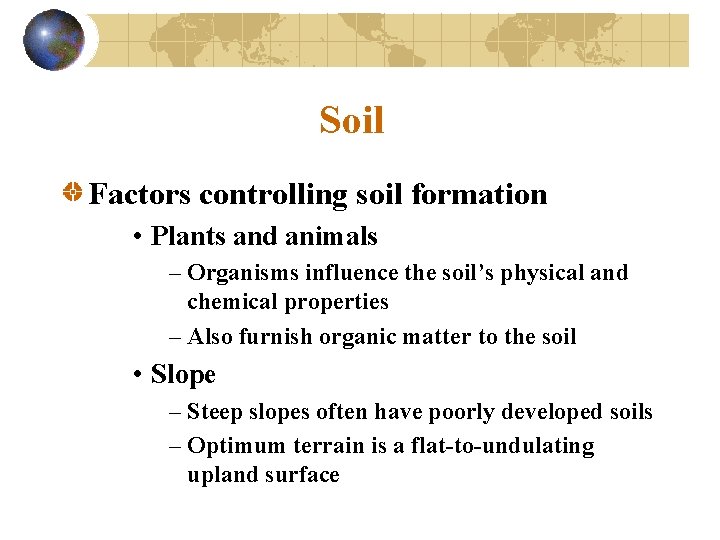
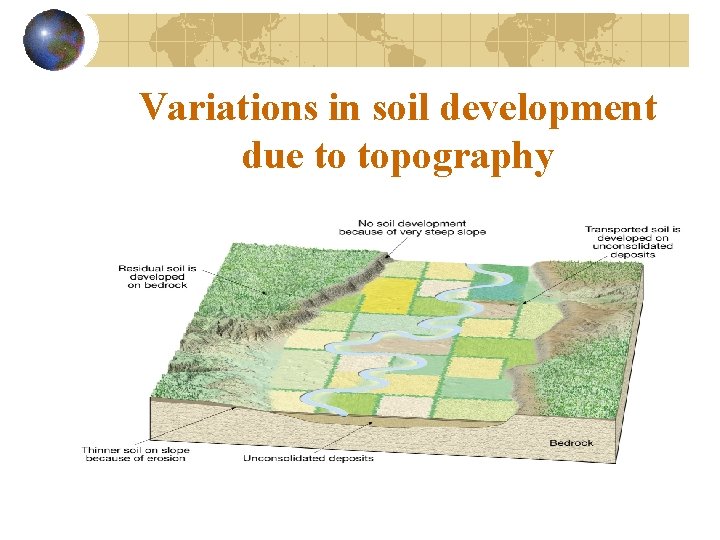
Soil Factors controlling soil formation • Plants and animals – Organisms influence the soil’s physical and chemical properties – Also furnish organic matter to the soil • Slope – Steep slopes often have poorly developed soils – Optimum terrain is a flat-to-undulating upland surface
Variations in soil development due to topography
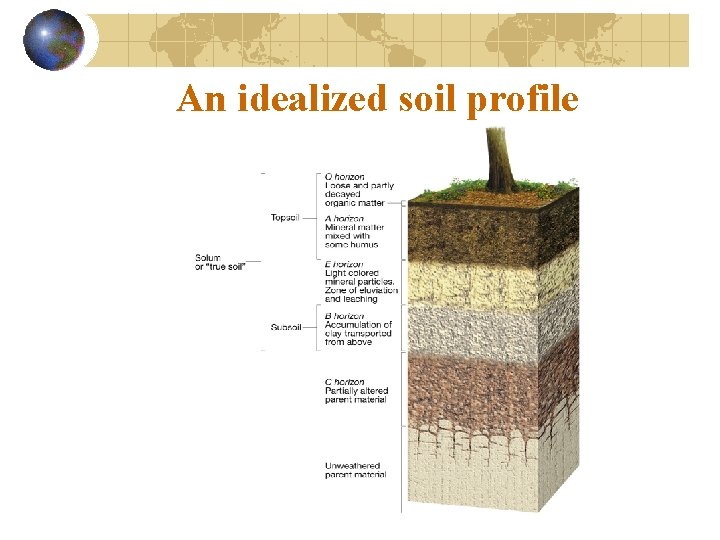
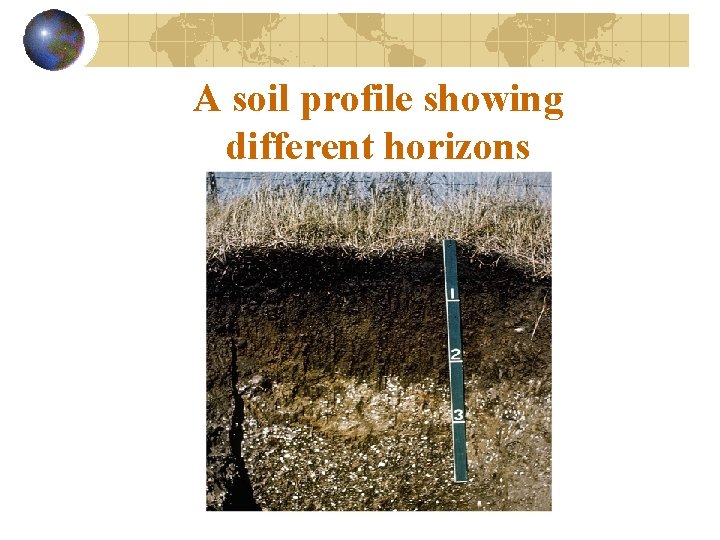
Soil The soil profile • Soil forming processes operate from the surface downward • Vertical differences are called horizons – zones or layers of soil
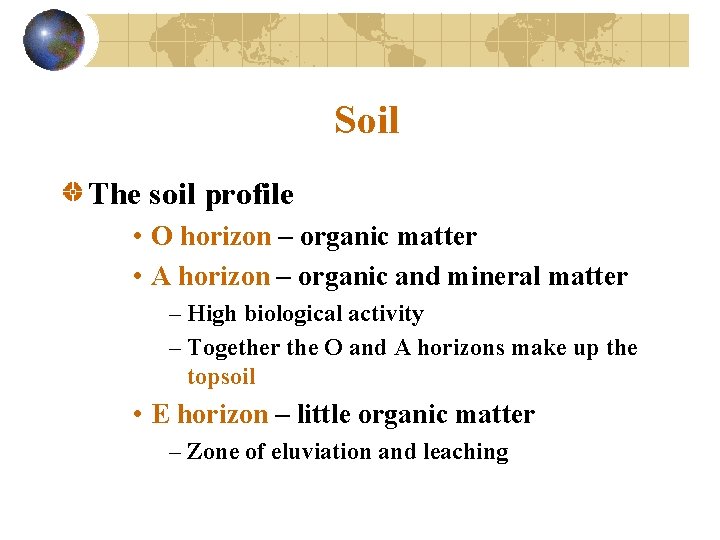
Soil The soil profile • O horizon – organic matter • A horizon – organic and mineral matter – High biological activity – Together the O and A horizons make up the topsoil • E horizon – little organic matter – Zone of eluviation and leaching
Soil The soil profile • B horizon – zone of accumulation • C horizon – partially altered parent material The O, A, E, and B horizons together are called the solum, or “true soil”
An idealized soil profile
A soil profile showing different horizons
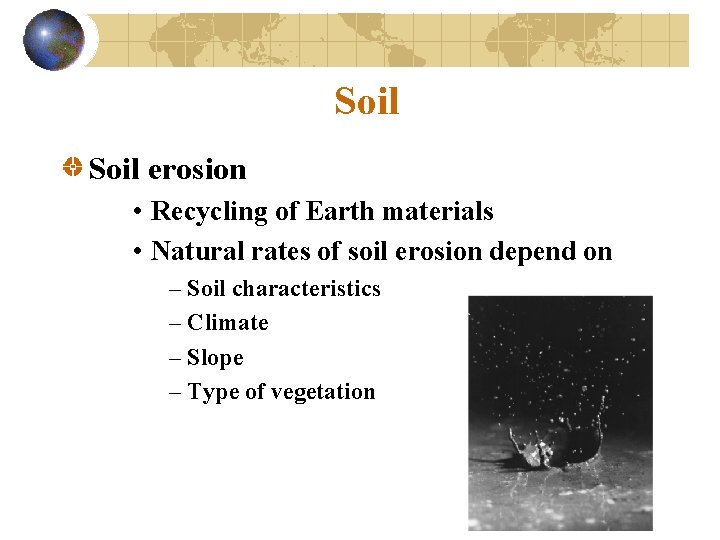
Soil erosion • Recycling of Earth materials • Natural rates of soil erosion depend on – Soil characteristics – Climate – Slope – Type of vegetation
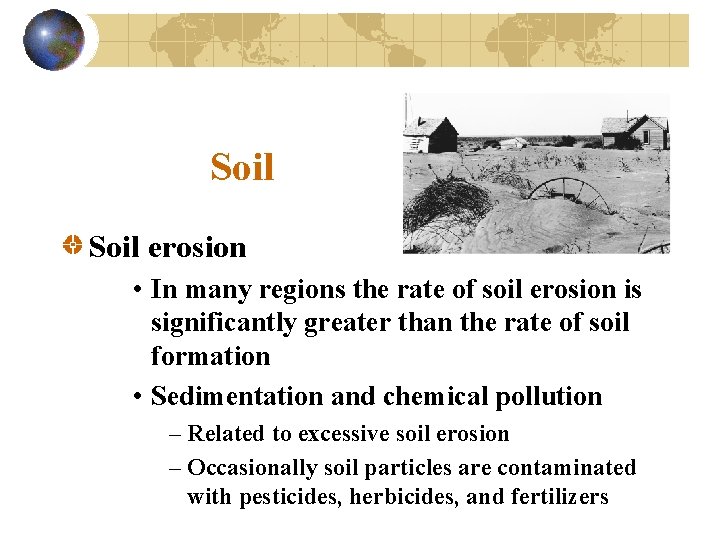
Soil erosion • In many regions the rate of soil erosion is significantly greater than the rate of soil formation • Sedimentation and chemical pollution – Related to excessive soil erosion – Occasionally soil particles are contaminated with pesticides, herbicides, and fertilizers