
Chapter 5 WeatherClimate Blowing in the Wind Benefits

Chapter 5 Weather/Climate

Blowing in the Wind • Benefits of wind • Hazards of wind • “Red tides” • Volcanoes and climate • Everything is connected Fig. 5 -1, p. 78

Blowing in the Wind Fig. 5 -1, p. 78
Weather and Climate • Differences between weather and climate • Major factors determining climate – Uneven heating of Earth’s surface – Earth’s rotation – Properties of air, water, and land
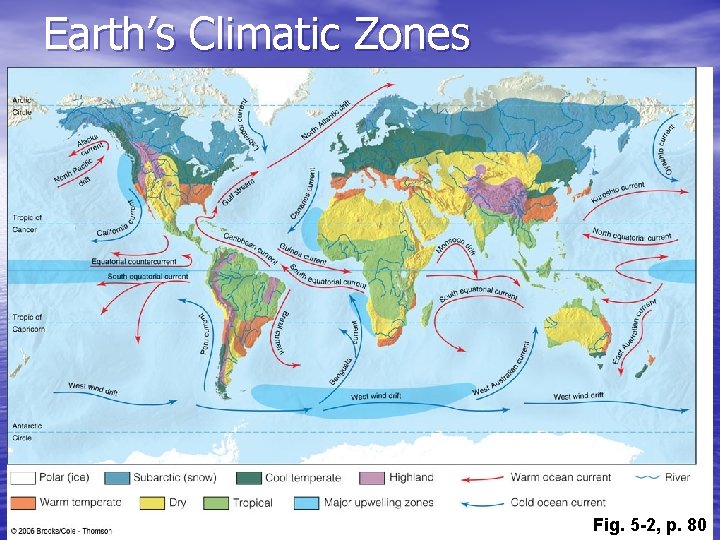
Earth’s Climatic Zones Fig. 5 -2, p. 80
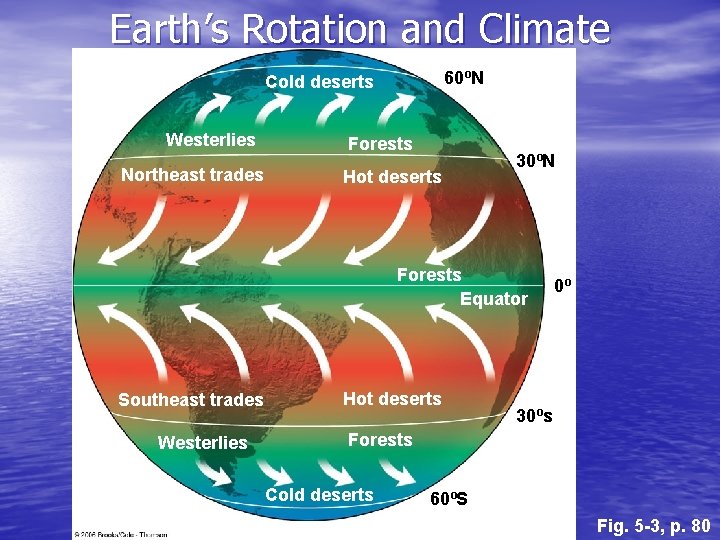
Earth’s Rotation and Climate 60ºN Cold deserts Westerlies Northeast trades Forests Hot deserts 30ºN Forests Equator Southeast trades Westerlies Hot deserts 0º 30ºs Forests Cold deserts 60ºS Fig. 5 -3, p. 80
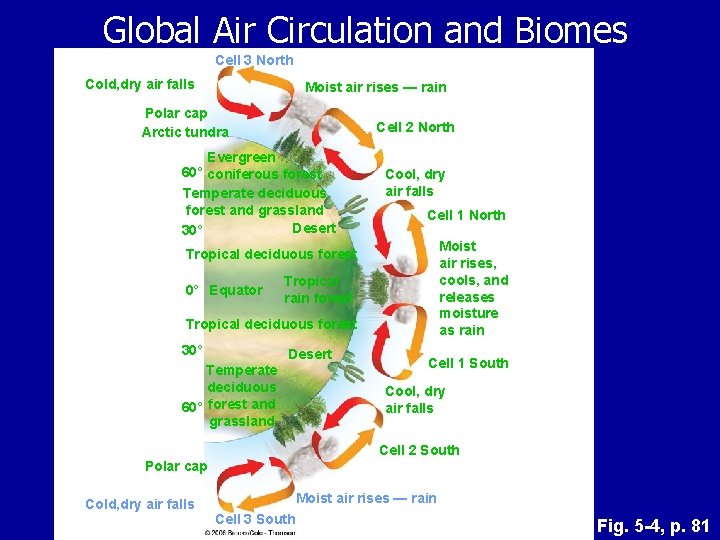
Global Air Circulation and Biomes Cell 3 North Cold, dry air falls Moist air rises — rain Polar cap Arctic tundra Cell 2 North Evergreen 60° coniferous forest Temperate deciduous forest and grassland Desert 30° Cool, dry air falls Cell 1 North Moist air rises, cools, and releases moisture as rain Tropical deciduous forest 0° Equator Tropical rain forest Tropical deciduous forest 30° Desert Temperate deciduous 60° forest and grassland Cell 1 South Cool, dry air falls Cell 2 South Polar cap Cold, dry air falls Moist air rises — rain Cell 3 South Fig. 5 -4, p. 81
Effects of Water, Wind, and Land on Climate • Ocean currents and wind • Gases in the atmosphere – Greenhouse gases and the Greenhouse Effect • Topography and local climate • Microclimates in urban areas
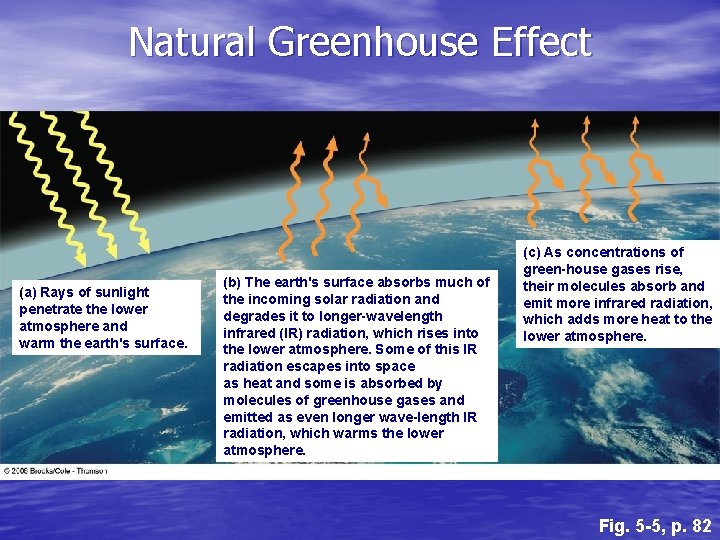
Natural Greenhouse Effect (a) Rays of sunlight penetrate the lower atmosphere and warm the earth's surface. (b) The earth's surface absorbs much of the incoming solar radiation and degrades it to longer-wavelength infrared (IR) radiation, which rises into the lower atmosphere. Some of this IR radiation escapes into space as heat and some is absorbed by molecules of greenhouse gases and emitted as even longer wave-length IR radiation, which warms the lower atmosphere. (c) As concentrations of green-house gases rise, their molecules absorb and emit more infrared radiation, which adds more heat to the lower atmosphere. Fig. 5 -5, p. 82
- Slides: 9