
Chapter 5 Value Chain Analysis and ActivityBased Management
Chapter 5 Value Chain Analysis and Activity-Based Management Prepared by Douglas Cloud Pepperdine University
2 Objectives 1. Describe strategic cost management. After studying thisvalue chain 2. Discuss the importance of the you shouldalternatives. approach tochapter, analyzing decision be able to: 3. Analyze an organization’s internal value chain, dividing it into process and activities. 4. Explain how process management can help improve organizational performance. 5. Determine the costs of individual activities and the activity costs associated with various cost objectives.
3 Strategic Cost Management Strategic cost management is defined as making decisions concerning specific cost drivers within the context of an organization’s business strategy, its internal value chain, and its place in a larger value chain stretching from the development and use of resources to the final consumers.

4 Elements of a Value-Chain for a Beverage-Packaging Plant First level: Business entities Timber Farm Pulp Mill Final Customer Paperboard Manufacturer Grocery Store to second level Paperboard Converter Beverage Company
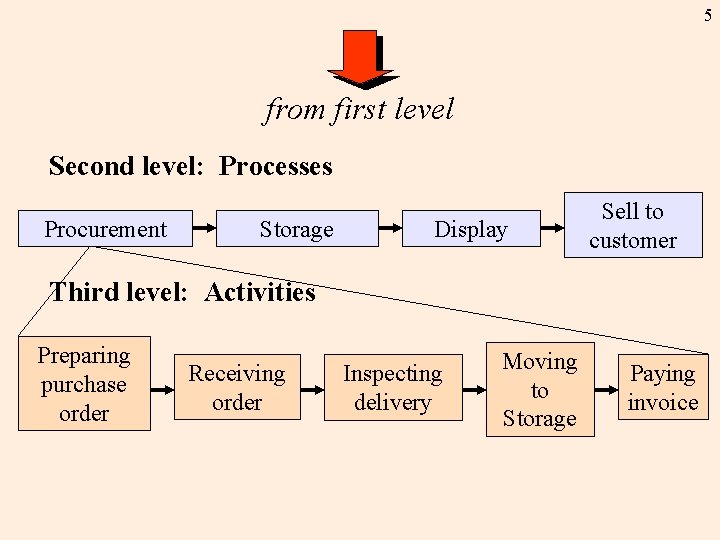
5 from first level Second level: Processes Procurement Storage Display Sell to customer Third level: Activities Preparing purchase order Receiving order Inspecting delivery Moving to Storage Paying invoice

6 Usefulness of the Value Chain Perspective The goal of maximizing final customer value while minimizing final customer cost leads organizations to examine internal and external links in the value chain.

The Value Chain Perspective Fosters Supplier-Buyer Partnerships Value Chain Perspective Focuses on Processes, Not Departments

8 The Value-Chain Perspective § Comprehensive § Focused on the final customers § Strategic § Basic for partnerships between vendors and customers

9 Structural Cost Drivers Making fundamental choices about the size and scope of operations and technologies involved. Organizational Cost Drivers Making choices concerning the organization of processes and activities Activity Cost Drivers Performing specific units of work (activities) to serve customer needs.
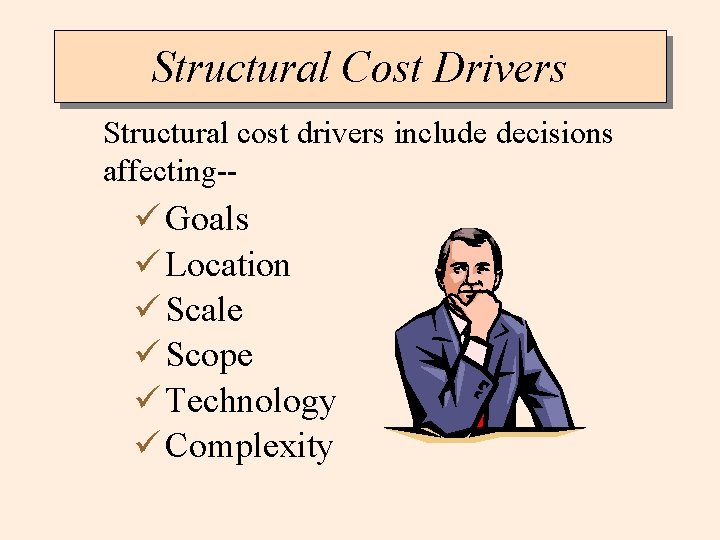
Structural Cost Drivers Structural cost drivers include decisions affecting-- ü Goals ü Location ü Scale ü Scope ü Technology ü Complexity

Structural Cost Drivers Organizational cost drivers include decisions affecting-- § § Organization of processes Layout efficiency Product configuration Exploitation of linkages in the value chain § Work force involvement § Attitudes toward total quality management
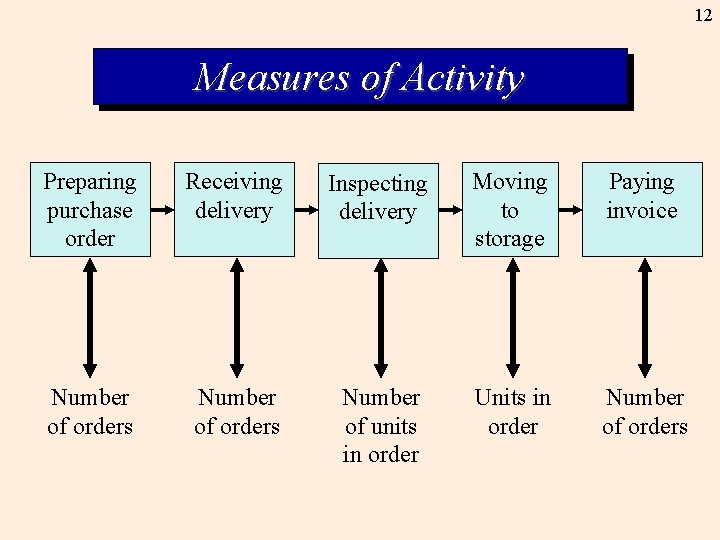
12 Measures of Activity Preparing purchase order Receiving delivery Inspecting delivery Moving to storage Paying invoice Number of orders Number of units in order Units in order Number of orders
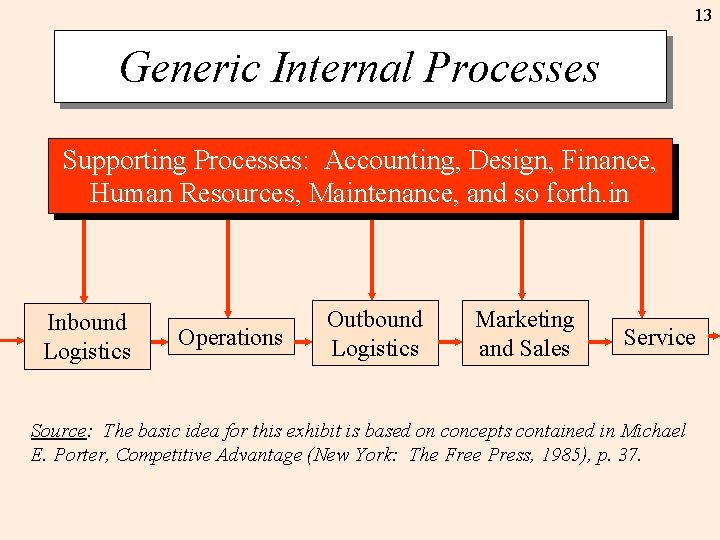
13 Generic Internal Processes Supporting Processes: Accounting, Design, Finance, Human Resources, Maintenance, and so forth. in Inbound Logistics Operations Outbound Logistics Marketing and Sales Service Source: The basic idea for this exhibit is based on concepts contained in Michael E. Porter, Competitive Advantage (New York: The Free Press, 1985), p. 37.
14 Representative Activities Accounting • Processing employee paychecks • Developing budgets • Determining activity costs • Verifying the existence of recorded assets
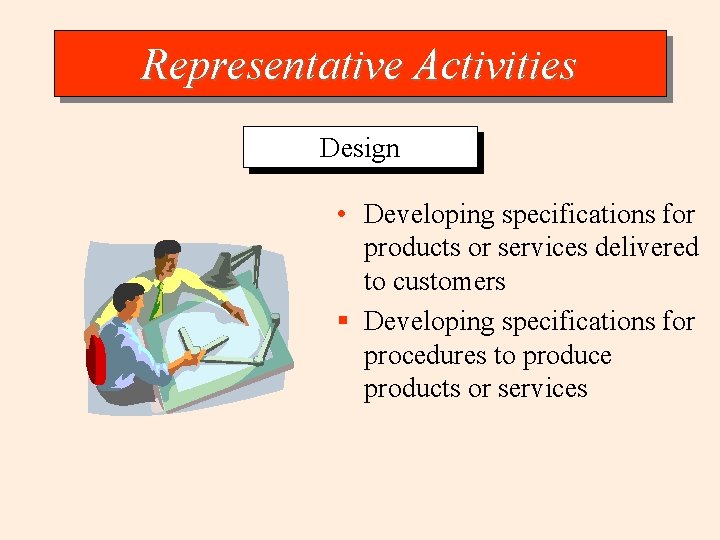
Representative Activities Design • Developing specifications for products or services delivered to customers § Developing specifications for procedures to produce products or services
Representative Activities Finance • Signing checks • Obtaining financial resources
Representative Activities Human Resources • Hiring employees • Training employees Maintenance • Repairing equipment • Cleaning buildings
18 Process Map It is a schematic overview of all the activities within a process.
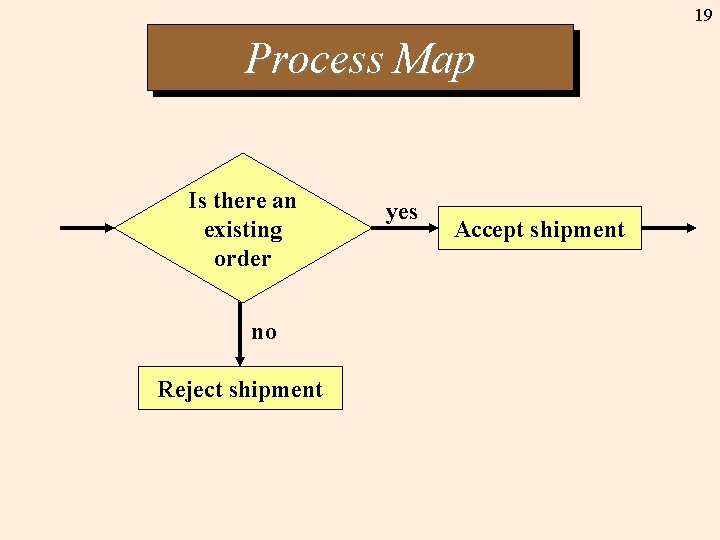
19 Process Map Is there an existing order no Reject shipment yes Accept shipment

20 Process Map Activity: Placing a Purchase Order Go to file cabinet Open drawer containing blank purchase orders Return to desk Remove one purchase order Close drawer
21 In continuous improvement, an organization’s employees constantly evaluate products, services, and processes seeking ways to do better. wa
22 Activity-Based Costing Activity-based costing (ABC) involves determining the cost of activities and tracing their costs to cost objectives on the basis of the cost objectives utilization of units of activity.
23 Activity-Based Costing Activity-based costing is used to develop cost information for the following (and other) purposes in which management might be interested: § The cost of processing a purchase order to assist in continuous improvement. § The cost of a product or service to determine the profitability of the product or service. § The cost of alternative long-distance telephone carriers to identify the carrier with the best combination of quality, service, and cost.
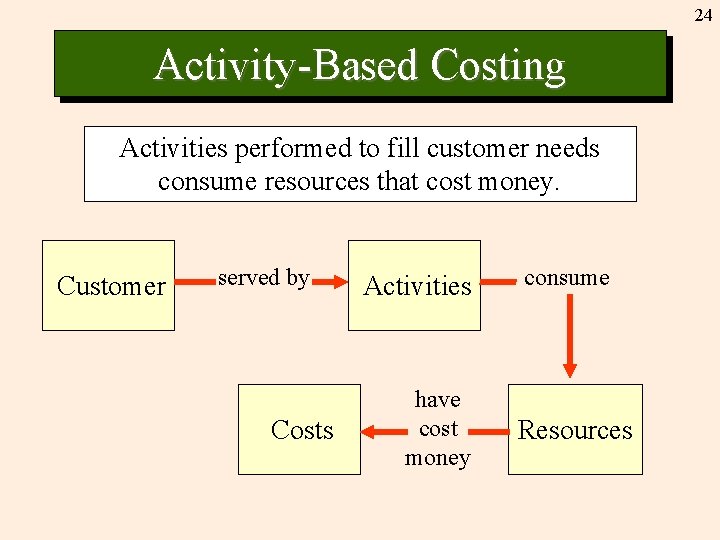
24 Activity-Based Costing Activities performed to fill customer needs consume resources that cost money. Customer served by Costs Activities have cost money consume Resources
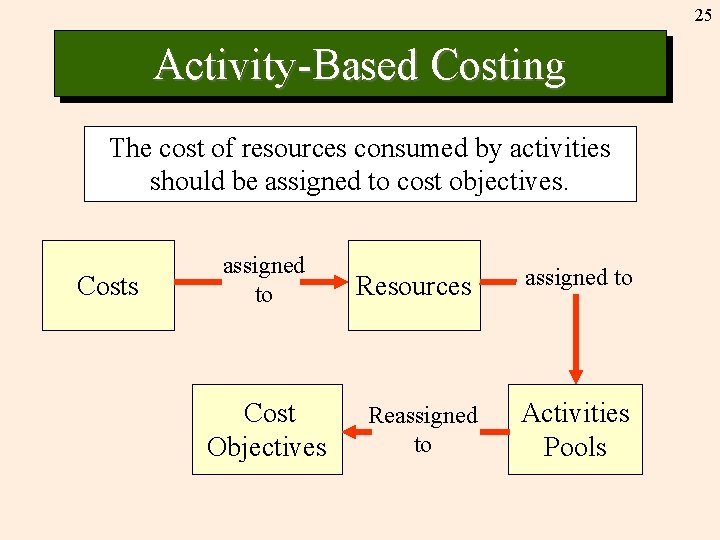
25 Activity-Based Costing The cost of resources consumed by activities should be assigned to cost objectives. Costs assigned to Cost Objectives Resources assigned to Reassigned to Activities Pools
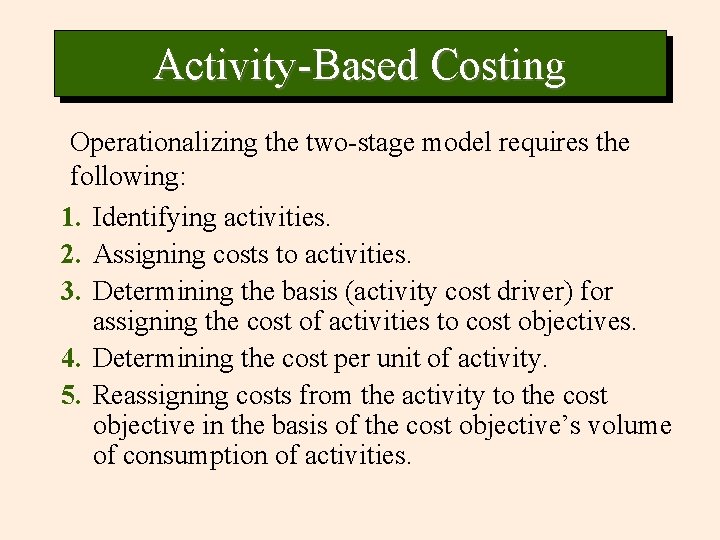
Activity-Based Costing Operationalizing the two-stage model requires the following: 1. Identifying activities. 2. Assigning costs to activities. 3. Determining the basis (activity cost driver) for assigning the cost of activities to cost objectives. 4. Determining the cost per unit of activity. 5. Reassigning costs from the activity to the cost objective in the basis of the cost objective’s volume of consumption of activities.
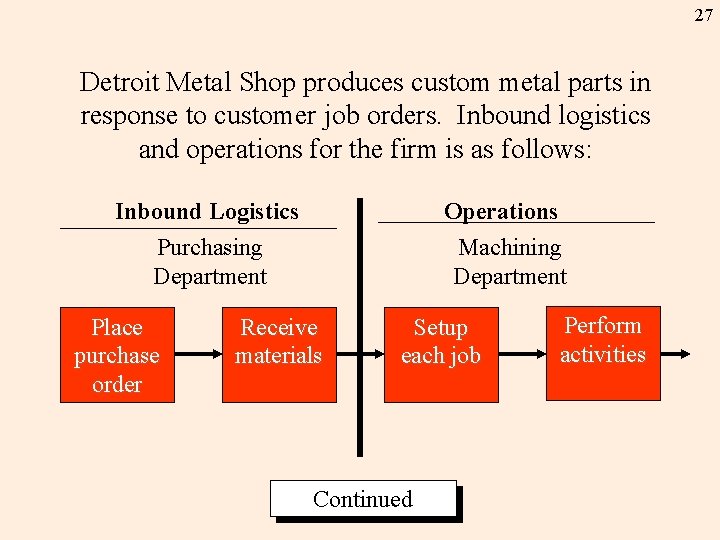
27 Detroit Metal Shop produces custom metal parts in response to customer job orders. Inbound logistics and operations for the firm is as follows: Inbound Logistics Purchasing Department Place purchase order Operations Machining Department Receive materials Setup each job Continued Perform activities
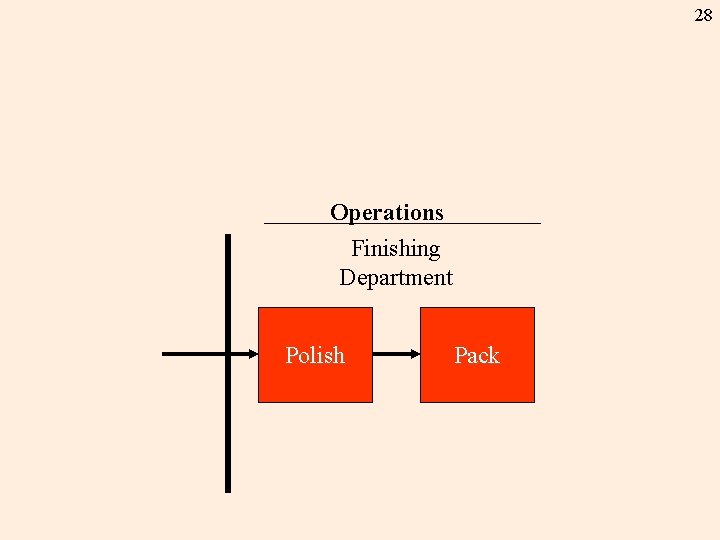
28 Operations Finishing Department Polish Pack
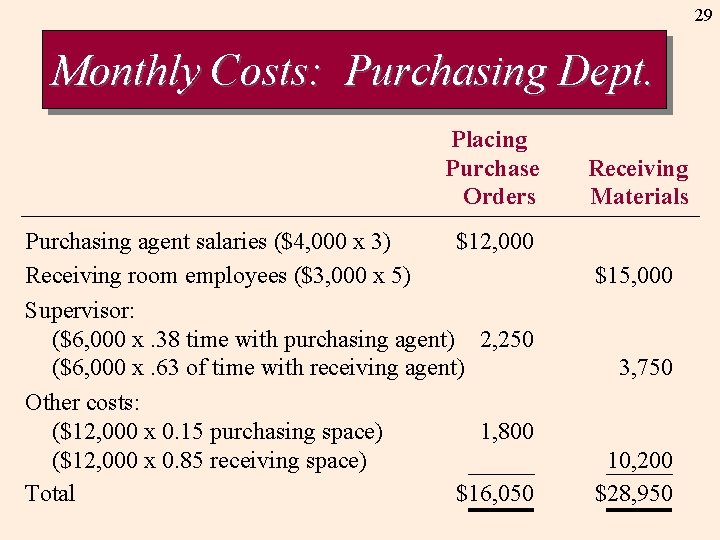
29 Monthly Costs: Purchasing Dept. Placing Purchase Orders Purchasing agent salaries ($4, 000 x 3) $12, 000 Receiving room employees ($3, 000 x 5) Supervisor: ($6, 000 x. 38 time with purchasing agent) 2, 250 ($6, 000 x. 63 of time with receiving agent) Other costs: ($12, 000 x 0. 15 purchasing space) 1, 800 ($12, 000 x 0. 85 receiving space) Total $16, 050 Receiving Materials $15, 000 3, 750 10, 200 $28, 950
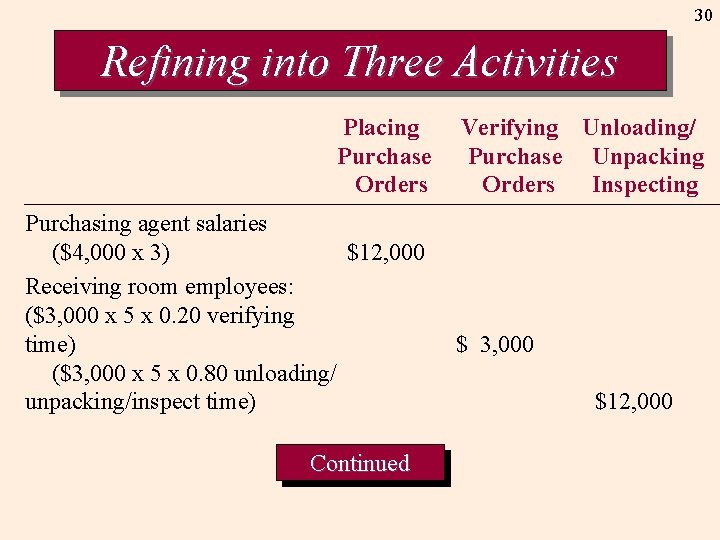
30 Refining into Three Activities Placing Purchase Orders Purchasing agent salaries ($4, 000 x 3) $12, 000 Receiving room employees: ($3, 000 x 5 x 0. 20 verifying time) ($3, 000 x 5 x 0. 80 unloading/ unpacking/inspect time) Continued Verifying Unloading/ Purchase Unpacking Orders Inspecting $ 3, 000 $12, 000
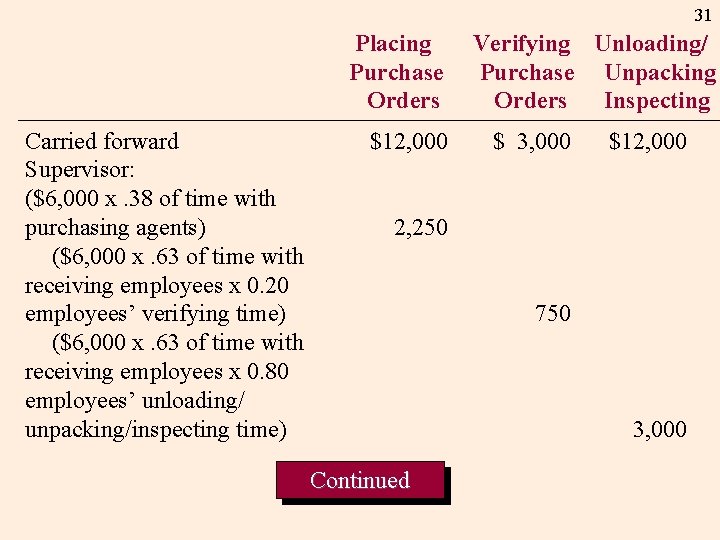
31 Placing Purchase Orders Carried forward Supervisor: ($6, 000 x. 38 of time with purchasing agents) ($6, 000 x. 63 of time with receiving employees x 0. 20 employees’ verifying time) ($6, 000 x. 63 of time with receiving employees x 0. 80 employees’ unloading/ unpacking/inspecting time) $12, 000 Verifying Unloading/ Purchase Unpacking Orders Inspecting $ 3, 000 $12, 000 2, 250 750 3, 000 Continued

32 Placing Purchase Orders Carried forward Other costs*: ($12, 000 x 0. 15 purchasing space) ($12, 000 x 0. 85 receiving space) Total $14, 250 Verifying Unloading/ Purchase Unpacking Orders Inspecting $ 3, 750 $15, 000 $ 3, 750 10, 200 $25, 200 1, 800 $16, 050 * Because the purchase order is verified before delivery trucks are unloaded, the space devoted to this activity is assumed to be insignificant.
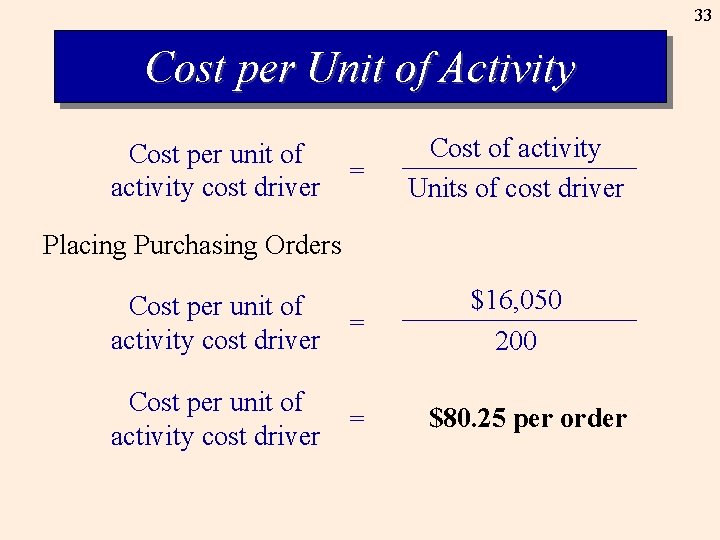
33 Cost per Unit of Activity = Cost of activity Units of cost driver Cost per unit of activity cost driver = $16, 050 200 Cost per unit of activity cost driver = Cost per unit of activity cost driver Placing Purchasing Orders $80. 25 per order
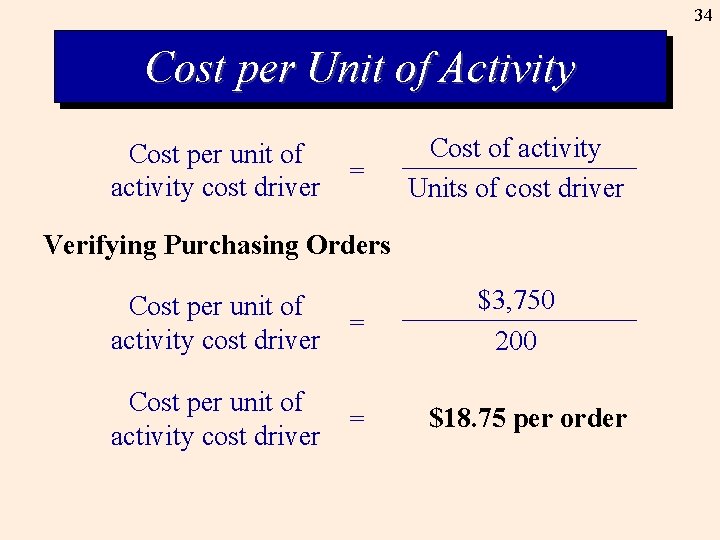
34 Cost per Unit of Activity Cost per unit of activity cost driver = Cost of activity Units of cost driver Verifying Purchasing Orders Cost per unit of activity cost driver = $3, 750 200 $18. 75 per order

35 Cost per Unit of Activity Cost per unit of activity cost driver = Cost of activity Units of cost driver Unloading/Unpacking/Inspecting Cost per unit of activity cost driver = $25, 200 $800, 000 (direct materials) = 0. 0315 per dollar
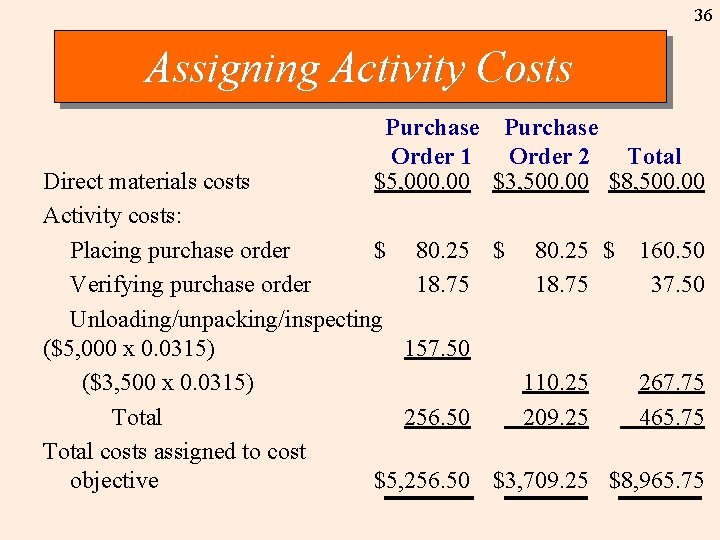
36 Assigning Activity Costs Purchase Order 1 Order 2 Total $5, 000. 00 $3, 500. 00 $8, 500. 00 Direct materials costs Activity costs: Placing purchase order $ 80. 25 $ 160. 50 Verifying purchase order 18. 75 37. 50 Unloading/unpacking/inspecting ($5, 000 x 0. 0315) 157. 50 ($3, 500 x 0. 0315) 110. 25 267. 75 Total 256. 50 209. 25 465. 75 Total costs assigned to cost objective $5, 256. 50 $3, 709. 25 $8, 965. 75
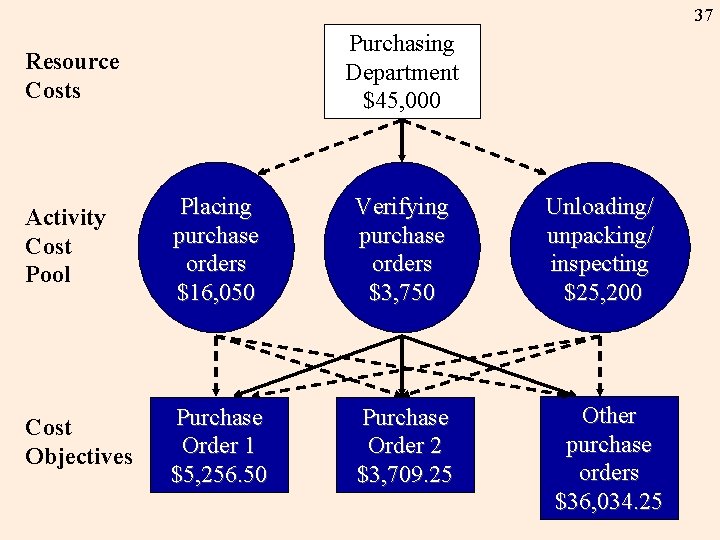
37 Purchasing Department $45, 000 Resource Costs Activity Cost Pool Placing purchase orders $16, 050 Verifying purchase orders $3, 750 Cost Objectives Purchase Order 1 $5, 256. 50 Purchase Order 2 $3, 709. 25 Unloading/ unpacking/ inspecting $25, 200 Other purchase orders $36, 034. 25
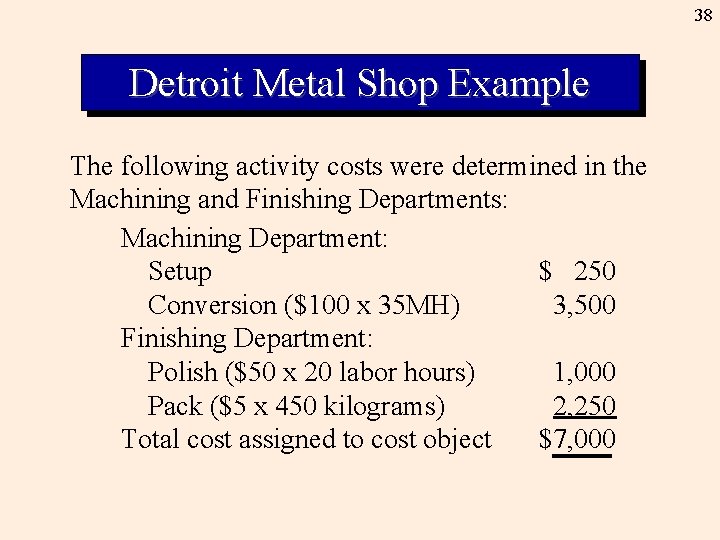
38 Detroit Metal Shop Example The following activity costs were determined in the Machining and Finishing Departments: Machining Department: Setup $ 250 Conversion ($100 x 35 MH) 3, 500 Finishing Department: Polish ($50 x 20 labor hours) 1, 000 Pack ($5 x 450 kilograms) 2, 250 Total cost assigned to cost object $7, 000
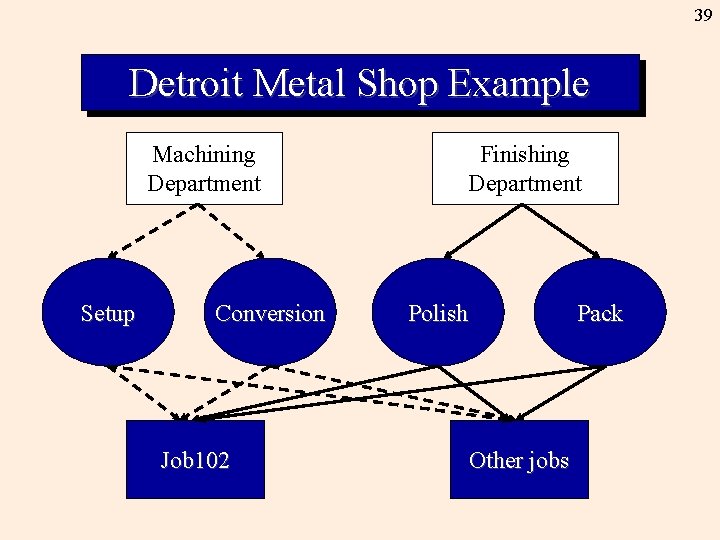
39 Detroit Metal Shop Example Machining Department Setup Conversion Job 102 Finishing Department Polish Other jobs Pack
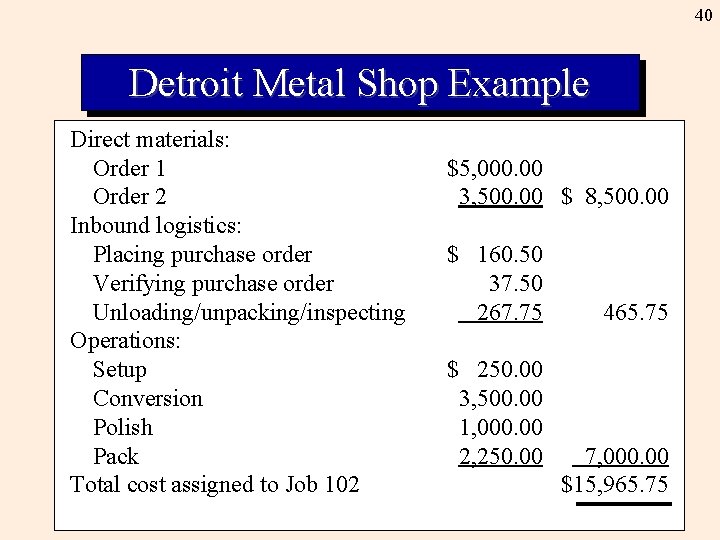
40 Detroit Metal Shop Example Direct materials: Order 1 Order 2 Inbound logistics: Placing purchase order Verifying purchase order Unloading/unpacking/inspecting Operations: Setup Conversion Polish Pack Total cost assigned to Job 102 $5, 000. 00 3, 500. 00 $ 8, 500. 00 $ 160. 50 37. 50 267. 75 $ 250. 00 3, 500. 00 1, 000. 00 2, 250. 00 465. 75 7, 000. 00 $15, 965. 75
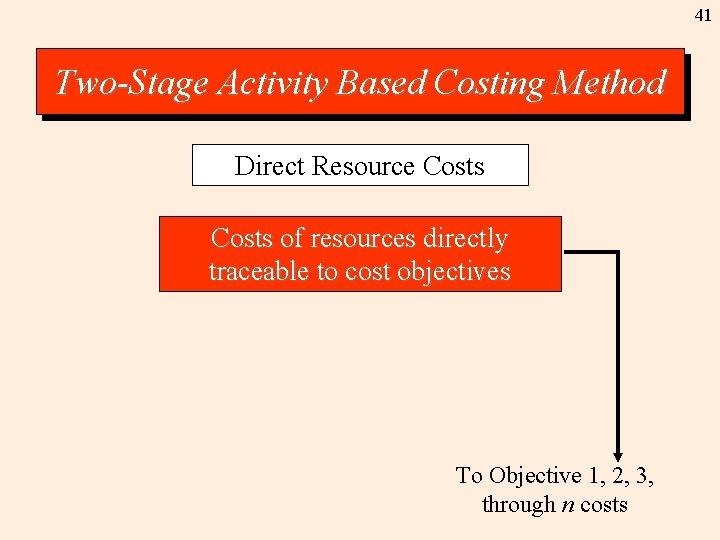
41 Two-Stage Activity Based Costing Method Direct Resource Costs of resources directly traceable to cost objectives To Objective 1, 2, 3, through n costs

42 Two-Stage Activity Based Costing Method Stage 1: Indirect resources costs are assigned to activity pools. Cost of Resource 1 Activity 1 Cost of Resource 2 Activity 2 Cost of Resource 3 Activity 3 Continued Activity 4 Cost of Resource n Activity n
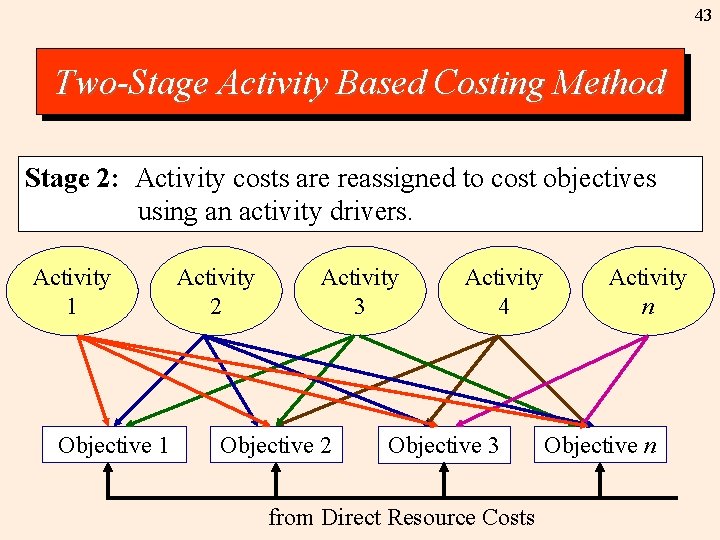
43 Two-Stage Activity Based Costing Method Stage 2: Activity costs are reassigned to cost objectives using an activity drivers. Activity 1 Objective 1 Activity 2 Activity 3 Objective 2 Activity 4 Objective 3 from Direct Resource Costs Activity n Objective n
44 Additional Considerations Because activity-based costing is not guided by financial accounting requirements, there is wide variation in the components of ABC systems.
45 Reducing Non-Value. Added Activities • Movement • Waiting • Setup • Inspection

46 Reducing Non-Value. Added Activities Continuous improvement and process reengineering seek to minimize nonvalue-added activities.
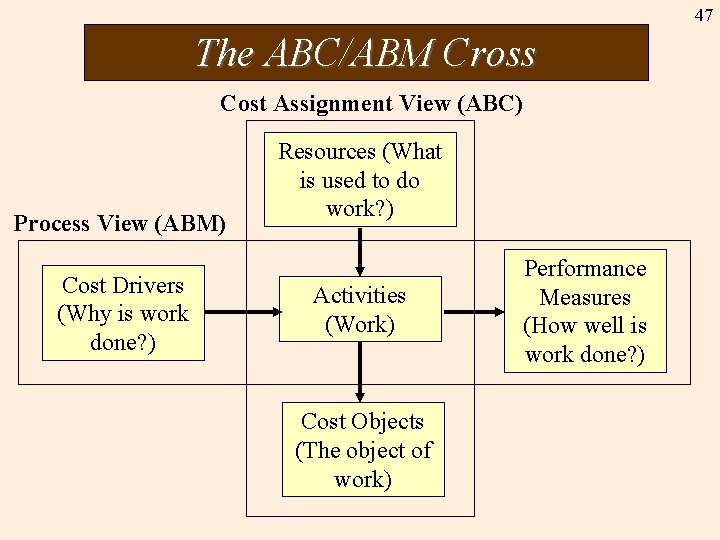
47 The ABC/ABM Cross Cost Assignment View (ABC) Process View (ABM) Cost Drivers (Why is work done? ) Resources (What is used to do work? ) Activities (Work) Cost Objects (The object of work) Performance Measures (How well is work done? )
48 Chapter 5 The End

49
- Slides: 49