
Chapter 5 Valuation of Bonds and Stock u
Chapter 5 Valuation of Bonds and Stock u. First Principles: u Value of financial securities = PV of expected future cash flows u. To value bonds and stocks we need to: u Estimate future cash flows: size (how much) and timing (when) u Discount future cash flows at an appropriate rate Jacoby, Stangeland Wajeeh, 2000 1

Bond Features l What is a bond l l l debt issued by a corporation or a governmental body. A bond represents a loan made by investors to the issuer. In return for his/her money, the investor receives a legal claim on future cash flows of the borrower. l The issuer promises to: l l make regular coupon payments every period until the bond matures, and pay the face (par) value of the bond when it matures. l Default l an issuer who fails to pay is subject to legal action on behalf of the lenders (bondholders). Jacoby, Stangeland Wajeeh, 2000 2
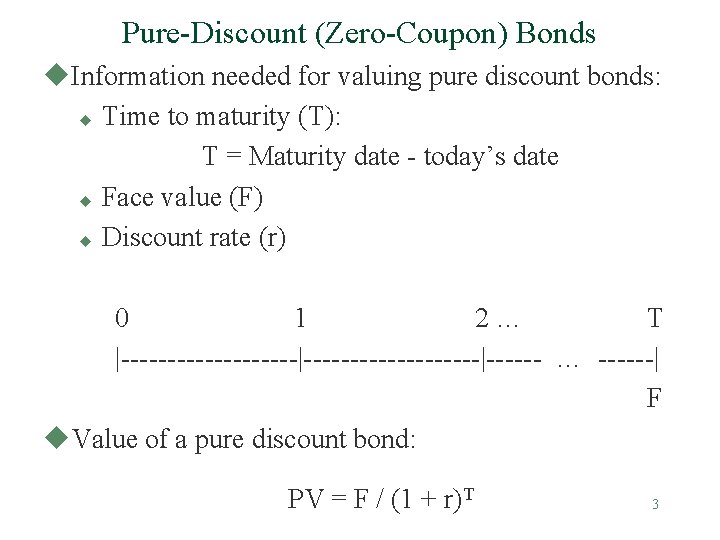
Pure-Discount (Zero-Coupon) Bonds u. Information needed for valuing pure discount bonds: u Time to maturity (T): T = Maturity date - today’s date u Face value (F) u Discount rate (r) 0 1 2… T |-------------------|------ … ------| F u. Value of a pure discount bond: PV = F / (1 + r)T 3
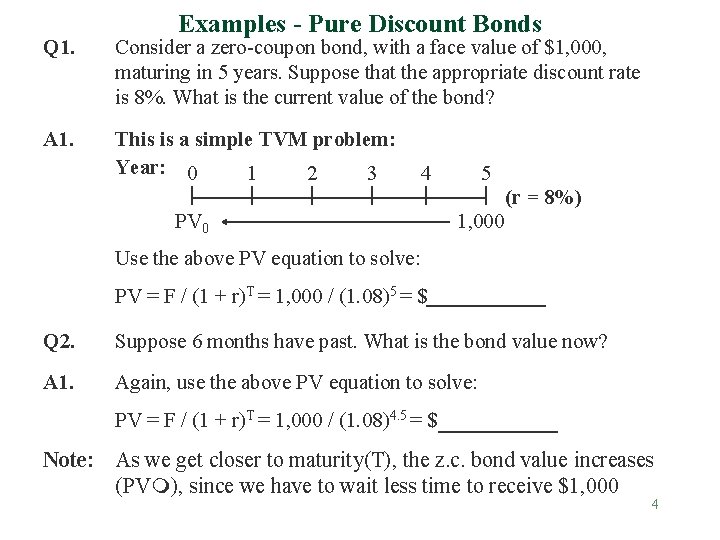
Examples - Pure Discount Bonds Q 1. Consider a zero-coupon bond, with a face value of $1, 000, maturing in 5 years. Suppose that the appropriate discount rate is 8%. What is the current value of the bond? A 1. This is a simple TVM problem: Year: 0 1 2 3 4 5 (r = 8%) PV 0 1, 000 Use the above PV equation to solve: PV = F / (1 + r)T = 1, 000 / (1. 08)5 = $ Q 2. Suppose 6 months have past. What is the bond value now? A 1. Again, use the above PV equation to solve: PV = F / (1 + r)T = 1, 000 / (1. 08)4. 5 = $ Note: As we get closer to maturity(T), the z. c. bond value increases (PVm), since we have to wait less time to receive $1, 000 4
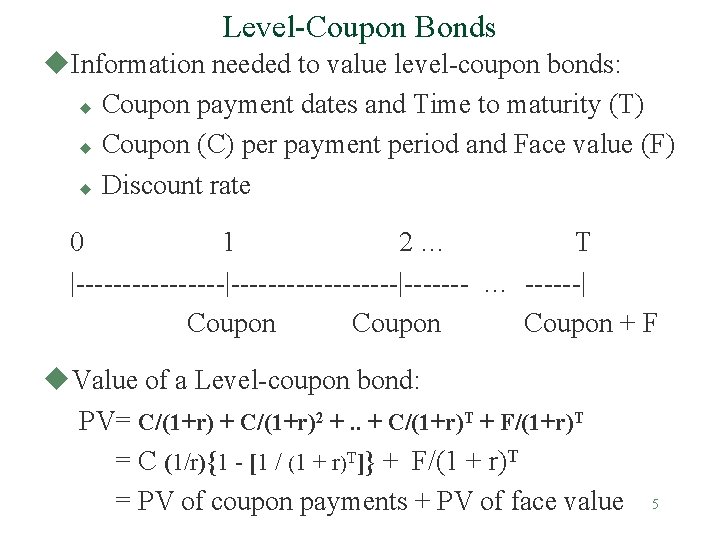
Level-Coupon Bonds u. Information needed to value level-coupon bonds: u Coupon payment dates and Time to maturity (T) u Coupon (C) per payment period and Face value (F) u Discount rate 0 1 2… T |------------------|------- … ------| Coupon + F u. Value of a Level-coupon bond: PV= C/(1+r) + C/(1+r)2 +. . + C/(1+r)T + F/(1+r)T = C (1/r){1 - [1 / (1 + r)T]} + F/(1 + r)T = PV of coupon payments + PV of face value 5
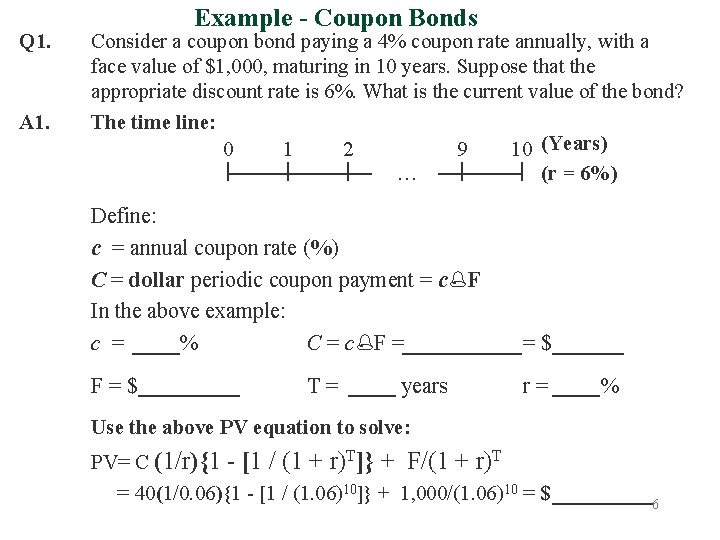
Q 1. A 1. Example - Coupon Bonds Consider a coupon bond paying a 4% coupon rate annually, with a face value of $1, 000, maturing in 10 years. Suppose that the appropriate discount rate is 6%. What is the current value of the bond? The time line: 0 1 2 9 10 (Years) … (r = 6%) Define: c = annual coupon rate (%) C = dollar periodic coupon payment = c%F In the above example: c = % C = c %F = =$ F=$ r= T= years % Use the above PV equation to solve: PV= C (1/r){1 - [1 / (1 + r)T]} + F/(1 + r)T = 40(1/0. 06){1 - [1 / (1. 06)10]} + 1, 000/(1. 06)10 = $ 6
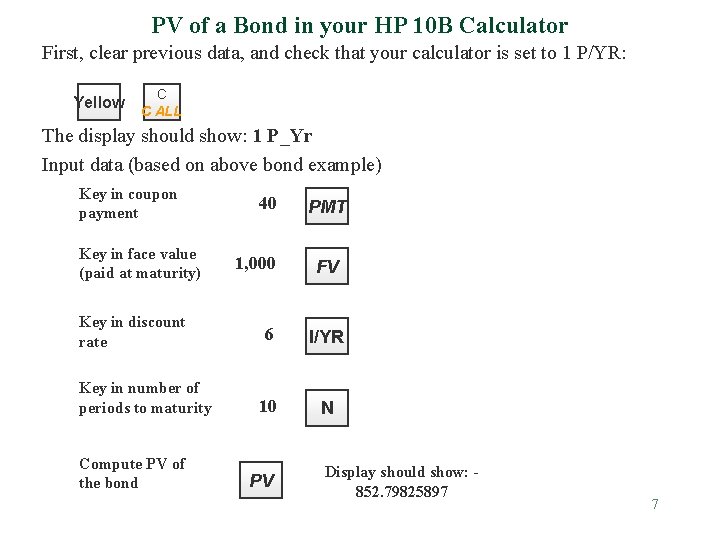
PV of a Bond in your HP 10 B Calculator First, clear previous data, and check that your calculator is set to 1 P/YR: Yellow C C ALL The display should show: 1 P_Yr Input data (based on above bond example) Key in coupon payment Key in face value (paid at maturity) Key in discount rate Key in number of periods to maturity Compute PV of the bond 40 1, 000 PMT FV 6 I/YR 10 N PV Display should show: 852. 79825897 7
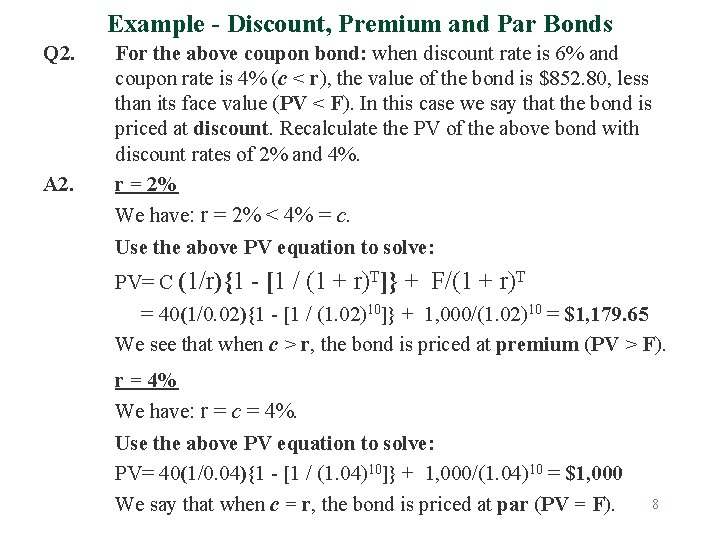
Example - Discount, Premium and Par Bonds Q 2. A 2. For the above coupon bond: when discount rate is 6% and coupon rate is 4% (c < r), the value of the bond is $852. 80, less than its face value (PV < F). In this case we say that the bond is priced at discount. Recalculate the PV of the above bond with discount rates of 2% and 4%. r = 2% We have: r = 2% < 4% = c. Use the above PV equation to solve: PV= C (1/r){1 - [1 / (1 + r)T]} + F/(1 + r)T = 40(1/0. 02){1 - [1 / (1. 02)10]} + 1, 000/(1. 02)10 = $1, 179. 65 We see that when c > r, the bond is priced at premium (PV > F). r = 4% We have: r = c = 4%. Use the above PV equation to solve: PV= 40(1/0. 04){1 - [1 / (1. 04)10]} + 1, 000/(1. 04)10 = $1, 000 We say that when c = r, the bond is priced at par (PV = F). 8
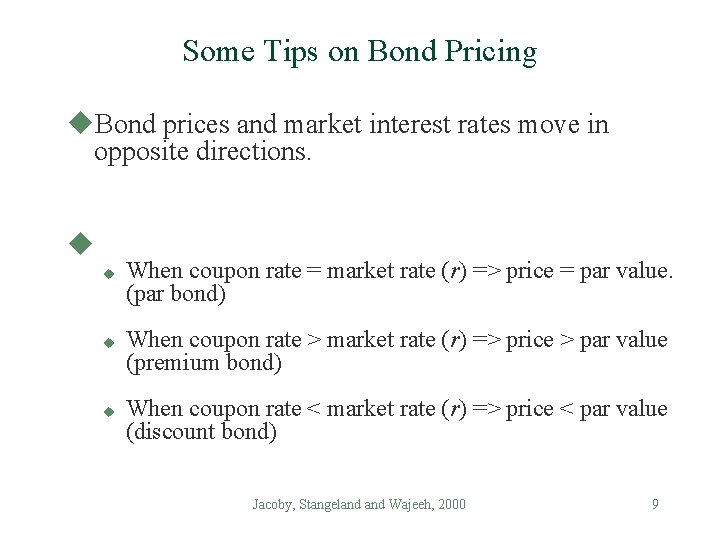
Some Tips on Bond Pricing u. Bond prices and market interest rates move in opposite directions. u u When coupon rate = market rate (r) => price = par value. (par bond) When coupon rate > market rate (r) => price > par value (premium bond) When coupon rate < market rate (r) => price < par value (discount bond) Jacoby, Stangeland Wajeeh, 2000 9
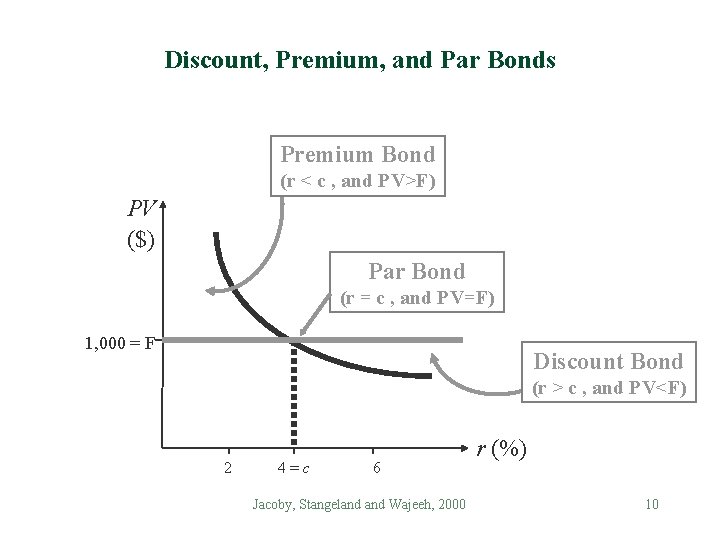
Discount, Premium, and Par Bonds Premium Bond (r < c , and PV>F) PV ($) Par Bond (r = c , and PV=F) 1, 000 = F Discount Bond (r > c , and PV<F) 2 4=c 6 Jacoby, Stangeland Wajeeh, 2000 r (%) 10
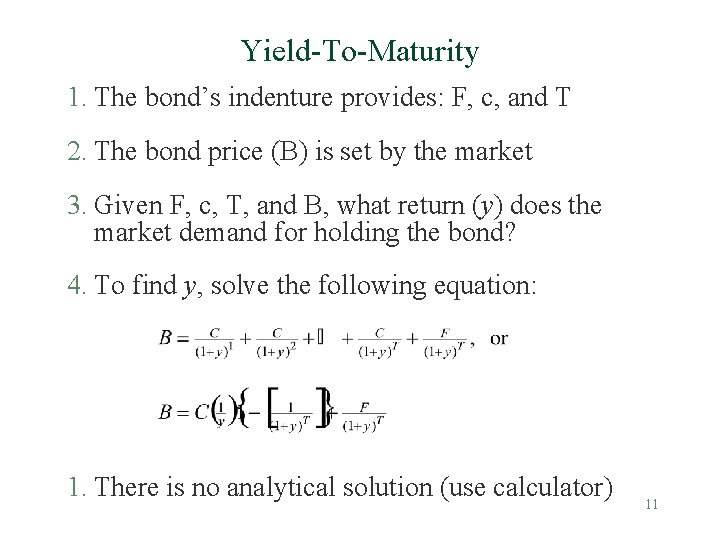
Yield-To-Maturity 1. The bond’s indenture provides: F, c, and T 2. The bond price (B) is set by the market 3. Given F, c, T, and B, what return (y) does the market demand for holding the bond? 4. To find y, solve the following equation: 1. There is no analytical solution (use calculator) 11
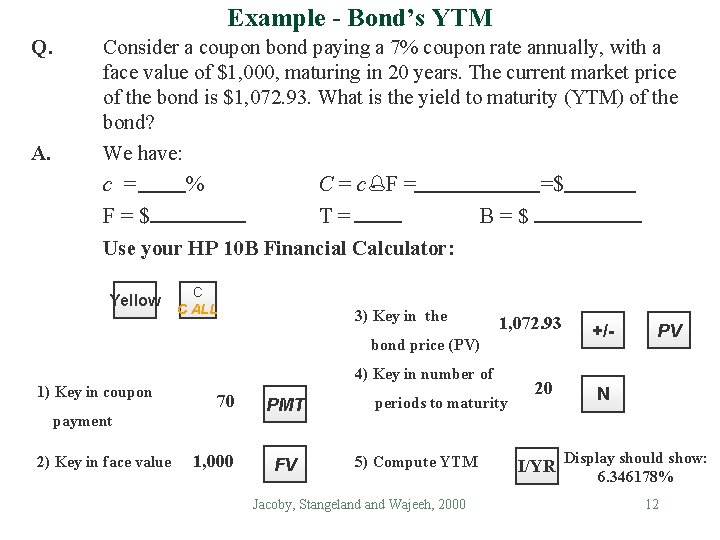
Example - Bond’s YTM Q. A. Consider a coupon bond paying a 7% coupon rate annually, with a face value of $1, 000, maturing in 20 years. The current market price of the bond is $1, 072. 93. What is the yield to maturity (YTM) of the bond? We have: c = % C = c %F = =$ F=$ T= Use your HP 10 B Financial Calculator: Yellow C C ALL B=$ 3) Key in the 1, 072. 93 bond price (PV) 4) Key in number of 1) Key in coupon 70 payment 2) Key in face value 1, 000 PMT FV periods to maturity 5) Compute YTM Jacoby, Stangeland Wajeeh, 2000 20 I/YR +/- PV N Display should show: 6. 346178% 12
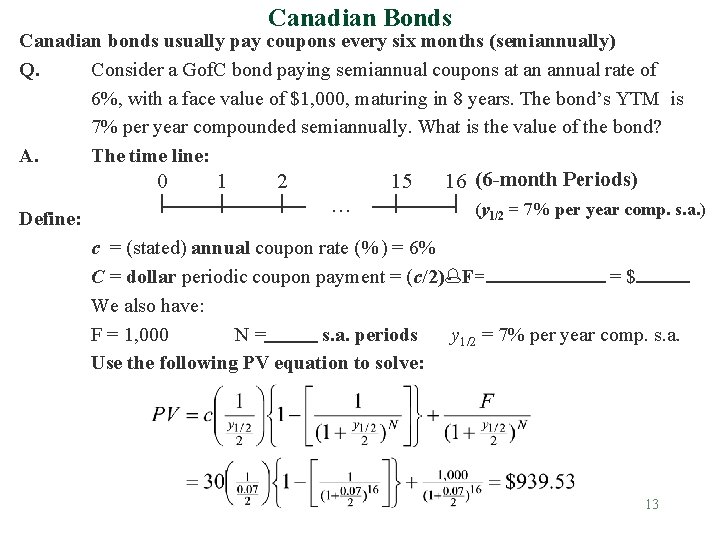
Canadian Bonds Canadian bonds usually pay coupons every six months (semiannually) Q. Consider a Gof. C bond paying semiannual coupons at an annual rate of 6%, with a face value of $1, 000, maturing in 8 years. The bond’s YTM is 7% per year compounded semiannually. What is the value of the bond? A. The time line: 0 Define: 1 2 15 … 16 (6 -month Periods) (y 1/2 = 7% per year comp. s. a. ) c = (stated) annual coupon rate (%) = 6% C = dollar periodic coupon payment = (c/2)%F= =$ We also have: F = 1, 000 N= s. a. periods y 1/2 = 7% per year comp. s. a. Use the following PV equation to solve: 13
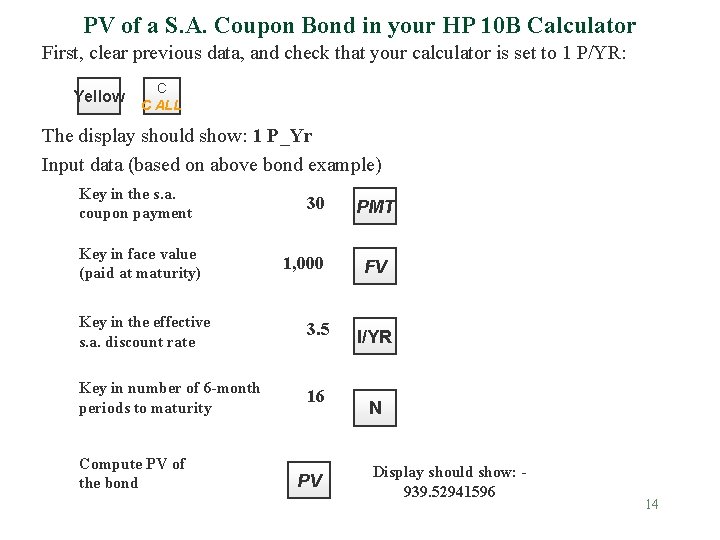
PV of a S. A. Coupon Bond in your HP 10 B Calculator First, clear previous data, and check that your calculator is set to 1 P/YR: Yellow C C ALL The display should show: 1 P_Yr Input data (based on above bond example) Key in the s. a. coupon payment Key in face value (paid at maturity) 30 1, 000 Key in the effective s. a. discount rate 3. 5 Key in number of 6 -month periods to maturity 16 Compute PV of the bond PV PMT FV I/YR N Display should show: 939. 52941596 14
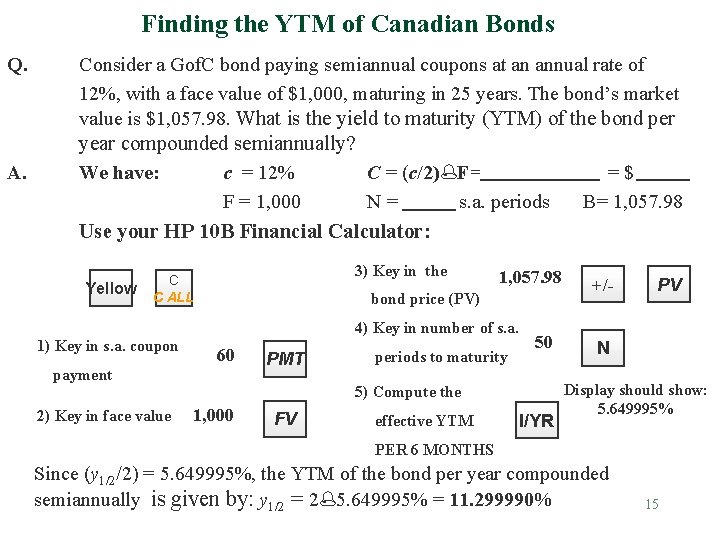
Finding the YTM of Canadian Bonds Q. A. Consider a Gof. C bond paying semiannual coupons at an annual rate of 12%, with a face value of $1, 000, maturing in 25 years. The bond’s market value is $1, 057. 98. What is the yield to maturity (YTM) of the bond per year compounded semiannually? We have: c = 12% C = (c/2)%F= F = 1, 000 N= s. a. periods Use your HP 10 B Financial Calculator: Yellow 3) Key in the C C ALL 1, 057. 98 bond price (PV) 4) Key in number of s. a. 1) Key in s. a. coupon 60 payment 2) Key in face value PMT periods to maturity 50 5) Compute the 1, 000 FV effective YTM I/YR =$ B= 1, 057. 98 +/- PV N Display should show: 5. 649995% PER 6 MONTHS Since (y 1/2/2) = 5. 649995%, the YTM of the bond per year compounded semiannually is given by: y 1/2 = 2%5. 649995% = 11. 299990% 15
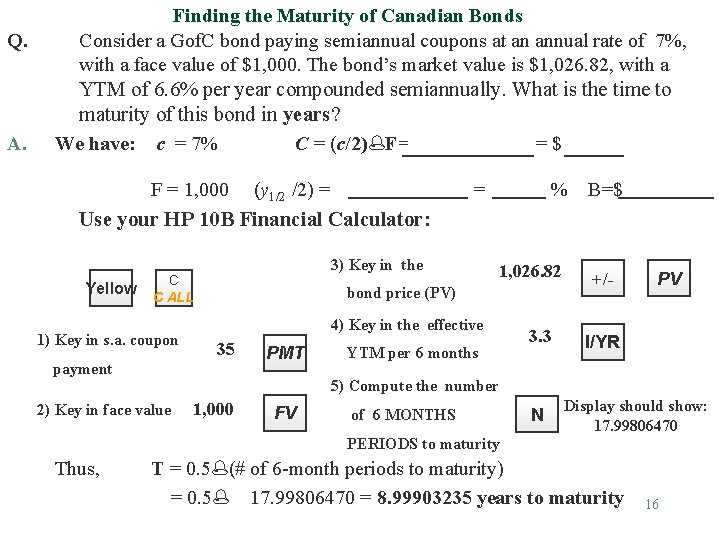
Q. A. Finding the Maturity of Canadian Bonds Consider a Gof. C bond paying semiannual coupons at an annual rate of 7%, with a face value of $1, 000. The bond’s market value is $1, 026. 82, with a YTM of 6. 6% per year compounded semiannually. What is the time to maturity of this bond in years? We have: c = 7% C = (c/2)%F= =$ F = 1, 000 (y 1/2 /2) = = % B=$ Use your HP 10 B Financial Calculator: Yellow 3) Key in the C C ALL 1) Key in s. a. coupon 1, 026. 82 bond price (PV) 4) Key in the effective 35 payment PMT YTM per 6 months 3. 3 +/- PV I/YR 5) Compute the number 2) Key in face value 1, 000 FV of 6 MONTHS N Display should show: 17. 99806470 PERIODS to maturity Thus, T = 0. 5%(# of 6 -month periods to maturity) = 0. 5% 17. 99806470 = 8. 99903235 years to maturity 16
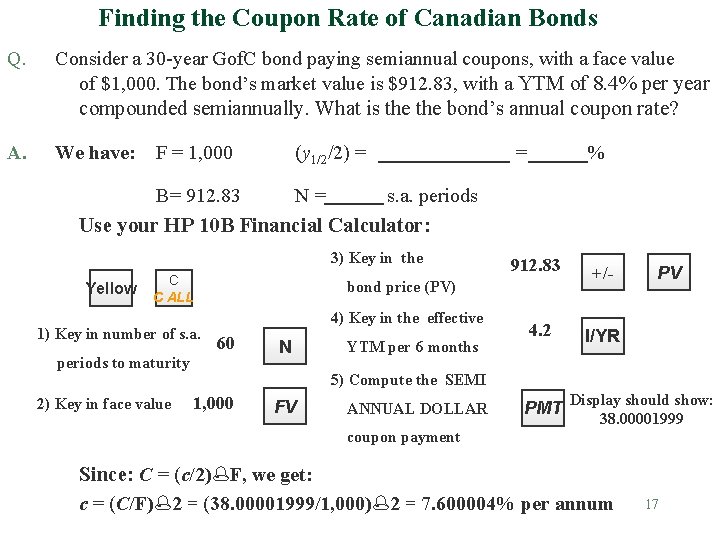
Finding the Coupon Rate of Canadian Bonds Q. Consider a 30 -year Gof. C bond paying semiannual coupons, with a face value of $1, 000. The bond’s market value is $912. 83, with a YTM of 8. 4% per year compounded semiannually. What is the bond’s annual coupon rate? A. We have: F = 1, 000 (y 1/2/2) = B= 912. 83 N= = % 912. 83 +/- 4. 2 I/YR s. a. periods Use your HP 10 B Financial Calculator: 3) Key in the Yellow C C ALL 1) Key in number of s. a. bond price (PV) 4) Key in the effective 60 periods to maturity 2) Key in face value N YTM per 6 months PV 5) Compute the SEMI 1, 000 FV ANNUAL DOLLAR PMT Display should show: 38. 00001999 coupon payment Since: C = (c/2)%F, we get: c = (C/F)%2 = (38. 00001999/1, 000)%2 = 7. 600004% per annum 17
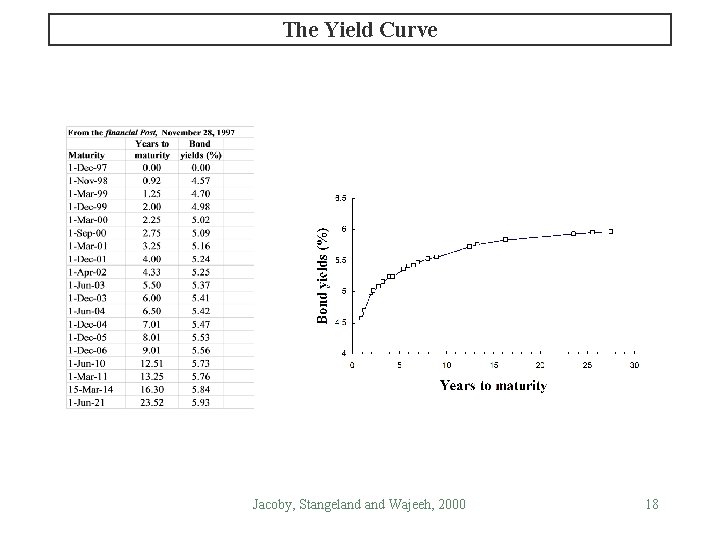
The Yield Curve Jacoby, Stangeland Wajeeh, 2000 18
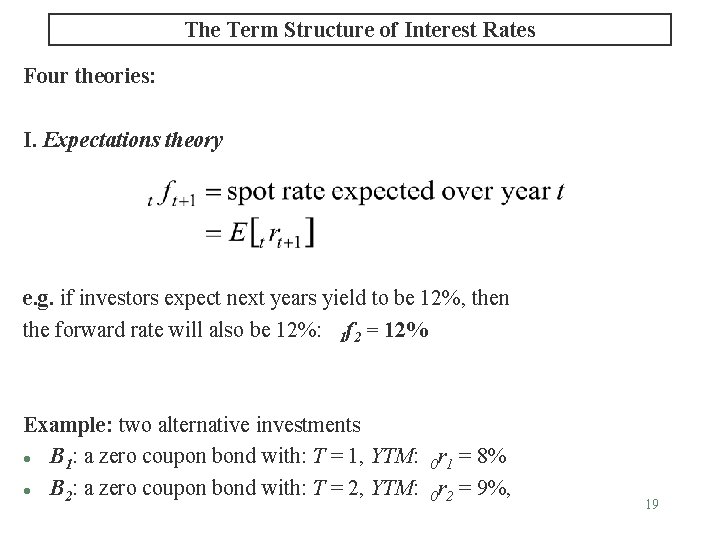
The Term Structure of Interest Rates Four theories: I. Expectations theory e. g. if investors expect next years yield to be 12%, then the forward rate will also be 12%: 1 f 2 = 12% Example: two alternative investments l B 1: a zero coupon bond with: T = 1, YTM: 0 r 1 = 8% l B 2: a zero coupon bond with: T = 2, YTM: 0 r 2 = 9%, 19
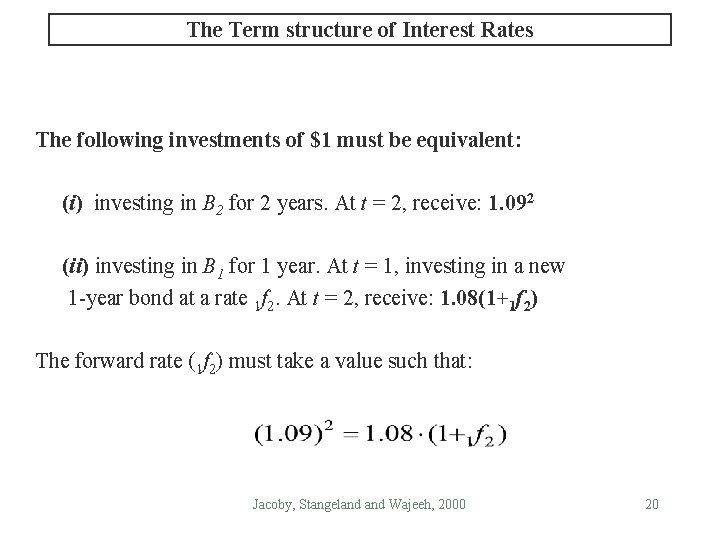
The Term structure of Interest Rates The following investments of $1 must be equivalent: (i) investing in B 2 for 2 years. At t = 2, receive: 1. 092 (ii) investing in B 1 for 1 year. At t = 1, investing in a new 1 -year bond at a rate 1 f 2. At t = 2, receive: 1. 08(1+1 f 2) The forward rate (1 f 2) must take a value such that: Jacoby, Stangeland Wajeeh, 2000 20
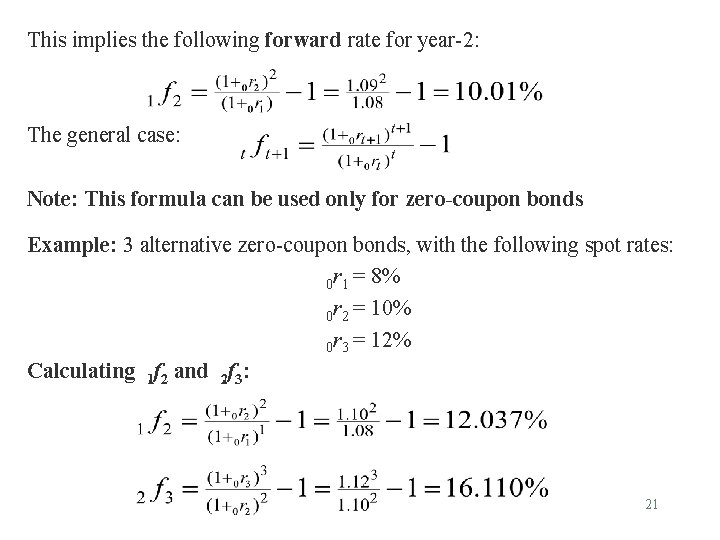
This implies the following forward rate for year-2: The general case: Note: This formula can be used only for zero-coupon bonds Example: 3 alternative zero-coupon bonds, with the following spot rates: 0 r 1 = 8% 0 r 2 = 10% 0 r 3 = 12% Calculating 1 f 2 and 2 f 3: 21
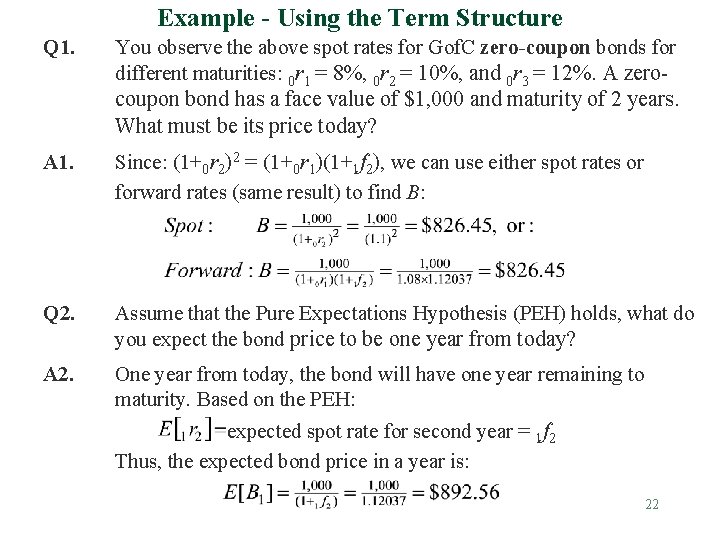
Example - Using the Term Structure Q 1. You observe the above spot rates for Gof. C zero-coupon bonds for different maturities: 0 r 1 = 8%, 0 r 2 = 10%, and 0 r 3 = 12%. A zerocoupon bond has a face value of $1, 000 and maturity of 2 years. What must be its price today? A 1. Since: (1+0 r 2)2 = (1+0 r 1)(1+1 f 2), we can use either spot rates or forward rates (same result) to find B: Q 2. Assume that the Pure Expectations Hypothesis (PEH) holds, what do you expect the bond price to be one year from today? A 2. One year from today, the bond will have one year remaining to maturity. Based on the PEH: expected spot rate for second year = 1 f 2 Thus, the expected bond price in a year is: 22
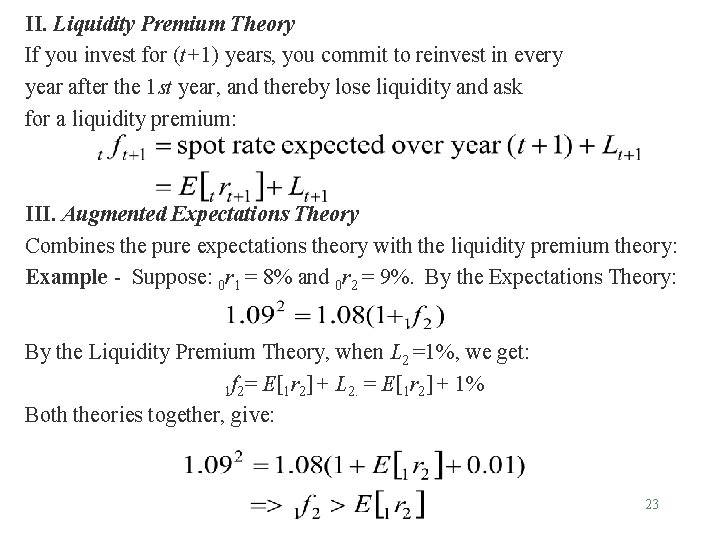
II. Liquidity Premium Theory If you invest for (t+1) years, you commit to reinvest in every year after the 1 st year, and thereby lose liquidity and ask for a liquidity premium: III. Augmented Expectations Theory Combines the pure expectations theory with the liquidity premium theory: Example - Suppose: 0 r 1 = 8% and 0 r 2 = 9%. By the Expectations Theory: By the Liquidity Premium Theory, when L 2 =1%, we get: 1 f 2= E[1 r 2] + L 2. = E[1 r 2] + 1% Both theories together, give: 23
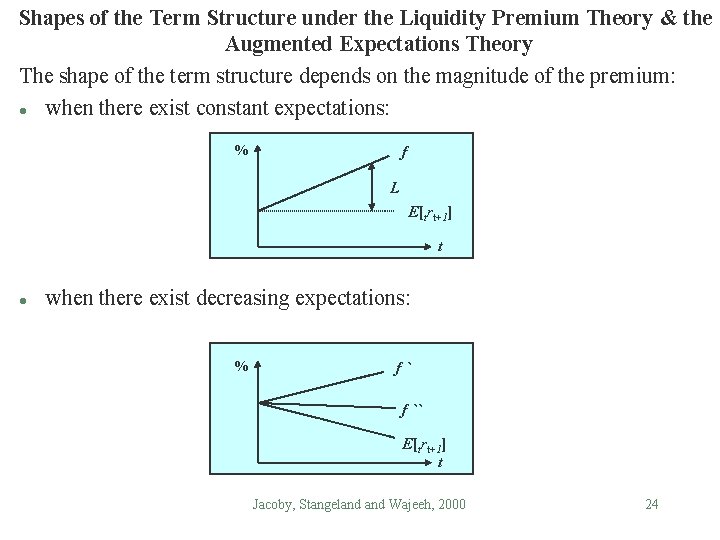
Shapes of the Term Structure under the Liquidity Premium Theory & the Augmented Expectations Theory The shape of the term structure depends on the magnitude of the premium: l when there exist constant expectations: % f L E[trt+1] t l when there exist decreasing expectations: % f` f `` E[trt+1] t Jacoby, Stangeland Wajeeh, 2000 24
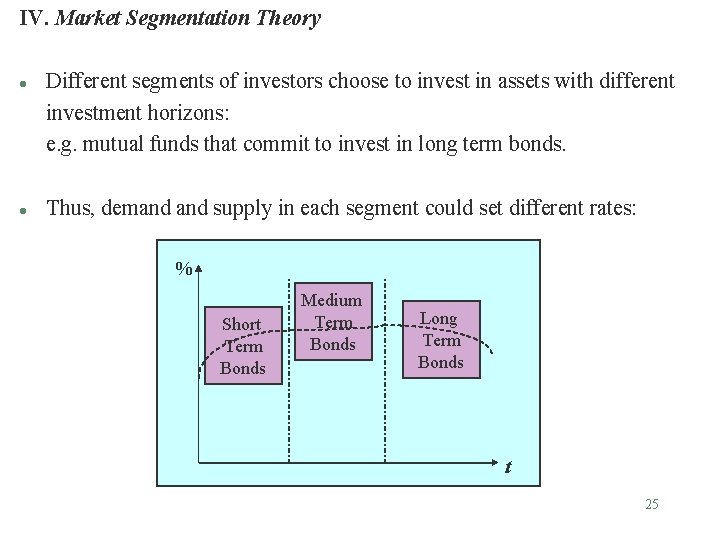
IV. Market Segmentation Theory l l Different segments of investors choose to invest in assets with different investment horizons: e. g. mutual funds that commit to invest in long term bonds. Thus, demand supply in each segment could set different rates: % Short Term Bonds Medium Term Bonds Long Term Bonds t 25
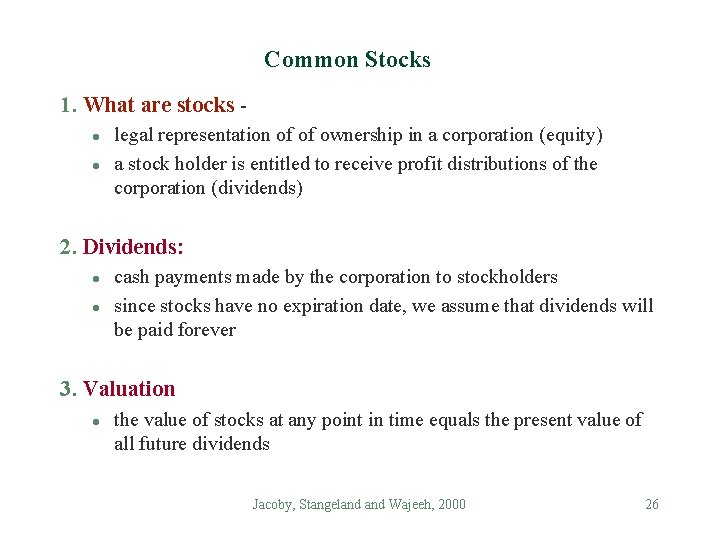
Common Stocks 1. What are stocks l l legal representation of of ownership in a corporation (equity) a stock holder is entitled to receive profit distributions of the corporation (dividends) 2. Dividends: l l cash payments made by the corporation to stockholders since stocks have no expiration date, we assume that dividends will be paid forever 3. Valuation l the value of stocks at any point in time equals the present value of all future dividends Jacoby, Stangeland Wajeeh, 2000 26
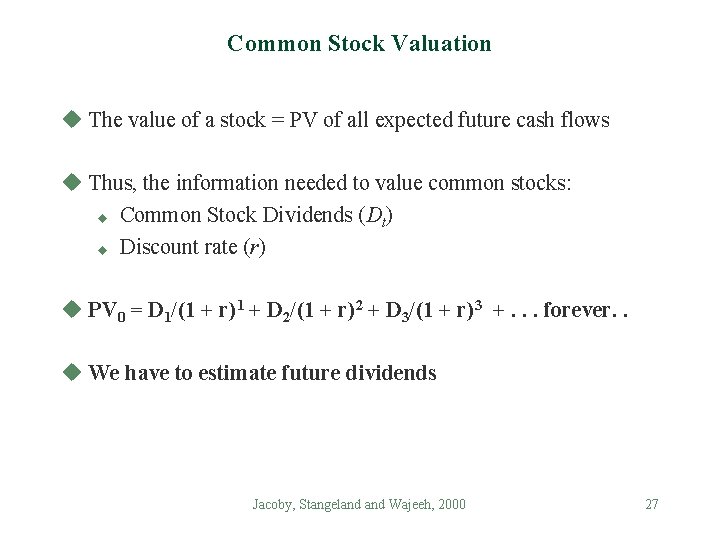
Common Stock Valuation u The value of a stock = PV of all expected future cash flows u Thus, the information needed to value common stocks: u Common Stock Dividends (Dt) u Discount rate (r) u PV 0 = D 1/(1 + r)1 + D 2/(1 + r)2 + D 3/(1 + r)3 +. . . forever. . u We have to estimate future dividends Jacoby, Stangeland Wajeeh, 2000 27
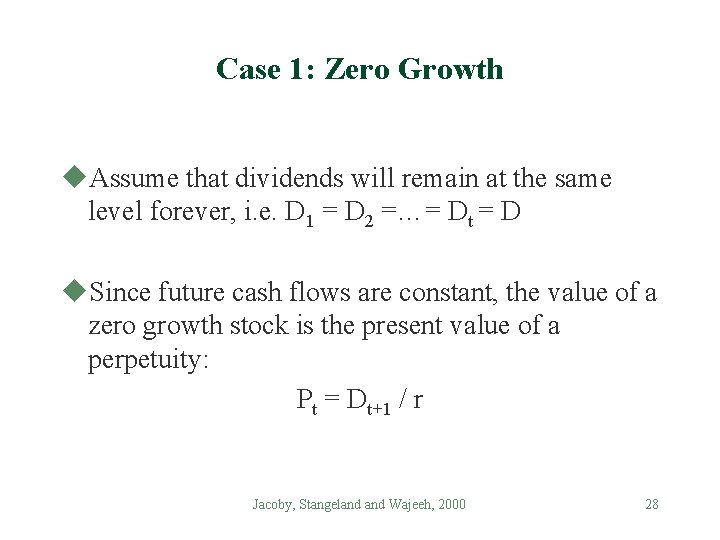
Case 1: Zero Growth u. Assume that dividends will remain at the same level forever, i. e. D 1 = D 2 =…= Dt = D u. Since future cash flows are constant, the value of a zero growth stock is the present value of a perpetuity: Pt = Dt+1 / r Jacoby, Stangeland Wajeeh, 2000 28
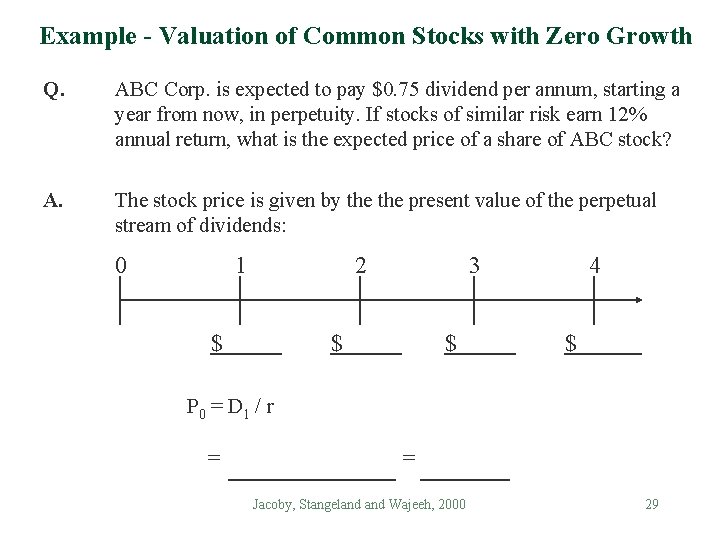
Example - Valuation of Common Stocks with Zero Growth Q. ABC Corp. is expected to pay $0. 75 dividend per annum, starting a year from now, in perpetuity. If stocks of similar risk earn 12% annual return, what is the expected price of a share of ABC stock? A. The stock price is given by the present value of the perpetual stream of dividends: 0 1 2 $ 3 $ $ 4 $ P 0 = D 1 / r = = Jacoby, Stangeland Wajeeh, 2000 29
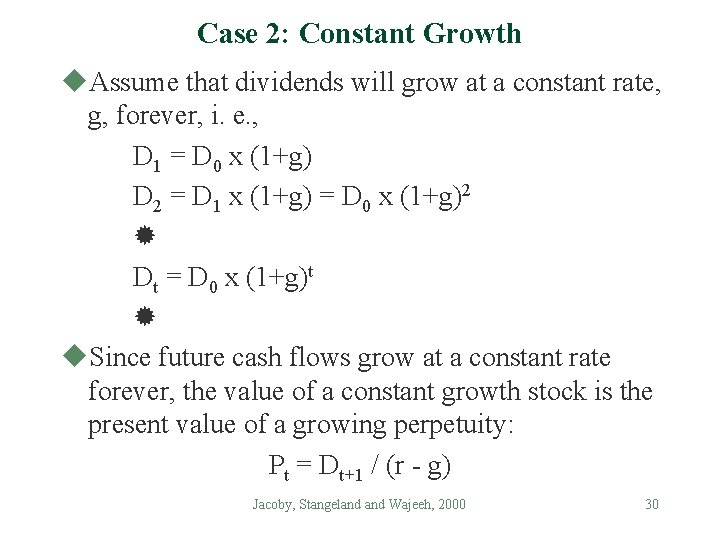
Case 2: Constant Growth u. Assume that dividends will grow at a constant rate, g, forever, i. e. , D 1 = D 0 x (1+g) D 2 = D 1 x (1+g) = D 0 x (1+g)2 ® Dt = D 0 x (1+g)t ® u. Since future cash flows grow at a constant rate forever, the value of a constant growth stock is the present value of a growing perpetuity: Pt = Dt+1 / (r - g) Jacoby, Stangeland Wajeeh, 2000 30
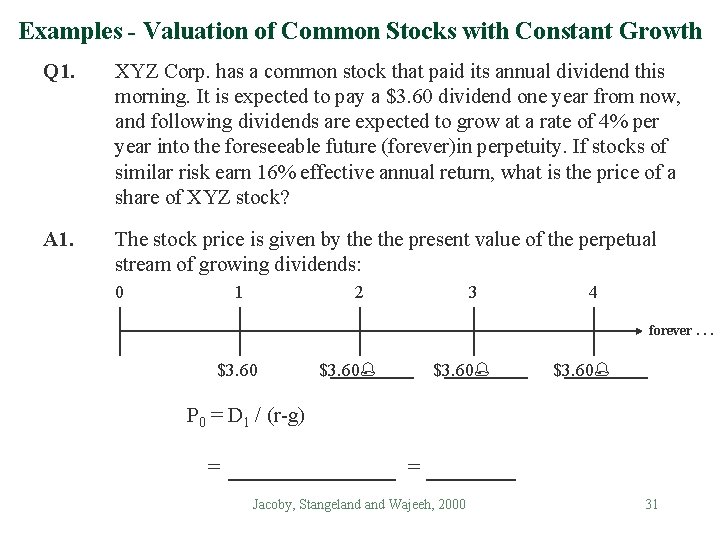
Examples - Valuation of Common Stocks with Constant Growth Q 1. XYZ Corp. has a common stock that paid its annual dividend this morning. It is expected to pay a $3. 60 dividend one year from now, and following dividends are expected to grow at a rate of 4% per year into the foreseeable future (forever)in perpetuity. If stocks of similar risk earn 16% effective annual return, what is the price of a share of XYZ stock? A 1. The stock price is given by the present value of the perpetual stream of growing dividends: 0 1 2 3 4 forever. . . $3. 60% P 0 = D 1 / (r-g) = = Jacoby, Stangeland Wajeeh, 2000 31
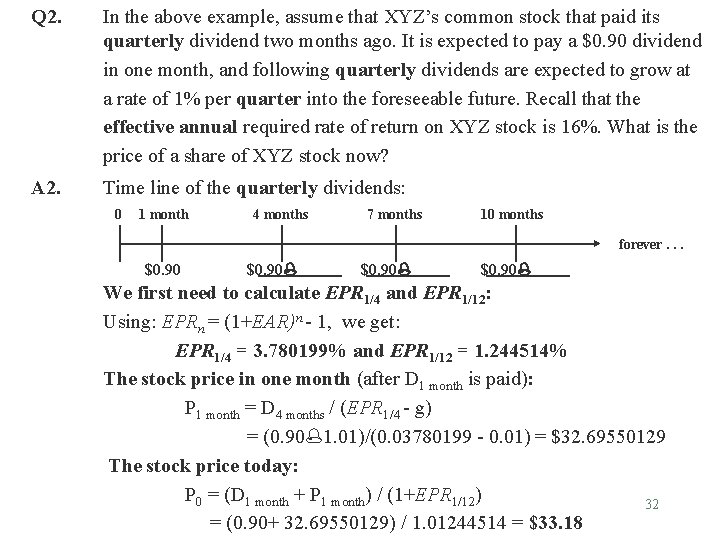
Q 2. In the above example, assume that XYZ’s common stock that paid its quarterly dividend two months ago. It is expected to pay a $0. 90 dividend in one month, and following quarterly dividends are expected to grow at a rate of 1% per quarter into the foreseeable future. Recall that the effective annual required rate of return on XYZ stock is 16%. What is the price of a share of XYZ stock now? A 2. Time line of the quarterly dividends: 0 1 month 4 months 7 months 10 months forever. . . $0. 90% We first need to calculate EPR 1/4 and EPR 1/12: Using: EPRn = (1+EAR)n - 1, we get: EPR 1/4 = 3. 780199% and EPR 1/12 = 1. 244514% The stock price in one month (after D 1 month is paid): P 1 month = D 4 months / (EPR 1/4 - g) = (0. 90%1. 01)/(0. 03780199 - 0. 01) = $32. 69550129 The stock price today: P 0 = (D 1 month + P 1 month) / (1+EPR 1/12) 32 = (0. 90+ 32. 69550129) / 1. 01244514 = $33. 18
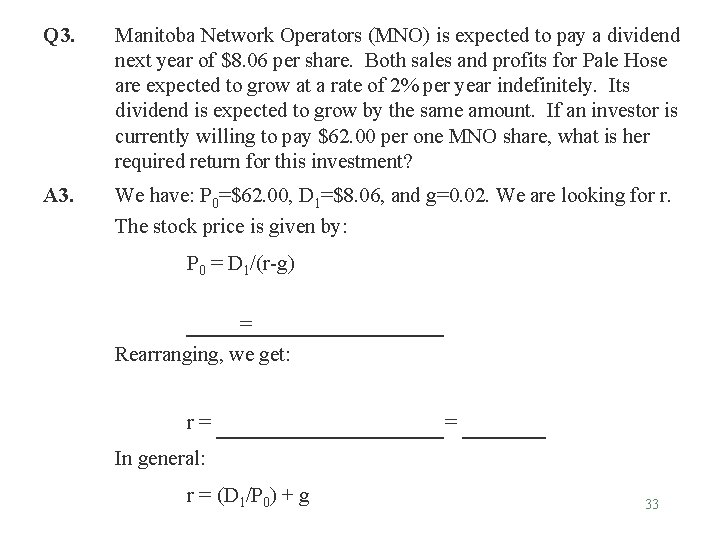
Q 3. Manitoba Network Operators (MNO) is expected to pay a dividend next year of $8. 06 per share. Both sales and profits for Pale Hose are expected to grow at a rate of 2% per year indefinitely. Its dividend is expected to grow by the same amount. If an investor is currently willing to pay $62. 00 per one MNO share, what is her required return for this investment? A 3. We have: P 0=$62. 00, D 1=$8. 06, and g=0. 02. We are looking for r. The stock price is given by: P 0 = D 1/(r-g) = Rearranging, we get: r= = In general: r = (D 1/P 0) + g 33
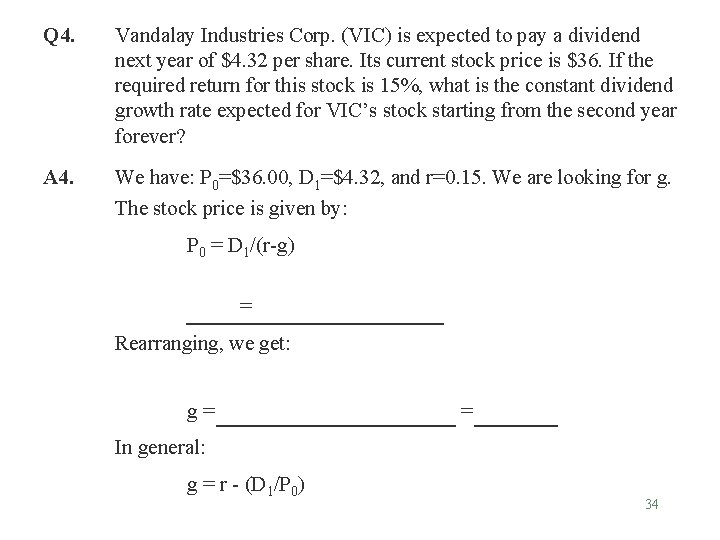
Q 4. Vandalay Industries Corp. (VIC) is expected to pay a dividend next year of $4. 32 per share. Its current stock price is $36. If the required return for this stock is 15%, what is the constant dividend growth rate expected for VIC’s stock starting from the second year forever? A 4. We have: P 0=$36. 00, D 1=$4. 32, and r=0. 15. We are looking for g. The stock price is given by: P 0 = D 1/(r-g) = Rearranging, we get: g= = In general: g = r - (D 1/P 0) 34
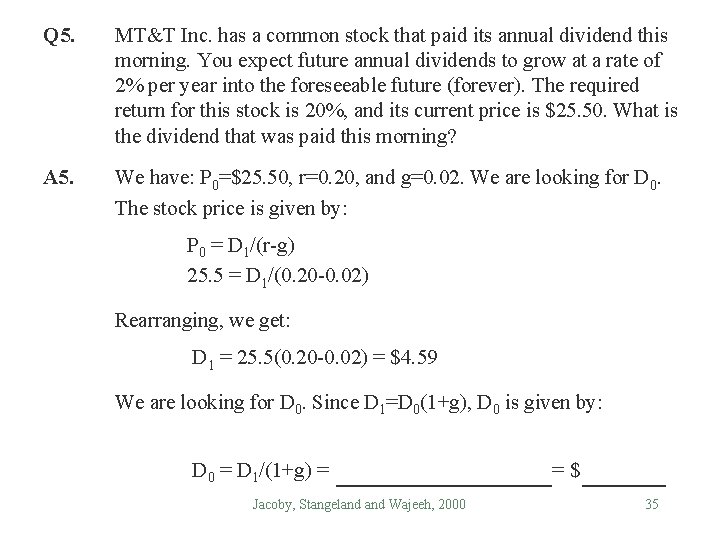
Q 5. MT&T Inc. has a common stock that paid its annual dividend this morning. You expect future annual dividends to grow at a rate of 2% per year into the foreseeable future (forever). The required return for this stock is 20%, and its current price is $25. 50. What is the dividend that was paid this morning? A 5. We have: P 0=$25. 50, r=0. 20, and g=0. 02. We are looking for D 0. The stock price is given by: P 0 = D 1/(r-g) 25. 5 = D 1/(0. 20 -0. 02) Rearranging, we get: D 1 = 25. 5(0. 20 -0. 02) = $4. 59 We are looking for D 0. Since D 1=D 0(1+g), D 0 is given by: D 0 = D 1/(1+g) = Jacoby, Stangeland Wajeeh, 2000 =$ 35
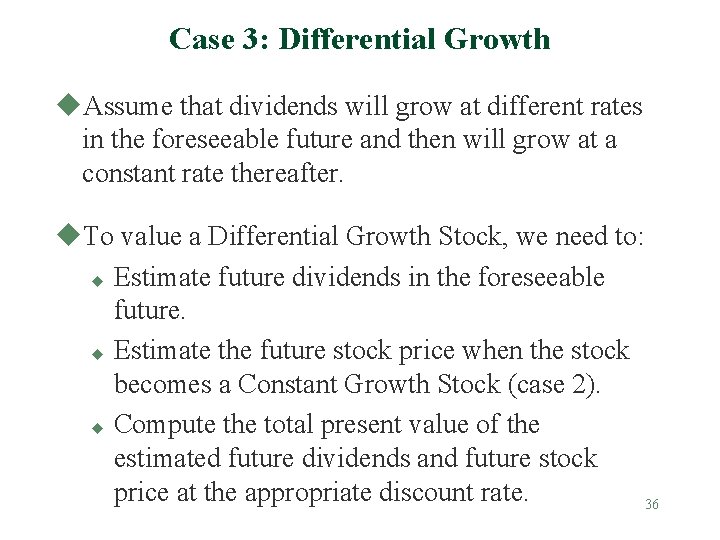
Case 3: Differential Growth u. Assume that dividends will grow at different rates in the foreseeable future and then will grow at a constant rate thereafter. u. To value a Differential Growth Stock, we need to: u Estimate future dividends in the foreseeable future. u Estimate the future stock price when the stock becomes a Constant Growth Stock (case 2). u Compute the total present value of the estimated future dividends and future stock price at the appropriate discount rate. 36
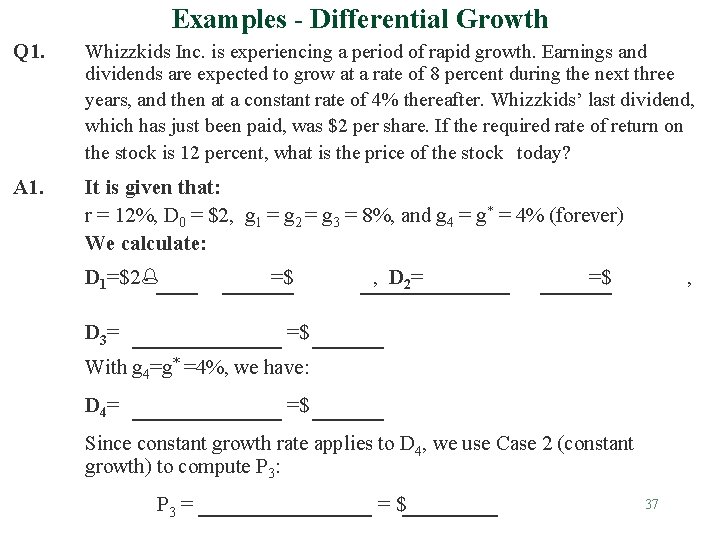
Examples - Differential Growth Q 1. Whizzkids Inc. is experiencing a period of rapid growth. Earnings and dividends are expected to grow at a rate of 8 percent during the next three years, and then at a constant rate of 4% thereafter. Whizzkids’ last dividend, which has just been paid, was $2 per share. If the required rate of return on the stock is 12 percent, what is the price of the stock today? A 1. It is given that: r = 12%, D 0 = $2, g 1 = g 2 = g 3 = 8%, and g 4 = g* = 4% (forever) We calculate: D 1=$2% D 3= =$ , D 2= =$ , =$ With g 4=g* =4%, we have: D 4= =$ Since constant growth rate applies to D 4, we use Case 2 (constant growth) to compute P 3: P 3 = =$ 37
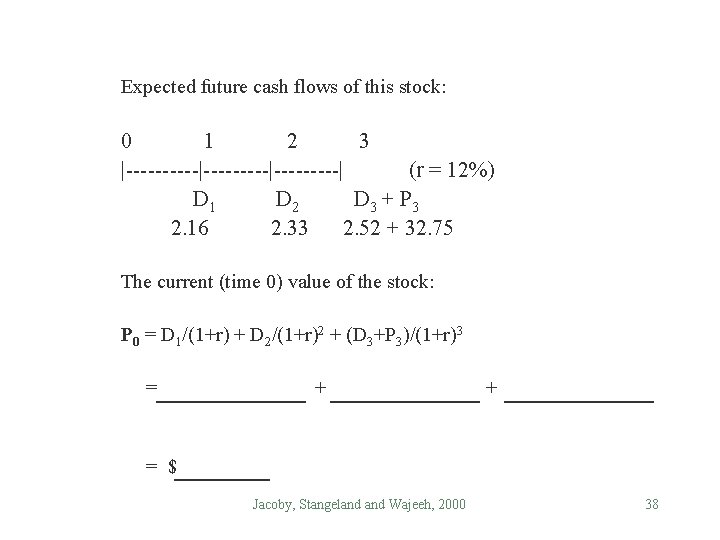
Expected future cash flows of this stock: 0 1 2 3 |-----|---------| (r = 12%) D 1 D 2 D 3 + P 3 2. 16 2. 33 2. 52 + 32. 75 The current (time 0) value of the stock: P 0 = D 1/(1+r) + D 2/(1+r)2 + (D 3+P 3)/(1+r)3 = + + = $ Jacoby, Stangeland Wajeeh, 2000 38
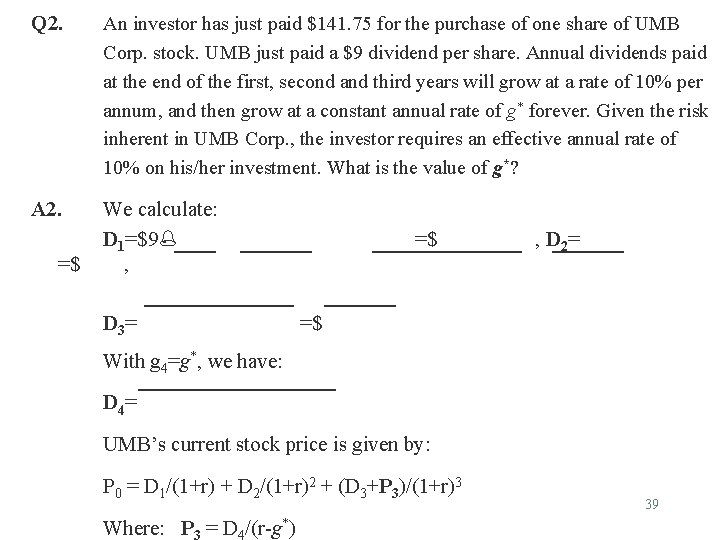
Q 2. An investor has just paid $141. 75 for the purchase of one share of UMB Corp. stock. UMB just paid a $9 dividend per share. Annual dividends paid at the end of the first, second and third years will grow at a rate of 10% per annum, and then grow at a constant annual rate of g* forever. Given the risk inherent in UMB Corp. , the investor requires an effective annual rate of 10% on his/her investment. What is the value of g*? A 2. We calculate: D 1=$9% , =$ D 3= =$ , D 2= =$ With g 4=g*, we have: D 4= UMB’s current stock price is given by: P 0 = D 1/(1+r) + D 2/(1+r)2 + (D 3+P 3)/(1+r)3 Where: P 3 = D 4/(r-g*) 39
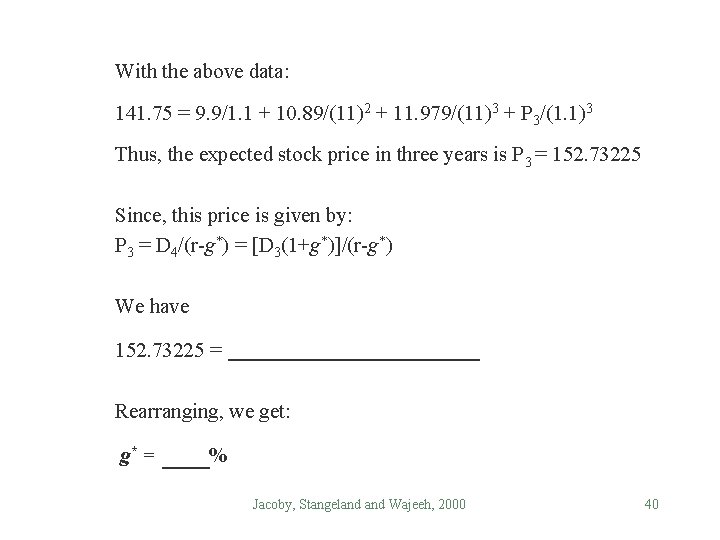
With the above data: 141. 75 = 9. 9/1. 1 + 10. 89/(11)2 + 11. 979/(11)3 + P 3/(1. 1)3 Thus, the expected stock price in three years is P 3 = 152. 73225 Since, this price is given by: P 3 = D 4/(r-g*) = [D 3(1+g*)]/(r-g*) We have 152. 73225 = Rearranging, we get: g* = % Jacoby, Stangeland Wajeeh, 2000 40
- Slides: 40