
CHAPTER 5 UNEMPLOYMENT COMPENSATION TAXES FUTA and SUTA
- Slides: 18
CHAPTER 5 UNEMPLOYMENT COMPENSATION TAXES
FUTA and SUTA q FUTA q q Federal Unemployment Tax Act q Federal law that imposes an employer tax q Required for administration of federal and state unemployment insurance programs SUTA q State Unemployment Tax Act q Different law in each state q Funds used to pay benefits and administer program at individual state’s level
Who is Covered Under FUTA originated through passage of SSA of 1935 q Employers are liable for this tax if q Pay $1, 500 or more of wages in any quarter in current or prior year q Employ one or more persons, on one day in each of 20 weeks in current or prior year q Special rules for agricultural and household employers q If employer owes FUTA – liable for entire year!! q Employees include Part-time, temps and regular workers q Workers on vacation/sick leave q Agricultural employees (special rules) q Household employer q
Employees Covered Under FUTA q General rule is everyone is considered an EE if common-law relationship exists q Also included Drivers who distribute food/beverage or deliver laundry q Traveling salespeople (specific situations) q q Specific exceptions as follows q q q q q Partners Directors Independent contractors Home workers Full-time life insurance salespeople Children under 21 working for parents RRTA or governmental employees Nonprofits (church, educational, etc. ) Complete list on page 5. 4
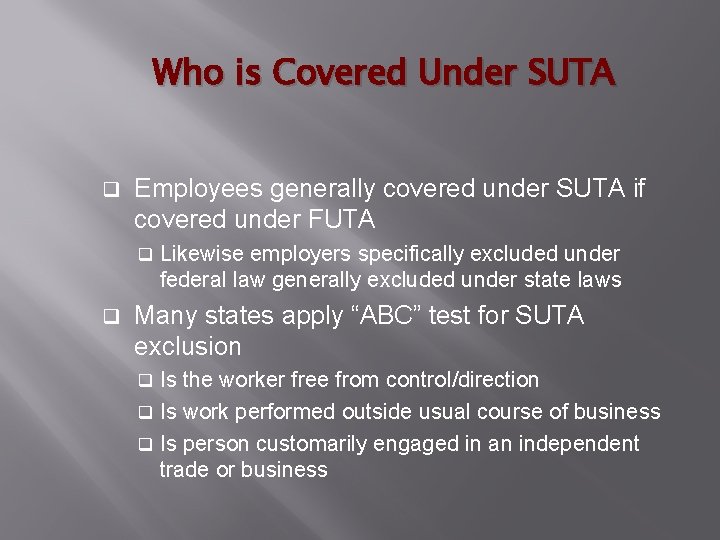
Who is Covered Under SUTA q Employees generally covered under SUTA if covered under FUTA q q Likewise employers specifically excluded under federal law generally excluded under state laws Many states apply “ABC” test for SUTA exclusion Is the worker free from control/direction q Is work performed outside usual course of business q Is person customarily engaged in an independent trade or business q
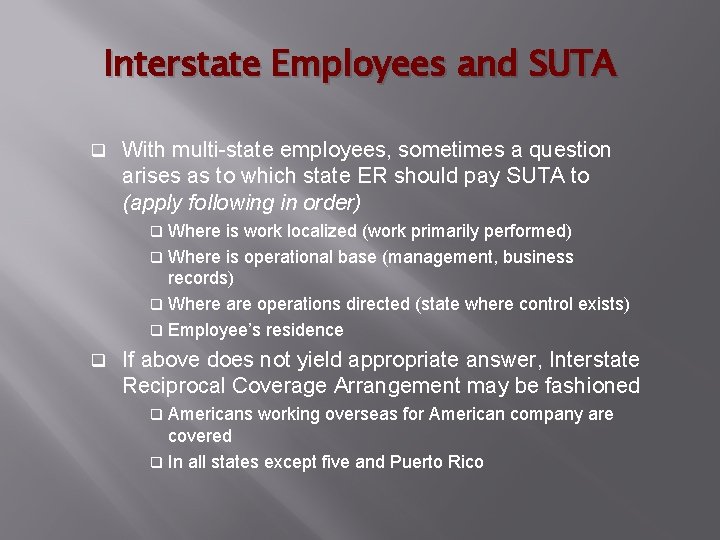
Interstate Employees and SUTA q With multi-state employees, sometimes a question arises as to which state ER should pay SUTA to (apply following in order) Where is work localized (work primarily performed) q Where is operational base (management, business records) q Where are operations directed (state where control exists) q Employee’s residence q q If above does not yield appropriate answer, Interstate Reciprocal Coverage Arrangement may be fashioned Americans working overseas for American company are covered q In all states except five and Puerto Rico q
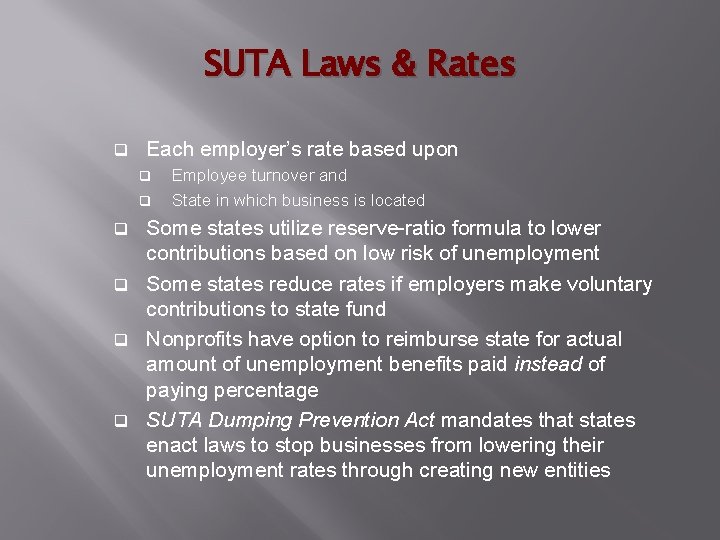
SUTA Laws & Rates q Each employer’s rate based upon q q Employee turnover and State in which business is located Some states utilize reserve-ratio formula to lower contributions based on low risk of unemployment q Some states reduce rates if employers make voluntary contributions to state fund q Nonprofits have option to reimburse state for actual amount of unemployment benefits paid instead of paying percentage q SUTA Dumping Prevention Act mandates that states enact laws to stop businesses from lowering their unemployment rates through creating new entities q
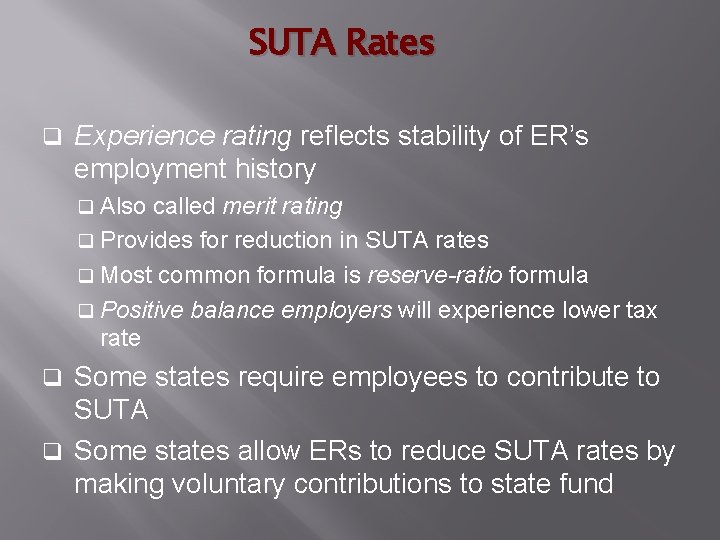
SUTA Rates q Experience rating reflects stability of ER’s employment history q Also called merit rating q Provides for reduction in SUTA rates q Most common formula is reserve-ratio formula q Positive balance employers will experience lower tax rate Some states require employees to contribute to SUTA q Some states allow ERs to reduce SUTA rates by making voluntary contributions to state fund q
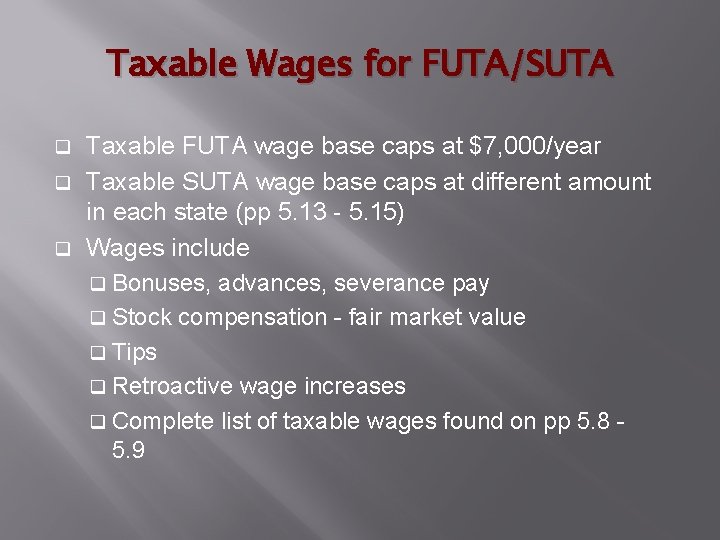
Taxable Wages for FUTA/SUTA Taxable FUTA wage base caps at $7, 000/year q Taxable SUTA wage base caps at different amount in each state (pp 5. 13 - 5. 15) q Wages include q Bonuses, advances, severance pay q Stock compensation - fair market value q Tips q Retroactive wage increases q Complete list of taxable wages found on pp 5. 8 5. 9 q
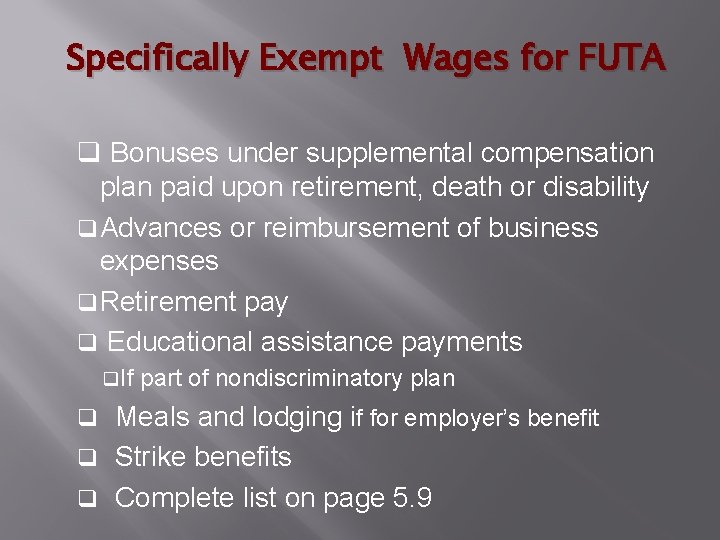
Specifically Exempt Wages for FUTA q Bonuses under supplemental compensation plan paid upon retirement, death or disability q Advances or reimbursement of business expenses q Retirement pay q Educational assistance payments q. If part of nondiscriminatory plan Meals and lodging if for employer’s benefit q Strike benefits q Complete list on page 5. 9 q
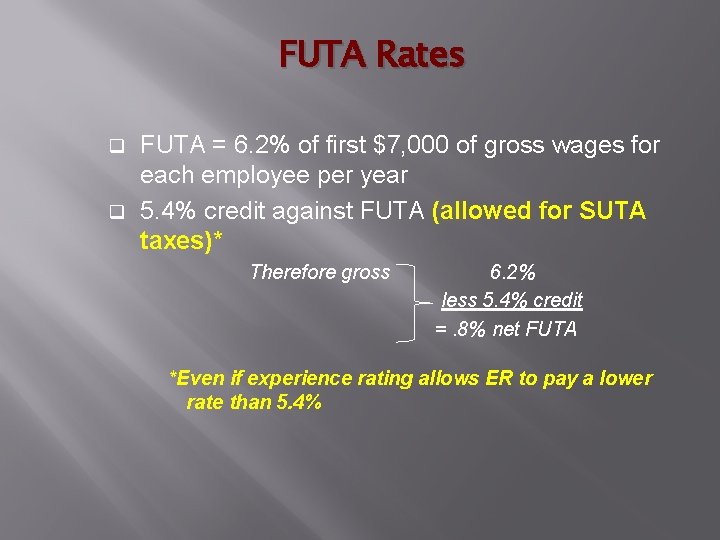
FUTA Rates FUTA = 6. 2% of first $7, 000 of gross wages for each employee per year q 5. 4% credit against FUTA (allowed for SUTA taxes)* q Therefore gross 6. 2% less 5. 4% credit =. 8% net FUTA *Even if experience rating allows ER to pay a lower rate than 5. 4%
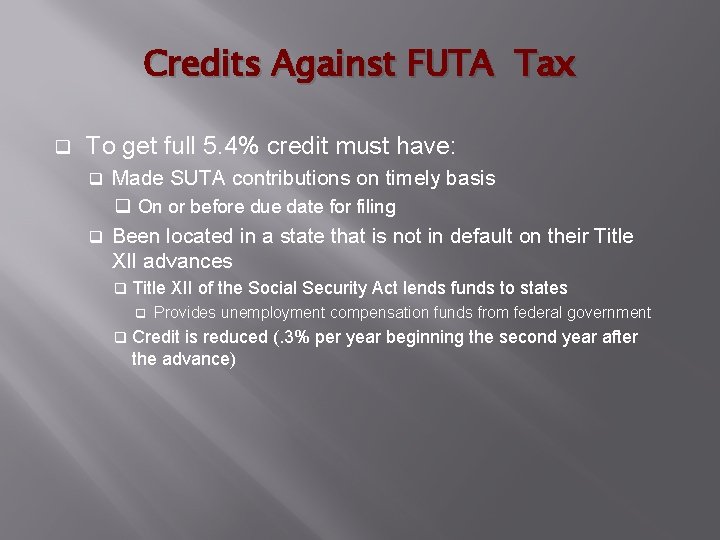
Credits Against FUTA Tax q To get full 5. 4% credit must have: q Made SUTA contributions on timely basis q On or before due date for filing q Been located in a state that is not in default on their Title XII advances q Title XII of the Social Security Act lends funds to states q q Provides unemployment compensation funds from federal government Credit is reduced (. 3% per year beginning the second year after the advance)
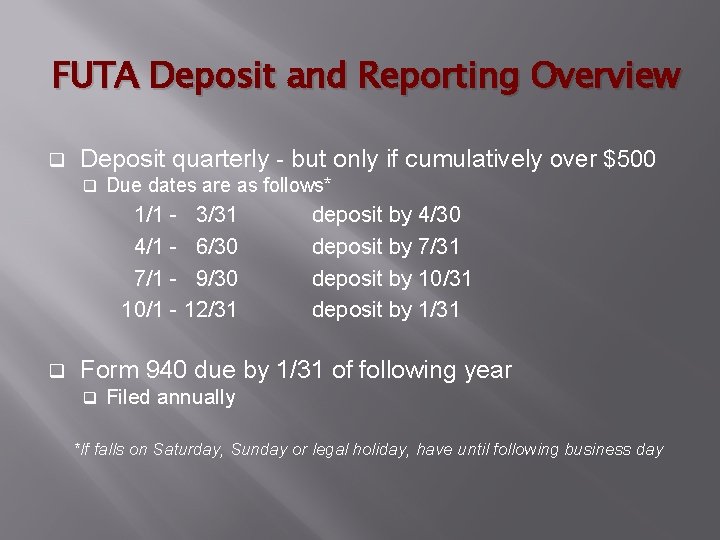
FUTA Deposit and Reporting Overview q Deposit quarterly - but only if cumulatively over $500 q Due dates are as follows* 1/1 - 3/31 4/1 - 6/30 7/1 - 9/30 10/1 - 12/31 q deposit by 4/30 deposit by 7/31 deposit by 10/31 deposit by 1/31 Form 940 due by 1/31 of following year q Filed annually *If falls on Saturday, Sunday or legal holiday, have until following business day
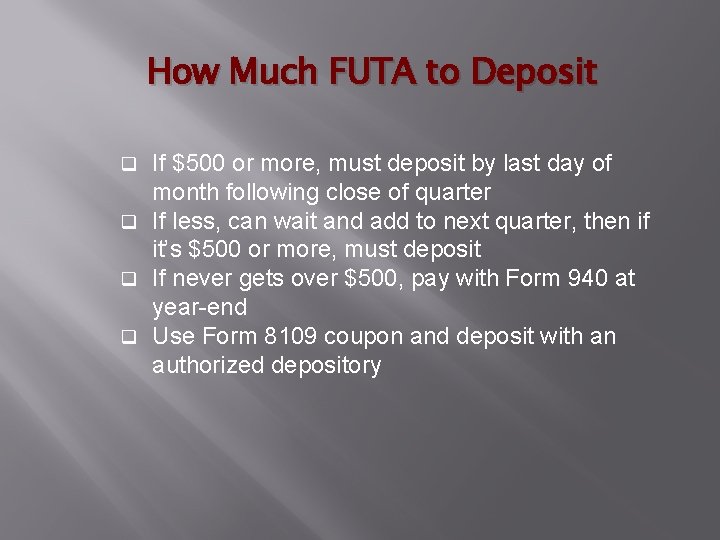
How Much FUTA to Deposit If $500 or more, must deposit by last day of month following close of quarter q If less, can wait and add to next quarter, then if it’s $500 or more, must deposit q If never gets over $500, pay with Form 940 at year-end q Use Form 8109 coupon and deposit with an authorized depository q
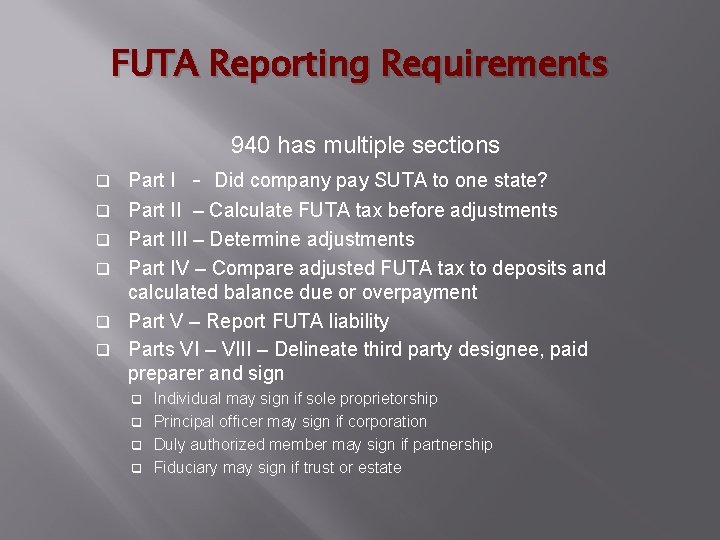
FUTA Reporting Requirements 940 has multiple sections q q q Part I - Did company pay SUTA to one state? Part II – Calculate FUTA tax before adjustments Part III – Determine adjustments Part IV – Compare adjusted FUTA tax to deposits and calculated balance due or overpayment Part V – Report FUTA liability Parts VI – VIII – Delineate third party designee, paid preparer and sign Individual may sign if sole proprietorship q Principal officer may sign if corporation q Duly authorized member may sign if partnership q Fiduciary may sign if trust or estate q
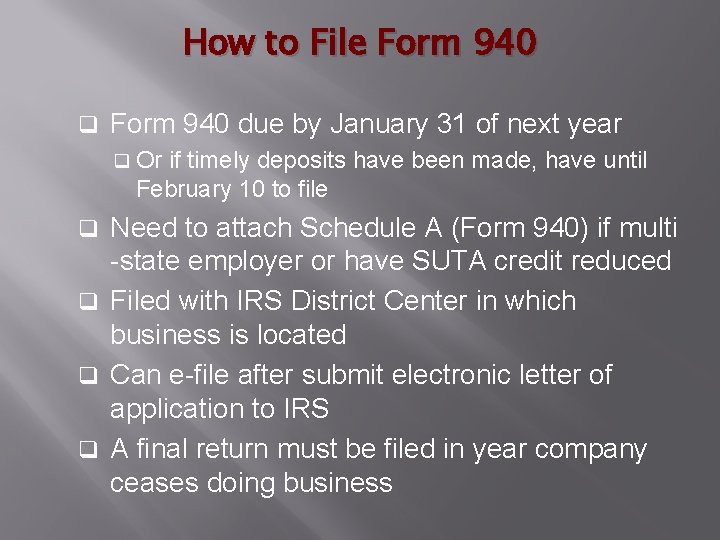
How to File Form 940 q Form 940 due by January 31 of next year q Or if timely deposits have been made, have until February 10 to file Need to attach Schedule A (Form 940) if multi -state employer or have SUTA credit reduced q Filed with IRS District Center in which business is located q Can e-file after submit electronic letter of application to IRS q A final return must be filed in year company ceases doing business q
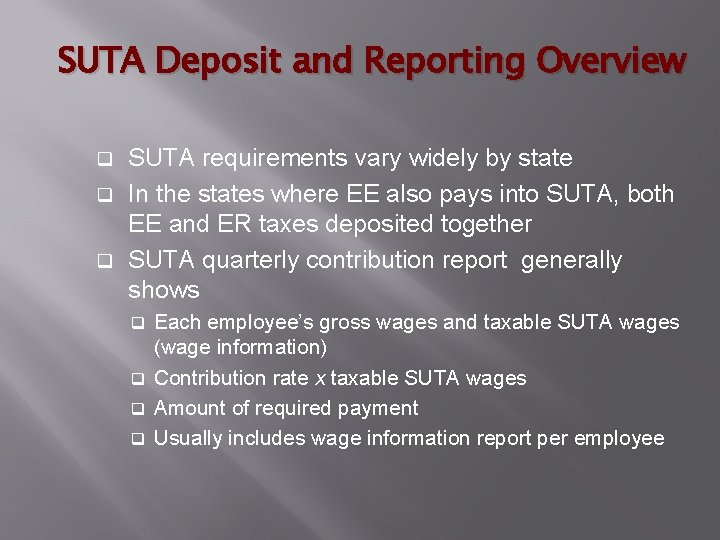
SUTA Deposit and Reporting Overview SUTA requirements vary widely by state q In the states where EE also pays into SUTA, both EE and ER taxes deposited together q SUTA quarterly contribution report generally shows q Each employee’s gross wages and taxable SUTA wages (wage information) q Contribution rate x taxable SUTA wages q Amount of required payment q Usually includes wage information report per employee q
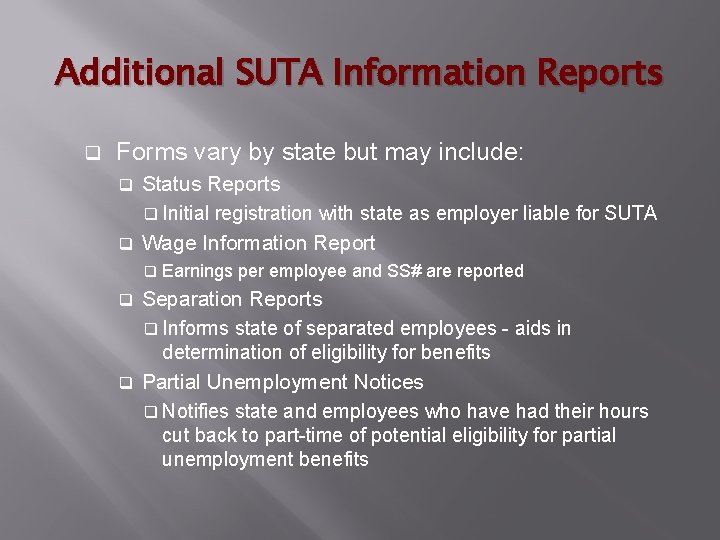
Additional SUTA Information Reports q Forms vary by state but may include: Status Reports q Initial registration with state as employer liable for SUTA q Wage Information Report q q Earnings per employee and SS# are reported Separation Reports q Informs state of separated employees - aids in determination of eligibility for benefits q Partial Unemployment Notices q Notifies state and employees who have had their hours cut back to part-time of potential eligibility for partial unemployment benefits q