
Chapter 5 Understanding the requirements 1 Requirements engineering
- Slides: 52
Chapter 5 Understanding the requirements 1
Requirements engineering • The broad spectrum of tasks and techniques that lead to an understanding of requirements is called requirements engineering • From a software process perspective, requirements engineering is a major software engineering action that begins during the communication activity and continues into the modeling activity 2
Requirements engineering • It encompasses seven distinct tasks: inception, elicitation, elaboration, negotiation, specification, validation, and management 3
Requirements engineering: inception • At project inception, you establish a basic understanding of the problem, the people who want a solution, the nature of the solution that is desired, and the effectiveness of preliminary communication and collaboration between the other stakeholders and the software team. 4
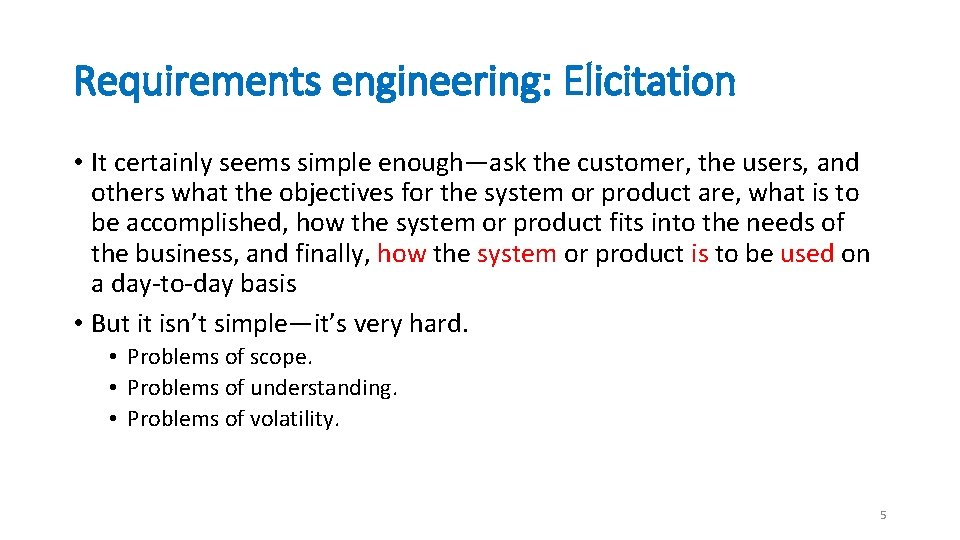
Requirements engineering: Elicitation • It certainly seems simple enough—ask the customer, the users, and others what the objectives for the system or product are, what is to be accomplished, how the system or product fits into the needs of the business, and finally, how the system or product is to be used on a day-to-day basis • But it isn’t simple—it’s very hard. • Problems of scope. • Problems of understanding. • Problems of volatility. 5
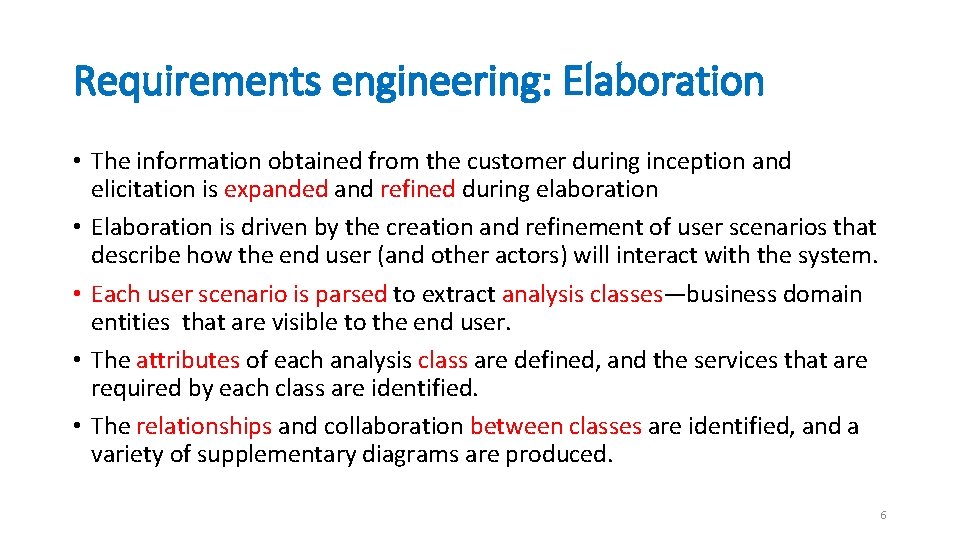
Requirements engineering: Elaboration • The information obtained from the customer during inception and elicitation is expanded and refined during elaboration • Elaboration is driven by the creation and refinement of user scenarios that describe how the end user (and other actors) will interact with the system. • Each user scenario is parsed to extract analysis classes—business domain entities that are visible to the end user. • The attributes of each analysis class are defined, and the services that are required by each class are identified. • The relationships and collaboration between classes are identified, and a variety of supplementary diagrams are produced. 6
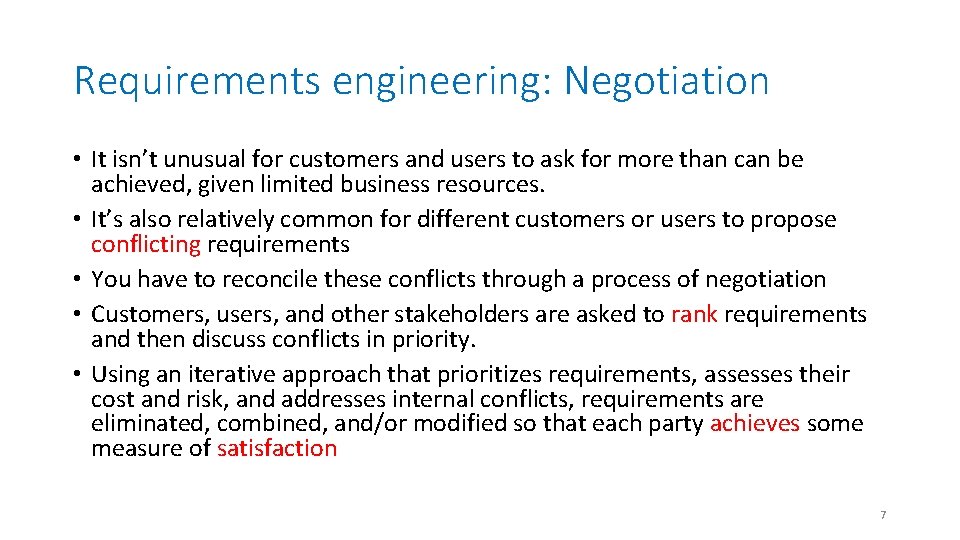
Requirements engineering: Negotiation • It isn’t unusual for customers and users to ask for more than can be achieved, given limited business resources. • It’s also relatively common for different customers or users to propose conflicting requirements • You have to reconcile these conflicts through a process of negotiation • Customers, users, and other stakeholders are asked to rank requirements and then discuss conflicts in priority. • Using an iterative approach that prioritizes requirements, assesses their cost and risk, and addresses internal conflicts, requirements are eliminated, combined, and/or modified so that each party achieves some measure of satisfaction 7
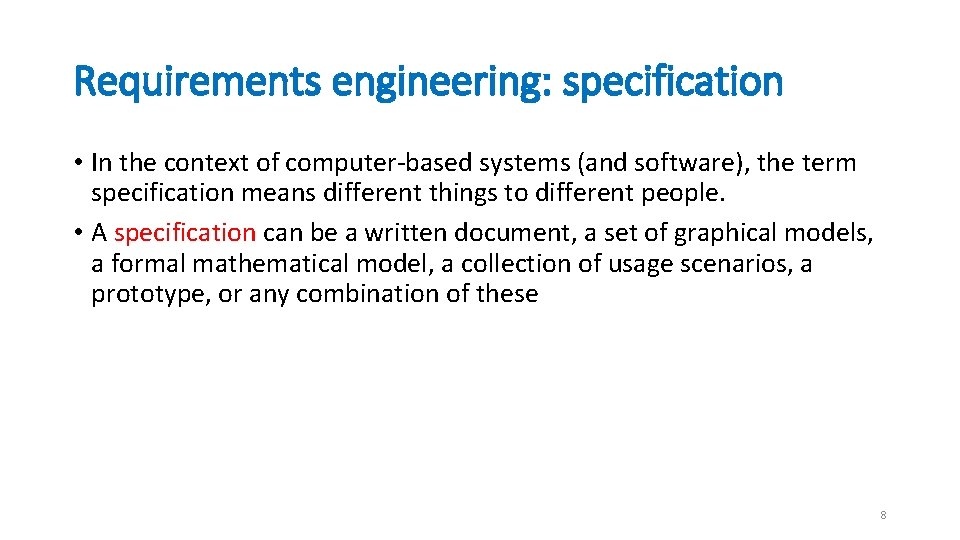
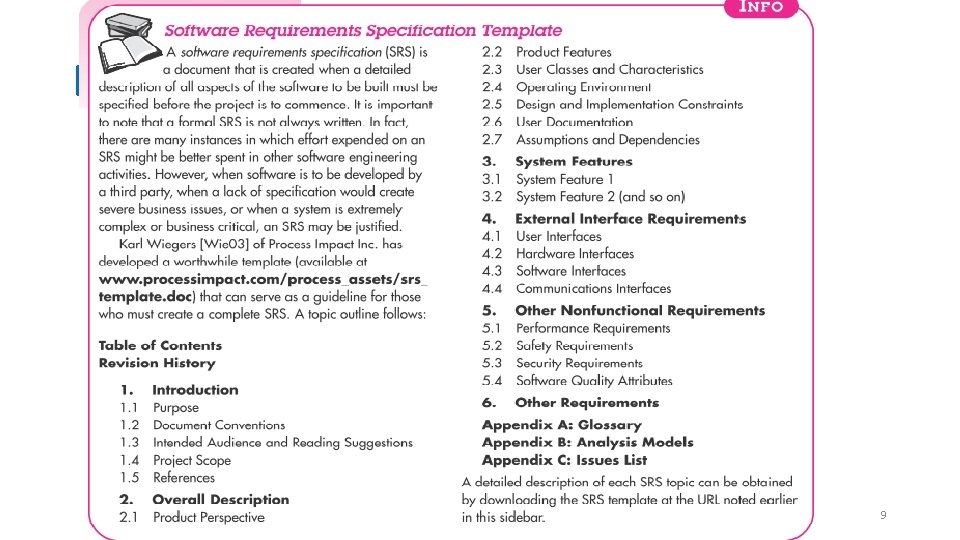
Requirements engineering: specification • In the context of computer-based systems (and software), the term specification means different things to different people. • A specification can be a written document, a set of graphical models, a formal mathematical model, a collection of usage scenarios, a prototype, or any combination of these 8
Requirements engineering 9
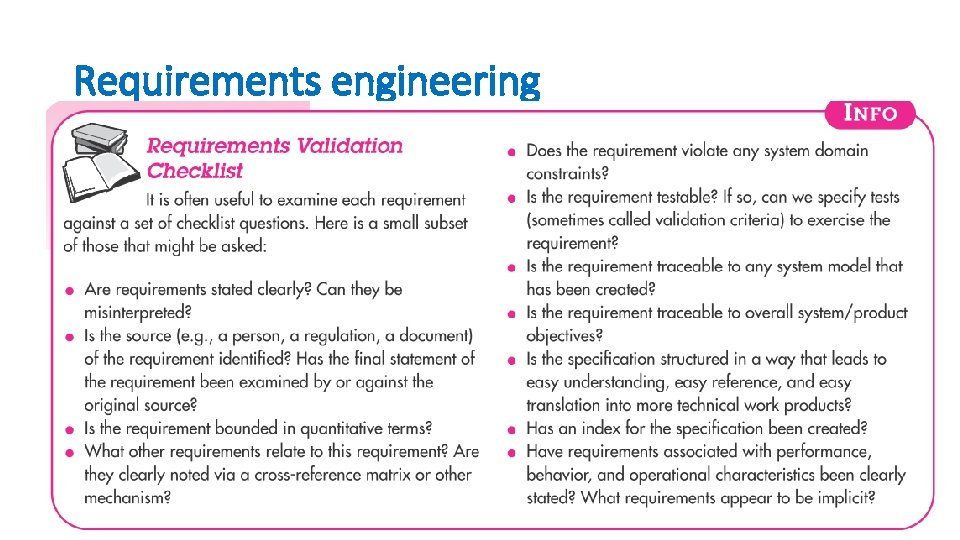
Requirements engineering: Validation • The work products produced as a consequence of requirements engineering are assessed for quality during a validation step. • Requirements validation examines the specification to ensure that all software requirements have been stated unambiguously; that inconsistencies, omissions, and errors have been detected and corrected; and that the work products conform to the standards established for the process, the project, and the product. 10
Requirements engineering 11
Requirements engineering: Requirements management • Requirements management is a set of activities that help the project team identify, control, and track requirements and changes to requirements at any time as the project proceeds 12
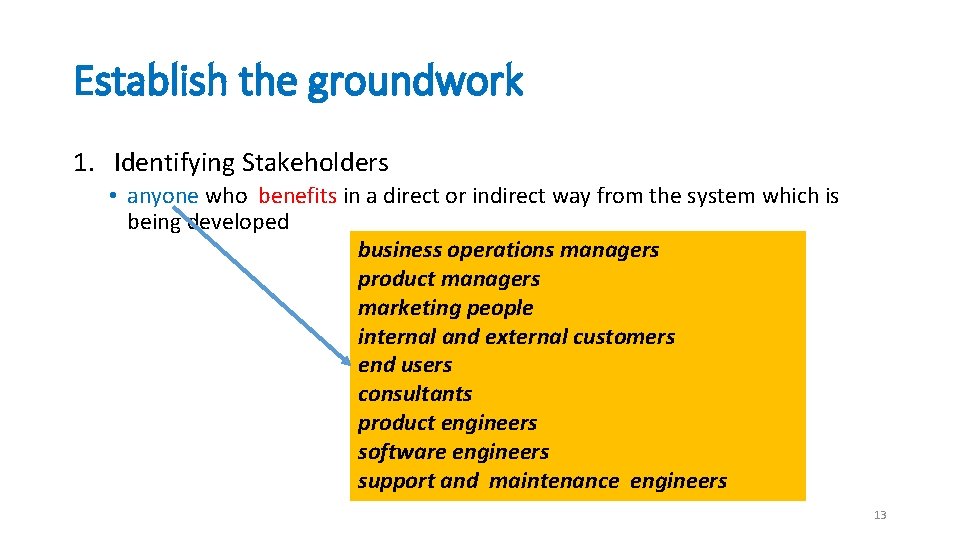
Establish the groundwork 1. Identifying Stakeholders • anyone who benefits in a direct or indirect way from the system which is being developed business operations managers product managers marketing people internal and external customers end users consultants product engineers software engineers support and maintenance engineers 13
Establish the groundwork • At inception, you should create a list of people who will contribute input as requirements are elicited (Section 5. 3). • The initial list will grow as stakeholders are contacted because every stakeholder will be asked: “Whom else do you think I should talk to? ” 14
Establish the groundwork 2. Recognizing Multiple Viewpoints • You should categorize all stakeholder information (including inconsistent and conflicting requirements) in a way that will allow decision makers to choose an internally consistent set of requirements for the system. 15
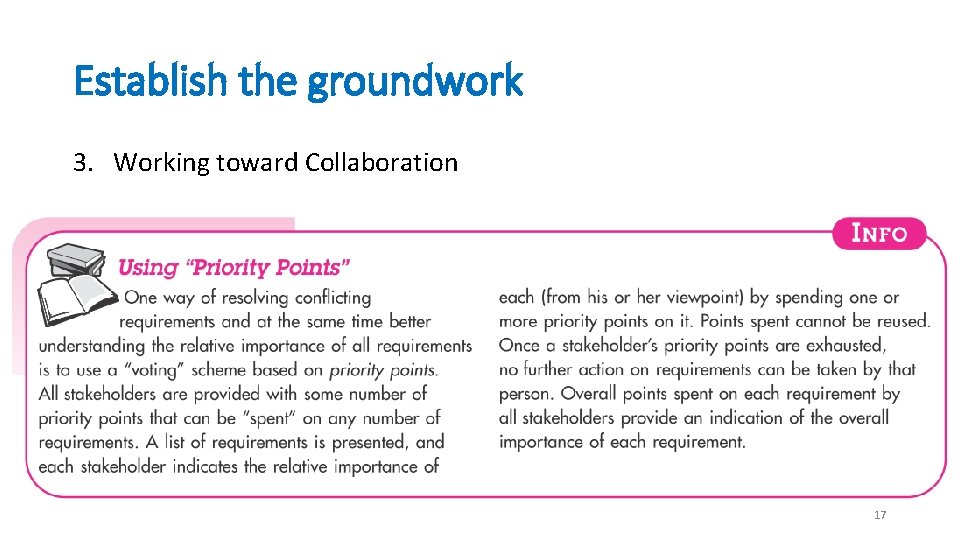
Establish the groundwork 3. Working toward Collaboration • The job of a requirements engineer is to identify areas of commonality (i. e. , requirements on which all stakeholders agree) and areas of conflict or inconsistency (i. e. , requirements that are desired by one stakeholder but conflict with the needs of another stakeholder). • Collaboration does not necessarily mean that requirements are defined by committee. In many cases, stakeholders collaborate by providing their view of requirements, but a strong “project champion”(e. g. , a business manager or a senior technologist) may make the final decision about which requirements make the cut. 16
Establish the groundwork 3. Working toward Collaboration 17
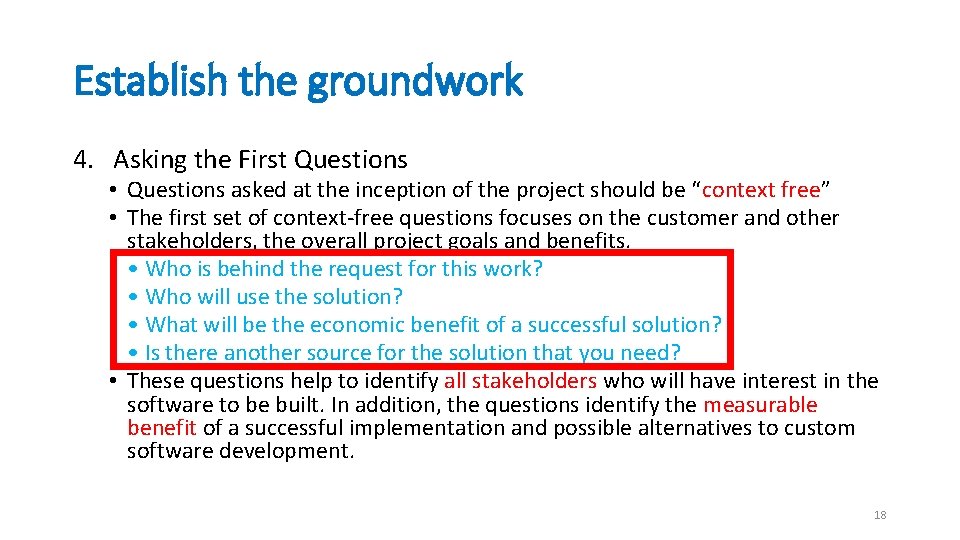
Establish the groundwork 4. Asking the First Questions • Questions asked at the inception of the project should be “context free” • The first set of context-free questions focuses on the customer and other stakeholders, the overall project goals and benefits. • • Who is behind the request for this work? • • Who will use the solution? • • What will be the economic benefit of a successful solution? • • Is there another source for the solution that you need? • These questions help to identify all stakeholders who will have interest in the software to be built. In addition, the questions identify the measurable benefit of a successful implementation and possible alternatives to custom software development. 18
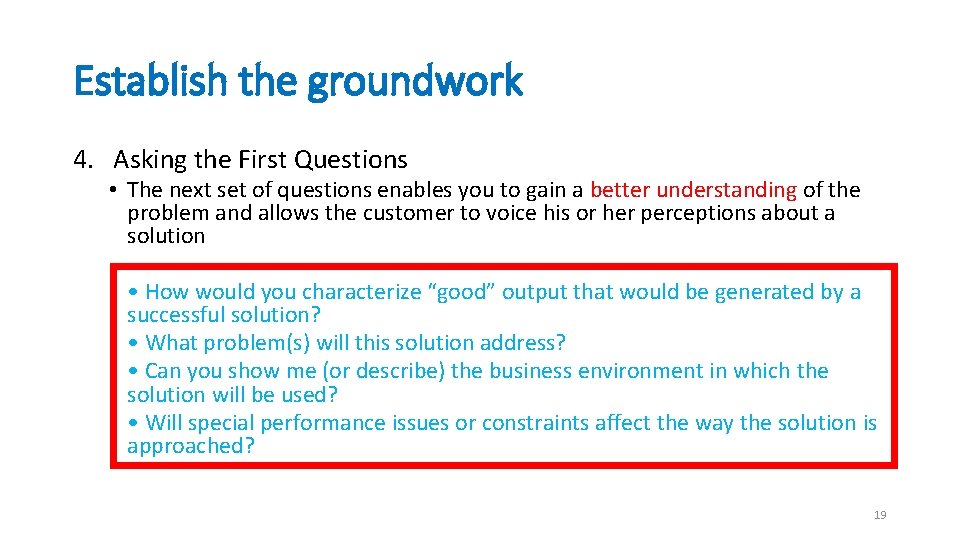
Establish the groundwork 4. Asking the First Questions • The next set of questions enables you to gain a better understanding of the problem and allows the customer to voice his or her perceptions about a solution • • How would you characterize “good” output that would be generated by a successful solution? • • What problem(s) will this solution address? • • Can you show me (or describe) the business environment in which the solution will be used? • • Will special performance issues or constraints affect the way the solution is approached? 19
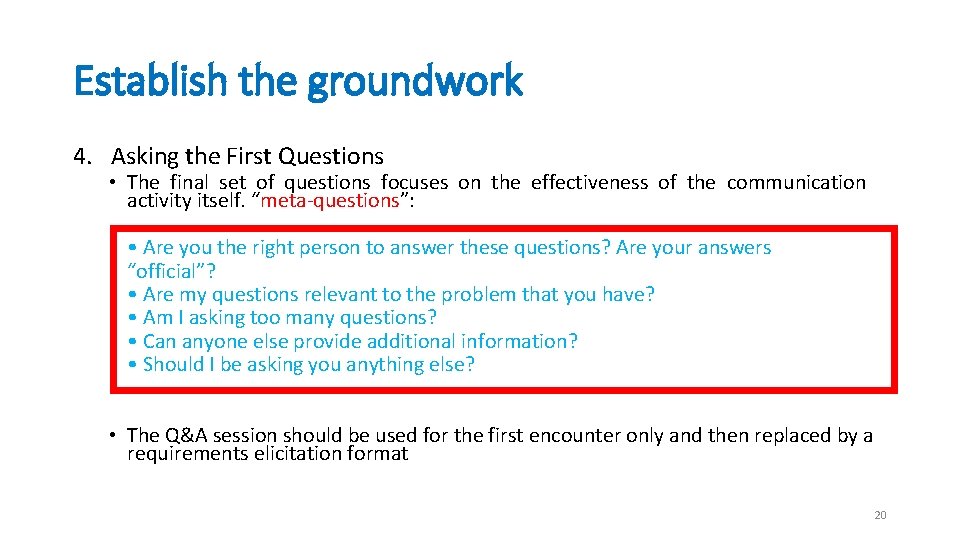
Establish the groundwork 4. Asking the First Questions • The final set of questions focuses on the effectiveness of the communication activity itself. “meta-questions”: • • Are you the right person to answer these questions? Are your answers “official”? • Are my questions relevant to the problem that you have? • Am I asking too many questions? • Can anyone else provide additional information? • Should I be asking you anything else? • The Q&A session should be used for the first encounter only and then replaced by a requirements elicitation format 20
Requirements gathering combines elements of problem solving, elaboration, negotiation, and specification. 21
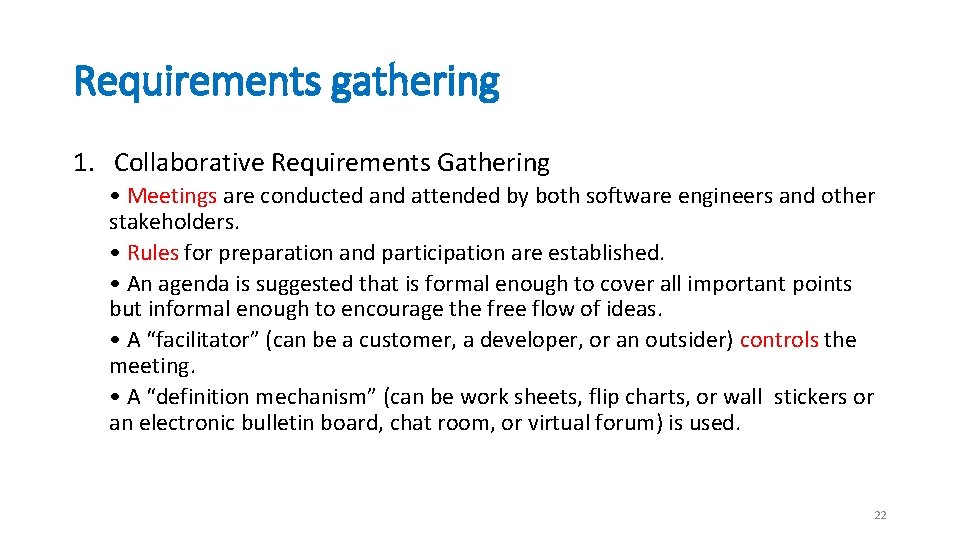
Requirements gathering 1. Collaborative Requirements Gathering • Meetings are conducted and attended by both software engineers and other stakeholders. • Rules for preparation and participation are established. • An agenda is suggested that is formal enough to cover all important points but informal enough to encourage the free flow of ideas. • A “facilitator” (can be a customer, a developer, or an outsider) controls the meeting. • A “definition mechanism” (can be work sheets, flip charts, or wall stickers or an electronic bulletin board, chat room, or virtual forum) is used. 22
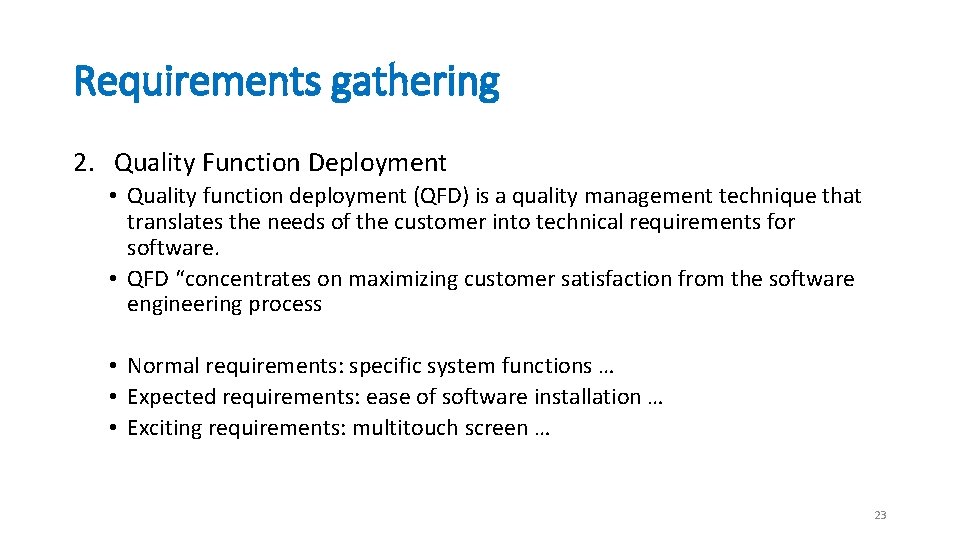
Requirements gathering 2. Quality Function Deployment • Quality function deployment (QFD) is a quality management technique that translates the needs of the customer into technical requirements for software. • QFD “concentrates on maximizing customer satisfaction from the software engineering process • Normal requirements: specific system functions … • Expected requirements: ease of software installation … • Exciting requirements: multitouch screen … 23
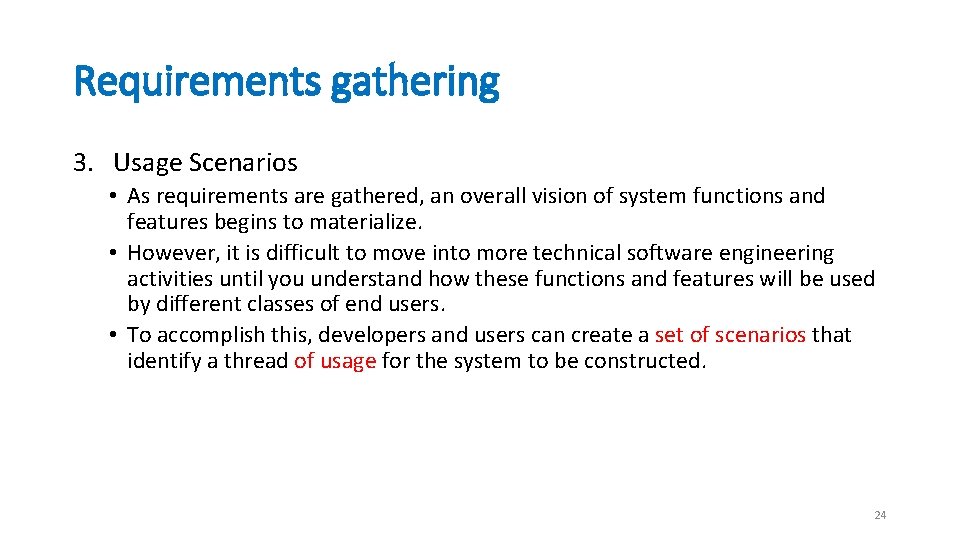
Requirements gathering 3. Usage Scenarios • As requirements are gathered, an overall vision of system functions and features begins to materialize. • However, it is difficult to move into more technical software engineering activities until you understand how these functions and features will be used by different classes of end users. • To accomplish this, developers and users can create a set of scenarios that identify a thread of usage for the system to be constructed. 24
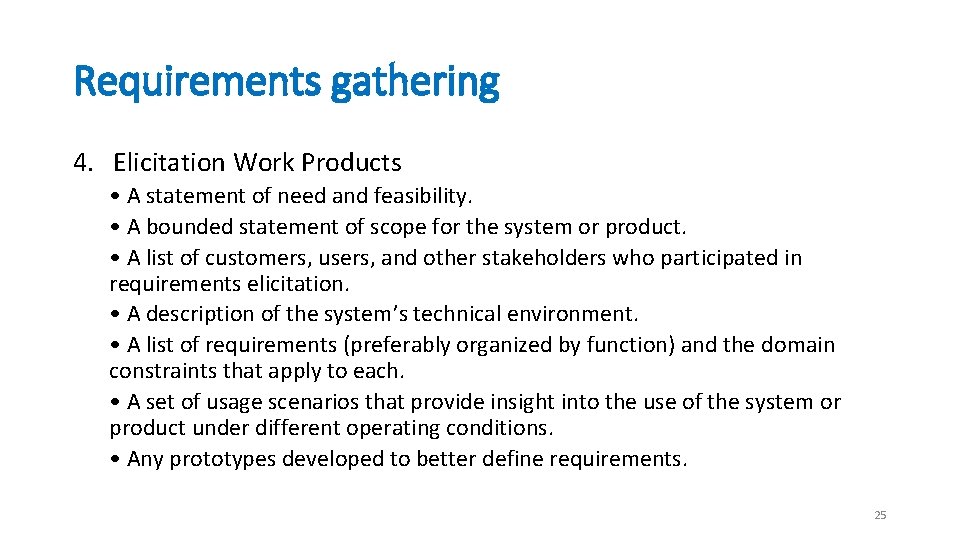
Requirements gathering 4. Elicitation Work Products • A statement of need and feasibility. • A bounded statement of scope for the system or product. • A list of customers, users, and other stakeholders who participated in requirements elicitation. • A description of the system’s technical environment. • A list of requirements (preferably organized by function) and the domain constraints that apply to each. • A set of usage scenarios that provide insight into the use of the system or product under different operating conditions. • Any prototypes developed to better define requirements. 25
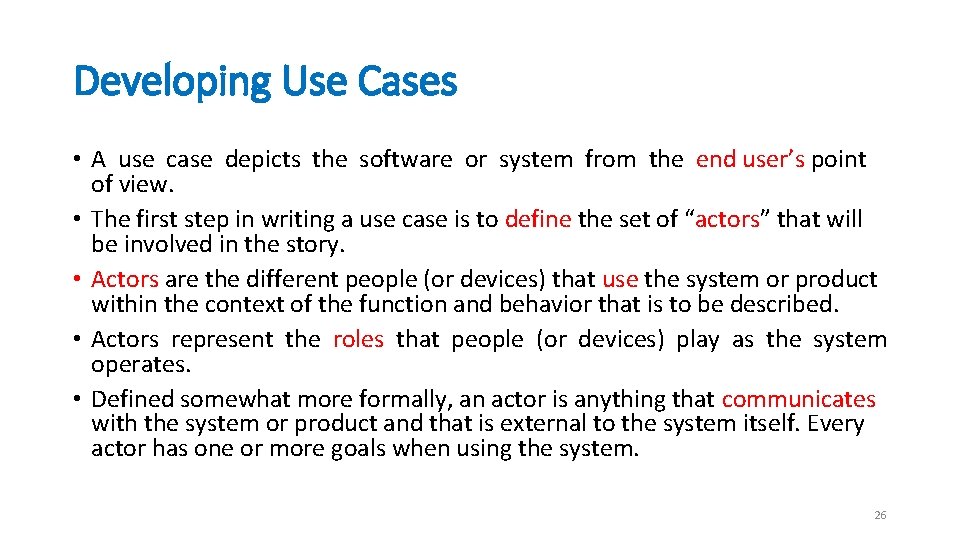
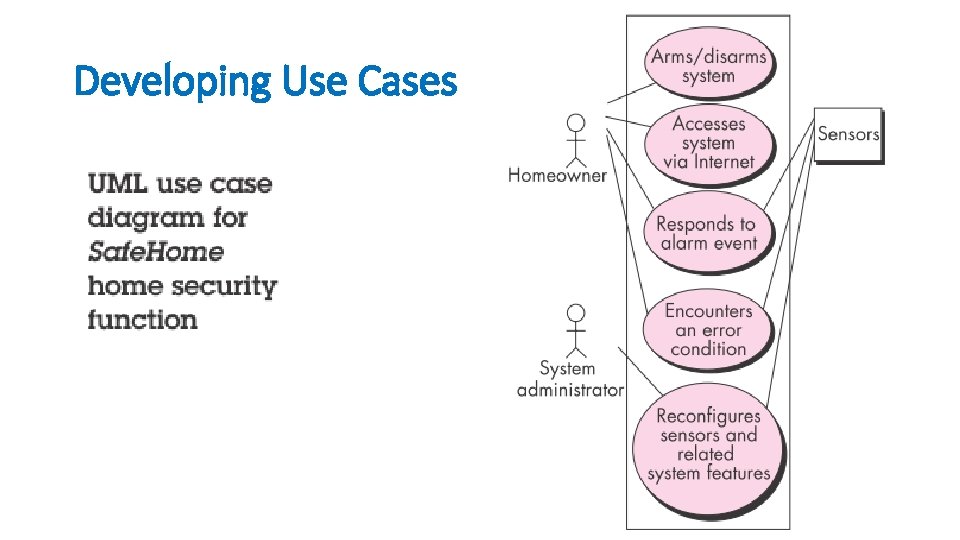
Developing Use Cases • A use case depicts the software or system from the end user’s point of view. • The first step in writing a use case is to define the set of “actors” that will be involved in the story. • Actors are the different people (or devices) that use the system or product within the context of the function and behavior that is to be described. • Actors represent the roles that people (or devices) play as the system operates. • Defined somewhat more formally, an actor is anything that communicates with the system or product and that is external to the system itself. Every actor has one or more goals when using the system. 26
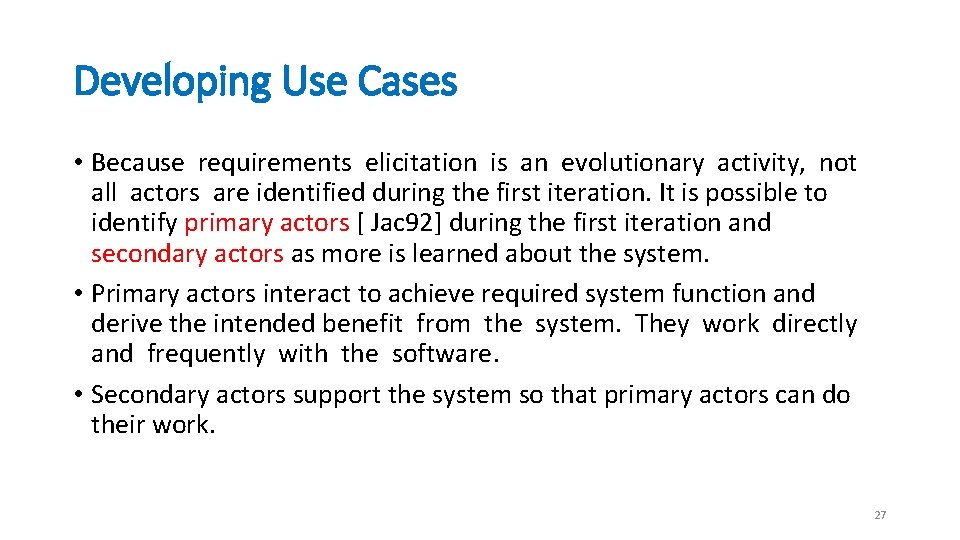
Developing Use Cases • Because requirements elicitation is an evolutionary activity, not all actors are identified during the first iteration. It is possible to identify primary actors [ Jac 92] during the first iteration and secondary actors as more is learned about the system. • Primary actors interact to achieve required system function and derive the intended benefit from the system. They work directly and frequently with the software. • Secondary actors support the system so that primary actors can do their work. 27
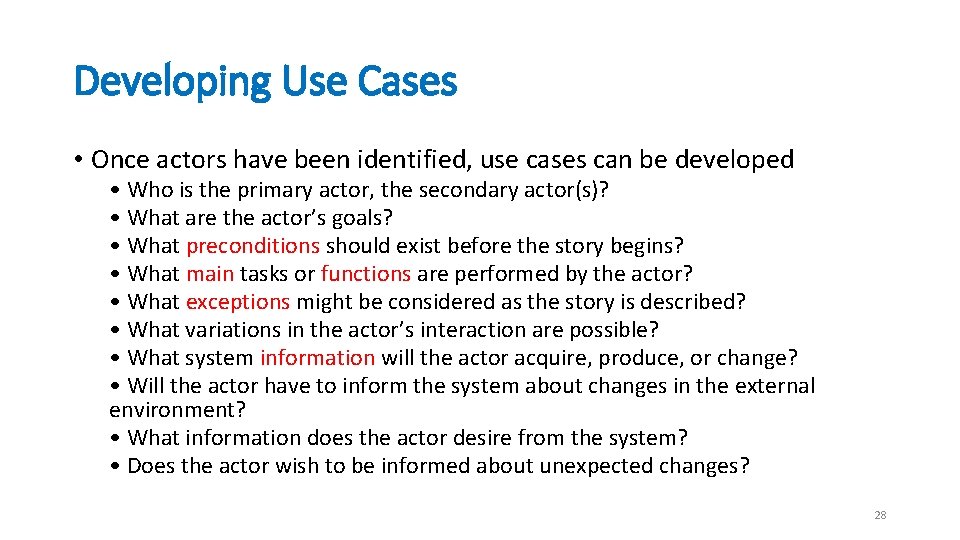
Developing Use Cases • Once actors have been identified, use cases can be developed • Who is the primary actor, the secondary actor(s)? • What are the actor’s goals? • What preconditions should exist before the story begins? • What main tasks or functions are performed by the actor? • What exceptions might be considered as the story is described? • What variations in the actor’s interaction are possible? • What system information will the actor acquire, produce, or change? • Will the actor have to inform the system about changes in the external environment? • What information does the actor desire from the system? • Does the actor wish to be informed about unexpected changes? 28
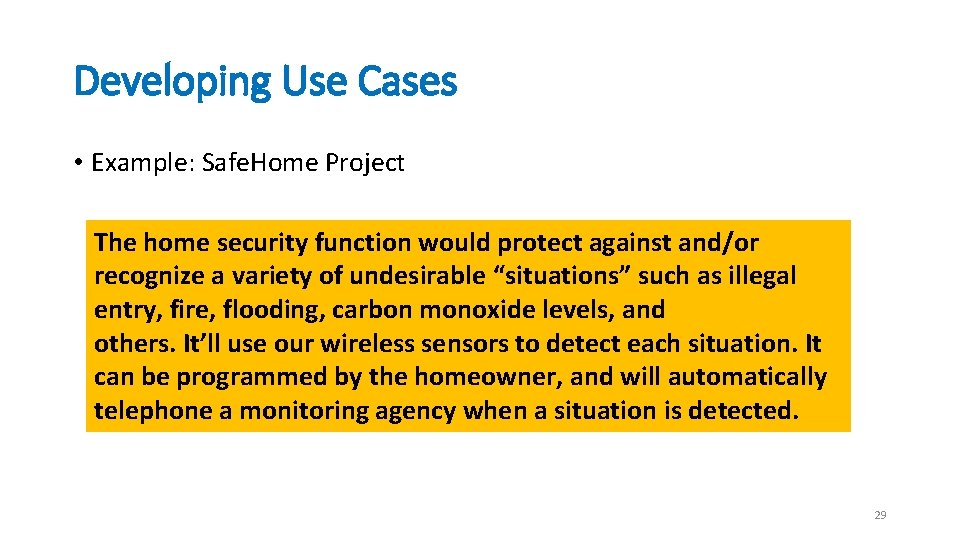
Developing Use Cases • Example: Safe. Home Project The home security function would protect against and/or recognize a variety of undesirable “situations” such as illegal entry, fire, flooding, carbon monoxide levels, and others. It’ll use our wireless sensors to detect each situation. It can be programmed by the homeowner, and will automatically telephone a monitoring agency when a situation is detected. 29
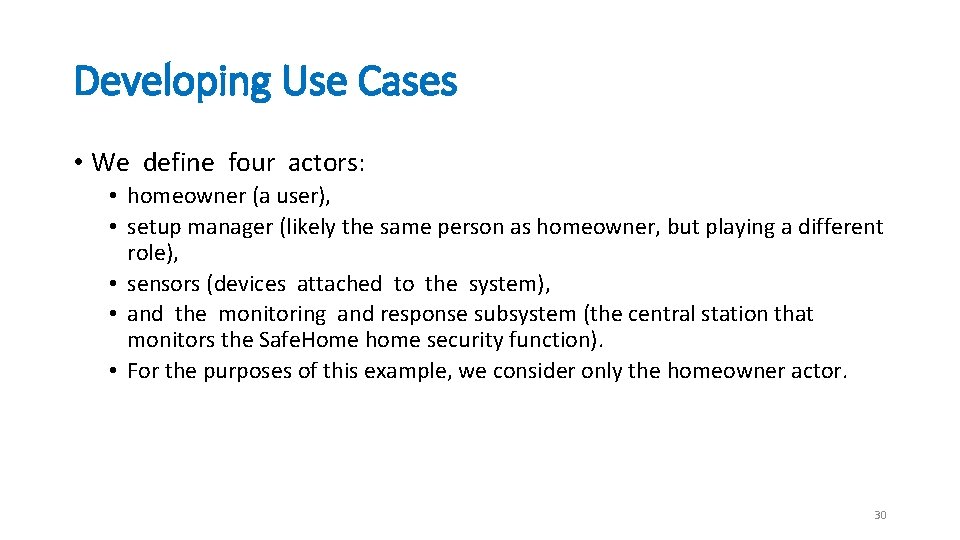
Developing Use Cases • We define four actors: • homeowner (a user), • setup manager (likely the same person as homeowner, but playing a different role), • sensors (devices attached to the system), • and the monitoring and response subsystem (the central station that monitors the Safe. Home home security function). • For the purposes of this example, we consider only the homeowner actor. 30
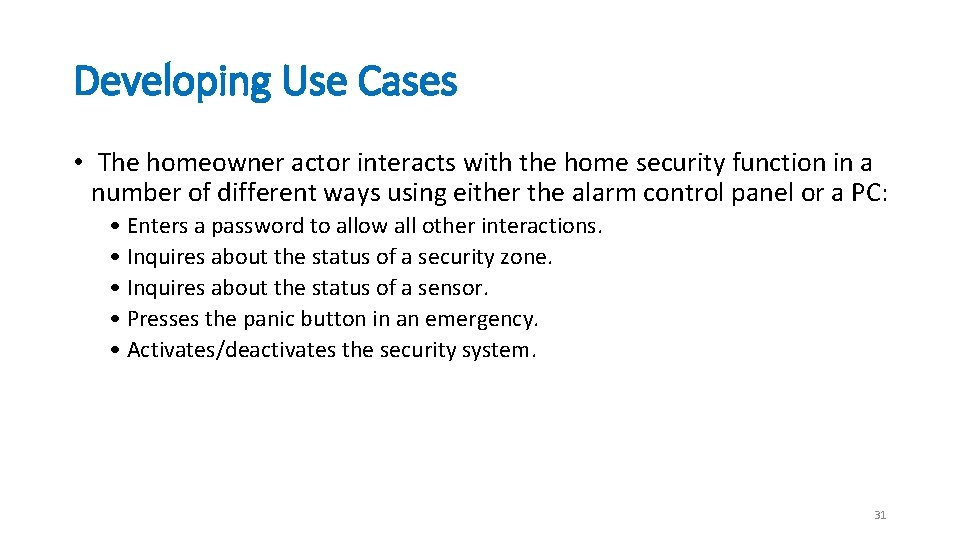
Developing Use Cases • The homeowner actor interacts with the home security function in a number of different ways using either the alarm control panel or a PC: • Enters a password to allow all other interactions. • Inquires about the status of a security zone. • Inquires about the status of a sensor. • Presses the panic button in an emergency. • Activates/deactivates the security system. 31
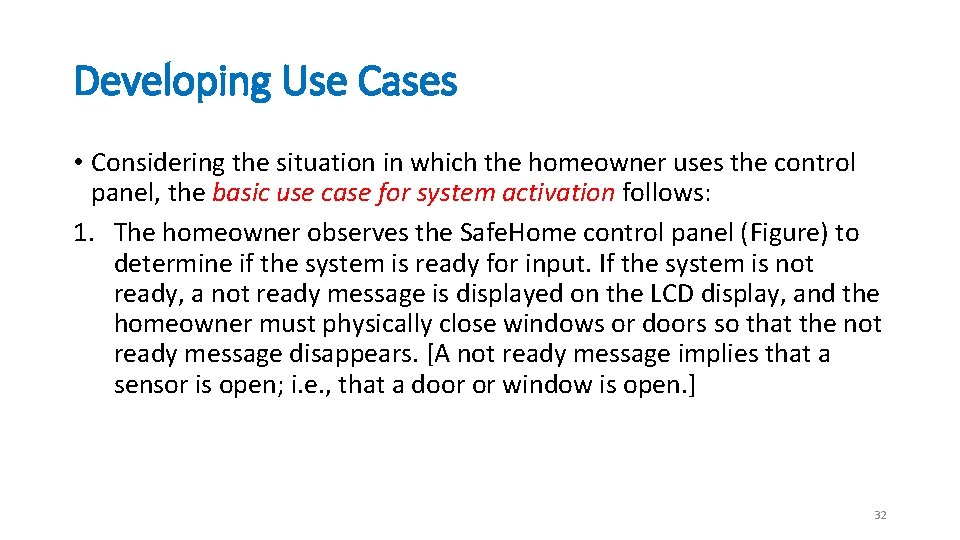
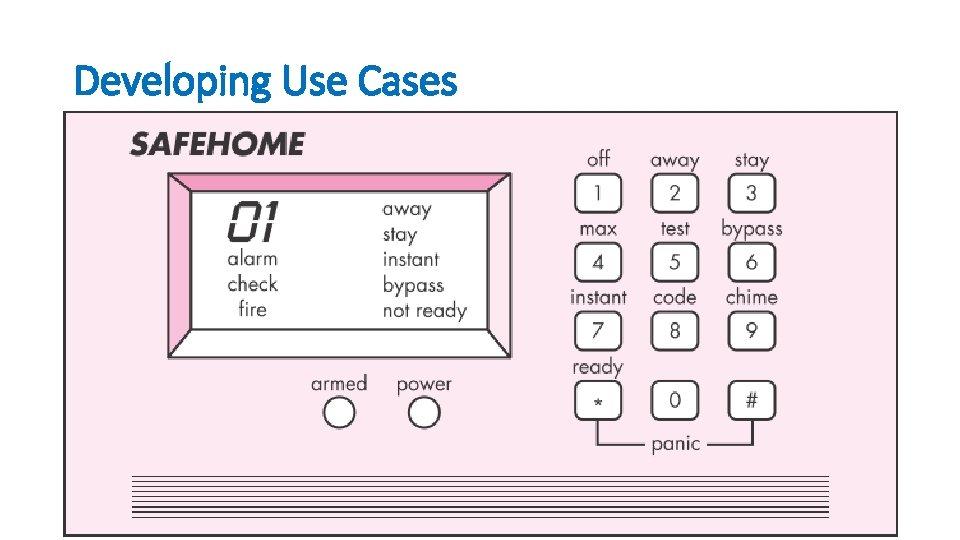
Developing Use Cases • Considering the situation in which the homeowner uses the control panel, the basic use case for system activation follows: 1. The homeowner observes the Safe. Home control panel (Figure) to determine if the system is ready for input. If the system is not ready, a not ready message is displayed on the LCD display, and the homeowner must physically close windows or doors so that the not ready message disappears. [A not ready message implies that a sensor is open; i. e. , that a door or window is open. ] 32
Developing Use Cases 33
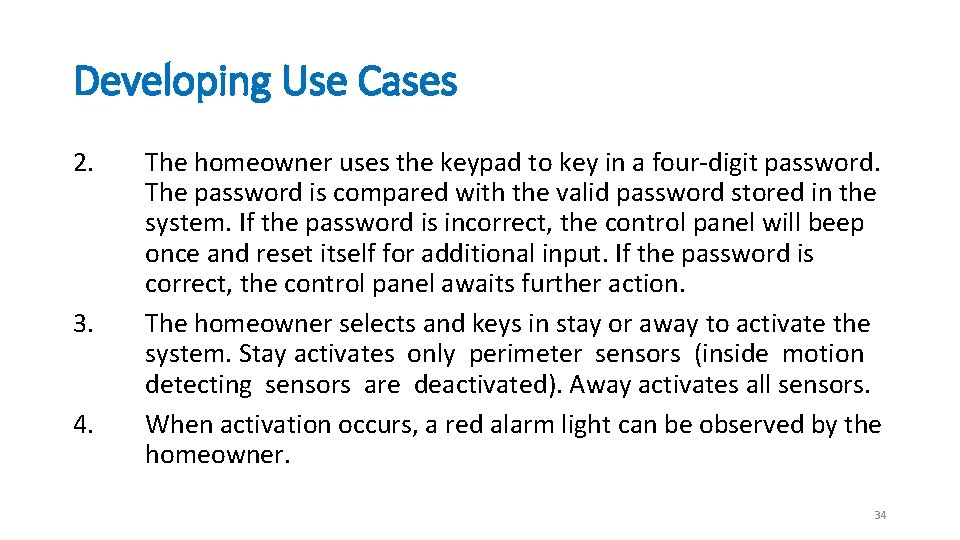
Developing Use Cases 2. 3. 4. The homeowner uses the keypad to key in a four-digit password. The password is compared with the valid password stored in the system. If the password is incorrect, the control panel will beep once and reset itself for additional input. If the password is correct, the control panel awaits further action. The homeowner selects and keys in stay or away to activate the system. Stay activates only perimeter sensors (inside motion detecting sensors are deactivated). Away activates all sensors. When activation occurs, a red alarm light can be observed by the homeowner. 34
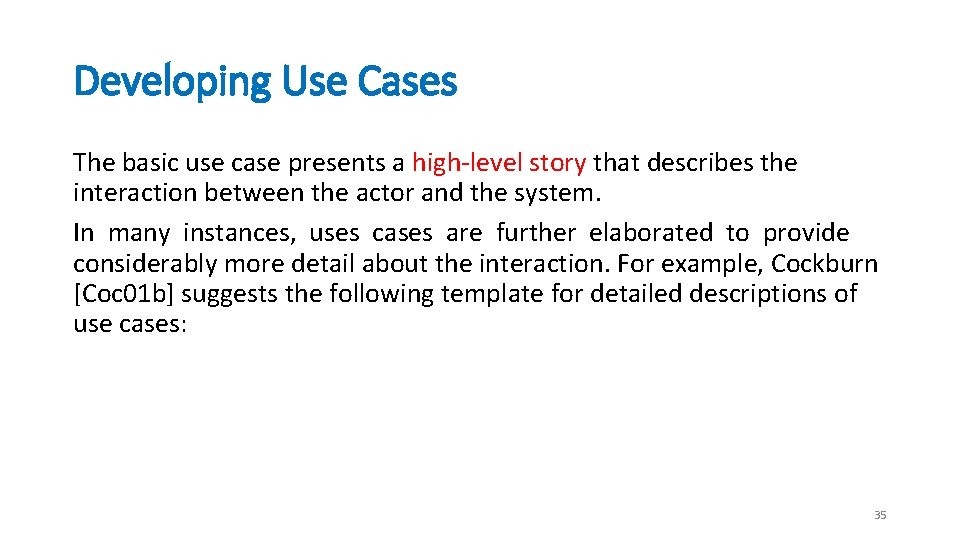
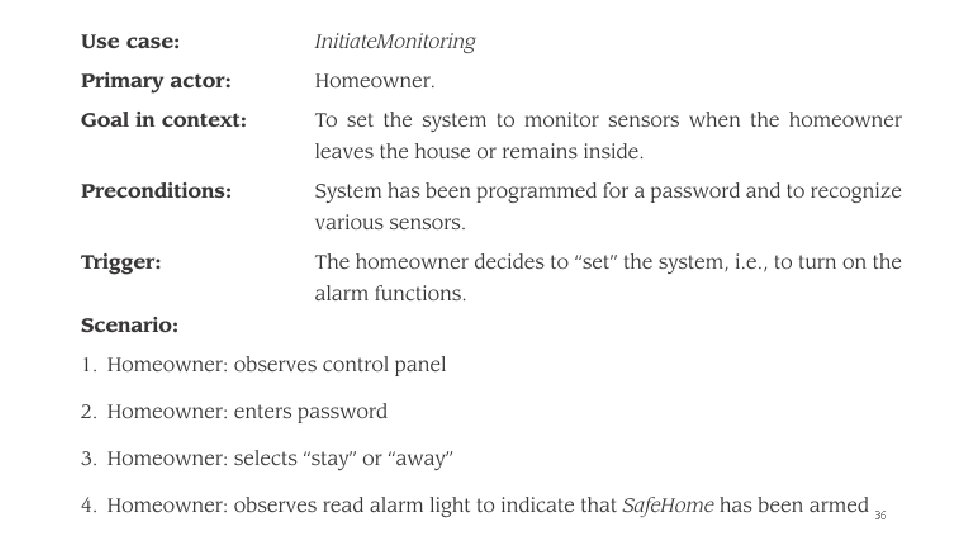
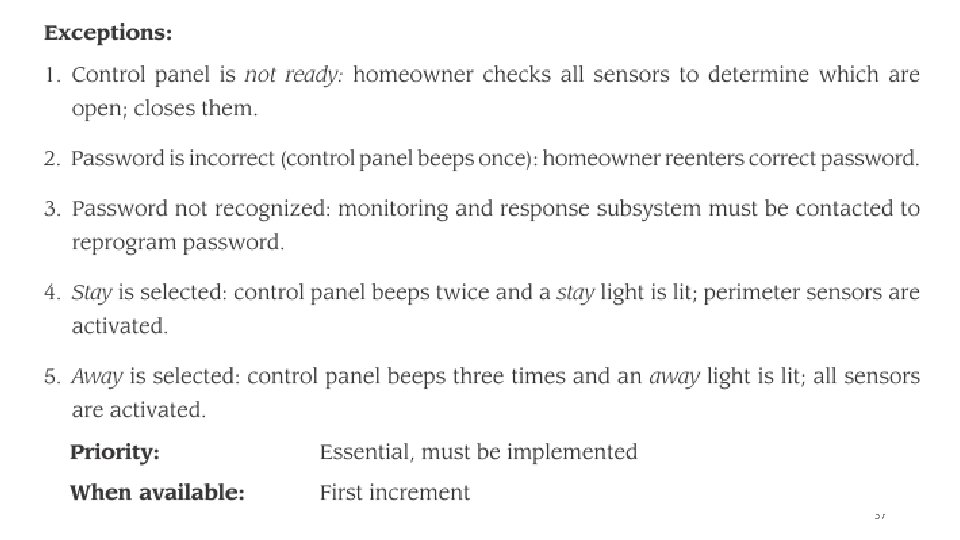
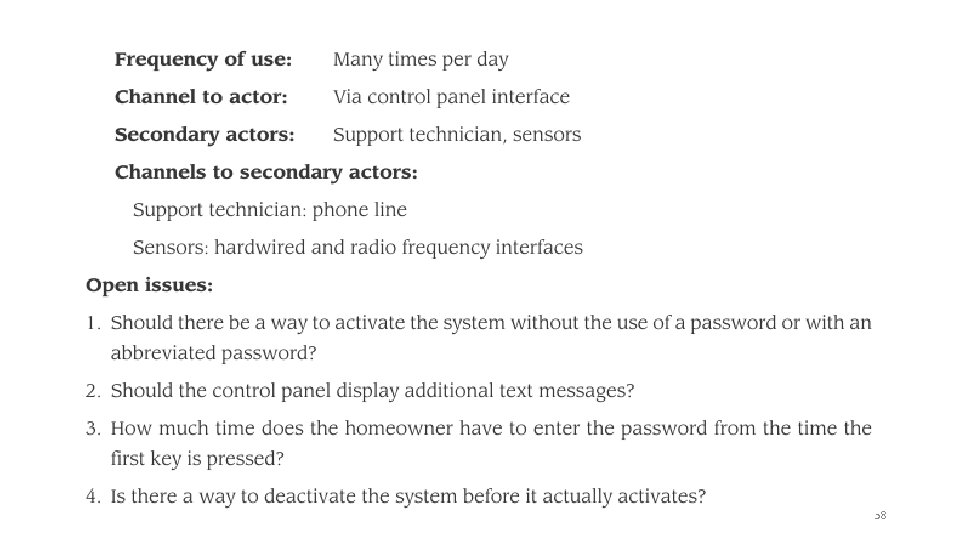
Developing Use Cases The basic use case presents a high-level story that describes the interaction between the actor and the system. In many instances, uses cases are further elaborated to provide considerably more detail about the interaction. For example, Cockburn [Coc 01 b] suggests the following template for detailed descriptions of use cases: 35
Developing Use Cases 36
Developing Use Cases 37
Developing Use Cases 38
Developing Use Cases • Use cases for other homeowner interactions would be developed in a similar manner. • It is important to review each use case with care. If some element of the interaction is ambiguous, it is likely that a review of the use case will indicate a problem 39
Developing Use Cases 40
Building the requirements model (brief overview) Elements of the Requirements Model • There are many different ways to look at the requirements for a computer-based system 41
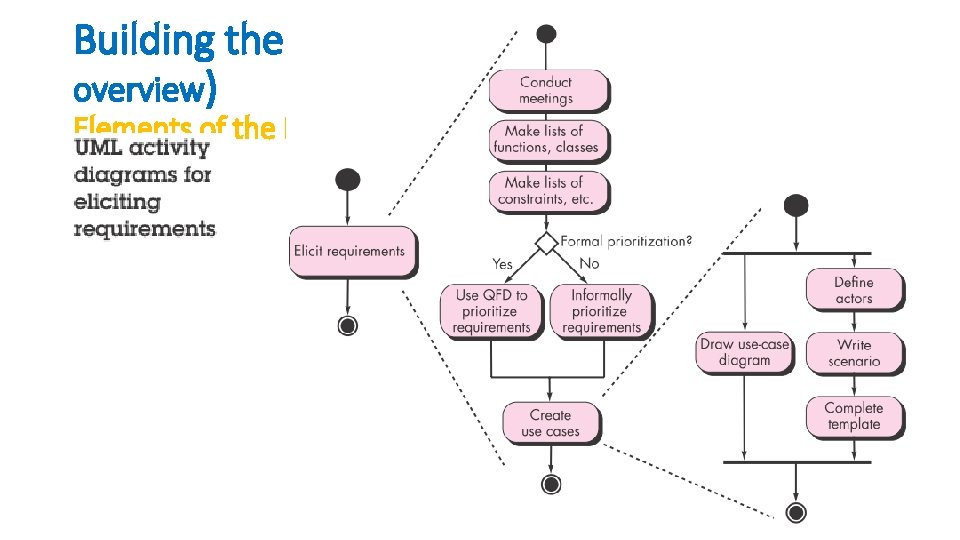
Building the requirements model (brief overview) Elements of the Requirements Model • Scenario-based elements • The system is described from the user’s point of view using a scenario-based approach (e. g. use cases) • Scenario-based elements of the requirements model are often the first part of the model that is developed 42
Building the requirements model (brief overview) Elements of the Requirements Model 43
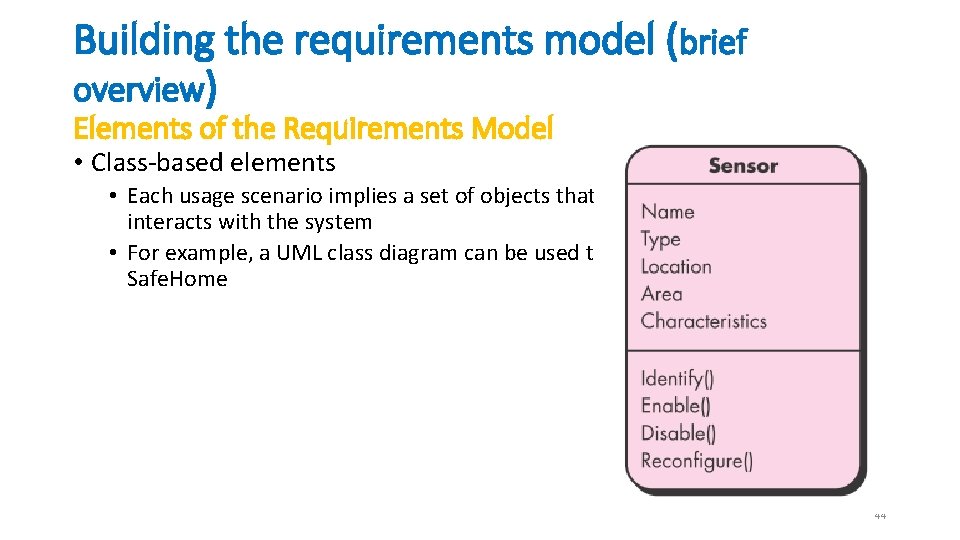
Building the requirements model (brief overview) Elements of the Requirements Model • Class-based elements • Each usage scenario implies a set of objects that are manipulated as an actor interacts with the system • For example, a UML class diagram can be used to depict a Sensor class for the Safe. Home 44
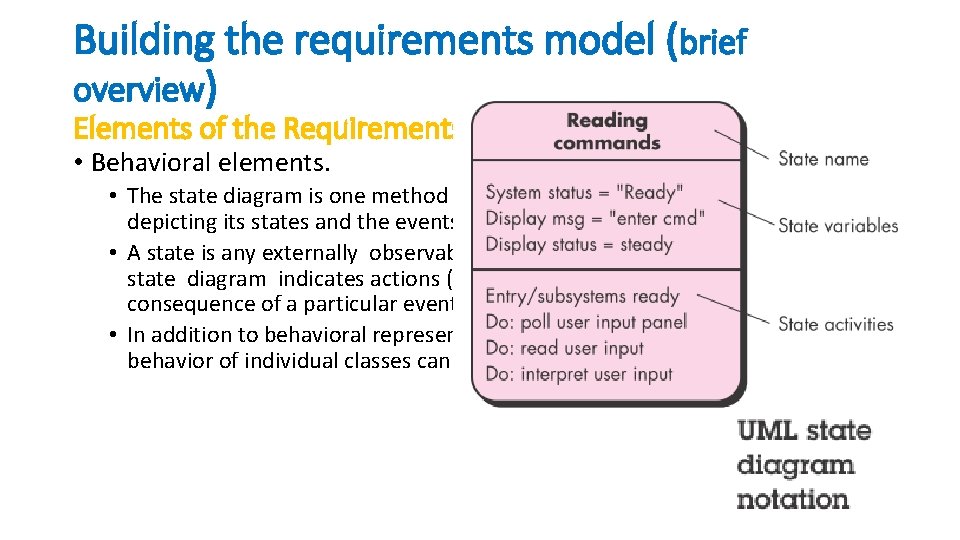
Building the requirements model (brief overview) Elements of the Requirements Model • Behavioral elements. • The state diagram is one method for representing the behavior of a system by depicting its states and the events that cause the system to change state. • A state is any externally observable mode of behavior. In addition, the state diagram indicates actions (e. g. , process activation) taken as a consequence of a particular event. • In addition to behavioral representations of the system as a whole, the behavior of individual classes can also be modeled 45
Building the requirements model (brief overview) Elements of the Requirements Model • Flow-oriented elements • Information is transformed as it flows through a computer-based system. • The system accepts input in a variety of forms, applies functions to transform it, and produces output in a variety of forms. 46
Building the requirements model (brief overview) Elements of the Requirements Model • Analysis Patterns • Anyone who has done requirements engineering on more than a few software projects begins to notice that certain problems reoccur across all projects within a specific application domain. These analysis patterns [Fow 97] suggest solutions (e. g. , a class, a function, a behavior) within the application domain that can be reused when modeling many applications. 47
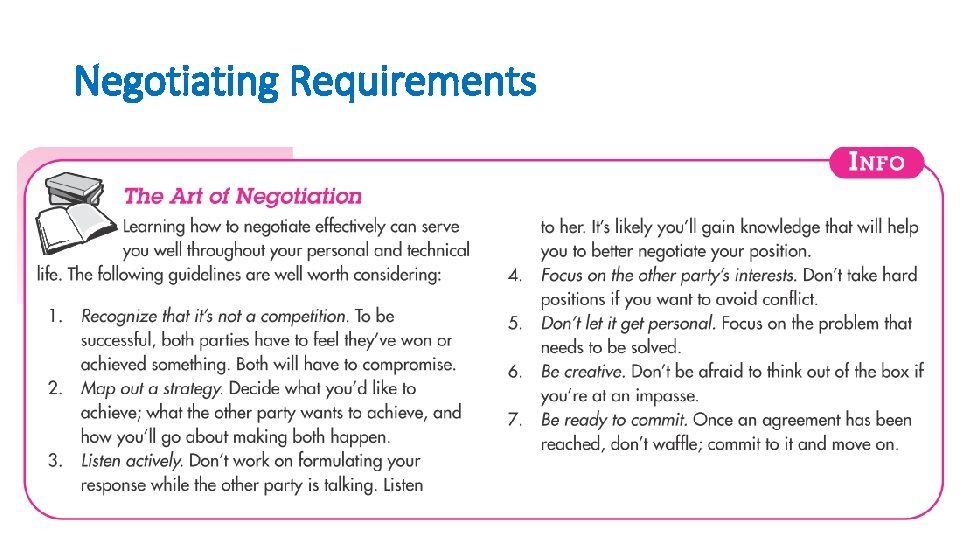
Negotiating Requirements • NEGOTIATING REQUIREMENTS • In an ideal requirements engineering context, the inception, elicitation, and elaboration tasks determine customer requirements in sufficient detail to proceed to subsequent software engineering activities. Unfortunately, this rarely happens • In reality, you may have to enter into a negotiation with one or more stakeholders 48
Validating Requirements • As each element of the requirements model is created, it is examined for inconsistency, omissions, and ambiguity. • Is each requirement consistent with the overall objectives for the system/product? • Have all requirements been specified at the proper level of abstraction? That is, do some requirements provide a level of technical detail that is inappropriate at this stage? • Is the requirement really necessary or does it represent an add-on feature that may not be essential to the objective of the system? 49
Validating Requirements • Is each requirement bounded and unambiguous? • Does each requirement have attribution? That is, is a source (generally, a specific individual) noted for each requirement? • Do any requirements conflict with other requirements? • Is each requirement achievable in the technical environment that will house the system or product? • Is each requirement testable, once implemented? • Does the requirements model properly reflect the information, function, and behavior of the system to be built? 50
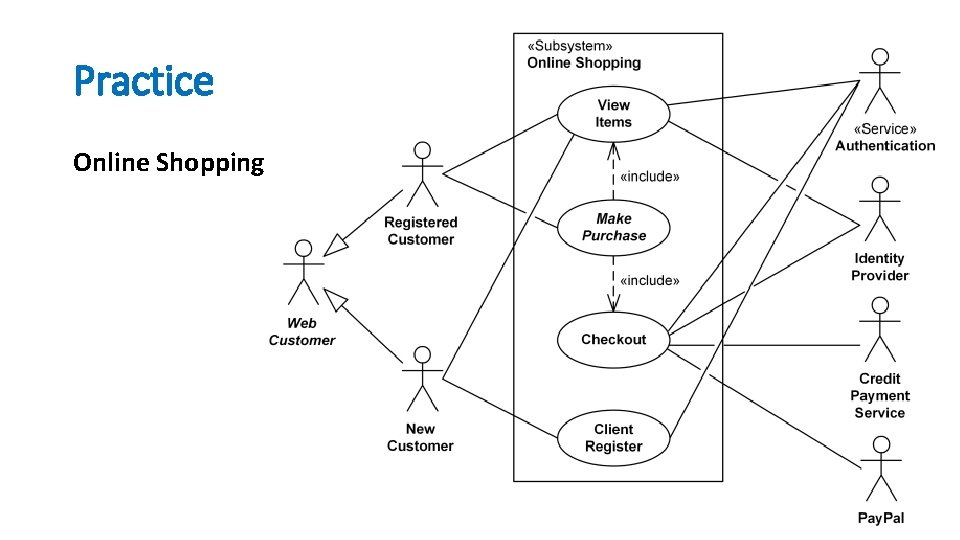
Practice Online Shopping 51
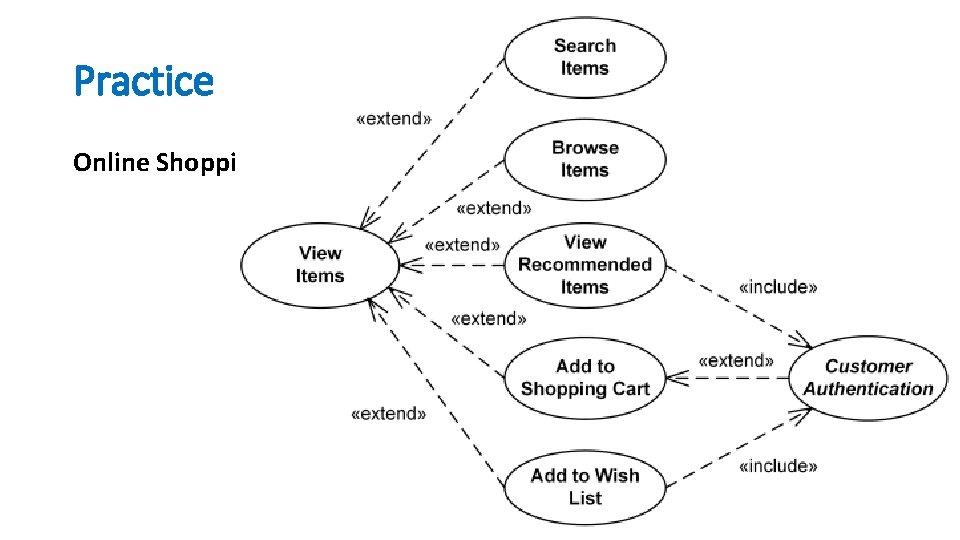
Practice Online Shopping 52