
Chapter 5 U S Political Parties 1 What
- Slides: 49
Chapter 5: U. S. Political Parties
1. What is a Political Party • A political party can be defined as a group of persons who seek to control government through the winning of elections and the holding of public office. • Two Major political parties in the U. S. = Democrats and Republicans • Major Parties = the dominant political parties in a nation. https: //www. youtube. com/watch? v=Lto. MZMG •
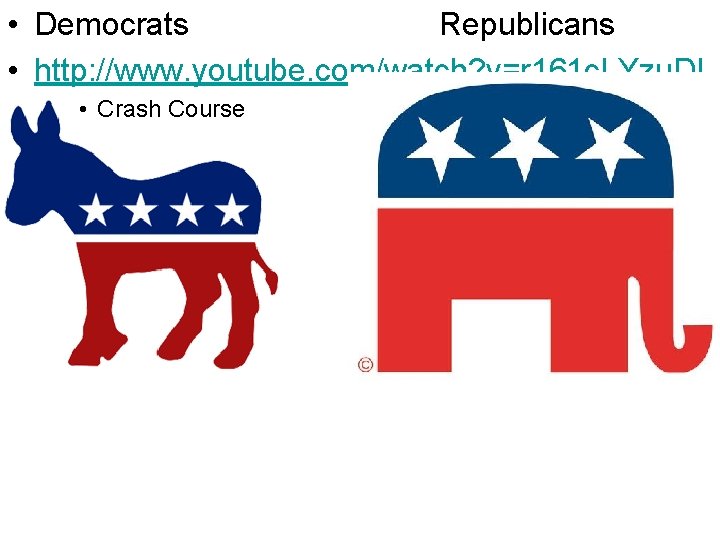
• Democrats Republicans • http: //www. youtube. com/watch? v=r 161 c. LYzu. DI • Crash Course
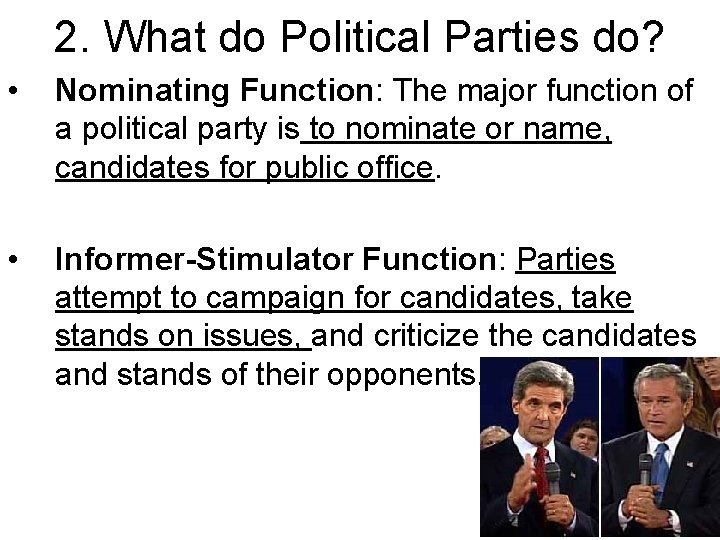
2. What do Political Parties do? • Nominating Function: The major function of a political party is to nominate or name, candidates for public office. • Informer-Stimulator Function: Parties attempt to campaign for candidates, take stands on issues, and criticize the candidates and stands of their opponents.
Functions • Presenting alternatives to the electorate – Voters need choices among candidates and among policy alternatives – Democratic Party Platform – Republican Party Platform
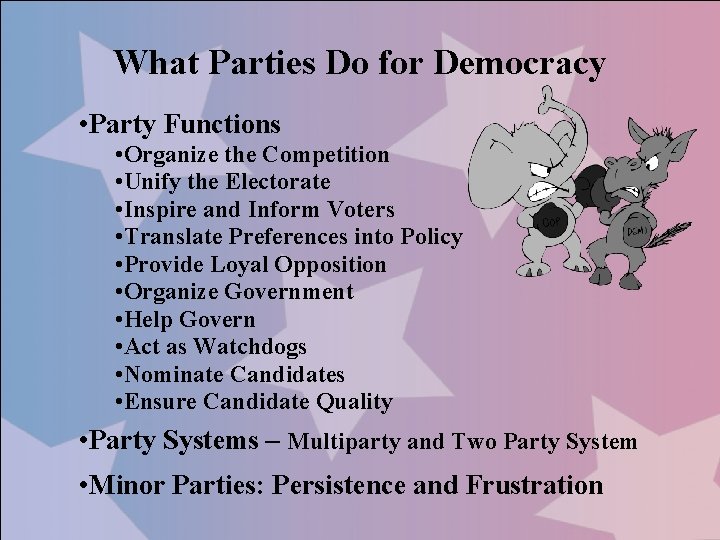
What Parties Do for Democracy • Party Functions • Organize the Competition • Unify the Electorate • Inspire and Inform Voters • Translate Preferences into Policy • Provide Loyal Opposition • Organize Government • Help Govern • Act as Watchdogs • Nominate Candidates • Ensure Candidate Quality • Party Systems – Multiparty and Two Party System • Minor Parties: Persistence and Frustration
3. What do Political Parties do? • Informer stimulator: – • They try to make their party as appealing as possible without offending any voters. Do you want your politicians sugar-coating what they are saying? ?
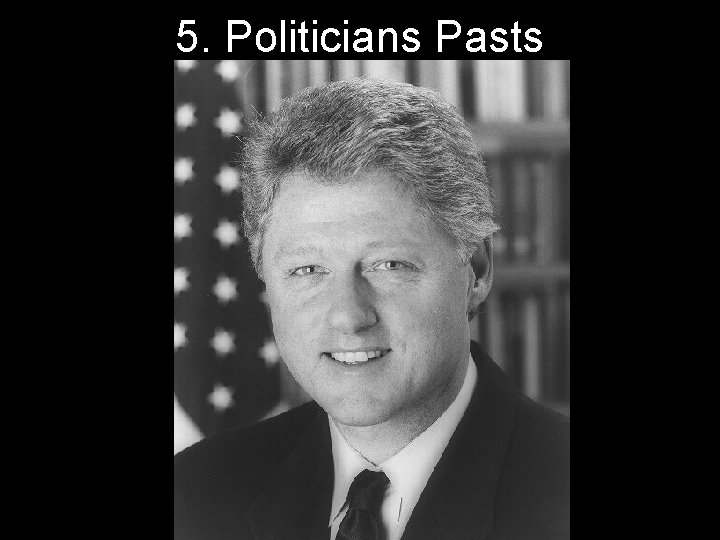
4. What do Political Parties do? • “Seal of Approval” Function: Political parties evaluate candidates so that the most successful candidate will be elected. – Parties want people of “high moral character” to lead. – If they try to elect people with troubled pasts, then they may be hurt in future elections. – Who are some politicians that you can think of that had “troubled pasts”?
5. Politicians Pasts
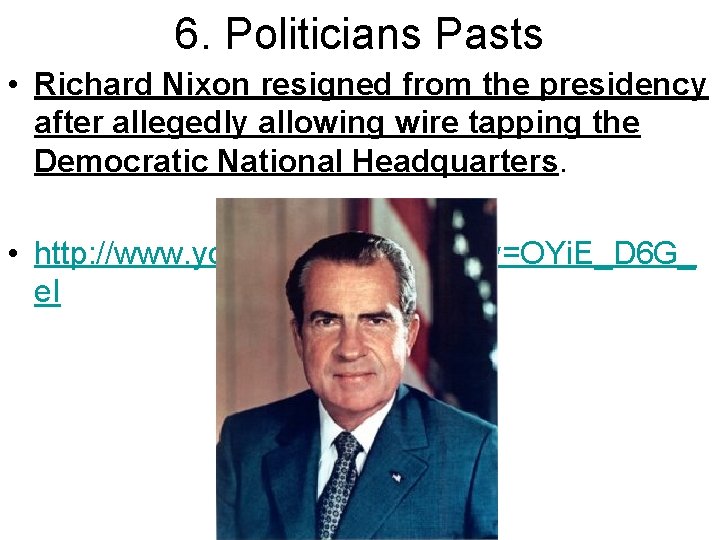
6. Politicians Pasts • Richard Nixon resigned from the presidency after allegedly allowing wire tapping the Democratic National Headquarters. • http: //www. youtube. com/watch? v=OYi. E_D 6 G_ e. I
7. What do Political Parties do? • Governmental Function: Gov’t is run along with party lines. • Many times decisions are with the interests of the governing party. – What can some negatives of this be?
8. The Watchdog Function • Parties act as watchdogs over the conduct of the public’s business. • Usually done by the party out of power.
History of American Party System • US developed the modern political party • US relatively unique in the world in having a 2 -Party System – most of the world is multiparty (with a few uniparty systems in non-democratic states)
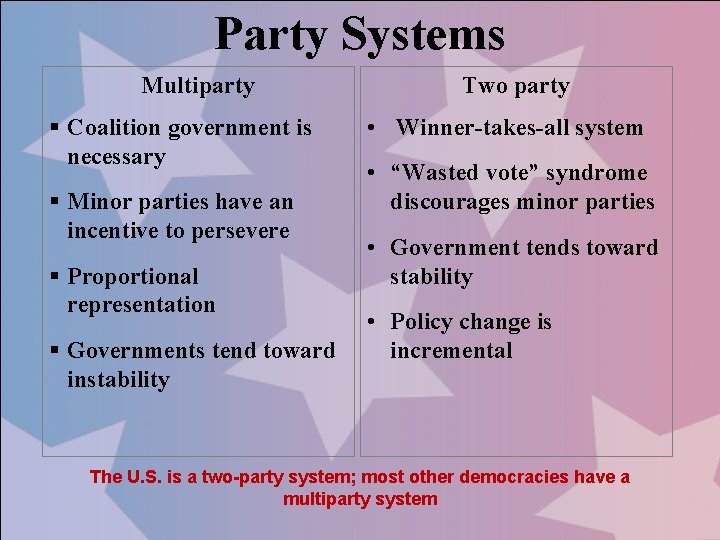
Party Systems Multiparty § Coalition government is necessary § Minor parties have an incentive to persevere § Proportional representation § Governments tend toward instability Two party • Winner-takes-all system • “Wasted vote” syndrome discourages minor parties • Government tends toward stability • Policy change is incremental The U. S. is a two-party system; most other democracies have a multiparty system
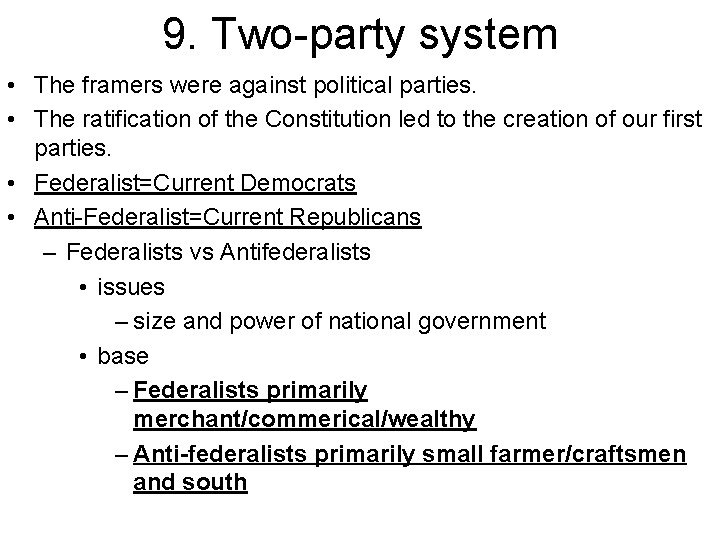
9. Two-party system • The framers were against political parties. • The ratification of the Constitution led to the creation of our first parties. • Federalist=Current Democrats • Anti-Federalist=Current Republicans – Federalists vs Antifederalists • issues – size and power of national government • base – Federalists primarily merchant/commerical/wealthy – Anti-federalists primarily small farmer/craftsmen and south
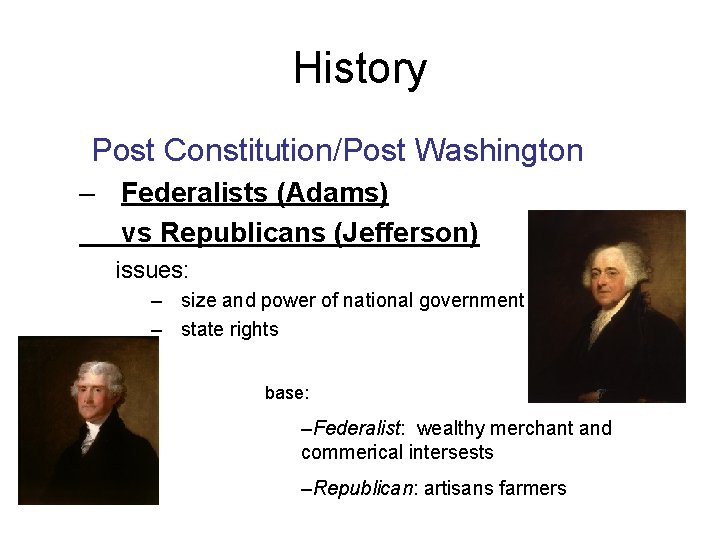
History Post Constitution/Post Washington – Federalists (Adams) vs Republicans (Jefferson) issues: – size and power of national government – state rights base: –Federalist: wealthy merchant and commerical intersests –Republican: artisans farmers
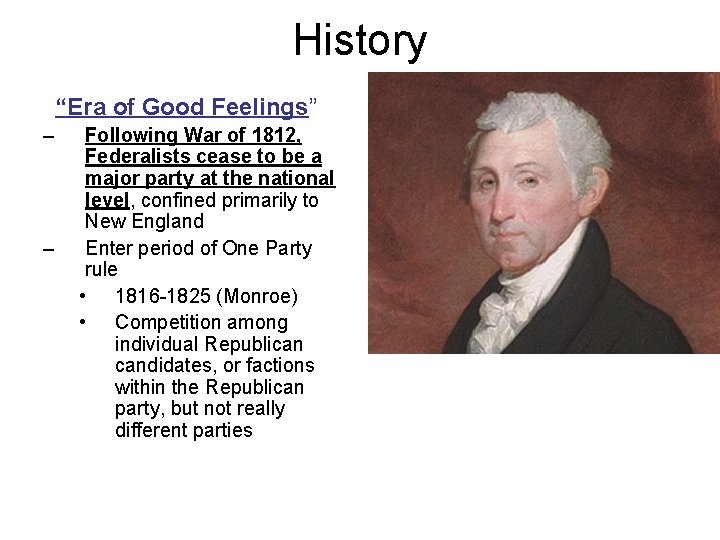
History “Era of Good Feelings” – – Following War of 1812, Federalists cease to be a major party at the national level, confined primarily to New England Enter period of One Party rule • 1816 -1825 (Monroe) • Competition among individual Republican candidates, or factions within the Republican party, but not really different parties
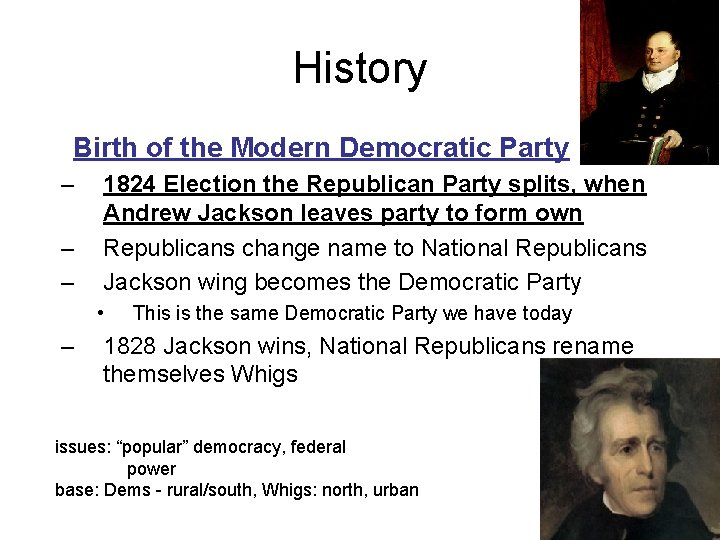
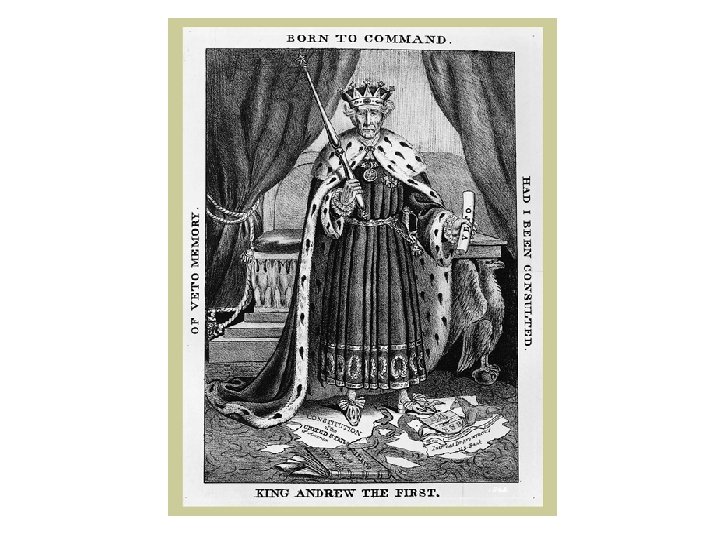
History Birth of the Modern Democratic Party – – – 1824 Election the Republican Party splits, when Andrew Jackson leaves party to form own Republicans change name to National Republicans Jackson wing becomes the Democratic Party • – This is the same Democratic Party we have today 1828 Jackson wins, National Republicans rename themselves Whigs issues: “popular” democracy, federal power base: Dems - rural/south, Whigs: north, urban
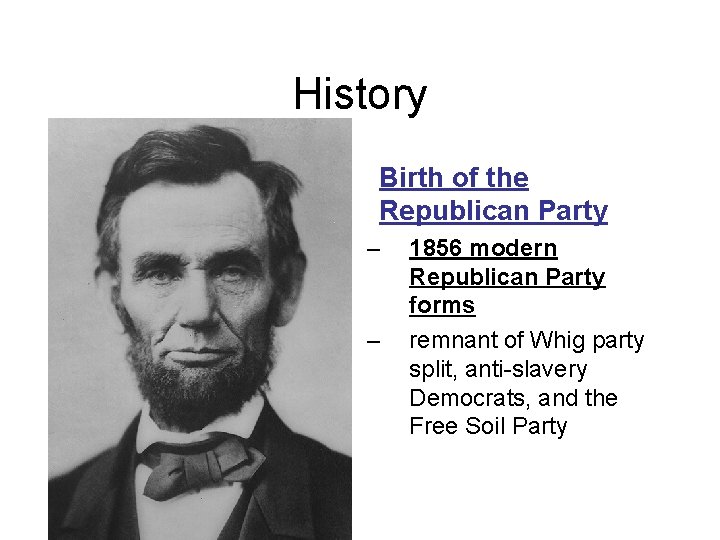
History Birth of the Republican Party – – 1856 modern Republican Party forms remnant of Whig party split, anti-slavery Democrats, and the Free Soil Party
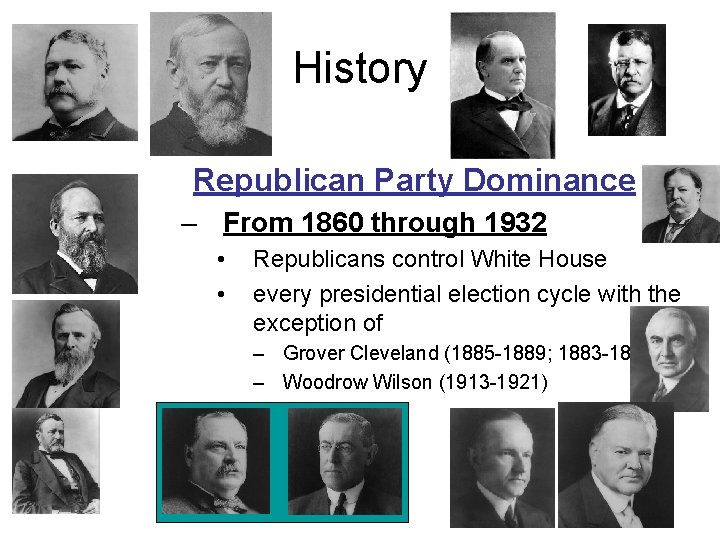
History Republican Party Dominance – From 1860 through 1932 • • Republicans control White House every presidential election cycle with the exception of – Grover Cleveland (1885 -1889; 1883 -1897) – Woodrow Wilson (1913 -1921)
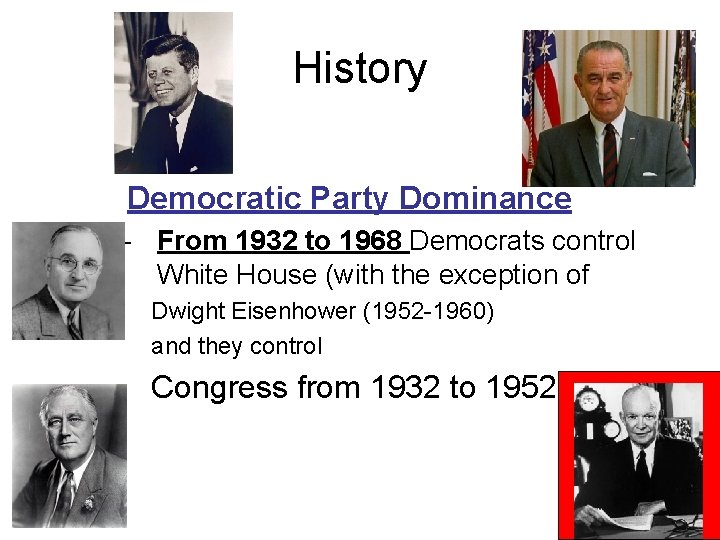
History Democratic Party Dominance – From 1932 to 1968 Democrats control White House (with the exception of Dwight Eisenhower (1952 -1960) and they control Congress from 1932 to 1952
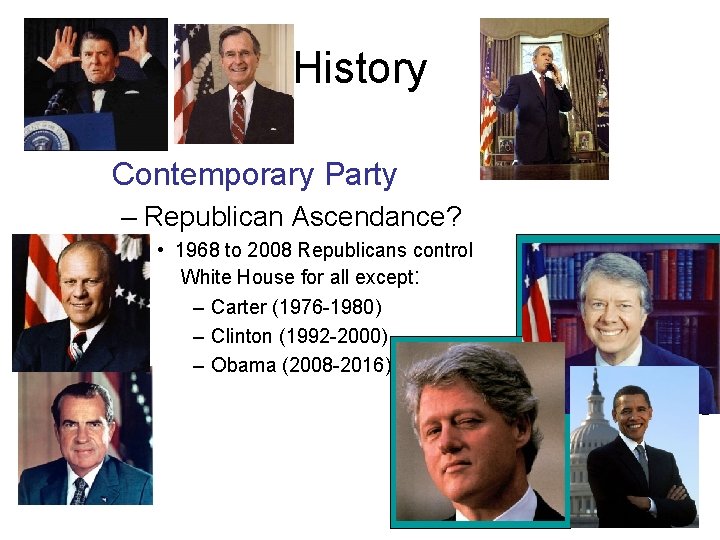
History Contemporary Party – Republican Ascendance? • 1968 to 2008 Republicans control White House for all except: – Carter (1976 -1980) – Clinton (1992 -2000) – Obama (2008 -2016)
10. Two Party system • Reasons for the two party system • The Historical Basis: Federalists and Anti. Federalists started it all. • Tradition: We accept it because its always been that way. Is that right?
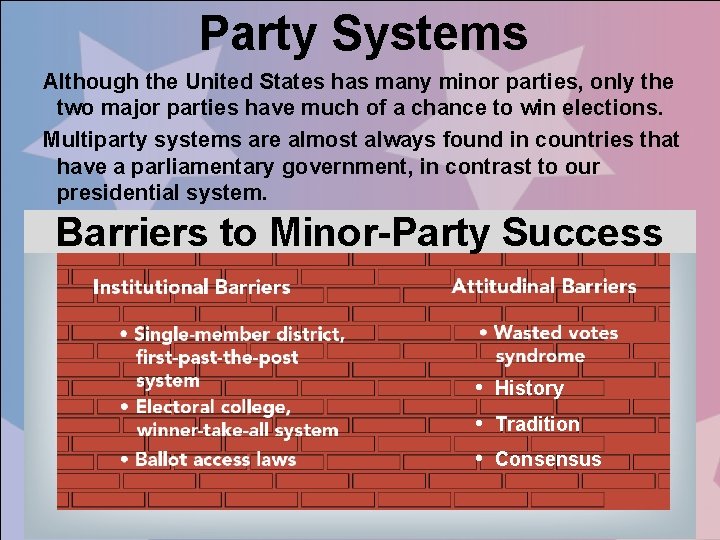
11. Two Party system The Electoral System – Single-member district elections help to limit the influence of minor parties. – Since the person who takes office needs the largest number of votes it helps to be from a large, recognized party.
12. One party system • In a one-party system the party captures control of the gov’t and, through various means, doesn’t allow other parties to form. • The one-party system is really a “no-party” system. • The Party is the Government • But the Government isn’t one big party……get it.
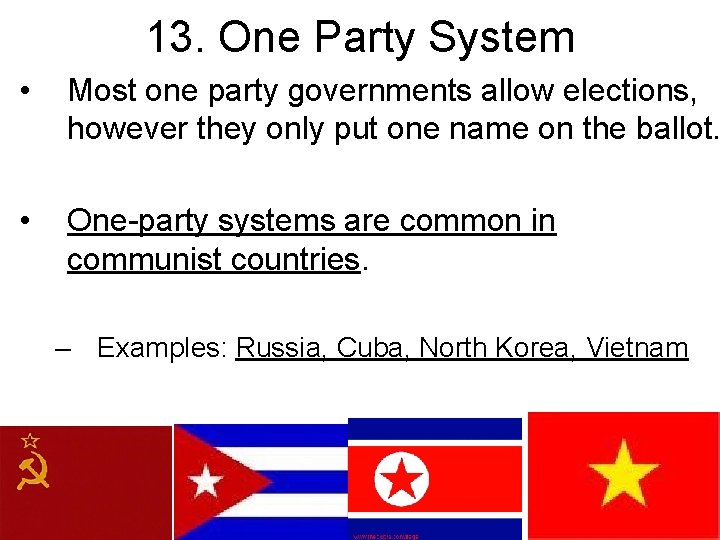
13. One Party System • Most one party governments allow elections, however they only put one name on the ballot. • One-party systems are common in communist countries. – Examples: Russia, Cuba, North Korea, Vietnam
12. Party Membership • Democrats tend to be supported by: African Americans, Catholics and Jews, and union members. • Republicans tend to be supported by: white males, Protestants, and the business community. • This is a generalization…of course this isn’t the case for every American*.
14. Minor Parties • Are divided into ideological parties, single-issue parties, economic protest parties, and splinter parties. • Examples of minor parties: Libertarian, Reform, Socialist, Prohibition, Natural Law, Communist, American Independent, Socialist Labor, U. S. Taxpayers. • http: //www. youtube. com/watch? v=6 Yyj. ZRPc. MU
Party Systems Although the United States has many minor parties, only the two major parties have much of a chance to win elections. Multiparty systems are almost always found in countries that have a parliamentary government, in contrast to our presidential system. Barriers to Minor-Party Success • History • Tradition • Consensus
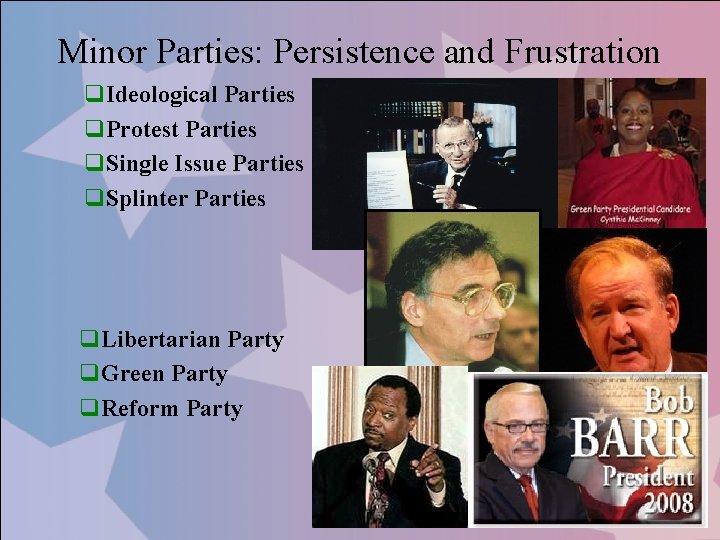
Minor Parties: Persistence and Frustration q. Ideological Parties q. Protest Parties q. Single Issue Parties q. Splinter Parties q. Libertarian Party q. Green Party q. Reform Party
15. Minor Parties • Ideological Parties – those based on a set of beliefs, a comprehensive view of social, economic, and political matters. • Examples: Socialist, Social Labor, Socialist Worker, Communist Parties.
16. Minor Parties • Single-issue parties: those concentrating on a single public policy matter. • Examples: “Know-Nothings” Party, Right to Life Party, American Party
17. Minor Parties • Economic Protest Parties -- those rooted in periods of economic discontent. • They focus their anger on certain areas of the economy like oil tycoons, Wall Street bankers, railroads etc. • Greenback Party
18. Minor Parties • Splinter Parties – Those which have split off a major party. • Most splinter parties have formed around some strong personality--most often one who has failed to win his major parties pres. nomination. • Example: Progressive Party, Am. Independent
19. Minor Parties • A strong “third-party” can play the role of a “spoiler role” in an election where the two major parties are evenly matched. • When innovations proposed by minor parties gain popular support, they are usually adopted by one or both of the major parties.
20. Organization of Political Parties • The role of the Presidency. – The President is the leader of his/her party. – The party not in power has no comparable leader. – Name a famous Democrat in office right now.
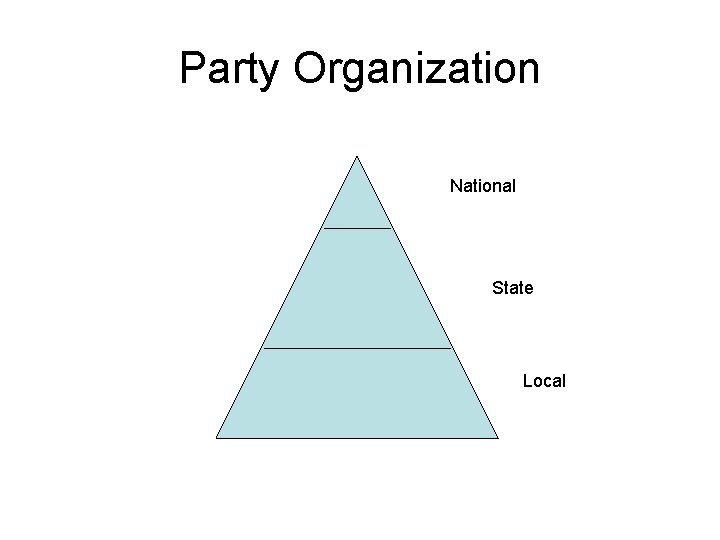
Party Organization National State Local
21. Organization of Political Parties • The Impact of Federalism Because American gov’t is decentralized, w/offices available at local, State, and federal levels, party organization is decentralized as well. • There are ½ a million elective offices. • Can the parties worry about
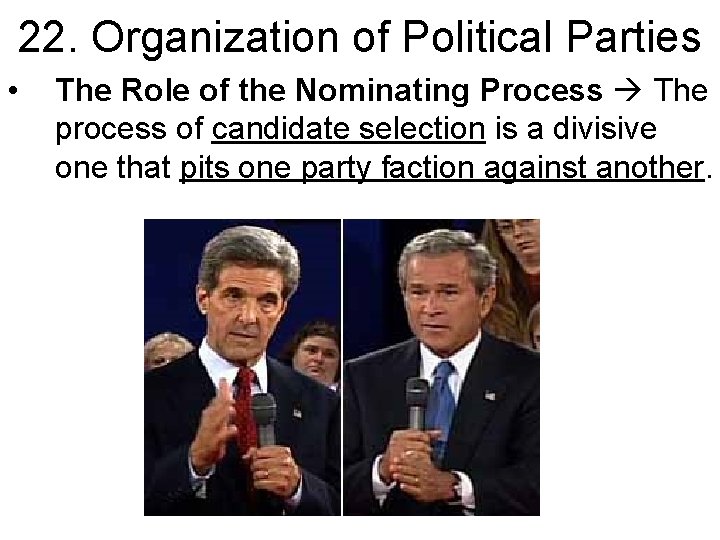
22. Organization of Political Parties • The Role of the Nominating Process The process of candidate selection is a divisive one that pits one party faction against another.
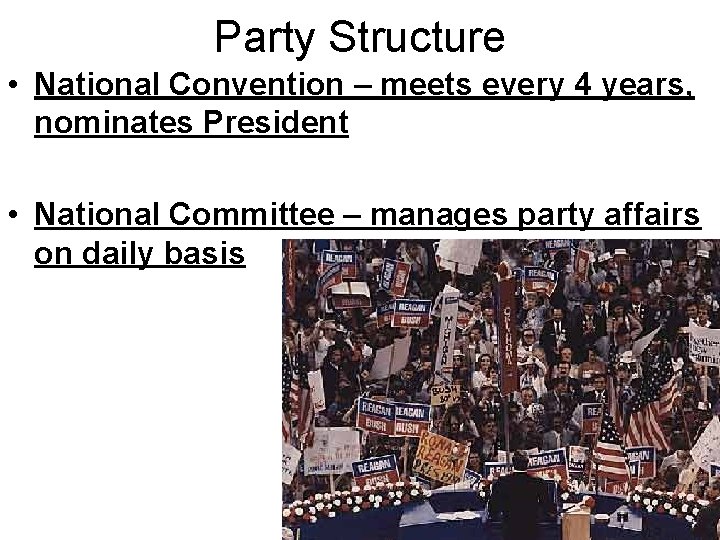
Party Structure • National Convention – meets every 4 years, nominates President • National Committee – manages party affairs on daily basis
23. National Party Machinery • Congressional campaign committee – supports party’s candidates • National chair – manages daily work
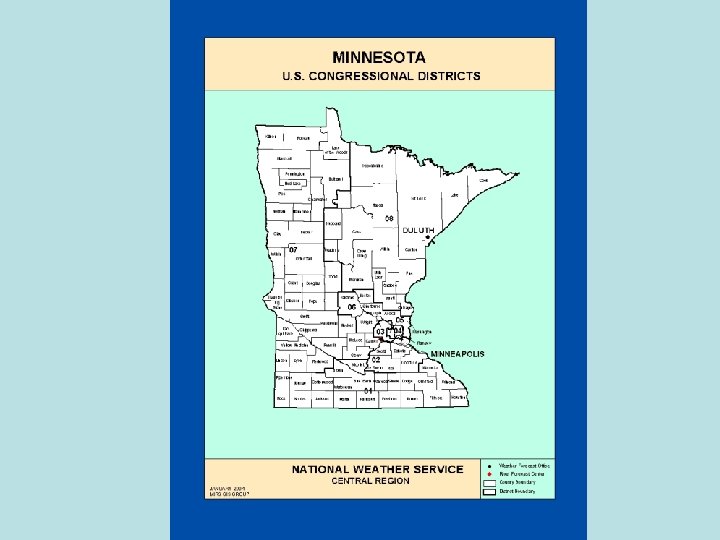
27. State/Local Party Machinery – The State Organization The job of the State Chairperson and committee is to further the party’s interests in that state. – The Local Organization Local party organization vary widely, generally following the State’s electoral map, with a party unit for each district in which elective offices are to be filled.
28. Elements to a Political Party 1. One element of each party is the party organization – leaders, activists, and hangers-on that control the party machinery. 2. Another is the segment of the electorate that regularly votes for that party’s candidates. 3. The third is the elected officials who are members of the party.
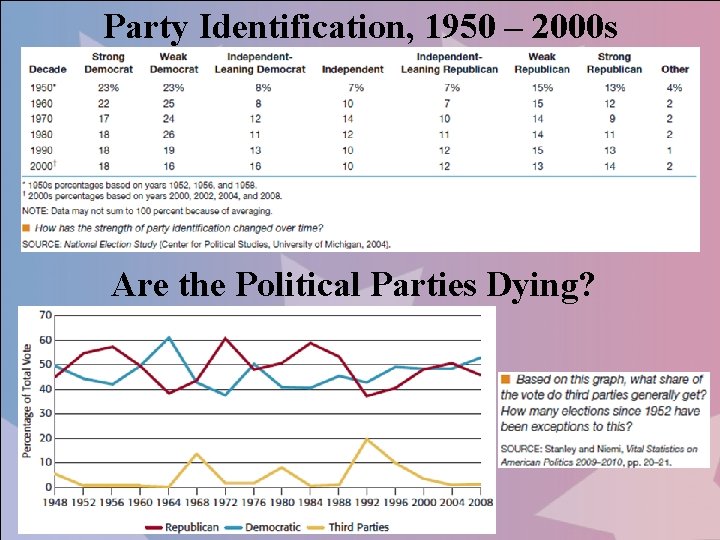
29. Future of Political Parties – Political parties have been in a state of decline since the late 1960’s. – Parties are unlikely to disappear as long as they continue to perform necessary functions. – http: //www. youtube. com/watch? v=Tx. Dg. Rr_Ynvc &list=PL 60982594 F 63671 BD – ^^“Right America: Feeling Wronged”^^
Party Identification, 1950 – 2000 s Are the Political Parties Dying?