
Chapter 5 Types of Compounds Section 5 2
- Slides: 20
Chapter 5 Types of Compounds Section 5. 2 Covalent Compounds
Objectives: Compare the properties of covalent and ionic substances, Distinguish among allotropes of an element, Apply formulas to name covalent compounds
Covalent Compounds Molecular Substances ◦ Have atoms held together by covalent bonds rather than ionic bonds
Covalent Properties The properties of a molecular substance are more variable than the properties of an ionic compound. Generally (comparing ionic and covalent): Lower melting points, softer than ionic compounds- due to the weak interparticle forces between molecules Less soluble in water than ionic compounds Not electrolytes -they do not easily form ions
Separation Techniques The differences between ionic and molecular substances are often used to classify them and to separate them from one another. Example: Separation of water from salt by distillation DISTILLATION: Method of separating substances in a mixture by evaporation of a liquid and subsequent condensation of its vapor
Molecular Elements/Diatomic Elements Molecules vary greatly in size- can contain just two or millions of atoms Elements usually occur naturally in a combined form with another element as compounds In some cases, two or more atoms of the same element can bond together to form a molecule
Molecular Elements/Diatomic Elements MOLECULAR ELEMENT: Molecule that forms when atoms of the same element bond together Molecular elements are NOT considered compounds – they contain atoms of only one element Identical atoms bond to reach the stability of a noble-gas electron configuration (share electron pairs)
Molecular Elements/Diatomic Elements There are 7 nonmetal elements found naturally as molecular elements. Diatomic Elements: Hydrogen (H 2), Nitrogen (N 2), Oxygen (O 2), Fluorine (F 2), Chlorine (Cl 2), Bromine (Br 2), Iodine (I 2) All are gases at RT, except Br 2 and I 2 - Br 2 is a liquid and I 2 is a solid
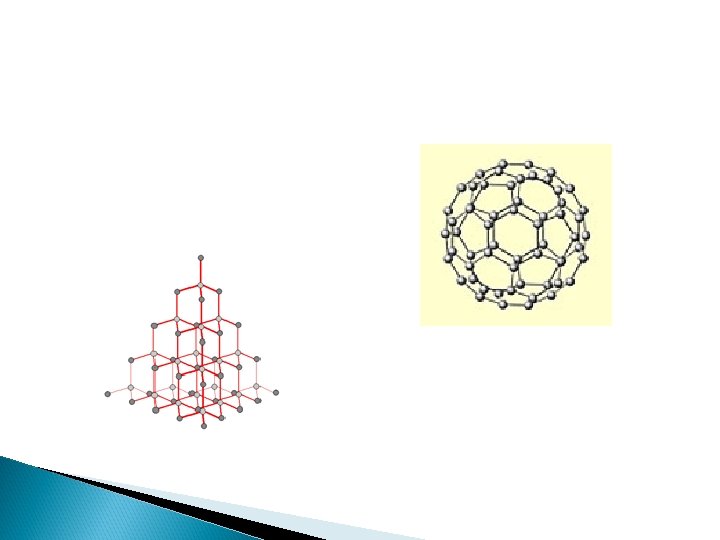
ALLOTROPES Molecules of a single element that differ in crystalline or molecular structure Examples: Oxygen (O 2) and Ozone (O 3) Carbon has several important allotropes with different properties: diamond, graphite, charcoal, fullerenes (pg 174) Even though allotropes contain the same element, they usually have different properties
Organic/Inorganic ORGANIC COMPOUNDS: Compounds that contain carbon (with a few exceptions) INORGANIC COMPOUNDS: Compounds that do not contain carbon Inorganic compounds that contain only two nonmetal elements bonded covalently are referred to as molecular binary compounds.
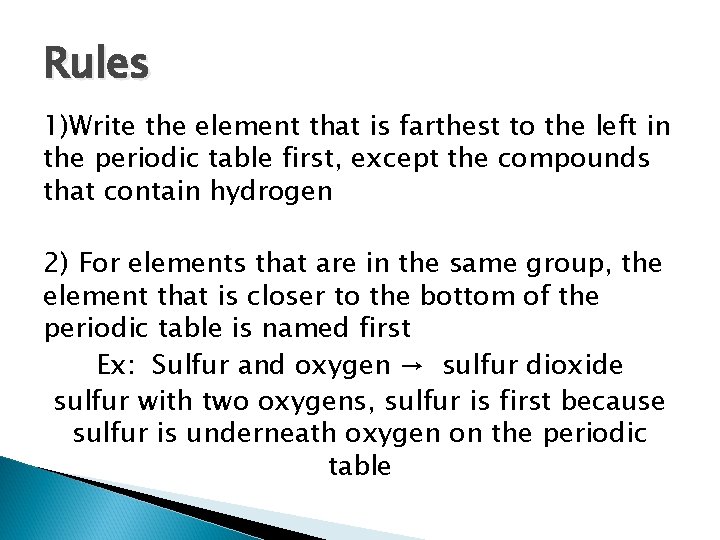
Naming Binary Inorganic Compounds Steps: 1) Write out the name of the first nonmetal 2) Write the name of the second nonmetal with its ending changed to –ide 3) Add a prefix to the name to indicate how many atoms of each element are present in the compound
Rules 1)Write the element that is farthest to the left in the periodic table first, except the compounds that contain hydrogen 2) For elements that are in the same group, the element that is closer to the bottom of the periodic table is named first Ex: Sulfur and oxygen → sulfur dioxide sulfur with two oxygens, sulfur is first because sulfur is underneath oxygen on the periodic table
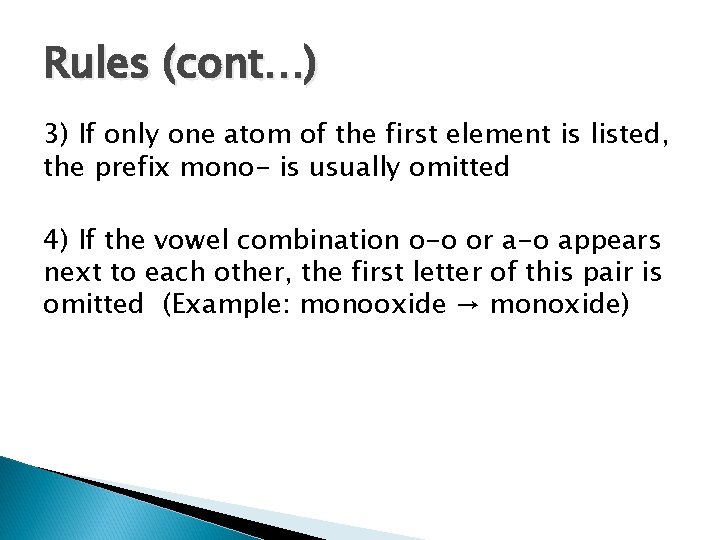
Rules (cont…) 3) If only one atom of the first element is listed, the prefix mono- is usually omitted 4) If the vowel combination o-o or a-o appears next to each other, the first letter of this pair is omitted (Example: monooxide → monoxide)
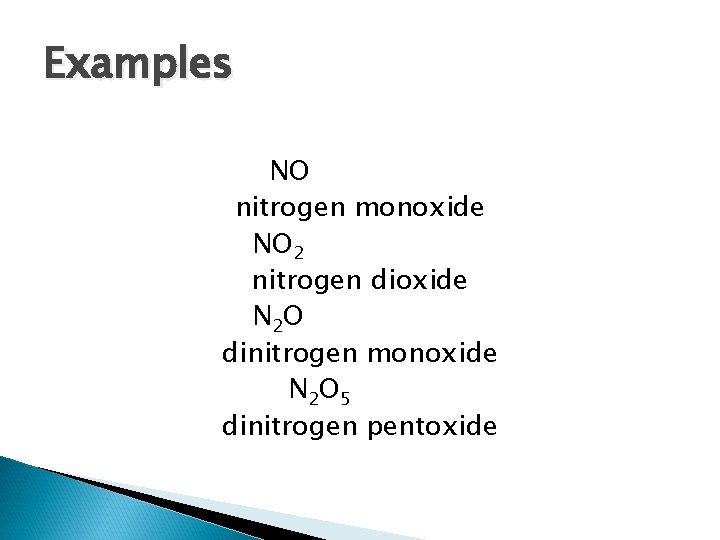
Examples NO nitrogen monoxide NO 2 nitrogen dioxide N 2 O dinitrogen monoxide N 2 O 5 dinitrogen pentoxide
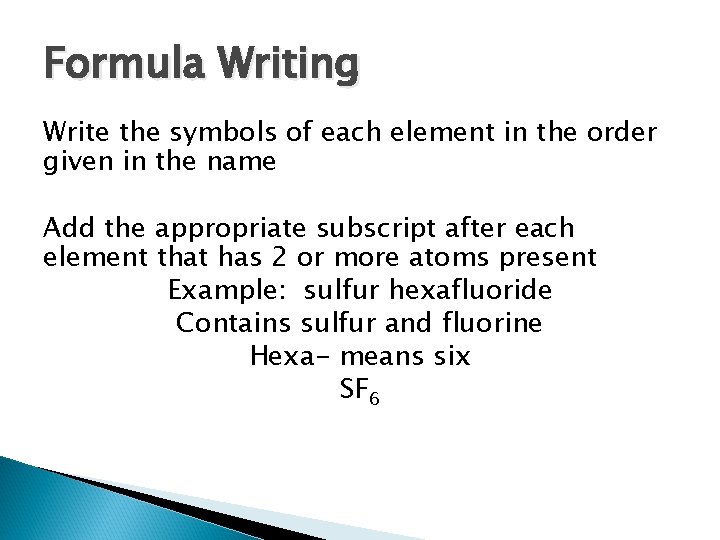
Formula Writing Write the symbols of each element in the order given in the name Add the appropriate subscript after each element that has 2 or more atoms present Example: sulfur hexafluoride Contains sulfur and fluorine Hexa- means six SF 6
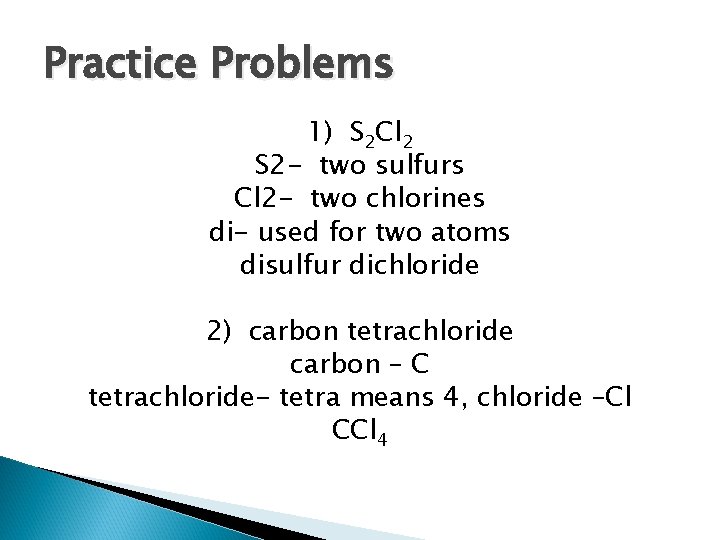
Practice Problems 1) S 2 Cl 2 S 2 - two sulfurs Cl 2 - two chlorines di- used for two atoms disulfur dichloride 2) carbon tetrachloride carbon – C tetrachloride- tetra means 4, chloride –Cl CCl 4
Naming Organic Compounds Organic compounds are the largest group of molecular compounds- carbon containing Carbon is able to bond to other atoms in rings and chains
Hydrocarbons HYDROCARBON: Organic compound that contains only the elements hydrogen and carbon Hydrocarbons occur naturally in fossil fuels and are used mainly as fuels and to make other organic compounds A carbon atom can form covalent bonds The simplest hydrocarbon is methane (one carbon bonded to four hydrogens)
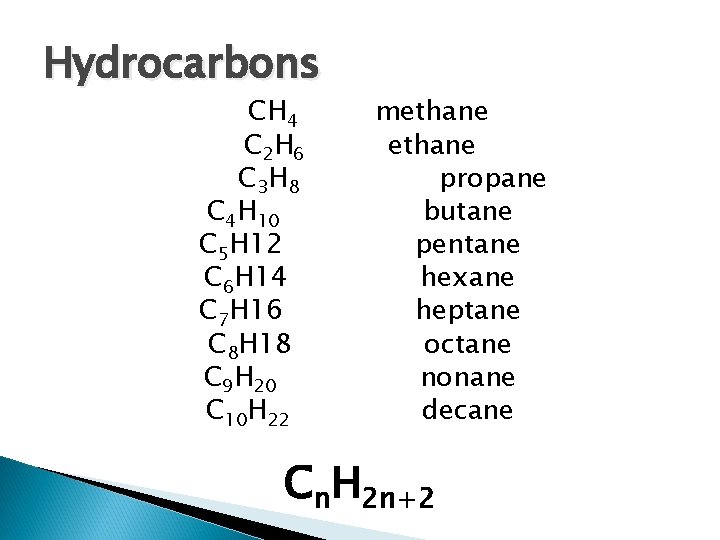
Hydrocarbons CH 4 C 2 H 6 C 3 H 8 C 4 H 10 C 5 H 12 C 6 H 14 C 7 H 16 C 8 H 18 C 9 H 20 C 10 H 22 methane propane butane pentane hexane heptane octane nonane decane Cn. H 2 n+2