
Chapter 5 Types of Compounds 5 1 Ionic
- Slides: 31
Chapter 5 Types of Compounds 5. 1 Ionic Compounds 5. 2 Molecular Substances
5. 1 Ionic Compounds - Objectives n n n Apply ionic charge to writing formulas for ionic compounds Apply formulas to name ionic compounds Interpret the information in a chemical formula
Formula and Names of Ionic Compounds n n n Ionic compounds are composed of ions bound by ionic bonds usually a metal and a nonmetal Ionic bonds are strong attractive forces Ionic compounds are usually solids at room temperature Many are crystalline Difficult to melt high melting points When melted or in solutions they conduct electricity
Binary Ionic Compounds n Binary compound- composed of two elements n Binary ionic compounds- composed of two different ions Na. Cl n KI n Ca. F 2 n
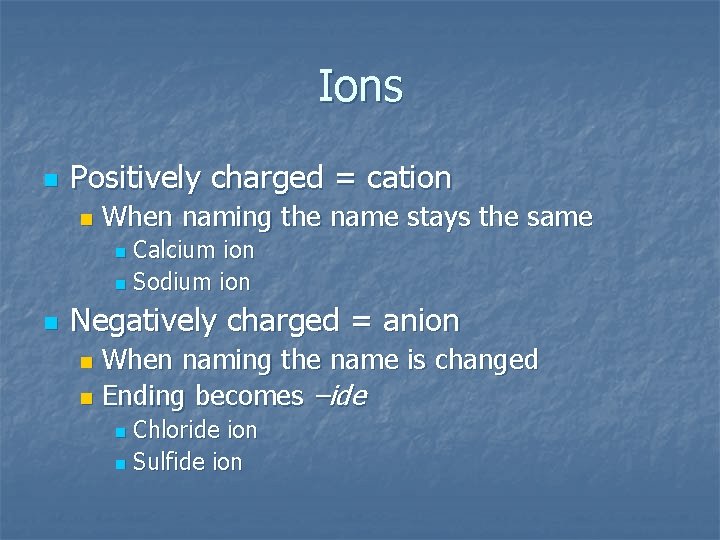
Ions n Positively charged = cation n When naming the name stays the same Calcium ion n Sodium ion n n Negatively charged = anion When naming the name is changed n Ending becomes –ide n Chloride ion n Sulfide ion n
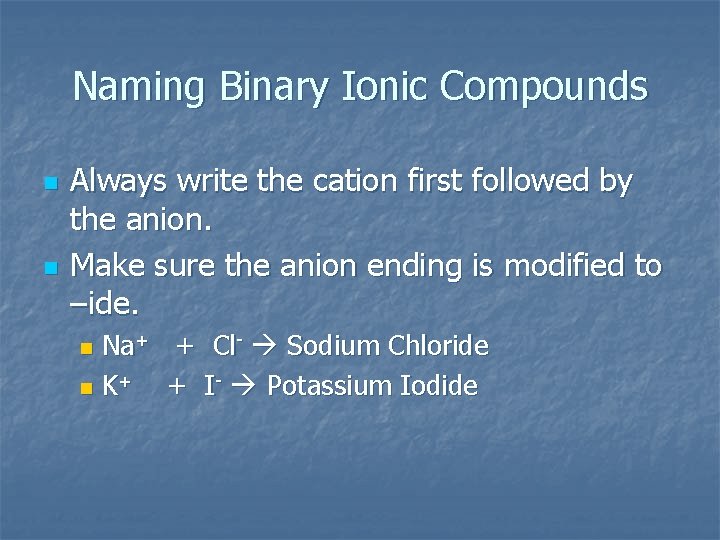
Naming Binary Ionic Compounds n n Always write the cation first followed by the anion. Make sure the anion ending is modified to –ide. Na+ n K+ n + Cl- Sodium Chloride + I- Potassium Iodide
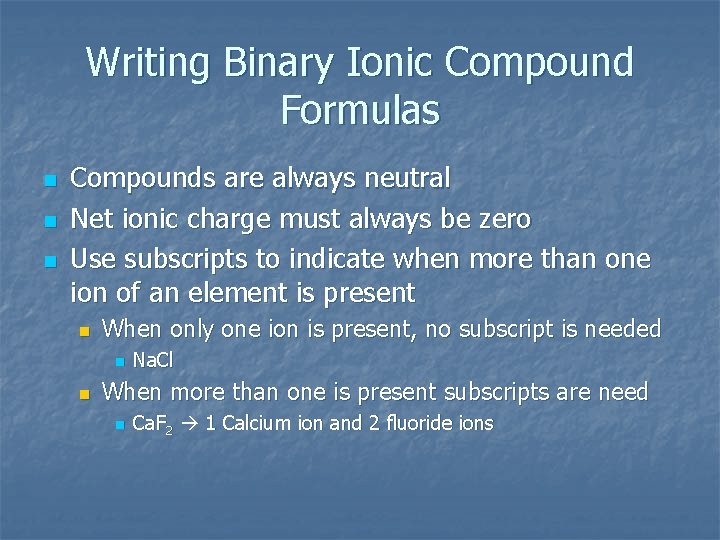
Writing Binary Ionic Compound Formulas n n n Compounds are always neutral Net ionic charge must always be zero Use subscripts to indicate when more than one ion of an element is present n When only one ion is present, no subscript is needed n n Na. Cl When more than one is present subscripts are need n Ca. F 2 1 Calcium ion and 2 fluoride ions
Binary Ionic Compounds n Always written in the smallest whole number ratio – Formula Unit n Example Calcium Fluoride
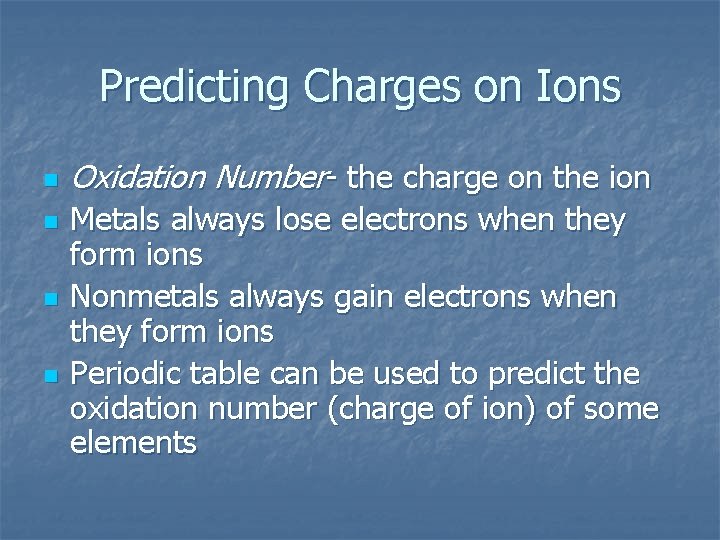
Predicting Charges on Ions n n Oxidation Number- the charge on the ion Metals always lose electrons when they form ions Nonmetals always gain electrons when they form ions Periodic table can be used to predict the oxidation number (charge of ion) of some elements
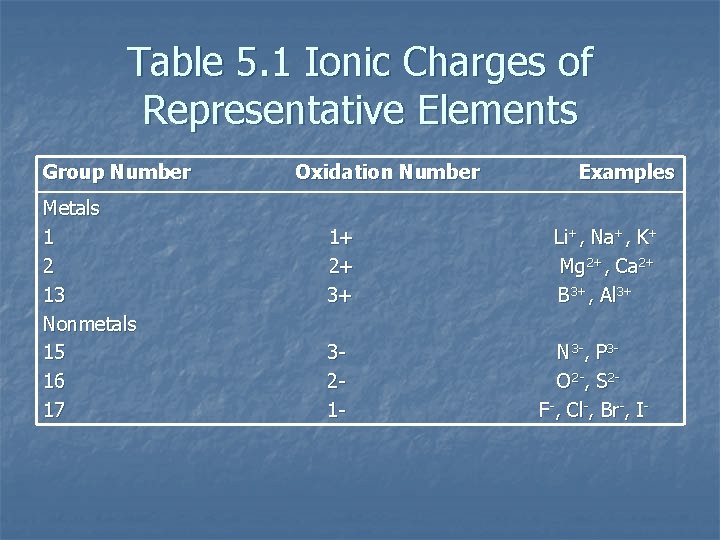
Table 5. 1 Ionic Charges of Representative Elements Group Number Metals 1 2 13 Nonmetals 15 16 17 Oxidation Number 1+ 2+ 3+ 321 - Examples Li +, Na+, K+ Mg 2+, Ca 2+ B 3+, Al 3+ N 3 -, P 3 O 2 -, S 2 F -, Cl-, Br-, I-
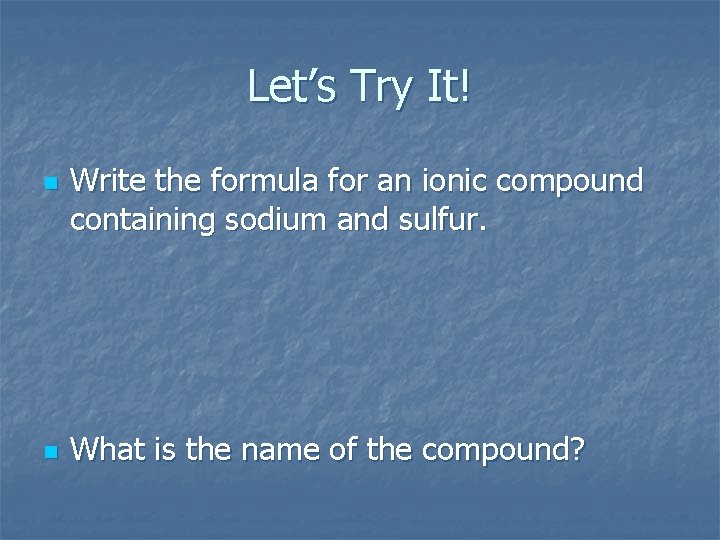
Let’s Try It! n n Write the formula for an ionic compound containing sodium and sulfur. What is the name of the compound?
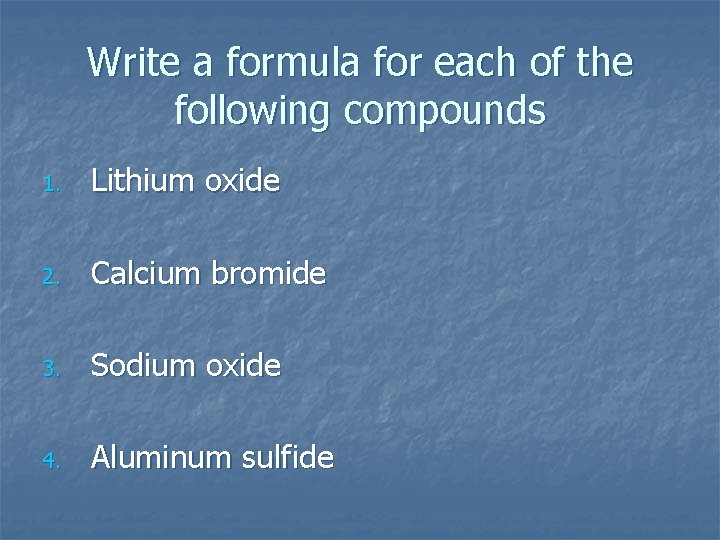
Write a formula for each of the following compounds 1. Lithium oxide 2. Calcium bromide 3. Sodium oxide 4. Aluminum sulfide
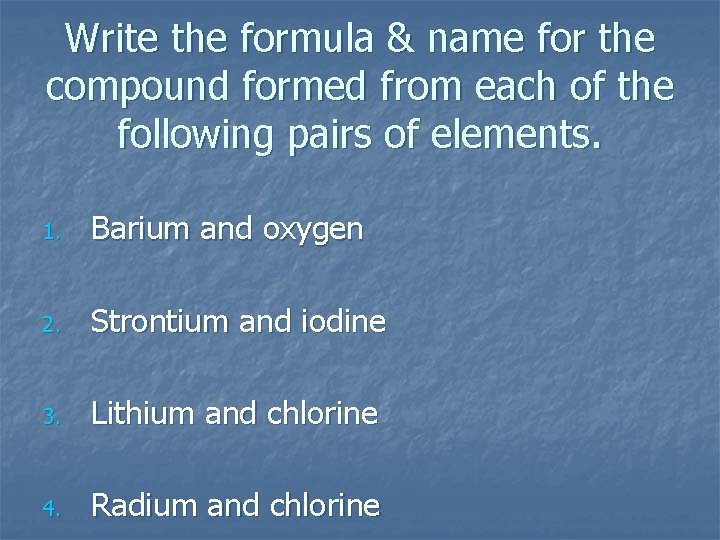
Write the formula & name for the compound formed from each of the following pairs of elements. 1. Barium and oxygen 2. Strontium and iodine 3. Lithium and chlorine 4. Radium and chlorine
5. 1 Ionic Compounds
Compounds Containing Polyatomic Ions n n n Polyatomic Ions-an ion that has two or more different elements Group of atoms are covalently bonded together when the atoms share electrons The individual atoms do not have a charge, but the group as a whole has an overall charge
Polyatomic Ions n Ionic compounds may contain positive metal ions bonded to negative polyatomic ions or negative nonmetal ions bonded to positive polyatomic ions
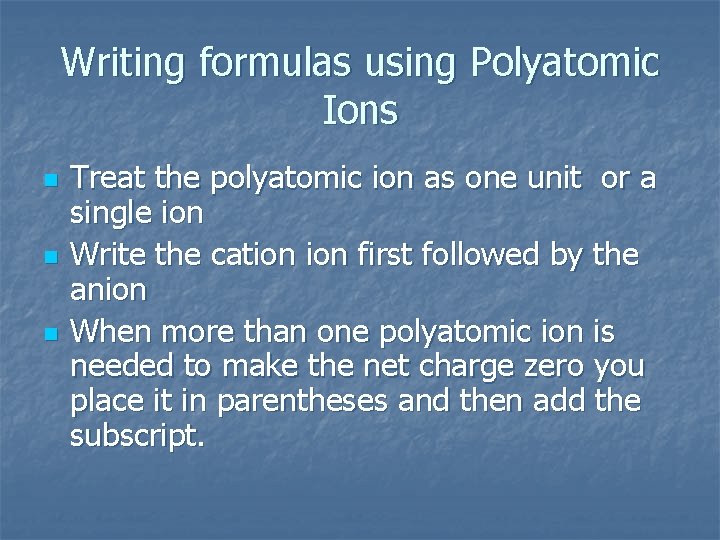
Writing formulas using Polyatomic Ions n n n Treat the polyatomic ion as one unit or a single ion Write the cation first followed by the anion When more than one polyatomic ion is needed to make the net charge zero you place it in parentheses and then add the subscript.
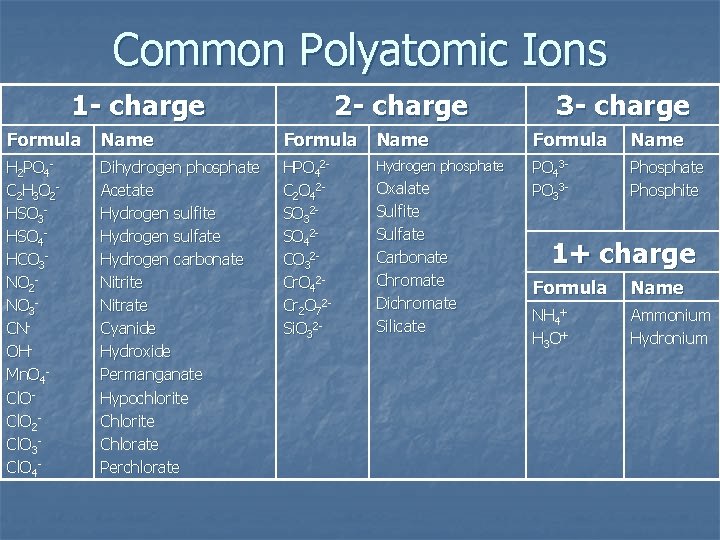
Common Polyatomic Ions 1 - charge 2 - charge 3 - charge Formula Name H 2 PO 4 C 2 H 3 O 2 HSO 3 HSO 4 HCO 3 NO 2 NO 3 CNOHMn. O 4 Cl. O 2 Cl. O 3 Cl. O 4 - Dihydrogen phosphate Acetate Hydrogen sulfite Hydrogen sulfate Hydrogen carbonate Nitrite Nitrate Cyanide Hydroxide Permanganate Hypochlorite Chlorate Perchlorate HPO 42 C 2 O 42 SO 32 SO 42 CO 32 Cr. O 42 Cr 2 O 72 Si. O 32 - Hydrogen phosphate PO 43 PO 33 - Phosphate Phosphite Oxalate Sulfite Sulfate Carbonate Chromate Dichromate Silicate 1+ charge Formula Name NH 4+ H 3 O+ Ammonium Hydronium
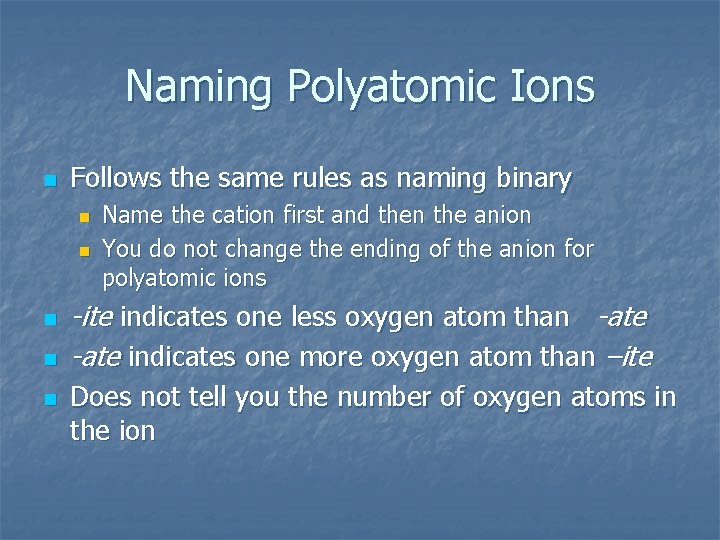
Naming Polyatomic Ions n Follows the same rules as naming binary n n n Name the cation first and then the anion You do not change the ending of the anion for polyatomic ions -ite indicates one less oxygen atom than -ate indicates one more oxygen atom than –ite Does not tell you the number of oxygen atoms in the ion
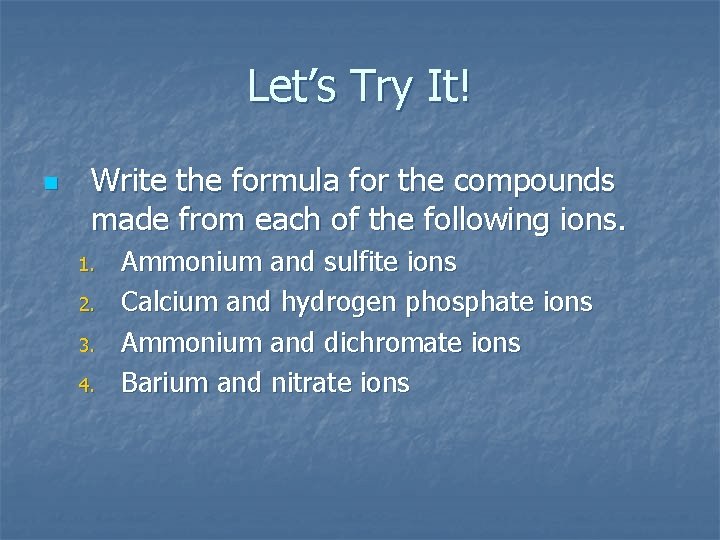
Let’s Try It! n Write the formula for the compounds made from each of the following ions. 1. 2. 3. 4. Ammonium and sulfite ions Calcium and hydrogen phosphate ions Ammonium and dichromate ions Barium and nitrate ions
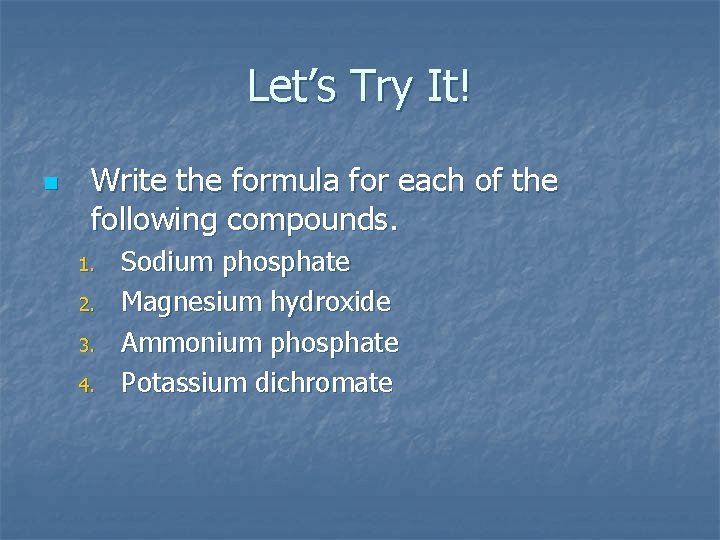
Let’s Try It! n Write the formula for each of the following compounds. 1. 2. 3. 4. Sodium phosphate Magnesium hydroxide Ammonium phosphate Potassium dichromate
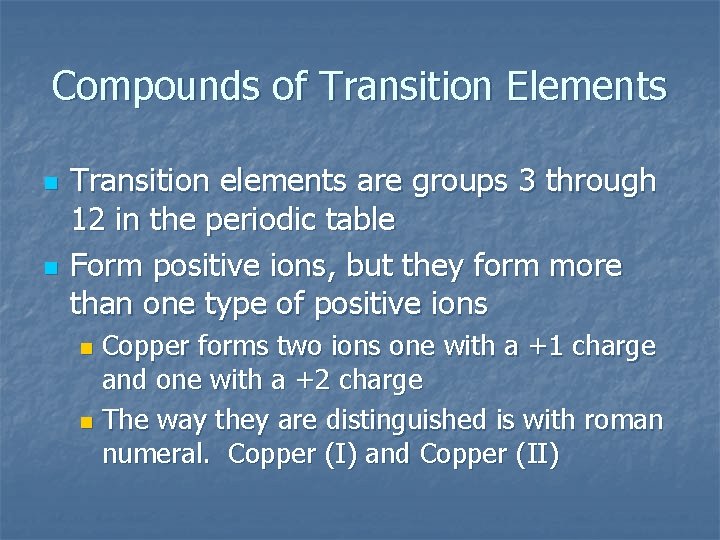
Compounds of Transition Elements n n Transition elements are groups 3 through 12 in the periodic table Form positive ions, but they form more than one type of positive ions Copper forms two ions one with a +1 charge and one with a +2 charge n The way they are distinguished is with roman numeral. Copper (I) and Copper (II) n
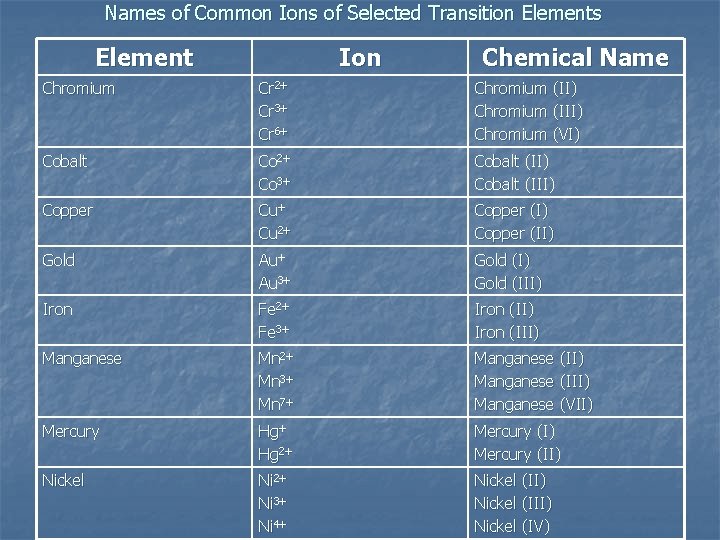
Names of Common Ions of Selected Transition Elements Element Ion Chemical Name Chromium Cr 2+ Cr 3+ Cr 6+ Chromium (II) Chromium (III) Chromium (VI) Cobalt Co 2+ Co 3+ Cobalt (II) Cobalt (III) Copper Cu+ Cu 2+ Copper (I) Copper (II) Gold Au+ Au 3+ Gold (I) Gold (III) Iron Fe 2+ Fe 3+ Iron (II) Iron (III) Manganese Mn 2+ Mn 3+ Mn 7+ Manganese (II) Manganese (III) Manganese (VII) Mercury Hg+ Hg 2+ Mercury (I) Mercury (II) Nickel Ni 2+ Ni 3+ Ni 4+ Nickel (II) Nickel (IV)
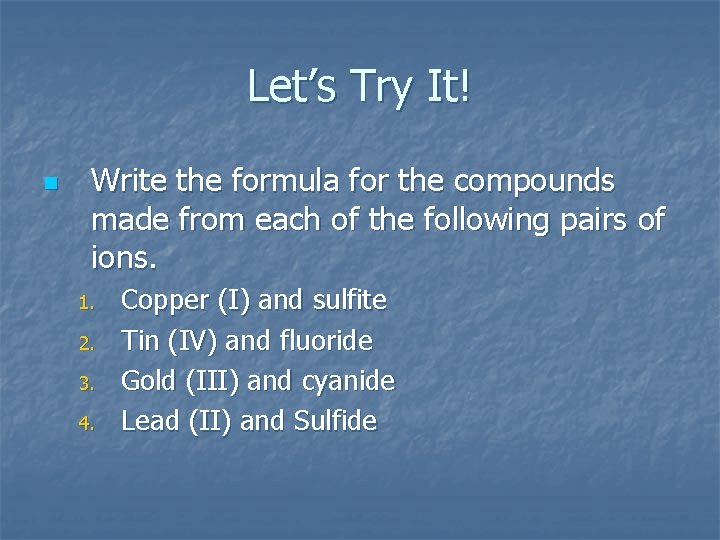
Let’s Try It! n Write the formula for the compounds made from each of the following pairs of ions. 1. 2. 3. 4. Copper (I) and sulfite Tin (IV) and fluoride Gold (III) and cyanide Lead (II) and Sulfide
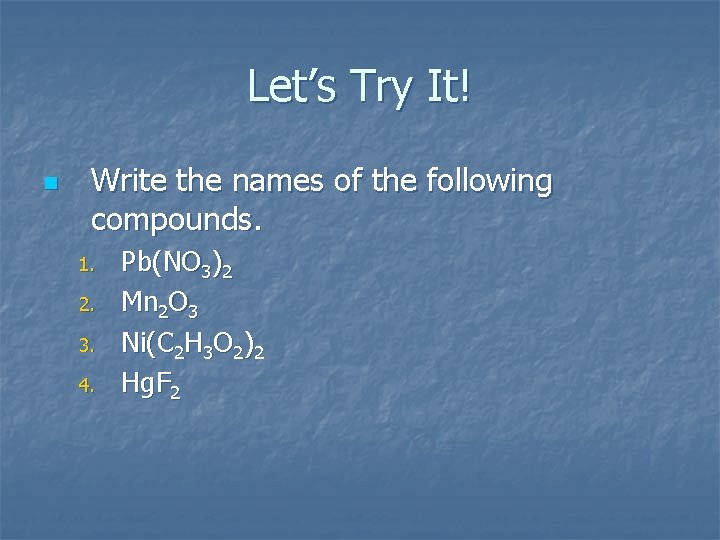
Let’s Try It! n Write the names of the following compounds. 1. 2. 3. 4. Pb(NO 3)2 Mn 2 O 3 Ni(C 2 H 3 O 2)2 Hg. F 2
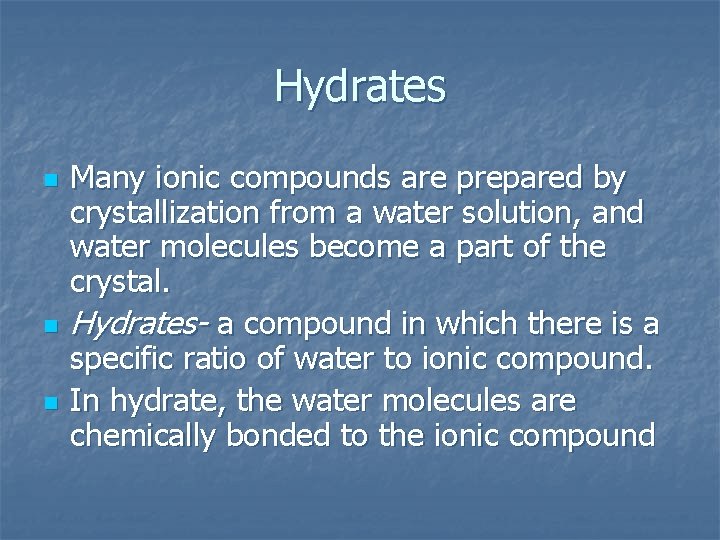
Hydrates n n n Many ionic compounds are prepared by crystallization from a water solution, and water molecules become a part of the crystal. Hydrates- a compound in which there is a specific ratio of water to ionic compound. In hydrate, the water molecules are chemically bonded to the ionic compound
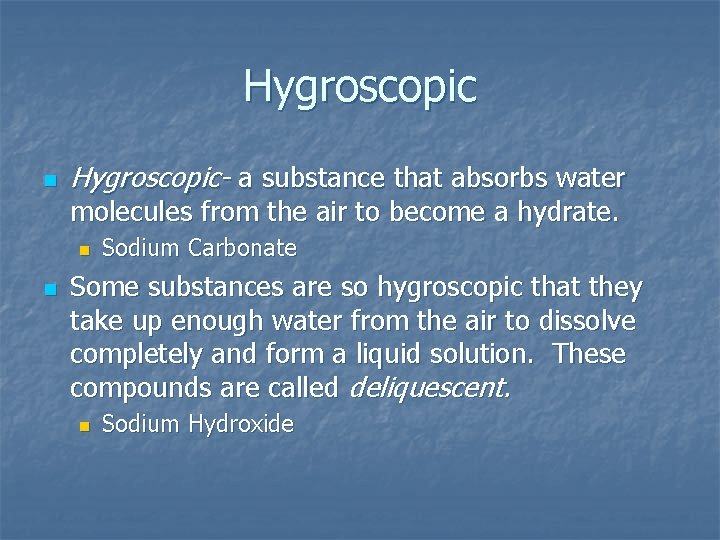
Hygroscopic n Hygroscopic- a substance that absorbs water molecules from the air to become a hydrate. n n Sodium Carbonate Some substances are so hygroscopic that they take up enough water from the air to dissolve completely and form a liquid solution. These compounds are called deliquescent. n Sodium Hydroxide
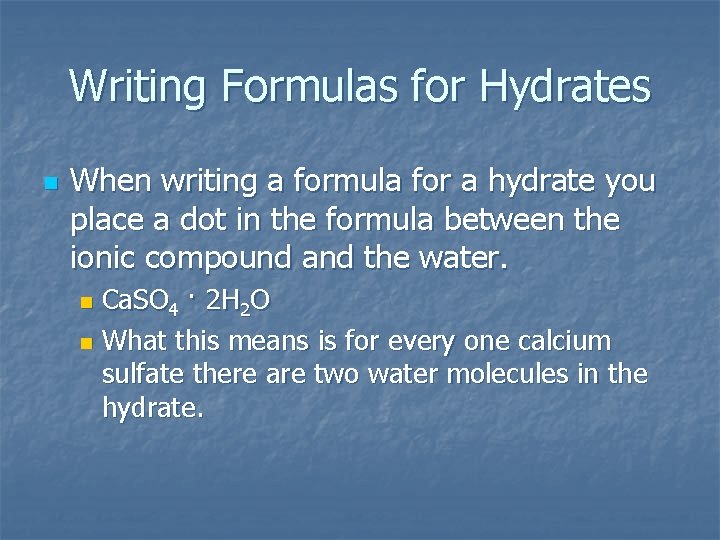
Writing Formulas for Hydrates n When writing a formula for a hydrate you place a dot in the formula between the ionic compound and the water. Ca. SO 4 · 2 H 2 O n What this means is for every one calcium sulfate there are two water molecules in the hydrate. n
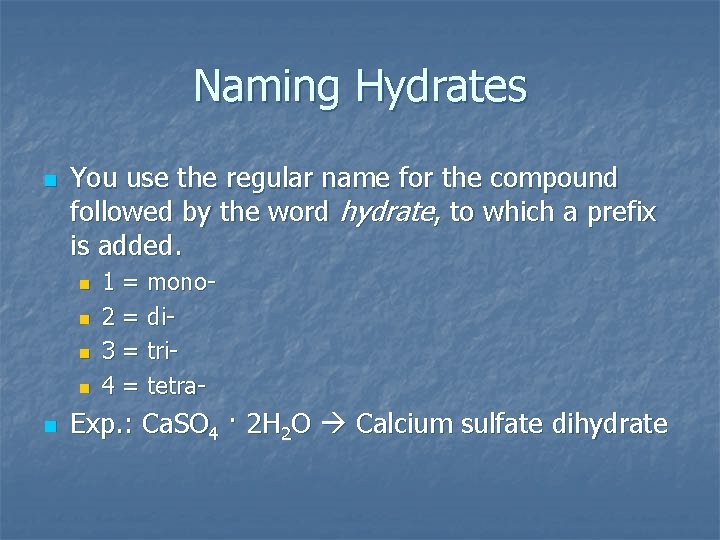
Naming Hydrates n You use the regular name for the compound followed by the word hydrate, to which a prefix is added. n n n 1 = mono 2 = di 3 = tri 4 = tetra- Exp. : Ca. SO 4 · 2 H 2 O Calcium sulfate dihydrate
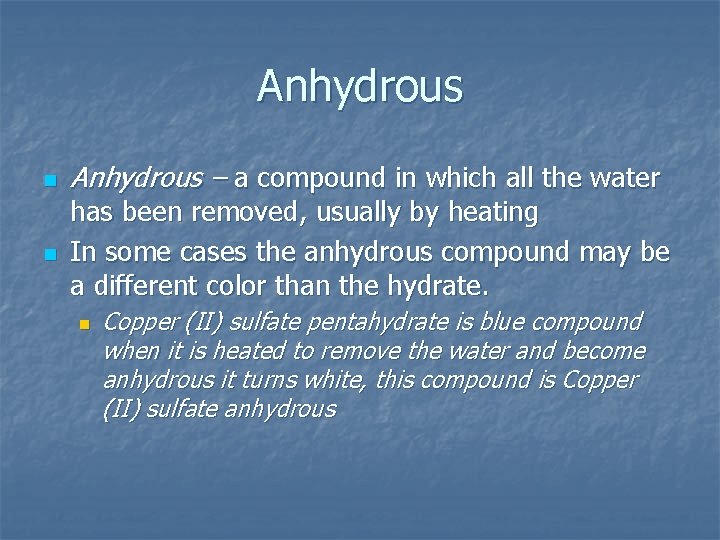
Anhydrous n n Anhydrous – a compound in which all the water has been removed, usually by heating In some cases the anhydrous compound may be a different color than the hydrate. n Copper (II) sulfate pentahydrate is blue compound when it is heated to remove the water and become anhydrous it turns white, this compound is Copper (II) sulfate anhydrous
Homework n P. 184 -185 #1 -5, 7, 8