
Chapter 5 Transient Conduction Many problems are time
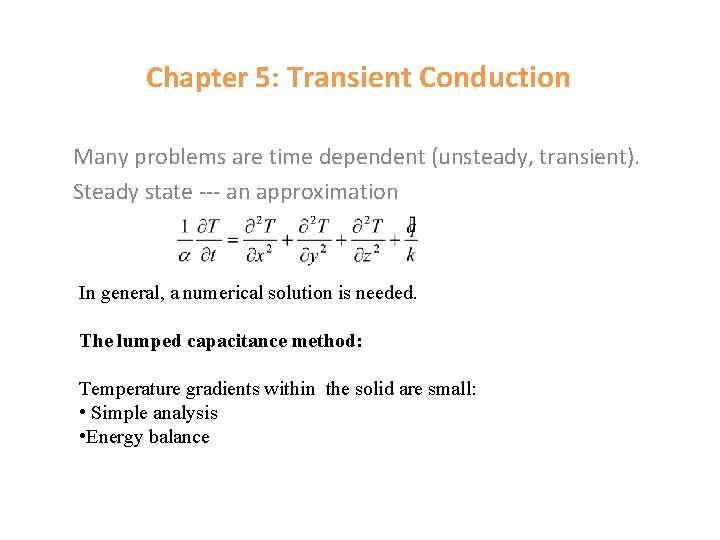
Chapter 5: Transient Conduction Many problems are time dependent (unsteady, transient). Steady state --- an approximation In general, a numerical solution is needed. The lumped capacitance method: Temperature gradients within the solid are small: • Simple analysis • Energy balance
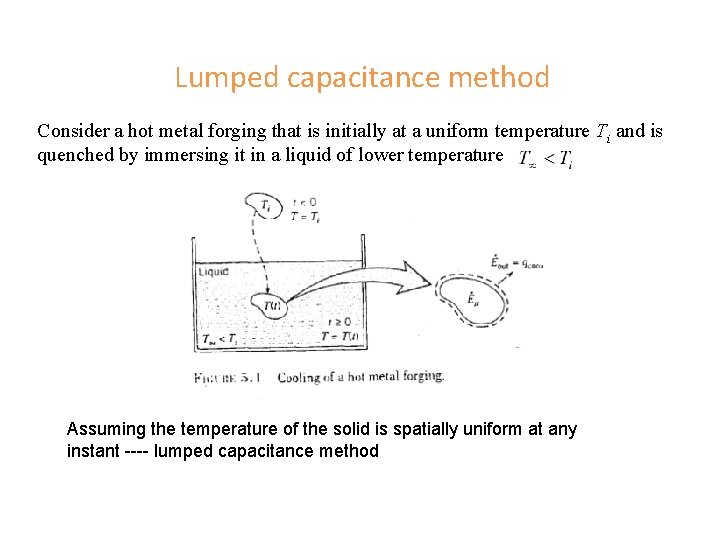
Lumped capacitance method Consider a hot metal forging that is initially at a uniform temperature Ti and is quenched by immersing it in a liquid of lower temperature Assuming the temperature of the solid is spatially uniform at any instant ---- lumped capacitance method
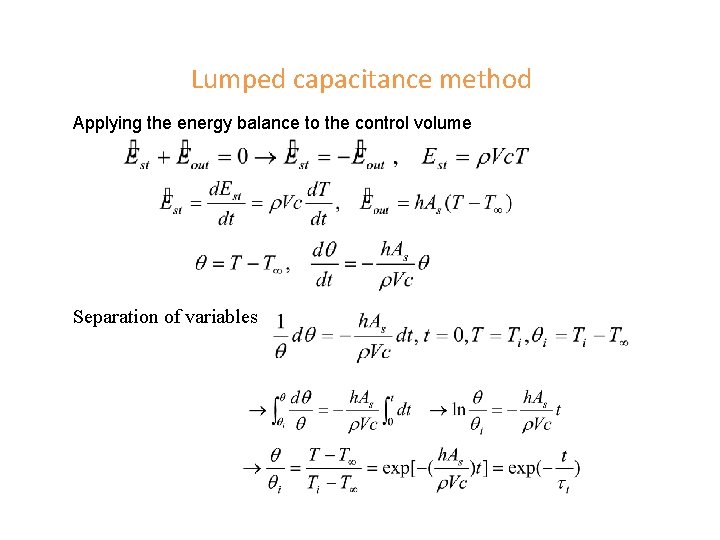
Lumped capacitance method Applying the energy balance to the control volume Separation of variables
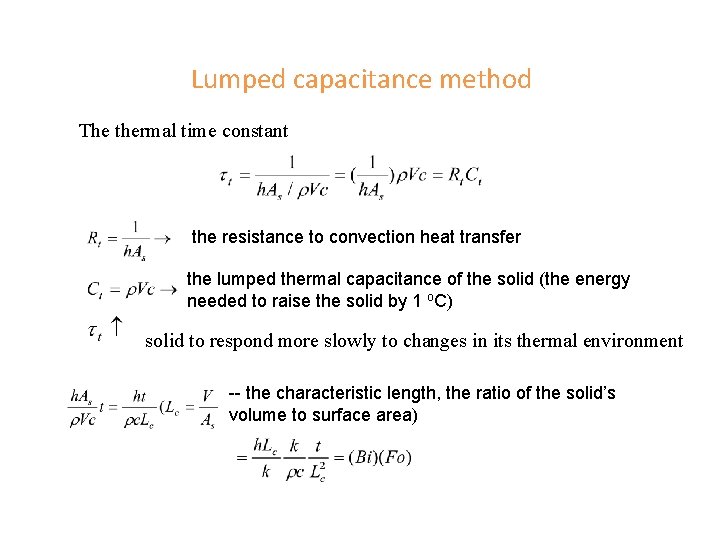
Lumped capacitance method The thermal time constant the resistance to convection heat transfer the lumped thermal capacitance of the solid (the energy needed to raise the solid by 1 o. C) solid to respond more slowly to changes in its thermal environment -- the characteristic length, the ratio of the solid’s volume to surface area)
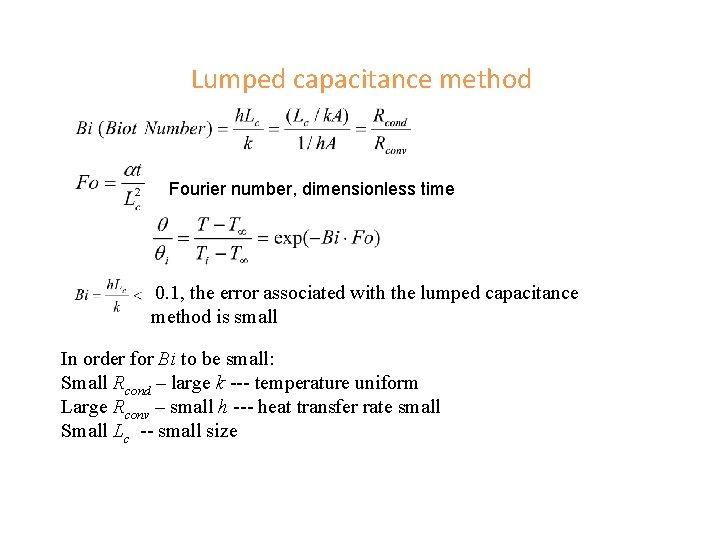
Lumped capacitance method Fourier number, dimensionless time 0. 1, the error associated with the lumped capacitance method is small In order for Bi to be small: Small Rcond – large k --- temperature uniform Large Rconv – small h --- heat transfer rate small Small Lc -- small size
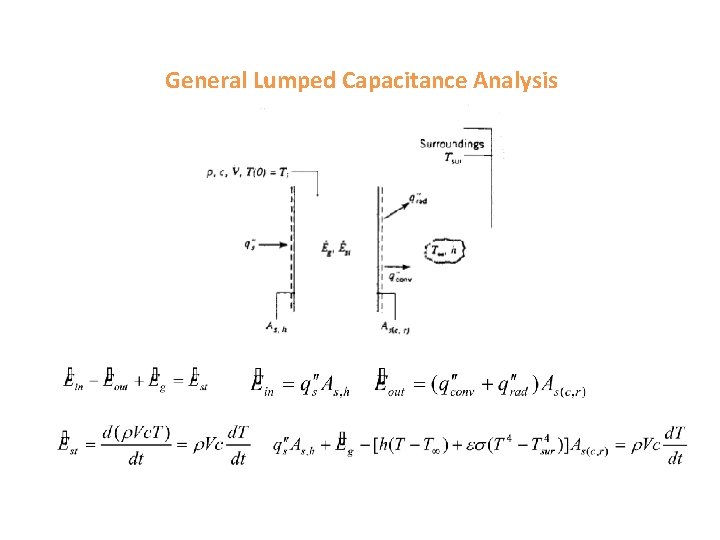
General Lumped Capacitance Analysis
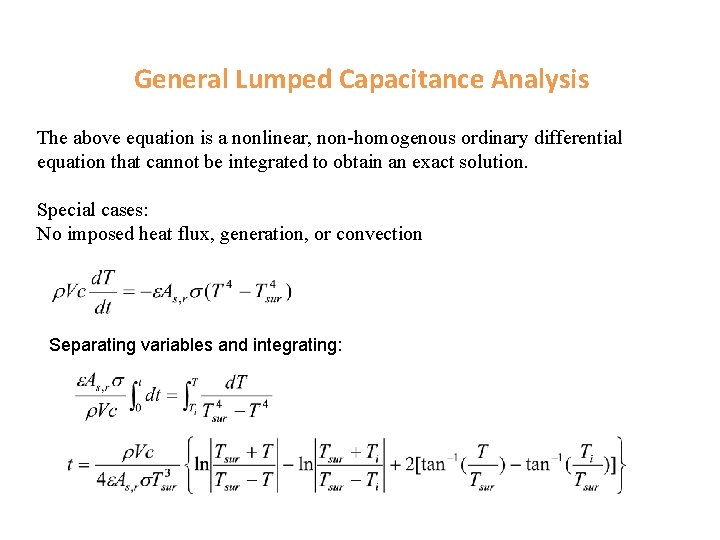
General Lumped Capacitance Analysis The above equation is a nonlinear, non-homogenous ordinary differential equation that cannot be integrated to obtain an exact solution. Special cases: No imposed heat flux, generation, or convection Separating variables and integrating:
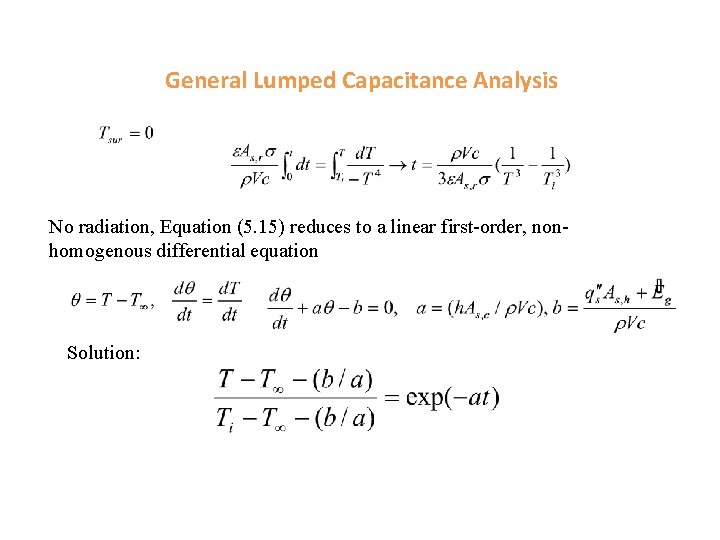
General Lumped Capacitance Analysis No radiation, Equation (5. 15) reduces to a linear first-order, nonhomogenous differential equation Solution:
- Slides: 8