
Chapter 5 Transient and SteadyState Response Analysis 5
- Slides: 9
Chapter 5 Transient and Steady-State Response Analysis
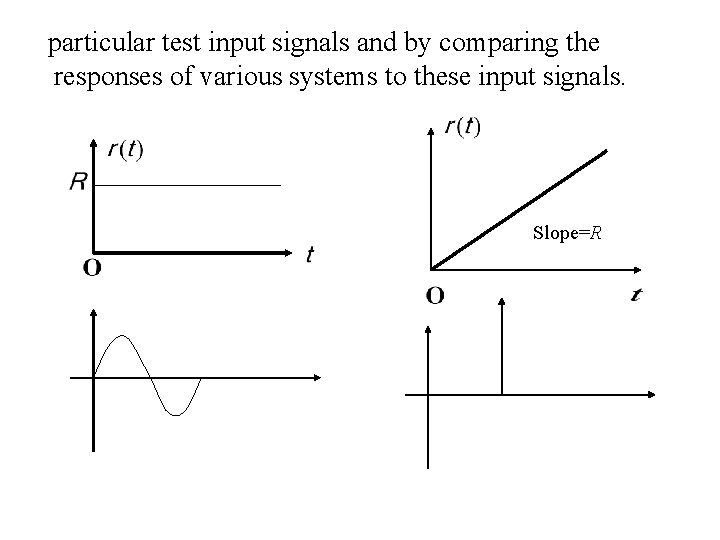
5. 1 Introduction Overview Once a system model is obtained, various methods are available for the analysis of system performance. In this chapter, we shall investigate the system response in time domain. Typical test signals. In practice, the input signal to a control system is unknown in advance but is random in nature. Therefore, in analyzing and designing control systems, some typical input test signals must be used as a basis of comparison of performance of various control systems. This basis may be set up by specifying
particular test input signals and by comparing the responses of various systems to these input signals. Slope=R
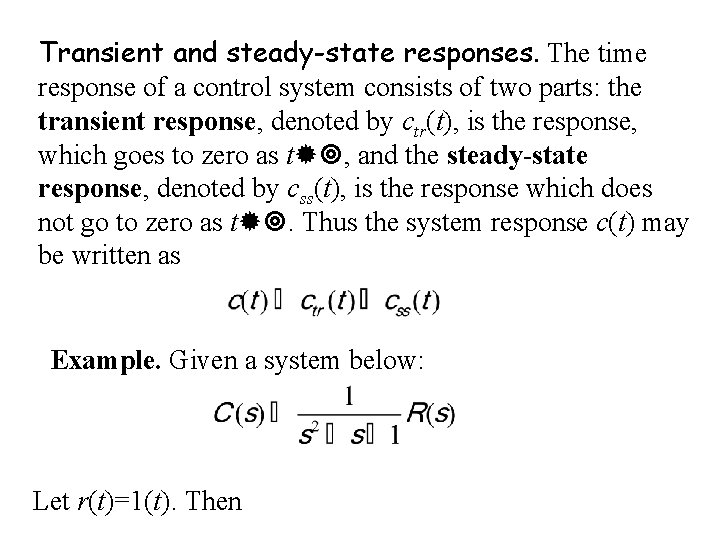
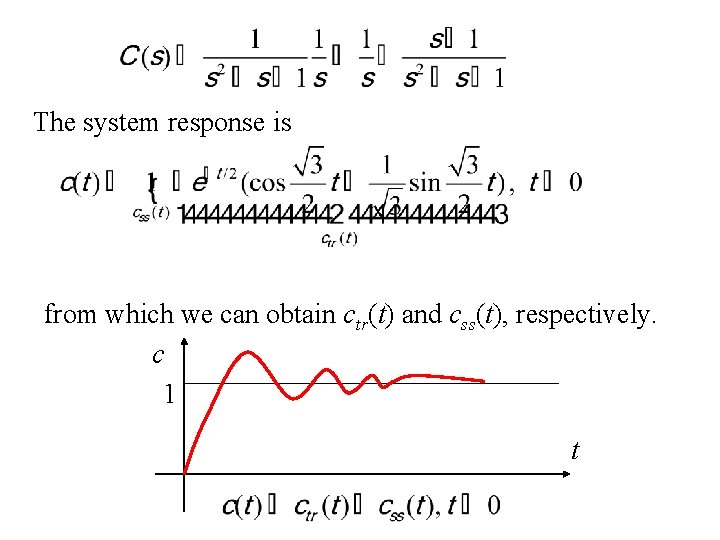
Transient and steady-state responses. The time response of a control system consists of two parts: the transient response, denoted by ctr(t), is the response, which goes to zero as t , and the steady-state response, denoted by css(t), is the response which does not go to zero as t . Thus the system response c(t) may be written as Example. Given a system below: Let r(t)=1(t). Then
The system response is from which we can obtain ctr(t) and css(t), respectively. c 1 t
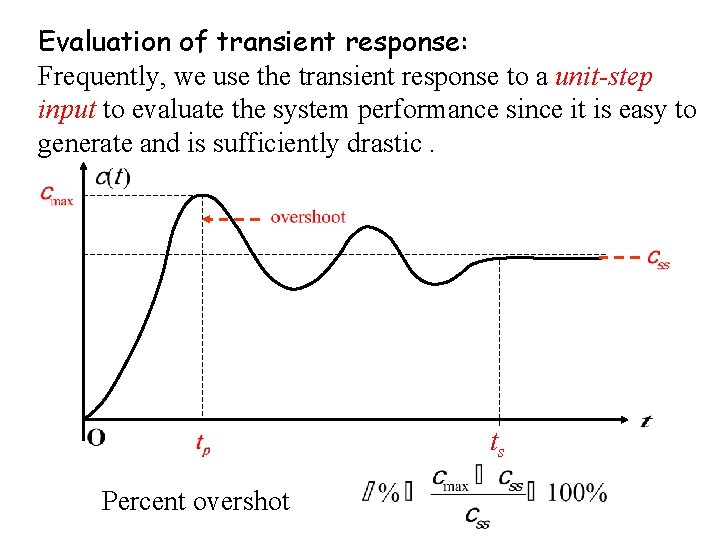
Evaluation of transient response: Frequently, we use the transient response to a unit-step input to evaluate the system performance since it is easy to generate and is sufficiently drastic. ts Percent overshot
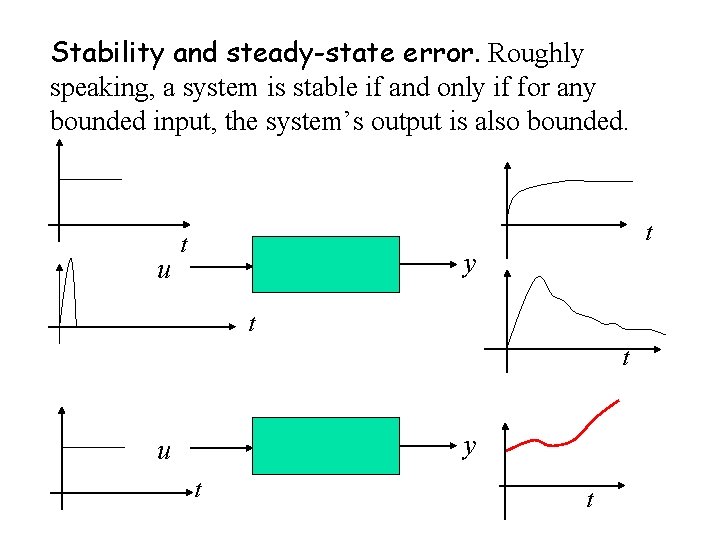
Stability and steady-state error. Roughly speaking, a system is stable if and only if for any bounded input, the system’s output is also bounded. u t t y u t t
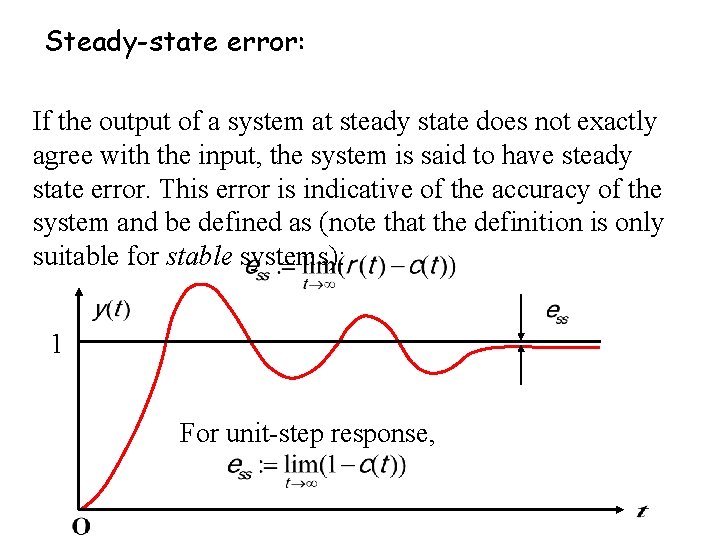
Steady-state error: If the output of a system at steady state does not exactly agree with the input, the system is said to have steady state error. This error is indicative of the accuracy of the system and be defined as (note that the definition is only suitable for stable systems): 1 For unit-step response,
The main purpose of this chapter is as follows: • To investigate, in time domain, the transient and steady-state performance for first-order, second-order and higher-order systems when some typical input signals are applied; • To introduce system stability criterion; • To investigate the steady-state error under some typical input signals.