
Chapter 5 Toward Independence When is it necessary

- Slides: 47
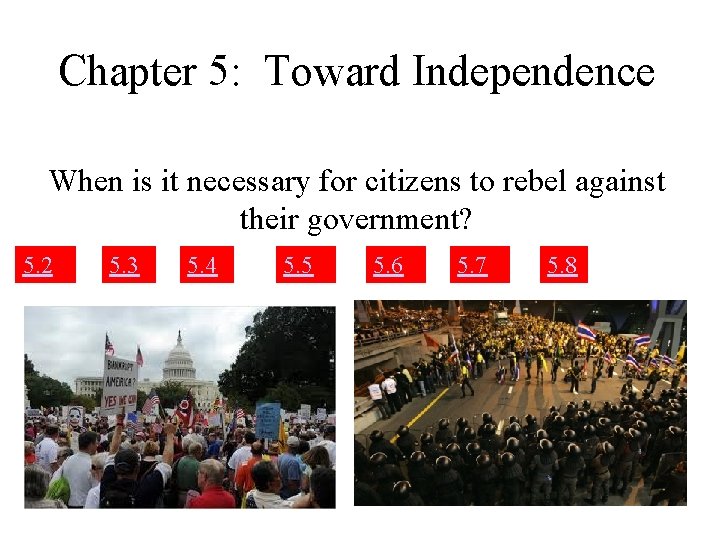
Chapter 5: Toward Independence When is it necessary for citizens to rebel against their government? 5. 2 5. 3 5. 4 5. 5 5. 6 5. 7 5. 8
Learning Goals and Scales • Complete Part 1 on 2 nd to last page. • Do initial ranking on part 2 on 2 nd to last page. • Do a ranking for LT 1 on 3 rd page.
Geography Challenge • Use orange books or on-line text. • Complete geography skills and critical thinking. • To use on-line text: – learntci – grahambr@tcaps. net – Username: graham 1 through graham 30 – Password: graham 1 through graham 30.
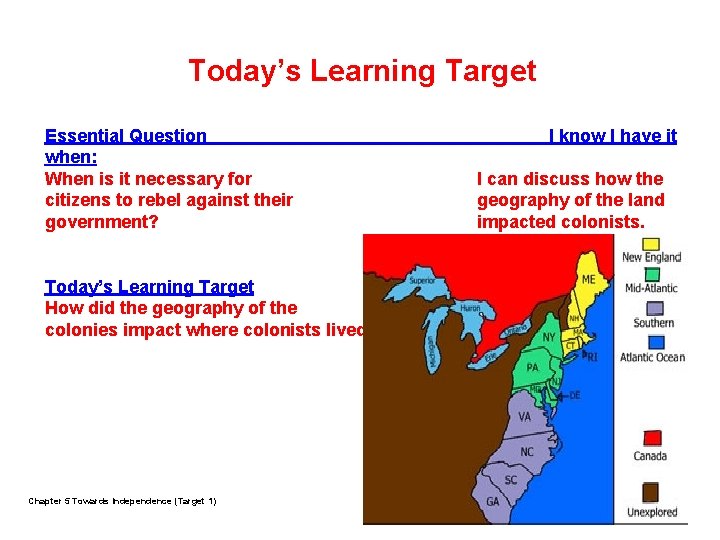
Today’s Learning Target Essential Question when: When is it necessary for citizens to rebel against their government? Today’s Learning Target How did the geography of the colonies impact where colonists lived? Chapter 5 Towards Independence (Target 1) I know I have it I can discuss how the geography of the land impacted colonists.
5. 1: Introduction 1. What is the name of Paul Revere’s Horse? 2. What were the two groups of colonists called? (One supported the King and one wanted to govern themselves. ) 3. What left the British in great debt? 4. What was the British response to this debt?
5. 1: Introduction Answers 1. What was Paul Revere’s Horses Name? Brown Beauty 2. What were the two groups of colonists called? (One supported the King and one wanted to govern themselves. ) Patriots (Whigs), Loyalists (Tories) 3. What left the British in great debt? War debt (French and Indian war) 4. What was the British response to this debt? New taxes on the colonists
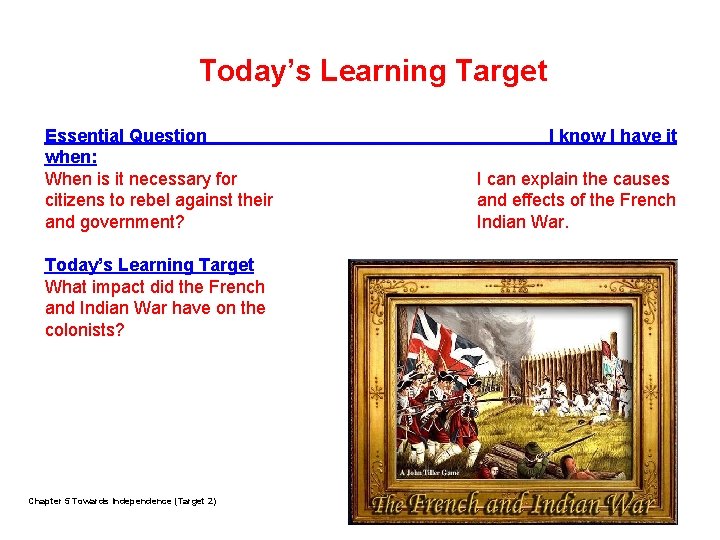
Today’s Learning Target Essential Question when: When is it necessary for citizens to rebel against their and government? Today’s Learning Target What impact did the French and Indian War have on the colonists? Chapter 5 Towards Independence (Target 2) I know I have it I can explain the causes and effects of the French Indian War.
5. 2: Before 1763 • Britain and colonies have good relations. • Colonists govern themselves and British left them alone.
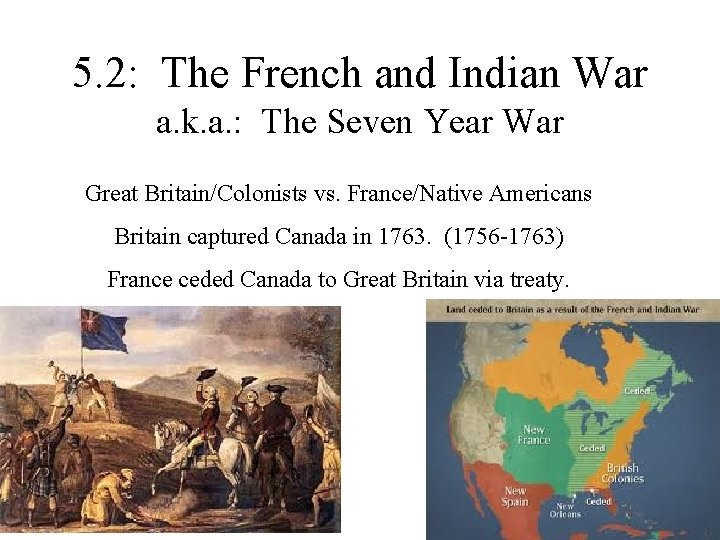
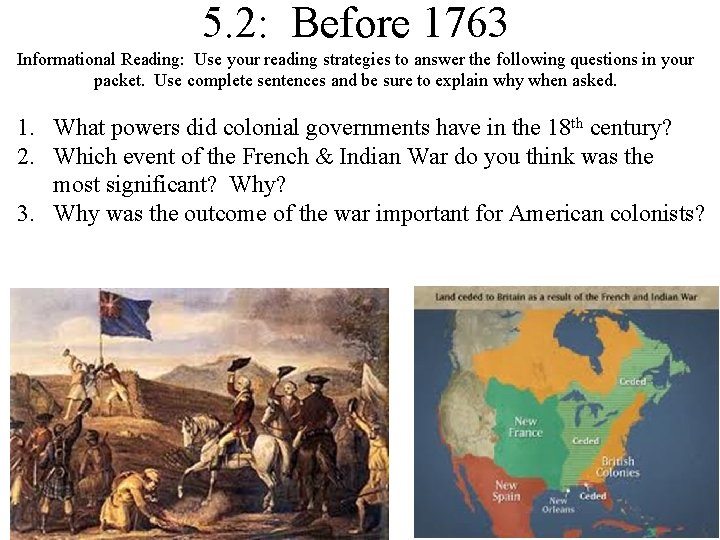
5. 2: The French and Indian War a. k. a. : The Seven Year War Great Britain/Colonists vs. France/Native Americans Britain captured Canada in 1763. (1756 -1763) France ceded Canada to Great Britain via treaty.
5. 2: Before 1763 Informational Reading: Use your reading strategies to answer the following questions in your packet. Use complete sentences and be sure to explain why when asked. 1. What powers did colonial governments have in the 18 th century? 2. Which event of the French & Indian War do you think was the most significant? Why? 3. Why was the outcome of the war important for American colonists?
5. 2: Answers 2. Possible answers: a. In 1754, Washington and his men opened fire on a French scouting party in the Ohio Valley. This event began the French and Indian War. b. In 1759, British troops captured Canada. This was an important turning point for the Americans, who had suffered many losses to the French. 3. The territory in North America controlled by Great Britain expanded greatly. Colonists felt proud to be British and hopeful for the future.
French and Indian War
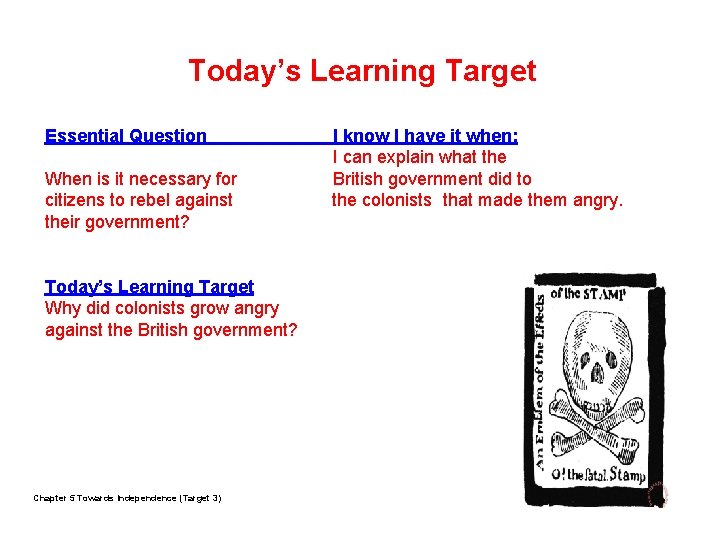
Today’s Learning Target Essential Question When is it necessary for citizens to rebel against their government? Today’s Learning Target Why did colonists grow angry against the British government? Chapter 5 Towards Independence (Target 3) I know I have it when: I can explain what the British government did to the colonists that made them angry.
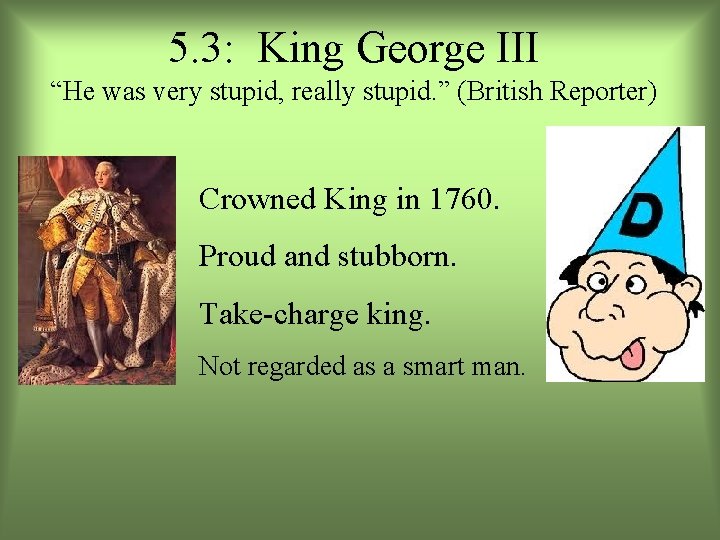
5. 3: King George III “He was very stupid, really stupid. ” (British Reporter) Crowned King in 1760. Proud and stubborn. Take-charge king. Not regarded as a smart man.
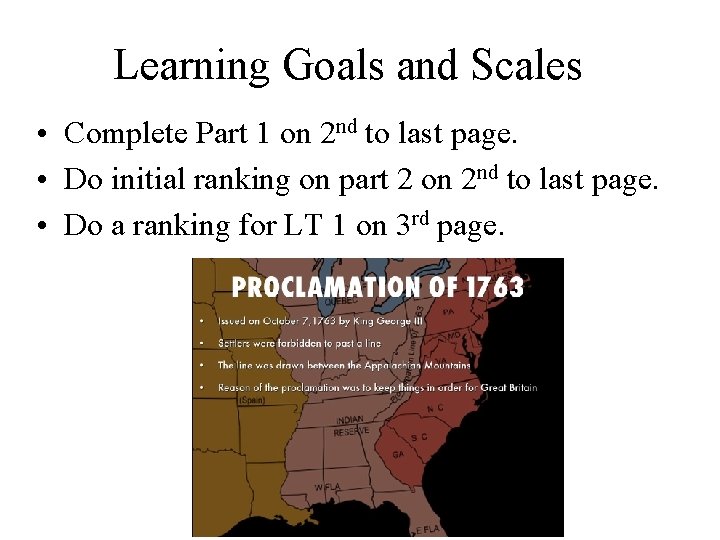
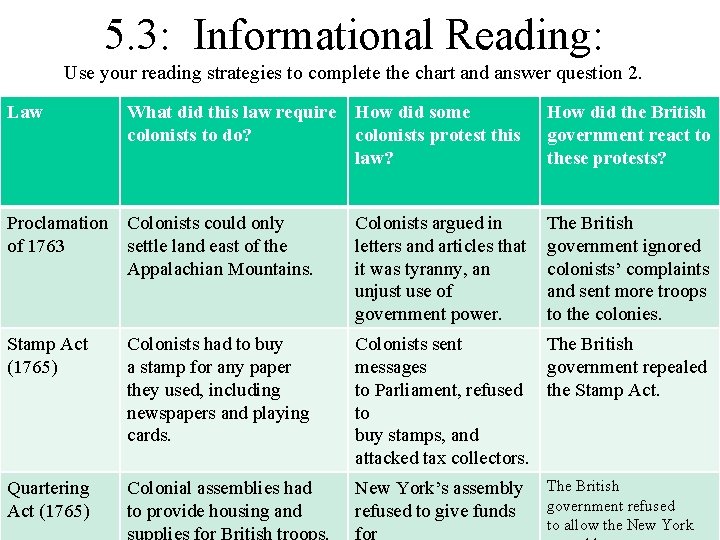
5. 3: Early British Actions British Impose New Laws after French & Indian War. 1. Proclamation of 1763: Settlers were to stay east of the Appalachian Mountains. 2. Stamp Act: A tax on paper. Each piece of paper must have a stamp. 3. Quartering Act: Colonists must provide British soldiers with housing and other living items. (For the most part, colonists ignored these demands. )
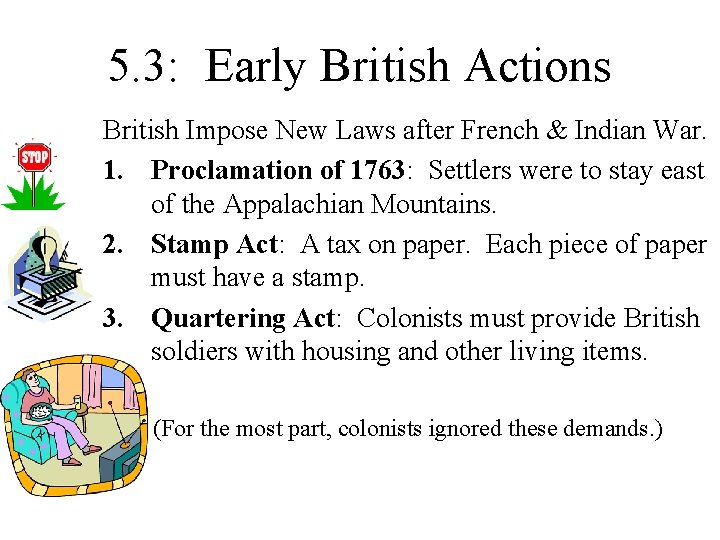
5. 3: Informational Reading: Use your reading strategies to complete the chart and answer question 2. Law Proclamation of 1763 Stamp Act (1765) Quartering Act (1765) What did this law require colonists to do? How did some colonists protest this law? How did the British government react to these protests?
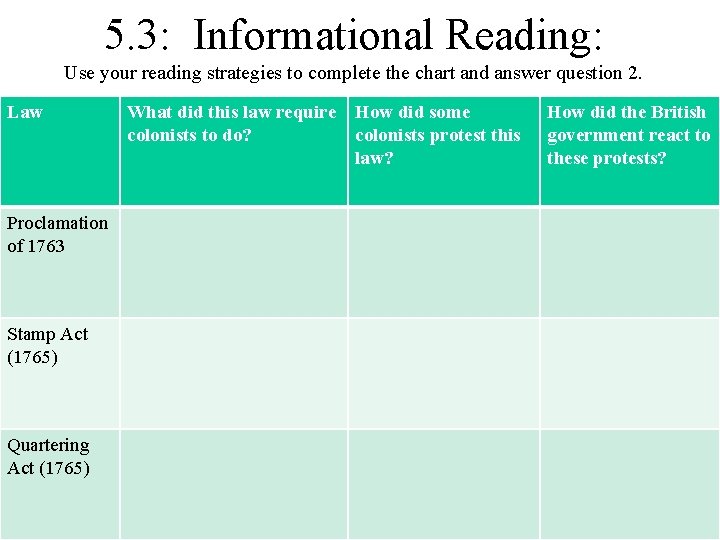
5. 3: Informational Reading: Use your reading strategies to complete the chart and answer question 2. Law What did this law require colonists to do? Proclamation Colonists could only of 1763 settle land east of the Appalachian Mountains. Stamp Act (1765) Quartering Act (1765) How did some colonists protest this law? How did the British government react to these protests? Colonists argued in letters and articles that it was tyranny, an unjust use of government power. The British government ignored colonists’ complaints and sent more troops to the colonies.
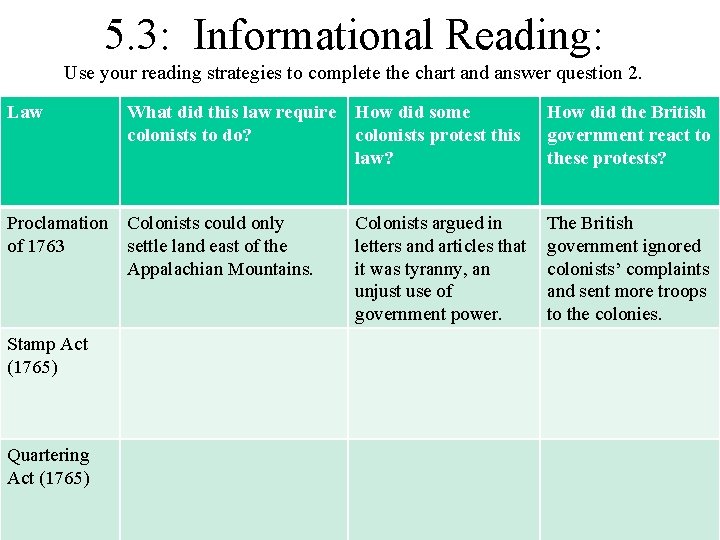
5. 3: Informational Reading: Use your reading strategies to complete the chart and answer question 2. Law How did some colonists protest this law? How did the British government react to these protests? Proclamation Colonists could only of 1763 settle land east of the Appalachian Mountains. Colonists argued in letters and articles that it was tyranny, an unjust use of government power. The British government ignored colonists’ complaints and sent more troops to the colonies. Stamp Act (1765) Colonists sent The British messages government repealed to Parliament, refused the Stamp Act. to buy stamps, and attacked tax collectors. Quartering Act (1765) What did this law require colonists to do? Colonists had to buy a stamp for any paper they used, including newspapers and playing cards.
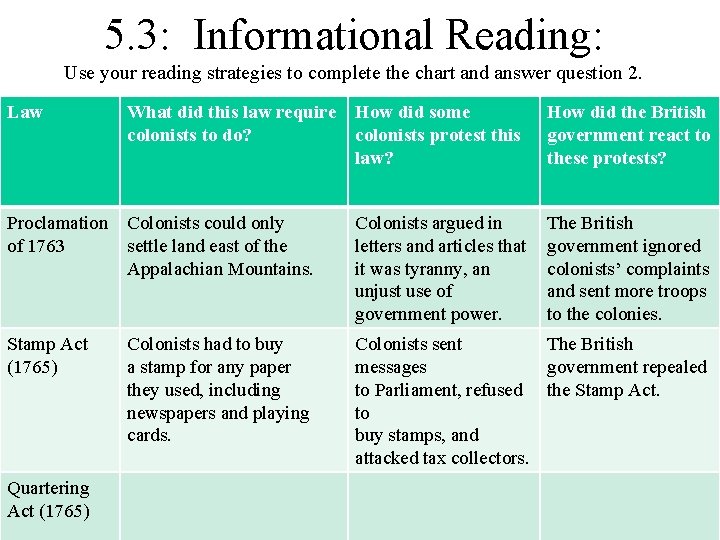
5. 3: Informational Reading: Use your reading strategies to complete the chart and answer question 2. Law What did this law require colonists to do? How did some colonists protest this law? How did the British government react to these protests? Proclamation Colonists could only of 1763 settle land east of the Appalachian Mountains. Colonists argued in letters and articles that it was tyranny, an unjust use of government power. The British government ignored colonists’ complaints and sent more troops to the colonies. Stamp Act (1765) Colonists had to buy a stamp for any paper they used, including newspapers and playing cards. Colonists sent The British messages government repealed to Parliament, refused the Stamp Act. to buy stamps, and attacked tax collectors. Quartering Act (1765) Colonial assemblies had to provide housing and supplies for British troops. New York’s assembly refused to give funds for The British government refused to allow the New York
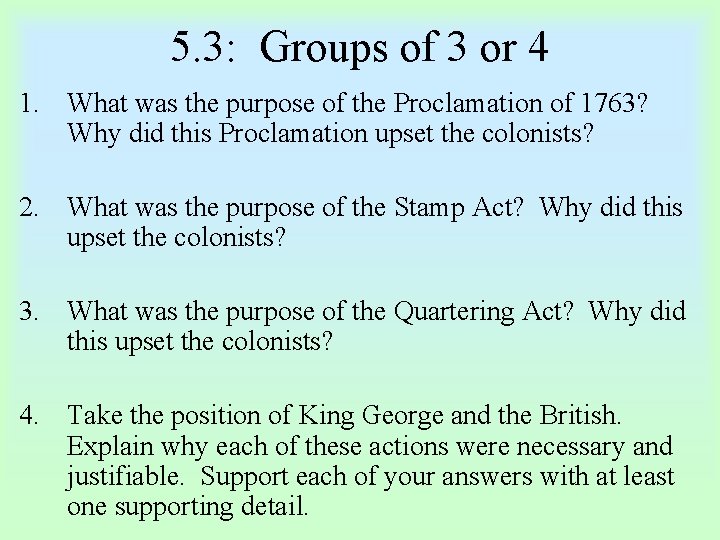
5. 3: Groups of 3 or 4 1. What was the purpose of the Proclamation of 1763? Why did this Proclamation upset the colonists? 2. What was the purpose of the Stamp Act? Why did this upset the colonists? 3. What was the purpose of the Quartering Act? Why did this upset the colonists? 4. Take the position of King George and the British. Explain why each of these actions were necessary and justifiable. Support each of your answers with at least one supporting detail.
Early British Actions
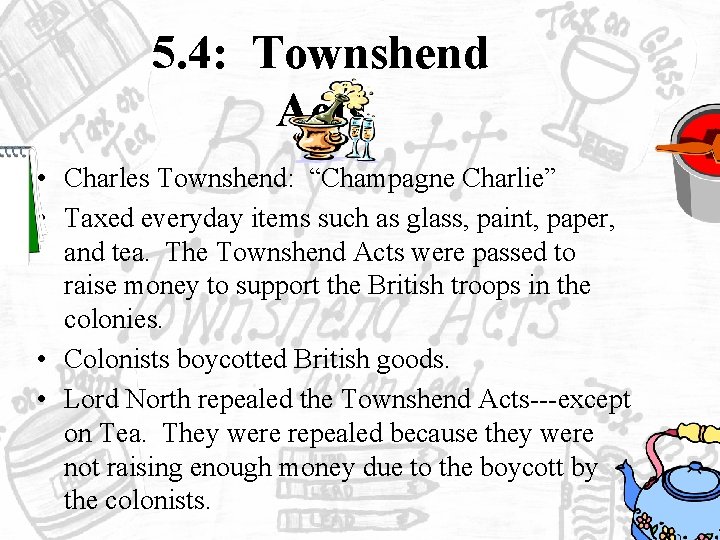
5. 4: Townshend Townsend Acts • Charles Townshend: “Champagne Charlie” • Taxed everyday items such as glass, paint, paper, and tea. The Townshend Acts were passed to raise money to support the British troops in the colonies. • Colonists boycotted British goods. • Lord North repealed the Townshend Acts---except on Tea. They were repealed because they were not raising enough money due to the boycott by the colonists.
Complete the KWL chart for section 5. 5: The Boston Massacre
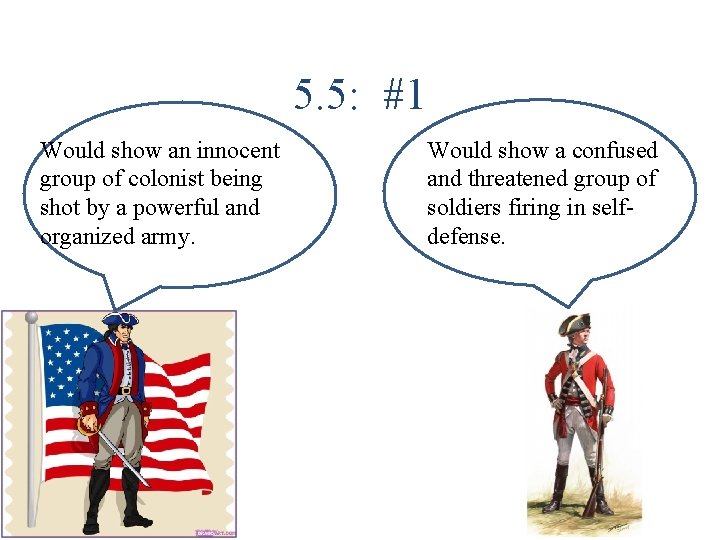
5. 5: #1 Would show an innocent group of colonist being shot by a powerful and organized army. Would show a confused and threatened group of soldiers firing in selfdefense.
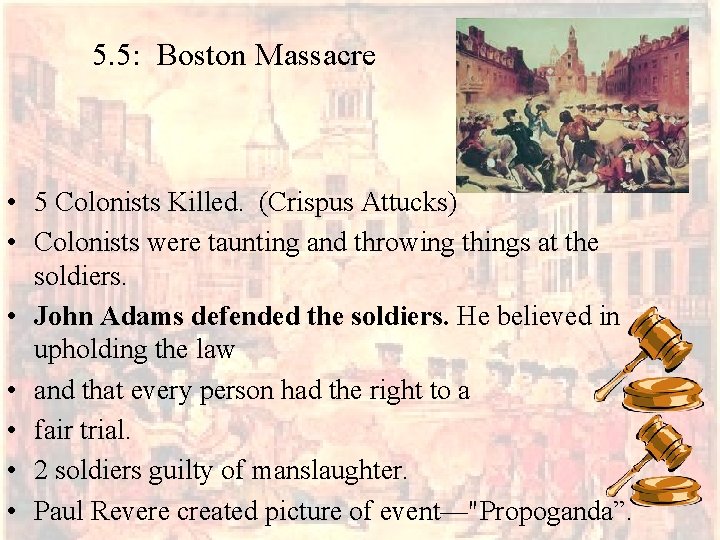
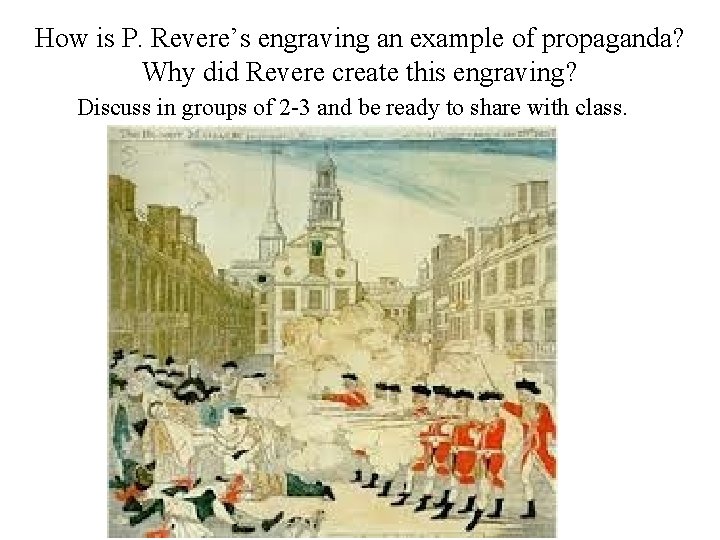
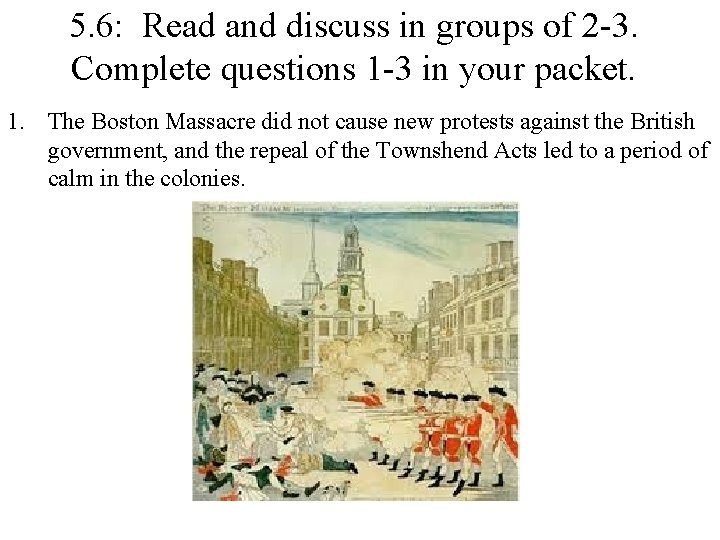
5. 5: Boston Massacre • 5 Colonists Killed. (Crispus Attucks) • Colonists were taunting and throwing things at the soldiers. • John Adams defended the soldiers. He believed in upholding the law • and that every person had the right to a • fair trial. • 2 soldiers guilty of manslaughter. • Paul Revere created picture of event—"Propoganda”.
How is P. Revere’s engraving an example of propaganda? Why did Revere create this engraving? Discuss in groups of 2 -3 and be ready to share with class.
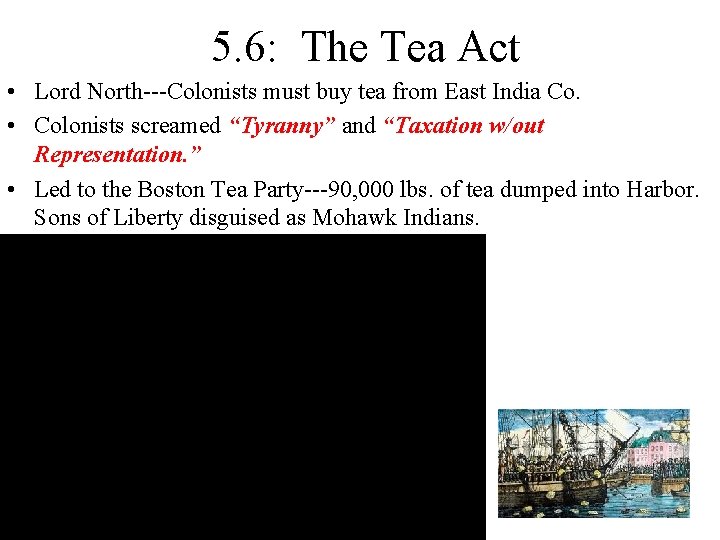
5. 6: The Tea Act • Lord North---Colonists must buy tea from East India Co. • Colonists screamed “Tyranny” and “Taxation w/out Representation. ” • Led to the Boston Tea Party---90, 000 lbs. of tea dumped into Harbor. Sons of Liberty disguised as Mohawk Indians.
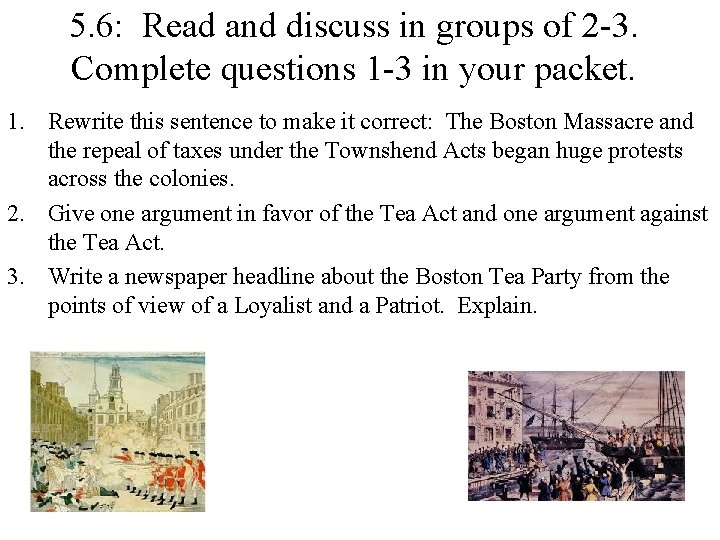
5. 6: Read and discuss in groups of 2 -3. Complete questions 1 -3 in your packet. 1. Rewrite this sentence to make it correct: The Boston Massacre and the repeal of taxes under the Townshend Acts began huge protests across the colonies. 2. Give one argument in favor of the Tea Act and one argument against the Tea Act. 3. Write a newspaper headline about the Boston Tea Party from the points of view of a Loyalist and a Patriot. Explain.
5. 6: Read and discuss in groups of 2 -3. Complete questions 1 -3 in your packet. 1. The Boston Massacre did not cause new protests against the British government, and the repeal of the Townshend Acts led to a period of calm in the colonies.
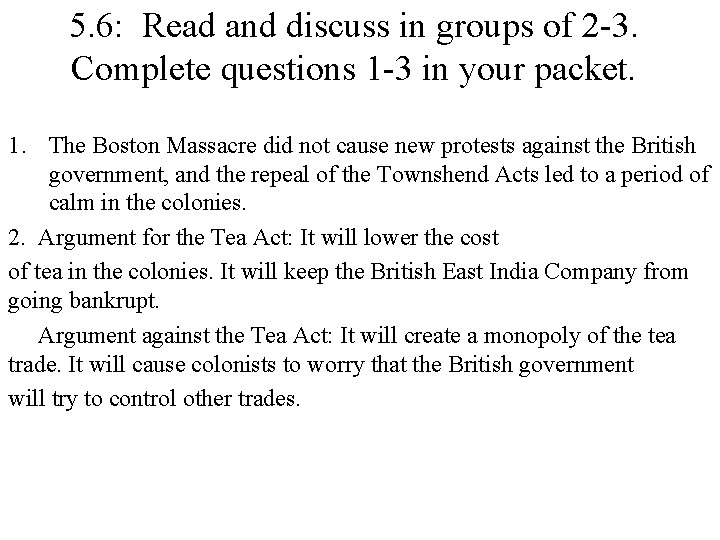
5. 6: Read and discuss in groups of 2 -3. Complete questions 1 -3 in your packet. 1. The Boston Massacre did not cause new protests against the British government, and the repeal of the Townshend Acts led to a period of calm in the colonies. 2. Argument for the Tea Act: It will lower the cost of tea in the colonies. It will keep the British East India Company from going bankrupt. Argument against the Tea Act: It will create a monopoly of the tea trade. It will cause colonists to worry that the British government will try to control other trades.
5. 6: Read and discuss in groups of 2 -3. Complete questions 1 -3 in your packet. 1. The Boston Massacre did not cause new protests against the British government, and the repeal of the Townshend Acts led to a period of calm in the colonies. 2. Argument for the Tea Act: It will lower the cost of tea in the colonies. It will keep the British East India Company from going bankrupt. Argument against the Tea Act: It will create a monopoly of the tea trade. It will cause colonists to worry that the British government will try to control other trades. 3. Loyalist Headline: “Patriot Temper Tantrum at Boston Harbor” Patriot Headline: “Magnificent Moment of Defending Our Rights”
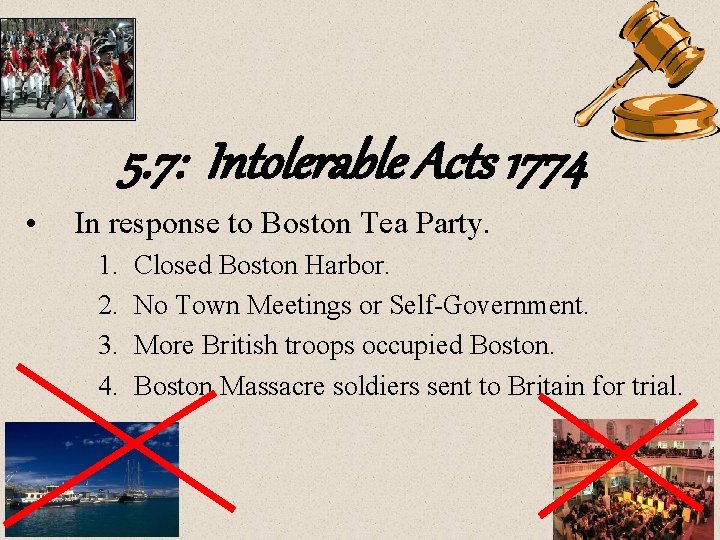
5. 7: Intolerable Acts 1774 • In response to Boston Tea Party. 1. 2. 3. 4. Closed Boston Harbor. No Town Meetings or Self-Government. More British troops occupied Boston Massacre soldiers sent to Britain for trial.
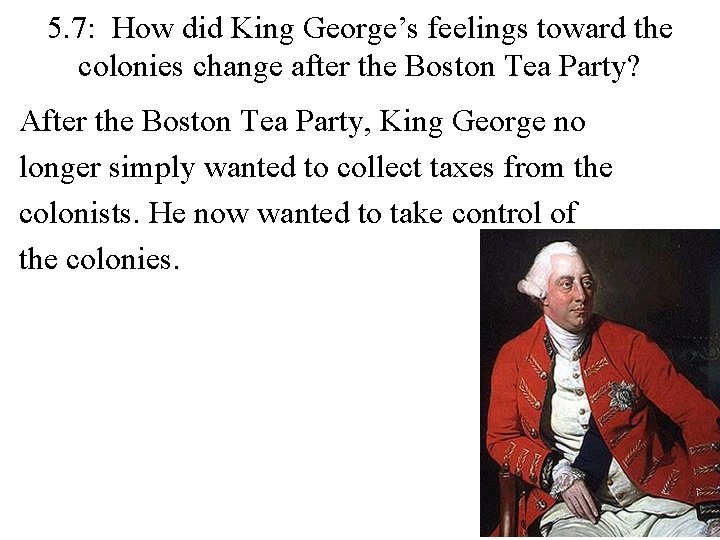
5. 7: How did King George’s feelings toward the colonies change after the Boston Tea Party? After the Boston Tea Party, King George no longer simply wanted to collect taxes from the colonists. He now wanted to take control of the colonies.
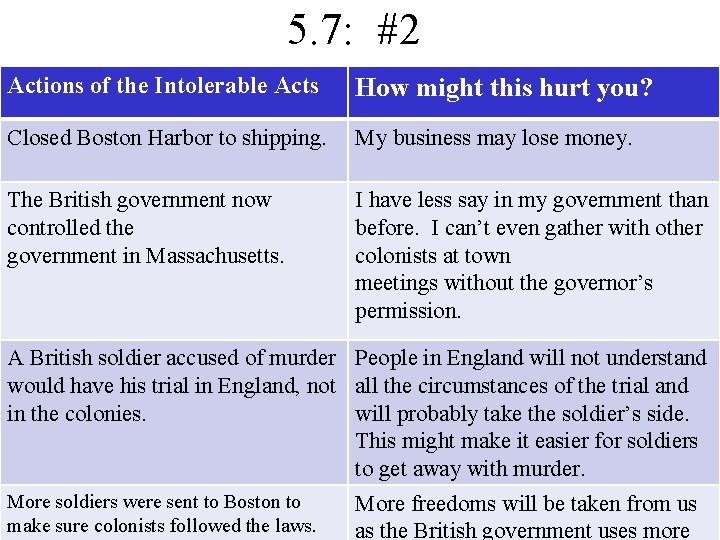
5. 7: #2 Actions of the Intolerable Acts How might this hurt you? Closed Boston Harbor to shipping. My business may lose money. The British government now controlled the government in Massachusetts. I have less say in my government than before. I can’t even gather with other colonists at town meetings without the governor’s permission. A British soldier accused of murder People in England will not understand would have his trial in England, not all the circumstances of the trial and in the colonies. will probably take the soldier’s side. This might make it easier for soldiers to get away with murder. More soldiers were sent to Boston to make sure colonists followed the laws. More freedoms will be taken from us as the British government uses more
5. 7: #3 Examples of Colonist’s Actions to Oppose Intolerable Acts: 1. Boycott British Goods. 2. Merchants shut down their shops. 3. Virginia called for Continental Congress Meeting. 4. Formation of Militias.
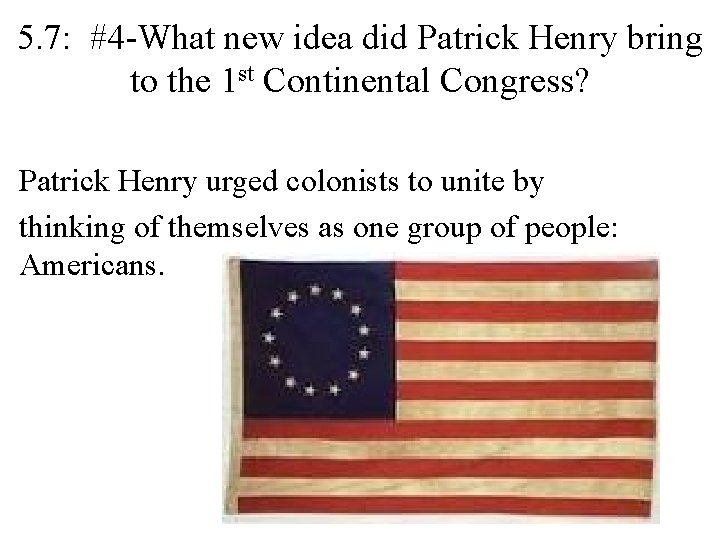
5. 7: #4 -What new idea did Patrick Henry bring to the 1 st Continental Congress? Patrick Henry urged colonists to unite by thinking of themselves as one group of people: Americans.
5. 7: #5. What decisions did the Continental Congress make? st 1 The First Continental Congress decided to send a message to King George asking him to recognize their rights. The Congress also called for a new boycott of British goods until the Intolerable Acts were repealed.
5. 7: • • st 1 Continental Congress September, 1774 in Philadelphia. Petitioned King George. Boycott British Goods. Meet again in May.
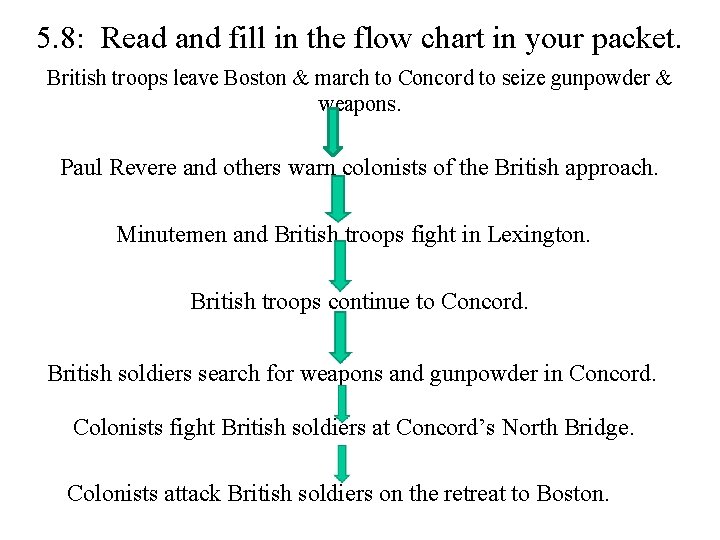
5. 8: Read and fill in the flow chart in your packet. British troops leave Boston & march to Concord to seize gunpowder & weapons. Paul Revere and others warn colonists of the British approach. Minutemen and British troops fight in Lexington. British troops continue to Concord. British soldiers search for weapons and gunpowder in Concord. Colonists fight British soldiers at Concord’s North Bridge. Colonists attack British soldiers on the retreat to Boston.
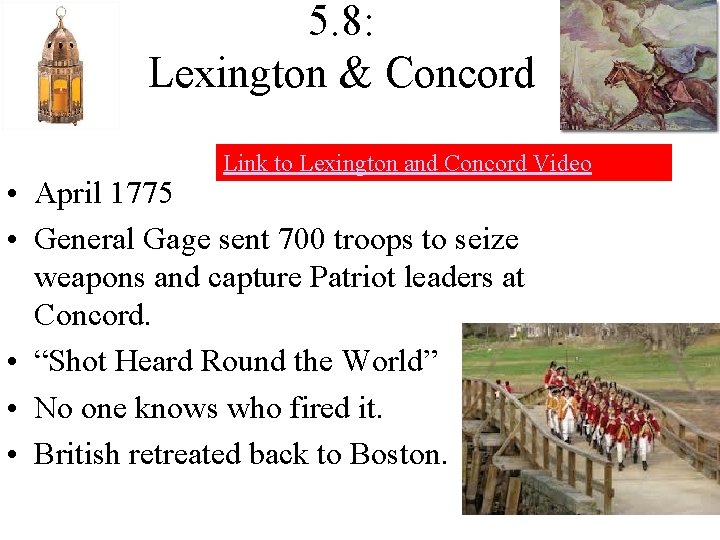
5. 8: Lexington & Concord Link to Lexington and Concord Video • April 1775 • General Gage sent 700 troops to seize weapons and capture Patriot leaders at Concord. • “Shot Heard Round the World” • No one knows who fired it. • British retreated back to Boston.
The Real Story of Paul Revere Link. Paul Revere Poem by Longfellow Rewriting the story of Paul Revere
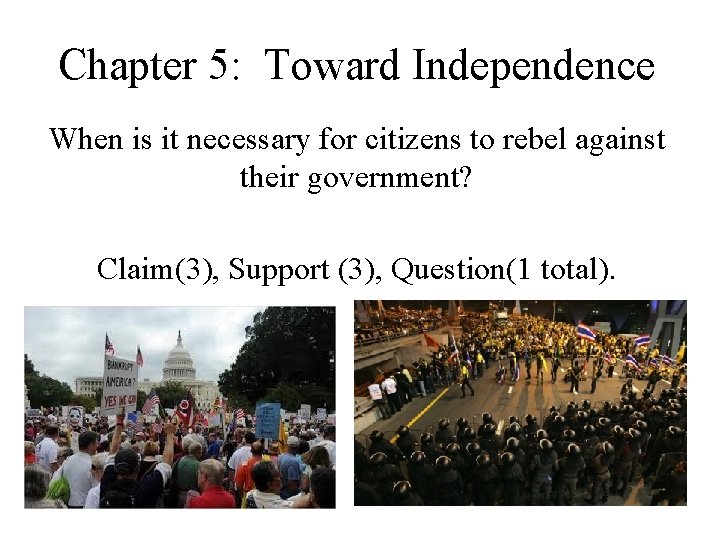
Chapter 5: Toward Independence When is it necessary for citizens to rebel against their government? Claim(3), Support (3), Question(1 total).
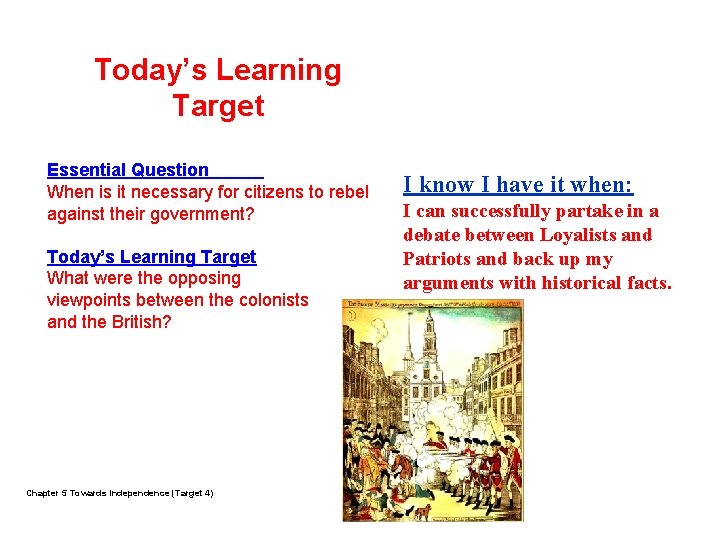
Today’s Learning Target Essential Question When is it necessary for citizens to rebel against their government? Today’s Learning Target What were the opposing viewpoints between the colonists and the British? Chapter 5 Towards Independence (Target 4) I know I have it when: I can successfully partake in a debate between Loyalists and Patriots and back up my arguments with historical facts.
Create 3 questions that you would ask to any of the following historical figures if they were alive and in this room today: King George III Charles Townsend (Champagne Charlie) John Adams Paul Revere Patrick Henry • The Questions Must: 1. 2. 3. 4. Pertain to historical events of pre-revolutionary times in the British colonies of North American that were introduced or covered in chapter 5. Be well written and in complete sentences. Be easy to understand. Have a clear objective (purpose). For example, clearly state the expectations of the person answering. i. e. : Clearly explain why…. . by giving three examples.