
Chapter 5 Tissues Principal Types of Tissue Four
- Slides: 42
Chapter 5 Tissues
Principal Types of Tissue Four types of tissues: n Epithelial tissue n Connective tissue n Muscle tissue n Nervous tissue
Extracellular Matrix (ECM) n Functions n Helps bind tissues together structurally ECM components bind to each other and to integrins in plasma membranes of cells n In some tissues, it is primarily intercellular junctions that hold cells together n n Allows local communication among ECM and various cells—through connection via integrins in plasma membranes
Extracellular Matrix (ECM) n Components n Water n Proteins n Structural proteins n n n Collagen—strong, flexible protein fiber Elastin—elastic fibers Includes glycoproteins—proteins with a few carbohydrate attachments n n Fibronectin and laminins help connect the ECM components to cells by binding with integrins in plasma membranes Glycoprotein attachments also allow local communication within a tissue
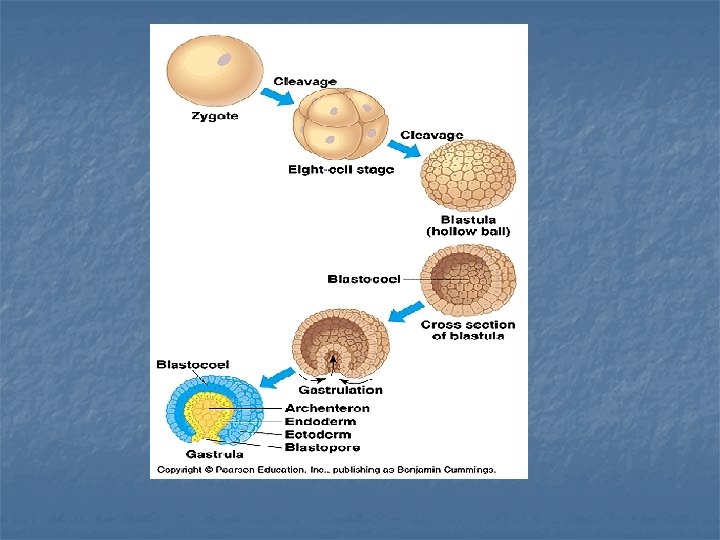
Embryonic Development of Tissues n n n Primary germ layers (Figure 5 -2) n Endoderm n Mesoderm n Ectoderm Gastrulation—process of cell movement and differentiation, which results in development of primary germ layers Histogenesis—the process by which the primary germ layers differentiate into different kinds of tissue
Types of tissues There are 4 main types of tissues: 1) Epithelial tissue 2) Connective tissue 3) Muscle tissue 4) Nervous tissue n
Epithelial Tissue n Functions Protection n Sensory functions n Secretion n Absorption n Excretion n
Epithelial Tissue n Types and locations n Epithelium is divided into two types: Membranous (covering or lining) epithelium n Glandular epithelium n n Locations Membranous epithelium—covers the body and some of its parts; lines the serous cavities, blood and lymphatic vessels, and respiratory, digestive, and genitourinary tracts n Glandular epithelium—secretory units of endocrine and exocrine glands n
Epithelial Tissue n Classification of epithelial tissue n Classification based on cell shape n n Squamous Cuboidal Columnar Pseudostratified columnar
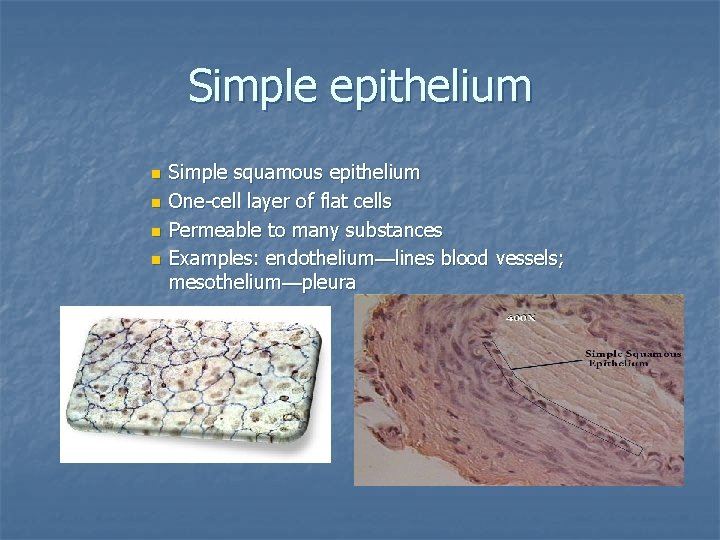
Simple epithelium n n Simple squamous epithelium One-cell layer of flat cells Permeable to many substances Examples: endothelium—lines blood vessels; mesothelium—pleura
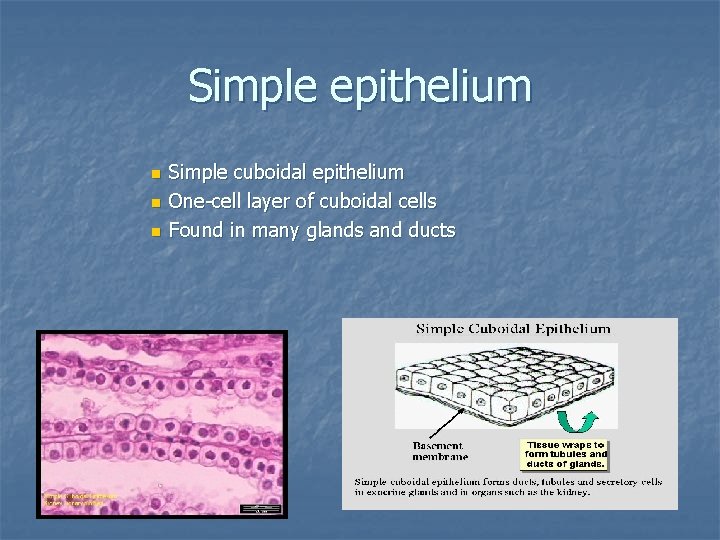
Simple epithelium n n n Simple cuboidal epithelium One-cell layer of cuboidal cells Found in many glands and ducts
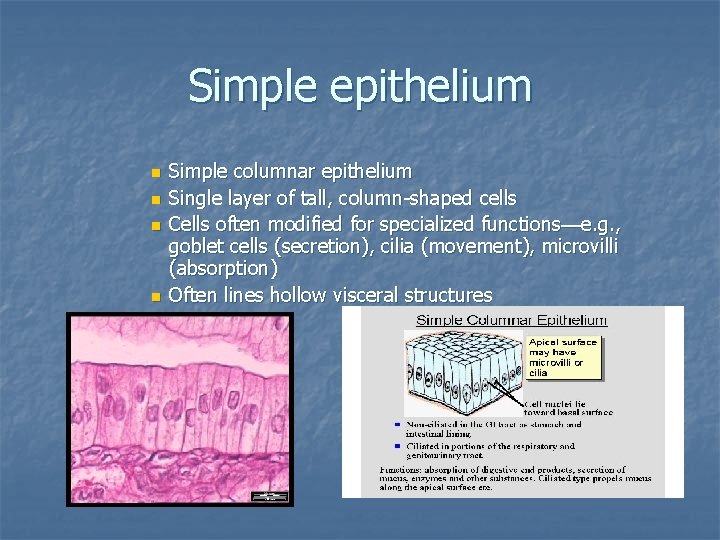
Simple epithelium n n Simple columnar epithelium Single layer of tall, column-shaped cells Cells often modified for specialized functions—e. g. , goblet cells (secretion), cilia (movement), microvilli (absorption) Often lines hollow visceral structures
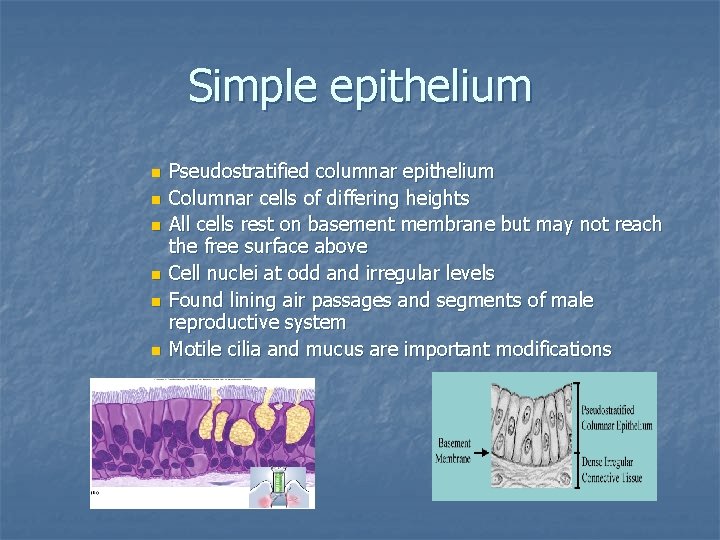
Simple epithelium n n n Pseudostratified columnar epithelium Columnar cells of differing heights All cells rest on basement membrane but may not reach the free surface above Cell nuclei at odd and irregular levels Found lining air passages and segments of male reproductive system Motile cilia and mucus are important modifications
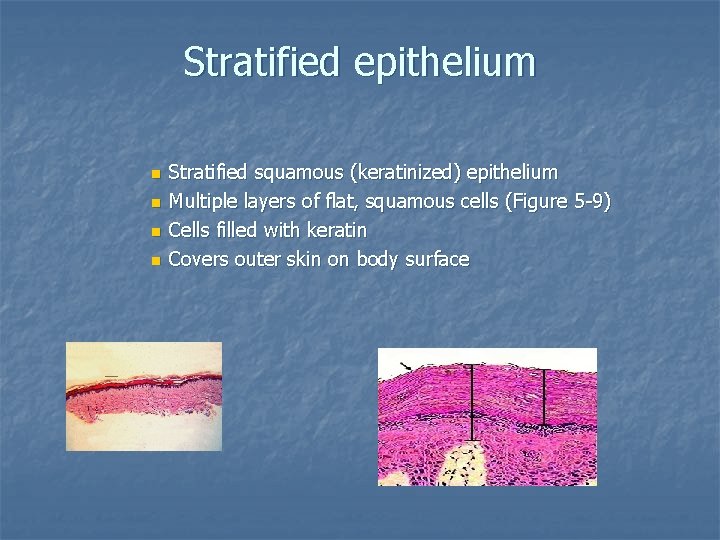
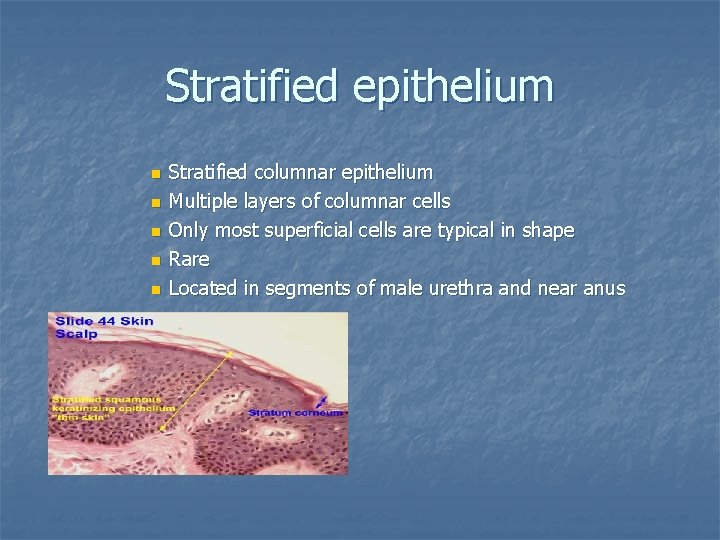
Stratified epithelium n n Stratified squamous (keratinized) epithelium Multiple layers of flat, squamous cells (Figure 5 -9) Cells filled with keratin Covers outer skin on body surface
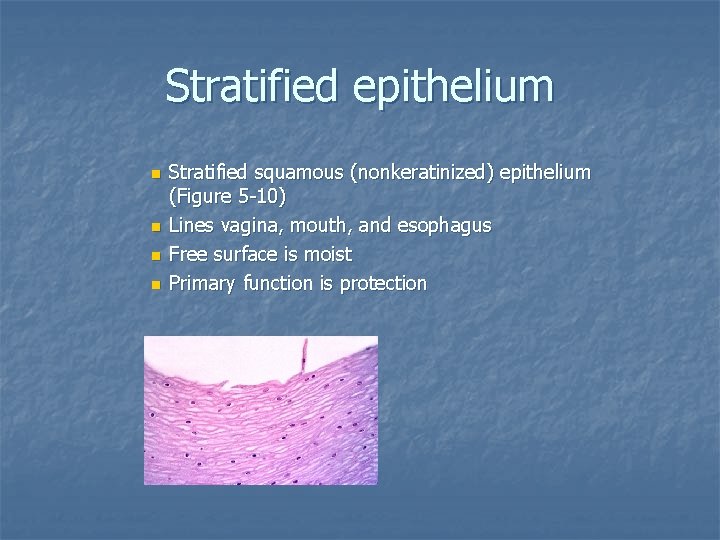
Stratified epithelium n n Stratified squamous (nonkeratinized) epithelium (Figure 5 -10) Lines vagina, mouth, and esophagus Free surface is moist Primary function is protection
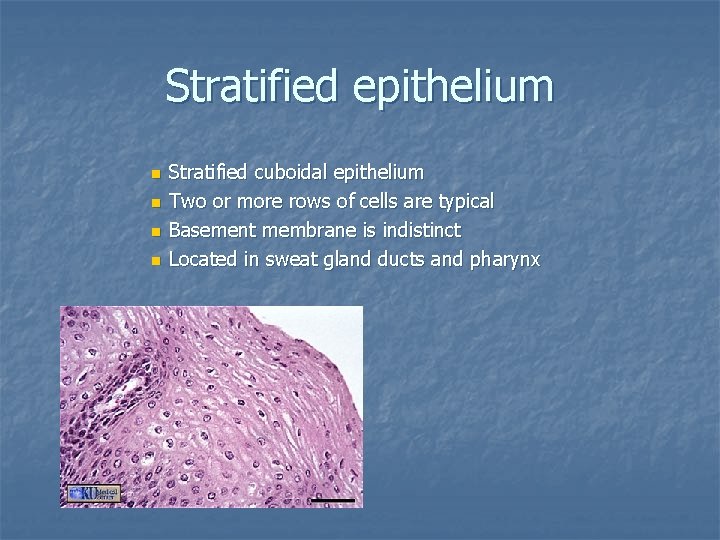
Stratified epithelium n n Stratified cuboidal epithelium Two or more rows of cells are typical Basement membrane is indistinct Located in sweat gland ducts and pharynx
Stratified epithelium n n n Stratified columnar epithelium Multiple layers of columnar cells Only most superficial cells are typical in shape Rare Located in segments of male urethra and near anus
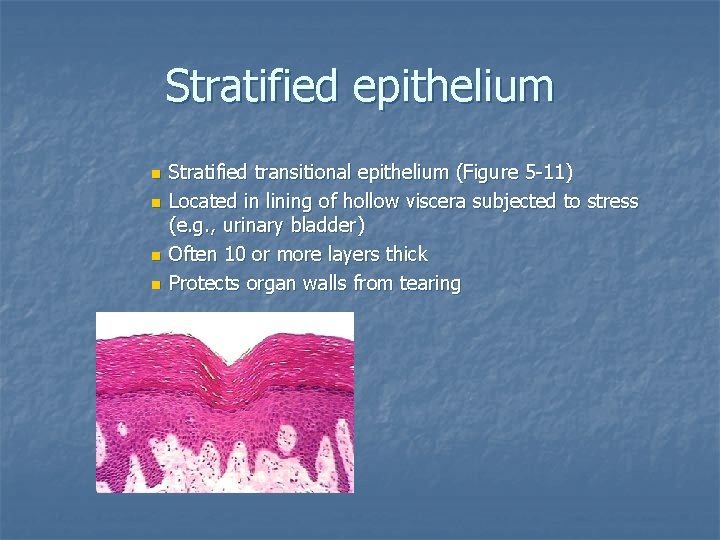
Stratified epithelium n n Stratified transitional epithelium (Figure 5 -11) Located in lining of hollow viscera subjected to stress (e. g. , urinary bladder) Often 10 or more layers thick Protects organ walls from tearing
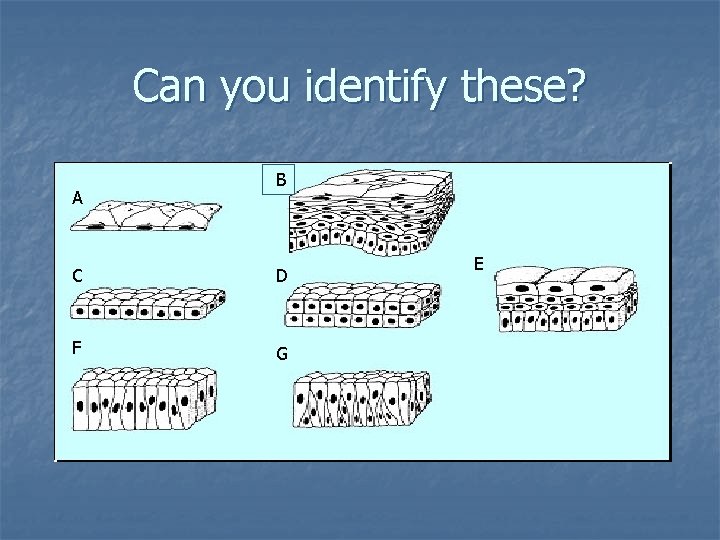
Can you identify these? A B C D F G E
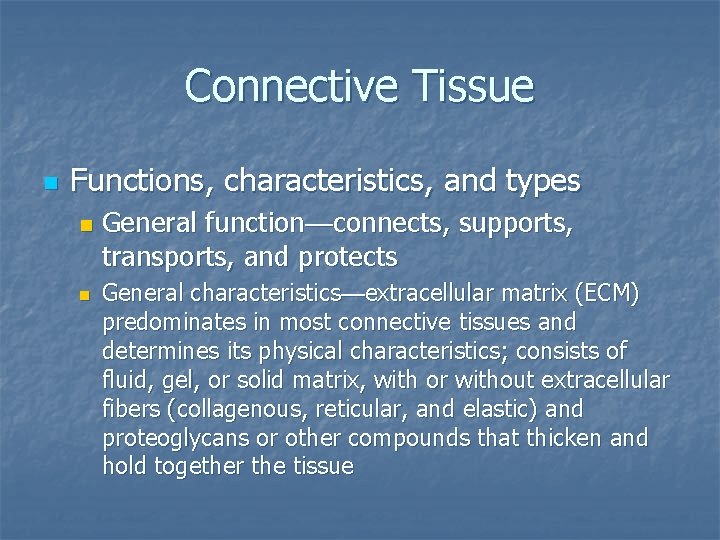
Connective Tissue n Functions, characteristics, and types n n General function—connects, supports, transports, and protects General characteristics—extracellular matrix (ECM) predominates in most connective tissues and determines its physical characteristics; consists of fluid, gel, or solid matrix, with or without extracellular fibers (collagenous, reticular, and elastic) and proteoglycans or other compounds that thicken and hold together the tissue
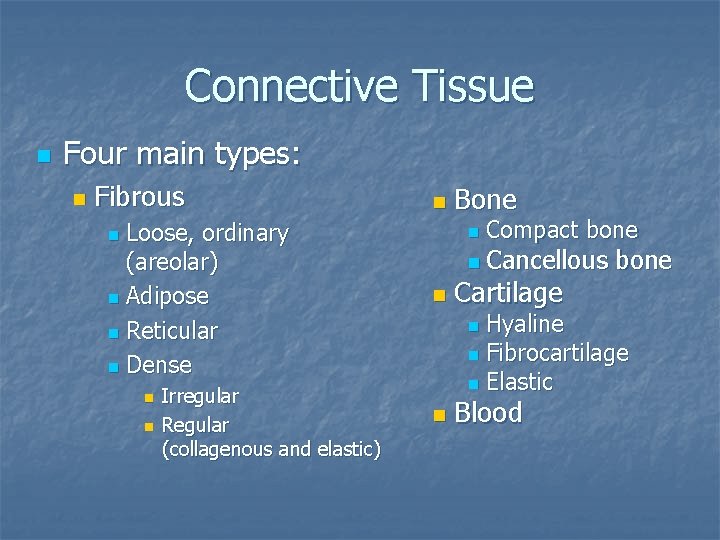
Connective Tissue n Four main types: n Fibrous Loose, ordinary (areolar) n Adipose n Reticular n Dense n n n Irregular Regular (collagenous and elastic) Bone Compact bone n Cancellous n Cartilage bone Hyaline n Fibrocartilage n Elastic n n Blood
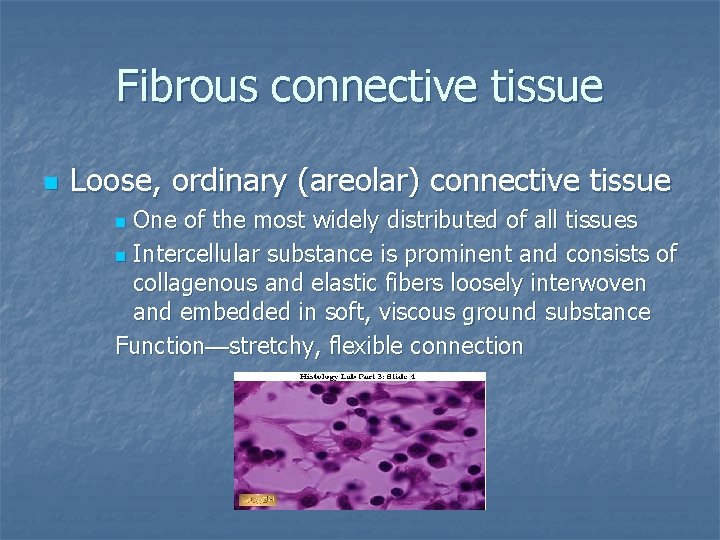
Fibrous connective tissue n Loose, ordinary (areolar) connective tissue One of the most widely distributed of all tissues n Intercellular substance is prominent and consists of collagenous and elastic fibers loosely interwoven and embedded in soft, viscous ground substance Function—stretchy, flexible connection n
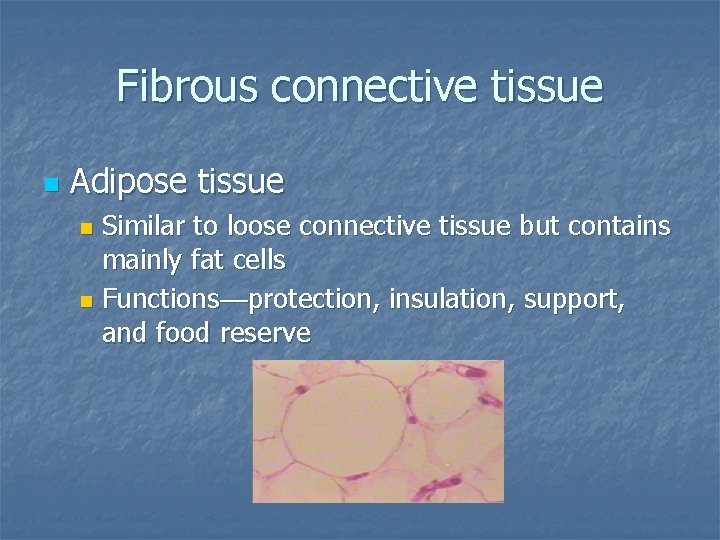
Fibrous connective tissue n Adipose tissue Similar to loose connective tissue but contains mainly fat cells n Functions—protection, insulation, support, and food reserve n
Fibrous connective tissue n Reticular tissue n n n Forms framework of spleen, lymph nodes, and bone marrow Consists of network of branching reticular fibers with reticular cells overlying them Functions—defense against microorganisms and other injurious substances; reticular meshwork filters out injurious particles, and reticular cells phagocytose them
Dense fibrous tissue n Matrix consists mainly of fibers packed densely and relatively few fibroblast cells n n Irregular—fibers intertwine irregularly to form a thick mat (Figure 5 -20) Regular—bundles of fibers are arranged in regular, parallel rows n n Collagenous—mostly collagenous fibers in ECM (Figure 5 -21 and 5 -22) Elastic—mostly elastic fibers in ECM (Figure 5 -23) Locations—composes structures that need great tensile strength, such as tendons and ligaments; also dermis and outer capsule of kidney and spleen n Function—furnishes flexible connections that are strong or stretchy n
Bone tissue n Highly specialized connective tissue type n n n Cells—osteocytes—embedded in a calcified matrix Inorganic component of matrix accounts for 65% of total bone tissue Functions: n Support n Protection n Point of attachment for muscles n Reservoir for minerals n Supports blood-forming tissue
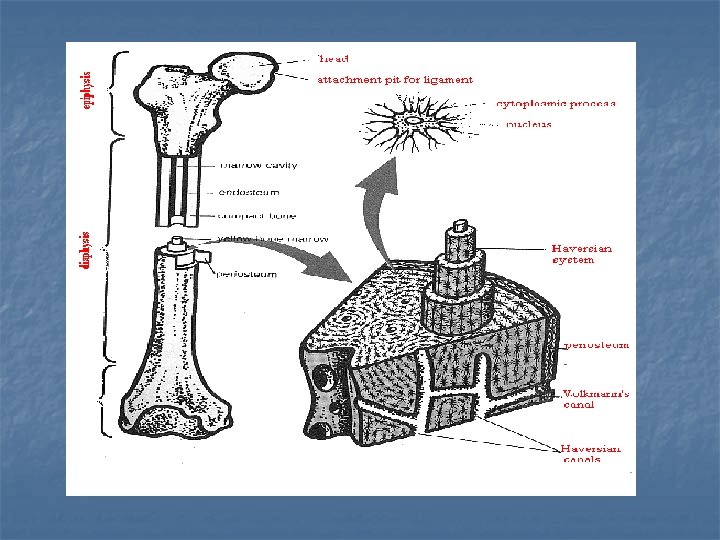
Compact bone n Osteon (Haversian system) n n n Cell types: n n Structural unity of bone Spaces for osteocytes called lacunae Matrix present in concentric rings called lamellae Canaliculi are canals that join lacunae with the central Haversian canal Osteocyte—mature, inactive bone cell Osteoblast—active, bone-forming cell Osteoclast—bone-destroying cell Formation (ossification) (Figure 5 -24) n n In membranes—e. g. , flat bones of skull From cartilage (endochondral)—e. g. , long bones, such as the humerus
Cancellous bone n Trabeculae—thin beams of bone n Supports red bone marrow Myeloid tissue—a type of reticular tissue n Produces blood cells n n Called spongy bone because of its spongelike appearance
Cartilage Chondrocyte is only cell type present n Lacunae house cells, as in bone n Avascular—therefore, nutrition of cells depends on diffusion of nutrients through matrix n Heals slowly after injury because of slow nutrient transfer to the cells n Perichondrium is membrane that surrounds cartilage n
Types of Cartilage n Hyaline (Figure 5 -28) n n Fibrocartilage (Figure 5 -29) n n n Appearance is shiny and translucent Most prevalent type of cartilage Located on the ends of articulating bones Strongest and most durable type of cartilage Matrix is semirigid and filled with strong, white fibers Found in intervertebral disks and pubic symphysis Serves as shock-absorbing material between bones at the knee (menisci) Elastic (Figure 5 -30) n n n Contains many fine, elastic fibers Provides strength and flexibility Located in external ear and larynx
Blood n n n A liquid tissue Contains neither ground substance nor fibers Composition of whole blood n n Liquid fraction (plasma) is the matrix— 55% of total blood volume Formed elements contribute 45% of total blood volume n n n Red blood cells, erythrocytes White blood cells, leukocytes Platelets, thrombocytes
Blood (cont. ) n Functions n n n Transportation Regulation of body temperature Regulation of body p. H White blood cells destroy bacteria Circulating blood tissue is formed in the red bone marrow by a process called hematopoiesis; the bloodforming tissue is sometimes called hematopoietic tissue
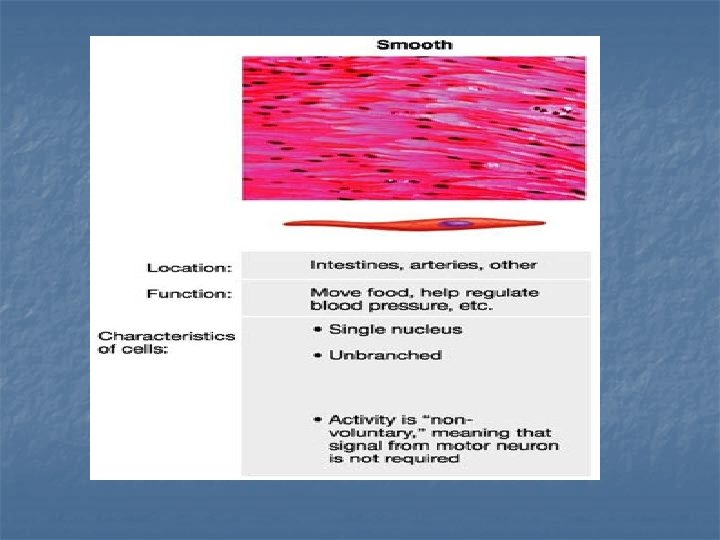
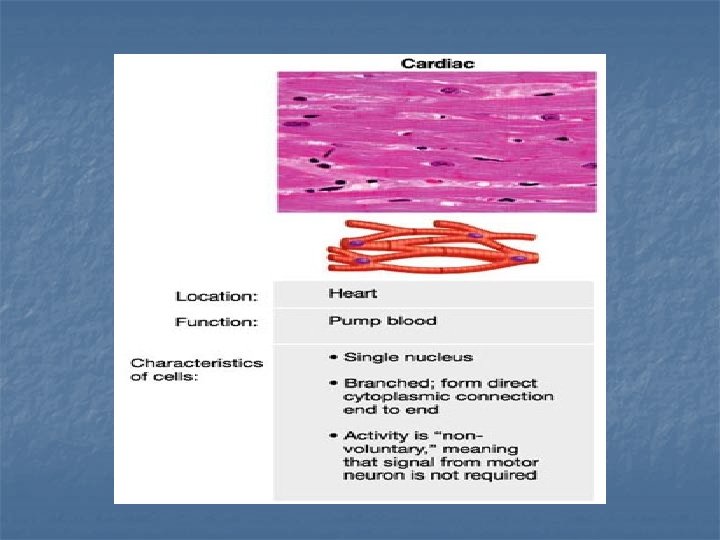
Muscle Tissue n Types (Table 5 -7) n n n Skeletal, or striated voluntary (Figure 5 -32) Smooth, or nonstriated involuntary, or visceral (Figures 5 -33 and 5 -34) Cardiac, or striated involuntary (Figure 5 -35)
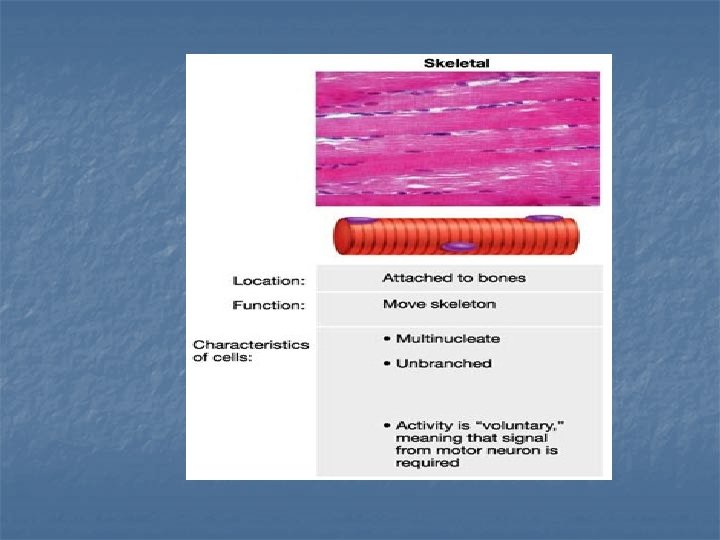
Muscle Tissue n Microscopic characteristics n n n Skeletal muscle—threadlike cells with many cross striations and many nuclei per cell Smooth muscle—elongated, narrow cells, no cross striations, one nucleus per cell Cardiac muscle—branching cells with intercalated disks (formed by abutment of plasma membranes of two cells)
Nervous Tissue n n n Functions—rapid regulation and integration of body activities Specialized characteristics n Excitability n Conductivity Organs n Brain n Spinal cord n Nerves
Nervous Tissue n Cell types (Table 5 -7) n Neuron—conducting unit of system (Figure 536) Cell body, or soma n Processes n n Axon (single process)—transmits nerve impulse away from the cell body Dendrites (one or more)—transmit nerve impulse toward the cell body and axon Neuroglia—special connecting, supporting, coordinating cells that surround the neurons
Tissue Repair n n n Tissues have a varying capacity to repair themselves; damaged tissue regenerates or is replaced by scar tissue Regeneration—growth of new tissue (Figure 5 -37) Scar—dense fibrous mass; unusually thick scar is a keloid (Figure 5 -38) Epithelial and connective tissues have the greatest ability to regenerate Muscle and nervous tissues have a limited capacity to regenerate