
Chapter 5 Tissues 2 Introduction Tissue groups of


- Slides: 38
Chapter 5 Tissues 2
Introduction • Tissue: groups of cells with similar function • Histology: study of tissues • Tissue types – Epithelial, connective, muscle, nervous 3
Epithelial Tissue 4
Introduction • • Protects underlying tissues Absorbs nutrients Secretes hormones, mucus, enzymes Excretes waste 5
Introduction (cont’d. ) • Basement membrane: anchor • Named according to shape, arrangement, function • Cells are closely packed 6
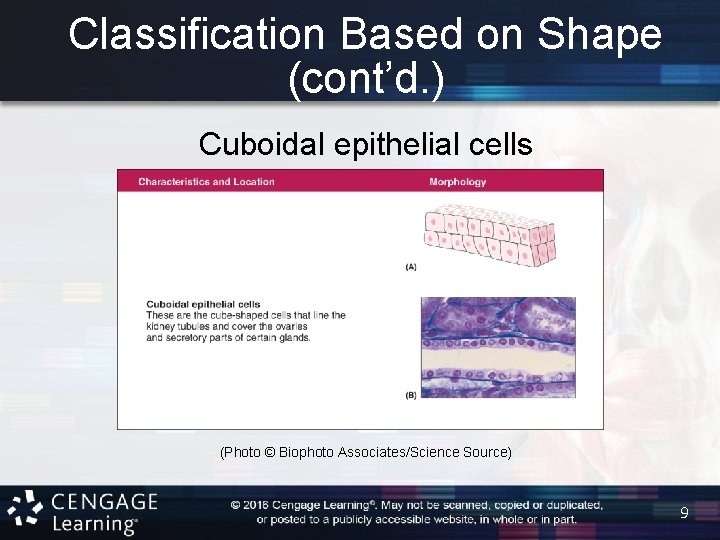
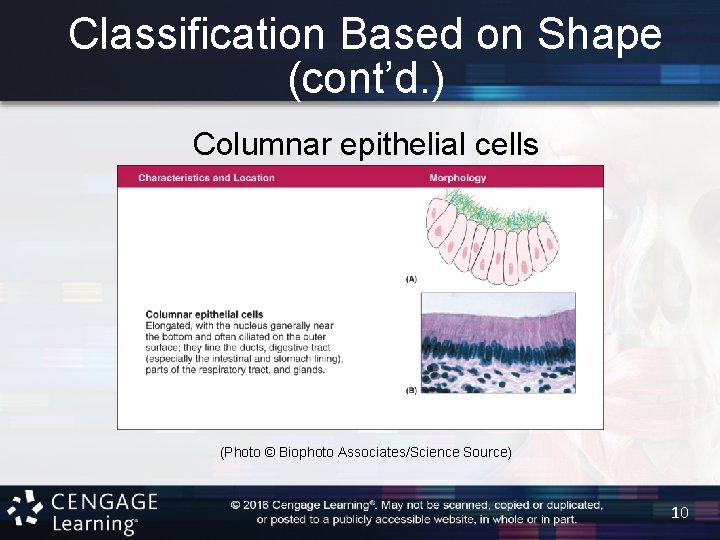
Classification Based on Shape • Squamous: flat (protection) • Cuboidal: cube shaped (protection and secretion) • Columnar: tall and rectangular (secretion and absorption) 7
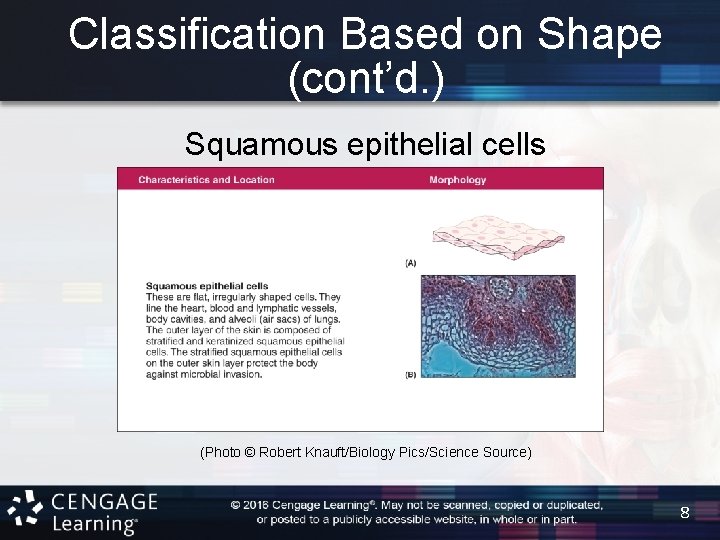
Classification Based on Shape (cont’d. ) Squamous epithelial cells (Photo © Robert Knauft/Biology Pics/Science Source) 8
Classification Based on Shape (cont’d. ) Cuboidal epithelial cells (Photo © Biophoto Associates/Science Source) 9
Classification Based on Shape (cont’d. ) Columnar epithelial cells (Photo © Biophoto Associates/Science Source) 10
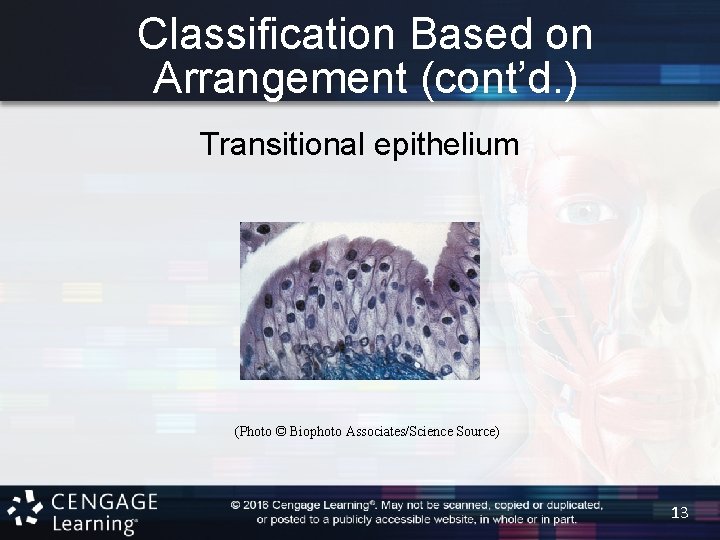
Classification Based on Arrangement • Simple: one cell layer • Stratified: several layers • Pseudostratified: appears to be several layers but is not • Transitional: several layers of easily stretched cells 11
Classification Based on Arrangement (cont’d. ) Pseudostratified ciliated, columnar epithelium (Photo © Steve Gschmeissner/Science Source) 12
Classification Based on Arrangement (cont’d. ) Transitional epithelium (Photo © Biophoto Associates/Science Source) 13
Classification Based on Function • • Mucous membrane: mucus production Exocrine glands: simple and compound Endocrine: hormone secretion Endothelium: lines vessels – Endocardium • Mesothelium (serous): lines great cavities 14
Connective Tissue 15
Introduction • Cells with large amount of intercellular material • Matrix embedded with: – Collagen – Elastin • Subgroups: loose, dense, specialized 16
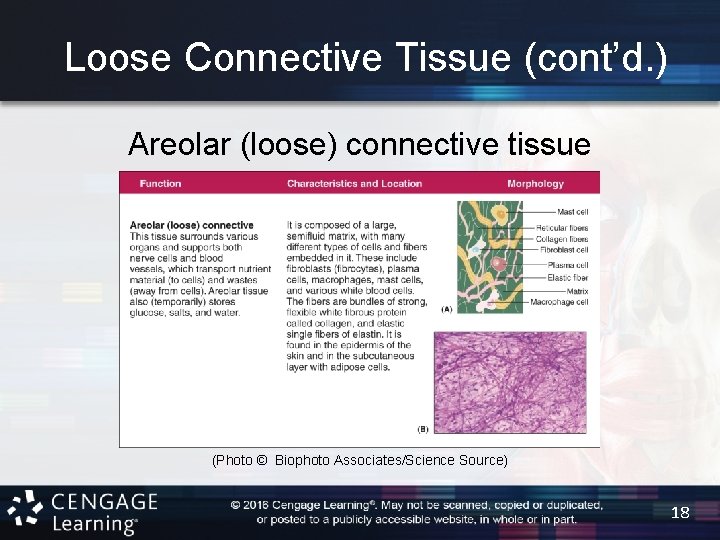
Loose Connective Tissue • Fills space between and penetrates organs • Areolar: injury repair, phagocytosis, inflammatory response – Fibroblasts, histiocytes, mast cells • Adipose: fat storage • Reticular: framework 17
Loose Connective Tissue (cont’d. ) Areolar (loose) connective tissue (Photo © Biophoto Associates/Science Source) 18
Dense Connective Tissue • Regular arrangement – Tendons, ligaments, aponeuroses • Irregular arrangement – Muscle sheaths, joint capsules, fascia 19
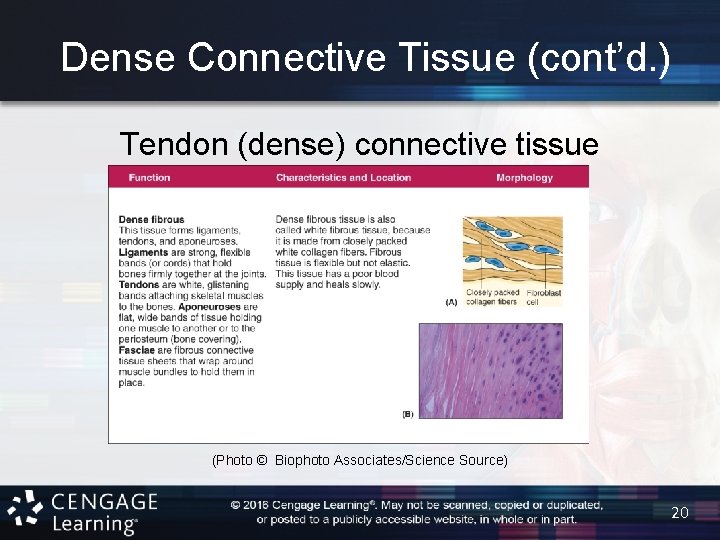
Dense Connective Tissue (cont’d. ) Tendon (dense) connective tissue (Photo © Biophoto Associates/Science Source) 20
Specialized Connective Tissue • Cartilage – Cells called chondrocytes • Found in lacunae – Types • Hyaline: ribs, nose, trachea • Fibrocartilage: intervertebral disks • Elastic: ears, auditory tubes, epiglottis 21
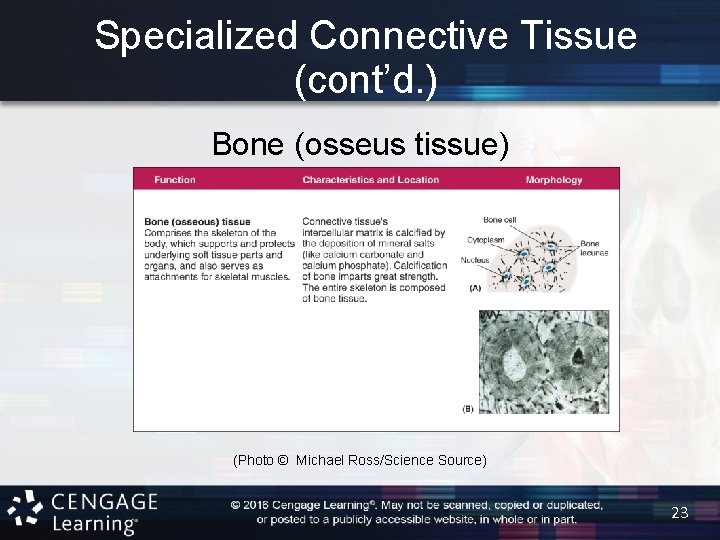
Specialized Connective Tissue (cont’d. ) • Bone – Compact – Cancellous – Mineral salts: especially calcium and phosphorus • Teeth – Dentin – Enamel 22
Specialized Connective Tissue (cont’d. ) Bone (osseus tissue) (Photo © Michael Ross/Science Source) 23
Specialized Connective Tissue (cont’d. ) • Blood: fluid portion and formed elements • Lymphoid: antibody production and disease protection • Reticuloendothelial system: phagocytosis – Kupffer cells in liver – Macrophages – Neuroglia • Synovial: lines joints 24
Connective Tissue Functions • Support – Bones, cartilage • Nourishment – Blood • Transportation – Blood • Connection – Tendons, ligaments 25
Connective Tissue Functions (cont’d. ) • Movement – Bones, tendons • Protection and insulation – Bones, blood, fat • Storage – Bone, fat • Attachment and separation – Attaches skin to muscle 26
Muscle Tissue 27
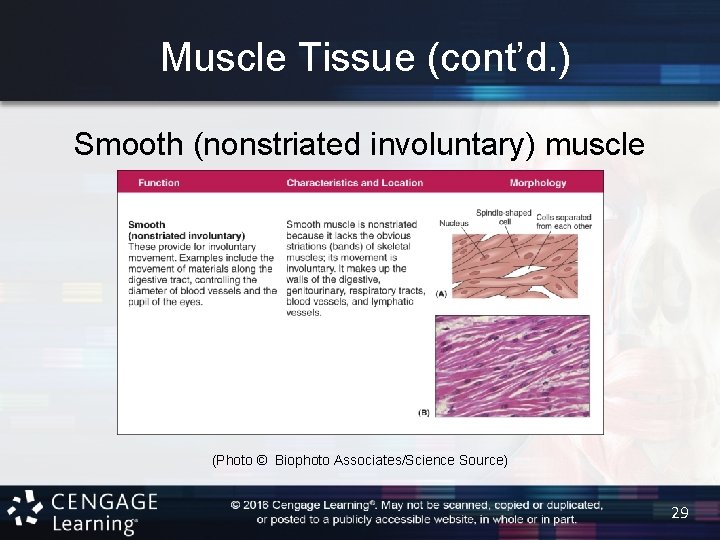
Muscle Tissue (cont’d. ) • Smooth – Spindle-shaped, single nucleus – Not striated – Involuntary – Digestive tract, arteries and veins, ureters – Peristalsis 28
Muscle Tissue (cont’d. ) Smooth (nonstriated involuntary) muscle (Photo © Biophoto Associates/Science Source) 29
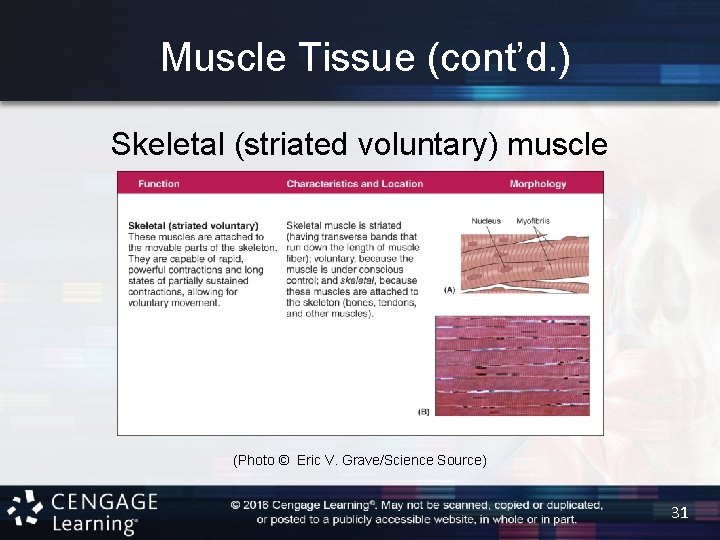
Muscle Tissue (cont’d. ) • Striated (skeletal) – Long thin cells – Multinucleated and striated – Actin and myosin – Voluntary – Movement by pulling on bones 30
Muscle Tissue (cont’d. ) Skeletal (striated voluntary) muscle (Photo © Eric V. Grave/Science Source) 31
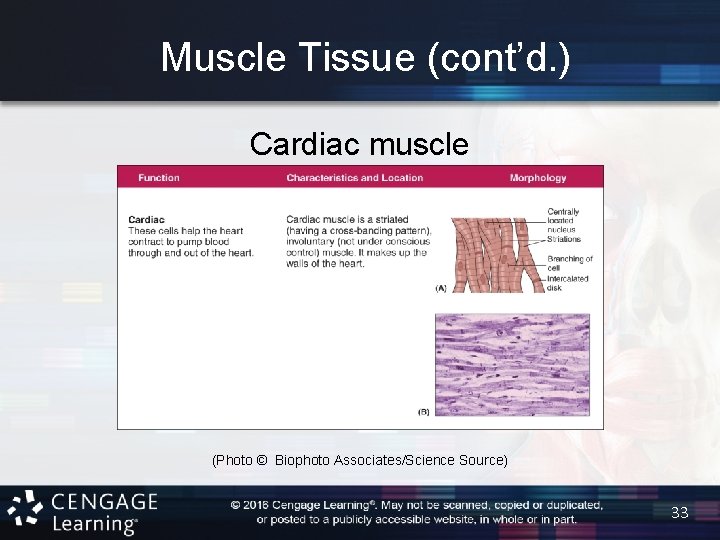
Muscle Tissue (cont’d. ) • Cardiac – Only in the heart – Uninucleated and striated – Involuntary – Cylindrical shape • Connected to other cardiac muscle cells by intercalated disks 32
Muscle Tissue (cont’d. ) Cardiac muscle (Photo © Biophoto Associates/Science Source) 33
Nervous Tissue 34
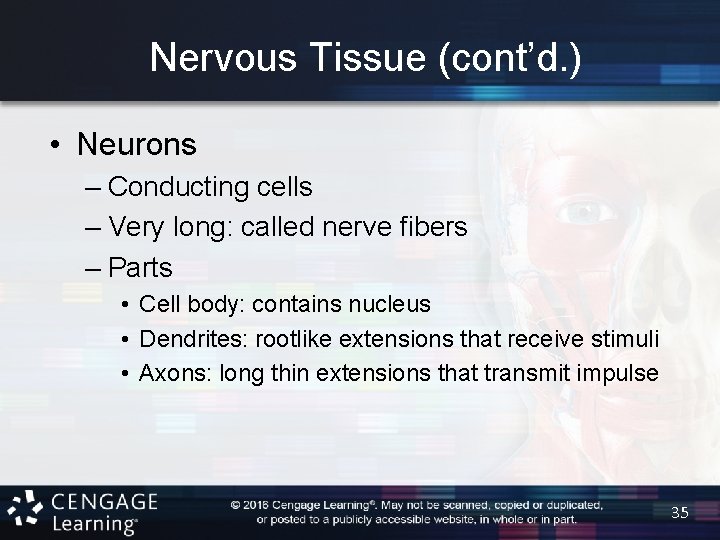
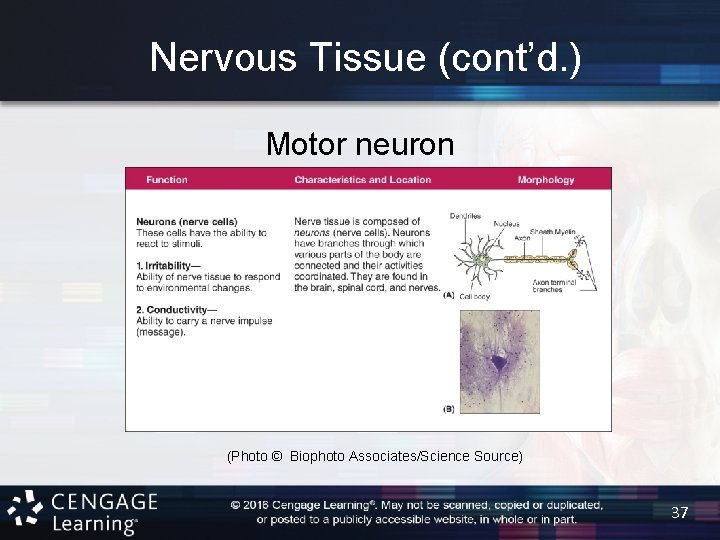
Nervous Tissue (cont’d. ) • Neurons – Conducting cells – Very long: called nerve fibers – Parts • Cell body: contains nucleus • Dendrites: rootlike extensions that receive stimuli • Axons: long thin extensions that transmit impulse 35
Nervous Tissue (cont’d. ) • Neuroglia: supporting cells • Nervous tissue – Makes up brain, spinal cord, and nerves – Is most highly organized tissue of the body – Controls and coordinates body activities – Allows perception – Controls emotion and reasoning – Stores memories 36
Nervous Tissue (cont’d. ) Motor neuron (Photo © Biophoto Associates/Science Source) 37
Summary • Introduced the concept of tissues and how to classify tissues • Classified epithelial tissue based on shape and arrangement • Described the three major types of connective tissue • Described the three types of muscle tissue • Discussed nervous tissue and its functions 38