
Chapter 5 Timing of Entry Overview Increasing returns


- Slides: 13
Chapter 5 Timing of Entry
Overview § Increasing returns suggests that timing of entry can be very important. § There a number of advantages and disadvantages to being a first mover, early follower or late entrant. These categories are defined as follows: § First movers are the first entrants to sell in a new product or service category (“pioneers”) § Early followers are early to market but not first. § Late entrants do not enter the market until the product begins to penetrate the mass market or later. 5 -5
First-Mover Advantages and Disadvantages § Being a first mover can confer the advantages of: § Brand loyalty and technological leadership § Preemption of scarce assets § Exploiting buyer switching costs § Reaping increasing returns advantages. § However, first movers often bear disadvantages also: § High research and development expenses § Undeveloped supply and distribution channels § Immature enabling technologies and complements § Uncertainty of customer requirements 5 -6
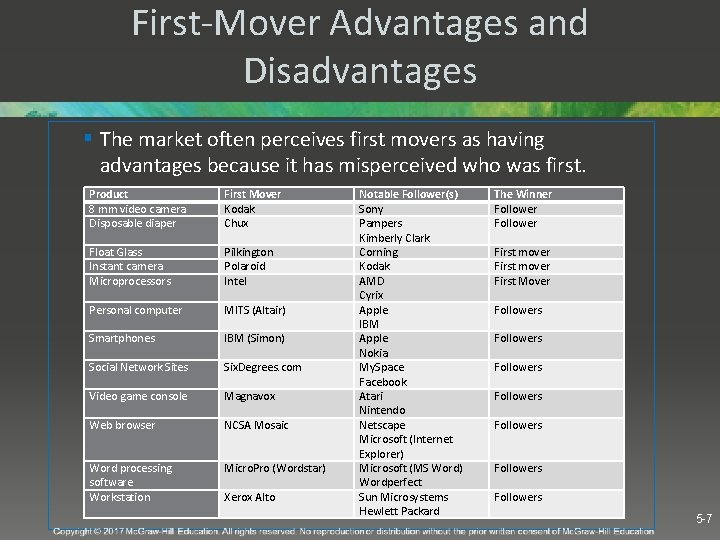
First-Mover Advantages and Disadvantages § The market often perceives first movers as having advantages because it has misperceived who was first. Product 8 mm video camera Disposable diaper First Mover Kodak Chux Float Glass Instant camera Microprocessors Pilkington Polaroid Intel Personal computer MITS (Altair) Smartphones IBM (Simon) Social Network Sites Six. Degrees. com Video game console Magnavox Web browser NCSA Mosaic Word processing software Workstation Micro. Pro (Wordstar) Xerox Alto Notable Follower(s) Sony Pampers Kimberly Clark Corning Kodak AMD Cyrix Apple IBM Apple Nokia My. Space Facebook Atari Nintendo Netscape Microsoft (Internet Explorer) Microsoft (MS Word) Wordperfect Sun Microsystems Hewlett Packard The Winner Follower First mover First Mover Followers Followers 5 -7
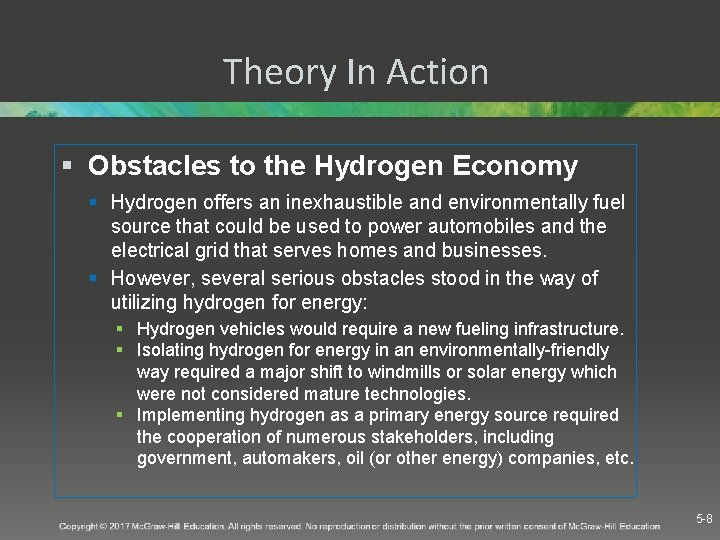
Theory In Action § Obstacles to the Hydrogen Economy § Hydrogen offers an inexhaustible and environmentally fuel source that could be used to power automobiles and the electrical grid that serves homes and businesses. § However, several serious obstacles stood in the way of utilizing hydrogen for energy: § Hydrogen vehicles would require a new fueling infrastructure. § Isolating hydrogen for energy in an environmentally-friendly way required a major shift to windmills or solar energy which were not considered mature technologies. § Implementing hydrogen as a primary energy source required the cooperation of numerous stakeholders, including government, automakers, oil (or other energy) companies, etc. 5 -8
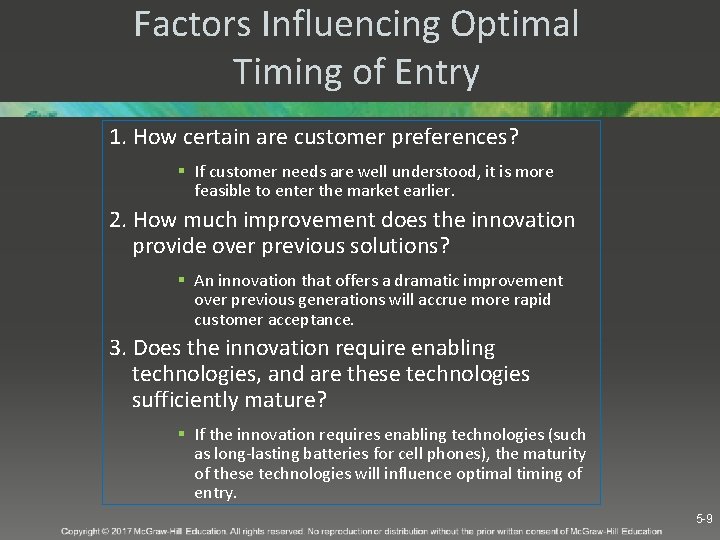
Factors Influencing Optimal Timing of Entry 1. How certain are customer preferences? § If customer needs are well understood, it is more feasible to enter the market earlier. 2. How much improvement does the innovation provide over previous solutions? § An innovation that offers a dramatic improvement over previous generations will accrue more rapid customer acceptance. 3. Does the innovation require enabling technologies, and are these technologies sufficiently mature? § If the innovation requires enabling technologies (such as long-lasting batteries for cell phones), the maturity of these technologies will influence optimal timing of entry. 5 -9
Factors Influencing Optimal Timing of Entry 4. Do complementary goods influence the value of the innovation, and are they sufficiently available? § Not all innovations require complementary goods, but for those that do (e. g. , games for video consoles), availability of complements will influence customer acceptance. 5. How high is the threat of competitive entry? § If there are significant entry barriers, the may be less need to rush to market to build increasing returns ahead of others. 6. Are there increasing returns to adoption? § If so, allowing competitors to get a head start can be very risky. 5 -10
Factors Influencing Optimal Timing of Entry 7. Can the firm withstand early losses? § The first mover bears the bulk of R&D expenses and may endure a significant period without revenues; the earlier a firm enters, the more capital resources it may need. 8. Does the firm have resources to accelerate market acceptance? § Firms with significant capital resources can invest in aggressive marketing and supplier and distributor development, increasing the rate of early adoption. 9. Is the firm’s reputation likely to reduce the uncertainty of customers, suppliers, and distributors? § Innovations from well-respected firms may be adopted more rapidly, enabling earlier successful entry. 5 -11
Research Brief Whether and When to Enter? § Will Mitchell studied 30 years of data on whether and when an incumbent in one subfield of the medical diagnostic imaging industry would enter another subfield. He found: § If only one firm can produce an inimitable good, it can enter if and when it wants. If several firms could produce a good that will subsequently be inimitable, they race to capture the market. § If good is highly imitable, firms prefer to wait while others invest in developing the market. § Firms were more likely to enter if they had specialized assets that would be useful in the new subfield or if their current products were threatened by the new subfield. § Firms entered earlier when their core products were threatened and there were several potential rivals. 5 -12
Strategies to Improve Timing Options § To have more choices in its timing of entry, a firm needs to be able to develop the innovation early or quickly. § A firm with fast-cycle development processes can be both an early entrant, and can quickly refine its innovation in response to customer feedback. § In essence, a firm with very fast-cycle development processes can reap both first- and second-mover advantages. 5 -13
Part Two: Formulating Technological Innovation Strategy § Assessing the firm’s position and defining its strategic direction, § Choosing innovation projects in which to invest, including both quantitative and qualitative valuation techniques, § Deciding whether and how the firm will collaborate on development activities, choosing a collaboration mode, and choosing and monitoring partners, § Crafting a strategy for protecting – or diffusing – a technological innovation through such methods as patents, trademarks, copyrights, and trade secrets. 5 -15
From Six. Degrees. com to Facebook: The Rise of Social Networking Sites § Six. Degrees. com was started in 1997 and attracted three million members, but users felt that not enough of their friends were members and there was little to do on the site. § Friendster was launched in 2003, and rapidly attracted seven million users, but its servers could not handle the traffic, causing many delays. § My. Space was also started in 2003, and leveraged the 20 million users of e. Universe to jumpstart membership, but heavy advertising annoyed users. § In 2006, Facebook was made available to the public, and used a more open platform that enabled a rapid proliferation of games, product review sites, and user-created groups. It was also easier for users to restrict who viewed their profile. The site attracted 901 million users by 2012. § Other popular sites (e. g. , Twitter, Linked-in, etc. ) offered different functionality that did not compete directly against Facebook. § In 2011, Google introduced a site to compete directly against Facebook called Google+, which attracted 100 million users by 2015, but there was still speculation about whether it could overtake Facebook. 5 -3
From Six. Degrees. com to Facebook: The Rise of Social Networking Sites Discussion Questions: 1. Why did the first social networking sites fail? Is there anything they could have done to survive? 2. What factors made My. Space more successful than Friendster and Six. Degrees. com? What factors enabled Facebook to overtake My. Space? 3. Are there significant switching costs that lock users into a particular social networking site? 4. What will determine if Google+ can overtake Facebook? 5 -4