
Chapter 5 Third generation systems Wideband Digital Modulation
Chapter 5: Third generation systems. Wideband Digital Modulation

Principle of Spread Spectrum Communications � First and second generation communication systems divide the total available bandwidth into smaller bandwidth channels third generation systems share the entire bandwidth without mutual interference � However, � This is possible through the use of Pseudo- Noise (PN) codes
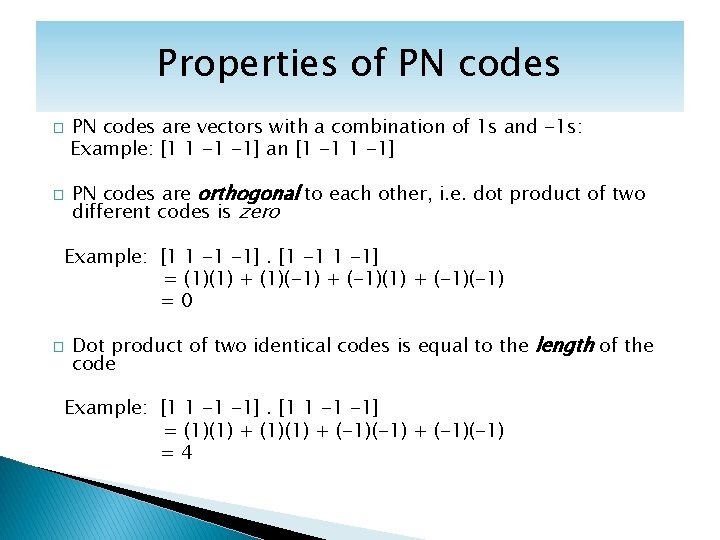
Properties of PN codes � � PN codes are vectors with a combination of 1 s and -1 s: Example: [1 1 -1 -1] an [1 -1] PN codes are orthogonal to each other, i. e. dot product of two different codes is zero Example: [1 1 -1 -1]. [1 -1] = (1)(1) + (1)(-1) + (-1)(-1) =0 � Dot product of two identical codes is equal to the length of the code Example: [1 1 -1 -1] = (1)(1) + (-1) =4
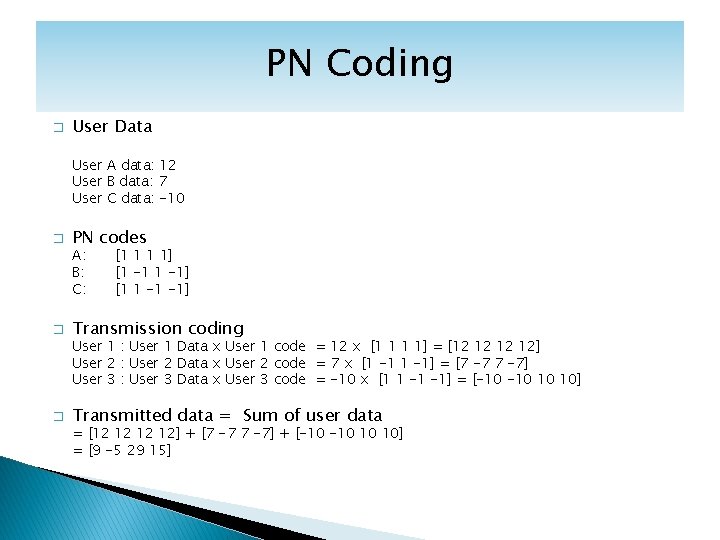
PN Coding � User Data User A data: 12 User B data: 7 User C data: -10 � PN codes A: B: C: � [1 1 1 1] [1 -1] [1 1 -1 -1] Transmission coding User 1 : User 1 Data x User 1 code = 12 x [1 1 1 1] = [12 12] User 2 : User 2 Data x User 2 code = 7 x [1 -1] = [7 -7] User 3 : User 3 Data x User 3 code = -10 x [1 1 -1 -1] = [-10 10 10] � Transmitted data = Sum of user data = [12 12] + [7 -7] + [-10 10 10] = [9 -5 29 15]
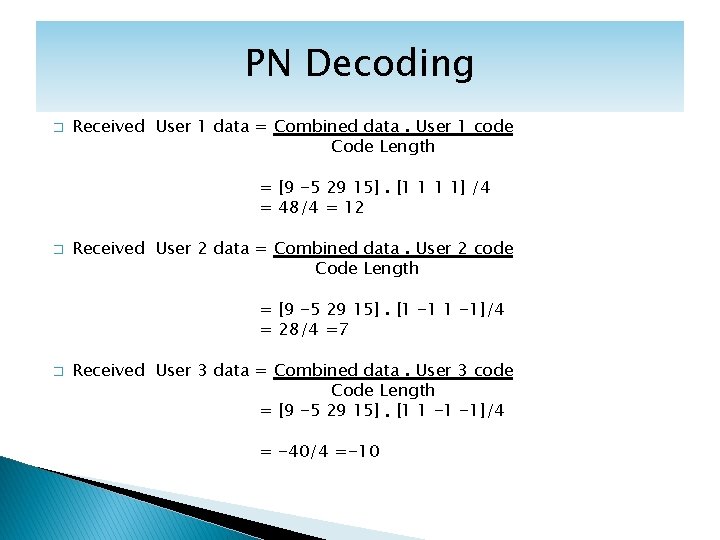
PN Decoding � Received User 1 data = Combined data. User 1 code Code Length = [9 -5 29 15]. [1 1 1 1] /4 = 48/4 = 12 � Received User 2 data = Combined data. User 2 code Code Length = [9 -5 29 15]. [1 -1]/4 = 28/4 =7 � Received User 3 data = Combined data. User 3 code Code Length = [9 -5 29 15]. [1 1 -1 -1]/4 = -40/4 =-10
Spread Spectrum transmission and reception spectrum systems have two stages of modulation (at transmitter) and demodulation (at receiver) � Spread � First stage is carrier modulation /demodulation as in 1 G and 2 G systems � Second stage is PN modulation/demodulation which increases the bandwidth of the system
Frequency Hopping Spread Spectrum (FHSS) � FHSS evolved during World War II, primarily as a technique for naval ships to avoid detection by enemy submarines � Ships would keep changing the radio signal frequency or hopping through a set of frequencies � PN Codes would help design orthogonal frequency sets to avoid interference
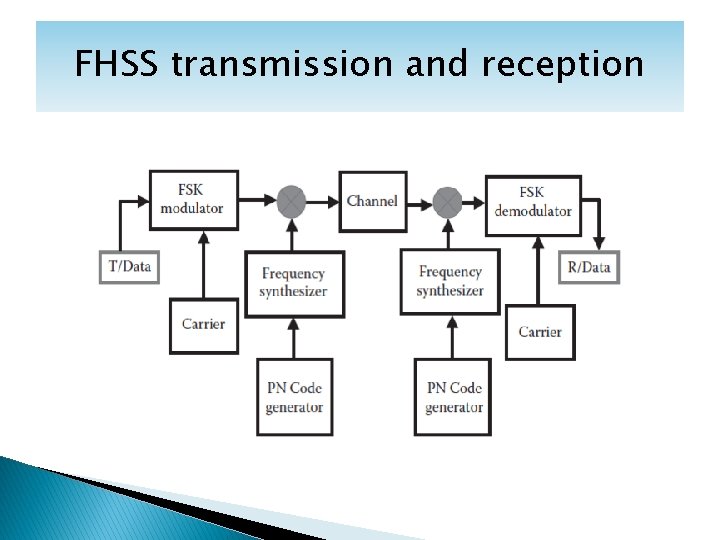
FHSS transmission and reception
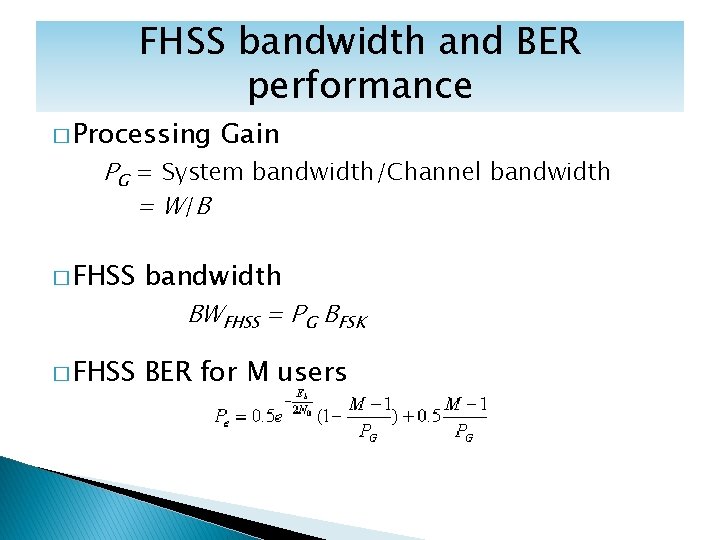
FHSS bandwidth and BER performance � Processing Gain PG = System bandwidth/Channel bandwidth = W /B � FHSS bandwidth � FHSS BER for M users BWFHSS = PG BFSK
Direct Sequence Spread Spectrum (DSSS) � DSSS is simpler type of Spread Spectrum using PN coding � Developed by Qualcomm in 1995 as CDMA (Code Division Multiple Access) � Initial system was called IS-95 which led on to CDMA 2000 and W-CDMA
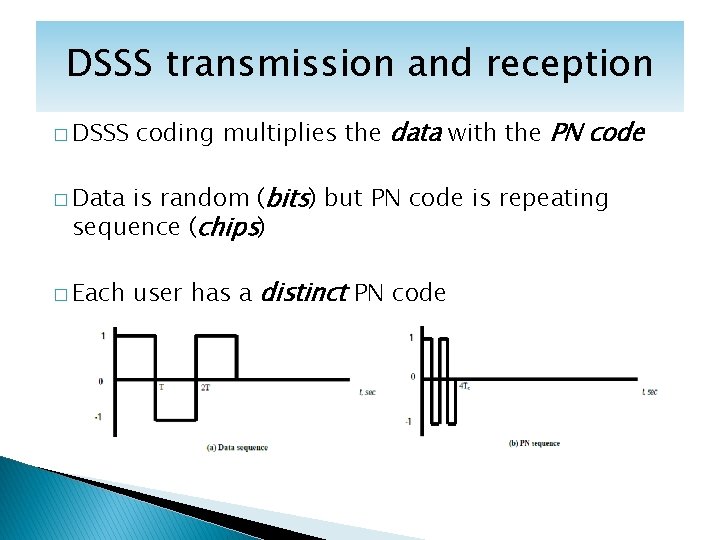
DSSS transmission and reception � DSSS coding multiplies the data with the PN code is random (bits) but PN code is repeating sequence (chips) � Data � Each user has a distinct PN code
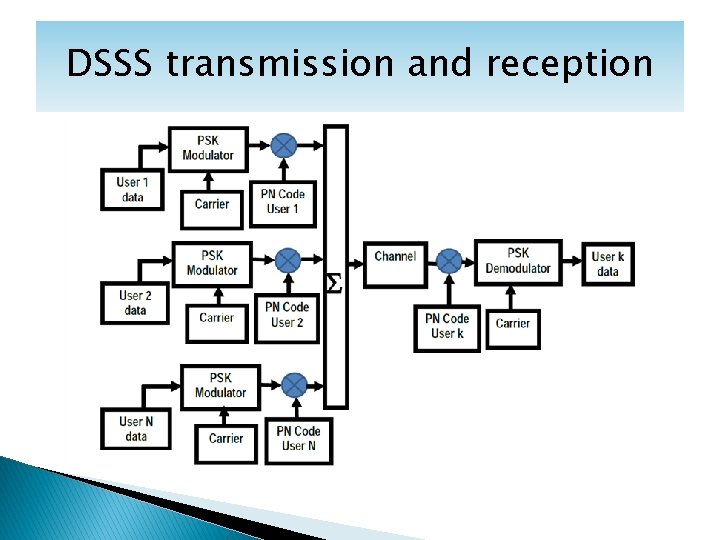
DSSS transmission and reception
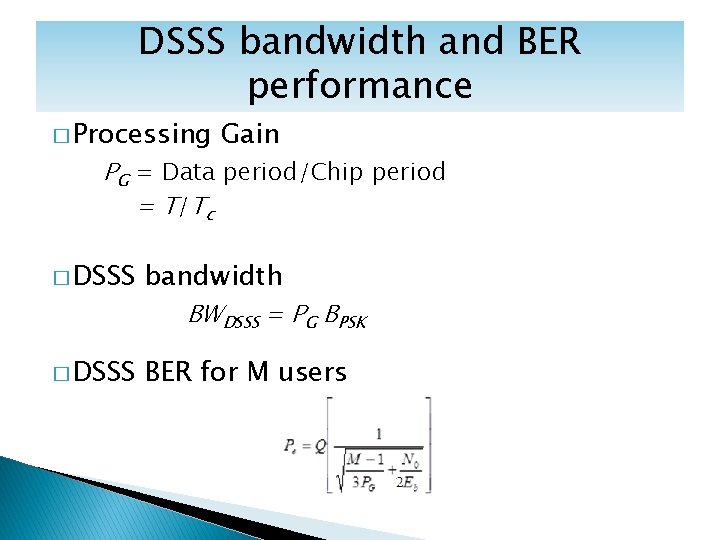
DSSS bandwidth and BER performance � Processing Gain PG = Data period/Chip period = T /Tc � DSSS bandwidth � DSSS BER for M users BWDSSS = PG BPSK
Advantages and disadvantages of Spread Spectrum systems spectrum systems have higher noise immunity and fading due to large bandwidth � Spread � Pseudo-random nature of the PN sequence provides increased signal security � Lower jamming effects on system due to lower power density � High bandwidth requires wideband circuitry and wideband system models Spectrum systems are more complex due to 2 -stage modulation systems; � Spread
- Slides: 14