
CHAPTER 5 THERMOCHEMISTRY Energy Energy is the ability
CHAPTER 5 THERMOCHEMISTRY
Energy • Energy is the ability to do work or transfer heat. – Energy used to cause an object that has mass to move is called work. – Energy used to cause the temperature of an object to rise is called heat. • This chapter is about thermodynamics, which is the study of energy transformations, and thermochemistry, which applies the field to chemical reactions, specifically. Thermochemistry © 2015 Pearson Education, Inc.
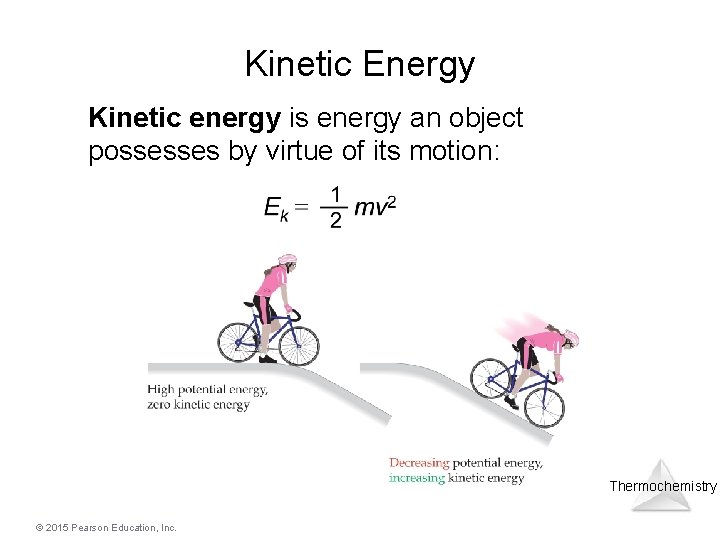
Kinetic Energy Kinetic energy is energy an object possesses by virtue of its motion: Thermochemistry © 2015 Pearson Education, Inc.
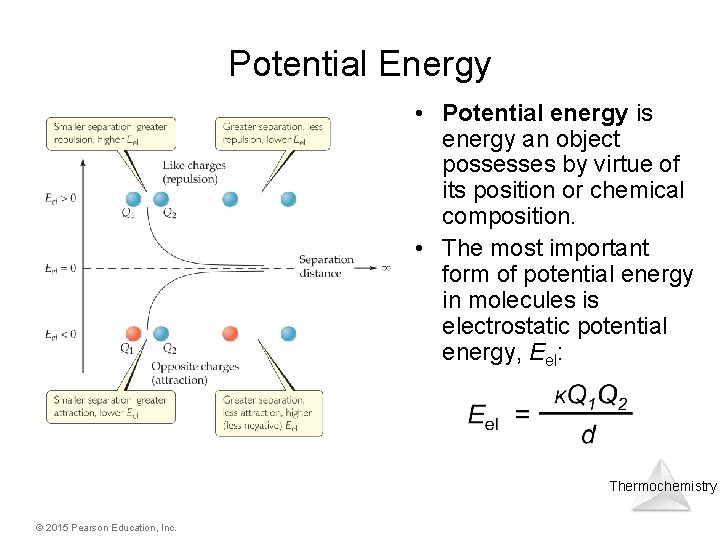
Potential Energy • Potential energy is energy an object possesses by virtue of its position or chemical composition. • The most important form of potential energy in molecules is electrostatic potential energy, Eel: Thermochemistry © 2015 Pearson Education, Inc.
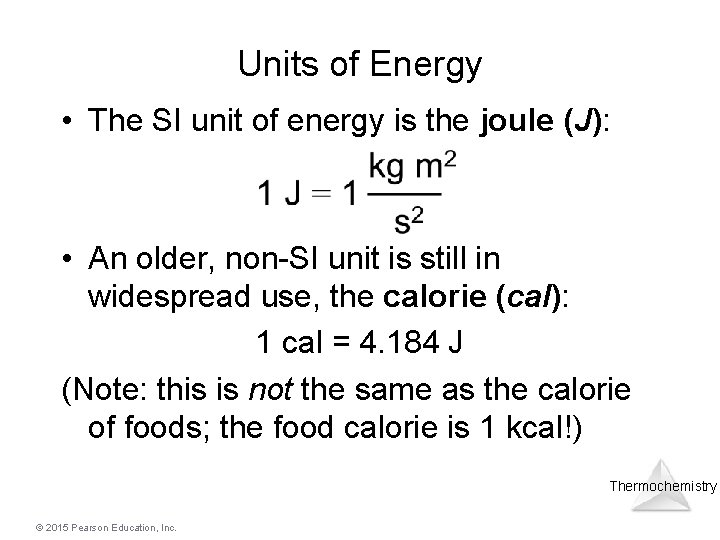
Units of Energy • The SI unit of energy is the joule (J): • An older, non-SI unit is still in widespread use, the calorie (cal): 1 cal = 4. 184 J (Note: this is not the same as the calorie of foods; the food calorie is 1 kcal!) Thermochemistry © 2015 Pearson Education, Inc.
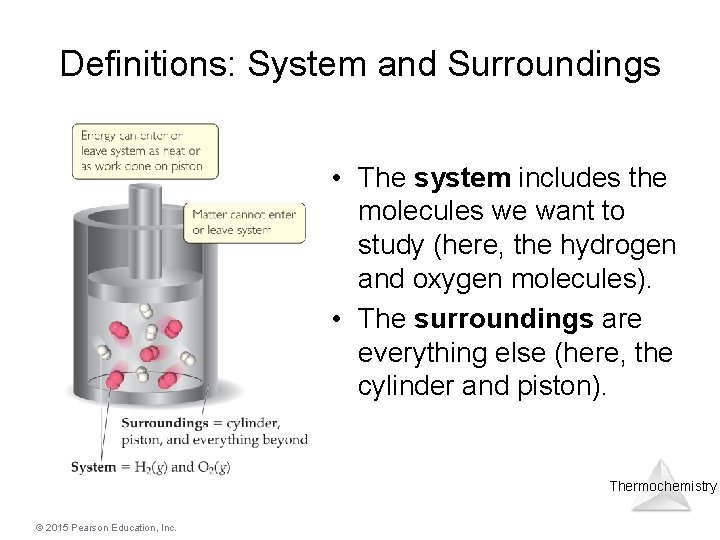
Definitions: System and Surroundings • The system includes the molecules we want to study (here, the hydrogen and oxygen molecules). • The surroundings are everything else (here, the cylinder and piston). Thermochemistry © 2015 Pearson Education, Inc.
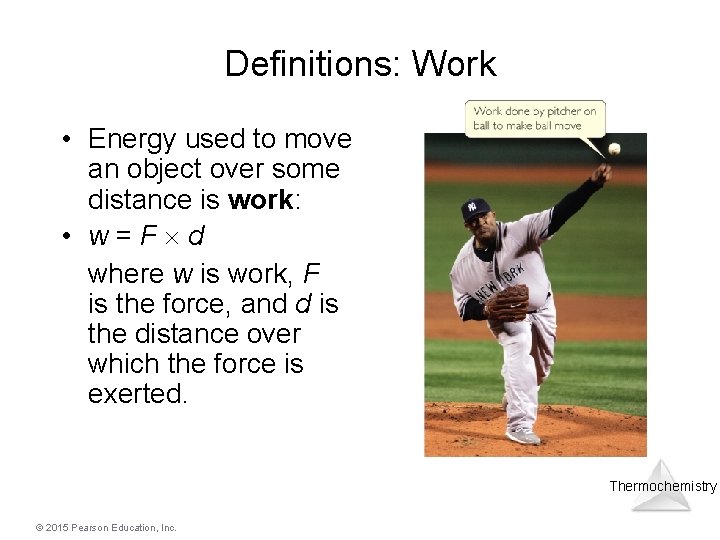
Definitions: Work • Energy used to move an object over some distance is work: • w = F d where w is work, F is the force, and d is the distance over which the force is exerted. Thermochemistry © 2015 Pearson Education, Inc.
Energy transformations – Energy is the capacity for doing work or supplying heat – Thermochemistry is the study of energy changes that occur during chemical reactions and changes in state – Chemical potential energy is the energy stored in chemical bonds • Chemical reactions transform substances into different substances with a different amount of chemical energy • Energy changes occur as either heat transfer or work, or a combination of both – Heat (q), is energy that transfers from one object to another due to temperature differences • Heat always flows from a warmer object to a cooler object

Heat • Energy can also be transferred as heat. • Heat flows from warmer objects to cooler objects. Thermochemistry © 2015 Pearson Education, Inc.
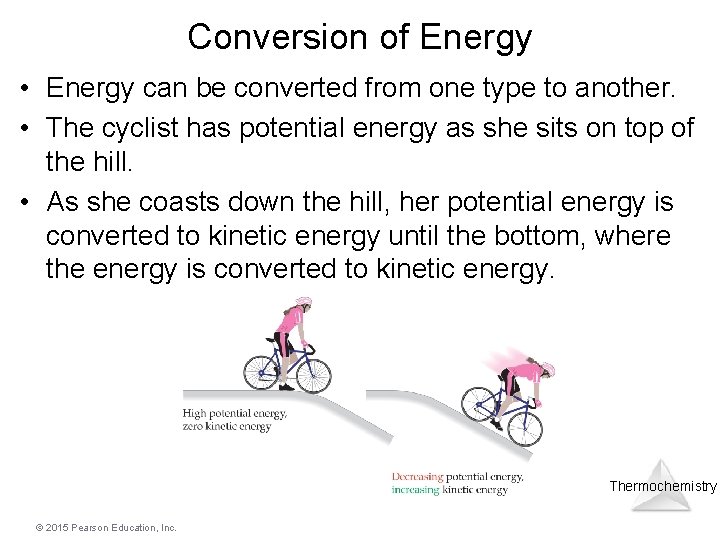
Conversion of Energy • Energy can be converted from one type to another. • The cyclist has potential energy as she sits on top of the hill. • As she coasts down the hill, her potential energy is converted to kinetic energy until the bottom, where the energy is converted to kinetic energy. Thermochemistry © 2015 Pearson Education, Inc.
First Law of Thermodynamics • Energy is neither created nor destroyed. • In other words, the total energy of the universe is a constant; if the system loses energy, it must be gained by the surroundings, and vice versa. Thermochemistry © 2015 Pearson Education, Inc.
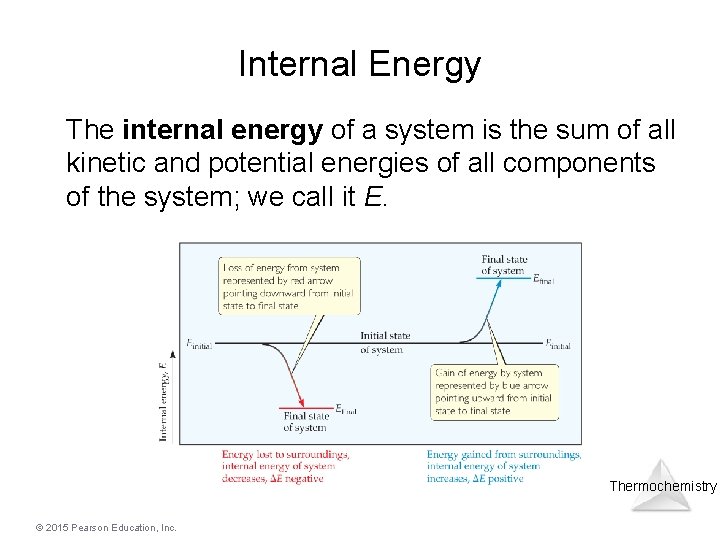
Internal Energy The internal energy of a system is the sum of all kinetic and potential energies of all components of the system; we call it E. Thermochemistry © 2015 Pearson Education, Inc.
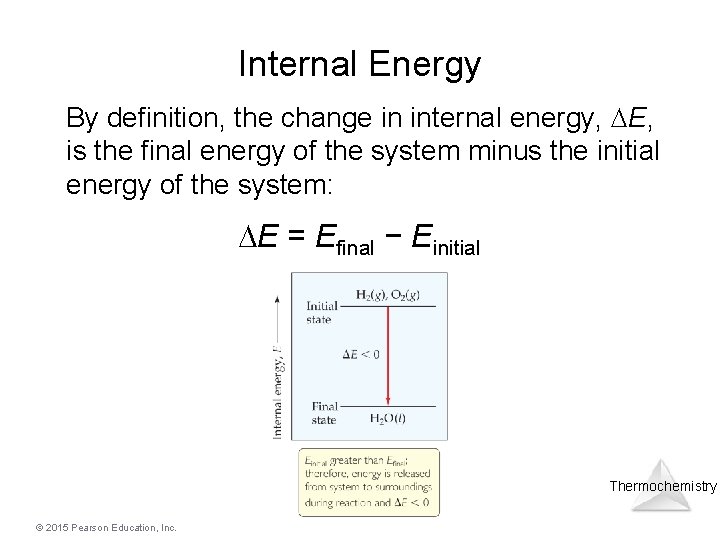
Internal Energy By definition, the change in internal energy, E, is the final energy of the system minus the initial energy of the system: E = Efinal − Einitial Thermochemistry © 2015 Pearson Education, Inc.
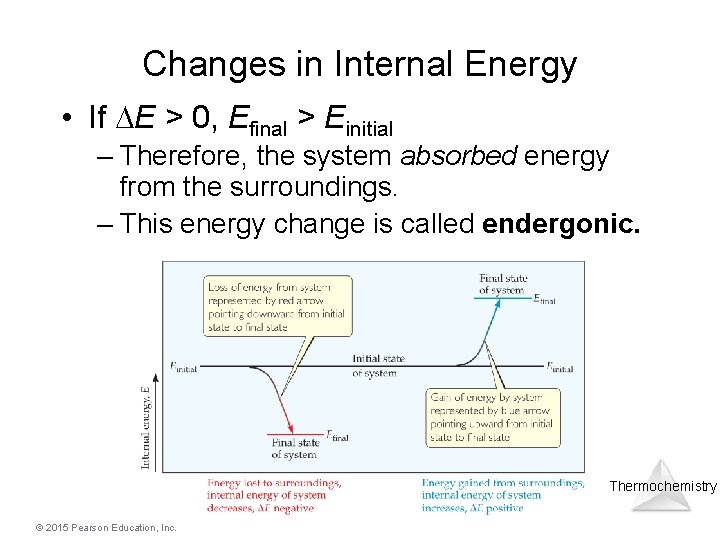
Changes in Internal Energy • If E > 0, Efinal > Einitial – Therefore, the system absorbed energy from the surroundings. – This energy change is called endergonic. Thermochemistry © 2015 Pearson Education, Inc.
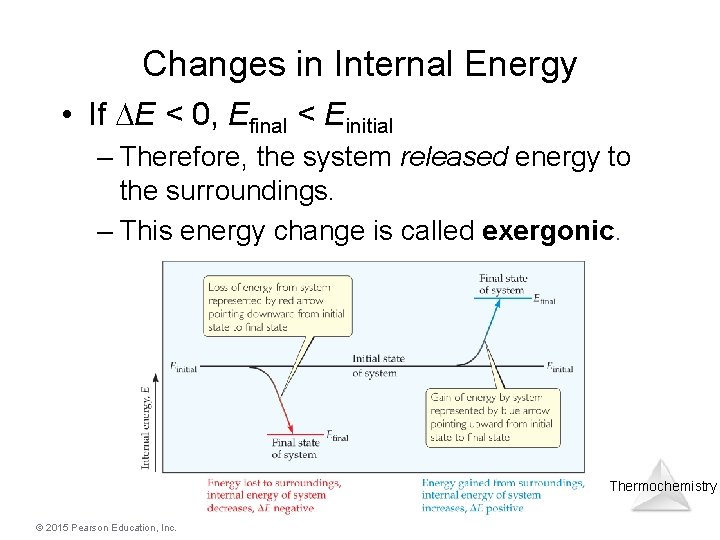
Changes in Internal Energy • If E < 0, Efinal < Einitial – Therefore, the system released energy to the surroundings. – This energy change is called exergonic. Thermochemistry © 2015 Pearson Education, Inc.
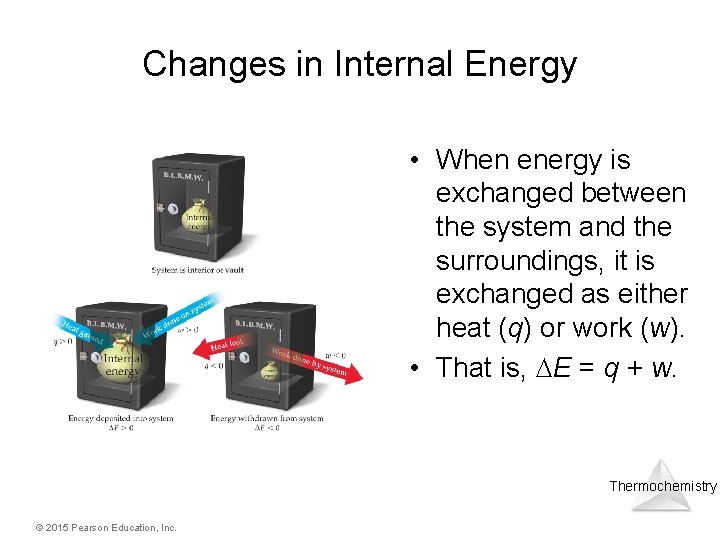
Changes in Internal Energy • When energy is exchanged between the system and the surroundings, it is exchanged as either heat (q) or work (w). • That is, E = q + w. Thermochemistry © 2015 Pearson Education, Inc.
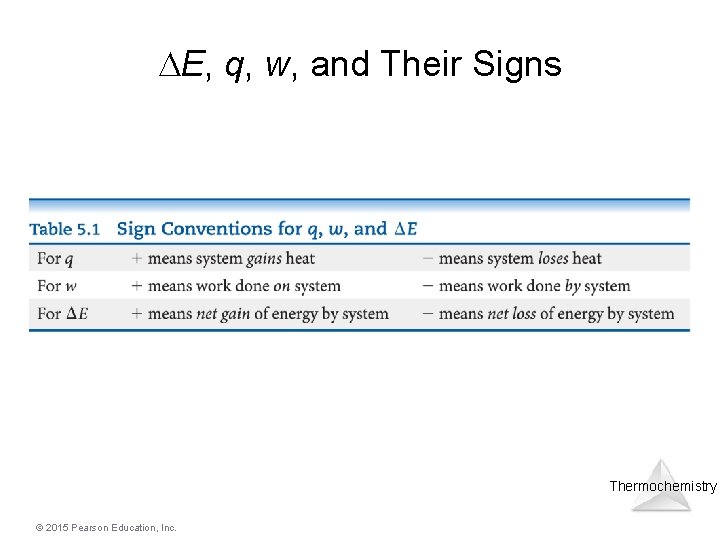
E, q, w, and Their Signs Thermochemistry © 2015 Pearson Education, Inc.
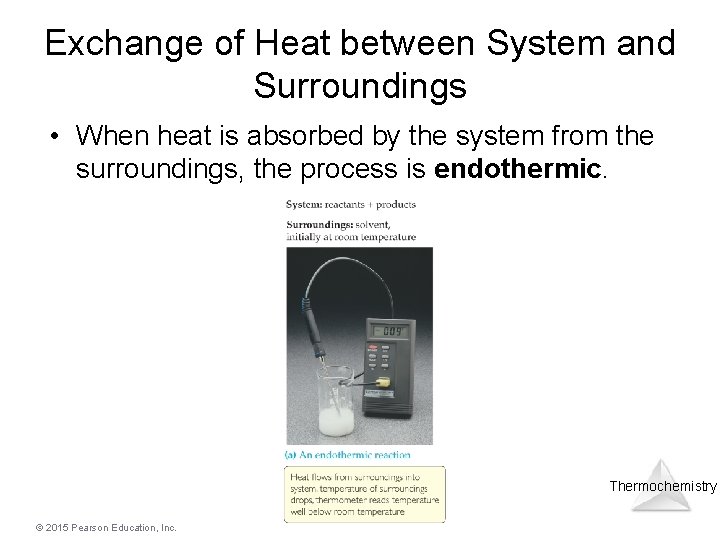
Exchange of Heat between System and Surroundings • When heat is absorbed by the system from the surroundings, the process is endothermic. Thermochemistry © 2015 Pearson Education, Inc.
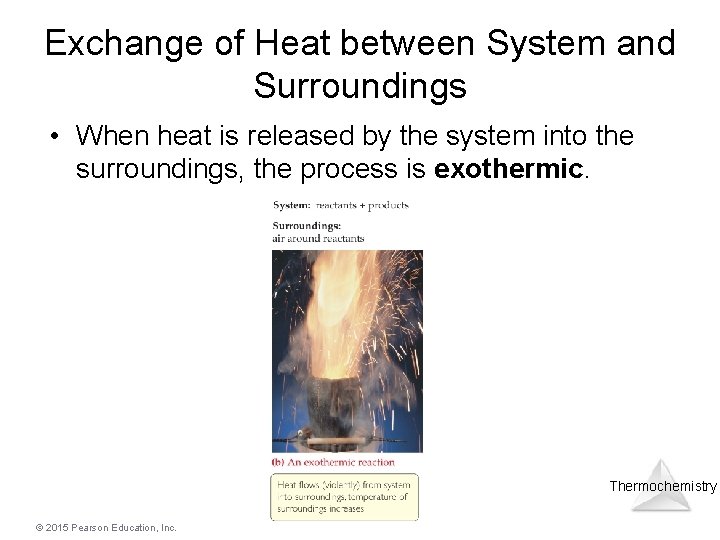
Exchange of Heat between System and Surroundings • When heat is released by the system into the surroundings, the process is exothermic. Thermochemistry © 2015 Pearson Education, Inc.
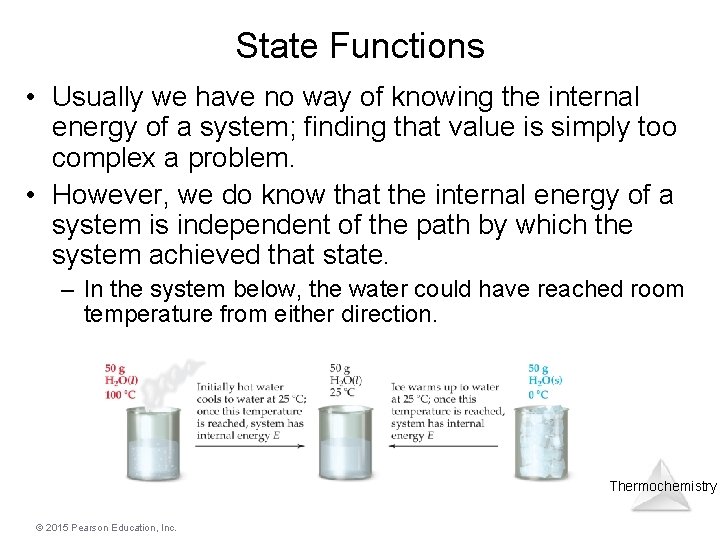
State Functions • Usually we have no way of knowing the internal energy of a system; finding that value is simply too complex a problem. • However, we do know that the internal energy of a system is independent of the path by which the system achieved that state. – In the system below, the water could have reached room temperature from either direction. Thermochemistry © 2015 Pearson Education, Inc.
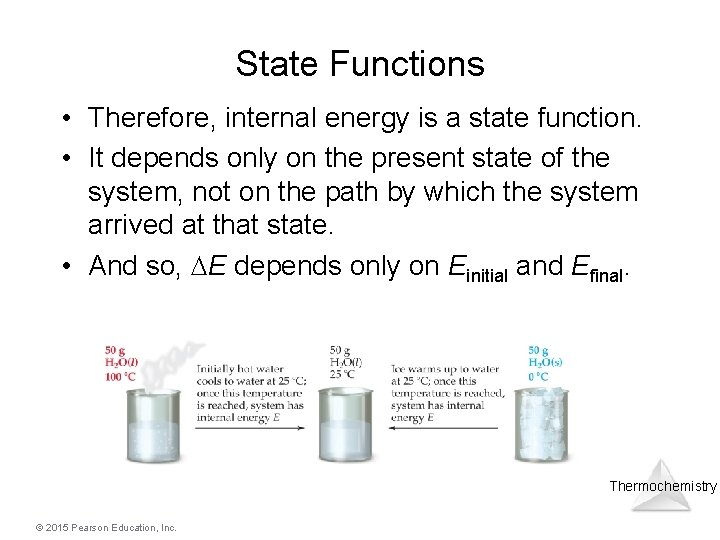
State Functions • Therefore, internal energy is a state function. • It depends only on the present state of the system, not on the path by which the system arrived at that state. • And so, E depends only on Einitial and Efinal. Thermochemistry © 2015 Pearson Education, Inc.
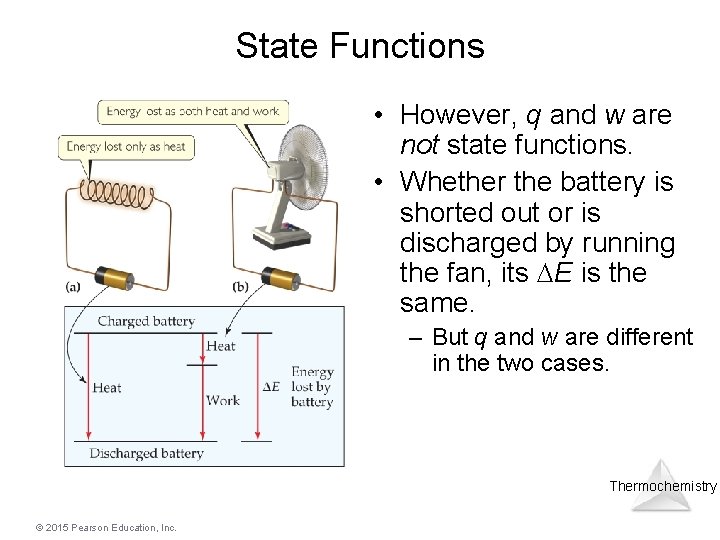
State Functions • However, q and w are not state functions. • Whether the battery is shorted out or is discharged by running the fan, its E is the same. – But q and w are different in the two cases. Thermochemistry © 2015 Pearson Education, Inc.
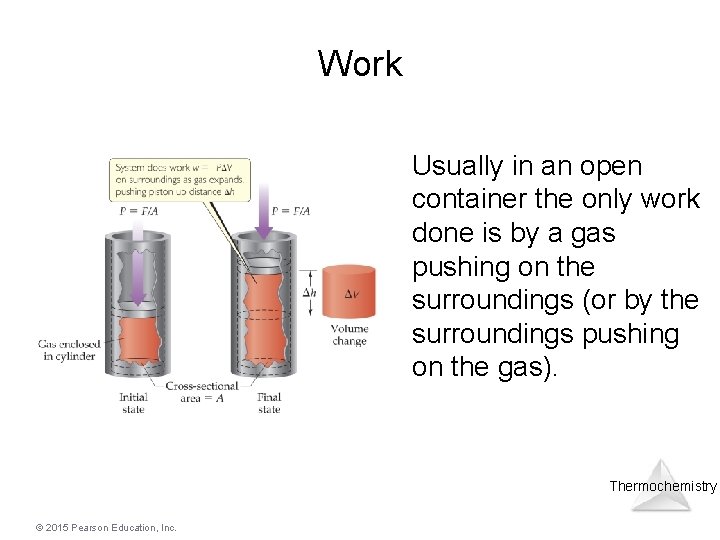
Work Usually in an open container the only work done is by a gas pushing on the surroundings (or by the surroundings pushing on the gas). Thermochemistry © 2015 Pearson Education, Inc.
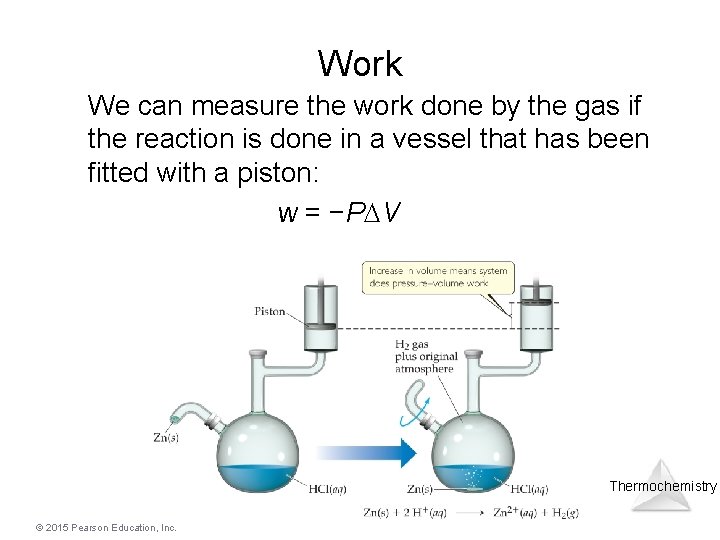
Work We can measure the work done by the gas if the reaction is done in a vessel that has been fitted with a piston: w = −P V Thermochemistry © 2015 Pearson Education, Inc.
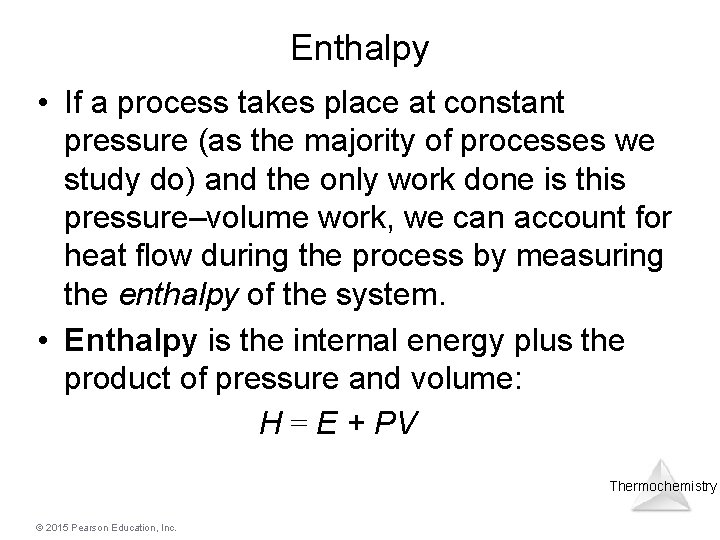
Enthalpy • If a process takes place at constant pressure (as the majority of processes we study do) and the only work done is this pressure–volume work, we can account for heat flow during the process by measuring the enthalpy of the system. • Enthalpy is the internal energy plus the product of pressure and volume: H = E + PV Thermochemistry © 2015 Pearson Education, Inc.
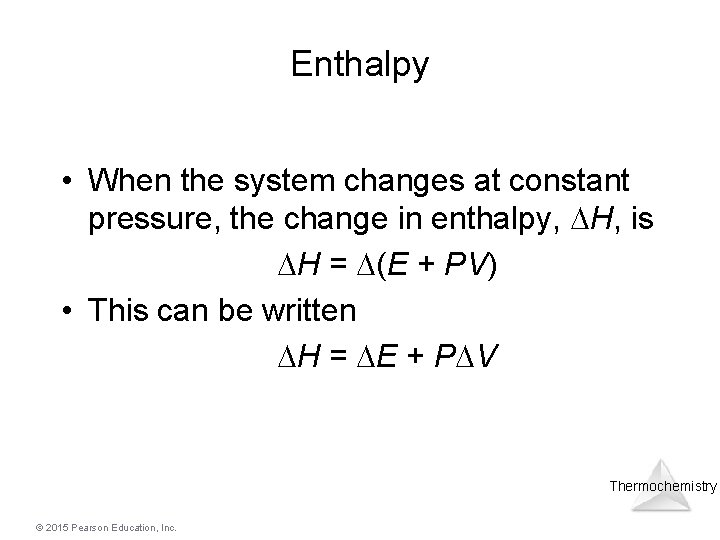
Enthalpy • When the system changes at constant pressure, the change in enthalpy, H, is H = (E + PV) • This can be written H = E + P V Thermochemistry © 2015 Pearson Education, Inc.
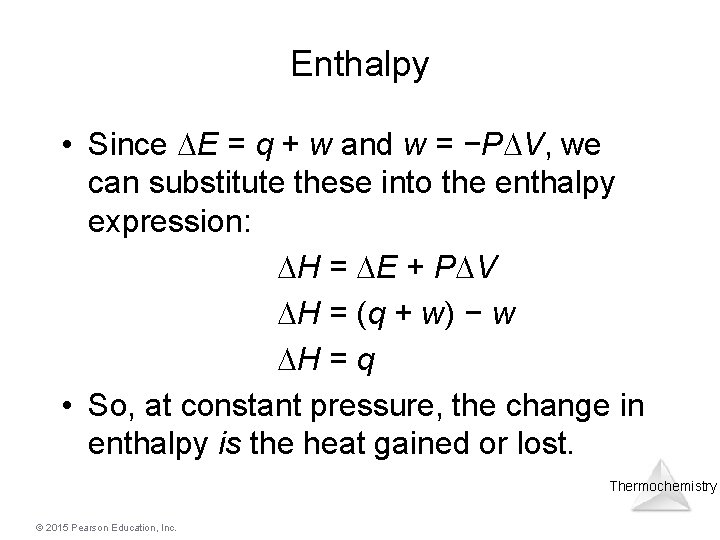
Enthalpy • Since E = q + w and w = −P V, we can substitute these into the enthalpy expression: H = E + P V H = (q + w) − w H = q • So, at constant pressure, the change in enthalpy is the heat gained or lost. Thermochemistry © 2015 Pearson Education, Inc.
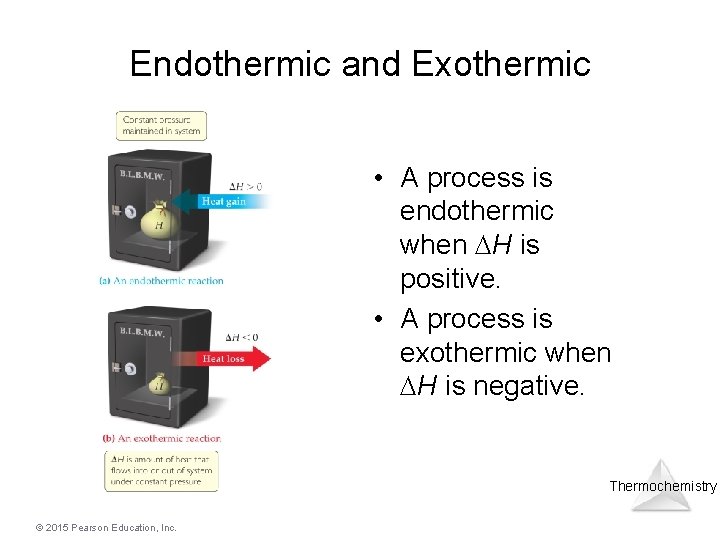
Endothermic and Exothermic • A process is endothermic when H is positive. • A process is exothermic when H is negative. Thermochemistry © 2015 Pearson Education, Inc.
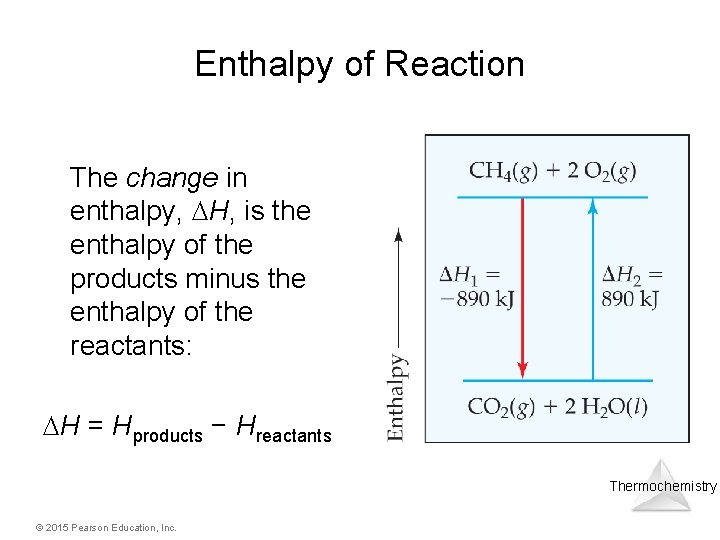
Enthalpy of Reaction The change in enthalpy, H, is the enthalpy of the products minus the enthalpy of the reactants: H = Hproducts − Hreactants Thermochemistry © 2015 Pearson Education, Inc.
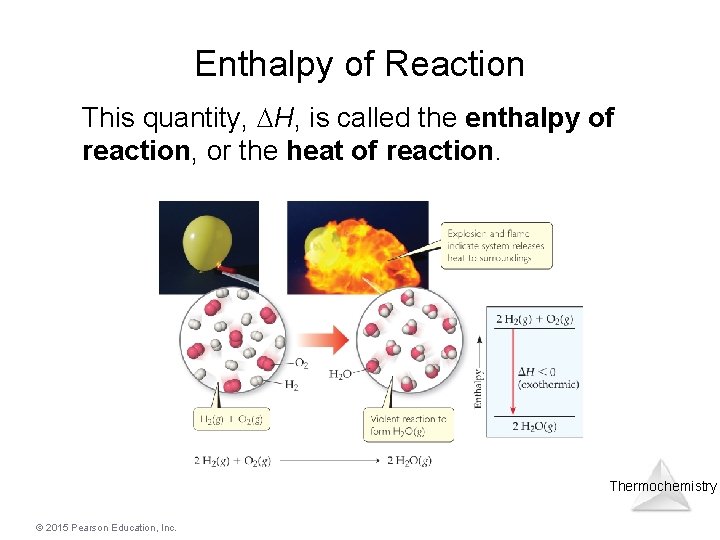
Enthalpy of Reaction This quantity, H, is called the enthalpy of reaction, or the heat of reaction. Thermochemistry © 2015 Pearson Education, Inc.
The Truth about Enthalpy 1. Enthalpy is an extensive property. 2. H for a reaction in the forward direction is equal in size, but opposite in sign, to H for the reverse reaction. 3. H for a reaction depends on the state of the products and the state of the reactants. Thermochemistry © 2015 Pearson Education, Inc.
THERMOCHEMISTRY Define the following terms in your notebook: 1) Thermochemistry 2) Kinetic energy 3) Potential energy 4) Calorimeter 5) Temperature 6) Joule 7) Heat transfer 8) Conduction 9) Convection 10) Radiation
THERMOCHEMISTRY Study of the transfers of energy as heat that accompany chemical reactions and physical changes All chemical reactions are accompanied by a change in energy Usually absorb (endothermic) or release (exothermic) energy as heat
TYPES OF ENERGY Kinetic Energy – the energy an object has because of its motion � Thermal Energy – The kinetic energy of molecules, energy in the form of heat Potential Energy – the amount of energy stored in an object � Chemical Energy – energy stored within chemical bonds
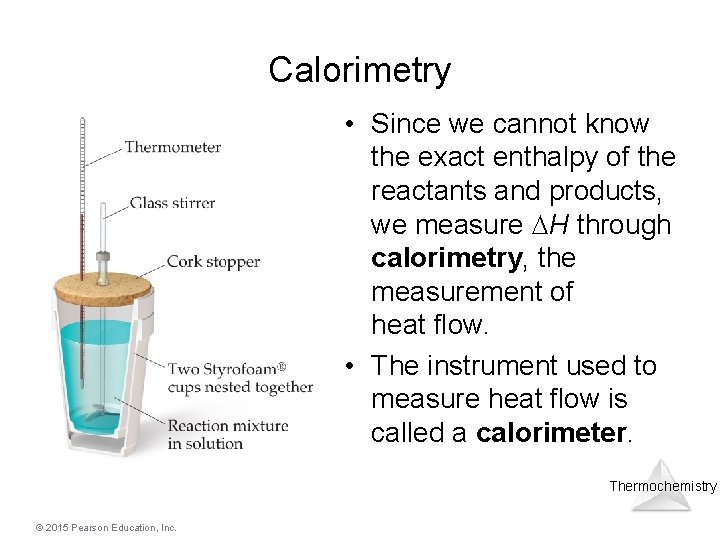
Calorimetry • Since we cannot know the exact enthalpy of the reactants and products, we measure H through calorimetry, the measurement of heat flow. • The instrument used to measure heat flow is called a calorimeter. Thermochemistry © 2015 Pearson Education, Inc.
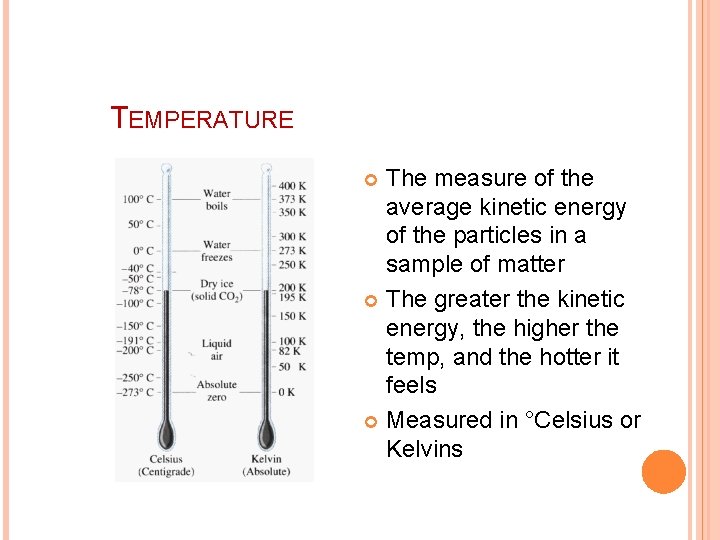
TEMPERATURE The measure of the average kinetic energy of the particles in a sample of matter The greater the kinetic energy, the higher the temp, and the hotter it feels Measured in °Celsius or Kelvins
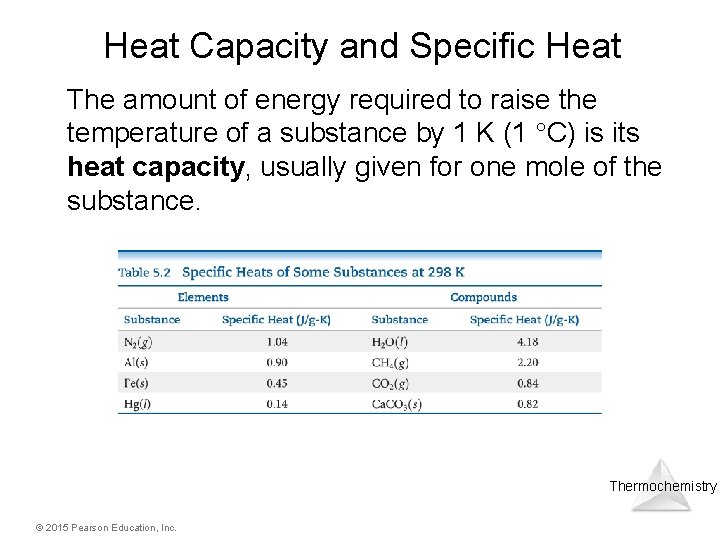
Heat Capacity and Specific Heat The amount of energy required to raise the temperature of a substance by 1 K (1 C) is its heat capacity, usually given for one mole of the substance. Thermochemistry © 2015 Pearson Education, Inc.
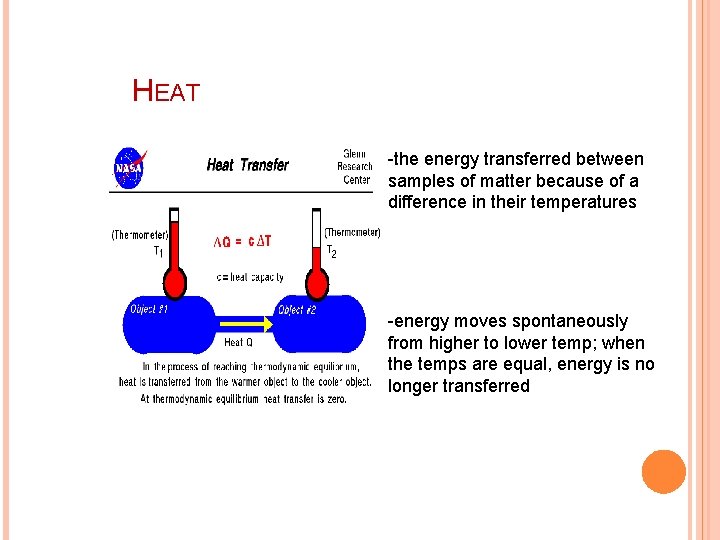
HEAT -the energy transferred between samples of matter because of a difference in their temperatures -energy moves spontaneously from higher to lower temp; when the temps are equal, energy is no longer transferred
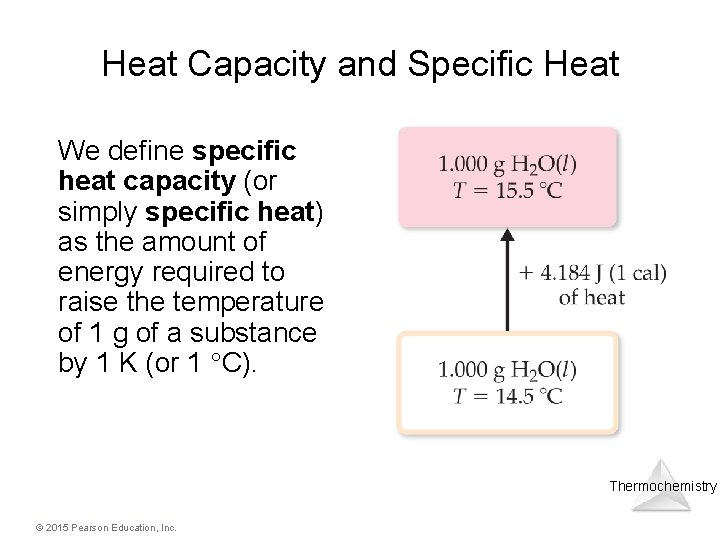
Heat Capacity and Specific Heat We define specific heat capacity (or simply specific heat) as the amount of energy required to raise the temperature of 1 g of a substance by 1 K (or 1 C). Thermochemistry © 2015 Pearson Education, Inc.
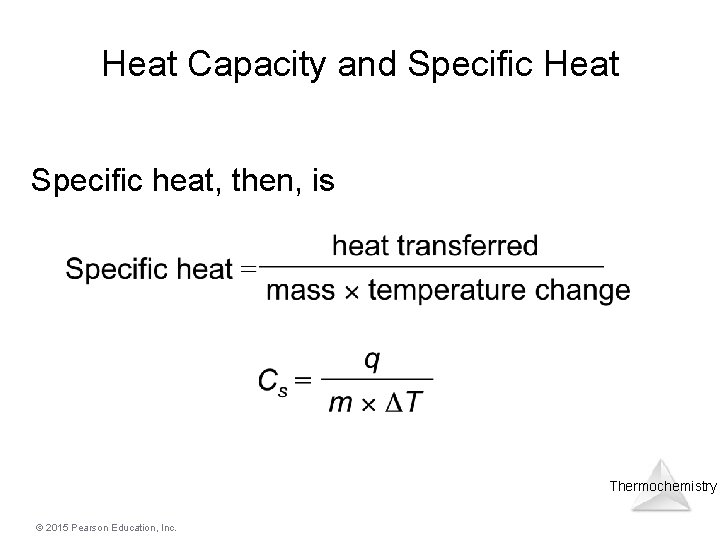
Heat Capacity and Specific Heat Specific heat, then, is Thermochemistry © 2015 Pearson Education, Inc.
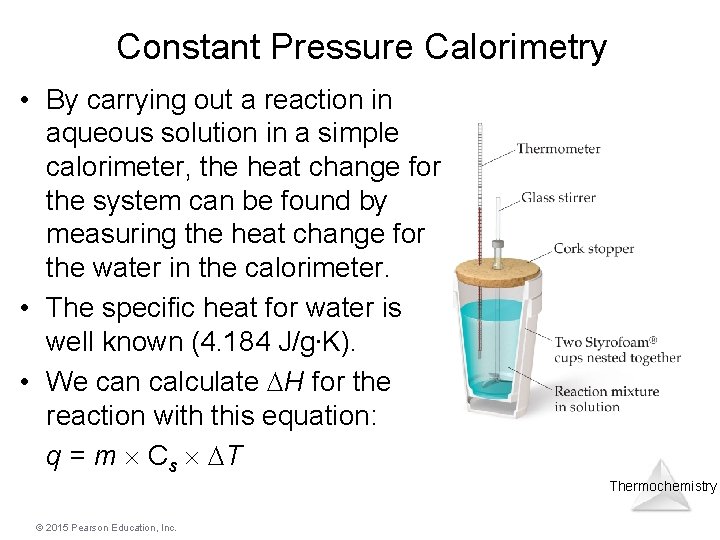
Constant Pressure Calorimetry • By carrying out a reaction in aqueous solution in a simple calorimeter, the heat change for the system can be found by measuring the heat change for the water in the calorimeter. • The specific heat for water is well known (4. 184 J/g∙K). • We can calculate H for the reaction with this equation: q = m Cs T Thermochemistry © 2015 Pearson Education, Inc.
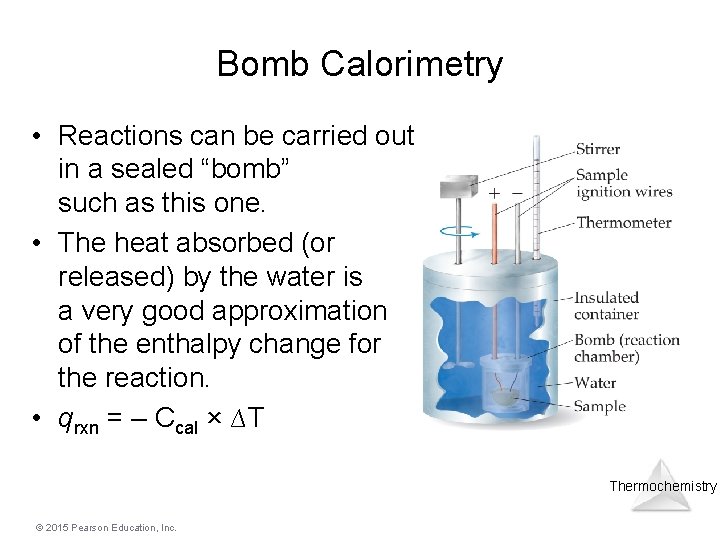
Bomb Calorimetry • Reactions can be carried out in a sealed “bomb” such as this one. • The heat absorbed (or released) by the water is a very good approximation of the enthalpy change for the reaction. • qrxn = – Ccal × ∆T Thermochemistry © 2015 Pearson Education, Inc.
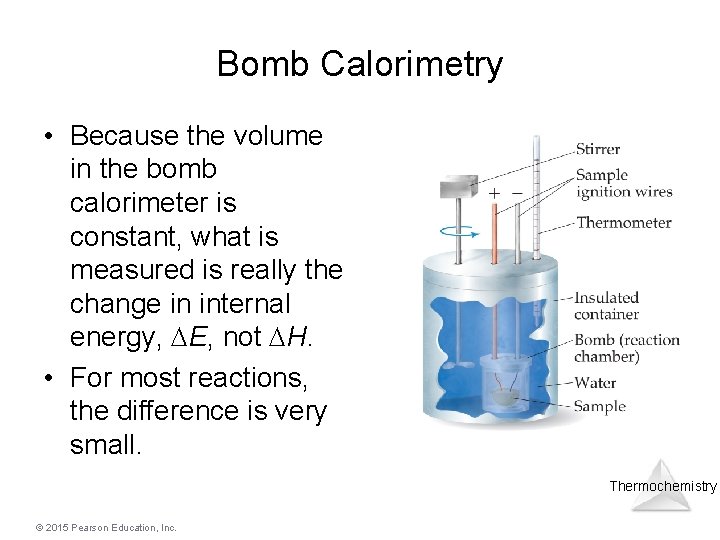
Bomb Calorimetry • Because the volume in the bomb calorimeter is constant, what is measured is really the change in internal energy, E, not H. • For most reactions, the difference is very small. Thermochemistry © 2015 Pearson Education, Inc.
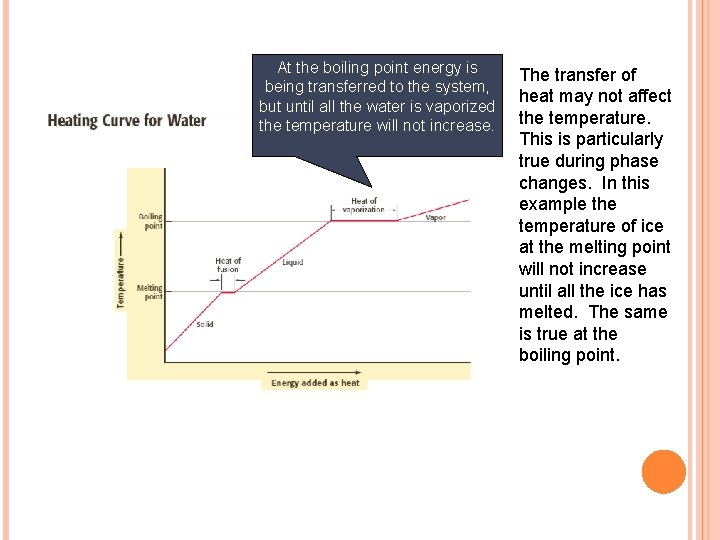
At the boiling point energy is being transferred to the system, but until all the water is vaporized the temperature will not increase. The transfer of heat may not affect the temperature. This is particularly true during phase changes. In this example the temperature of ice at the melting point will not increase until all the ice has melted. The same is true at the boiling point.
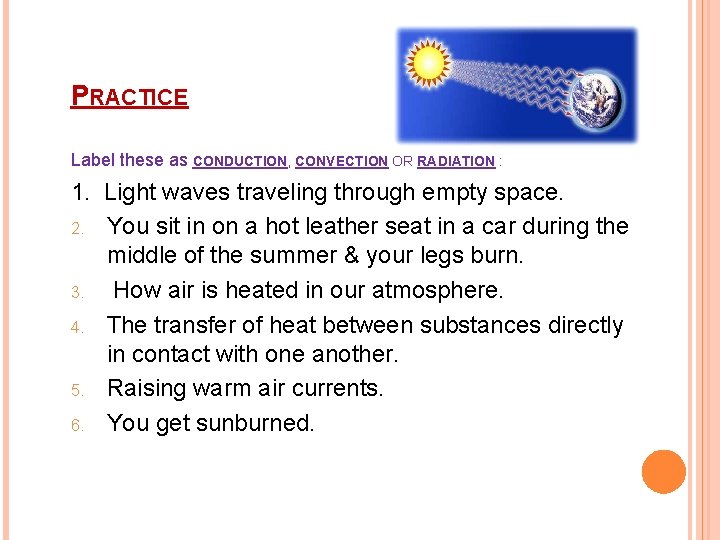
PRACTICE Label these as CONDUCTION, CONVECTION OR RADIATION : 1. Light waves traveling through empty space. 2. You sit in on a hot leather seat in a car during the middle of the summer & your legs burn. 3. How air is heated in our atmosphere. 4. The transfer of heat between substances directly in contact with one another. 5. Raising warm air currents. 6. You get sunburned.
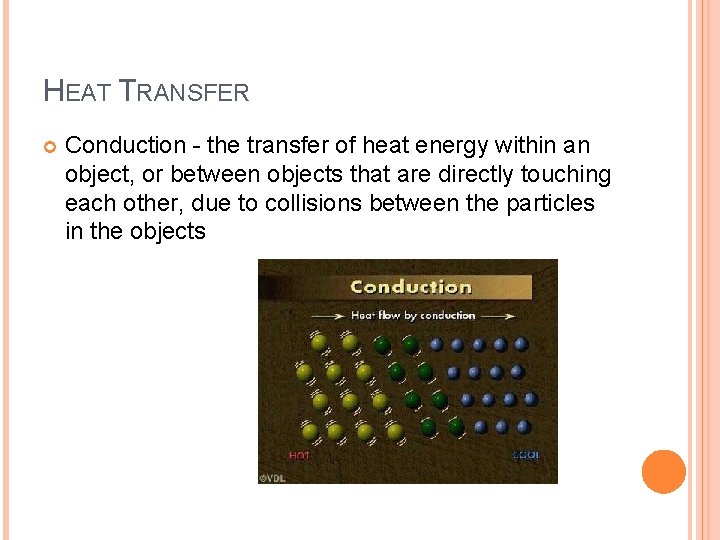
HEAT TRANSFER Conduction - the transfer of heat energy within an object, or between objects that are directly touching each other, due to collisions between the particles in the objects
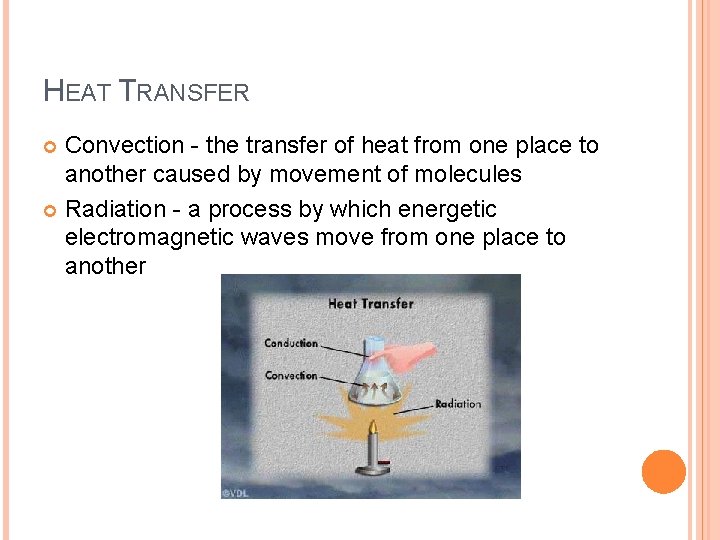
HEAT TRANSFER Convection - the transfer of heat from one place to another caused by movement of molecules Radiation - a process by which energetic electromagnetic waves move from one place to another
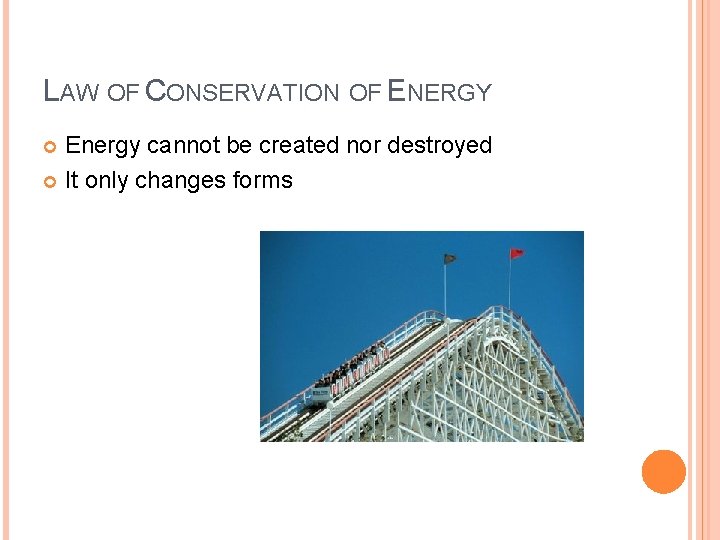
LAW OF CONSERVATION OF ENERGY Energy cannot be created nor destroyed It only changes forms
HEAT CAPACITY -the quantity of energy transferred as heat depends on the nature of the material changing temp, the mass changing temp, and the size of the temp change The equation to solve for heat capacity is: Q = m cp T Q stands for heat capacity in the unit of Joules or J, while m is mass in grams, cp is for specific heat usually in J/g ºC, and T is for temperature change in ºC
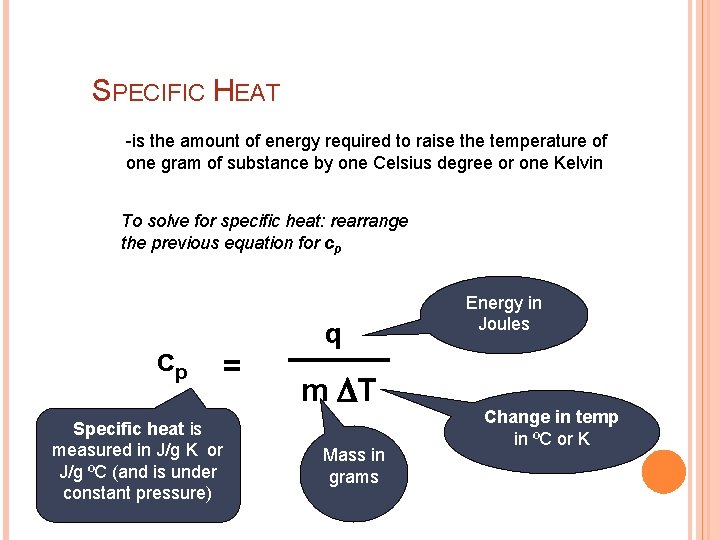
SPECIFIC HEAT -is the amount of energy required to raise the temperature of one gram of substance by one Celsius degree or one Kelvin To solve for specific heat: rearrange the previous equation for cp cp = Specific heat is measured in J/g K or J/g ºC (and is under constant pressure) q m T Mass in grams Energy in Joules Change in temp in ºC or K
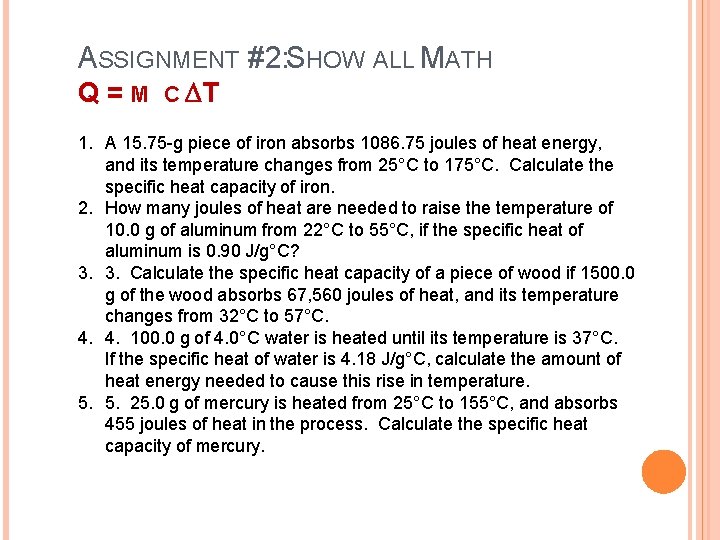
ASSIGNMENT #2: SHOW ALL MATH Q=M C T 1. A 15. 75 -g piece of iron absorbs 1086. 75 joules of heat energy, and its temperature changes from 25°C to 175°C. Calculate the specific heat capacity of iron. 2. How many joules of heat are needed to raise the temperature of 10. 0 g of aluminum from 22°C to 55°C, if the specific heat of aluminum is 0. 90 J/g°C? 3. 3. Calculate the specific heat capacity of a piece of wood if 1500. 0 g of the wood absorbs 67, 560 joules of heat, and its temperature changes from 32°C to 57°C. 4. 4. 100. 0 g of 4. 0°C water is heated until its temperature is 37°C. If the specific heat of water is 4. 18 J/g°C, calculate the amount of heat energy needed to cause this rise in temperature. 5. 5. 25. 0 g of mercury is heated from 25°C to 155°C, and absorbs 455 joules of heat in the process. Calculate the specific heat capacity of mercury.
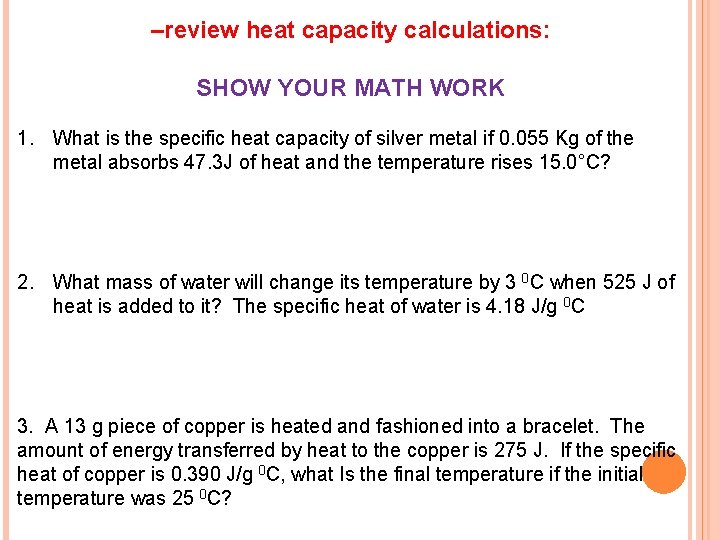
–review heat capacity calculations: SHOW YOUR MATH WORK 1. What is the specific heat capacity of silver metal if 0. 055 Kg of the metal absorbs 47. 3 J of heat and the temperature rises 15. 0°C? 2. What mass of water will change its temperature by 3 0 C when 525 J of heat is added to it? The specific heat of water is 4. 18 J/g 0 C 3. A 13 g piece of copper is heated and fashioned into a bracelet. The amount of energy transferred by heat to the copper is 275 J. If the specific heat of copper is 0. 390 J/g 0 C, what Is the final temperature if the initial temperature was 25 0 C?
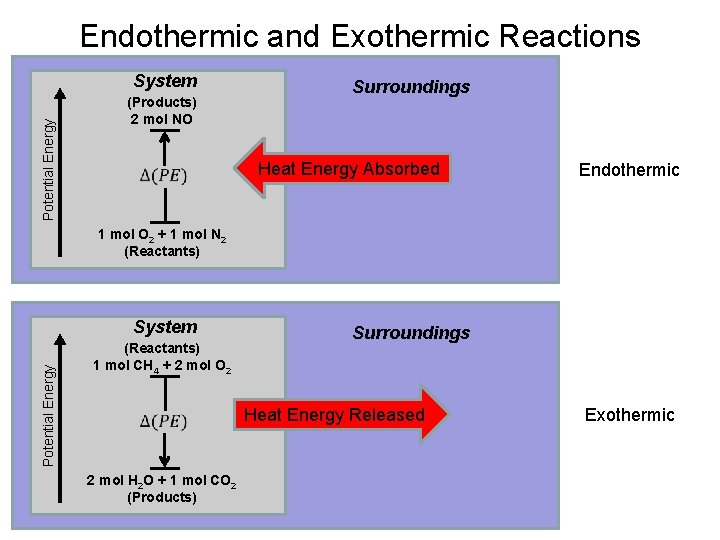
Endothermic and Exothermic Reactions Potential Energy System (Products) 2 mol NO Surroundings Heat Energy Absorbed Endothermic 1 mol O 2 + 1 mol N 2 (Reactants) Potential Energy System (Reactants) 1 mol CH 4 + 2 mol O 2 2 mol H 2 O + 1 mol CO 2 (Products) Surroundings Heat Energy Released Exothermic
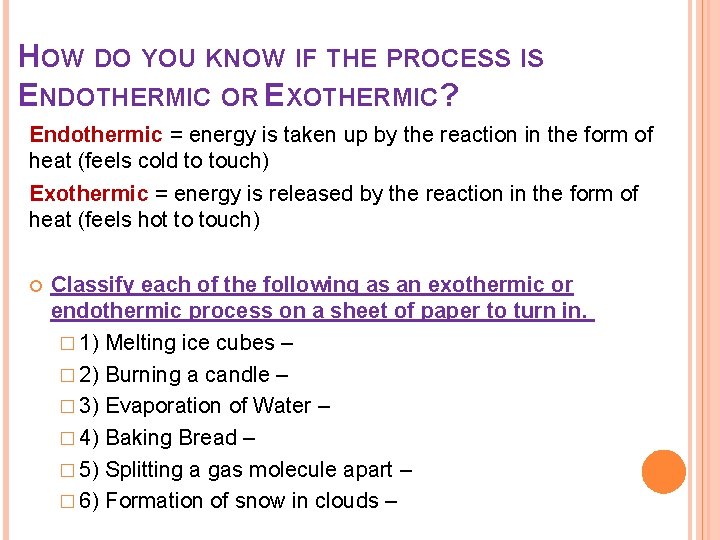
HOW DO YOU KNOW IF THE PROCESS IS ENDOTHERMIC OR EXOTHERMIC? Endothermic = energy is taken up by the reaction in the form of heat (feels cold to touch) Exothermic = energy is released by the reaction in the form of heat (feels hot to touch) Classify each of the following as an exothermic or endothermic process on a sheet of paper to turn in. � 1) Melting ice cubes – � 2) Burning a candle – � 3) Evaporation of Water – � 4) Baking Bread – � 5) Splitting a gas molecule apart – � 6) Formation of snow in clouds –
LOGIN IN TO EDPUZZLE. COM USING YOUR SCHOOL GOOGLE ACCOUNT TO: Watch, listen and answer the questions in the video called “Endothermic and Exothermic reactions” If new to my class then you may need to use the password dewpuse
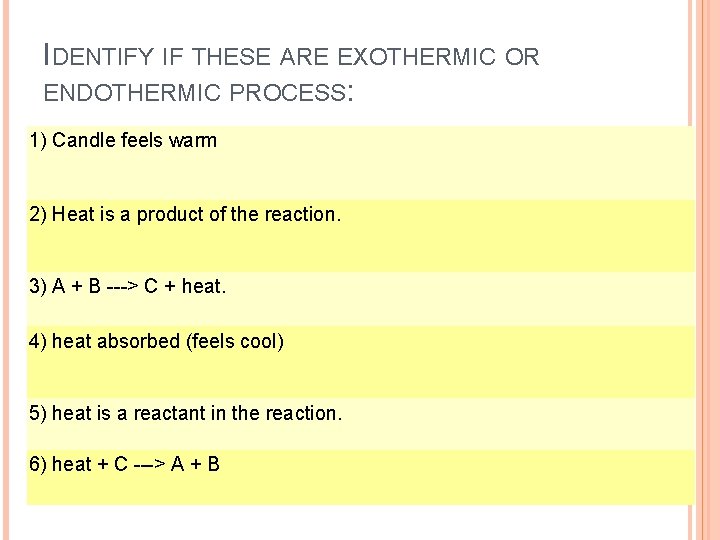
IDENTIFY IF THESE ARE EXOTHERMIC OR ENDOTHERMIC PROCESS: 1) Candle feels warm 2) Heat is a product of the reaction. 3) A + B ---> C + heat. 4) heat absorbed (feels cool) 5) heat is a reactant in the reaction. 6) heat + C ---> A + B
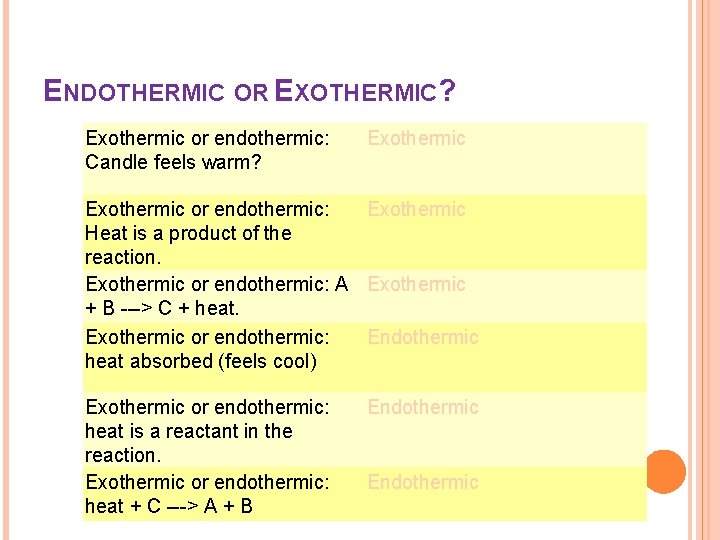
ENDOTHERMIC OR EXOTHERMIC? Exothermic or endothermic: Candle feels warm? Exothermic or endothermic: Exothermic Heat is a product of the reaction. Exothermic or endothermic: A Exothermic + B ---> C + heat. Exothermic or endothermic: Endothermic heat absorbed (feels cool) Exothermic or endothermic: heat is a reactant in the reaction. Exothermic or endothermic: heat + C ---> A + B Endothermic
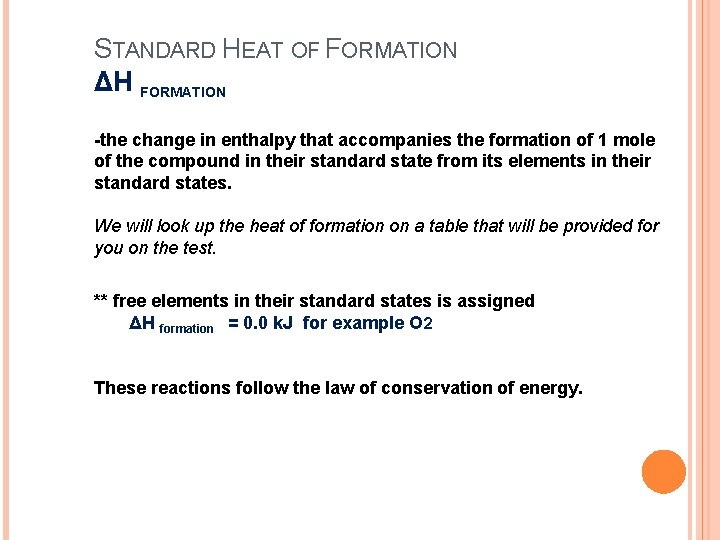
STANDARD HEAT OF FORMATION ΔH FORMATION -the change in enthalpy that accompanies the formation of 1 mole of the compound in their standard state from its elements in their standard states. We will look up the heat of formation on a table that will be provided for you on the test. ** free elements in their standard states is assigned ΔH formation = 0. 0 k. J for example O 2 These reactions follow the law of conservation of energy.
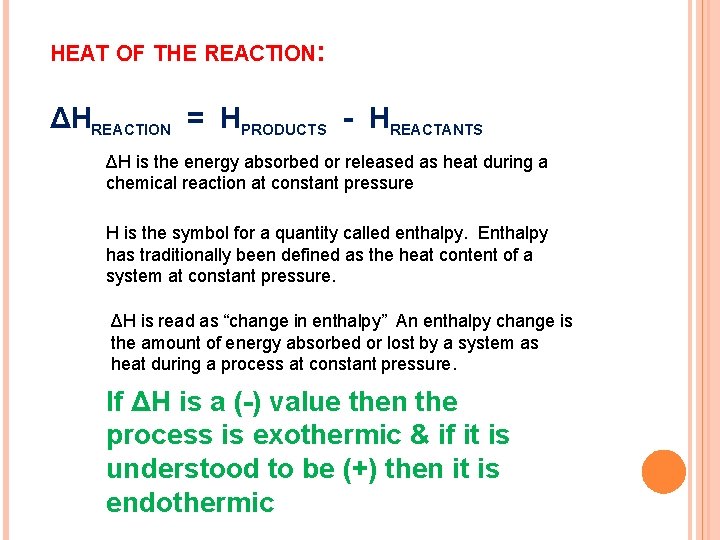
HEAT OF THE REACTION: ΔHREACTION = HPRODUCTS - HREACTANTS ΔH is the energy absorbed or released as heat during a chemical reaction at constant pressure H is the symbol for a quantity called enthalpy. Enthalpy has traditionally been defined as the heat content of a system at constant pressure. ΔH is read as “change in enthalpy” An enthalpy change is the amount of energy absorbed or lost by a system as heat during a process at constant pressure. If ΔH is a (-) value then the process is exothermic & if it is understood to be (+) then it is endothermic
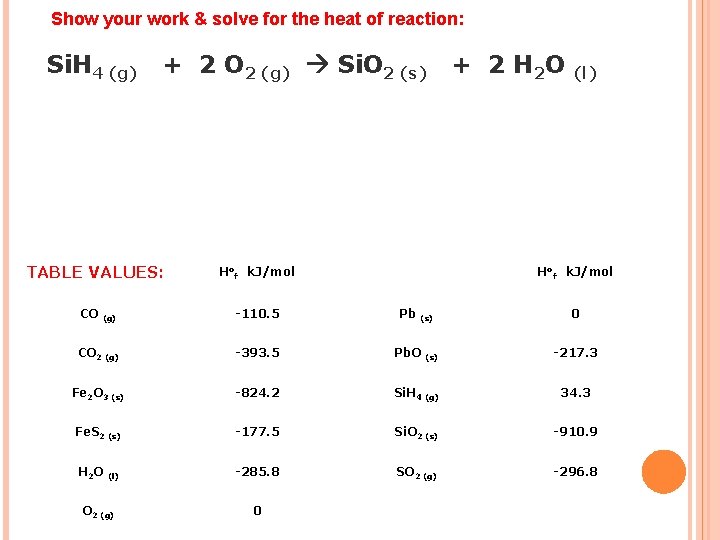
Show your work & solve for the heat of reaction: Si. H 4 (g) + 2 O 2 (g) Si. O 2 (s) + 2 H 2 O (l) TABLE VALUES: Hof k. J/mol CO (g) -110. 5 Pb (s) 0 CO 2 (g) -393. 5 Pb. O (s) -217. 3 Fe 2 O 3 (s) -824. 2 Si. H 4 (g) 34. 3 Fe. S 2 (s) -177. 5 Si. O 2 (s) -910. 9 H 2 O (l) -285. 8 SO 2 (g) -296. 8 O 2 (g) 0

REVIEW OF HEAT OF FORMATION CALCULATION: Calculate ∆H for the reaction of sulfur dioxide with oxygen. 2 SO 2 (g) + O 2 (g) 2 SO 3 (g) Given values from table: ∆Hf for SO 2 (g) = -296. 8 k. J ∆Hf for SO 3 (g) = -395. 7 k. J
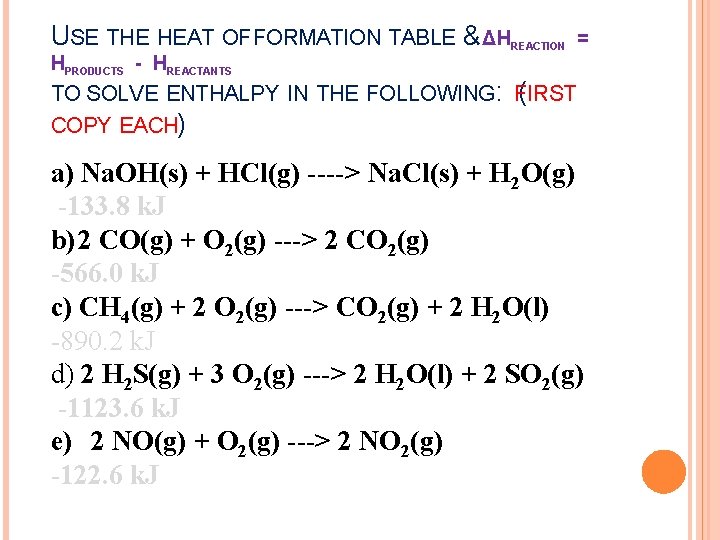
USE THE HEAT OF FORMATION TABLE & ΔH REACTION = HPRODUCTS - HREACTANTS TO SOLVE ENTHALPY IN THE FOLLOWING: ( FIRST COPY EACH) a) Na. OH(s) + HCl(g) ----> Na. Cl(s) + H 2 O(g) -133. 8 k. J b) 2 CO(g) + O 2(g) ---> 2 CO 2(g) -566. 0 k. J c) CH 4(g) + 2 O 2(g) ---> CO 2(g) + 2 H 2 O(l) -890. 2 k. J d) 2 H 2 S(g) + 3 O 2(g) ---> 2 H 2 O(l) + 2 SO 2(g) -1123. 6 k. J e) 2 NO(g) + O 2(g) ---> 2 NO 2(g) -122. 6 k. J
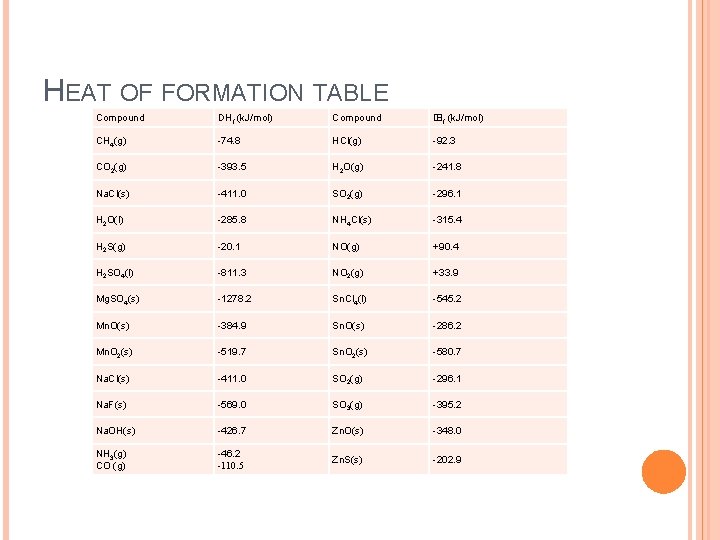
HEAT OF FORMATION TABLE Compound DHf (k. J/mol) Compound � Hf (k. J/mol) CH 4(g) -74. 8 HCl(g) -92. 3 CO 2(g) -393. 5 H 2 O(g) -241. 8 Na. Cl(s) -411. 0 SO 2(g) -296. 1 H 2 O(l) -285. 8 NH 4 Cl(s) -315. 4 H 2 S(g) -20. 1 NO(g) +90. 4 H 2 SO 4(l) -811. 3 NO 2(g) +33. 9 Mg. SO 4(s) -1278. 2 Sn. Cl 4(l) -545. 2 Mn. O(s) -384. 9 Sn. O(s) -286. 2 Mn. O 2(s) -519. 7 Sn. O 2(s) -580. 7 Na. Cl(s) -411. 0 SO 2(g) -296. 1 Na. F(s) -569. 0 SO 3(g) -395. 2 Na. OH(s) -426. 7 Zn. O(s) -348. 0 NH 3(g) CO (g) -46. 2 -110. 5 Zn. S(s) -202. 9
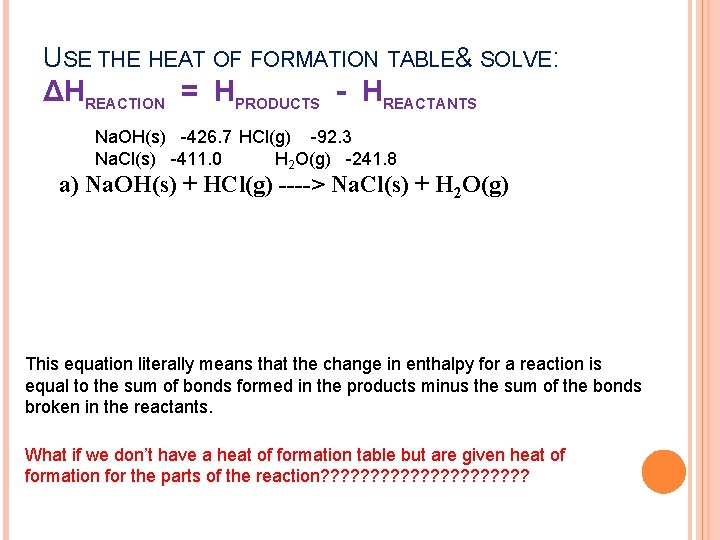
USE THE HEAT OF FORMATION TABLE& SOLVE: ΔHREACTION = HPRODUCTS - HREACTANTS Na. OH(s) -426. 7 HCl(g) -92. 3 Na. Cl(s) -411. 0 H 2 O(g) -241. 8 a) Na. OH(s) + HCl(g) ----> Na. Cl(s) + H 2 O(g) This equation literally means that the change in enthalpy for a reaction is equal to the sum of bonds formed in the products minus the sum of the bonds broken in the reactants. What if we don’t have a heat of formation table but are given heat of formation for the parts of the reaction? ? ? ? ? ?
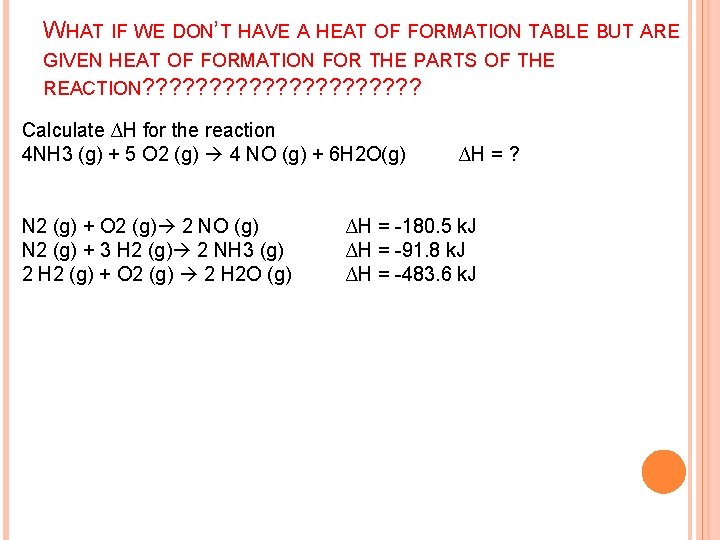
WHAT IF WE DON’T HAVE A HEAT OF FORMATION TABLE BUT ARE GIVEN HEAT OF FORMATION FOR THE PARTS OF THE REACTION? ? ? ? ? ? Calculate ∆H for the reaction 4 NH 3 (g) + 5 O 2 (g) 4 NO (g) + 6 H 2 O(g) N 2 (g) + O 2 (g) 2 NO (g) N 2 (g) + 3 H 2 (g) 2 NH 3 (g) 2 H 2 (g) + O 2 (g) 2 H 2 O (g) ∆H = ? ∆H = -180. 5 k. J ∆H = -91. 8 k. J ∆H = -483. 6 k. J
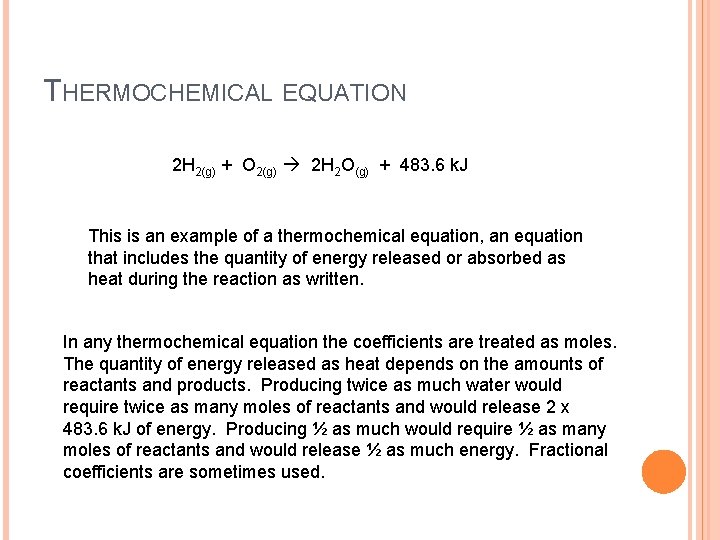
THERMOCHEMICAL EQUATION 2 H 2(g) + O 2(g) 2 H 2 O(g) + 483. 6 k. J This is an example of a thermochemical equation, an equation that includes the quantity of energy released or absorbed as heat during the reaction as written. In any thermochemical equation the coefficients are treated as moles. The quantity of energy released as heat depends on the amounts of reactants and products. Producing twice as much water would require twice as many moles of reactants and would release 2 x 483. 6 k. J of energy. Producing ½ as much would require ½ as many moles of reactants and would release ½ as much energy. Fractional coefficients are sometimes used.
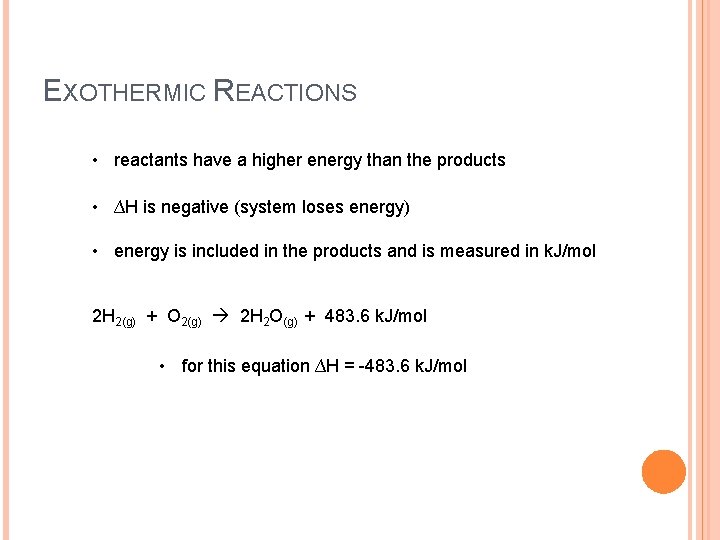
EXOTHERMIC REACTIONS • reactants have a higher energy than the products • ∆H is negative (system loses energy) • energy is included in the products and is measured in k. J/mol 2 H 2(g) + O 2(g) 2 H 2 O(g) + 483. 6 k. J/mol • for this equation ∆H = -483. 6 k. J/mol
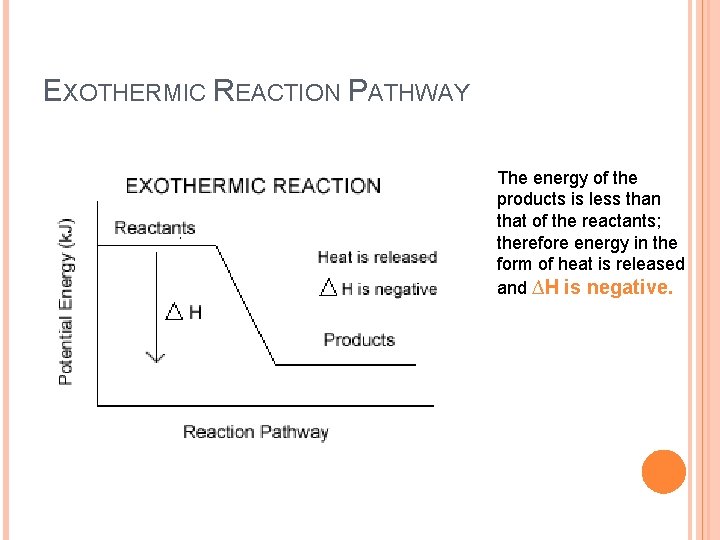
EXOTHERMIC REACTION PATHWAY The energy of the products is less than that of the reactants; therefore energy in the form of heat is released and ∆H is negative.
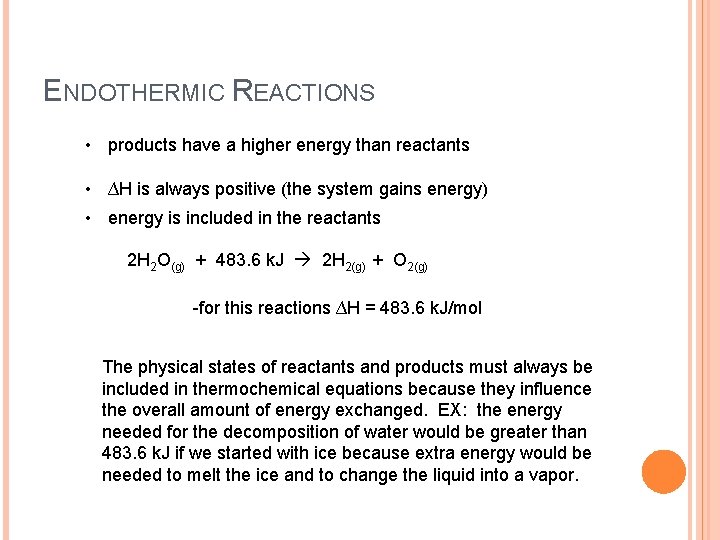
ENDOTHERMIC REACTIONS • products have a higher energy than reactants • ∆H is always positive (the system gains energy) • energy is included in the reactants 2 H 2 O(g) + 483. 6 k. J 2 H 2(g) + O 2(g) -for this reactions ∆H = 483. 6 k. J/mol The physical states of reactants and products must always be included in thermochemical equations because they influence the overall amount of energy exchanged. EX: the energy needed for the decomposition of water would be greater than 483. 6 k. J if we started with ice because extra energy would be needed to melt the ice and to change the liquid into a vapor.
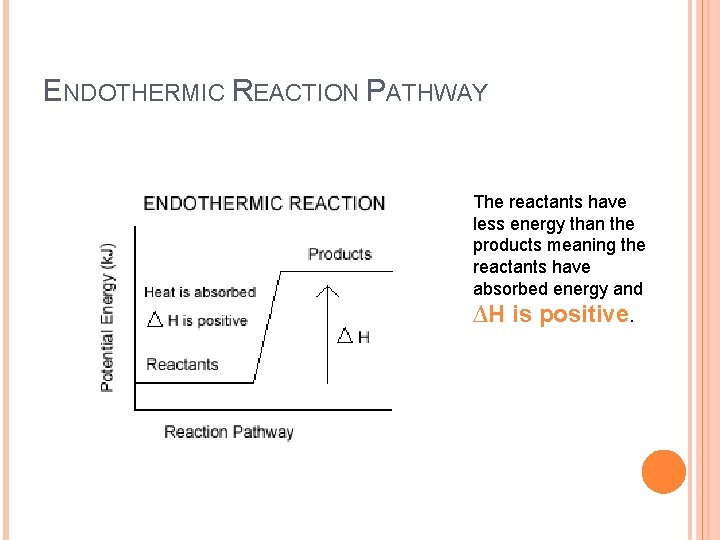
ENDOTHERMIC REACTION PATHWAY The reactants have less energy than the products meaning the reactants have absorbed energy and ∆H is positive.
Hess’s Law • H is well known for many reactions, and it is inconvenient to measure H for every reaction in which we are interested. • However, we can estimate H using published H values and the properties of enthalpy. Thermochemistry © 2015 Pearson Education, Inc.
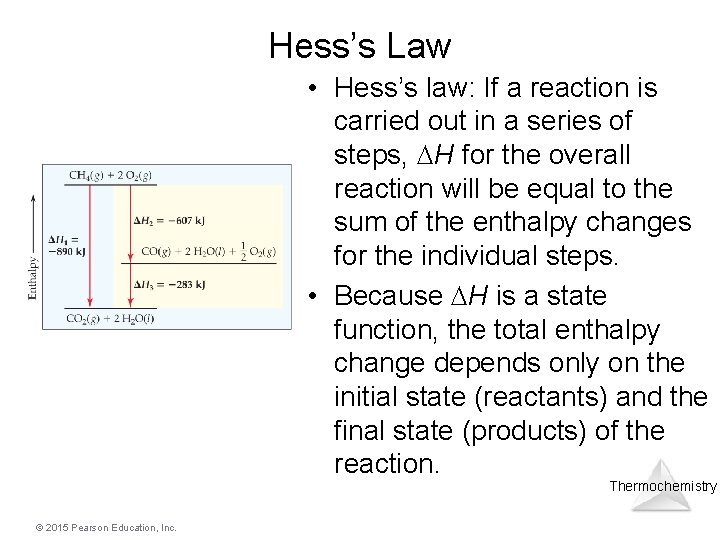
Hess’s Law • Hess’s law: If a reaction is carried out in a series of steps, H for the overall reaction will be equal to the sum of the enthalpy changes for the individual steps. • Because H is a state function, the total enthalpy change depends only on the initial state (reactants) and the final state (products) of the reaction. Thermochemistry © 2015 Pearson Education, Inc.
Enthalpies of Formation An enthalpy of formation, Hf, is defined as the enthalpy change for the reaction in which a compound is made from its constituent elements in their elemental forms. Thermochemistry © 2015 Pearson Education, Inc.
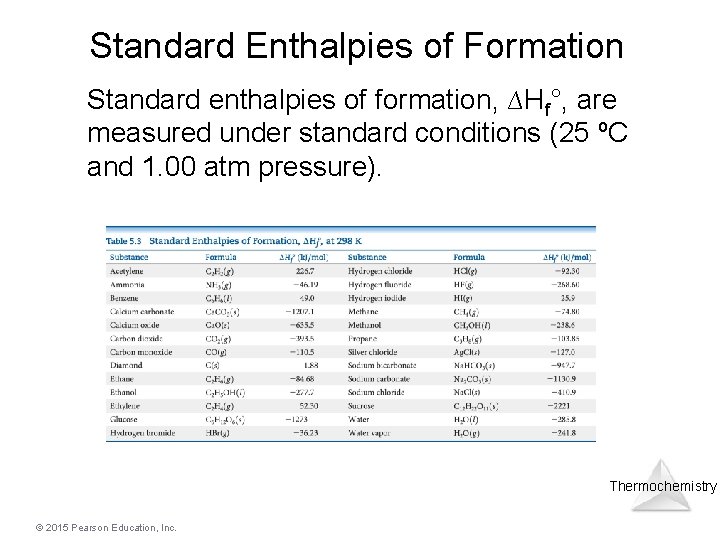
Standard Enthalpies of Formation Standard enthalpies of formation, ∆Hf°, are measured under standard conditions (25 ºC and 1. 00 atm pressure). Thermochemistry © 2015 Pearson Education, Inc.
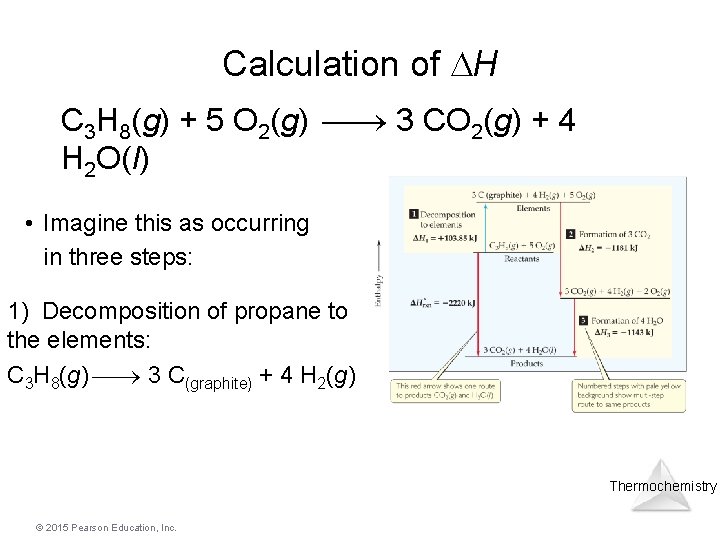
Calculation of H C 3 H 8(g) + 5 O 2(g) 3 CO 2(g) + 4 H 2 O(l) • Imagine this as occurring in three steps: 1) Decomposition of propane to the elements: C 3 H 8(g) 3 C(graphite) + 4 H 2(g) Thermochemistry © 2015 Pearson Education, Inc.
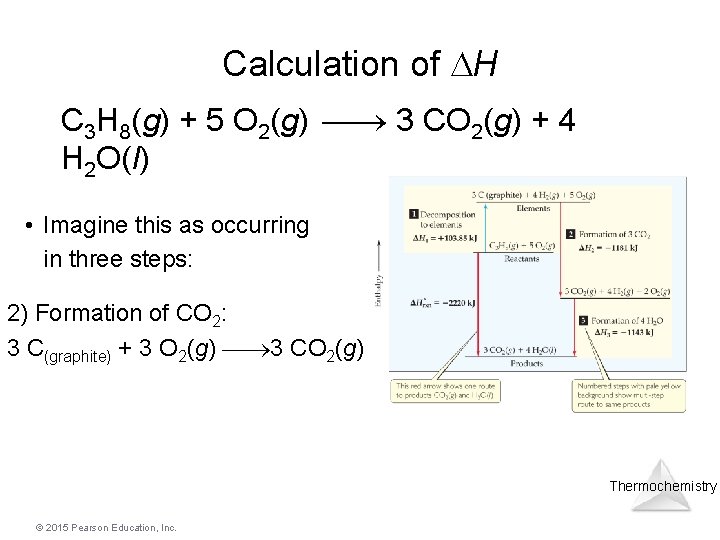
Calculation of H C 3 H 8(g) + 5 O 2(g) 3 CO 2(g) + 4 H 2 O(l) • Imagine this as occurring in three steps: 2) Formation of CO 2: 3 C(graphite) + 3 O 2(g) 3 CO 2(g) Thermochemistry © 2015 Pearson Education, Inc.
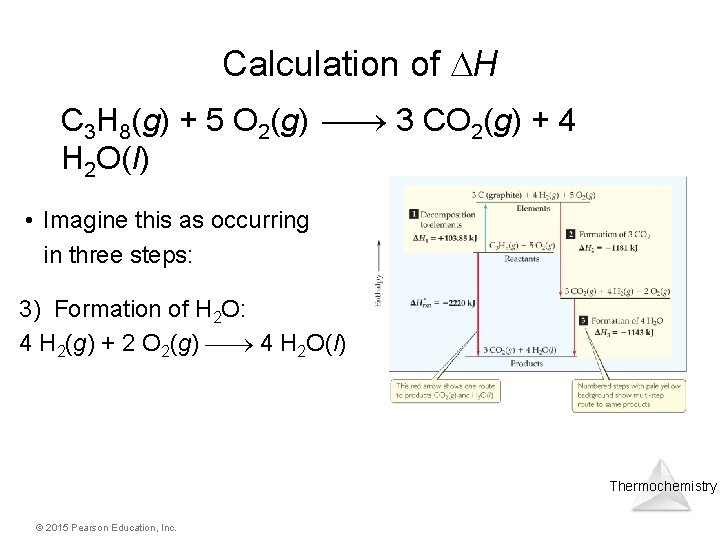
Calculation of H C 3 H 8(g) + 5 O 2(g) 3 CO 2(g) + 4 H 2 O(l) • Imagine this as occurring in three steps: 3) Formation of H 2 O: 4 H 2(g) + 2 O 2(g) 4 H 2 O(l) Thermochemistry © 2015 Pearson Education, Inc.
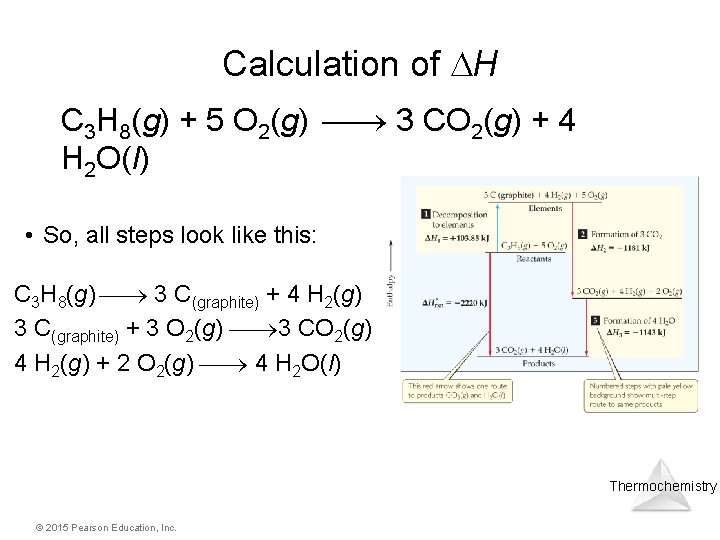
Calculation of H C 3 H 8(g) + 5 O 2(g) 3 CO 2(g) + 4 H 2 O(l) • So, all steps look like this: C 3 H 8(g) 3 C(graphite) + 4 H 2(g) 3 C(graphite) + 3 O 2(g) 3 CO 2(g) 4 H 2(g) + 2 O 2(g) 4 H 2 O(l) Thermochemistry © 2015 Pearson Education, Inc.
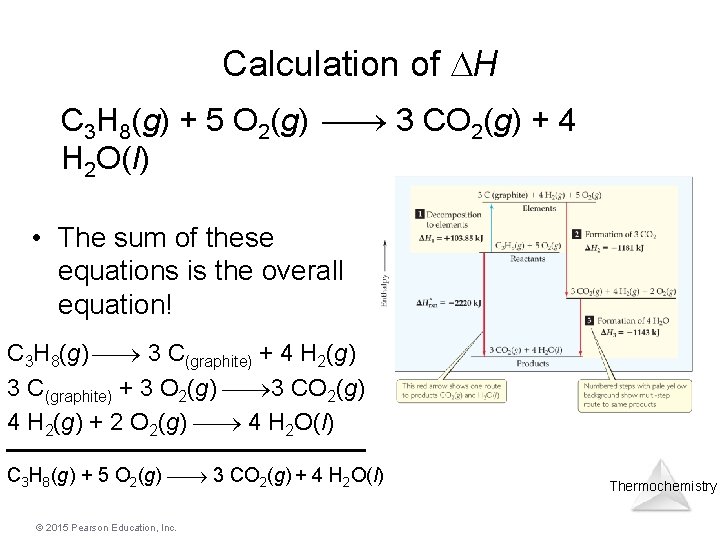
Calculation of H C 3 H 8(g) + 5 O 2(g) 3 CO 2(g) + 4 H 2 O(l) • The sum of these equations is the overall equation! C 3 H 8(g) 3 C(graphite) + 4 H 2(g) 3 C(graphite) + 3 O 2(g) 3 CO 2(g) 4 H 2(g) + 2 O 2(g) 4 H 2 O(l) C 3 H 8(g) + 5 O 2(g) 3 CO 2(g) + 4 H 2 O(l) © 2015 Pearson Education, Inc. Thermochemistry
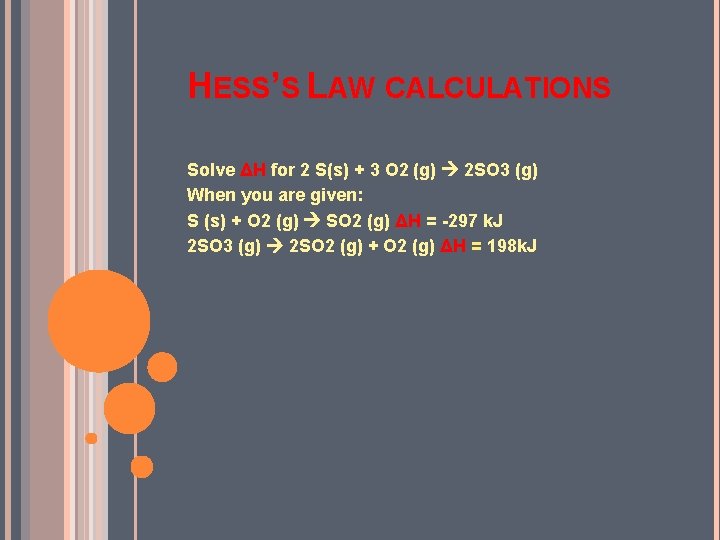
HESS’S LAW CALCULATIONS Solve ΔH for 2 S(s) + 3 O 2 (g) 2 SO 3 (g) When you are given: S (s) + O 2 (g) SO 2 (g) ΔH = -297 k. J 2 SO 3 (g) 2 SO 2 (g) + O 2 (g) ΔH = 198 k. J
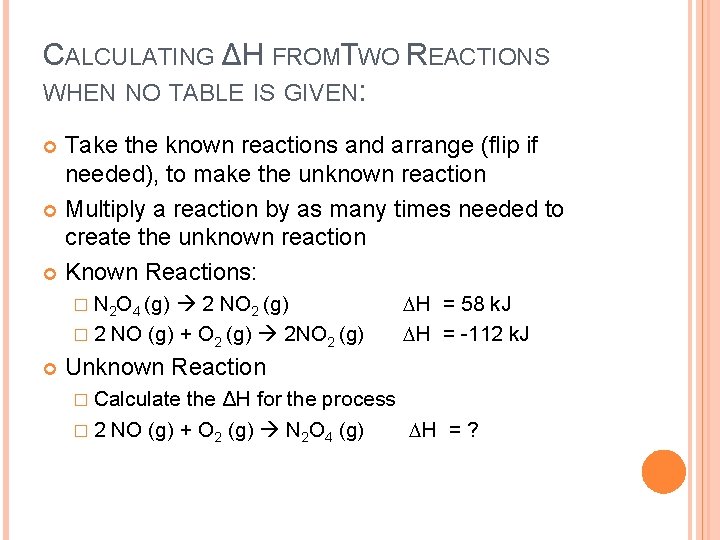
CALCULATING ΔH FROMT WO REACTIONS WHEN NO TABLE IS GIVEN: Take the known reactions and arrange (flip if needed), to make the unknown reaction Multiply a reaction by as many times needed to create the unknown reaction Known Reactions: � N 2 O 4 (g) 2 NO 2 (g) � 2 NO (g) + O 2 (g) 2 NO 2 (g) H = 58 k. J H = -112 k. J Unknown Reaction � Calculate the ΔH for the process � 2 NO (g) + O 2 (g) N 2 O 4 (g) H = ?
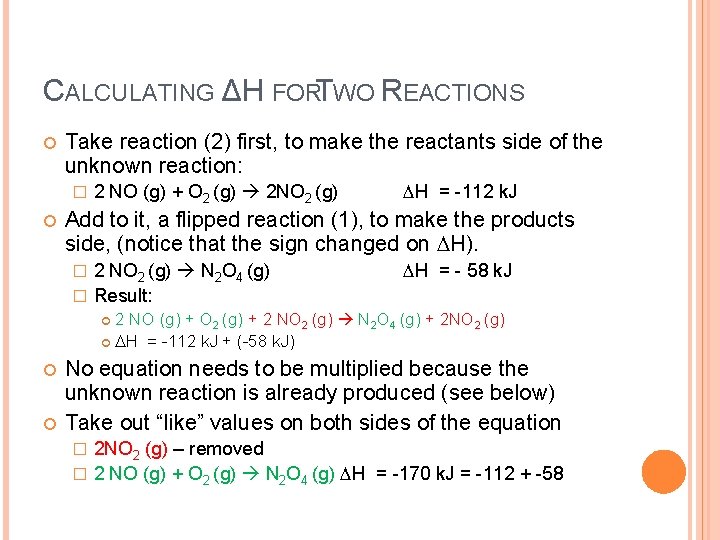
CALCULATING ΔH FORT WO REACTIONS Take reaction (2) first, to make the reactants side of the unknown reaction: � 2 NO (g) + O 2 (g) 2 NO 2 (g) H = -112 k. J Add to it, a flipped reaction (1), to make the products side, (notice that the sign changed on H). 2 NO 2 (g) N 2 O 4 (g) � Result: � H = - 58 k. J 2 NO (g) + O 2 (g) + 2 NO 2 (g) N 2 O 4 (g) + 2 NO 2 (g) H = -112 k. J + (-58 k. J) No equation needs to be multiplied because the unknown reaction is already produced (see below) Take out “like” values on both sides of the equation 2 NO 2 (g) – removed � 2 NO (g) + O 2 (g) N 2 O 4 (g) H = -170 k. J = -112 + -58 �
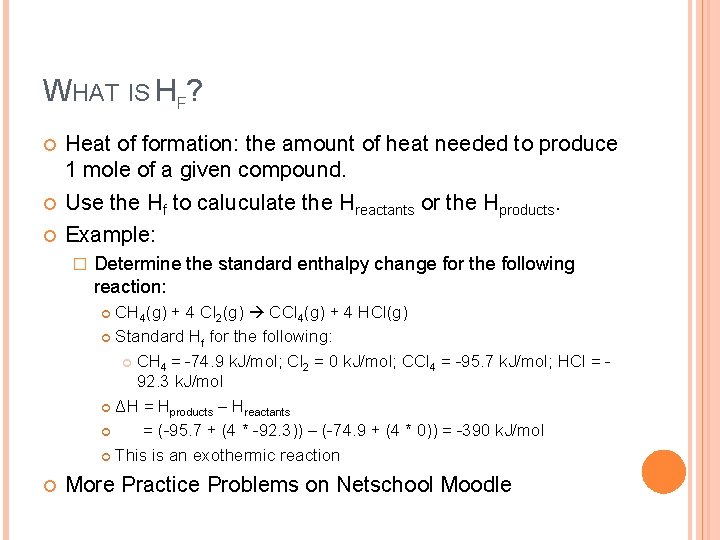
WHAT IS HF? Heat of formation: the amount of heat needed to produce 1 mole of a given compound. Use the Hf to caluculate the Hreactants or the Hproducts. Example: � Determine the standard enthalpy change for the following reaction: CH 4(g) + 4 Cl 2(g) CCl 4(g) + 4 HCl(g) Standard Hf for the following: CH 4 = -74. 9 k. J/mol; Cl 2 = 0 k. J/mol; CCl 4 = -95. 7 k. J/mol; HCl = 92. 3 k. J/mol ΔH = Hproducts – Hreactants = (-95. 7 + (4 * -92. 3)) – (-74. 9 + (4 * 0)) = -390 k. J/mol This is an exothermic reaction More Practice Problems on Netschool Moodle
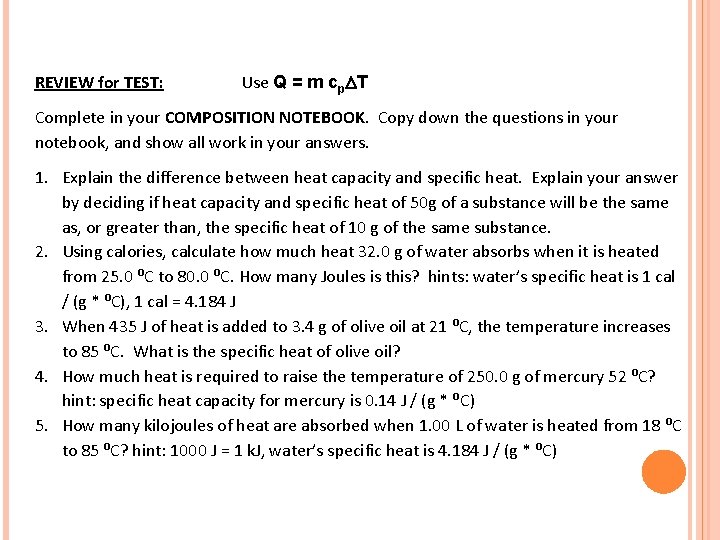
REVIEW for TEST: Use Q = m cp T Complete in your COMPOSITION NOTEBOOK. Copy down the questions in your notebook, and show all work in your answers. 1. Explain the difference between heat capacity and specific heat. Explain your answer by deciding if heat capacity and specific heat of 50 g of a substance will be the same as, or greater than, the specific heat of 10 g of the same substance. 2. Using calories, calculate how much heat 32. 0 g of water absorbs when it is heated from 25. 0 ⁰C to 80. 0 ⁰C. How many Joules is this? hints: water’s specific heat is 1 cal / (g * ⁰C), 1 cal = 4. 184 J 3. When 435 J of heat is added to 3. 4 g of olive oil at 21 ⁰C, the temperature increases to 85 ⁰C. What is the specific heat of olive oil? 4. How much heat is required to raise the temperature of 250. 0 g of mercury 52 ⁰C? hint: specific heat capacity for mercury is 0. 14 J / (g * ⁰C) 5. How many kilojoules of heat are absorbed when 1. 00 L of water is heated from 18 ⁰C to 85 ⁰C? hint: 1000 J = 1 k. J, water’s specific heat is 4. 184 J / (g * ⁰C)
- Slides: 84