
Chapter 5 The Structure and Function of Macromolecules



- Slides: 70
Chapter 5 The Structure and Function of Macromolecules 1
The Molecules of Life • Overview: – Another level in the hierarchy of biological organization is reached when small organic molecules are joined together – Atom ---> molecule --- compound 2
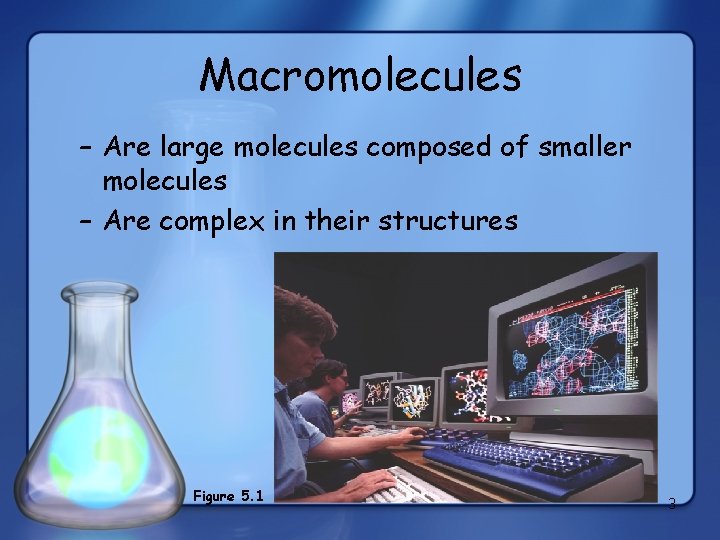
Macromolecules – Are large molecules composed of smaller molecules – Are complex in their structures Figure 5. 1 3
Macromolecules • Most macromolecules are polymers, built from monomers • Four classes of life’s organic molecules are polymers – Carbohydrates – Proteins – Nucleic acids – Lipids 4
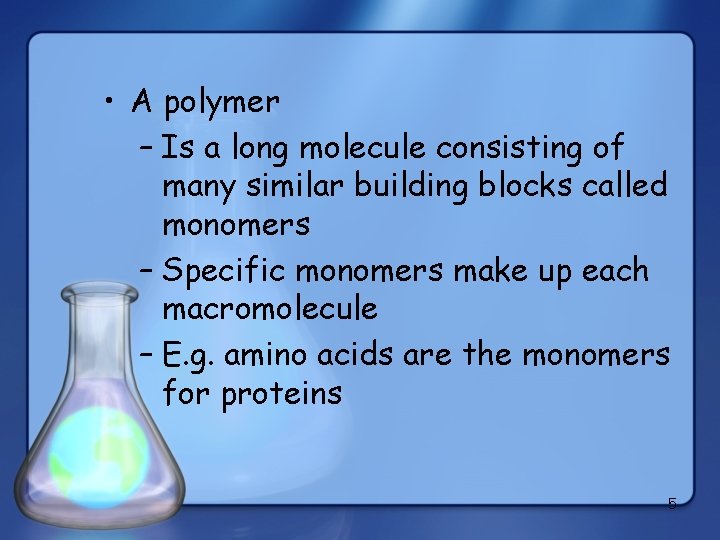
• A polymer – Is a long molecule consisting of many similar building blocks called monomers – Specific monomers make up each macromolecule – E. g. amino acids are the monomers for proteins 5
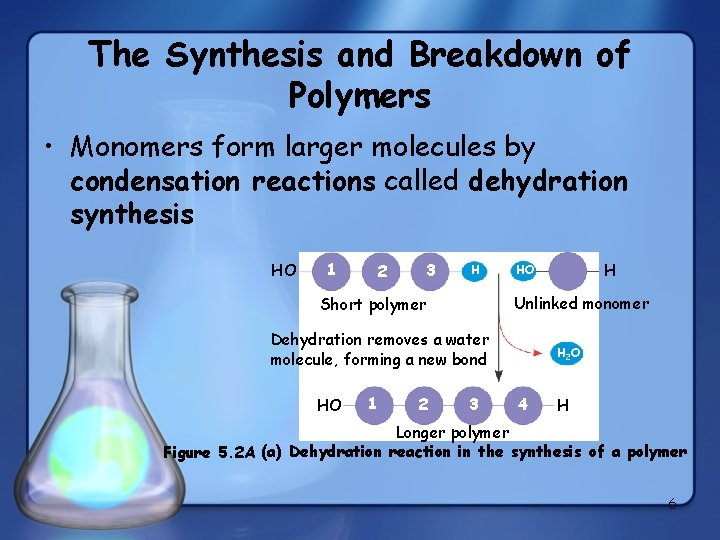
The Synthesis and Breakdown of Polymers • Monomers form larger molecules by condensation reactions called dehydration synthesis HO 1 2 3 H Unlinked monomer Short polymer Dehydration removes a water molecule, forming a new bond HO 1 2 H HO 3 H 2 O 4 H Longer polymer Figure 5. 2 A (a) Dehydration reaction in the synthesis of a polymer 6
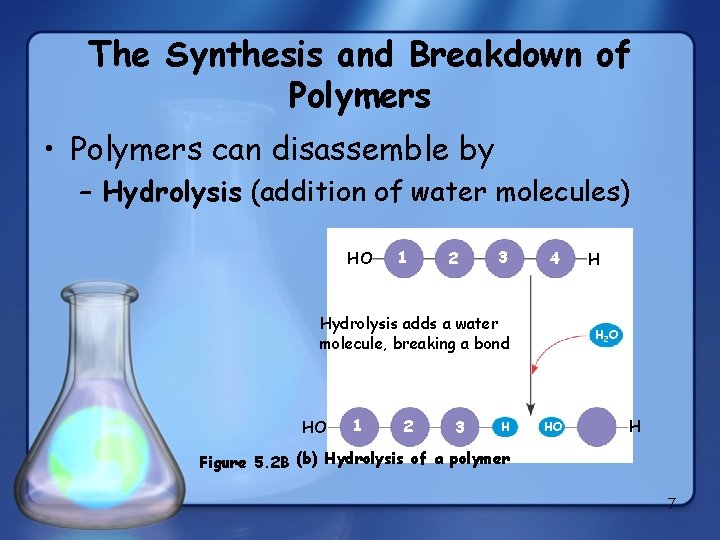
The Synthesis and Breakdown of Polymers • Polymers can disassemble by – Hydrolysis (addition of water molecules) HO 1 2 3 4 Hydrolysis adds a water molecule, breaking a bond HO 1 2 3 H H H 2 O HO H Figure 5. 2 B (b) Hydrolysis of a polymer 7
• Although organisms share the same limited number of monomer types, each organism is unique based on the arrangement of monomers into polymers • An immense variety of polymers can be built from a small set of monomers 8
Carbohydrates • Serve as fuel and building material • Include both sugars and their polymers (starch, cellulose, etc. ) 9
Sugars • Monosaccharides – Are the simplest sugars – Can be used for fuel – Can be converted into other organic molecules – Can be combined into polymers 10
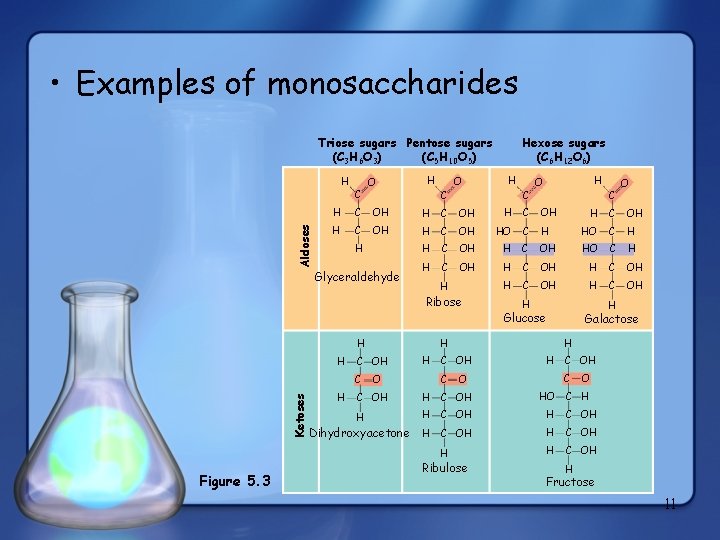
• Examples of monosaccharides Triose sugars Pentose sugars (C 3 H 6 O 3) (C 5 H 10 O 5) Aldoses H C O H O C H C OH H C OH HO C H C OH H Glyceraldehyde H H C OH H HO C H C OH HO C H H C OH H H Glucose Galactose H C OH C O O C OH HO H H C OH Dihydroxyacetone H C OH H H O H H C OH C Ketoses H C Ribose Figure 5. 3 Hexose sugars (C 6 H 12 O 6) Ribulose C H H Fructose 11
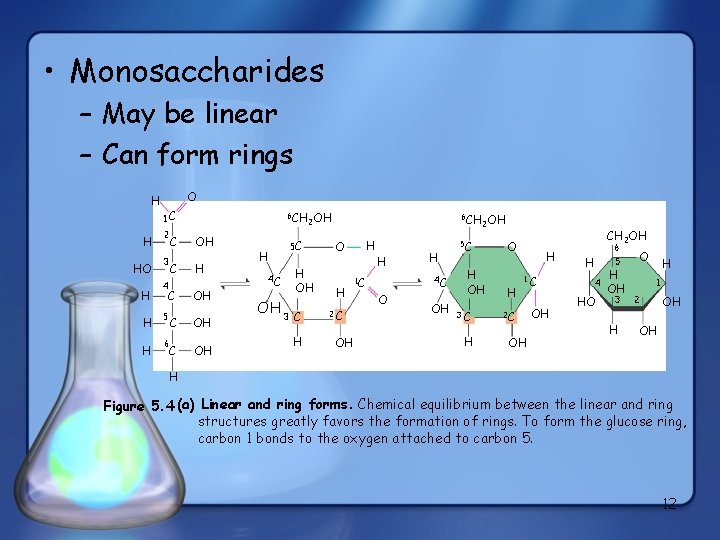
• Monosaccharides – May be linear – Can form rings H H HO H O 1 C 2 6 CH C OH 3 4 H 5 H 6 C C OH OH 2 OH 5 C H OH O H OH 4 C 3 C H 6 CH H 2 C OH H 1 C H O H 5 C H OH 4 C OH 2 OH 3 C H CH 2 OH O H H 1 2 C OH H C OH 6 5 4 HO H OH 3 H O H 1 2 OH OH H Figure 5. 4 (a) Linear and ring forms. Chemical equilibrium between the linear and ring structures greatly favors the formation of rings. To form the glucose ring, carbon 1 bonds to the oxygen attached to carbon 5. 12
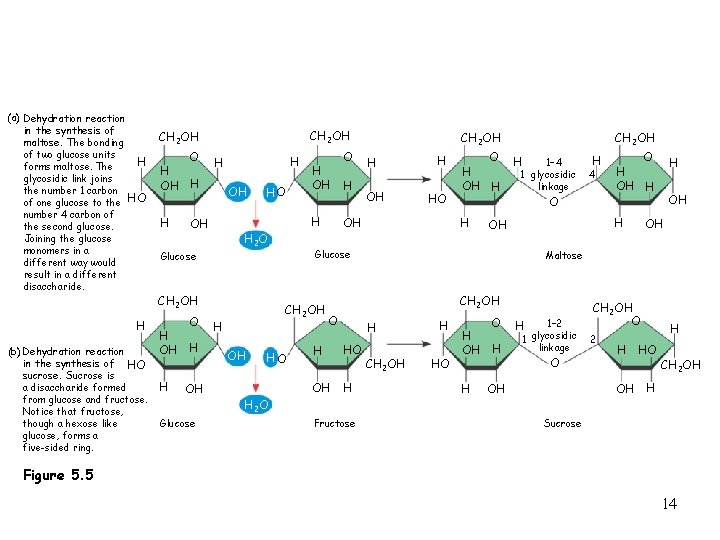
• Disaccharides – Consist of two monosaccharides – Are joined by a glycosidic linkage 13
(a) Dehydration reaction in the synthesis of maltose. The bonding of two glucose units H forms maltose. The glycosidic link joins the number 1 carbon of one glucose to the HO number 4 carbon of the second glucose. Joining the glucose monomers in a different way would result in a different disaccharide. H (b) Dehydration reaction in the synthesis of HO sucrose. Sucrose is a disaccharide formed from glucose and fructose. Notice that fructose, though a hexose like glucose, forms a five-sided ring. CH 2 OH O H OH HO H OH H 2 O CH 2 OH H H OH Glucose CH 2 OH HO H 2 O O H H OHOH H HO O H OH H H OH CH 2 OH H 1– 4 1 glycosidic linkage HO OH H Fructose O H OH OH Maltose H H 4 O CH 2 OH O H OH Glucose O H OH CH 2 OH H HO O H OH H H 1– 2 H glycosidic 1 linkage O CH 2 OH O 2 H HO H CH 2 OH OH Sucrose Figure 5. 5 14
Polysaccharides • Polysaccharides – Are polymers of sugars – Serve many roles in organisms 15
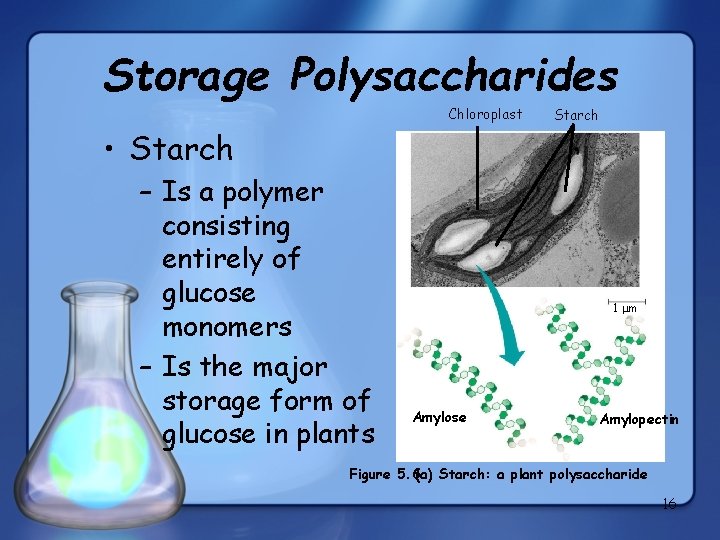
Storage Polysaccharides Chloroplast Starch • Starch – Is a polymer consisting entirely of glucose monomers – Is the major storage form of glucose in plants 1 m Amylose Amylopectin Figure 5. 6(a) Starch: a plant polysaccharide 16
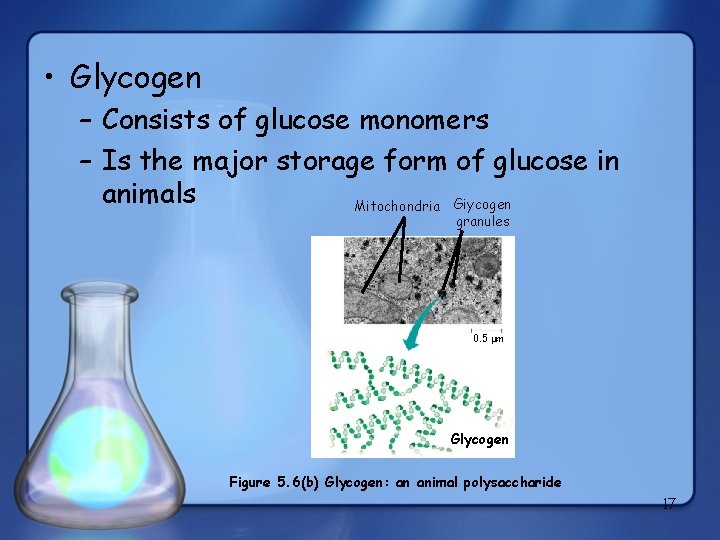
• Glycogen – Consists of glucose monomers – Is the major storage form of glucose in animals Mitochondria Giycogen granules 0. 5 m Glycogen Figure 5. 6 (b) Glycogen: an animal polysaccharide 17
Structural Polysaccharides • Cellulose – Is a polymer of glucose 18
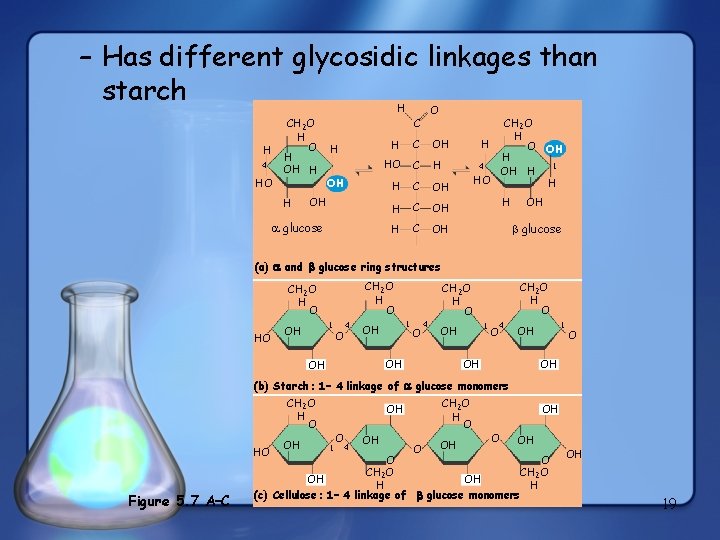
– Has different glycosidic linkages than starch H 4 HO CH 2 O H OH H H OH OH glucose O C H C OH HO C H H C OH CH 2 O H H O OH H 4 1 OH H HO H H OH glucose (a) and glucose ring structures CH 2 O H O HO 1 OH O 4 1 OH OH OH CH 2 O H O O 4 1 OH OH (b) Starch: 1– 4 linkage of glucose monomers CH 2 O H O HO Figure 5. 7 A–C OH CH 2 O H O OH 1 O 4 OH O O CH 2 O OH OH H H (c) Cellulose: 1– 4 linkage of glucose monomers OH 19
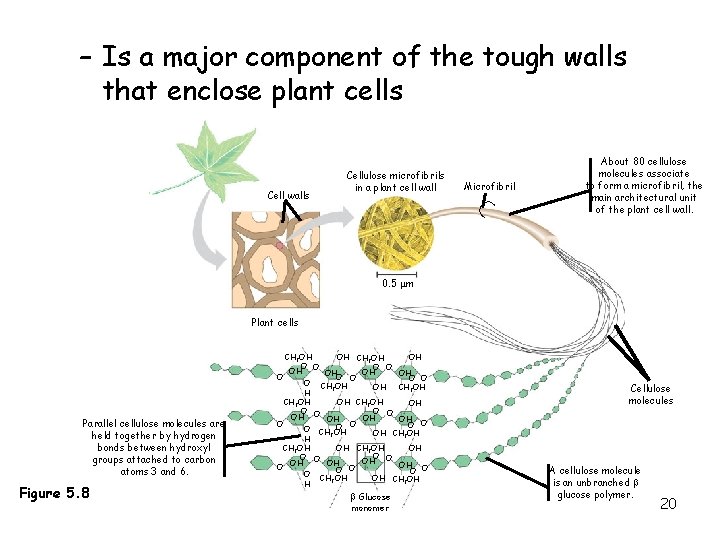
– Is a major component of the tough walls that enclose plant cells Microfibril Cell walls Cellulose microfibrils in a plant cell wall About 80 cellulose molecules associate to form a microfibril, the main architectural unit of the plant cell wall. 0. 5 m Plant cells Parallel cellulose molecules are held together by hydrogen bonds between hydroxyl groups attached to carbon atoms 3 and 6. Figure 5. 8 OH CH 2 OH O O OH OH O O O CH OH OH CH 2 OH 2 H CH 2 OH OH O O O CH OH OH CH 2 2 OH H CH 2 OH OH OH CH 2 OH O O OH OH OH O O O O CH OH OH CH 2 OH 2 H Glucose monomer Cellulose molecules A cellulose molecule is an unbranched glucose polymer. 20
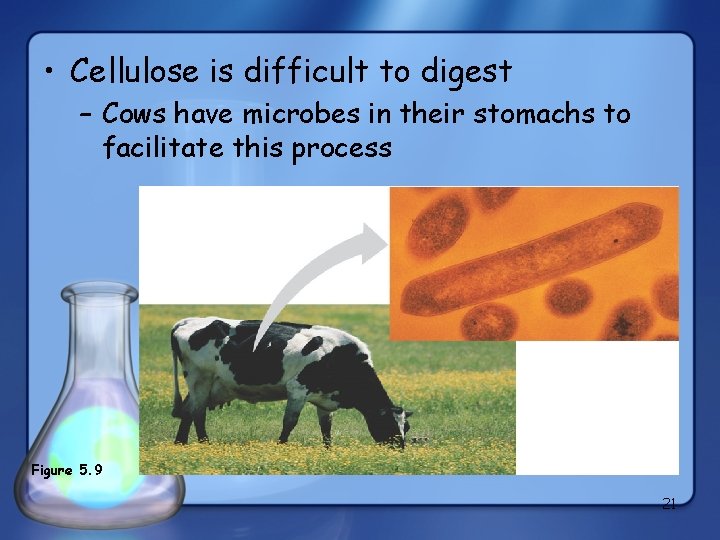
• Cellulose is difficult to digest – Cows have microbes in their stomachs to facilitate this process Figure 5. 9 21
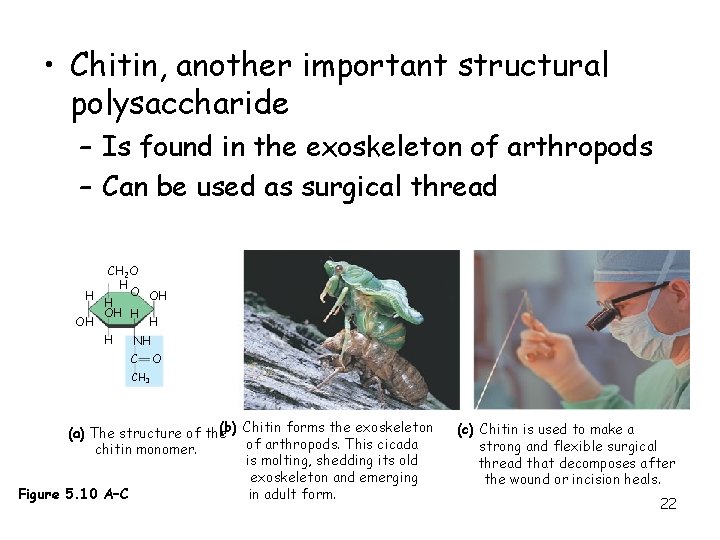
• Chitin, another important structural polysaccharide – Is found in the exoskeleton of arthropods – Can be used as surgical thread CH 2 O H O OH H H NH C O CH 3 (b) Chitin forms the exoskeleton (a) The structure of the of arthropods. This cicada chitin monomer. is molting, shedding its old exoskeleton and emerging Figure 5. 10 A–C in adult form. (c) Chitin is used to make a strong and flexible surgical thread that decomposes after the wound or incision heals. 22
Lipids • Lipids are a diverse group of hydrophobic molecules • Lipids – Are the one class of large biological molecules that do not consist of polymers – Share the common trait of being hydrophobic 23
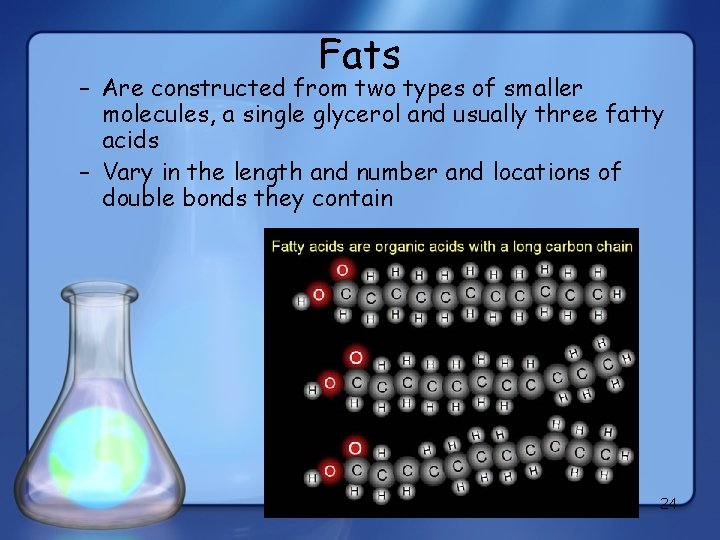
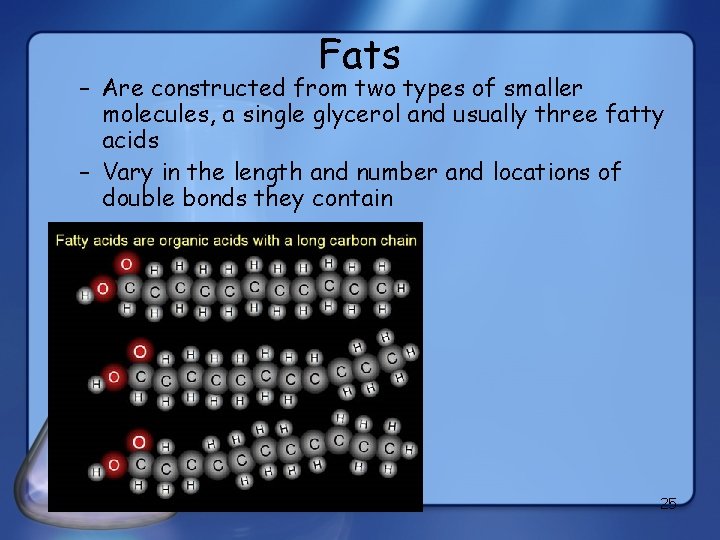
Fats – Are constructed from two types of smaller molecules, a single glycerol and usually three fatty acids – Vary in the length and number and locations of double bonds they contain 24
Fats – Are constructed from two types of smaller molecules, a single glycerol and usually three fatty acids – Vary in the length and number and locations of double bonds they contain 25
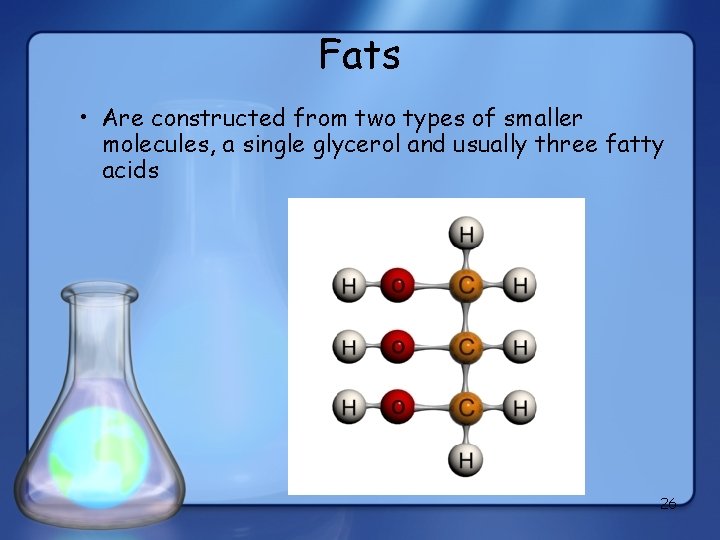
Fats • Are constructed from two types of smaller molecules, a single glycerol and usually three fatty acids 26
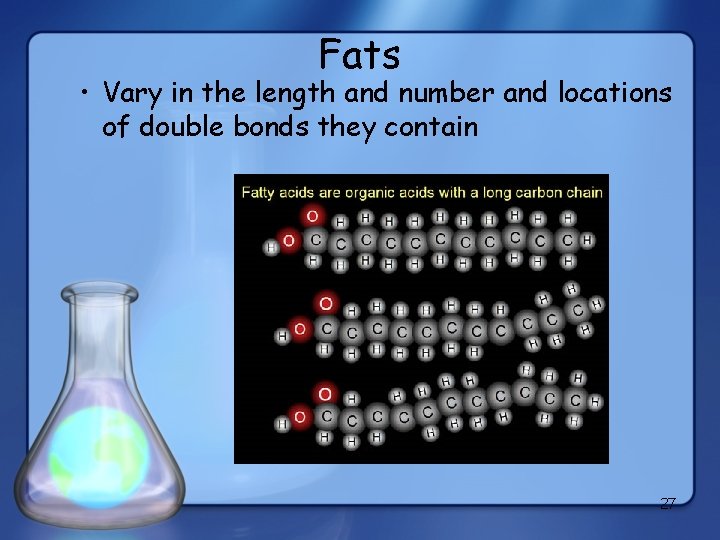
Fats • Vary in the length and number and locations of double bonds they contain 27
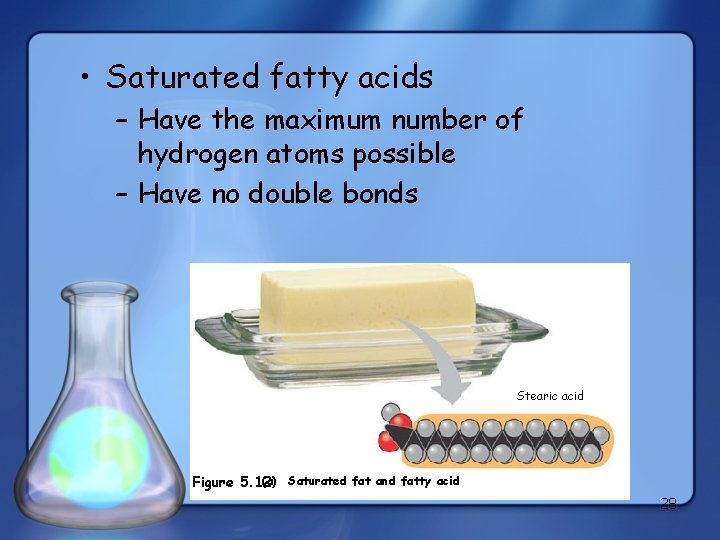
• Saturated fatty acids – Have the maximum number of hydrogen atoms possible – Have no double bonds Stearic acid (a) Saturated fat and fatty acid Figure 5. 12 28
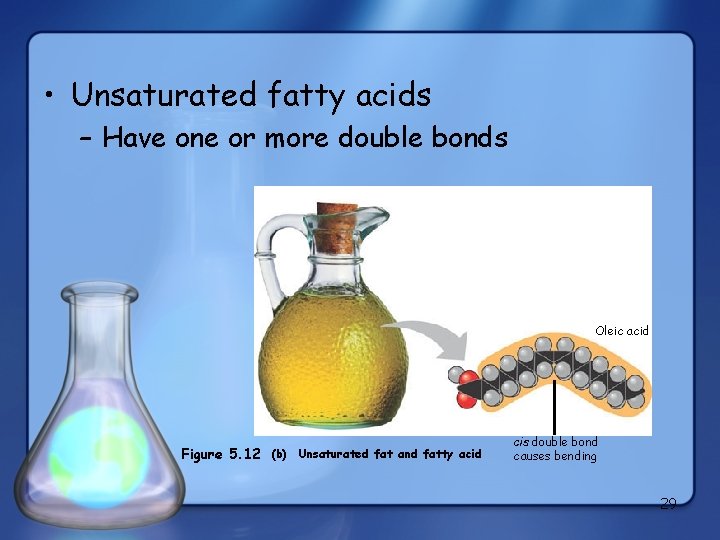
• Unsaturated fatty acids – Have one or more double bonds Oleic acid Figure 5. 12 (b) Unsaturated fat and fatty acid cis double bond causes bending 29
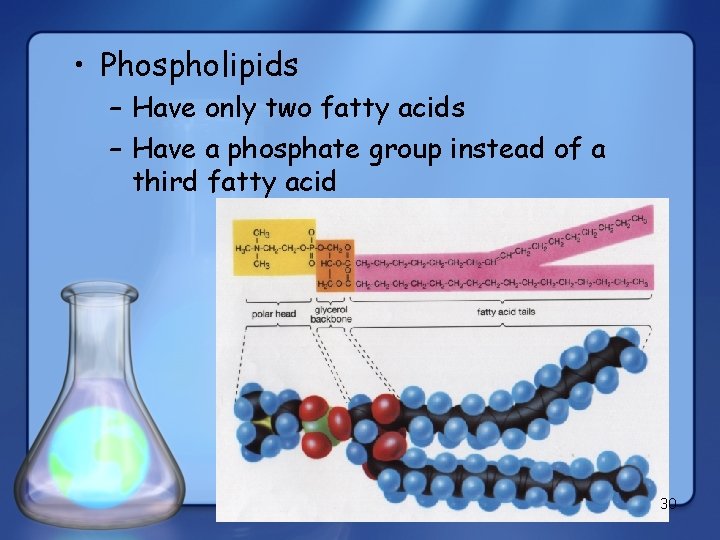
• Phospholipids – Have only two fatty acids – Have a phosphate group instead of a third fatty acid 30
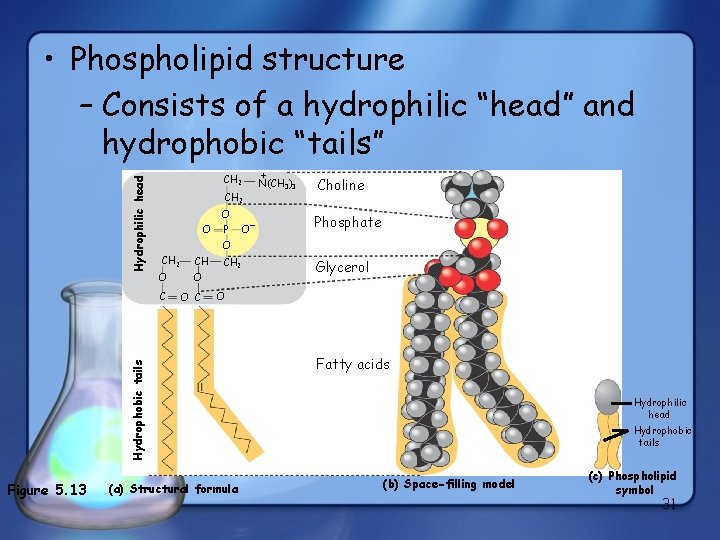
CH 2 O O P Figure 5. 13 O– + N(CH 3)3 Choline Phosphate O CH 2 CH O O C CH 2 Glycerol O Hydrophobic tails Hydrophilic head • Phospholipid structure – Consists of a hydrophilic “head” and hydrophobic “tails” (a) Structural formula Fatty acids Hydrophilic head Hydrophobic tails (b) Space-filling model (c) Phospholipid symbol 31
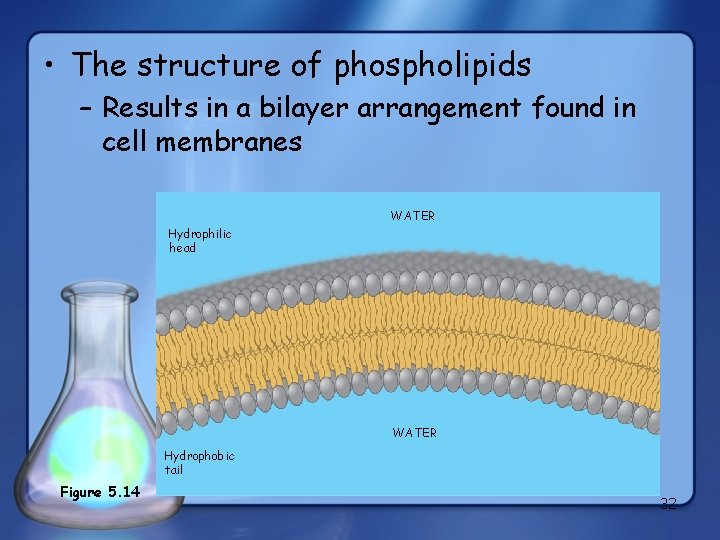
• The structure of phospholipids – Results in a bilayer arrangement found in cell membranes WATER Hydrophilic head WATER Hydrophobic tail Figure 5. 14 32
Steroids • Steroids – Are lipids characterized by a carbon skeleton consisting of four fused rings 33
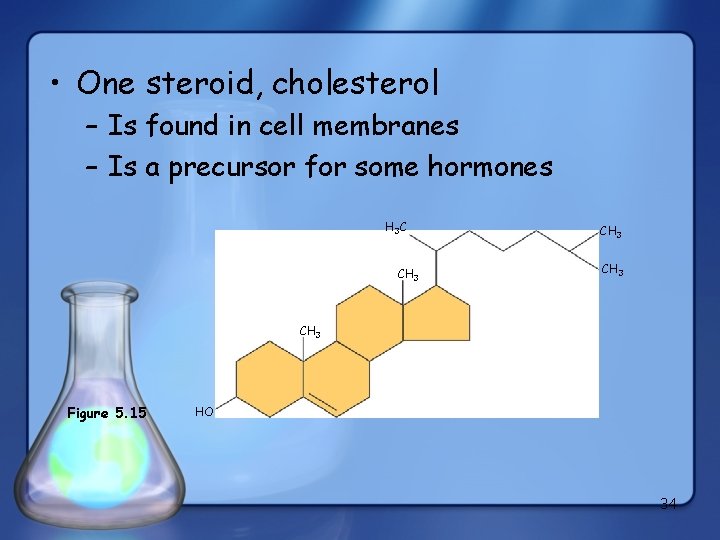
• One steroid, cholesterol – Is found in cell membranes – Is a precursor for some hormones H 3 C CH 3 Figure 5. 15 HO 34
Proteins • Proteins have many structures, resulting in a wide range of functions • Proteins do most of the work in cells and act as enzymes • Proteins are made of monomers called amino acids 35
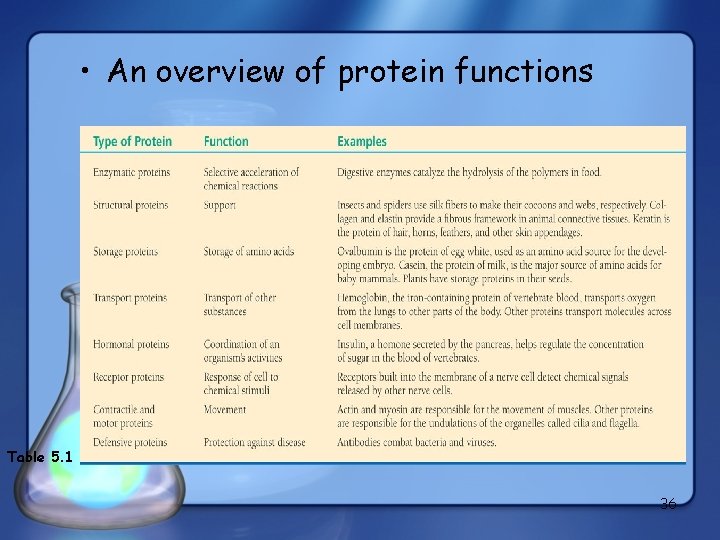
• An overview of protein functions Table 5. 1 36
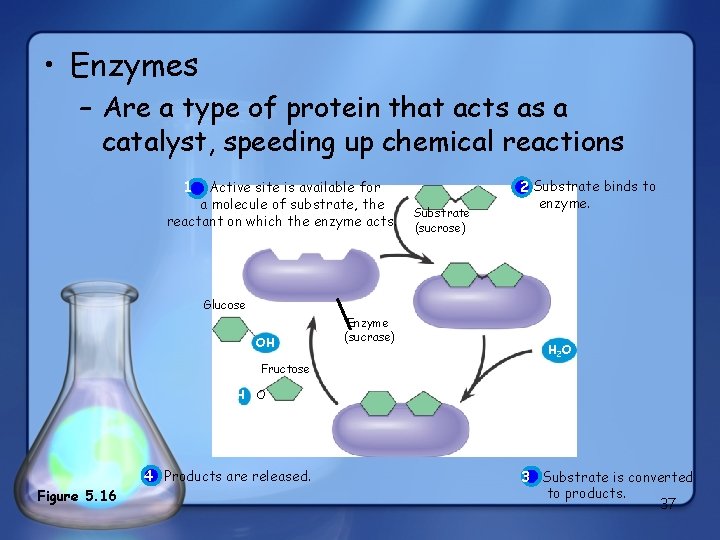
• Enzymes – Are a type of protein that acts as a catalyst, speeding up chemical reactions 1 Active site is available for a molecule of substrate, the reactant on which the enzyme acts. Substrate (sucrose) 2 Substrate binds to enzyme. Glucose OH Enzyme (sucrase) H 2 O Fructose H O 4 Products are released. Figure 5. 16 3 Substrate is converted to products. 37
Polypeptides • Polypeptides – Are polymers (chains) of amino acids • A protein – Consists of one or more polypeptides 38
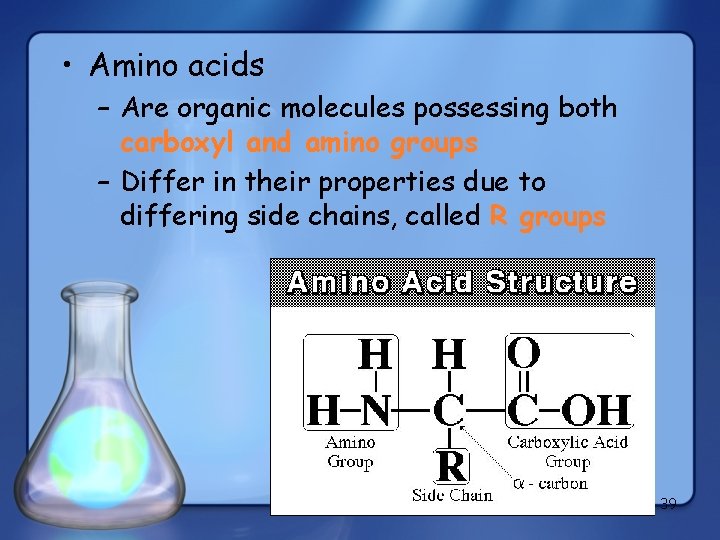
• Amino acids – Are organic molecules possessing both carboxyl and amino groups – Differ in their properties due to differing side chains, called R groups 39
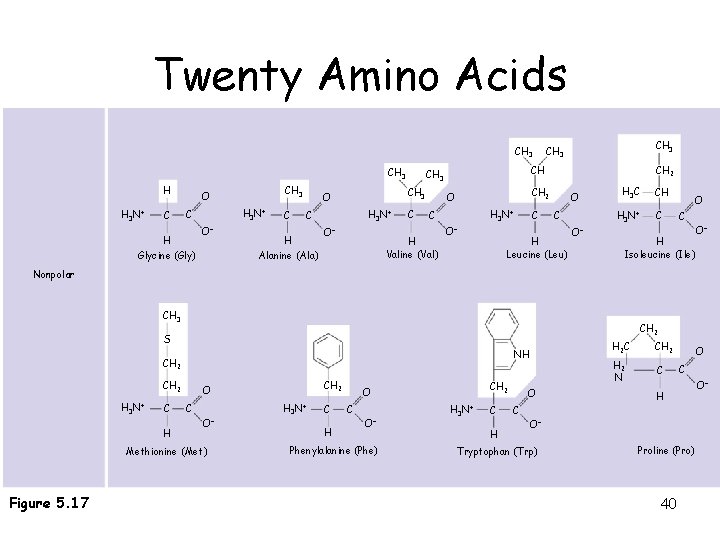
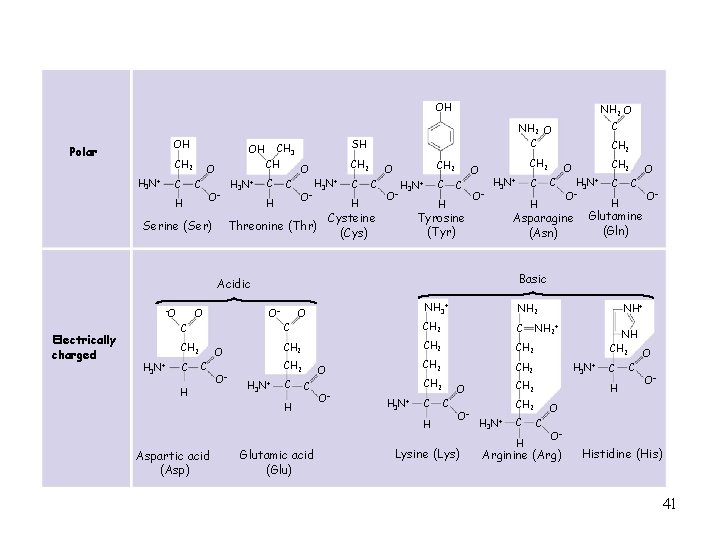
Twenty Amino Acids • 20 different amino acids make up proteins CH 3 H H 3 N+ C CH 3 O H 3 N+ C H Glycine (Gly) O– C H 3 N+ C H O– C CH 2 O H 3 N+ C H Valine (Val) Alanine (Ala) CH CH 3 O– C CH 2 O C H Leucine (Leu) H 3 C H 3 N+ O– CH C O C H Isoleucine (Ile) O– Nonpolar CH 3 CH 2 S NH CH 2 H 3 N+ C H H 3 N+ C O– Methionine (Met) Figure 5. 17 CH 2 O C H CH 2 O C O– Phenylalanine (Phe) H 3 N+ C H O C H 2 C CH 2 N C O C H O– Tryptophan (Trp) Proline (Pro) 40 O–
OH OH Polar CH 2 H 3 N+ C CH O C H O– Serine (Ser) H 3 N+ C O– H CH 2 H 3 N+ C H CH 2 O C O– C H 3 N+ O C H O– H 3 N+ Tyrosine (Tyr) Cysteine (Cys) Threonine (Thr) Electrically charged H 3 N+ CH 2 O CH 2 C H 3 N+ O– C H O NH 3+ NH 2 C C CH 2 CH 2 C O C H O– CH 2 H 3 N+ C H Aspartic acid (Asp) C O C H O– Glutamine (Gln) Basic O– O CH 2 Asparagine (Asn) Acidic –O C NH 2 O C SH CH 3 OH NH 2 O Glutamic acid (Glu) O– Lysine (Lys) NH 2+ H 3 N+ CH 2 O C NH+ CH 2 H 3 N+ C H NH CH 2 O C C O– H O C O– Arginine (Arg) Histidine (His) 41
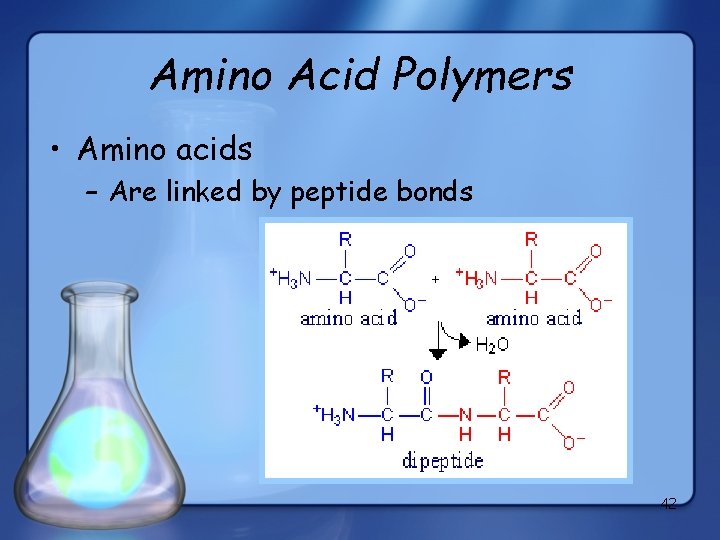
Amino Acid Polymers • Amino acids – Are linked by peptide bonds 42
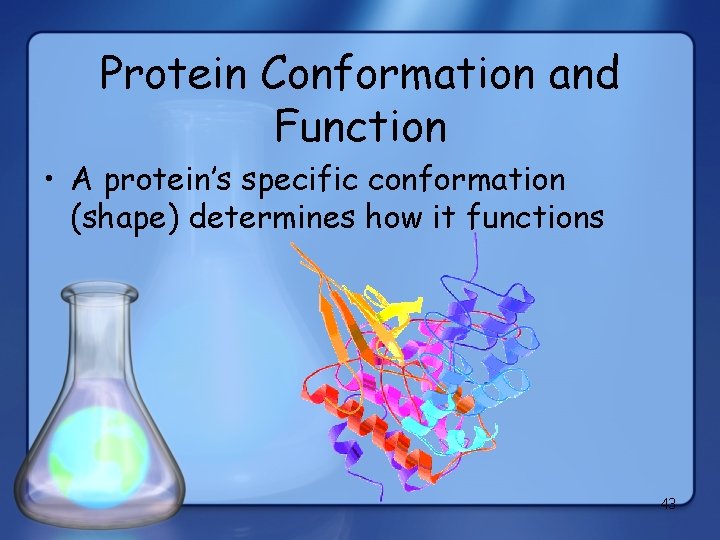
Protein Conformation and Function • A protein’s specific conformation (shape) determines how it functions 43
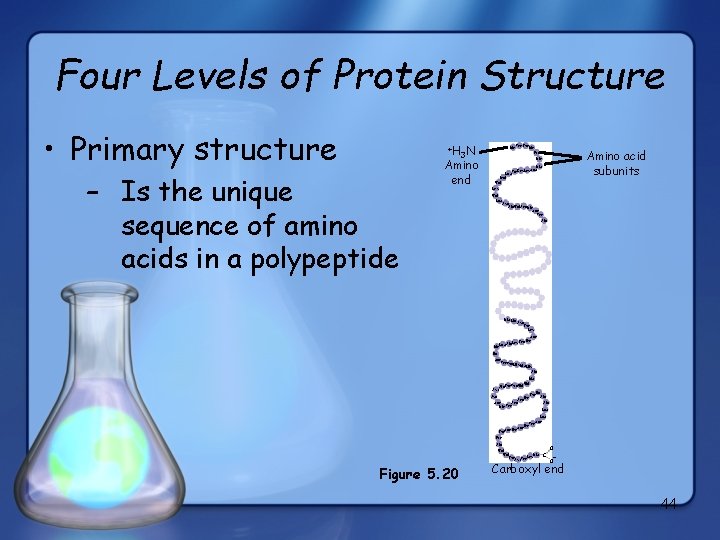
Four Levels of Protein Structure • Primary structure +H – Is the unique sequence of amino acids in a polypeptide 3 N Amino end Gly Pro. Thr. Gly Thr Amino acid subunits Gly Glu Cys Lys. Seu Leu. Pro Met Val Lys Val Leu Asp Ala. Val Arg. Gly Ser Pro Ala Glu Lle Asp Thr Lys Ser Lys Trp. Tyr Leu Ala Gly lle Ser Pro Phe. His Glu His Ala. Thr. Phe. Val Asn Glu Val Thr Asp Tyr Arg Ser Arg Gly Pro lle Ala Leu Ser Pro Ser. Tyr Ser Thr Ala Val Glu Thr Pro. Lys Asn Figure 5. 20 o c – o Carboxyl end 44
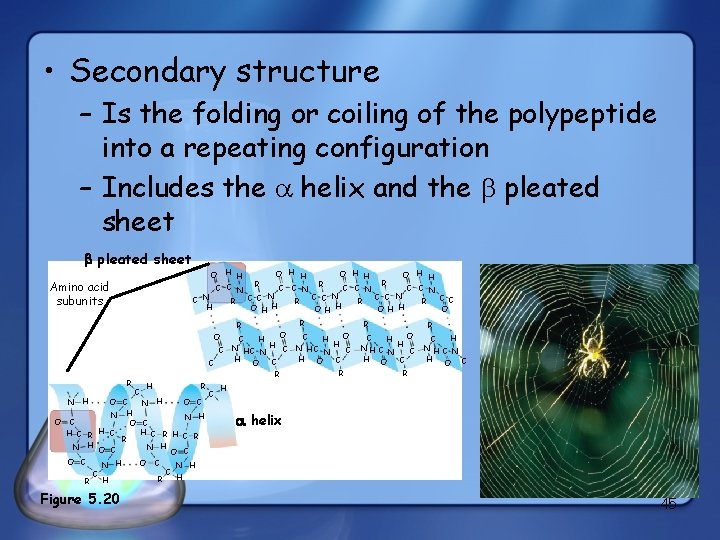
• Secondary structure – Is the folding or coiling of the polypeptide into a repeating configuration – Includes the helix and the pleated sheet Amino acid subunits O H H C C N H R R C C N O H H C C R N H C H R O C N H N H O C H C R N H O C O C N H C C H R R H Figure 5. 20 C R R O H H C C N OH H R R R O O H H C C N OH H R O C H H N HC N H C N C H H C O R R C R O C H H NH C N C H C O R R C C O R H C N H O C H helix 45
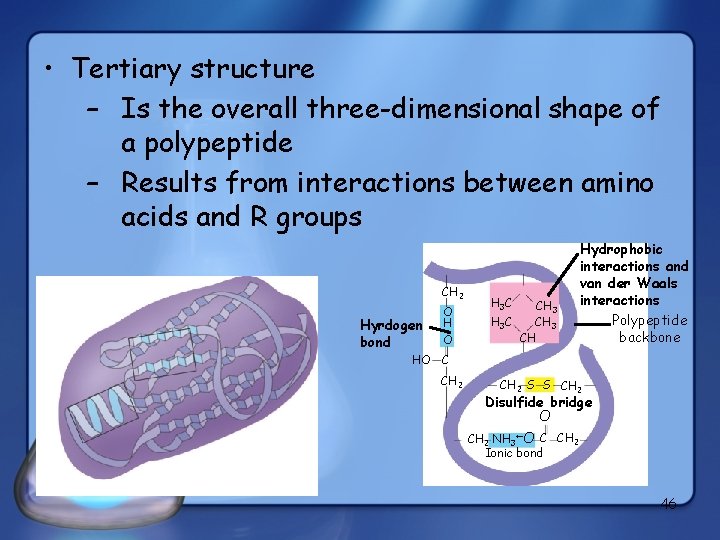
• Tertiary structure – Is the overall three-dimensional shape of a polypeptide – Results from interactions between amino acids and R groups Hyrdogen bond CH 2 O H 3 C CH CH 3 H 3 C CH 3 CH Hydrophobic interactions and van der Waals interactions Polypeptide backbone HO C CH 2 S S CH 2 Disulfide bridge O CH 2 NH 3+-O C CH 2 Ionic bond 46
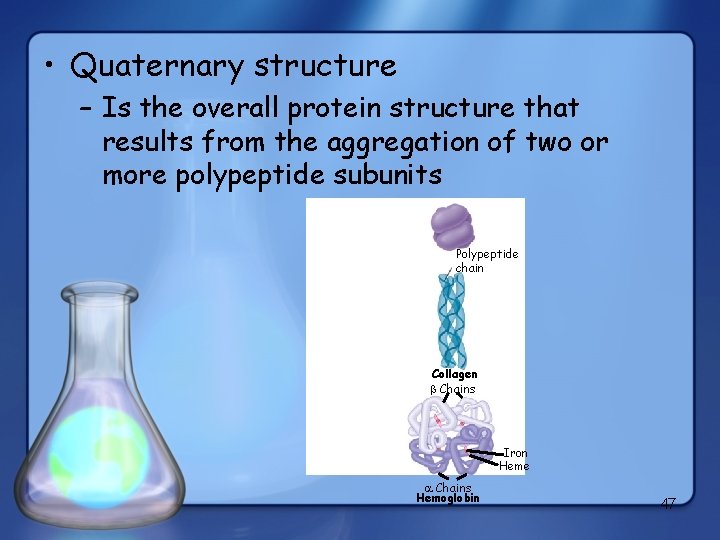
• Quaternary structure – Is the overall protein structure that results from the aggregation of two or more polypeptide subunits Polypeptide chain Collagen Chains Iron Heme Chains Hemoglobin 47
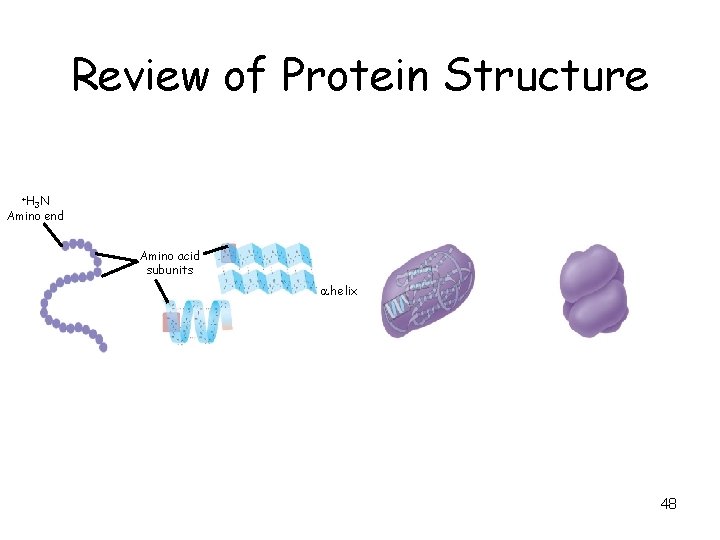
Review of Protein Structure +H 3 N Amino end Amino acid subunits helix 48
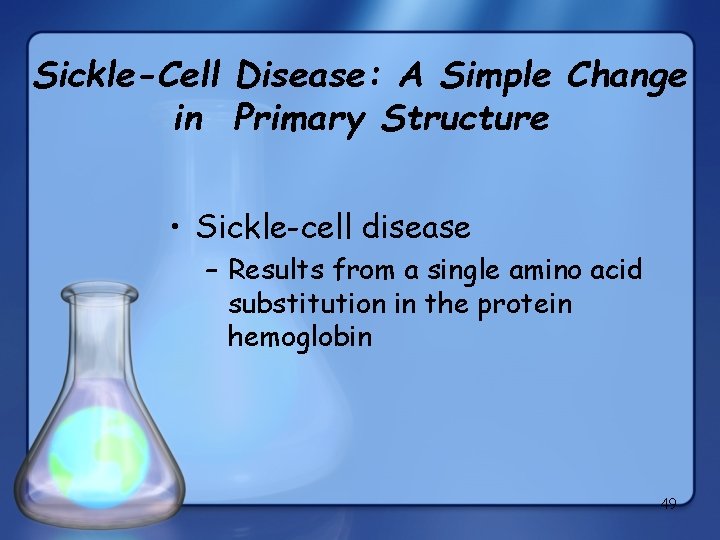
Sickle-Cell Disease: A Simple Change in Primary Structure • Sickle-cell disease – Results from a single amino acid substitution in the protein hemoglobin 49
Primary structure Normal hemoglobin Val His Leu Thr Pro Glul Glu 1 2 3 4 5 6 7 Secondary and tertiary structures Red blood cell shape Figure 5. 21 Val His Leu Thr Pro Molecules do not associate with one another, each carries oxygen. Normal cells are full of individual hemoglobin molecules, each carrying oxygen Val Glu structure 1 2 3 4 5 6 7 Secondary subunit and tertiary structures Quaternary Hemoglobin A structure Function Sickle-cell hemoglobin . . . Primary Quaternary structure Function 10 m . . . Exposed hydrophobic region subunit 10 m Hemoglobin S Molecules interact with one another to crystallize into a fiber, capacity to carry oxygen is greatly reduced. Red blood cell shape Fibers of abnormal hemoglobin deform cell into sickle shape. 50
What Determines Protein Conformation? • Protein conformation Depends on the physical and chemical conditions of the protein’s environment • Temperature, p. H, etc. affect protein structure 51
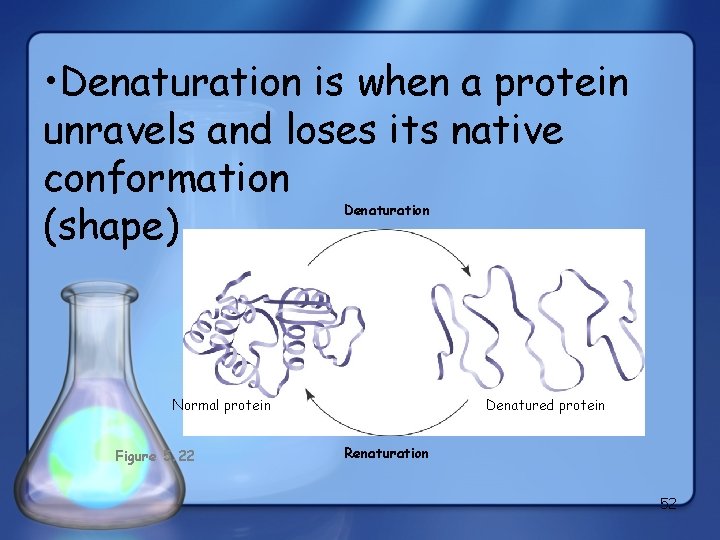
• Denaturation is when a protein unravels and loses its native conformation (shape) Denaturation Normal protein Figure 5. 22 Denatured protein Renaturation 52
The Protein-Folding Problem • Most proteins – Probably go through several intermediate states on their way to a stable conformation – Denaturated proteins no longer work in their unfolded condition – Proteins may be denaturated by extreme changes in p. H or temperature 53
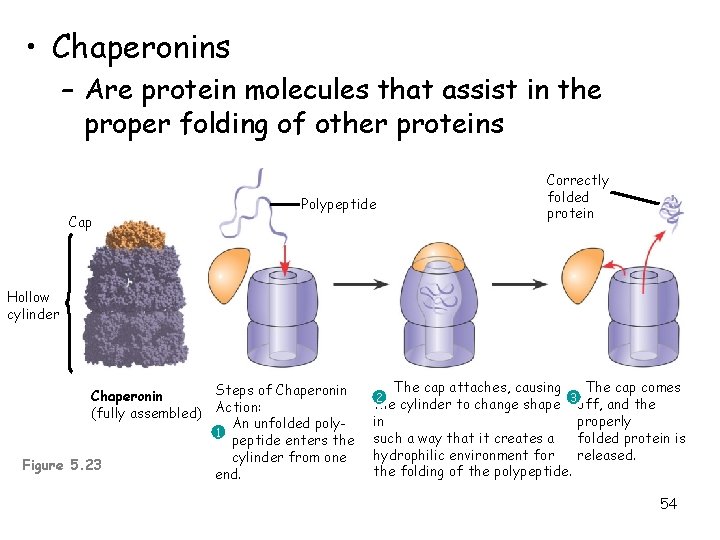
• Chaperonins – Are protein molecules that assist in the proper folding of other proteins Cap Polypeptide Correctly folded protein Hollow cylinder Steps of Chaperonin (fully assembled) Action: An unfolded poly 1 peptide enters the cylinder from one Figure 5. 23 end. The cap attaches, causing The cap comes 3 the cylinder to change shape off, and the in properly such a way that it creates a folded protein is hydrophilic environment for released. the folding of the polypeptide. 2 54
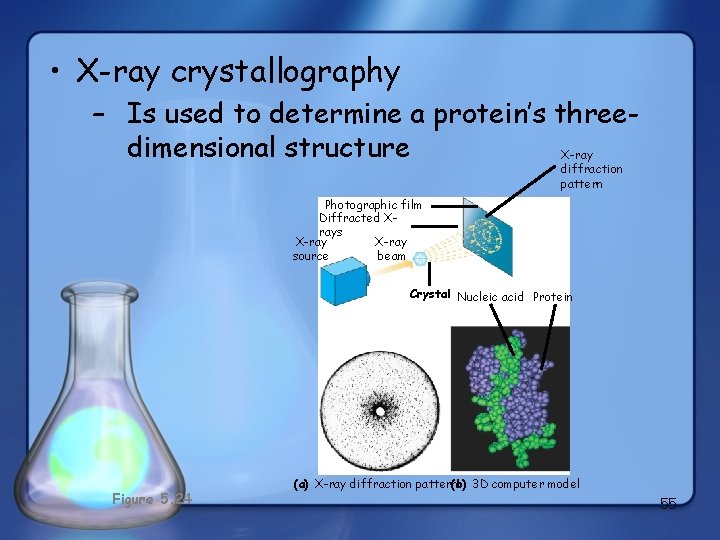
• X-ray crystallography – Is used to determine a protein’s threedimensional structure X-ray diffraction pattern Photographic film Diffracted Xrays X-ray beam source Crystal Nucleic acid Protein Figure 5. 24 (b) 3 D computer model (a) X-ray diffraction pattern 55
Nucleic Acids • Nucleic acids store and transmit hereditary information • Genes – Are the units of inheritance – Program the amino acid sequence of polypeptides – Are made of nucleotide sequences on DNA 56
The Roles of Nucleic Acids • There are two types of nucleic acids – Deoxyribonucleic acid (DNA) – Ribonucleic acid (RNA) 57
Deoxyribonucleic Acid • DNA – Stores information for the synthesis of specific proteins – Found in the nucleus of cells 58
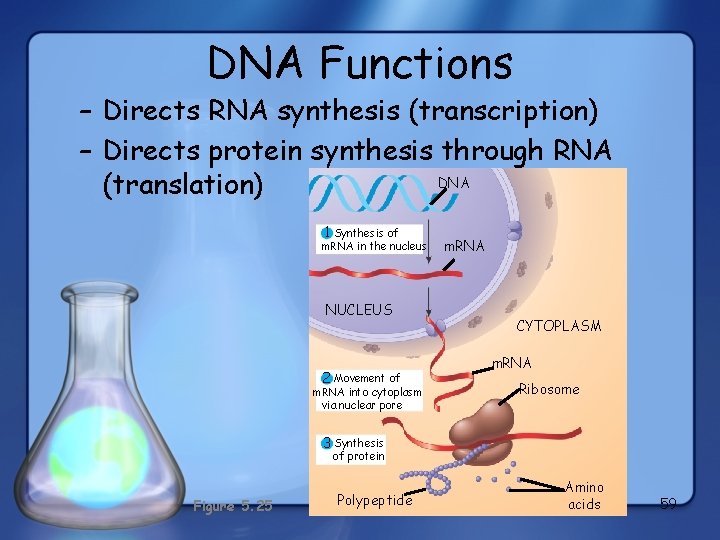
DNA Functions – Directs RNA synthesis (transcription) – Directs protein synthesis through RNA DNA (translation) 1 Synthesis of m. RNA in the nucleus NUCLEUS 2 Movement of m. RNA into cytoplasm via nuclear pore m. RNA CYTOPLASM m. RNA Ribosome 3 Synthesis of protein Figure 5. 25 Polypeptide Amino acids 59
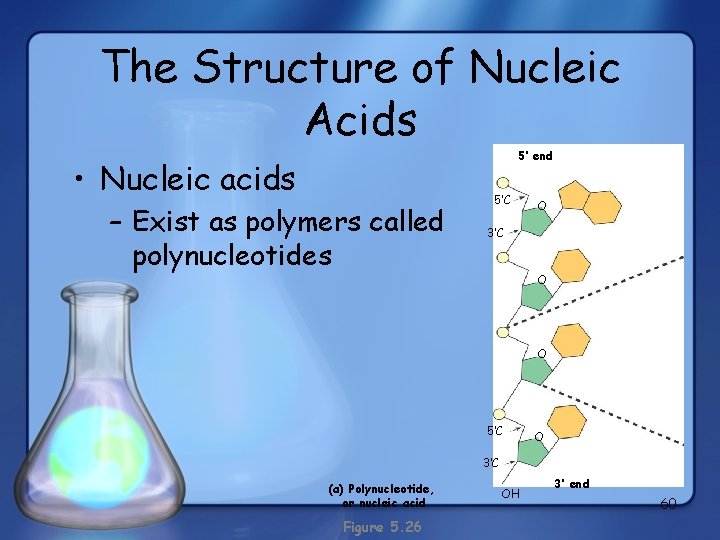
The Structure of Nucleic Acids 5’ end • Nucleic acids – Exist as polymers called polynucleotides 5’C O 3’C O O 5’C O 3’C (a) Polynucleotide, or nucleic acid Figure 5. 26 OH 3’ end 60
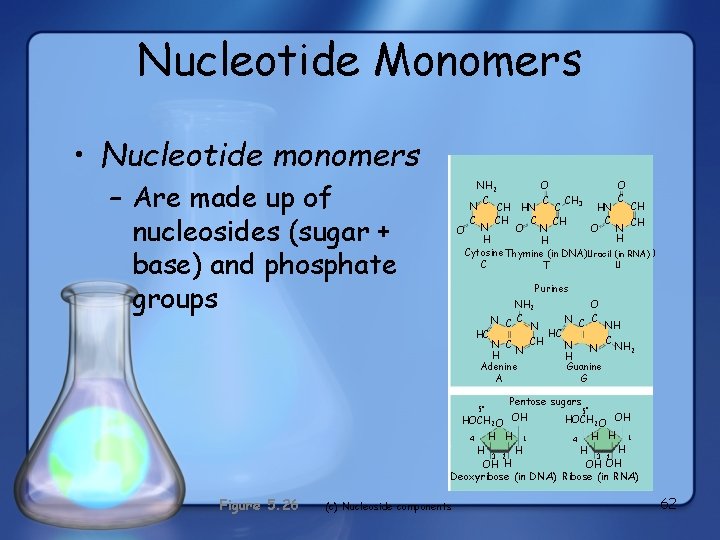
• Each polynucleotide – Consists of monomers called nucleotides – Sugar + phosphate + nitrogen base Nucleoside Nitrogenous base O O P 5’C O CH 2 O O Phosphate group Figure 5. 26 3’C Pentose sugar (b) Nucleotide 61
Nucleotide Monomers • Nucleotide monomers Nitrogenous bases Pyrimidines NH 2 O O C C CH C 3 N CH C CH HN HN CH C C CH N N O O H H H Cytosine Thymine (in DNA)Uracil (in. RNA) Uracil (in U C U T – Are made up of nucleosides (sugar + base) and phosphate groups Purines O NH 2 N C C NH N HC HC C CH N C N NH 2 N N H H Adenine Guanine A G 5” Pentose sugars HOCH 2 O OH 4’ H H 1’ 5” HOCH 2 O OH 4’ H H 1’ H H H 3’ 2’ OH H OH OH Deoxyribose (in DNA) Ribose (in RNA) Figure 5. 26 (c) Nucleoside components 62
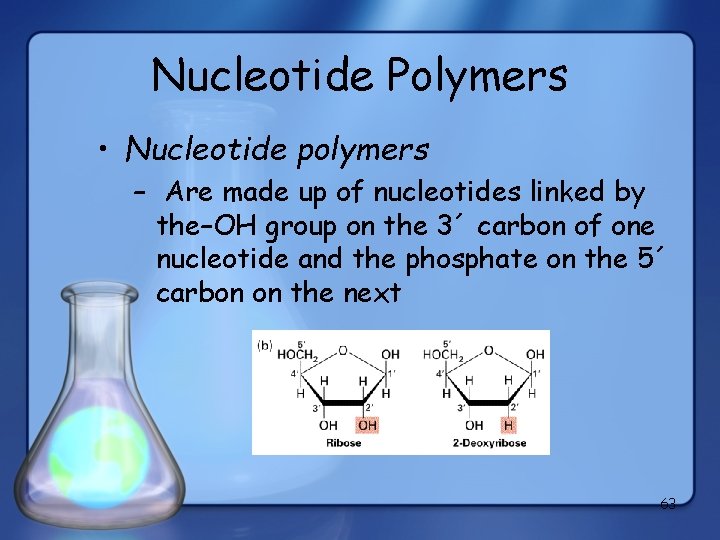
Nucleotide Polymers • Nucleotide polymers – Are made up of nucleotides linked by the–OH group on the 3´ carbon of one nucleotide and the phosphate on the 5´ carbon on the next 63
Gene • The sequence of bases along a nucleotide polymer – Is unique for each gene 64
The DNA Double Helix • Cellular DNA molecules – Have two polynucleotides that spiral around an imaginary axis – Form a double helix 65
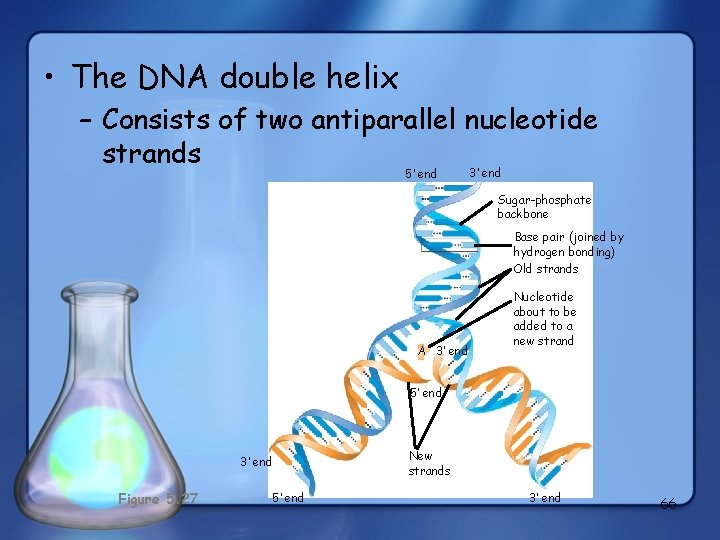
• The DNA double helix – Consists of two antiparallel nucleotide strands 3’ end 5’ end Sugar-phosphate backbone Base pair (joined by hydrogen bonding) Old strands A 3’ end Nucleotide about to be added to a new strand 5’ end 3’ end Figure 5. 27 5’ end New strands 3’ end 66
A, T, C, G • The nitrogenous bases in DNA – Form hydrogen bonds in a complementary fashion (A with T only, and C with G only) 67
DNA and Proteins as Tape Measures of Evolution • Molecular comparisons – Help biologists sort out the evolutionary connections among species 68
The Theme of Emergent Properties in the Chemistry of Life: A Review • Higher levels of organization – Result in the emergence of new properties • Organization – Is the key to the chemistry of life 69
70