
Chapter 5 The Skeletal System Structure of bone
Chapter 5 - The Skeletal System § Structure of bone § Bone Development § Axial and appendicular bone § Joints- articulations § Bone diseases Copyright © 2009 Pearson Education, Inc.
Skeletal System: Made of Connective Tissue § Bone: hard inorganic matrix of calcium salts § Compact: forms shaft and ends, contains marrow space § Spongy: trabeculae § Cells: osteoblast, osteocytes, osteoclasts § Types: long, flat, irregular § Osteons/haversian system: cellular arrangement § Periosteum: CT covering Copyright © 2009 Pearson Education, Inc.
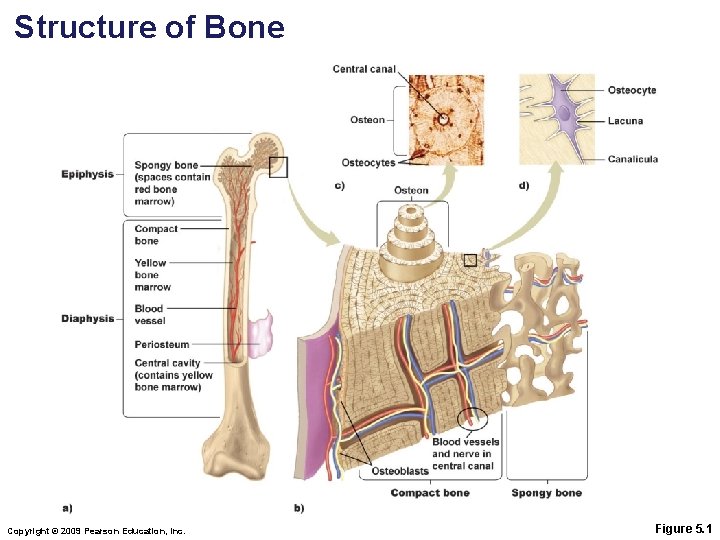
Structure of Bone Copyright © 2009 Pearson Education, Inc. Figure 5. 1
Cartilage and Ligaments § Cartilage § Function: support § Types: fibrocartilage, hyaline, and elastic cartilage § Ligaments § Function: attach bone to bone Copyright © 2009 Pearson Education, Inc.
Bone Development § Prenatal: cartilage model § Fetus: some conversion to bone § Childhood: primary and secondary ossification sites formed § Adolescence: cartilage growth plate elongates Copyright © 2009 Pearson Education, Inc.
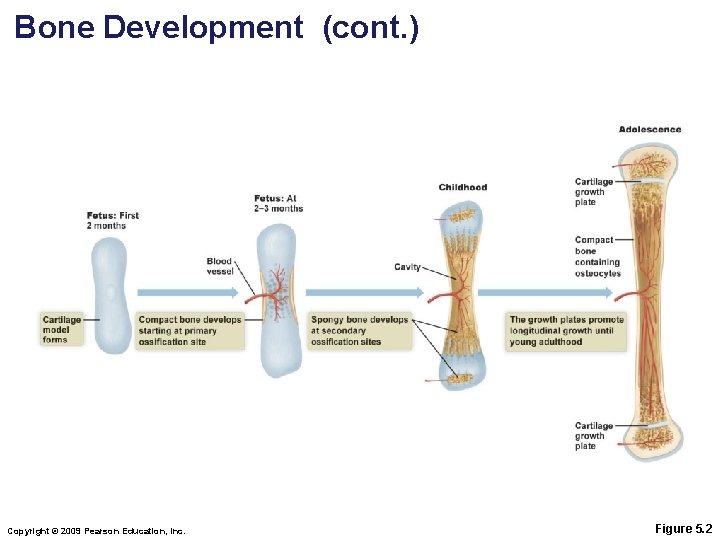
Bone Development (cont. ) Copyright © 2009 Pearson Education, Inc. Figure 5. 2
Mature Bone Remodeling and Repair § Changes in shape, size, strength § Dependent on diet, exercise, age § Bone cells regulated by hormones § Parathyroid hormone (PTH): removes calcium from bone § Calcitonin: adds calcium to bone § Repair: hematoma and callus formation PLAY Animation—Bone Repair Copyright © 2009 Pearson Education, Inc.
Functions of the Skeletal System § Protection: encases most internal organs § Support: allows body positions § Permits movement: muscle attachments for movement § Mineral reservoir: calcium and phosphorus Copyright © 2009 Pearson Education, Inc.
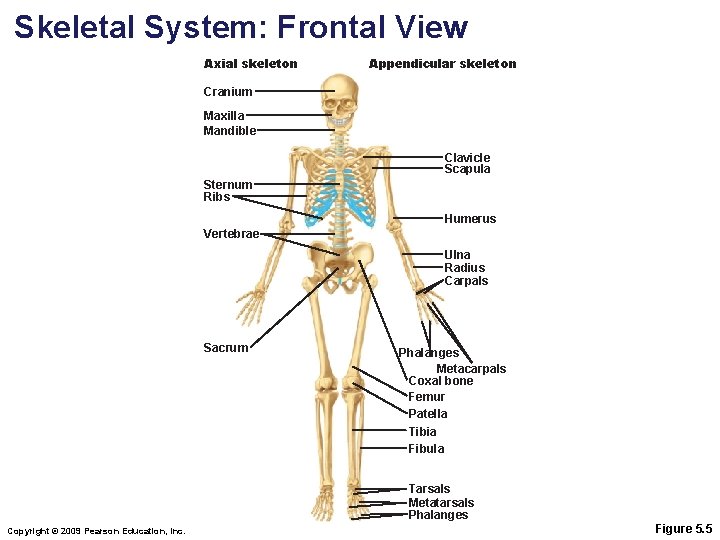
Skeletal System: Frontal View Axial skeleton Appendicular skeleton Cranium Maxilla Mandible Clavicle Scapula Sternum Ribs Humerus Vertebrae Ulna Radius Carpals Sacrum Phalanges Metacarpals Coxal bone Femur Patella Tibia Fibula Tarsals Metatarsals Phalanges Copyright © 2009 Pearson Education, Inc. Figure 5. 5
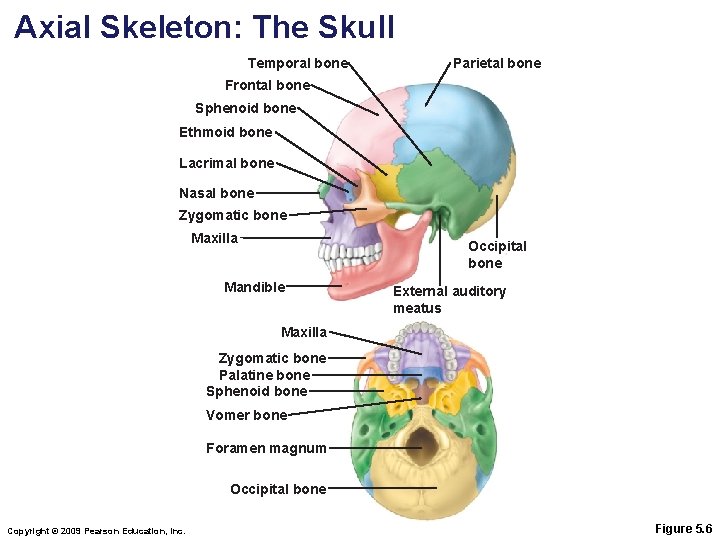
Axial Skeleton: The Skull Temporal bone Parietal bone Frontal bone Sphenoid bone Ethmoid bone Lacrimal bone Nasal bone Zygomatic bone Maxilla Occipital bone Mandible External auditory meatus Maxilla Zygomatic bone Palatine bone Sphenoid bone Vomer bone Foramen magnum Occipital bone Copyright © 2009 Pearson Education, Inc. Figure 5. 6
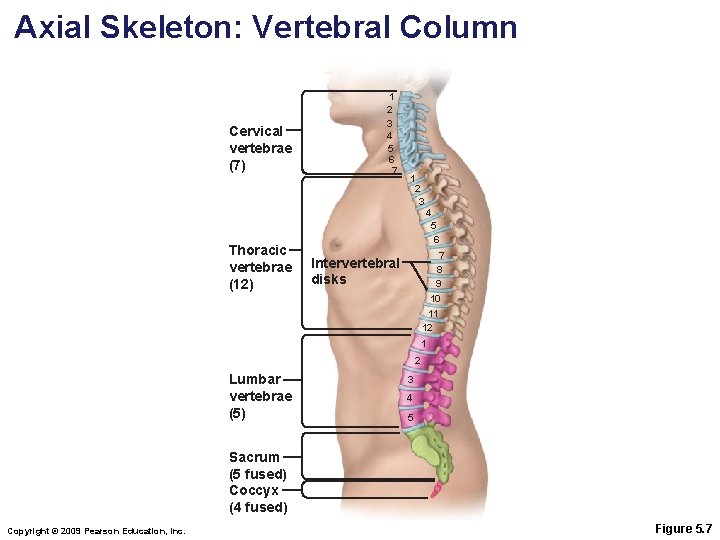
Axial Skeleton: Vertebral Column Cervical vertebrae (7) Thoracic vertebrae (12) 1 2 3 4 5 6 7 8 9 10 11 12 Intervertebral disks 1 2 Lumbar vertebrae (5) 3 4 5 Sacrum (5 fused) Coccyx (4 fused) Copyright © 2009 Pearson Education, Inc. Figure 5. 7
Axial Skeleton: Vertebral Column (cont. ) § Vertebral column § Regions: cervical, thoracic, lumbar, sacral, coccygeal § Intervertebral disks: cushion vertebrae; assist in movement and flexibility § Ribs § Twelve pairs § Bottom two pair floating § Sternum: breastbone § Three bones fused together Copyright © 2009 Pearson Education, Inc.
Appendicular Skeleton § Pectoral girdle: shoulder § Clavicle and scapulas § Pelvic girdles: hip § Coxal bones, sacrum, pubic symphysis § Limbs § Arms: humerus, radius, ulna, wrist and hand bones § Legs: femur, tibia, fibula, ankle and foot bones Copyright © 2009 Pearson Education, Inc.
Joints (Articulations) § Classified by degree of movement § Fibrous joint: immovable (e. g. , fontanels) § Cartilagenous joint: slightly movable, cartilage connection (e. g. , backbone) § Synovial joint: freely movable Copyright © 2009 Pearson Education, Inc.
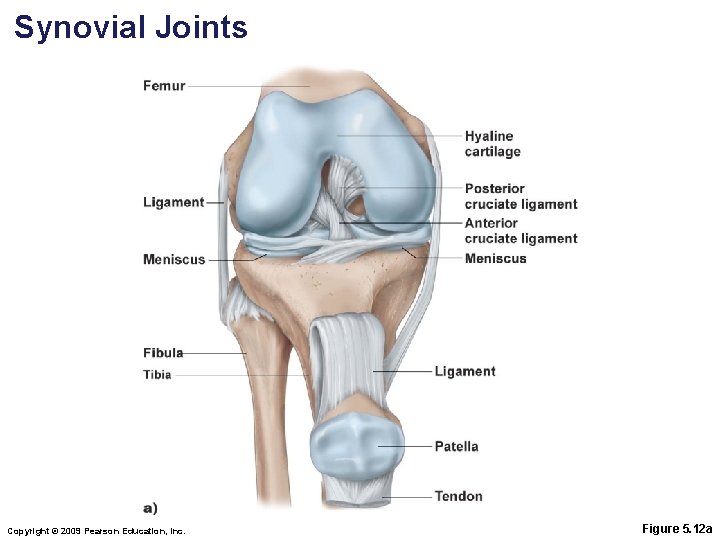
Synovial Joints Copyright © 2009 Pearson Education, Inc. Figure 5. 12 a
Synovial Joints (cont. ) § Joint capsule: synovial membrane + hyaline cartilage § Synovial membrane secretes synovial fluid as a lubricant § Hyaline cartilage acts as a cushion Copyright © 2009 Pearson Education, Inc.
Diseases and Disorders of the Skeletal System § Sprains: stretched or torn ligaments § Bursitis and tendinitis: inflammations § Arthritis: inflammation of joints Copyright © 2009 Pearson Education, Inc.
- Slides: 17