
Chapter 5 The Restaurant Business Walker Introduction to
Chapter 5: The Restaurant Business Walker: Introduction to Hospitality Management, 3 rd Edition © 2010 Pearson Education, Upper Saddle River, NJ 07458. All Rights Reserved.
Chapter 5 The Restaurant Business n n n n The Restaurant Business Classical Cuisine Food Trends and Practices Developing a Restaurant Menu Planning Classifications Trends Walker: Introduction to Hospitality Management, 3 rd Edition 2 © 2010 Pearson Education, Upper Saddle River, NJ 07458. All Rights Reserved.
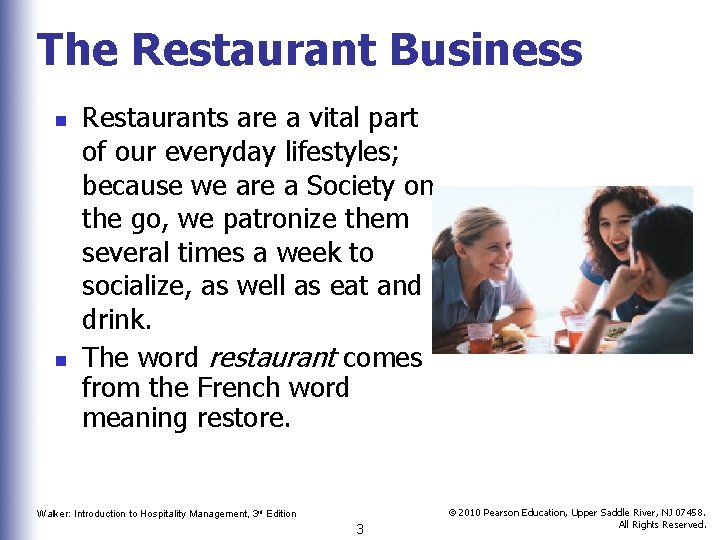
The Restaurant Business n n Restaurants are a vital part of our everyday lifestyles; because we are a Society on the go, we patronize them several times a week to socialize, as well as eat and drink. The word restaurant comes from the French word meaning restore. Walker: Introduction to Hospitality Management, 3 rd Edition 3 © 2010 Pearson Education, Upper Saddle River, NJ 07458. All Rights Reserved.
Classical Cuisine n North America gained most of its culinary legacy from France through 2 main events: n n French Revolution in 1793—caused the best French chefs of the day to lose their employment because their bosses lost their heads! Many chefs came to North America as a result. In 1784, Thomas Jefferson spent five years as envoy to France, and brought a French chef to the White House when he became president. Walker: Introduction to Hospitality Management, 3 rd Edition 4 © 2010 Pearson Education, Upper Saddle River, NJ 07458. All Rights Reserved.
Classical Cuisine n Mari-Antoine Careme is credited as the founder of classical cuisine. n August Escoffier is also noted for his many contributions to cuisine Walker: Introduction to Hospitality Management, 3 rd Edition 5 © 2010 Pearson Education, Upper Saddle River, NJ 07458. All Rights Reserved.
Classical Cuisine n n There are five mother sauces: Béchamel, velouté, espagnole, tomato, and hollandaise Nouvelle cuisine is a lighter cuisine and is based on simpler preparations— with the aid of processors, blenders, and juicers—using more natural flavors and ingredients. Walker: Introduction to Hospitality Management, 3 rd Edition 6 © 2010 Pearson Education, Upper Saddle River, NJ 07458. All Rights Reserved.
Food Trends & Practices n Chefs will need: n n n A strong culinary foundation. Multicultural cooking skills and strong employability traits. Additional management skills as passion, dependability, cooperation, and initiative. Walker: Introduction to Hospitality Management, 3 rd Edition 7 © 2010 Pearson Education, Upper Saddle River, NJ 07458. All Rights Reserved.
Culinary Practices n n n n To be a good cook, one must understand the basic techniques and principles of cooking. There are six skill areas that are important to becoming a successful chef: Cooking, menu development, sanitation/safety, accounting, computer training, food trends and practices for the new millennium. Walker: Introduction to Hospitality Management, 3 rd Edition 8 © 2010 Pearson Education, Upper Saddle River, NJ 07458. All Rights Reserved.
Culinary Practices (conclusion) n The most important thing to learn about the industry is that you can’t do it alone; it’s a team effort Walker: Introduction to Hospitality Management, 3 rd Edition 9 © 2010 Pearson Education, Upper Saddle River, NJ 07458. All Rights Reserved.
Developing a Restaurant n The successful development of a restaurant is dependent on a number of factors: 1. Operating philosophy: represents the way the company does business. 2. Restaurant Market is composed of those guests who will patronize the restaurant. • • A niche is a specific share or slot of a certain market. This area is analyzed by marketers to determine the demographics and potential business Walker: Introduction to Hospitality Management, 3 rd Edition 10 © 2010 Pearson Education, Upper Saddle River, NJ 07458. All Rights Reserved.
Developing a Restaurant 3. Concepts are created with guests in mind and should fit a definite market. 4. Location should also appeal to the target market. 5. Ambiance, or the atmosphere, that a restaurant creates has both immediate conscious and unconscious effects on guests. Walker: Introduction to Hospitality Management, 3 rd Edition 11 © 2010 Pearson Education, Upper Saddle River, NJ 07458. All Rights Reserved.
Menu Planning n There are six main types of menus: n A la carte menus—items are individually priced n Table d’hôte menus—a selection of one or more items for each course at a fixed price n Du jour menus—lists the items “of the day” n Tourist menus—used to attract tourists’ attention n California menus—are so named because in some California restaurants, guests may order any item on the menu at any time of the day n Cyclical menus—repeat themselves Walker: Introduction to Hospitality Management, 3 rd Edition 12 © 2010 Pearson Education, Upper Saddle River, NJ 07458. All Rights Reserved.
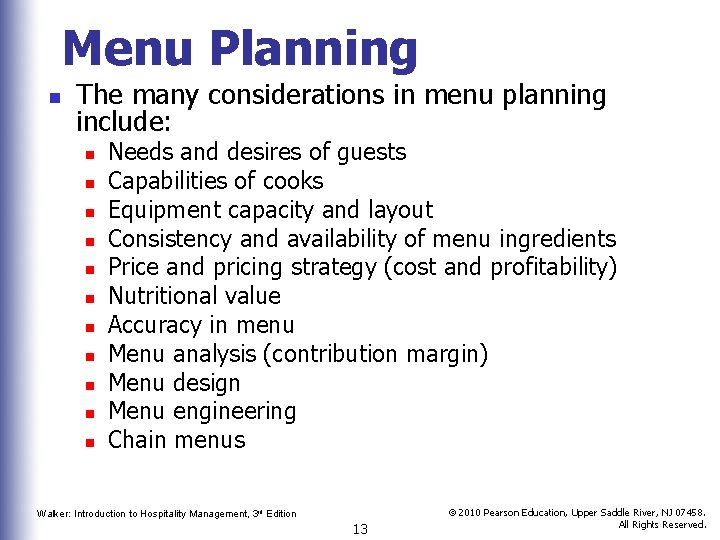
Menu Planning n The many considerations in menu planning include: n n n Needs and desires of guests Capabilities of cooks Equipment capacity and layout Consistency and availability of menu ingredients Price and pricing strategy (cost and profitability) Nutritional value Accuracy in menu Menu analysis (contribution margin) Menu design Menu engineering Chain menus Walker: Introduction to Hospitality Management, 3 rd Edition 13 © 2010 Pearson Education, Upper Saddle River, NJ 07458. All Rights Reserved.
Needs and desires of guests: n Guest needs and desires are what is important when planning a menu. The menu must harmonize with theme, concept, guest expectations, etc. Walker: Introduction to Hospitality Management, 3 rd Edition 14 © 2010 Pearson Education, Upper Saddle River, NJ 07458. All Rights Reserved.
Capabilities of cooks n Cook capabilities must harmonize with the menu and concept. An appropriate level of expertise must be employed to match the demands of the customer. This will affect many other aspects of the operation like, equipment needs, purchasing, salaries, etc. Walker: Introduction to Hospitality Management, 3 rd Edition 15 © 2010 Pearson Education, Upper Saddle River, NJ 07458. All Rights Reserved.
Equipment capacity and layout n Menus must be developed with regard to the capacity and layout of the equipment, or, the menu more or less dictates the competency of labor to hire and type of equipment necessary. Walker: Introduction to Hospitality Management, 3 rd Edition 16 © 2010 Pearson Education, Upper Saddle River, NJ 07458. All Rights Reserved.
Consistency and availability of menu ingredients n Ingredients must available year-round. Some may be more expensive at certain times of the year due so seasonality. Walker: Introduction to Hospitality Management, 3 rd Edition 17 © 2010 Pearson Education, Upper Saddle River, NJ 07458. All Rights Reserved.
Price and pricing strategy (cost and profitability): n The target market generally determines the menu pricing strategies. Factors to consider include, competition, food cost, labor cost, other costs, expected profit and contribution margin. Walker: Introduction to Hospitality Management, 3 rd Edition 18 © 2010 Pearson Education, Upper Saddle River, NJ 07458. All Rights Reserved.

Nutritional value n Customers are more health conscious which has promoted changes in menu selections and preparation methods. More and more businesses are posting nutritional value of food and some are using heart healthy approaches. Walker: Introduction to Hospitality Management, 3 rd Edition 19 © 2010 Pearson Education, Upper Saddle River, NJ 07458. All Rights Reserved.
Accuracy in menu n Laws prohibit misrepresentation of menu items. Truth in menu laws refers to the fact that descriptions on the menu must be accurate. Walker: Introduction to Hospitality Management, 3 rd Edition 20 © 2010 Pearson Education, Upper Saddle River, NJ 07458. All Rights Reserved.
Menu analysis (contribution margin) n Menus are analyzed by owners and management to determine profit and evaluate cost centers. Sales volume, contribution margin, food, beverage and labor costs are some of the tools used to analyze menus. Walker: Introduction to Hospitality Management, 3 rd Edition 21 © 2010 Pearson Education, Upper Saddle River, NJ 07458. All Rights Reserved.
Menu design n Menu presentation varies depending on concept; from verbal descriptions to chalk boards to formally presented menus. Menus are sales tools and play an important role in influencing guest decisions and help to establish a restaurant’s image and ambiance. Walker: Introduction to Hospitality Management, 3 rd Edition 22 © 2010 Pearson Education, Upper Saddle River, NJ 07458. All Rights Reserved.
Menu engineering n Menu engineering is an approach to setting menu prices and controlling costs. It is also used to determine the performance of menu items relative to profitability and cash flow. Walker: Introduction to Hospitality Management, 3 rd Edition 23 © 2010 Pearson Education, Upper Saddle River, NJ 07458. All Rights Reserved.
Classifications of Restaurants Walker: Introduction to Hospitality Management, 3 rd Edition 24 © 2010 Pearson Education, Upper Saddle River, NJ 07458. All Rights Reserved.
Independent Restaurants n n n Typically owned by 1 or more owners —usually involved in the day-to-day operation of the business Not affiliated with any national brand or name They offer the owner independence, creativity, and flexibility, but are accompanied by the risk of failing Walker: Introduction to Hospitality Management, 3 rd Edition 25 © 2010 Pearson Education, Upper Saddle River, NJ 07458. All Rights Reserved.
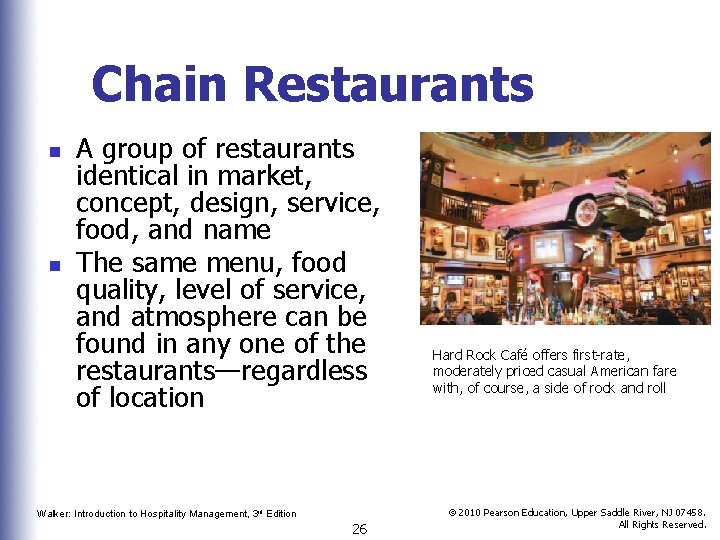
Chain Restaurants n n A group of restaurants identical in market, concept, design, service, food, and name The same menu, food quality, level of service, and atmosphere can be found in any one of the restaurants—regardless of location Walker: Introduction to Hospitality Management, 3 rd Edition 26 Hard Rock Café offers first-rate, moderately priced casual American fare with, of course, a side of rock and roll © 2010 Pearson Education, Upper Saddle River, NJ 07458. All Rights Reserved.
Fine Dining n n May be formal or casual and may be further categorized by price, decor/atmosphere, level of formality, and menu Many serve haute cuisine—a French term meaning “elegant dining, ” or literally “high food” Most are independently owned and operated by an entrepreneur or a partnership The level of service is generally high Walker: Introduction to Hospitality Management, 3 rd Edition 27 © 2010 Pearson Education, Upper Saddle River, NJ 07458. All Rights Reserved.
Theme Restaurants n n A combination of a sophisticated specialty and several other types of restaurants Generally serve a limited menu Walker: Introduction to Hospitality Management, 3 rd Edition 28 © 2010 Pearson Education, Upper Saddle River, NJ 07458. All Rights Reserved.
Theme Restaurants n Of the many popular theme restaurants, 2 stand out: n n First, the nostalgia of the 1950 s—as done in the T-Bird and Corvette diners Second, the dinner house category— among some of the better-known national and regional chains are TGI Friday’s, Houlihan’s, and Bennigan’s n Casual, American bistro-type restaurants that combine a lively atmosphere created in part by assorted bric-a-brac to decorate the various ledges and walls Walker: Introduction to Hospitality Management, 3 rd Edition 29 © 2010 Pearson Education, Upper Saddle River, NJ 07458. All Rights Reserved.
Celebrity Restaurants n n n Growing in popularity Wolfgang Puck, Naomi Campbell, Michael Jordan, etc. Celebrity restaurants generally have an extra zing to them—a winning combination of design, atmosphere, food, and perhaps the thrill of an occasional visit by the owner(s) Walker: Introduction to Hospitality Management, 3 rd Edition 30 © 2010 Pearson Education, Upper Saddle River, NJ 07458. All Rights Reserved.
Steak Houses n n n Adding additional value-priced items like chicken and fish to their menus in order to attract more customers Upscale market leaders are Ruth’s Chris, Morton’s, and Flemings The mid-price market leader is Outback Steakhouse Walker: Introduction to Hospitality Management, 3 rd Edition 31 © 2010 Pearson Education, Upper Saddle River, NJ 07458. All Rights Reserved.
Casual Dining n Relaxed—includes restaurants from several classifications: n n Mid-scale casual restaurants: Romano’s Macaroni Grill, The Olive Garden Family restaurants: Cracker Barrel, Coco’s, Carrow’s Ethnic restaurants: Flavor Thai, Cantina Latina, Panda Express Over the past few years, the trend in dinner-house restaurants has been toward more casual dining Walker: Introduction to Hospitality Management, 3 rd Edition 32 © 2010 Pearson Education, Upper Saddle River, NJ 07458. All Rights Reserved.
Family Restaurants n n Evolved from the coffee shop style of restaurant. Most are individually or family operated. Located in, or with easy access to, the suburbs. Most offer an informal setting with a simple menu and service designed to please the whole family. Walker: Introduction to Hospitality Management, 3 rd Edition 33 © 2010 Pearson Education, Upper Saddle River, NJ 07458. All Rights Reserved.
Ethnic Restaurants n n n Majority are independently owned and operated. Mexican restaurants are the fastest growing segment. Our major cities offer a great variety of ethnic restaurants, and their popularity is increasing. Walker: Introduction to Hospitality Management, 3 rd Edition 34 © 2010 Pearson Education, Upper Saddle River, NJ 07458. All Rights Reserved.
Quick-Service/Fast-Food Restaurants n n Included in this category: Hamburger, pizza, chicken, pancakes, sandwich shops, and delivery services Increasing in popularity because of their location strategies Walker: Introduction to Hospitality Management, 3 rd Edition 35 © 2010 Pearson Education, Upper Saddle River, NJ 07458. All Rights Reserved.
Hamburger n n n Mc. Donald’s New menu items (salads, breakfast, etc. ) Expanding overseas Co-developing sites with gasoline companies Each of the major hamburger restaurant chains has a unique positioning strategy to attract their target markets n n Burger King hamburgers are flame broiled Wendy’s uses fresh patties Walker: Introduction to Hospitality Management, 3 rd Edition 36 © 2010 Pearson Education, Upper Saddle River, NJ 07458. All Rights Reserved.
Pizza n n n Continues to grow $21 billion market Some major chains: n n Pizza Hut Domino’s Pizza Papa John’s Little Caesars Walker: Introduction to Hospitality Management, 3 rd Edition 37 © 2010 Pearson Education, Upper Saddle River, NJ 07458. All Rights Reserved.
Chicken n Perceived as a healthier alternative to burgers KFC is market leader Other chains: n n Church’s Chicken Popeye’s Walker: Introduction to Hospitality Management, 3 rd Edition 38 © 2010 Pearson Education, Upper Saddle River, NJ 07458. All Rights Reserved.
Sandwich n n n Recently, menu debuts in the sandwich segment have outpaced all others Classics, like melts and club sandwiches, have returned—but now there also wraps The leader in this segment is Subway— which operates more than 20, 000 units in 75 countries Walker: Introduction to Hospitality Management, 3 rd Edition 39 © 2010 Pearson Education, Upper Saddle River, NJ 07458. All Rights Reserved.
Bakery Café n n n Headed up by Panera Bread Goal is to make specialty bread broadly available to consumers across the United States Focuses on the art and craft of bread making with made-to-order sandwiches, tossed-to-order salads, and soup served in bread bowls Walker: Introduction to Hospitality Management, 3 rd Edition 40 © 2010 Pearson Education, Upper Saddle River, NJ 07458. All Rights Reserved.
Trends n n n n Demographics Branding Alternative outlets Globalization Continued diversification More twin and multiple locations More points of service Walker: Introduction to Hospitality Management, 3 rd Edition 41 © 2010 Pearson Education, Upper Saddle River, NJ 07458. All Rights Reserved.

The End Walker: Introduction to Hospitality Management, 3 rd Edition 42 © 2010 Pearson Education, Upper Saddle River, NJ 07458. All Rights Reserved.
- Slides: 42