
CHAPTER 5 THE PERIODIC TABLE Read introduction page
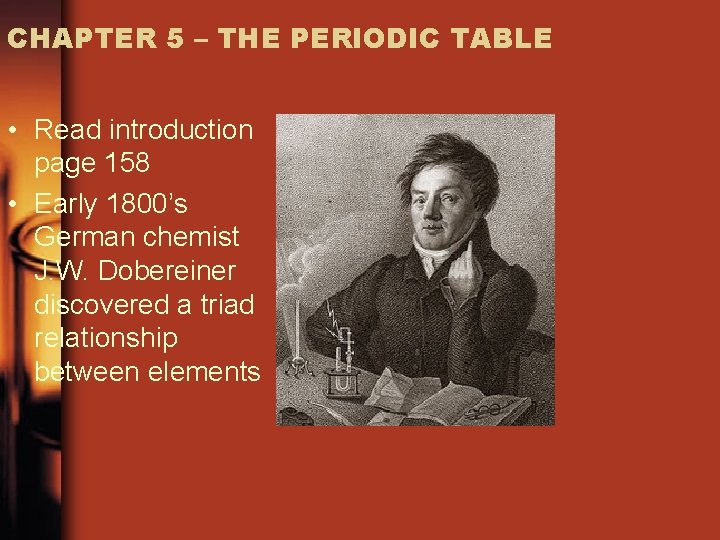
CHAPTER 5 – THE PERIODIC TABLE • Read introduction page 158 • Early 1800’s German chemist J. W. Dobereiner discovered a triad relationship between elements
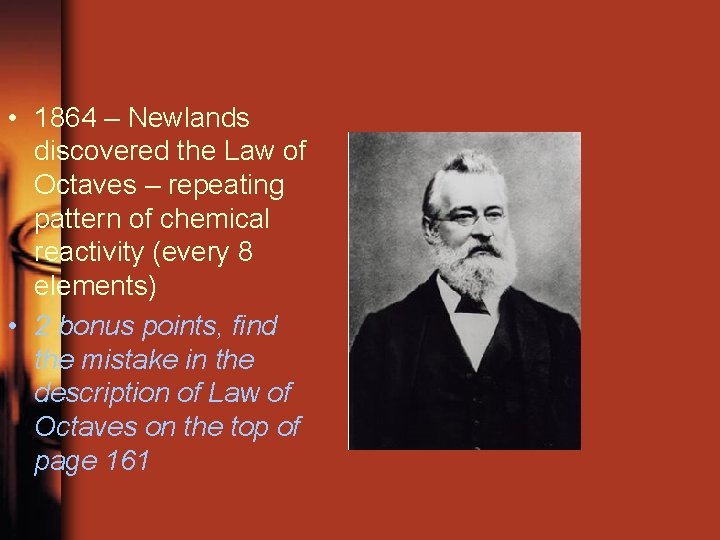
• 1864 – Newlands discovered the Law of Octaves – repeating pattern of chemical reactivity (every 8 elements) • 2 bonus points, find the mistake in the description of Law of Octaves on the top of page 161
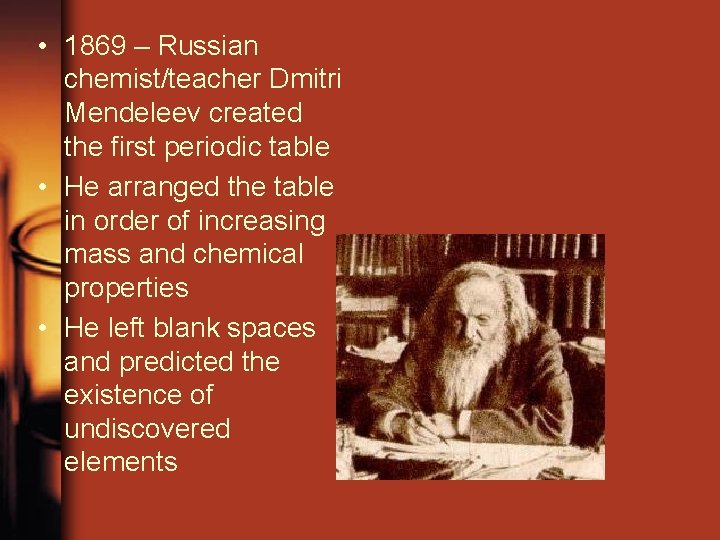
• 1869 – Russian chemist/teacher Dmitri Mendeleev created the first periodic table • He arranged the table in order of increasing mass and chemical properties • He left blank spaces and predicted the existence of undiscovered elements

• Moseley discovered atomic number by studying the frequency of x-rays produced when metals were bombarded with high energy electrons. • He hypothesized that this was due to a different positive charge in each nucleus.
• The Periodic Law – When elements are arranged in order of increasing atomic #, their physical and chemical properties show a periodic pattern. • Do not memorize lots of facts about elements – instead learn to predict an element’s properties by its position on the periodic chart.

Vertical columns – families have the same outer electron configuration – Have similar physical properties and chemistry H Li Na 1 S 1 [He] 2 S 1 [Ne] 3 S 1 K [Ar] 4 S 1 Identify the s, p, d, and f block Rb Cs [Kr] 5 S 1 [Xe] 6 S 1
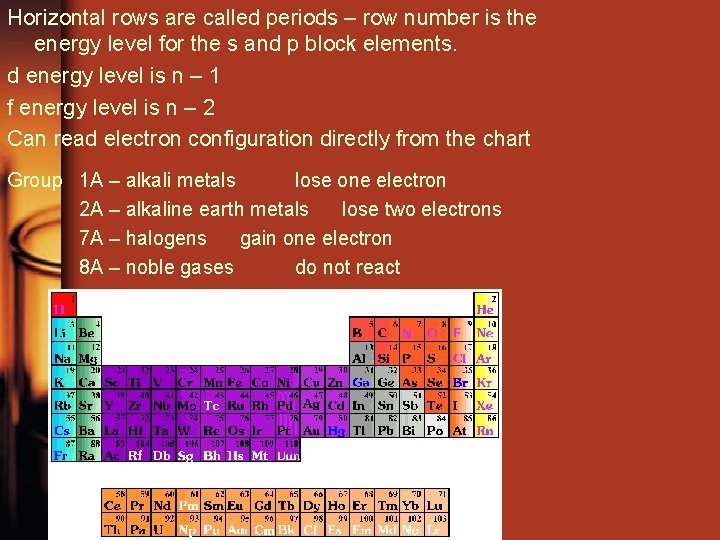
Horizontal rows are called periods – row number is the energy level for the s and p block elements. d energy level is n – 1 f energy level is n – 2 Can read electron configuration directly from the chart Group 1 A – alkali metals lose one electron 2 A – alkaline earth metals lose two electrons 7 A – halogens gain one electron 8 A – noble gases do not react

• Chemical reaction – competition for electrons • Electronegativity – a measure of an atom’s ability to compete for electrons
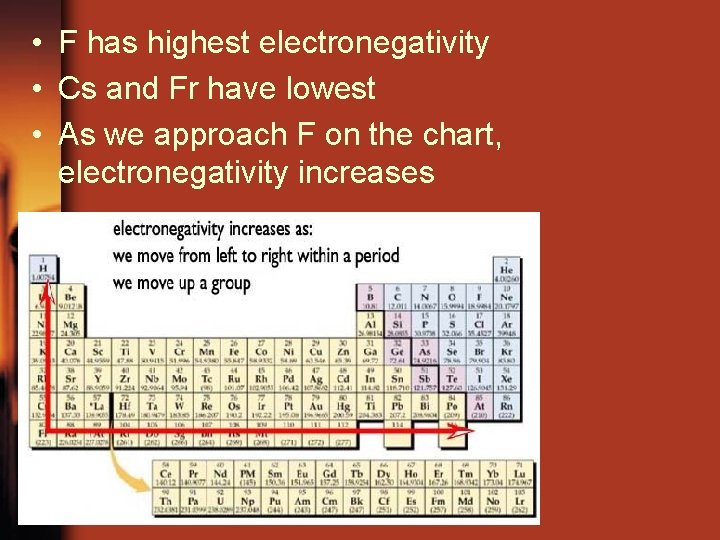
• F has highest electronegativity • Cs and Fr have lowest • As we approach F on the chart, electronegativity increases
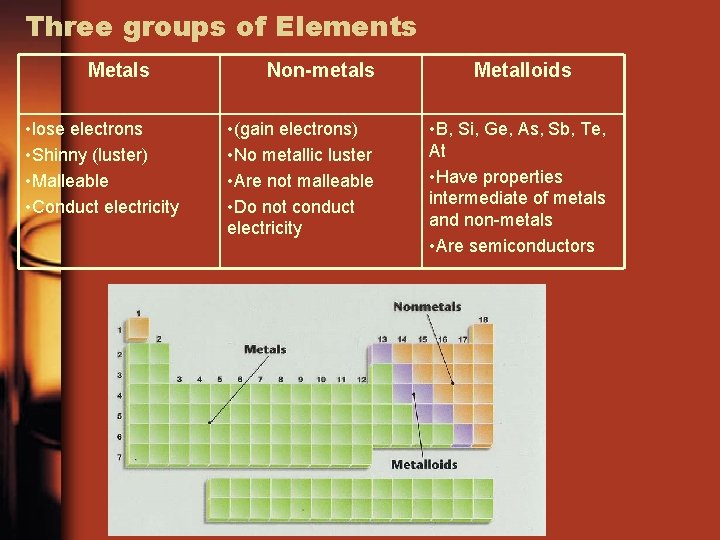
Three groups of Elements Metals • lose electrons • Shinny (luster) • Malleable • Conduct electricity Non-metals • (gain electrons) • No metallic luster • Are not malleable • Do not conduct electricity Metalloids • B, Si, Ge, As, Sb, Te, At • Have properties intermediate of metals and non-metals • Are semiconductors
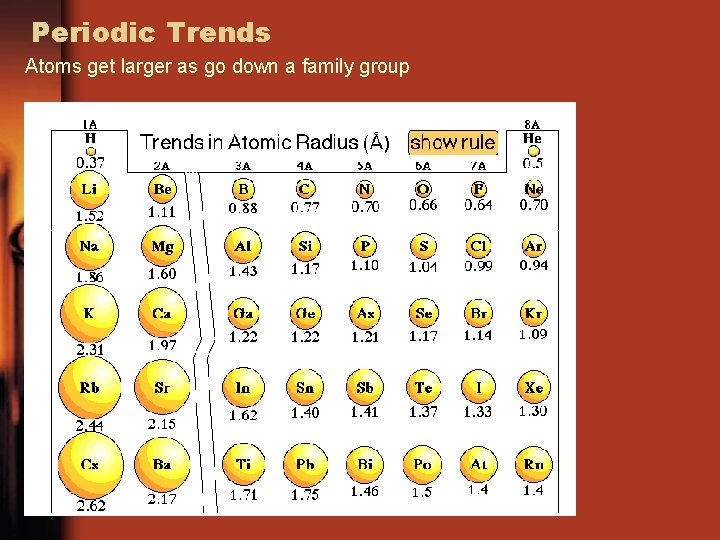
Periodic Trends Atoms get larger as go down a family group
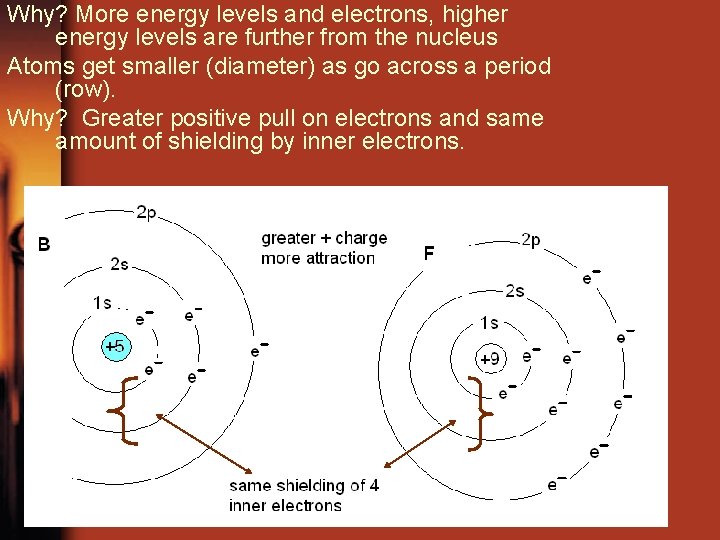
Why? More energy levels and electrons, higher energy levels are further from the nucleus Atoms get smaller (diameter) as go across a period (row). Why? Greater positive pull on electrons and same amount of shielding by inner electrons.
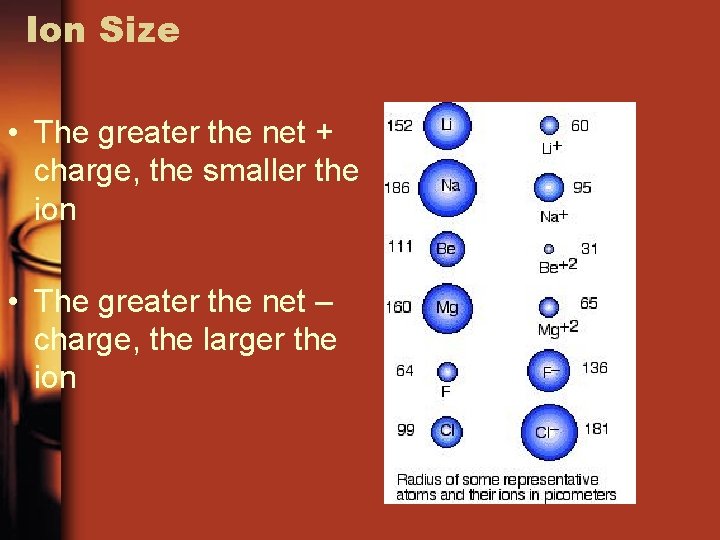
Ion Size • The greater the net + charge, the smaller the ion • The greater the net – charge, the larger the ion
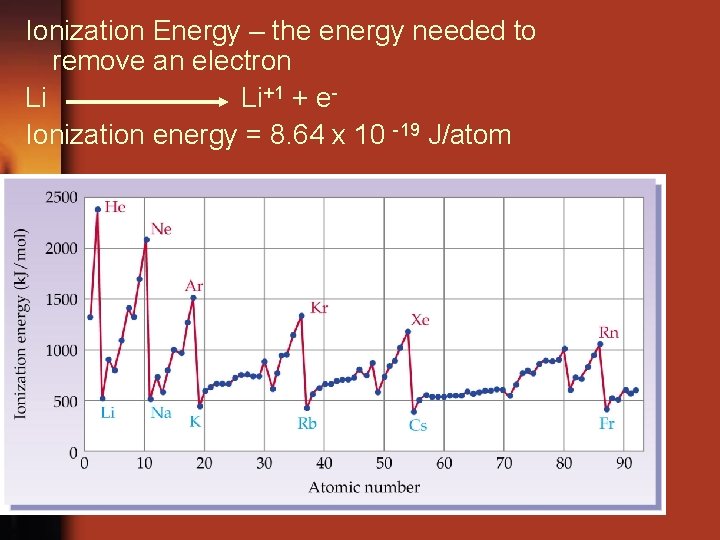
Ionization Energy – the energy needed to remove an electron Li Li+1 + e. Ionization energy = 8. 64 x 10 -19 J/atom
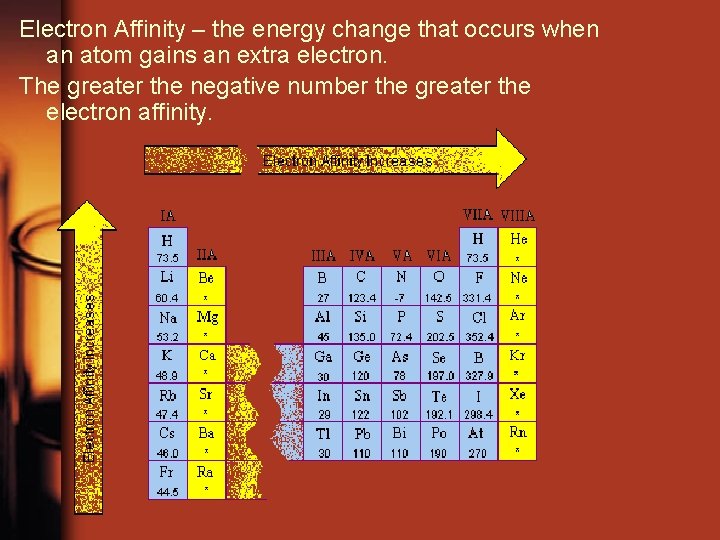
Electron Affinity – the energy change that occurs when an atom gains an extra electron. The greater the negative number the greater the electron affinity.
Complete Chapter questions • Pages 188 -189 1 -23, 25, 26, 29, 30, 33
- Slides: 16