
Chapter 5 The Periodic Table 1 Section 5
Chapter 5 The Periodic Table 1
Section 5. 1 ORGANIZING ELEMENTS 2
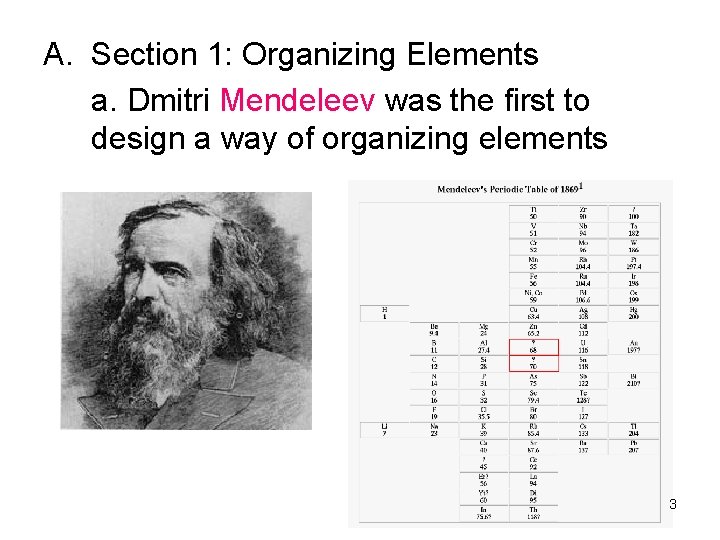
A. Section 1: Organizing Elements a. Dmitri Mendeleev was the first to design a way of organizing elements 3
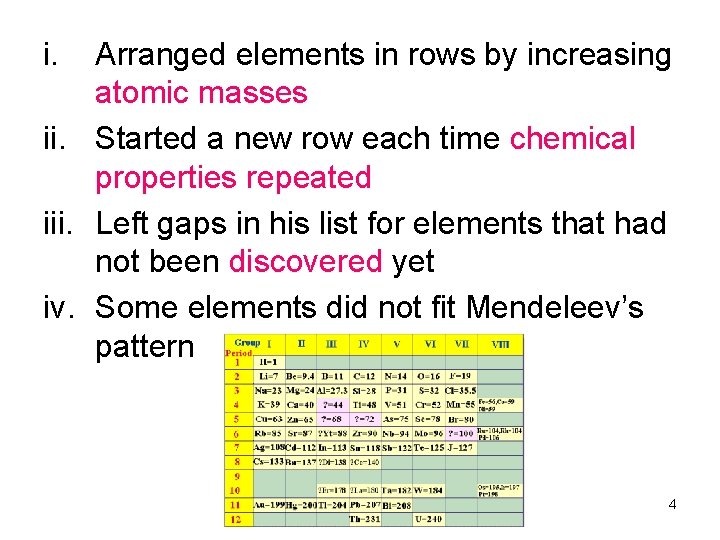
i. Arranged elements in rows by increasing atomic masses ii. Started a new row each time chemical properties repeated iii. Left gaps in his list for elements that had not been discovered yet iv. Some elements did not fit Mendeleev’s pattern 4
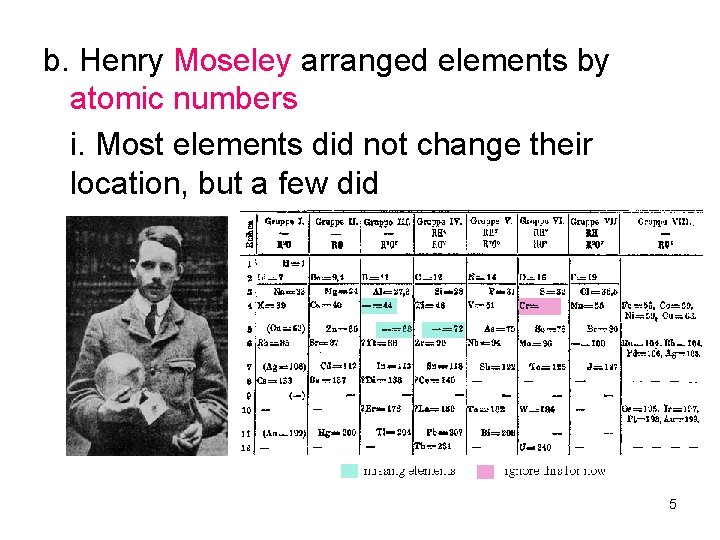
b. Henry Moseley arranged elements by atomic numbers i. Most elements did not change their location, but a few did 5
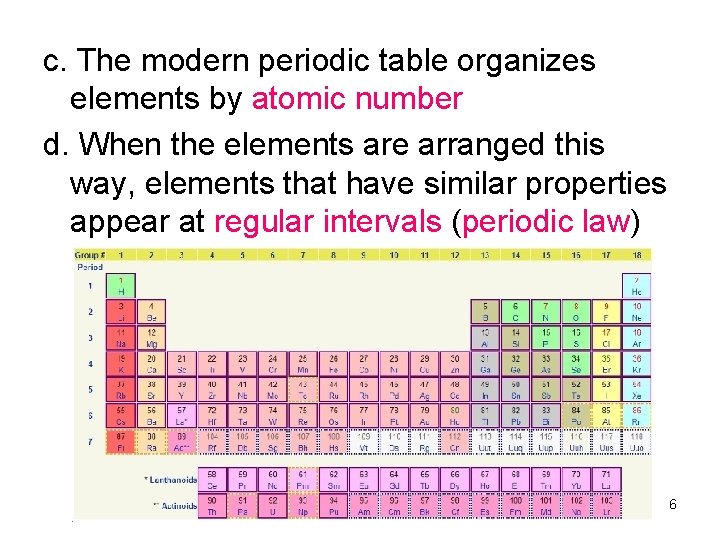
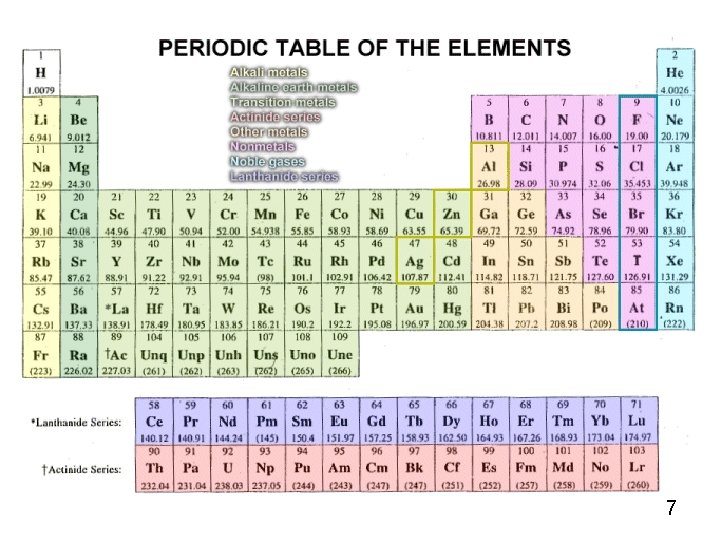
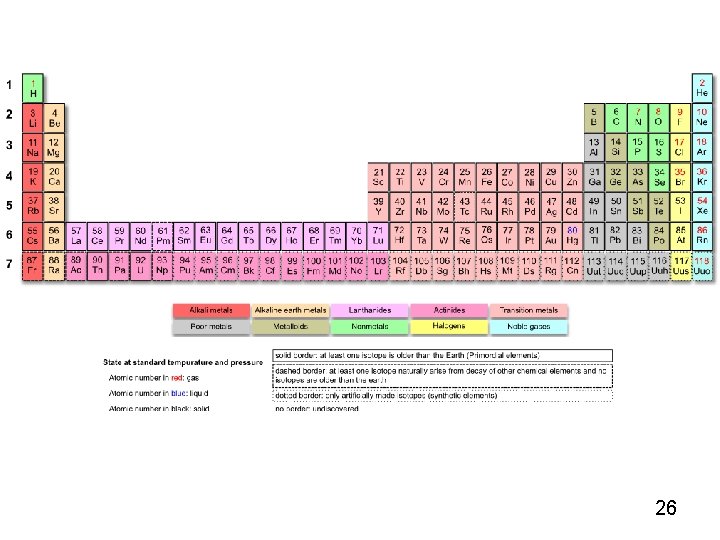
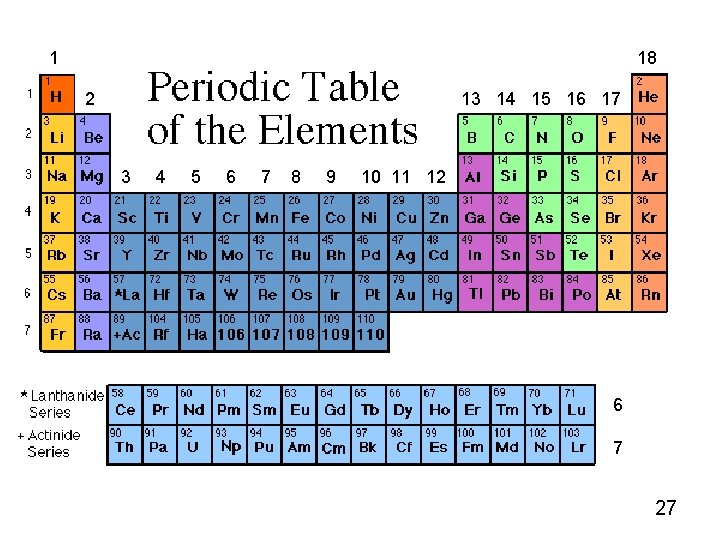
c. The modern periodic table organizes elements by atomic number d. When the elements are arranged this way, elements that have similar properties appear at regular intervals (periodic law) 6
7
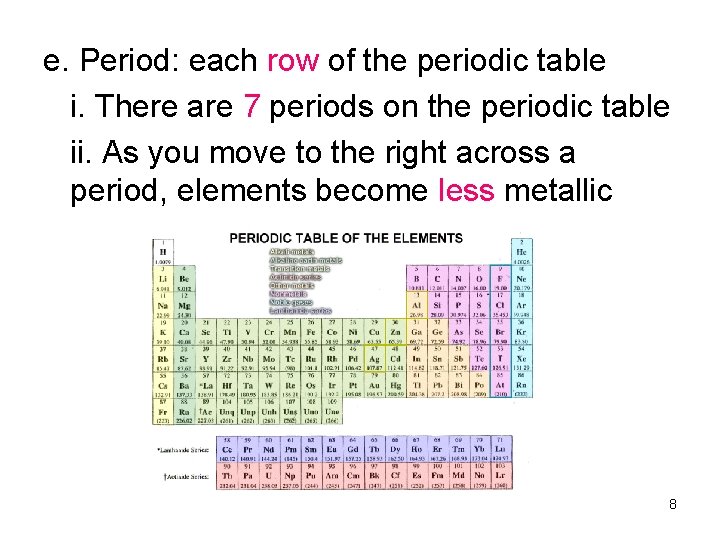
e. Period: each row of the periodic table i. There are 7 periods on the periodic table ii. As you move to the right across a period, elements become less metallic 8
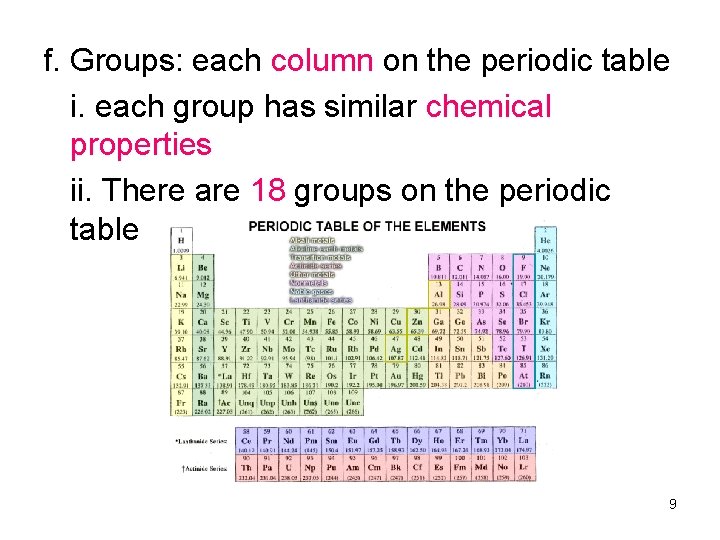
f. Groups: each column on the periodic table i. each group has similar chemical properties ii. There are 18 groups on the periodic table 9
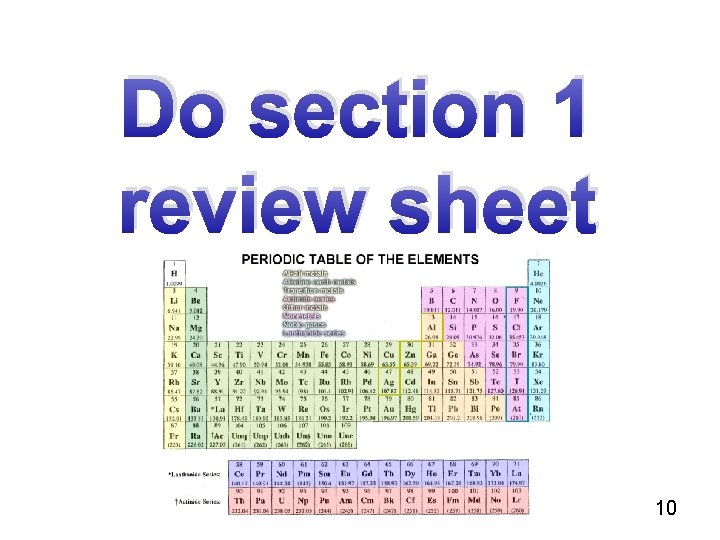
Do section 1 review sheet 10
Section 1 review • 1. Describe how Mendeleev organized his periodic table – By increasing atomic masses – Started a new row each time chemical properties repeated – Left gaps for undiscovered elements 11
Section 1 review • 2. Explain why Mendeleev left a space for the unknown (at the time) element germanium in his periodic table. – The properties of germanium did not match the next available group, so he moved it over to the group whose properties germanium did match, and left a space 12
Section 1 review • 3. State the property used to organize elements in the modern table. – Atomic number 13
Section 1 review • 4. Identify the following on the periodic table: a) The chemical symbol for mercury Ø Hg b) The period and group of gold Ø Period 6 Ø Group 11 c) The atomic mass of iron Ø 55. 845 14
Section 1 review • 4. Identify the following on the periodic table: d) The atomic number of neon Ø 10 e) The element represented by Cu Ø copper 15
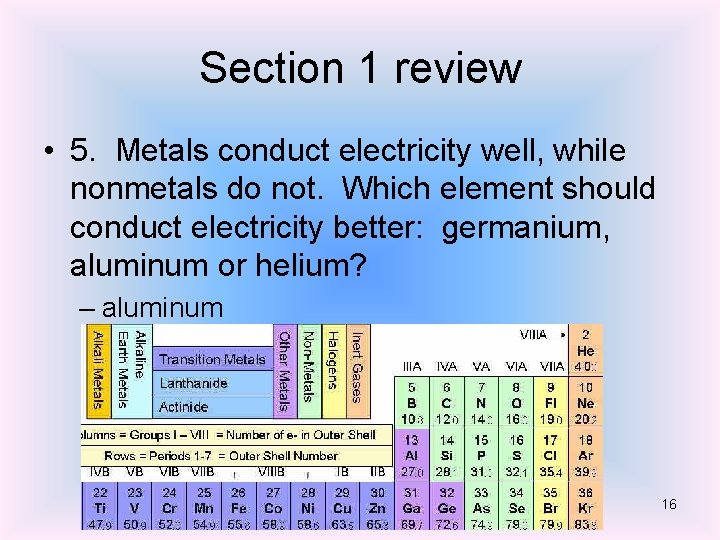
Section 1 review • 5. Metals conduct electricity well, while nonmetals do not. Which element should conduct electricity better: germanium, aluminum or helium? – aluminum 16
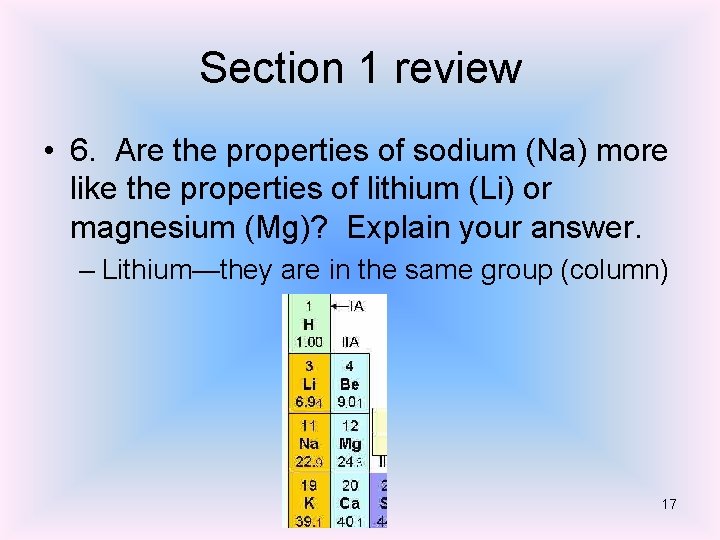
Section 1 review • 6. Are the properties of sodium (Na) more like the properties of lithium (Li) or magnesium (Mg)? Explain your answer. – Lithium—they are in the same group (column) 17
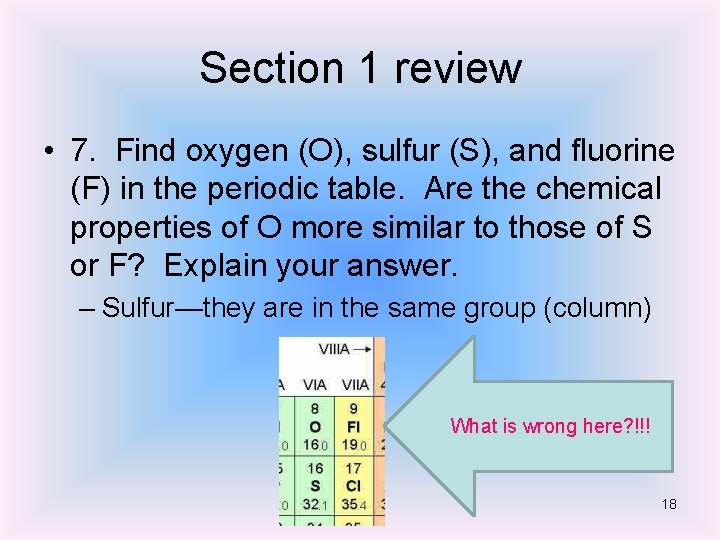
Section 1 review • 7. Find oxygen (O), sulfur (S), and fluorine (F) in the periodic table. Are the chemical properties of O more similar to those of S or F? Explain your answer. – Sulfur—they are in the same group (column) What is wrong here? !!! 18
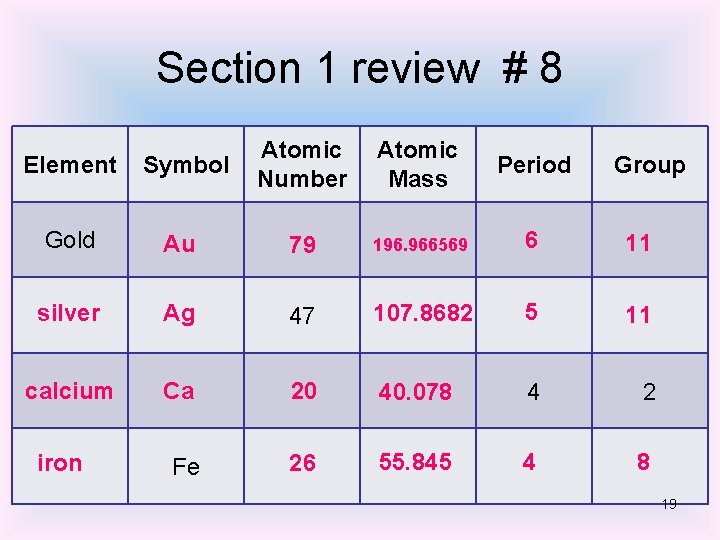
Section 1 review # 8 Element Symbol Atomic Number Gold Au 79 196. 966569 6 11 silver Ag 47 107. 8682 5 11 calcium Ca 20 40. 078 4 2 Fe 26 55. 845 4 8 iron Atomic Mass Period Group 19
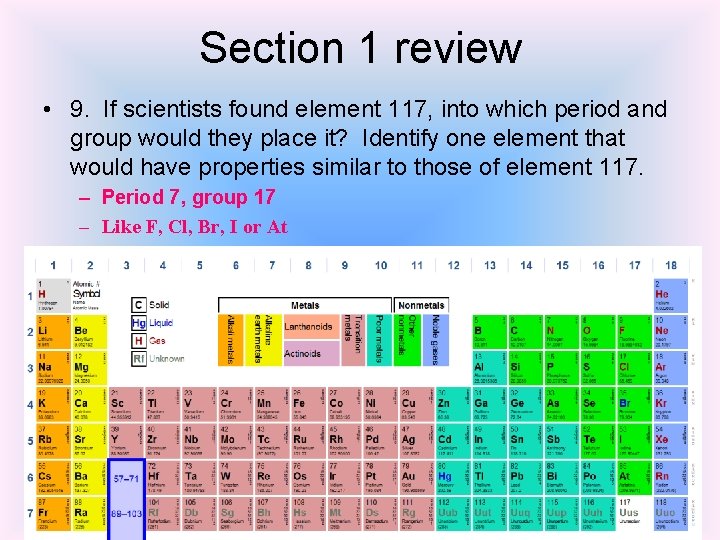
Section 1 review • 9. If scientists found element 117, into which period and group would they place it? Identify one element that would have properties similar to those of element 117. – Period 7, group 17 – Like F, Cl, Br, I or At 20

Section 5. 1 REVIEW 21
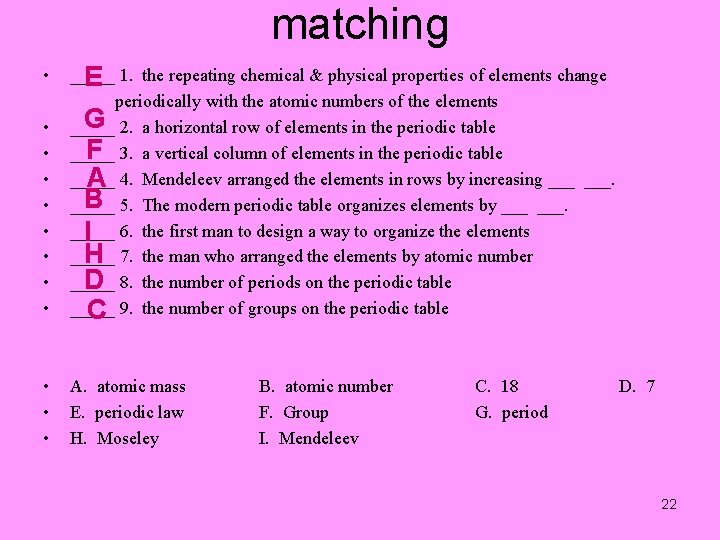
matching • • _____ E 1. the repeating chemical & physical properties of elements change periodically with the atomic numbers of the elements G 2. a horizontal row of elements in the periodic table _____ F 3. a vertical column of elements in the periodic table _____ A 4. Mendeleev arranged the elements in rows by increasing ___. B 5. The modern periodic table organizes elements by _____ I 6. the first man to design a way to organize the elements _____ H 7. the man who arranged the elements by atomic number _____ D 8. the number of periods on the periodic table _____ C 9. the number of groups on the periodic table • • • A. atomic mass E. periodic law H. Moseley • B. atomic number F. Group I. Mendeleev C. 18 G. period D. 7 22
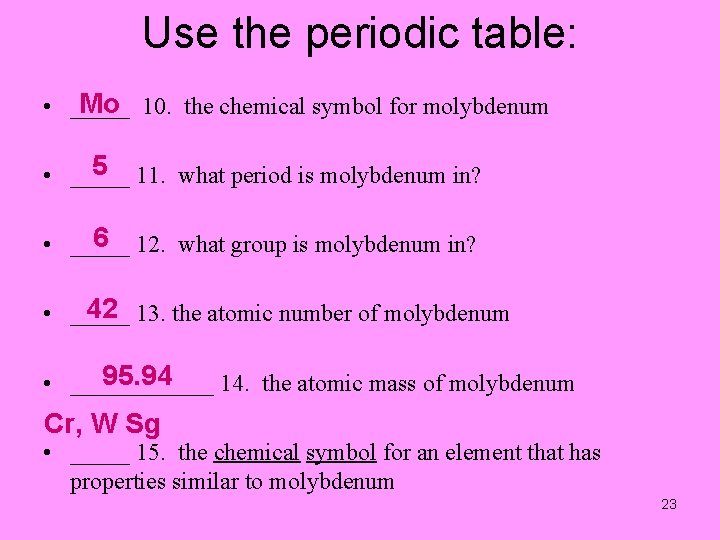
Use the periodic table: Mo 10. the chemical symbol for molybdenum • _____ 5 11. what period is molybdenum in? • _____ 6 12. what group is molybdenum in? • _____ 42 13. the atomic number of molybdenum • _____ 95. 94 • ______ 14. the atomic mass of molybdenum Cr, W Sg • _____ 15. the chemical symbol for an element that has properties similar to molybdenum 23
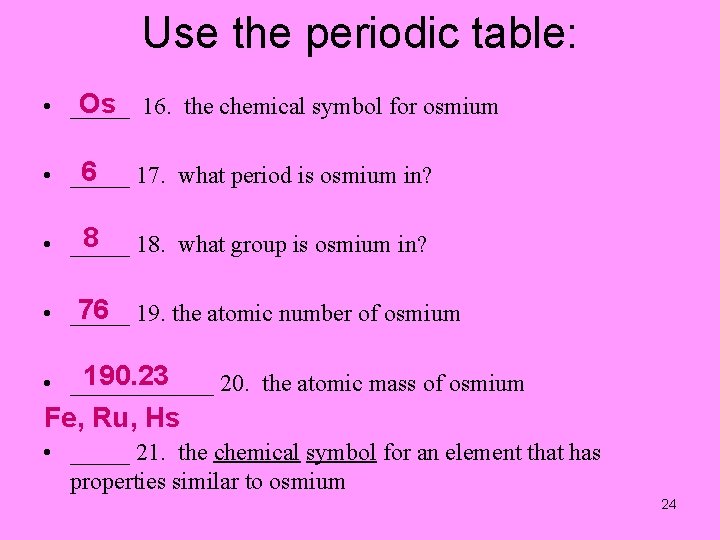
Use the periodic table: Os 16. the chemical symbol for osmium • _____ 6 17. what period is osmium in? • _____ 8 18. what group is osmium in? • _____ 76 19. the atomic number of osmium • _____ 190. 23 • ______ 20. the atomic mass of osmium Fe, Ru, Hs • _____ 21. the chemical symbol for an element that has properties similar to osmium 24
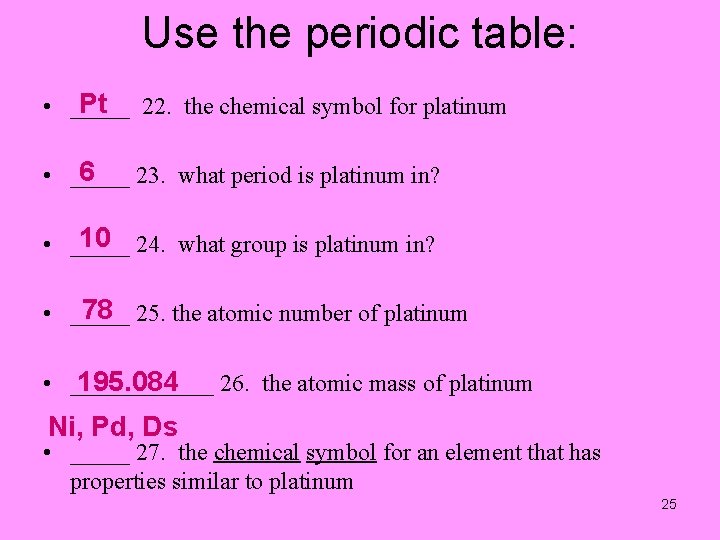
Use the periodic table: Pt 22. the chemical symbol for platinum • _____ 6 23. what period is platinum in? • _____ 10 24. what group is platinum in? • _____ 78 25. the atomic number of platinum • ____________ 195. 084 26. the atomic mass of platinum Ni, Pd, Ds • _____ 27. the chemical symbol for an element that has properties similar to platinum 25
26
1 18 2 13 14 15 16 17 3 4 5 6 7 8 9 10 11 12 6 7 27
Practice: Periodic Table and Valence Electrons 28
Questions • Definition of period – Horizontal row • Definition of group – Vertical column • What tells the # of valence electrons? – Group number (for 13 -18, subtract 10) • What tells the number of energy levels? – Period number 29
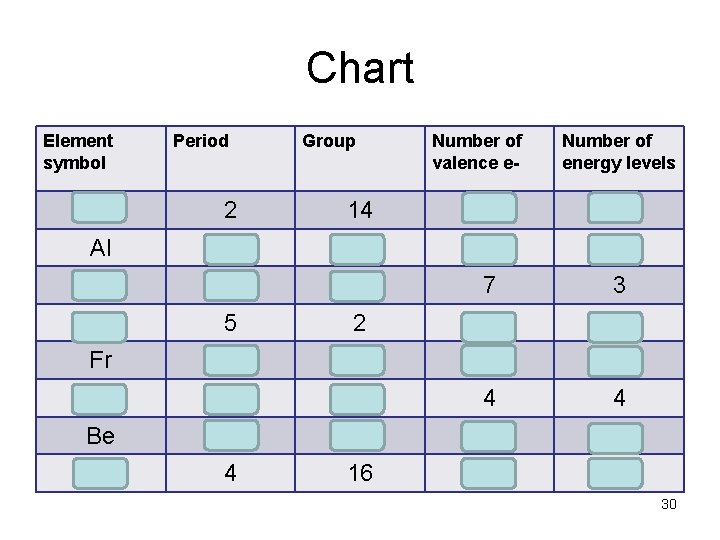
Chart Element symbol Period Group Number of valence e- Number of energy levels C 2 14 4 2 Al 3 13 3 3 Cl 3 17 7 3 Sr 5 2 2 5 Fr 7 1 1 7 Ge 4 14 4 4 Be 2 2 Se 4 16 6 4 30
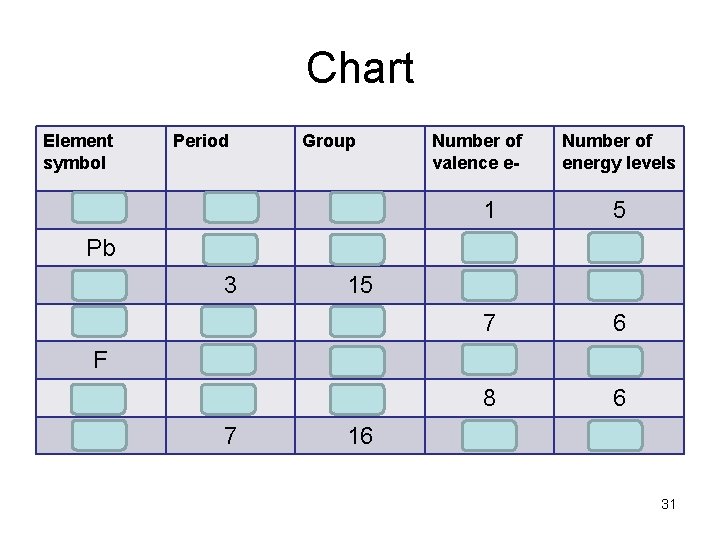
Chart Element symbol Period Group Number of valence e- Number of energy levels Rb 5 1 1 5 Pb 6 14 4 6 P 3 15 5 3 At 6 17 7 6 F 2 17 7 2 Rn 6 18 8 6 Uuh 7 16 6 7 31
Section 5. 2 EXPLORING THE PERIODIC TABLE 32
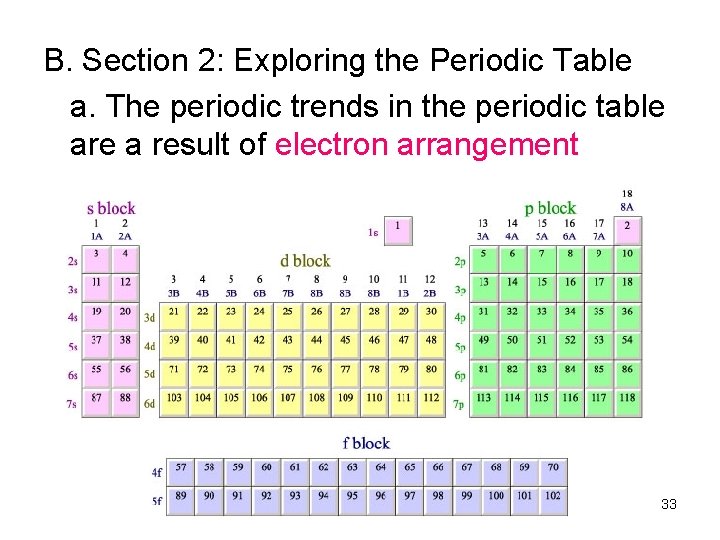
B. Section 2: Exploring the Periodic Table a. The periodic trends in the periodic table are a result of electron arrangement 33
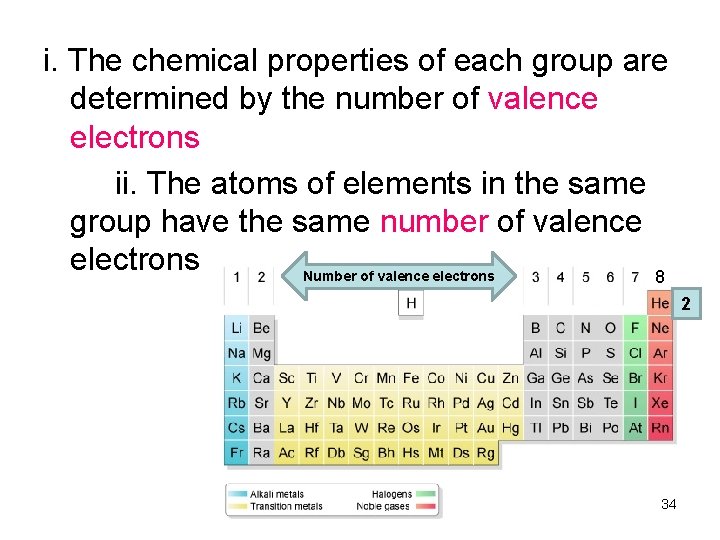
i. The chemical properties of each group are determined by the number of valence electrons ii. The atoms of elements in the same group have the same number of valence electrons Number of valence electrons 8 2 34
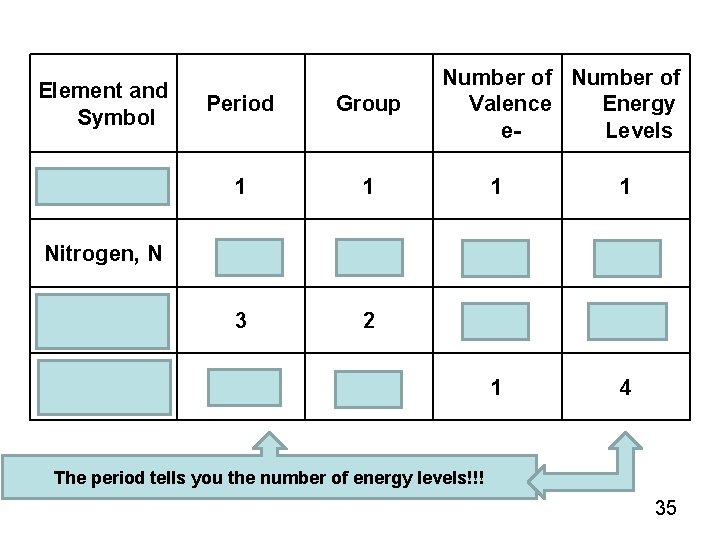
Number of Valence Energy e. Levels Element and Symbol Period Group Hydrogen, H 1 1 Nitrogen, N 2 15 5 2 Magnesium, Mg 3 2 2 3 Potassium, K 4 1 1 4 The period tells you the number of energy levels!!! 35
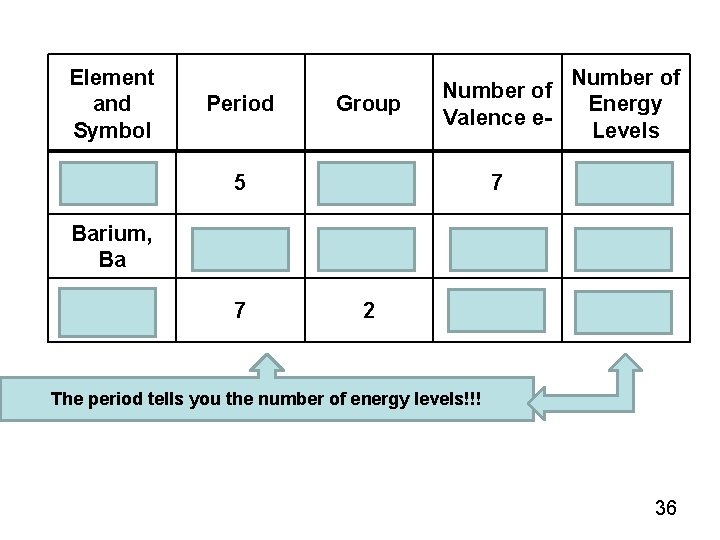
Element and Symbol Group Number of Valence e- Number of Energy Levels Period Iodine, I 5 17 7 5 Barium, Ba 6 2 2 6 Radium, Ra 7 2 2 7 The period tells you the number of energy levels!!! 36
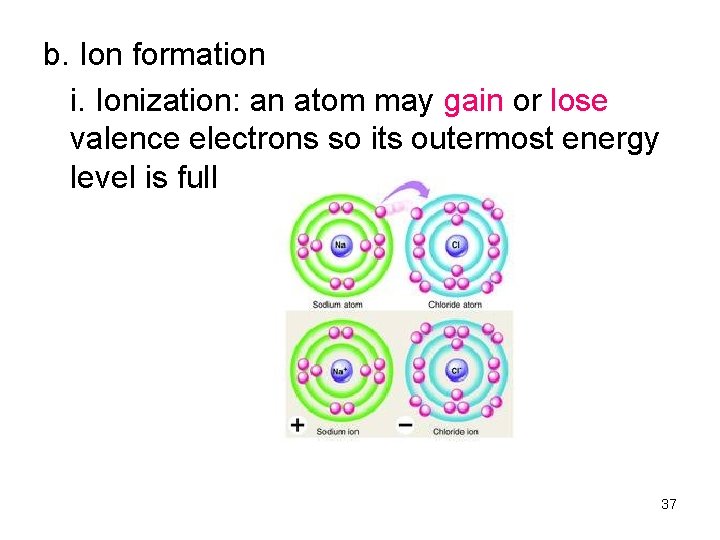
b. Ion formation i. Ionization: an atom may gain or lose valence electrons so its outermost energy level is full 37
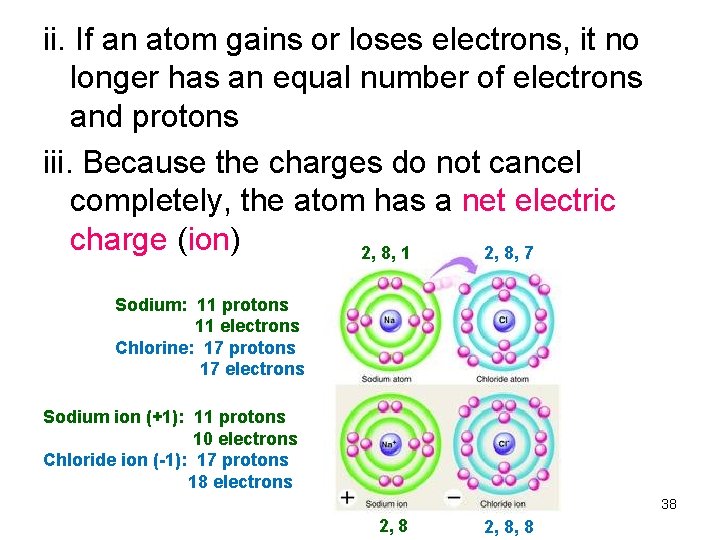
ii. If an atom gains or loses electrons, it no longer has an equal number of electrons and protons iii. Because the charges do not cancel completely, the atom has a net electric charge (ion) 2, 8, 1 2, 8, 7 Sodium: 11 protons 11 electrons Chlorine: 17 protons 17 electrons Sodium ion (+1): 11 protons 10 electrons Chloride ion (-1): 17 protons 18 electrons 38 2, 8, 8
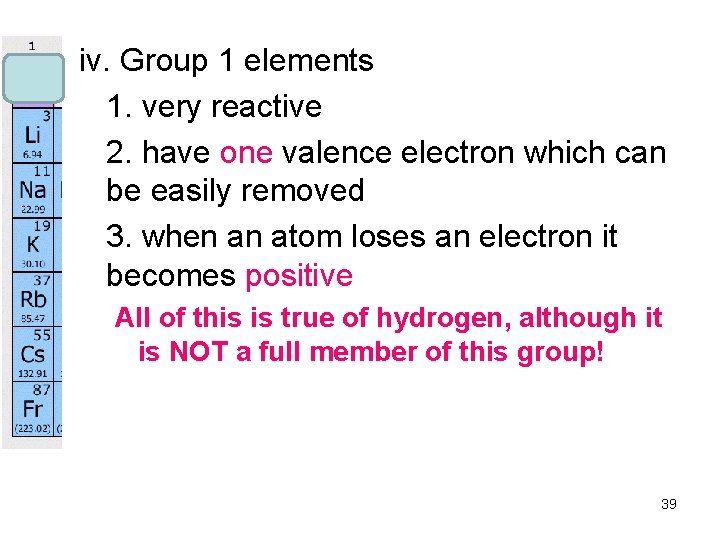
iv. Group 1 elements 1. very reactive 2. have one valence electron which can be easily removed 3. when an atom loses an electron it becomes positive All of this is true of hydrogen, although it is NOT a full member of this group! 39
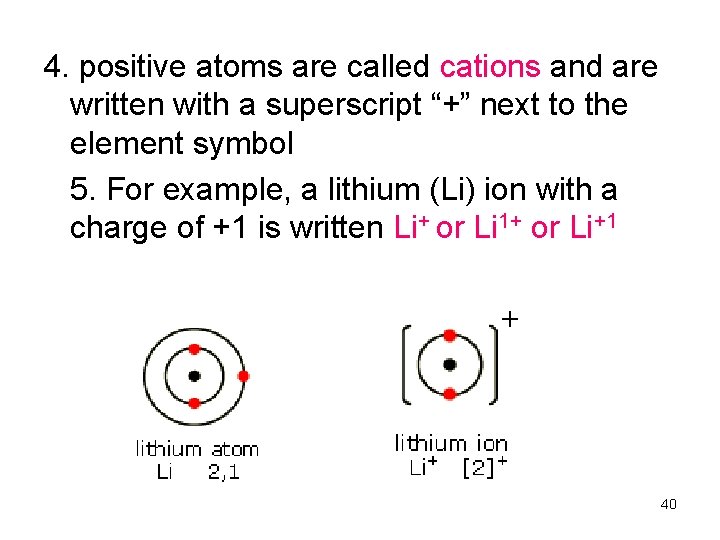
4. positive atoms are called cations and are written with a superscript “+” next to the element symbol 5. For example, a lithium (Li) ion with a charge of +1 is written Li+ or Li 1+ or Li+1 40
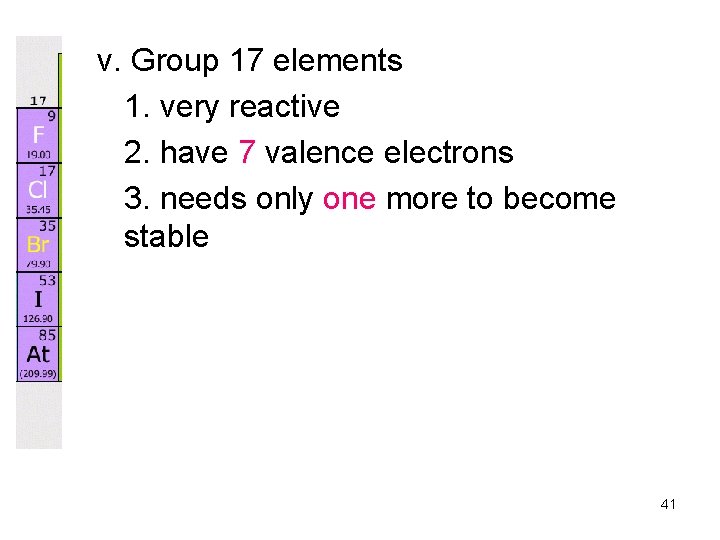
v. Group 17 elements 1. very reactive 2. have 7 valence electrons 3. needs only one more to become stable 41
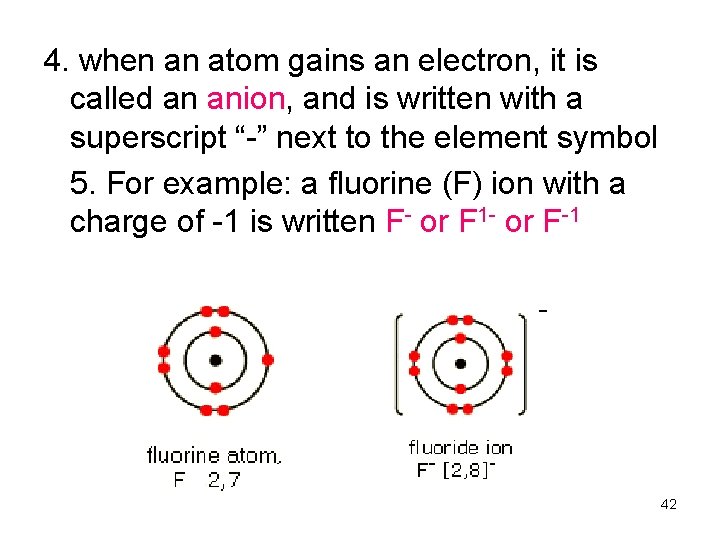
4. when an atom gains an electron, it is called an anion, and is written with a superscript “-” next to the element symbol 5. For example: a fluorine (F) ion with a charge of -1 is written F- or F 1 - or F-1 42
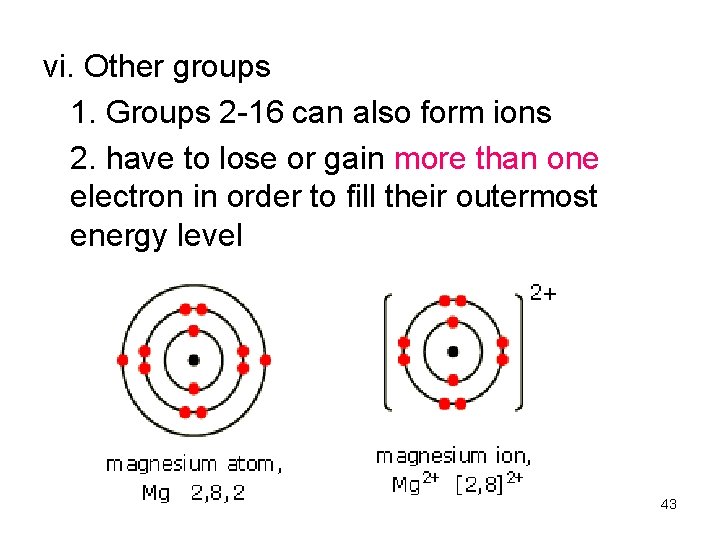
vi. Other groups 1. Groups 2 -16 can also form ions 2. have to lose or gain more than one electron in order to fill their outermost energy level 43
3. In general: a. atoms with fewer than four valence electrons lose electrons to form cations (positive ions) b. atoms with more than four valence electrons gain electrons to form anions (negative ions) 44
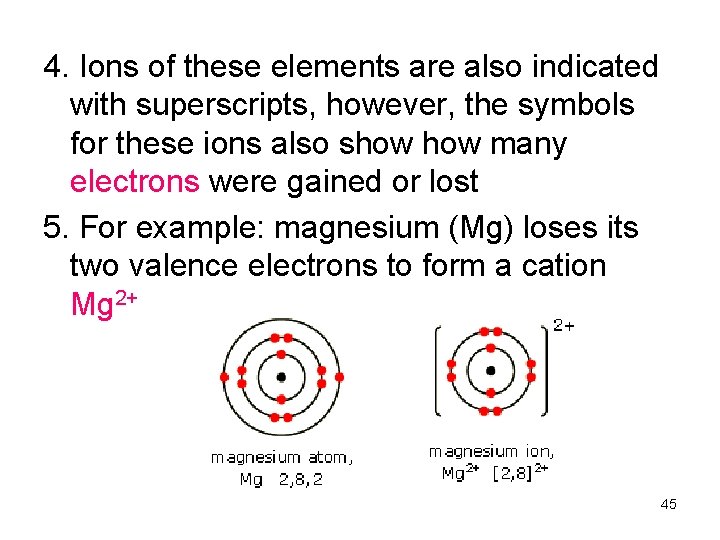
4. Ions of these elements are also indicated with superscripts, however, the symbols for these ions also show many electrons were gained or lost 5. For example: magnesium (Mg) loses its two valence electrons to form a cation Mg 2+ 45
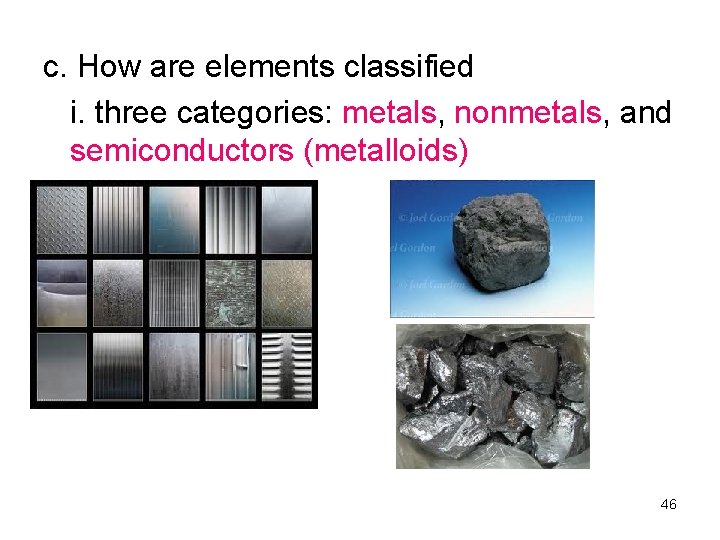
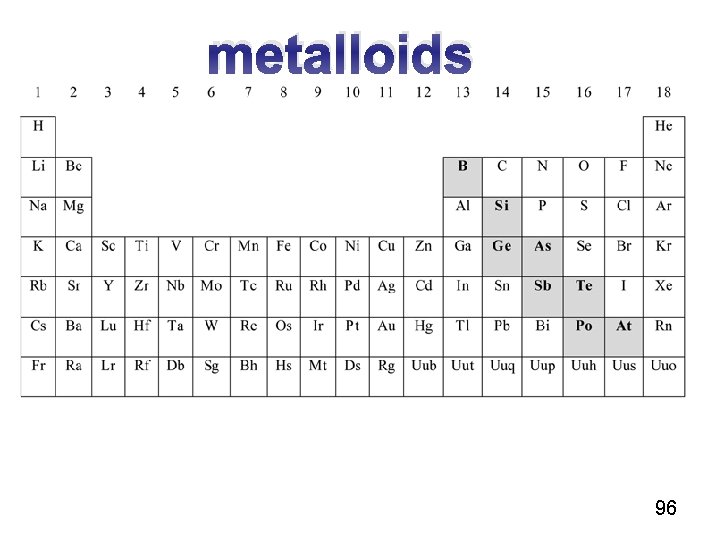
c. How are elements classified i. three categories: metals, nonmetals, and semiconductors (metalloids) 46
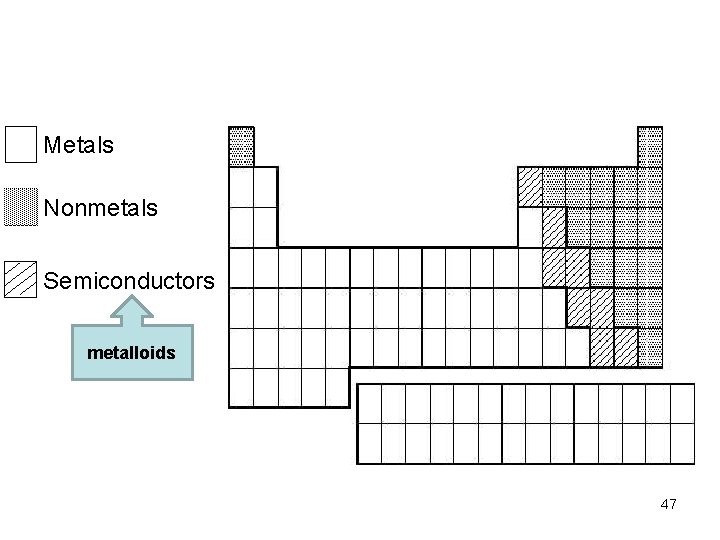
Metals Nonmetals Semiconductors metalloids 47
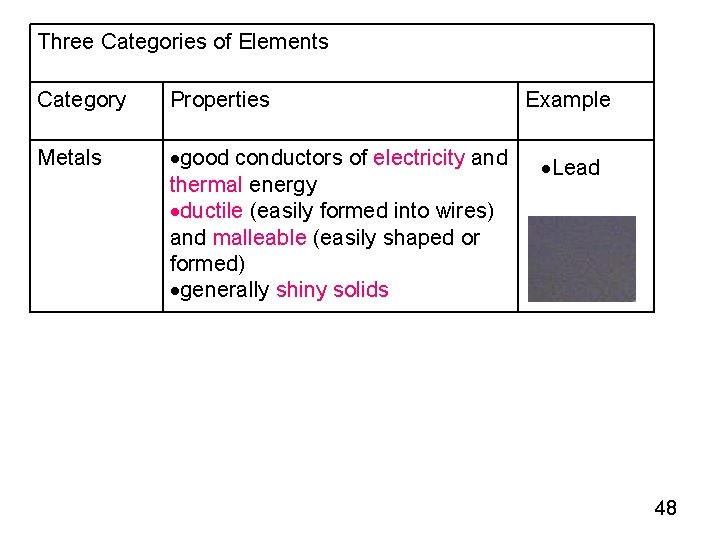
Three Categories of Elements Category Properties Metals good conductors of electricity and thermal energy ductile (easily formed into wires) and malleable (easily shaped or formed) generally shiny solids Example Lead 48
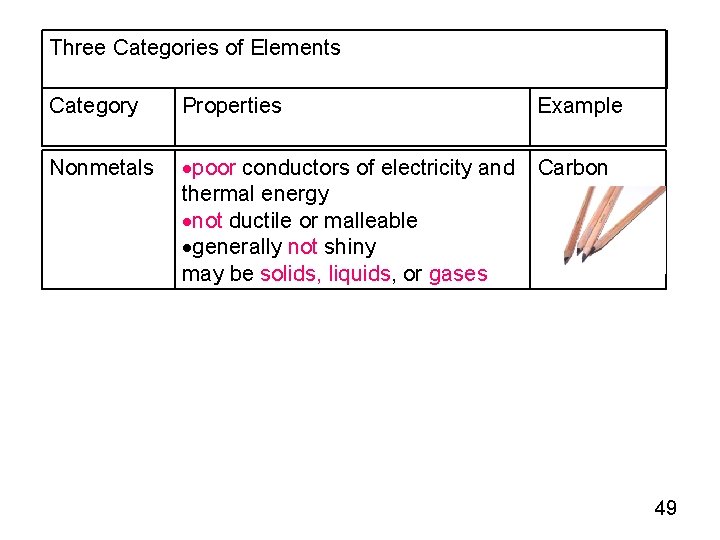
Three Categories of Elements Category Properties Example Nonmetals poor conductors of electricity and thermal energy not ductile or malleable generally not shiny may be solids, liquids, or gases Carbon 49
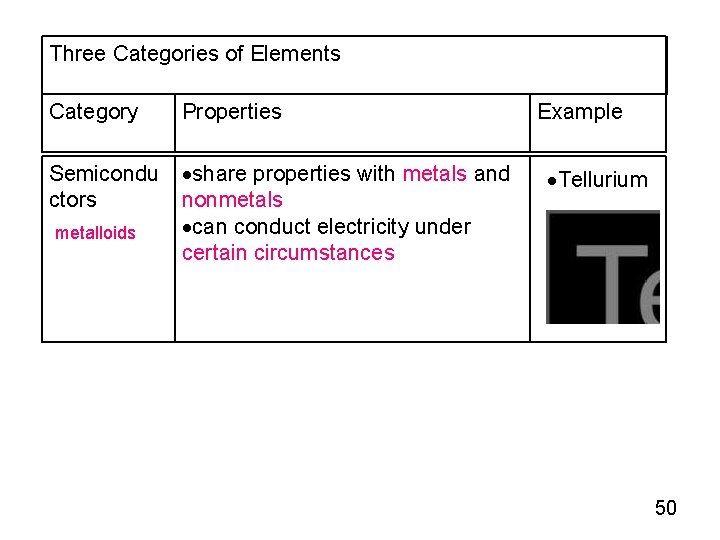
Three Categories of Elements Category Properties Semicondu ctors share properties with metals and nonmetals can conduct electricity under certain circumstances metalloids Example Tellurium 50
Do Ion Formation Practice Sheet 51
Ion Formation Practice • 1. How do we find the number of valence electrons an element has? • Look at the group number – 1 or 2 has 1 or 2 valence electrons – 13 -18: subtract 10 to get 3 – 8 valence electrons 52
Ion Formation Practice • 2. How many electrons can the folowing electron levels hold? 2 – Level 1: _____ – Level 2: _____ 8 18 – Level 3: _____ 18 it is • NOTE: although level 3 can hold ___, full when 8 electrons are on it; all energy levels (except level 1) are full with 8 electrons!!! 53
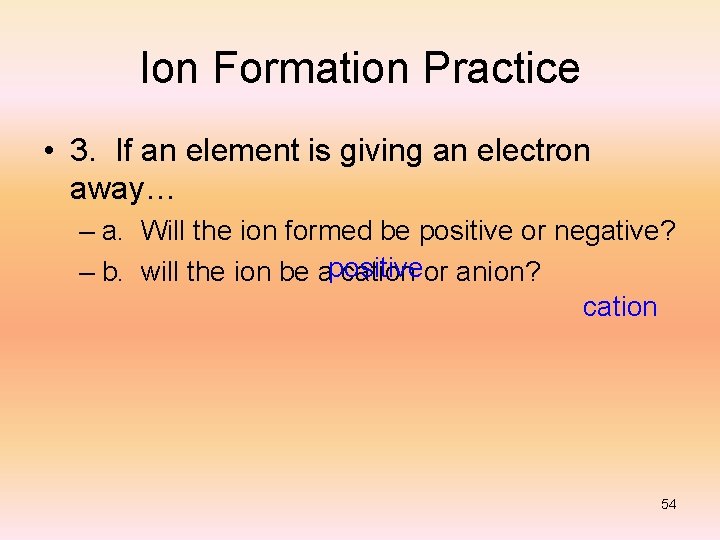
Ion Formation Practice • 3. If an element is giving an electron away… – a. Will the ion formed be positive or negative? – b. will the ion be apositive cation or anion? cation 54
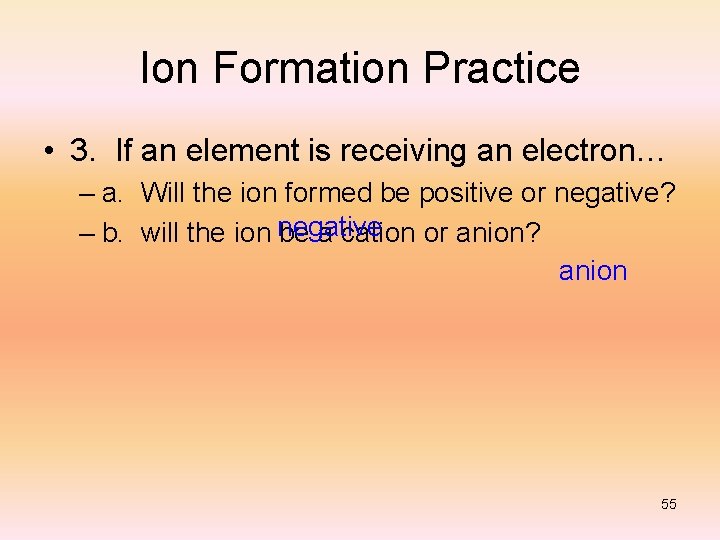
Ion Formation Practice • 3. If an element is receiving an electron… – a. Will the ion formed be positive or negative? – b. will the ion negative be a cation or anion? anion 55
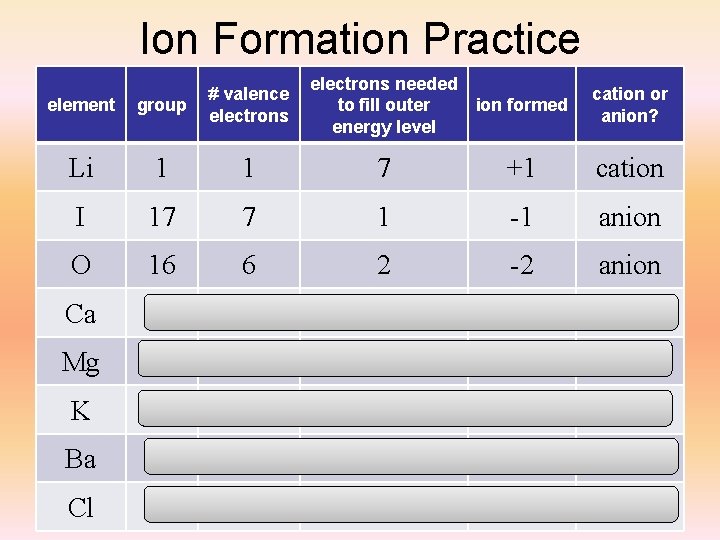
Ion Formation Practice electrons needed to fill outer ion formed energy level element group # valence electrons cation or anion? Li 1 1 7 +1 cation I 17 7 1 -1 anion O 16 6 2 -2 anion Ca 2 2 6 +2 cation Mg 2 2 6 +2 cation K 1 1 7 +1 cation Ba 2 2 6 +2 cation Cl 17 7 1 -1 anion 56
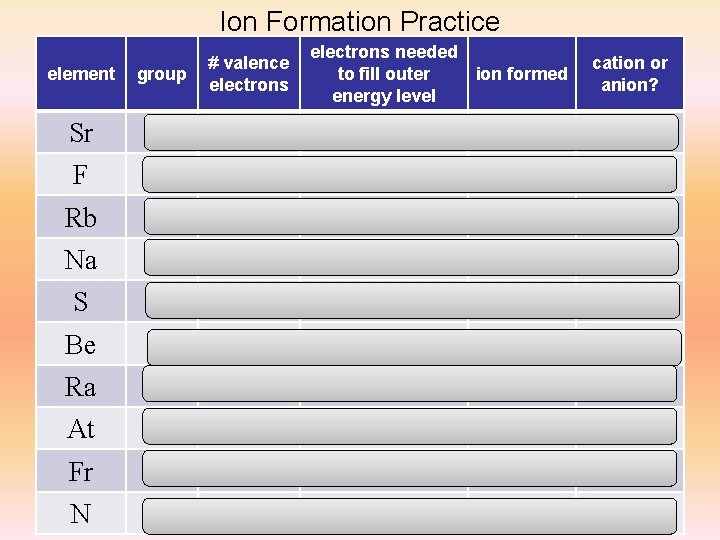
Ion Formation Practice electrons needed to fill outer ion formed energy level element group # valence electrons cation or anion? Sr 2 2 6 +2 cation F 17 7 1 -1 anion Rb 1 1 7 +1 cation Na 1 1 7 +1 cation S 16 6 2 -2 anion Be 2 2 6 +2 cation Ra 2 2 6 +2 cation At 17 7 1 -1 anion Fr 1 1 7 +1 cation N 15 5 3 -3 anion 57

Do section 2 review sheet 58
Section 2: Exploring the P. T. • 1. Explain why elements in a group on the periodic table have similar chemical properties. • they have the same number of valence electrons 59
Section 2: Exploring the P. T. • 2. Compare the number of valence electrons in an atom of oxygen (O) with the number of valence electrons in an atom of selenium (Se). Are O and Se in the same period or group? • both have 6 valence electrons • they are in the same group 60
Section 2: Exploring the P. T. • 3. Explain why atoms gain or lose electrons to form ions. • they gain or lose electrons in order to have a full outer level, which means 8 electrons (except if it’s the first level, which is full with 2 electrons) 61
Section 2: Exploring the P. T. • 4. Describe why lithium (Li) and other Group 1 elements usually form positive ions, while fluorine (F) and other Group 17 elements form negative ions. • group 1 elements lose one electron and thus have a full outer level • group 17 elements gain one electron and thus have a full outer level 62
Section 2: Exploring the P. T. • 5. List the three main categories of elements, and give an example of each. • metals—Cu, Ag, Au, Sn, Al, Na, Ca • nonmetals—F, H, O, S, Ar, Br, Cl • semiconductors (metalloids)—B, Si, Ge, As, Sb, Te, Po, At 63
Section 2: Exploring the P. T. • 6. Predict which ions cesium forms: Cs+ ions or Cs 2+ ions. • Cs+: it’s in group 1 and so gets rid of its one valence electron to form a +1 ion 64
Section 2: Exploring the P. T. • 7. Determine whether elements that fit the following descriptions are more likely to be metals or nonmetals: a) a shiny substance used to make flexible bed springs • metal b) a yellow powder from underground mines • nonmetal c) a gas that does not react • nonmetal 65
Section 2: Exploring the P. T. • 7. Determine whether elements that fit the following descriptions are more likely to be metals or nonmetals: d) a conducting material used within flexible wires • metal e) a brittle substance that does not conduct heat • nonmetal 66
Section 2: Exploring the P. T. • 8. Explain how a cation differs from an anion. • a cation is a positive ion that has more protons than electrons and comes from an element losing electrons • an anion is a negative ion that has more electrons than protons and comes from an element gaining electrons 67
Section 2: Exploring the P. T. • 9. Why do elements in groups share more chemical properties than elements in a period? • in a group they have the same number of valence electrons and will react in the same manner either by giving or taking the same number of electrons to become stable 68
Section 2: Exploring the P. T. • 10. Why do some atoms gain electrons to form ions and some lose electrons? • some atoms gain electrons because they have 5 – 7 valence electrons and only need 1 – 3 more electrons for a full outer level • some atoms lose electrons because they have 1 – 3 valence electrons and will lose those in order to reveal a full outer level 69 underneath

section 2 FLASHCARDS 70
5. 2 flashcards • The periodic trends in the periodic table are the result of ___. – electron arrangement • ion – an atom, radical or molecule that has gained or lost one or more electrons and has a negative or positive charge 71
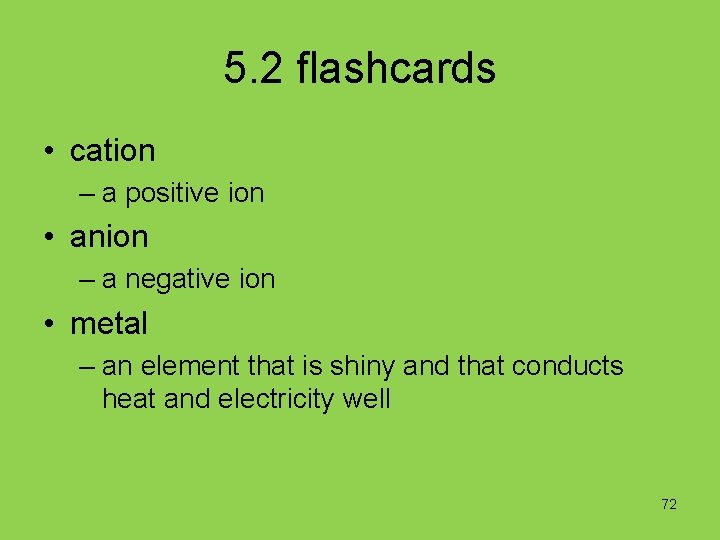
5. 2 flashcards • cation – a positive ion • anion – a negative ion • metal – an element that is shiny and that conducts heat and electricity well 72
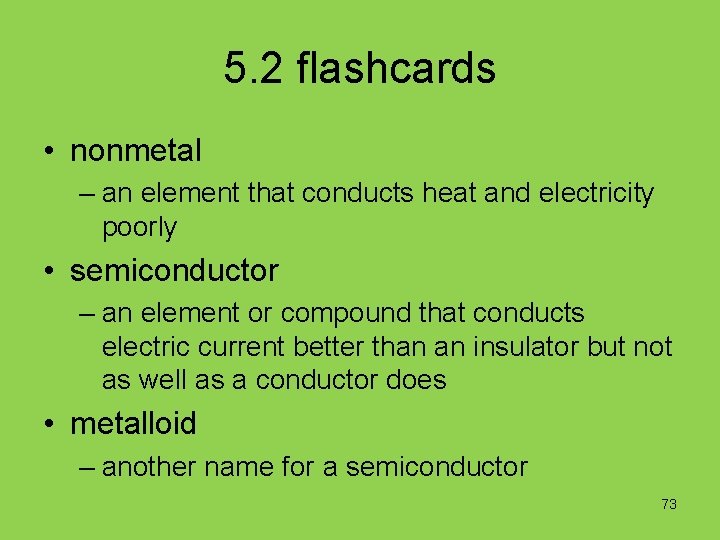
5. 2 flashcards • nonmetal – an element that conducts heat and electricity poorly • semiconductor – an element or compound that conducts electric current better than an insulator but not as well as a conductor does • metalloid – another name for a semiconductor 73

Section 5. 2 QUIZ REVIEW 74
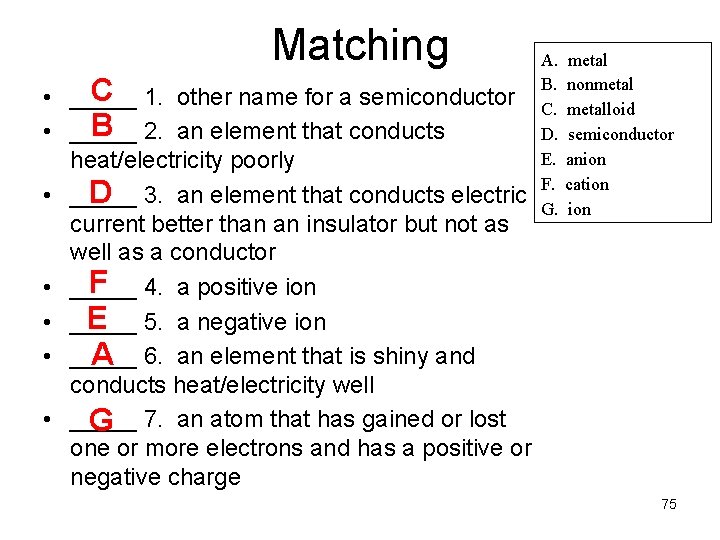
Matching C 1. other name for a semiconductor • _____ B 2. an element that conducts • _____ heat/electricity poorly D 3. an element that conducts electric • _____ current better than an insulator but not as well as a conductor F 4. a positive ion • _____ E 5. a negative ion • _____ A 6. an element that is shiny and conducts heat/electricity well • _____ G 7. an atom that has gained or lost one or more electrons and has a positive or negative charge A. B. C. D. E. F. G. metal nonmetalloid semiconductor anion cation 75
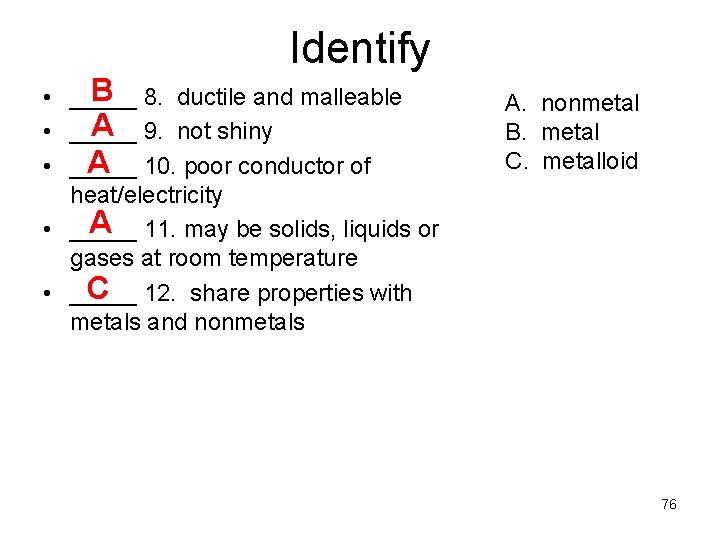
Identify B 8. ductile and malleable • _____ A 9. not shiny • _____ A 10. poor conductor of • _____ heat/electricity A 11. may be solids, liquids or • _____ gases at room temperature C 12. share properties with • _____ metals and nonmetals A. nonmetal B. metal C. metalloid 76
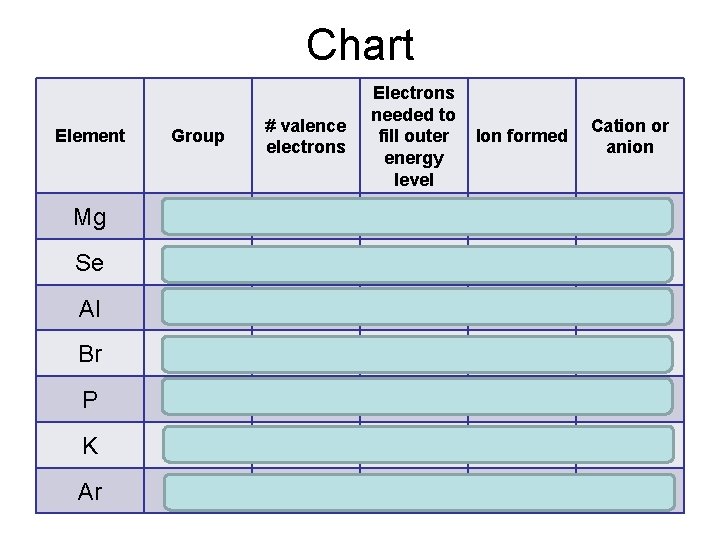
Chart Element Group # valence electrons Electrons needed to fill outer energy level Mg 2 2 6 +2 Cation Se 16 6 2 -2 Anion Al 13 3 5 +3 Cation Br 17 7 1 -1 Anion P 15 5 3 -3 Anion K 1 1 7 +1 Cation Ar 18 8 0 None Ion formed Cation or anion None 77
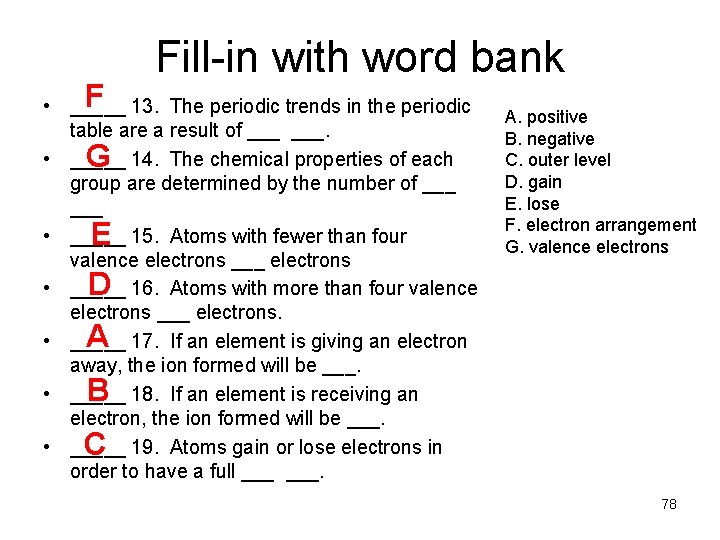
Fill-in with word bank F 13. The periodic trends in the periodic • _____ table are a result of ___. • _____ G 14. The chemical properties of each group are determined by the number of ___ • _____ E 15. Atoms with fewer than four valence electrons ___ electrons • _____ D 16. Atoms with more than four valence electrons ___ electrons. A 17. If an element is giving an electron • _____ away, the ion formed will be ___. B 18. If an element is receiving an • _____ electron, the ion formed will be ___. • _____ C 19. Atoms gain or lose electrons in order to have a full ___. A. positive B. negative C. outer level D. gain E. lose F. electron arrangement G. valence electrons 78
Section 5. 3 FAMILIES OF ELEMENTS 79
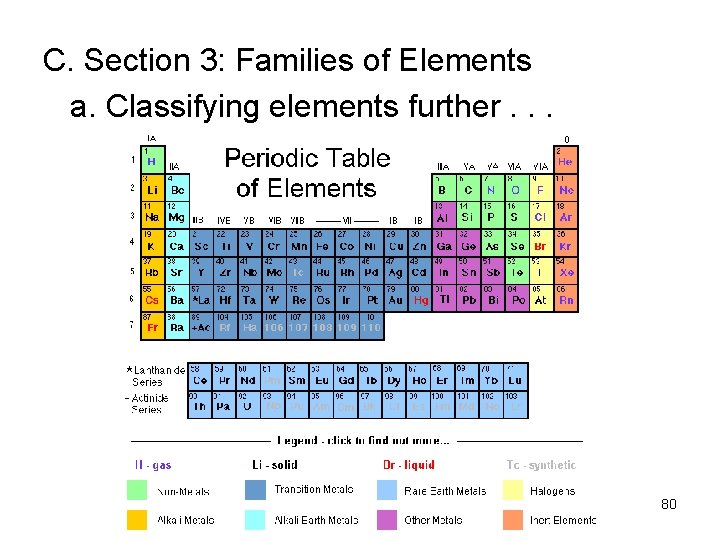
C. Section 3: Families of Elements a. Classifying elements further. . . 80
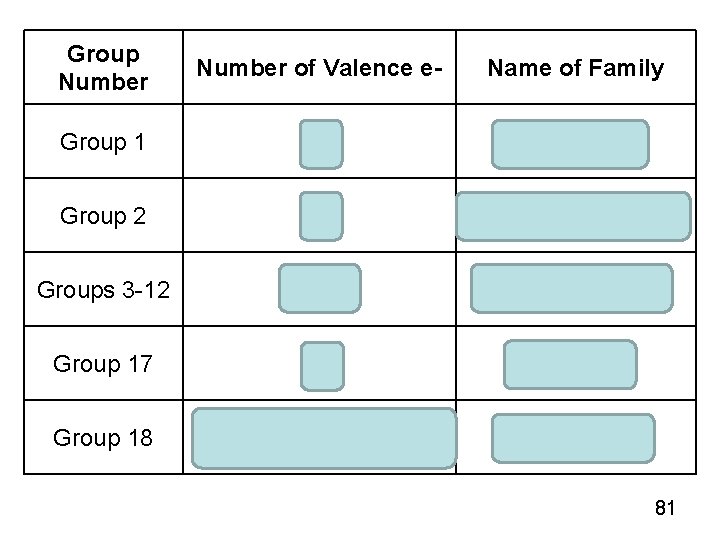
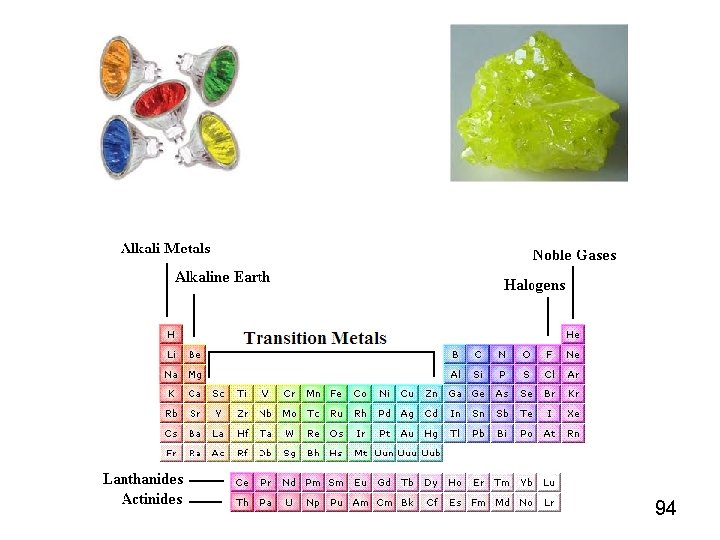
Group Number of Valence e- Name of Family Group 1 1 Alkali metals Group 2 2 Alkaline-earth metals Groups 3 -12 Varied Transition metals Group 17 7 Halogens Group 18 8 (except helium, which has 2) Noble Gases 81
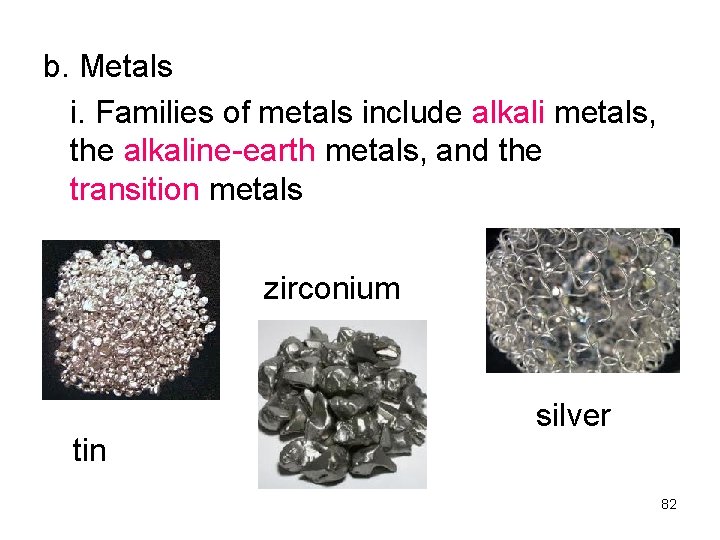
b. Metals i. Families of metals include alkali metals, the alkaline-earth metals, and the transition metals zirconium tin silver 82
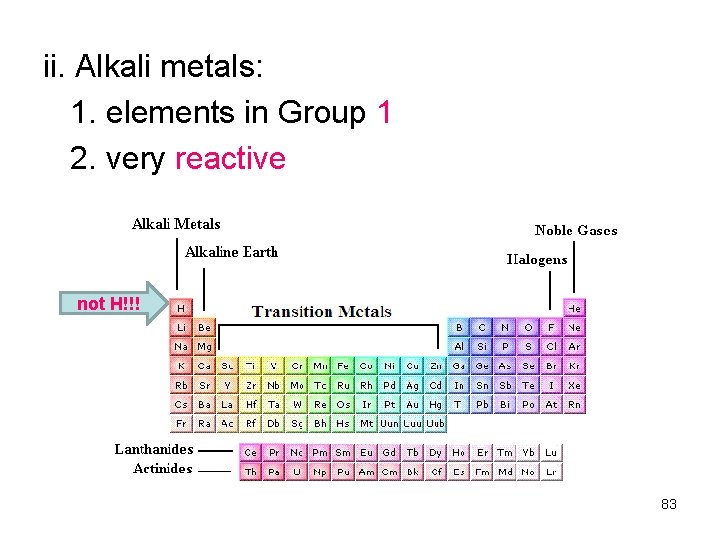
ii. Alkali metals: 1. elements in Group 1 2. very reactive not H!!! 83
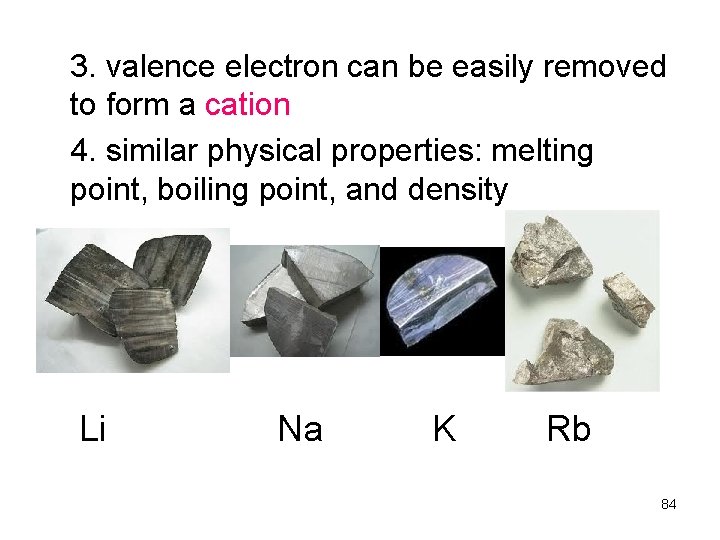
3. valence electron can be easily removed to form a cation 4. similar physical properties: melting point, boiling point, and density Li Na K Rb 84
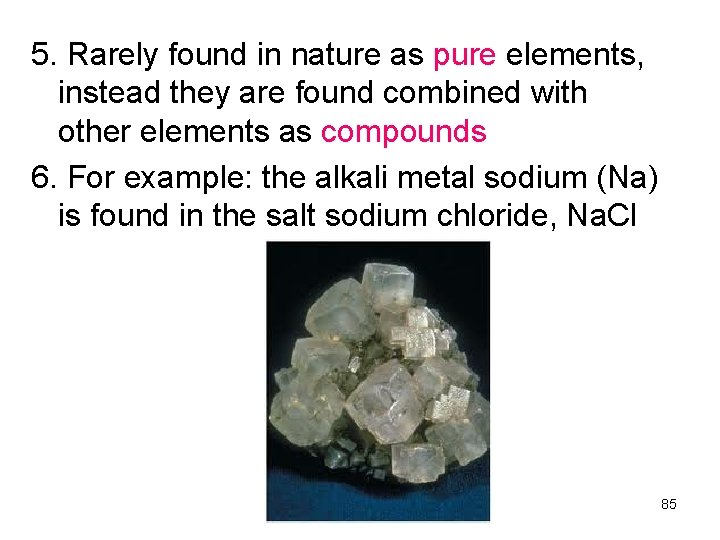
5. Rarely found in nature as pure elements, instead they are found combined with other elements as compounds 6. For example: the alkali metal sodium (Na) is found in the salt sodium chloride, Na. Cl 85
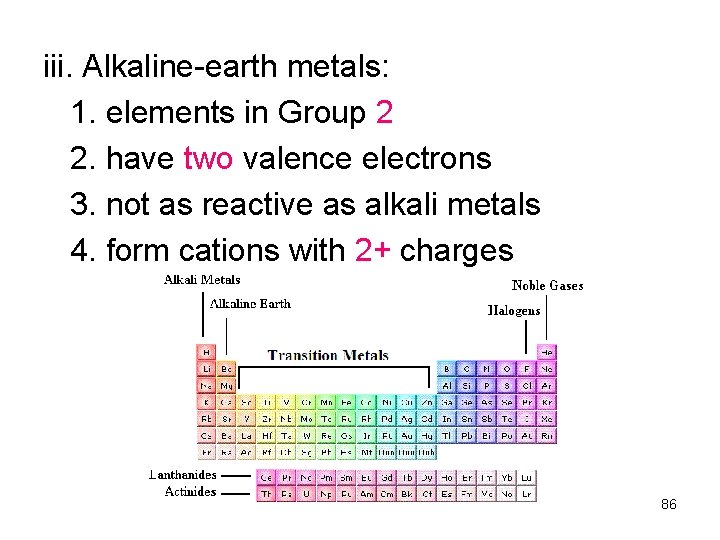
iii. Alkaline-earth metals: 1. elements in Group 2 2. have two valence electrons 3. not as reactive as alkali metals 4. form cations with 2+ charges 86
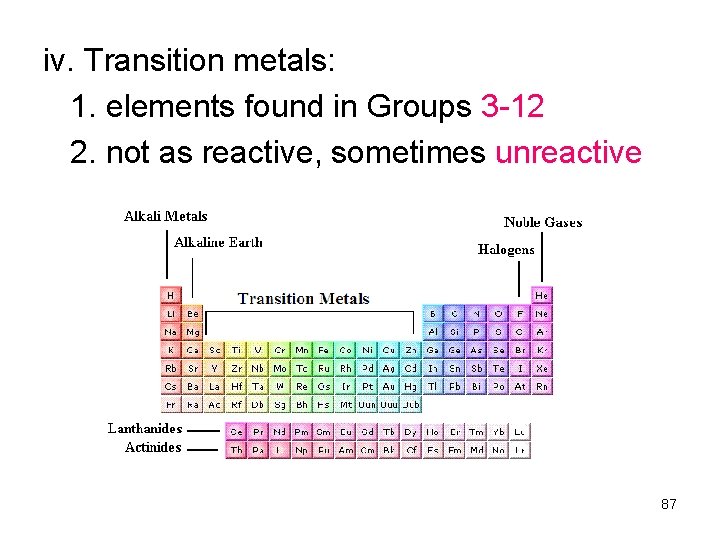
iv. Transition metals: 1. elements found in Groups 3 -12 2. not as reactive, sometimes unreactive 87
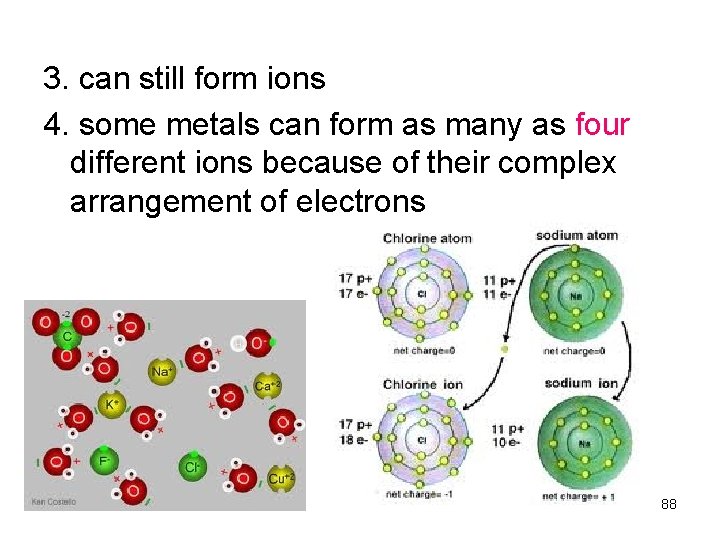
3. can still form ions 4. some metals can form as many as four different ions because of their complex arrangement of electrons 88
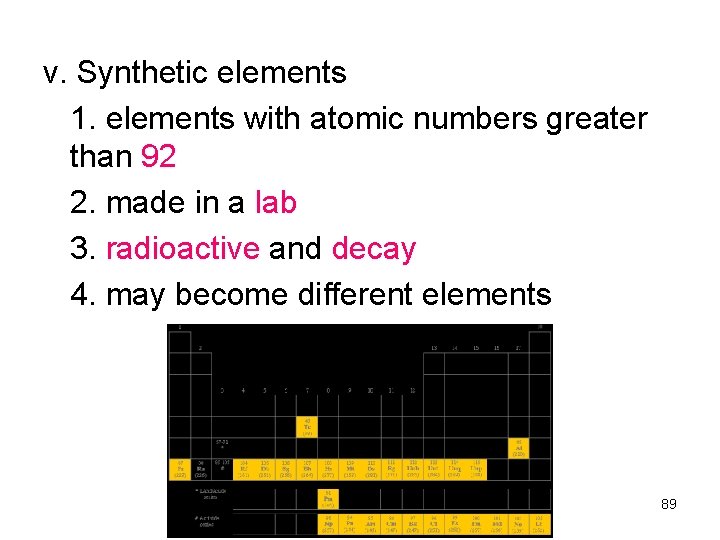
v. Synthetic elements 1. elements with atomic numbers greater than 92 2. made in a lab 3. radioactive and decay 4. may become different elements 89
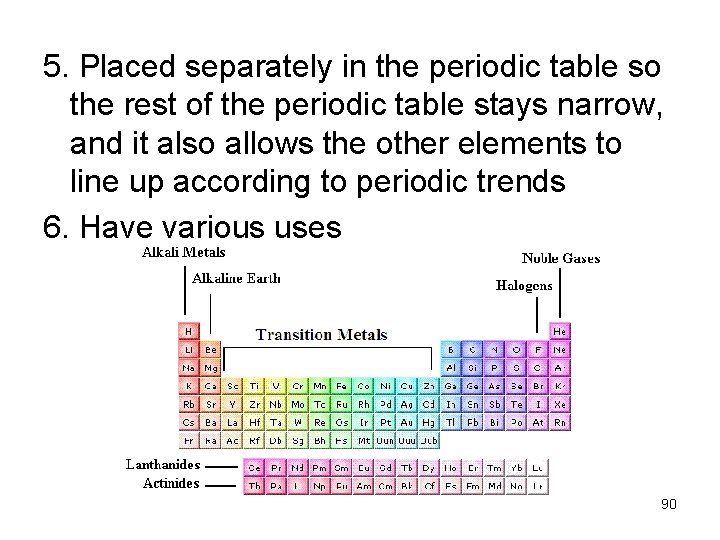
5. Placed separately in the periodic table so the rest of the periodic table stays narrow, and it also allows the other elements to line up according to periodic trends 6. Have various uses 90
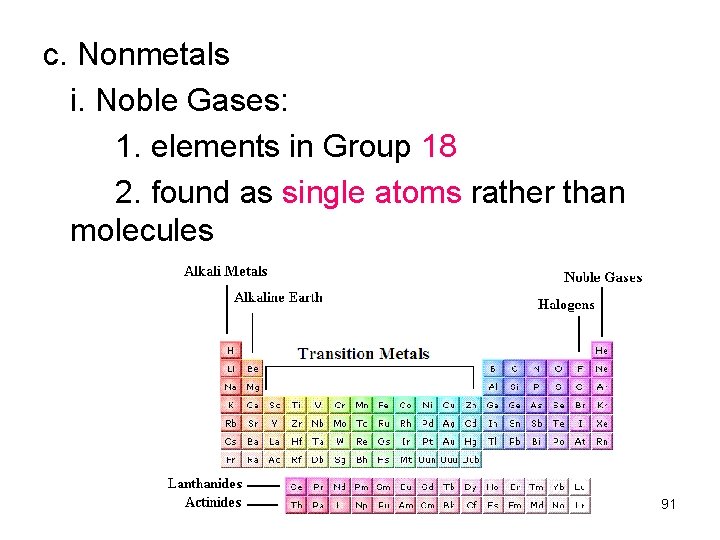
c. Nonmetals i. Noble Gases: 1. elements in Group 18 2. found as single atoms rather than molecules 91
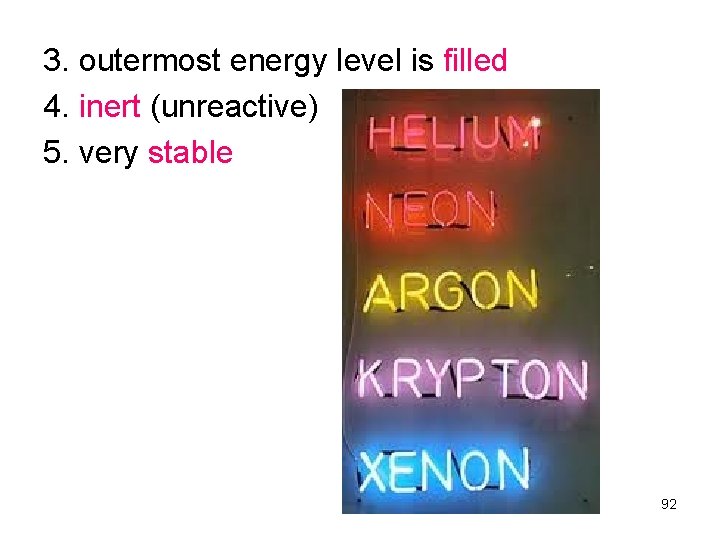
3. outermost energy level is filled 4. inert (unreactive) 5. very stable 92
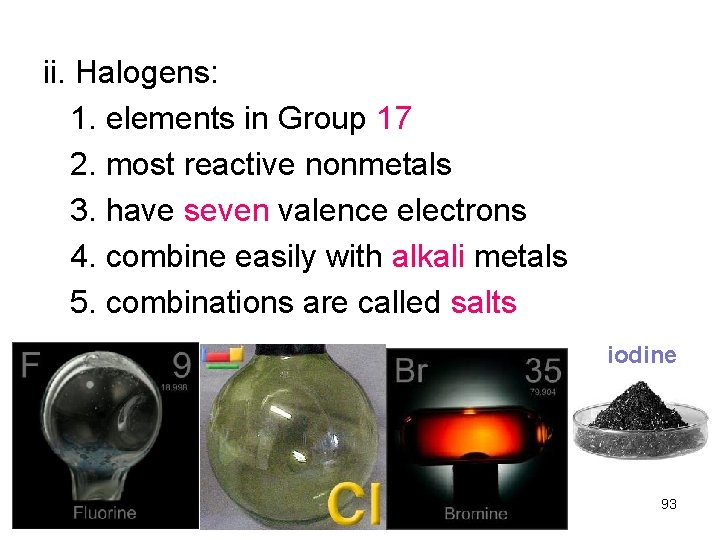
ii. Halogens: 1. elements in Group 17 2. most reactive nonmetals 3. have seven valence electrons 4. combine easily with alkali metals 5. combinations are called salts iodine 93
94
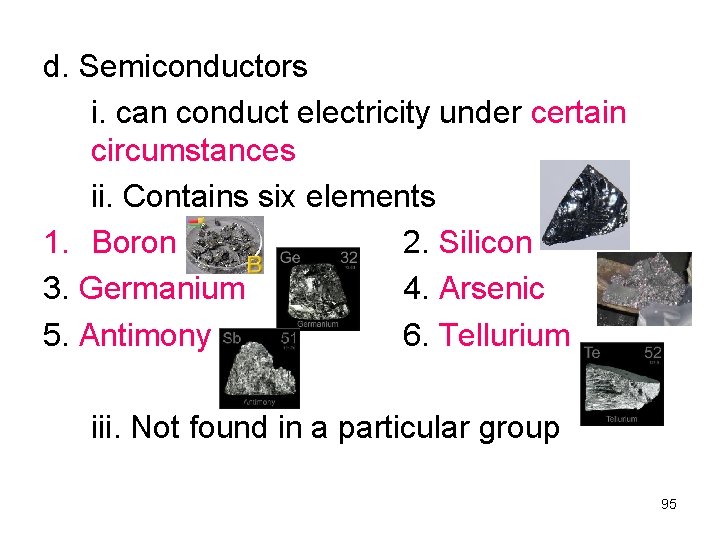
d. Semiconductors i. can conduct electricity under certain circumstances ii. Contains six elements 1. Boron 2. Silicon 3. Germanium 4. Arsenic 5. Antimony 6. Tellurium iii. Not found in a particular group 95
metalloids 96
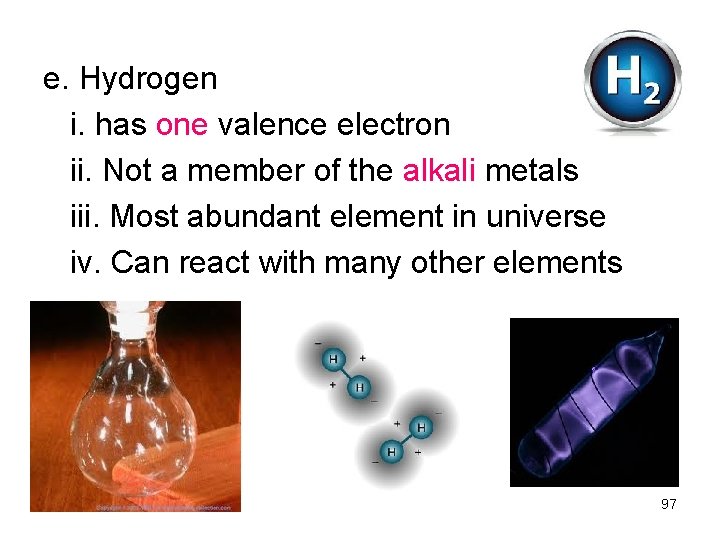
e. Hydrogen i. has one valence electron ii. Not a member of the alkali metals iii. Most abundant element in universe iv. Can react with many other elements 97
Section 5. 3 Review FAMILIES OF ELEMENTS 98
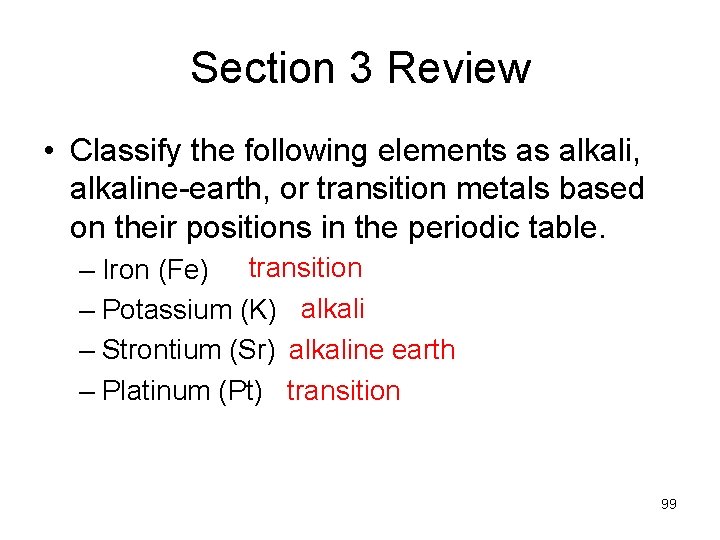
Section 3 Review • Classify the following elements as alkali, alkaline-earth, or transition metals based on their positions in the periodic table. – Iron (Fe) transition – Potassium (K) alkali – Strontium (Sr) alkaline earth – Platinum (Pt) transition 99
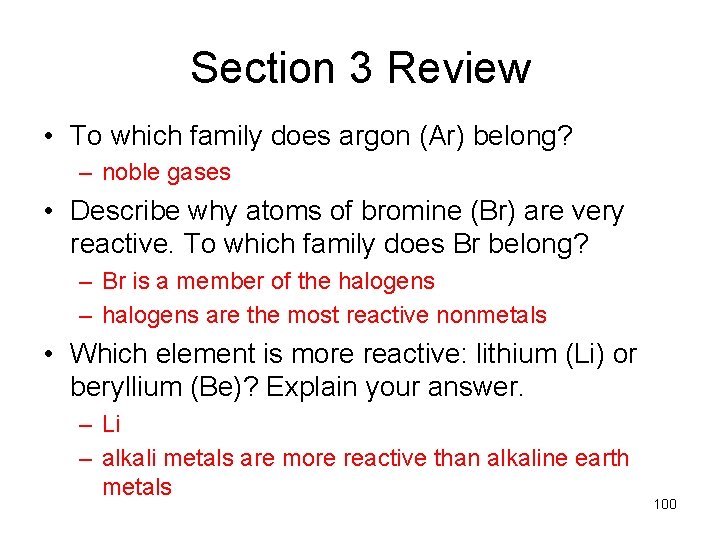
Section 3 Review • To which family does argon (Ar) belong? – noble gases • Describe why atoms of bromine (Br) are very reactive. To which family does Br belong? – Br is a member of the halogens – halogens are the most reactive nonmetals • Which element is more reactive: lithium (Li) or beryllium (Be)? Explain your answer. – Li – alkali metals are more reactive than alkaline earth metals 100
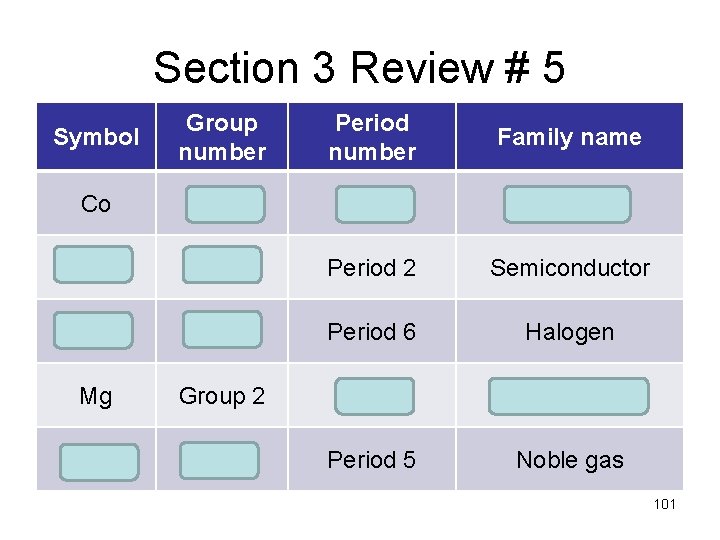
Section 3 Review # 5 Symbol Group number Period number Family name Co 9 4 Transition B 13 Period 2 Semiconductor At 17 Period 6 Halogen Mg Group 2 3 Alkaline earth Xe 18 Period 5 Noble gas 101

section 5. 3 QUIZ REVIEW 102
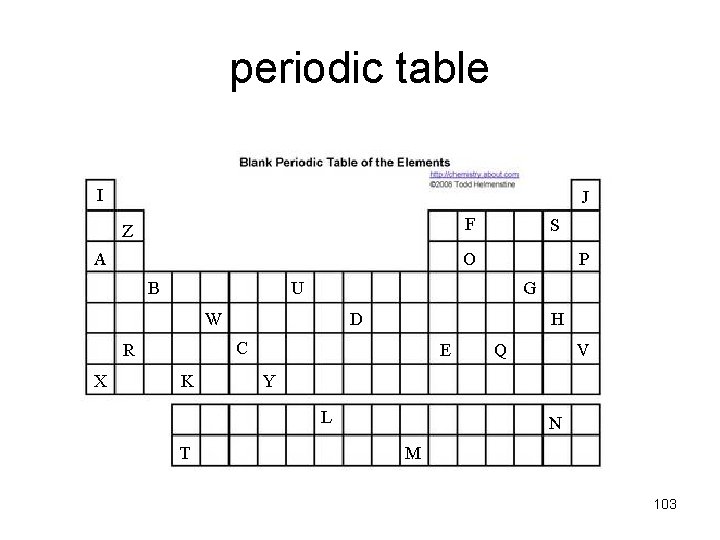
periodic table I J F Z A O B P U G W D H C R X S K E V Y L T Q N M 103
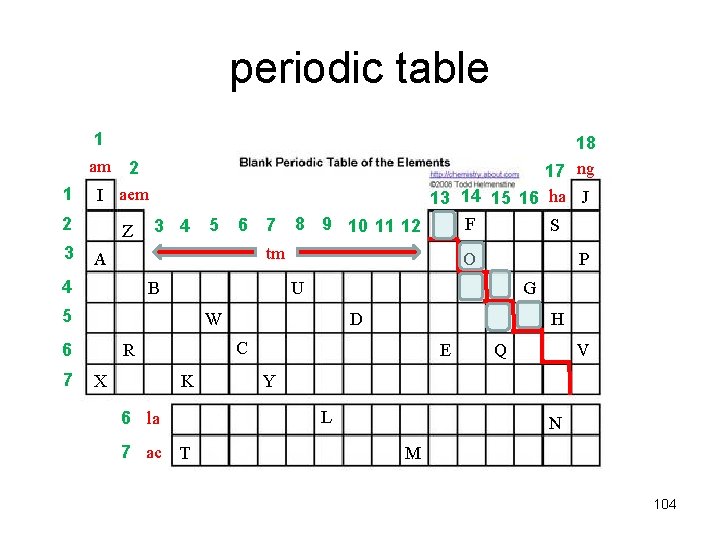
periodic table 1 am 2 1 I aem 2 3 Z 3 4 6 7 tm A 4 B O G W 6 D H C R X P U 5 7 5 18 17 ng 13 14 15 16 ha J F 8 9 10 11 12 S K 6 la 7 ac T E Q V Y L N M 104
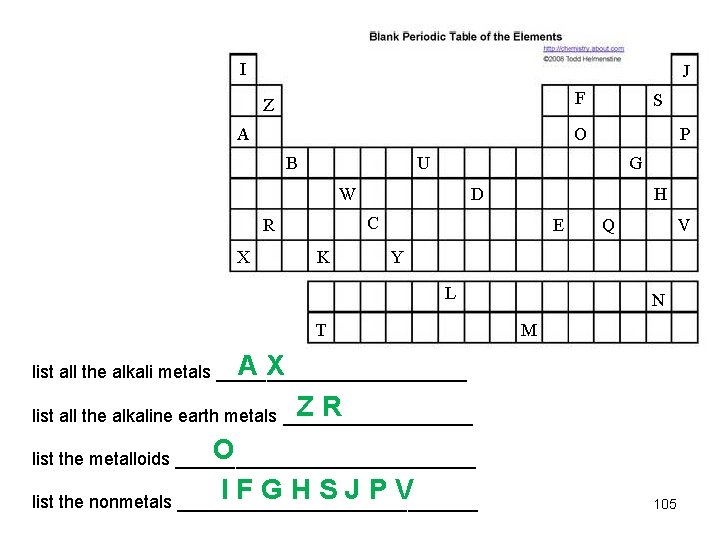
I J F Z A O B P U G W D H C R X S K E Q V Y L T N M AX list all the alkali metals _____________ ZR list all the alkaline earth metals __________ O list the metalloids _______________ IFGHSJPV list the nonmetals _______________ 105
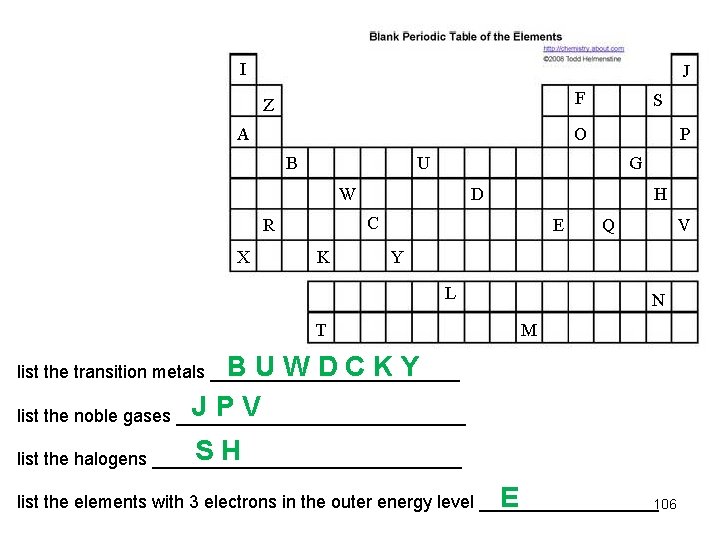
I J F Z A O B P U G W D H C R X S K E Q V Y L T N M BUWDCKY list the transition metals _____________ JPV list the noble gases _______________ SH list the halogens ________________ E list the elements with 3 electrons in the outer energy level _________ 106
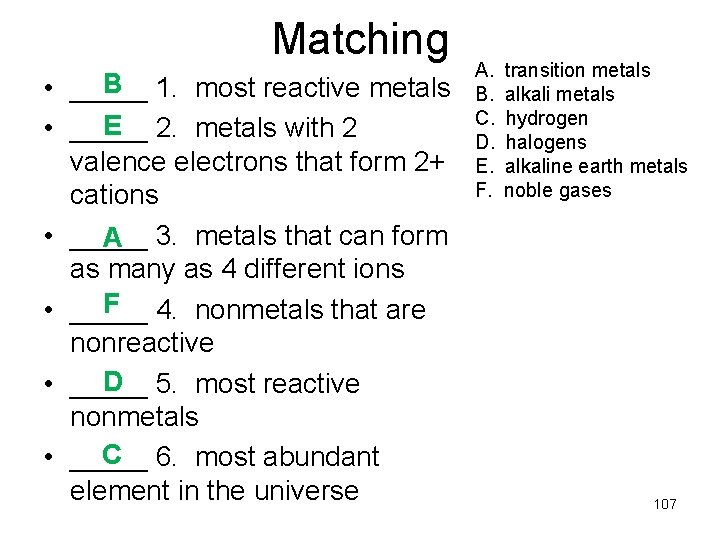
Matching B 1. most reactive metals • _____ E 2. metals with 2 • _____ valence electrons that form 2+ cations • _____ A 3. metals that can form as many as 4 different ions F 4. nonmetals that are • _____ nonreactive D 5. most reactive • _____ nonmetals C 6. most abundant • _____ element in the universe A. B. C. D. E. F. transition metals alkali metals hydrogen halogens alkaline earth metals noble gases 107
- Slides: 107