
Chapter 5 The Periodic Law Vocabulary Section 1

Chapter 5 The Periodic Law
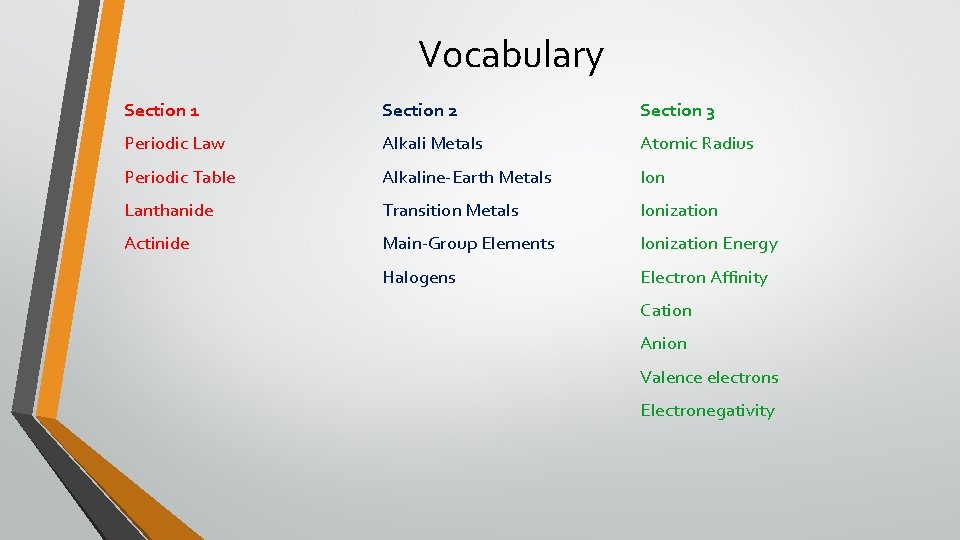
Vocabulary Section 1 Section 2 Section 3 Periodic Law Alkali Metals Atomic Radius Periodic Table Alkaline-Earth Metals Ion Lanthanide Transition Metals Ionization Actinide Main-Group Elements Ionization Energy Halogens Electron Affinity Cation Anion Valence electrons Electronegativity
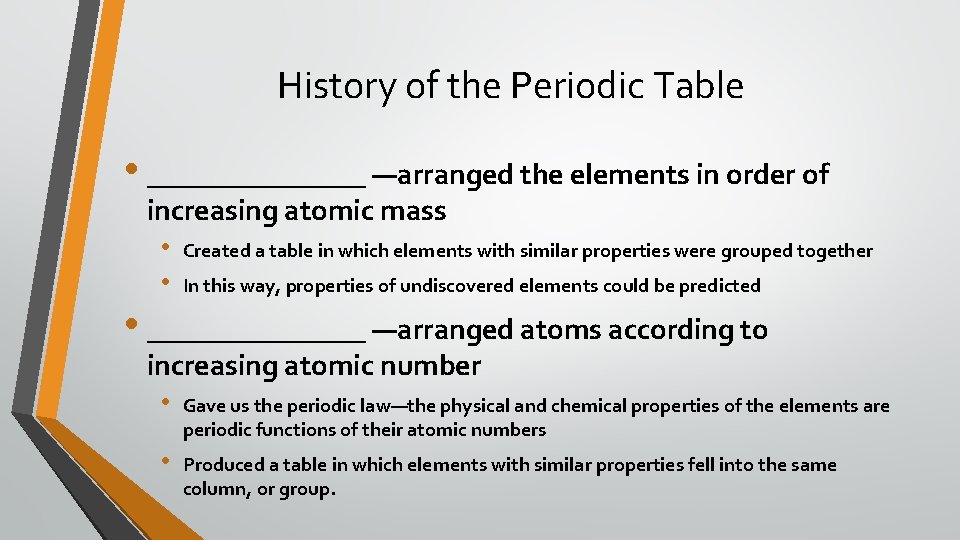
History of the Periodic Table • ________ —arranged the elements in order of increasing atomic mass • Created a table in which elements with similar properties were grouped together • In this way, properties of undiscovered elements could be predicted • ________ —arranged atoms according to increasing atomic number • Gave us the periodic law—the physical and chemical properties of the elements are periodic functions of their atomic numbers • Produced a table in which elements with similar properties fell into the same column, or group.
Section 2 Electron Configuration and the Periodic Table
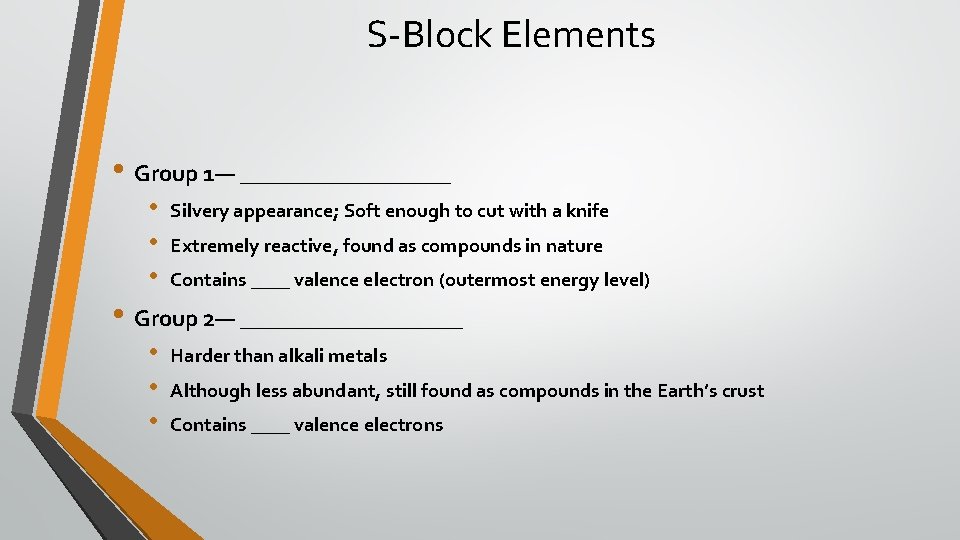
S-Block Elements • Group 1— _________ • • • Silvery appearance; Soft enough to cut with a knife Extremely reactive, found as compounds in nature Contains ____ valence electron (outermost energy level) • Group 2— __________ • • • Harder than alkali metals Although less abundant, still found as compounds in the Earth’s crust Contains ____ valence electrons
P-Block Elements • 6 Groups • • Group 13 – Boron • • Always found combined with other elements in nature Contains ___ valence electrons Group 14 – Carbon • • • Group varies in many properties because? Contains ___ valence electrons Allotropes – forms of an element in the same state of matter, but have different physical and chemical properties • Example: diamond and graphite are both made of carbon and are both solids, they differ in their properties because they have different structures – they are isotopes.
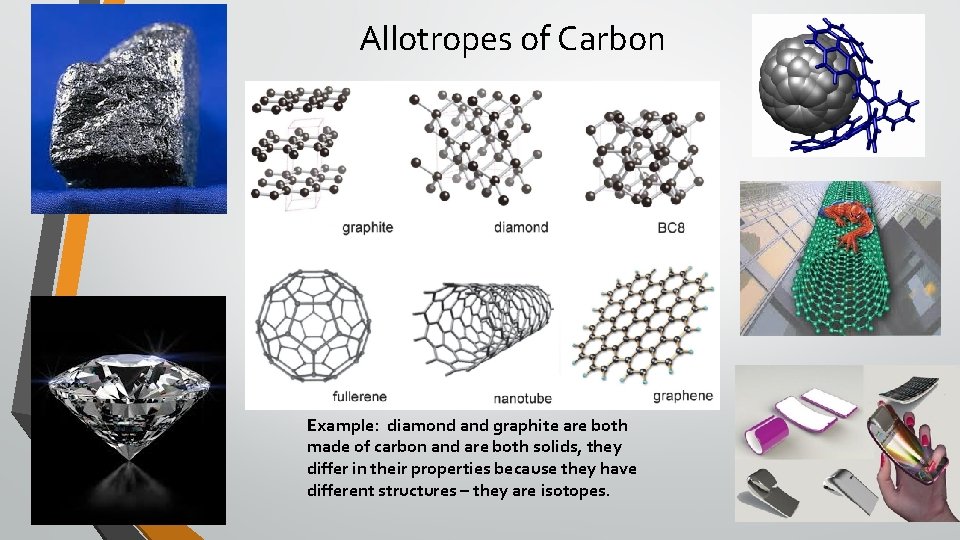
Allotropes of Carbon Example: diamond and graphite are both made of carbon and are both solids, they differ in their properties because they have different structures – they are isotopes.
P-Block Elements Continued • Group 15 – Nitrogen • Properties vary as in the carbon group • Contains ___ valence electrons • Group 16 – Oxygen • Act as nonmetals, meaning they tend to gain electrons • Contain ___ valence electrons
P-Block Elements Continued • Group 17 – ________ • Form compounds with metals (salts) • A salt is a combination of a metal and a halogen • Reactive nonmetals that tend to gain 1 electron • Contains __ valence electrons • Group 18 – ________ • Colorless • Unreactive • Contains ___ valence electrons – except helium which has 2 (filled orbitals)
d-Block Elements • Known as __________ • Share properties such as conductivity, luster, malleability, atomic size, electronegativity, ionization energy, melting points, and boiling points • May have multiple oxidation states • Tend to ______ electrons to become positively charged ions
f-Block Elements: __________ • _______ series (4 f) • Silvery metals • Similar reactivity like Group 2 (alkaline-earth metal) elements • _______ series (5 f) • Radioactive elements • Only four exist in nature; the rest are synthetic elements that are created in particle accelerators
Bell Ringer • For the following elements, name the block and group in which these elements are located on the periodic table; and whether high or low reactivity a. [He] 2 s 2 2 p 3 b. [Xe] 6 s 1 c. [Rn] 7 s 2 d. [Ar] 3 d 10 4 s 2 4 p 5

Section 3 Periodic Trends
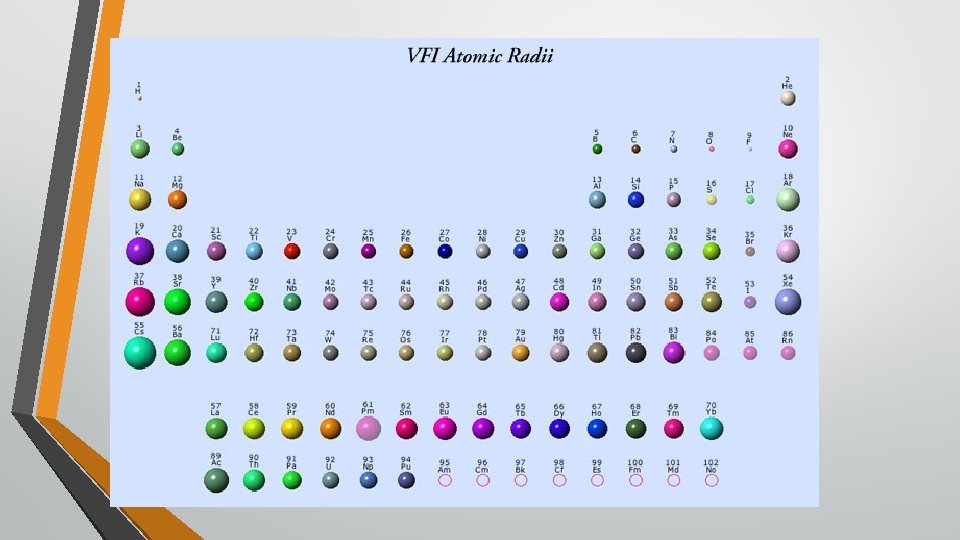
• What is it? • Atomic Radii One-half the distance between the nuclei of identical atoms that are bonded together • Period Trend • • • Gradual _______ in atomic radii from left to right Electrons pulled closer by the increasing positive charge of the nucleus Example: • Lithium is larger than Fluorine • Group Trend • • Gradual ________ down a group • • Positive charge of the nucleus is overridden by sheer number of electrons As electrons occupy sublevels in higher energy levels farther from the nucleus, the sizes of the atoms increase Example: • Iodine is larger than fluorine
• What is it? • Ionization Energy (IE) The energy required to remove one electron from the outer shell of an atom A + energy A+ + e- • ______ —an atom or group of elements that has a positive or negative charge • Periodic Trend • • • Ionization Energy ______ from left to right across a period Caused by increasing positive charge of nucleus Example: It takes more energy to remove an electron from fluorine than from lithium • Group Trend • • _______ from top to bottom down groups • Example: It takes less energy (easier) to remove an outer electron from Rubidium than from lithium Increase in distance from the nucleus = decrease in attraction between the nucleus and electrons
Removing electrons from positive ions • Second ionization energy—energy required to remove additional electrons from positive ions. • Requires much more energy than first ionization energy. • With each additional electron removed, the effect of nuclear charge increases on the electrons, making them increasingly more difficult to remove from the outer shell.
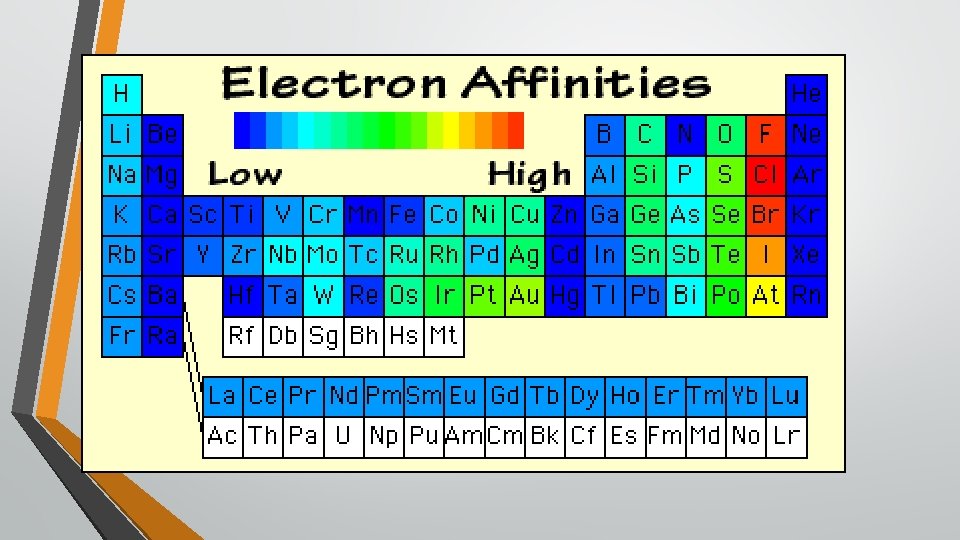
• What is it? Electron Affinity • The difference in energy when an electron is added to a neutral atom. • Most atoms release energy (F and Cl). A + e- A- + energy • Represented by a negative number. • Some require energy to gain an electron (N). (must be forced) A + e- + energy A- • Represented by a positive number. • Period Trend • ________ from left to right (halogens gain electrons most readily) • Caused by increase in effective nuclear charge; want to be noble gases. • Group Trend • Generally ________ down the group. • Caused by dominant increasing atomic radius which decreases effective nuclear charge.
Recall • Rank in order of increasing atomic radius: • Mn, Ca, Cu, Br • Li, Rb, H, K • Rank in order of increasing ionization energy: • Al, P, S, Si • Sb, P, As, N
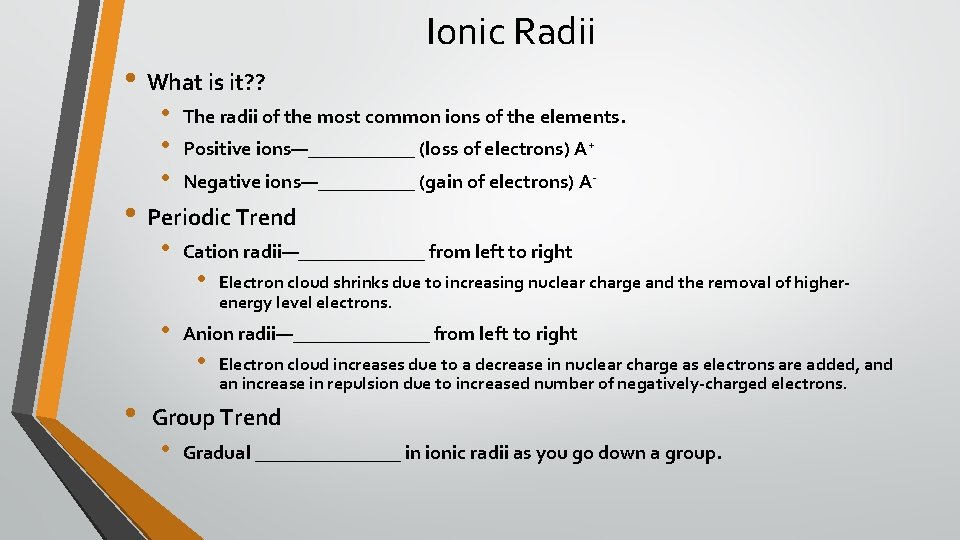
Ionic Radii • What is it? ? • • • The radii of the most common ions of the elements. • Cation radii—_______ from left to right Positive ions—______ (loss of electrons) A+ Negative ions—_____ (gain of electrons) A- • Periodic Trend • • • Electron cloud shrinks due to increasing nuclear charge and the removal of higherenergy level electrons. Anion radii—_______ from left to right • Electron cloud increases due to a decrease in nuclear charge as electrons are added, and an increase in repulsion due to increased number of negatively-charged electrons. Group Trend • Gradual ________ in ionic radii as you go down a group.
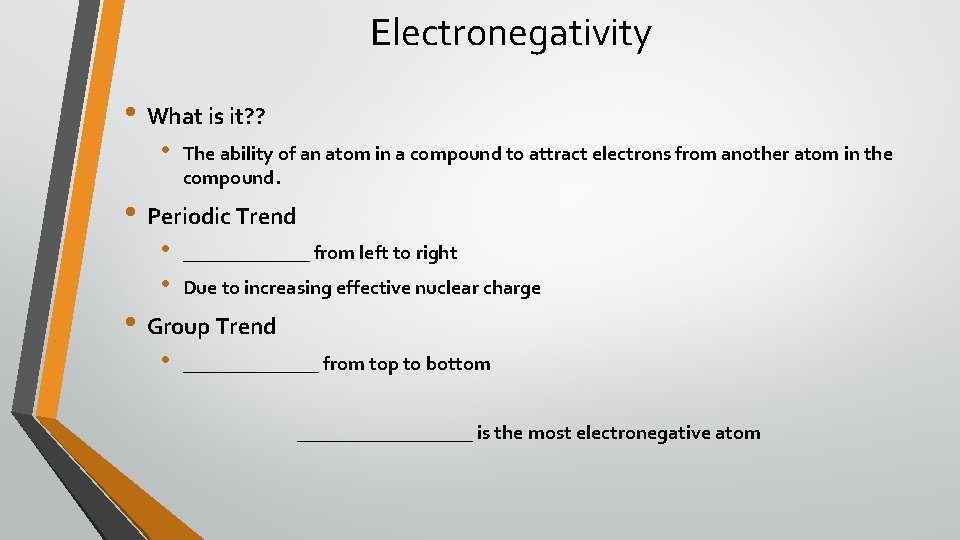
Electronegativity • What is it? ? • The ability of an atom in a compound to attract electrons from another atom in the compound. • Periodic Trend • • _______ from left to right Due to increasing effective nuclear charge • Group Trend • _______ from top to bottom _________ is the most electronegative atom
Valence Electrons • Chemical compounds are formed because electrons are lost, gained or shared • Only the _____ electrons are involved in forming compounds • ______ electrons – electrons available to be lost, gained or shared in the formation of chemical compounds • Ex: an electron lost from the 3 s sublevel of Na would form Na+
Ion Formation • A CATION (positive ion) forms when an atom ____ one or more valence electrons to attain noble gas configuration. • Na • Ba valence electrons ________ ion formed _______ • An ANION (negative ion) forms when an atom ____ one or more valence electrons to attain noble gas configuration. • O • Br • Ar valence electrons ________ ion formed _______ valence electrons ____ ion formed _______
White boarding Practice - Ion Formation • List the number of valence electrons for each element and the ion that will be formed • Ca • P • B • I • Kr • Te • Al valence electrons ________ ion formed _______ valence electrons ________ ion formed _______
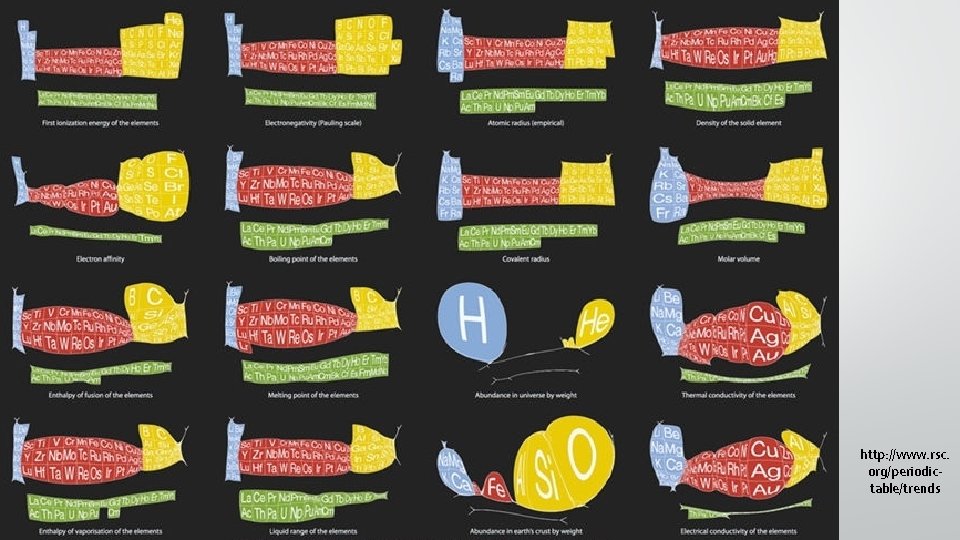
http: //www. rsc. org/periodictable/trends
- Slides: 26